USABILITY BASED RISK ASSESSMENT MODEL FOR
SOFTWARE DEVELOPMENT PROCESS
JAYALETCHUMI A/P T. SAMBANTHA MOORTHY
USABILITY BASED RISK ASSESSMENT MODEL FOR SOFTWARE DEVELOPMENT PROCESS
JAYALETCHUMI A/P T. SAMBANTHA MOORTHY
A thesis submitted in fulfilment of the requirements for the award of the degree of
Doctor of Philosophy
Advanced Informatics School Universiti Teknologi Malaysia
iii
Dedicated to my family especially my son, Kuhen who has been a strong and steadfast support in my PhD journey. They taught me the value of life and faithful
ACKNOWLEDGEMENT
Firstly, I would like to thank god for giving me determination and strength in completing this thesis.
Next, I would like to express immeasurable appreciation and deepest gratitude to my supervisors, Prof. Dr. Suhaimi Bin Ibrahim and Dr. Mohd Naz’ri Bin Mahrin for their untiring support, constructive input, advices, words of encouragement and guidance in making this study possible.
I also would like to thank my close friends, Dr. Huma Khan, Dr. Sugumaran Nallusamy, Ms. Mariayee Doraisamy and Ms. Sri Lakshmi Kanniah for their inspiring discussions and continual motivation which encouraged me further in completing this study successfully. My special gratitude goes to my parent, family members and friends for their help which has ease my PhD journey.
v
ABSTRACT
ABSTRAK
vii
TABLE OF CONTENTS
CHAPTER TITLE PAGE
DECLARATION ii
DEDICATION iii
ACKNOWLEDGEMENT iv
ABSTRACT v
ABSTRAK vi
TABLE OF CONTENTS vii
LIST OF TABLES xiv
LIST OF FIGURES xviii
LIST OF ABBREVIATIONS xxi
LIST OF APPENDICES xxii
1 INTRODUCTION 1
1.1 Background of the Problem 1
1.2 Problem Statement 5
1.3 Research Questions 7
1.4 Research Objectives 7
1.5 Scope of the Study 8
1.6 Significance of the Study 9
1.7 Glossary 10
1.8 Outline of the Thesis 12
2 LITERATURE REVIEW 14
2.1 Usability 14
2.1.1 The Concept and Definition of Usability 17
2.1.2 Usability Models 18
2.1.3 Usability Attribute and Sub Attribute 20 2.1.4 Usability Problem and Usability risk 22
2.2 Software Risk Management 23
2.2.1 Software Risk Management Model 25
2.2.2 Software Risk Management Process 29
2.3 Software Risk Assessment 31
2.3.1 Existing Software Risk Assessment Model 32 2.3.2 Existing Software Risk Assessment Tool 35 2.4 Current Issues on Usability Risk Assessment
Model 36
2.4.1 Integrated Usability Risk Assessment Model 37 2.5 Review on Possible Methods to be adopted 39
2.5.1 Review of Literature 39
2.5.2 Opinion/Inputs from experts 42
2.5.3 Responses from population 44
2.6 Development of Usability Risk Assessment Model 46
2.7 Summary 48
3 RESEARCH METHODOLOGY 49
3.1 Research Design 49
3.2 Research Phases and Process 51
3.2.1 Phase 1: Identification of Elements and Methods for Usability Risk Assessment
Model 55
3.2.1.1 Systematic Literature Review (SLR) 56 3.2.1.2 Literature Review using Secondary
ix
3.2.2 Phase 2: Identification of Potential Usability
Risks 64
3.2.2.1 Defining Usability Risk Factors
using Secondary Data Analysis 65
3.2.2.2 Survey Methodology 67
3.2.2.3 Identification of Usability Risk from Usability Risk Factors 74 3.2.2.4 Identification of Usability
Vulnerabilities 75
3.2.2.5 Expert Review 77
3.2.3 Phase 3: Analysis and Prioritization of
Potential Usability Risk 79
3.2.3.1 Delphi Method 79
3.2.4 Phase 4: Development of Usability Risk
Assessment Model 90
3.2.5 Phase 5: Evaluation of Usability Risk
Assessment Model 91
3.2.5.1 Case study 91
3.3 Chapter Summary 103
4 IDENTIFICATION OF ELEMENT AND METHODS
IN USABILITY RISK ASSESSMENT MODEL 105
4.1 Identification of elements in Usability Risk
Assessment Model 105
4.1.1 Research Question (RQ1) 106
4.1.2 Search Strategy 106
4.1.3 Study Selection Procedure 107
4.1.4 Publication Year 108
4.1.5 Focus of the Articles 109
4.1.6 Units of analysis 110
4.1.7.1 RQ1: What are the elements in
Usability Risk Assessment Model? 119
4.1.7.2 Method of Analysis 121
4.1.7.3 Integration with SDLC 122 4.1.8 Analysing Validity Threats 123
4.1.8.1 Investigator Bias 123
4.1.8.2 Publication Bias 123
4.1.8.3 Primary Studies Threats 124 4.1.8.4 Data Extraction Threats 124
4.1.9 Summary 125
4.2 Identification of Methods to Implement Elements in
Usability Risk Assessment Model 125
4.3 Chapter Summary 127
5 IDENTIFICATION OF USABILITY RISKS 128
5.1 Survey Conduction 128
5.1.1 Construction of Questionnaire 129 5.1.2 Pilot Survey and Reliability Test 132
5.1.3 Actual Survey 133
5.2 Result and Analysis 134
5.2.1 Descriptive Statistics of Respondents 134 5.2.2 Identification of Usability Risk Factors 138
5.2.2.1 Quantitative Analysis of the
Responses 138
5.2.2.2 Qualitative Analysis of the
Responses 141
5.3 Identification of Potential Usability Risk 149 5.4 Identification of Usability Vulnerabilities 151
5.5 Description of Usability Risks 152
5.6 Validation by Expert 152
xi
6 ANALYSIS AND INCORPORATION OF
POTENTIAL USABILITY RISK IN SOFTWARE
DEVELOPMENT LIFE CYCLE (SDLC) PHASES 162
6.1 The Delphi Method 162
6.1.1 The Delphi Rounds 163
6.1.2 The Delphi Experts 164
6.1.3 Duration of Delphi Study 165
6.1.4 Development of Questionnaire for Delphi
Study 166
6.1.4.1 Phase 1 Pilot Study 166
6.1.4.2 Phase 2 Pilot Study 168
6.1.4.3 Phase 3 Pilot Study 168
6.1.4.4 Conclusion on Pilot Study 169
6.1.5 Actual Delphi Study 169
6.1.5.1 Phase 1: Determining New Usability Risk and Probability of Occurrences
of Usability Risk 169
6.1.5.2 Phase 2 Delphi study: Determining Impact of Usability Risk on SDLC
Phases 177
6.1.5.3 Phase 3: Determining Mitigation
Plans for Usability Risk 181 6.1.6 Prioritization and Classification of Usability
Risks Based on Risk Exposure Level 194
6.2 Discussion 197
6.2.1 Probability of Occurrences of Usability Risk 197 6.2.2 Impact of Usability Risk on SDLC Phases 198 6.2.3 Risk exposure level, Prioritization and
Classification of Usability Risks
201 6.2.4 Mitigation Plans for Usability Risk 205
7 DEVELOPMENT OF USABILITY RISK
ASSESSMENT MODEL 206
7.1 Model Development techniques 206
7.2 Usability Risk Assessment Model 211
7.2.1 Incorporation of usability risks into SDLC
phases 214
7.3 Usability Risk Assessment Tool 217
7.3.1 Development Environment 218
7.3.2 Architecture of the Usability Risk
Assessment Tool 218
7.3.2.1 Presentation Layer 219
7.3.2.2 Business Layer 226
7.3.2.3 Data Layer 229
7.4 Testing of Usability Risk Assessment Tool 229
7.5 Chapter Summary 230
8 EVALUATION OF USABILITY RISK ASSESSMENT
MODEL 231
8.1 Conducting Case Study 232
8.2 Result and Analysis 234
8.2.1 Usability of Software 234
8.2.2 Number of Potential Usability Risk 236 8.2.3 Perceived Usefulness, Ease of Use and
Self-Predicted Future Usage of the Tool 246
8.2.3.1 Reliability Test 246
8.2.3.2 Perceived Usefulness 247
8.2.3.3 Ease of Use 248
8.2.3.4 Correlating Perceived Usefulness, Ease of Use, and Self-predicted
Future Usage 249
8.3 Discussion 250
xiii
8.4.1 Internal Validity 252
8.4.2 External Validity 253
8.4.3 Constructs Validity 253
8.4.4 Reliability 254
8.5 Chapter Summary 254
9 DISCUSSIONS AND FUTURE WORK 256
9.1 Research Summary 256
9.1.1 RQ1: What are the elements and methods in
Usability Risk Assessment Model? 257 9.1.1.1 Objective 1: To investigate elements
and methods in Usability Risk
Assessment Model 257
9.1.2 RQ2: How potential usability risks can be
incorporated into SDLC phases? 258 9.1.2.1 Objective 2: To identify potential
usability risk that influence usability
of software 258
9.1.2.2 Objective 3: To analyse and prioritize potential usability risks in
SDLC phases 259
9.1.3 RQ3: How a suitable Usability Risk Assessment Model can be proposed based
on the above findings? 260
9.1.3.1 Objective 4:To develop the proposed
Usability Risk Assessment Model 260 9.1.3.2 Objective 5:To evaluate the proposed
Usability Risk Assessment Model 261
9.2 Contribution and Significance of Study 261
9.3 Limitations of the Research 264
9.4 Conclusion and Future Work 265
REFERENCES 267
LIST OF TABLES
TABLE NO. TITLE PAGE
2.1 Comparison of quality attributes in various quality
models 16
2.2 Usability attributes defined by Alonso-Ríos (2009) and
Dubey (2012) 19
2.3 Usability attributes and sub-attributes by Dubey (2012) 20
2.4 List oftop ten software risks 24
2.5 Comparison of risk management models 28
2.6 Summary of software risks assessed by existing risk
assessment models 34
3.1 Research framework 50
3.2 Synonyms for keyword 56
3.3 Form used for recording data from primary studies 58 3.4 Modified form used for recording data from primary
studies 59
3.5 Study quality assessment checklist 61
3.6 Scoring for questions in quality assessment checklist 61 3.7 An example of data extracted from a study in IEEE 63 3.8 Example of usability risk factors identified from usability
attributes and sub-attributes 66
3.9 Questions to identify and characterize the target audience 67
3.10 Question to design the questionnaire 69
3.11 Example of data coding, constant comparison, and
memoing implementation 73
3.12 Identification of usability risk from usability risk factors 74
xv
3.14 Interpretation of Coefficient of Variation (CV) 84
3.15 Criteria for expert selection 88
3.16 Items in Software Usability Scale (SUS) 98 93 3.17 Items in questionnaire to measure perceived usefulness,
ease of use and self-predicted future usage 95
3.18 Pilot project selection criteria 97
3.19 Selected software projects based on category 98
3.20 Checklist for case study planning 100
4.1 Retrieved studies based on selection procedure 108 4.2 Retrieved studies based on source of articles 109
4.3 Focus of primary articles 110
4.4 Information recorded from retrieved articles 111 4.5 Method of analysis of software risk assessment model 121 5.1 Attributes and sub-attributes of usability 129
5.2 Usability risk factors 130
5.3 Cronbach’s Alpha value for constructs in questionnaire 132 5.4 Distribution of respondents based on ministries 135 5.5 Distribution of respondents based on age 135 5.6 Distribution of respondents based on service scheme 136 5.7 Distribution of respondents based on experience 137 5.8 Distribution of respondents based on knowledge on
usability 137
5.9 Agreement on occurrence of usability risk factors 138 5.10 Mapping of respondents’ opinion on possible usability
risk factors 143
5.11 Finalised list of usability risk factors 148 5.12 Potential usability risk identified from usability risk
factors 149
5.13 Details of experts involved in expert review 153 5.14 List of experts’ recommendations and action taken after
expert review 154
6.1 Three phases of Delphi study 163
6.3 Feedback and action taken after Phase 1 Pilot Study 167 6.4 Feedback and action taken after Phase 2 Pilot study 168
6.5 Suggestion on new usability risk 170
6.6 Constant Comparison and Memoing of suggested
usability risk 171
6.7 Initial probability of occurrences of usability risks 173 6.8 Probability of occurrences of usability risks 175 6.9 Initial impact of usability risks on SDLC phases 177 6.10 Impact of usability risks to SDLC phases 179
6.11 CV for each SDLC phases 181
6.12 Finalized mitigation plans for usability risks 184
6.13 Risk Level Matrix 194
6.14 Risk exposure level of usability risks 195
6.15 Usability risk grouped based on its probabilities of
occurrences 197
6.16 Impact of usability risks based on SDLC phases 199 6.17 Usability risks with ‘very high’ impact 201 6.18 Prioritization and classification of usability risks on
SDLC 202
7.1 Classification of usability risk in SDLC phases 214
8.1 Unit of analysis in case study 232
8.2 Usability of software 235
8.3 Possible usability vulnerabilities of Software Project A 236 8.4 Potential usability risks of Software Project A 237 8.5 Possible usability vulnerabilities of Software Project B 238 8.6 Potential usability risks of Software Project B 239 8.7 Possible usability vulnerabilities of Software Project C 241 8.8 Potential usability risks of Software Project C 242 8.9 Possible usability vulnerabilities of Software Project D 243 8.10 Potential usability risks of Software Project D 245 8.11 Number of usability vulnerabilities and potential usability
xvii
8.12 Cronbach’s Alpha value for Perceive Usefulness and
Ease of Use 246
8.13 Constructs of Perceived Usefulness 247
8.14 Constructs of ease of use 248
8.15 Correlation between perceived usefulness, ease of use,
and self-predicted future usage 250
8.16 Usability and number of potential usability risk of
LIST OF FIGURES
FIGURE NO. TITLE PAGE
1.1 Development of problem statement 6
2.1 Quality as defined in ISO/IEC 25010 15
2.2 Boehm’s Risk Management Model (Win-Win) 26
2.3 SEI’s Software Risk Management Model 30 27
2.4 Riskit Methodology 30 27
2.5 Software risk management processes 29
2.6 Overview of SLR steps 43 40
2.7 Three phases in data coding 45 41
2.8 Steps to conduct expert review 47 44
2.9 Seven-stage processes in survey 49 45
2.10 Standards, guidelines and models used in model
development 48
3.1 Research phases 52
3.2 Research process 53
3.3 Selection process of primary studies 60
3.4 The hierarchical structure of usability risk factors,
usability risks and usability vulnerabilities 65
3.5 Analysing survey results 70
3.6
Implementation of Grounded Theory to analyse respondent’s suggestion on possible usability risk
factors
72
3.7 Format used to describe usability risk 75
3.8 First snap shot of the statements taken from Kothari
xix
3.9 Second snap shot of the statements taken from Kothari
(2010) 76
3.10 Delphi method adopted in this research 81
3.11 Pilot studies that pilots all rounds before the actual
Delphi Process 85
3.12 Pilot studies that pilots each round separately 86
3.13 Expert selection process 87
3.14 Guidelines to conduct case study (Kitchenham,
Pickard, & Pfleeger, 1995) 92
3.15 Example of email sent to the experts 98
4.1 Distribution of articles according to publication year 108 4.2 Elements in software risk assessment models 119 7.1 Element and methods in Usability Risk Assessment
Model 209
7.2 Conceptual model of usability risk assessment 212 7.3 Prioritization of usability risks based on SDLC phases 217 7.4 The architecture of Usability Risk Assessment Tool 219 7.5 Login page to access Usability Risk Assessment Tool 220 7.6 Main page of Usability Risk Assessment Tool 220 7.7 Screen shots of interface showing registered software
projects 221
7.8 Screen shots of interface to add new software projects 221 7.9 Screen shot of interface to insert new usability risk 222 7.10 Screen shot of interface to identify usability
vulnerabilities 223
7.11 Screen shot of interface to identify usability risk 224 7.12 Screen shot of interface that classify usability risk
based on SDLC phases 224
7.13 Screen shot of interface that prioritize usability risk
within a SDLC phase 225
7.14 Screen shot of interface that provides mitigation plans
for the selected usability risk 226
xxi
LIST OF ABBREVIATIONS
ACM - Association for Computing Machinery ADO.Net - ActiveX Data Objects
ASP.Net - Active Server Pages .Net
CV - Coefficient of Variation
ICT - Information Communication and Technology IEEE - Institute of Electrical and Electronics Engineers IIS - Internet Information Server
MAMPU - Malaysian Administrative Modernization and Management Planning Unit
REBOK - Requirement Engineering Body Of Knowledge SDLC - Software Development Life Cycle
SEI - Software Engineering Institute SLR - Systematic Literature Review
SPSS - Statistical Package for Social Science
SQL - Structured Query Language
SRS - Software Requirement Specification
SWEBOK - Software Engineering Body Of Knowledge
LIST OF APPENDICES
APPENDIX TITLE PAGE
A Quality Assessment Scores for Selected Articles 289
B Complete List of Usability Risk Factors 290
C Questionnaire to Identify Usability Risk Factors 293 D System Usability Scale (SUS) Questionnaire 299 E Software Application Details Form (for Case
Study)
300
F Finalize list of usability risk and its descriptions, usability vulnerabilities with its descriptions, and category of usability vulnerabilities after expert
review 301
G Selection of Experts to participate in Delphi Method
322
H Questionnaire for Phase 1 Delphi Study 323
I Questionnaire for Phase 2 Delphi Study 325
J Questionnaire for Phase 3 Delphi Study 327
1
CHAPTER 1
INTRODUCTION
This chapter presents introduction on development of a usability risk assessment model as a mechanism to reduce usability problems in software. The first section explains the background of the research problem, followed by the problem statement, research questions, objectives, and scope of the research. The final section presents the significance of this research, and provides a brief description on key terms applied throughout the thesis.
1.1 Background of the Problem
The demand for faster, larger-scale software with better performance has increased during the past couple of years. However, the dependency on software has created great concern and criticism on quality problems in software currently being used. Meeting users’ expectations for quality software has been a tedious task for software developers (Okonta, Ojugo, Wemembu, & Ajani, 2013). This is attributable to unanticipated problems such as missing the deadlines, poorly defined software requirements, budgets being overrun and failing to deliver the expected business value (i.e., ROI) (Al-Ahmad et al., 2009; R. Kaur & Sengupta, 2013). Consequently,
the existence of quality problems in software has led to many software failures (R. Kaur & Sengupta, 2013; Verner, Sampson, & Cerpa, 2008), in line with reports
Users’ expectations for quality software are related to product quality (characteristics of software) and quality in use (the interaction of different users with software to meet their needs). In order to fulfil users’ expectations, Usability appears as a highly relevant quality attribute in achieving product quality and quality in the use of software, since usability can only be measured when the software are being used. The ISO/IEC 25010 (2011) standard defined usability as “the extent to which a product can be used by specified users to achieve specified goals with effectiveness,
efficiency and satisfaction in a specified context of use.” In addition, studies on existing quality models (Dromey, 1995; ISO/IEC25010, 2011; McCall, Richards, & Walters, 1977) also recognized usability as an important quality factor, and it has always been stated even in the first model of software quality, referred to as McCall Factors Criteria Metrics (FCM) (McCall, (1977).
3
Generally, the existence of usability problems could lead to software failure; by reducing these problems, more usable and quality software could be produced (Ahmed Seffah, Donyaee, Kline, & Padda, 2006).
Numerous approaches to decrease usability problems in software have been suggested in past studies in the related literature. Usability evaluation activities such as empirical testing, inspection, and metrics for usability standards were used to evaluate the usability of software (Humayoun, 2012). This only evaluates a completed system, and does not intervene in earlier stages of the development process (Lilja, Laakso, & Palomki, 2011). Alternatively, Den Ouden (2006) discovered that most problems related to software products can be traced back to design decisions made throughout the development process. As the quality of a product is greatly influenced by the quality of the process used to develop it, it is critical to tightly integrate usability with the Software Development Life Cycle (SDLC) to develop software with fewer usability problems (Lindgaard, 1994).
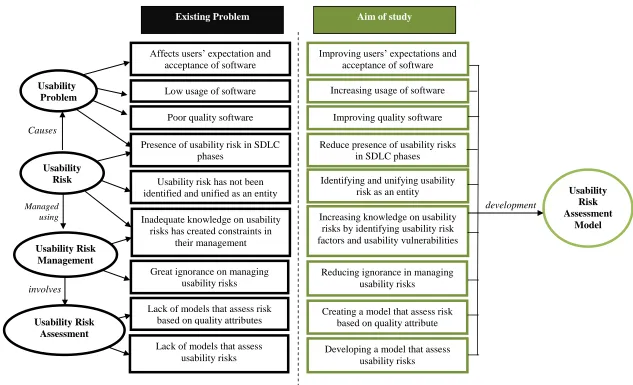
Generally, a usability risk can be understood as the potential action or activity that leads to undesirable outcomes that impact the usability of software. Unmanaged usability risks affect the software development process, and in turn lead to various usability problems in end products. However, this term is not widely used in the literature. The majority of prior work uses the term usability problems and not usablilty risks. The term usability risk was first introduced in the e-commerce and World Wide Web services context (Platt, 1999). Some studies on the sources and consequences of risks related to mobile applications used this term in their research (Dey & Häkkilä, 2008; Jin, Ko, Mun, & Ji, 2007; Ketola, 2002). Further investigation also revealed that knowledge on usability risks is still lacking, whereby there is a lack of effort in identifying and unifying usability risks as a unique entity, either in the form of checklists, models or others. Consequently, inadequate knowledge on usability risks has caused constraints in managing these risks during the software development process, which hinders the effort to reduce usability problems associated with the end product. Futhermore, The approach of usability risk management can only be entirely implemented once adequate knowledge on the associated risks is acquired. Since knowledge on usability risks is still lacking, there has been great ignorance in prior work in managing usability risks compared to other risks such as those of market, technology and money (Platt, 1999). Thus, there is a need to perform risk assessment prior to risk control in order to gain adequate knowledge on these risks (Boehm, 1991).
5
Maintainability. Usability was not taken into consideration in this model. Since there is lack in models used to assess usability risks, there is a need for the development of a risk assessment model based on usability risks, which aims to reduce usability problems in software.
1.2 ProblemStatement
Development teams currently face challenges in assessing potential usability risks during the SDLC for several reasons. Firstly, inadequate knowledge on usability risks has become a hindrance for development teams in reducing software usability problems. Subsequently, knowledge about usability risk factors and vulnerabilities that can further explain this concept is also lacking. Many studies have focused on risks underlying projects and processes meanwhile only a limited number of studies focused on risks underlying quality attributes. Overall, studies that focus on usability risks are still lacking. Secondly, the lack of knowledge on usability risks has created constraints in assessing them during the software development process. Without proper assessment, a risk control approach cannot be effectively implemented. In terms of risk assessment, there is a lack of models that assess usability risks during the SDLC. If development teams continue to develop software without assessing usability risks, the chances of producing software with more usability problems are higher.
Usability Risk Assessment
Model
Affects users’ expectation and acceptance of software
Low usage of software
Presence of usability risk in SDLC phases
Inadequate knowledge on usability risks has created constraints in
their management Usability risk has not been identified and unified as an entity
Great ignorance on managing usability risks
Lack of models that assess risk based on quality attributes
Lack of models that assess usability risks Poor quality software
Usability Risk Assessment Usability Risk Management Usability Risk Usability Problem
Creating a model that assess risk based on quality attribute
Developing a model that assess usability risks
Reduce presence of usability risks in SDLC phases
Improving quality software
Increasing knowledge on usability risks by identifying usability risk factors and usability vulnerabilities
Identifying and unifying usability risk as an entity
Reducing ignorance in managing usability risks
Aim of study Existing Problem
Improving users’ expectations and acceptance of software
Increasing usage of software
7
1.3 Research Questions (RQ)
This research aims to assess potential usability risks during the software development process by using the proposed Usability Risk Assessment Model. This research is expected to help development teams in identifying, analysing and prioritizing potential usability risks during the software development process to reduce usability problem. Based on the specified research problem, three research questions have been formulated, which are as follows:
RQ 1: What are the elements and methods in the Usability Risk Assessment Model? This question answers the concern on the elements that constitutes in the proposed model and the methods to implement these elements.
RQ 2: How potentialusability risks can be incorporated into SDLC phases?
This question answers the concern on how usability risks can be incorporated into SDLC phases.
RQ 3: How a suitable Usability Risk Assessment Model can be proposed based on the above findings?
This question answers the concern on how the findings from RQ1 and RQ2 can be used to develop the proposed model.
1.4 Research Objectives (RO)
The objectives of this research have been formulated based on the five research questions as follows:
RO 2: To identify potential usability risks that influences the usability of software This objective determines the potential usability risks which effects software usability.
RO 3: To analyse and prioritize potential usability risks in SDLC phases
This objective analyses and prioritises the identified usability risks (from RO 2) in order to incorporate usability risks in SDLC phases.
RO 4: To proposed aUsability Risk Assessment Model
This objective aims to develop the proposed model using the findings from RO 1, RO 2 and RO 3.
RO 5: To evaluate the proposed Usability Risk Assessment Model
This objective evaluates the developed model (from RO 4) to ensure it achieves aim of this research
1.5 Scope of the Study
This section presents the limitations of this study, which mainly includes the software quality and risk assessment approach. A further description on the software
quality and risk assessment approach is provided as follows.
Software quality scope
This study emphasizes the concept of software quality as explained in the
quality standard: ISO/IEC 25010: 2011 Systems and software engineering -- Systems and software Quality Requirements and Evaluation (SQuaRE) -- System and software quality models. Additionally, this study focuses on
9
Risk assessment approach scope
Although software risk management processes involve risk assessment and risk control, this study only focuses on the risk assessment process. This is because current knowledge on usability risks is still lacking, and it is difficult to control a risk without conducting a proper assessment process. The advantage of a risk assessment process is that it identifies, analyses, and prioritizes usability risks in SDLC phases, which could potentially increase the knowledge and awareness of development teams to develop more usable software. This study proposed a usability based risk assessment model that involves three core elements: Risk Identification, Risk Analysis and Risk Prioritization. However, the elements of Risk Classification and Risk Mitigation were included in this model to add value to the proposed model.
Since usability problem is also a common problem faced in Malaysian Public
Sector, respondents and experts involved in this study were selected from Malaysian Public Sector. Furthermore, possible usability risks during software development process vary among private and public sector. Thus, focus of this study remains on potential usability risks in software development process at public sector.
1.6 Significance of the Study
Achieving the objectives of this study provides theoretical and practical significance.
Theoretical significance
Process Quality/ Software Product Quality), Software Engineering Management (Section 3-Software Project Planning and Subsection 2.5-Risk Management), and Software Engineering Process (Section 2.2-Software Life Cycle Models). Since this study focuses on usability, it highlights knowledge on usability risks, usability risk factors and usability vulnerabilities.
Practical significance
The proposed model could aid software development teams, including project managers, quality managers and risk management teams to conduct usability risk assessment processes that identify, analyse, and prioritise potential usability risks that impact SDLC phases. This assessment process influences the development of quality software. Organisations could meet users’ expectations on quality by ensuring the identified usability risks are handled well in each phase during the SDLC. Knowledge and understanding on potential usability risks could also proactively facilitate the development of usability requirements for software, and support the evaluation of software implementation against its requirements.
1.7 Glossary
This section explains several key terms that have been used throughout this thesis. A detailed discussion for each term is provided in Chapter 2.
(a) Usability problem is perceived as an aspect of the system and/or a demand on the user which makes it unpleasant, inefficient, onerous, perturbing or impossible for the user to achieve their goals in typical contexts of use (Lavery, 1997).
(b) Usability risk factor is a cause or characteristic that typically influences the possibility of a risk event occurrence (Islam, 2009).
11
(d) Risk event can be certain or uncertain, and can be influenced by a single occurrence or a series of occurrences. There exists a cause for the occurrence of a risk event, which is known as a risk factor (Islam, 2009).
(e) Usability risk is the potential that a chosen action or activity leads to a loss
or an undesirable outcome which could impact usability of a software (Naik, 2013).
(f) Usability vulnerability is a weakness that can be accidentally triggered or intentionally exploited, which creates the potential for harm to software (Stoneburner et al., 2002).
(g) Threat is a potential for a person or natural event to exercise (accidentally trigger or intentionally exploit) specific vulnerabilities (Stoneburner et al., 2002).
(h) Probability of occurrence refers to the probability that a potential vulnerability may be exercised within the construct of the associated threat environment (Stoneburner et al., 2002).
(i) Impact is the amount of potential losses that an organization could suffer from a negative or harmful risk event (Stoneburner et al., 2002).
(j) Effectiveness is the degree to which specified users can achieve specified goals with accuracy and completeness in a specified context of use (ISO/IEC25010, 2011).
(k) Efficiency is the degree to which specified users expend appropriate amounts of resources in relation to the effectiveness achieved in a specified context of use use (ISO/IEC25010, 2011).
1.8 Outline of the Thesis
This thesis is organised in the following chapters:
Chapter 1 presents introduction to the research, and discusses the background of the research, problem statement, goals, research questions, objectives, scope and significance of the study.
Chapter 2 provides a comprehensive review of related studies in the existing body of literature. Initially, state-of-the-art on models, processes and tools relevant to software risk assessment and software risk management are reviewed. This chapter elaborates usability as one of the significant factors in producing quality software.
Chapter 3 discusses the phases of the research design and methodology in detail. Explanation of the research phases includes related activities and deliverables. This chapter also discusses the research instruments and the evaluation criteria which were adopted in this work.
Chapter 4 documents and illustrates the data collection process using Systematic Literature Review (SLR), and the adoption of an existing mapping study. Using these, elements and methods in the Usability Risk Assessment Model are identified to achieve the first objective of the research: To investigate elements and methods in the Usability Risk Assessment Model.
Chapter 5 explains the processes of identifying usability risk and usability vulnerabilities, and provides respective descriptions. The process of expert validation on usability risk and its vulnerabilities are also explained.
13
Chapter 7 describes the conceptual model of the Usability Risk Assessment Model, and explains in detail the design of the Usability Risk Assessment Tool.
Chapter 8 presents the evaluation of the Usability Risk Assessment Model using a quantitative case study.
Chapter 9 concludes this study by providing the research summary and achievements. The contributions and limitations of this research are also presented. Finally, some suggestions for future work are provided.
1.9 Chapter Summary
REFERENCES
Abran, Alain, Khelifi, Adel, Suryn, Witold, & Seffah, Ahmed. (2003). Usability Meanings and Interpretations in ISO Standards. Software Quality Journal, 11(4), 325-338.
Al-Ahmad, Walid, Al-Fagih, Khalid, Khanfar, Khalid, Alsamara, Khalid, Abuleil, Saleem, & Abu-Salem, Hani. (2009). A taxonomy of an IT project failure: Root Causes. International Management Review, 5(1), 93-104.
Aloini, Davide, Dulmin, Riccardo, & Mininno, Valeria. (2007). Risk management in ERP project introduction: Review of the literature. Information & Management, 44(6), 547-567.
Alonso-Ríos, David, Vázquez-García, Ana, Mosqueira-Rey, Eduardo, & Moret-Bonillo, Vicente. (2009). Usability: a critical analysis and a taxonomy. International Journal of Human-Computer Interaction, 26(1), 53-74.
Arunraj, N. S., Mandal, Saptarshi, & Maiti, J. (2013). Modeling uncertainty in risk assessment: An integrated approach with fuzzy set theory and Monte Carlo simulation. Accident Analysis & Prevention, 55(0), 242-255.
Ayyub, Bilal M. (2001). A Practical Guide on Conducting Expert-Opinion Elicitation of Probabilities and Consequences for Corps Facilities. Alexandria: Institute for Water Resources.
Babar, Muhammad Ali, Winkler, Dietmar, & Biffl, Stefan. (2007). Evaluating the usefulness and ease of use of a groupware tool for the software architecture
evaluation process. Paper presented at the ESEM 2007 First International Symposium on Empirical Software Engineering and Measurement.
Babar, Muhammad Ali, & Zhang, He. (2009). Systematic literature reviews in software engineering: Preliminary results from interviews with researchers.
Paper presented at the Proceedings of the 2009 3rd International Symposium on Empirical Software Engineering and Measurement.
Basili, Victor R, & Caldiera, Gianluigi. (2012). Improve software quality by reusing knowledge and experience. Sloan management review, 37.
268
2012 International Conference on.Advances in Engineering, Science and Management (ICAESM).
Bevan, Nigel. (1995). Usability is quality of use. Advances in human factors ergonomics, 20, 349-349.
Boehm, B. W., Brown, J. R., Kaspar, H., Lipow, M. , MacLeod, G. J., & Merrit, M. J. . (1978). Characteristics of software quality (Vol. 1): North-Holland Publishing Company.
Boehm, Barry W. (1989). Software risk management: Springer Berlin Heidelberg. Boehm, Barry W. (1991). Software risk management: principles and practices.
Software, IEEE, 8(1), 32-41.
Booth, Paul. (1989). An introduction to human-computer interaction: Psychology Press.
Boring, Ronald, Gertman, David, Joe, Jeffrey, Marble, Julie, Galyean, William, Blackwood, Larry, & Blackman, Harold. (2005). Simplified Expert Elicitation Guideline For Risk Assessment Of Operating Events (INL/EXT-05-00433). Washington, D.C.
Brereton, Pearl, Kitchenham, Barbara A, Budgen, David, Turner, Mark, & Khalil, Mohamed. (2007). Lessons from applying the systematic literature review process within the software engineering domain. Journal of Systems and Software, 80(4), 571-583.
Brooke, John. (1996). SUS-A quick and dirty usability scale. Usability evaluation in industry, 189(194), 4-7.
Brooks, Kenneth W. (1979). Delphi Technique: Expanding Applications. North Central Association Quarterly, 53(3), 377-385.
Bryant, A., & Charmaz, K. (2010). The Sage Handbook of Grounded Theory: Sage Publications.
Burton-Jones, Andrew, & Straub Jr, Detmar W. (2006). Reconceptualizing system usage: An approach and empirical test. Information systems research, 17(3), 228-246.
Carr, V., & Tah, J. H. M. (2001). A fuzzy approach to construction project risk assessment and analysis: construction project risk management system. Advances in Engineering Software, 32(10–11), 847-857.
Chakravarti, A K, Vasanta, B, Krishnana, A S A, & Dubash, R K. (1998). Modified Delphi methodology for technology forecasting: case study of electronics and
information technology in India (Vol.58): Technol. Forecast. Soc. Chang. Chan, Hing Kai, & Wang, Xiaojun. (2013). Fuzzy Hierarchical Model for Risk
Assessment. London: Springer London., 10, 978-971.
Chang, Tsung-Han, Hsu, Shu-Chen, & Wang, Tien-Chin. (2013). A proposed model for measuring the aggregative risk degree of implementing an RFID digital campus system with the consistent fuzzy preference relations. Applied Mathematical Modelling, 37(5), 2605-2622.
Charmaz, Kathy. (2007). Constructing Grounded Theory In D. S. G. College) (Eds.) (Ed.) A Practical Guide Through Qualitative Analysis
Chiam, Yin Kia, Staples, Mark, Ye, Xin, & Zhu, Liming. (2013). Applying a selection method to choose Quality Attribute Techniques. Information and Software Technology, 55(8), 1419-1436.
Choetkiertikul, M., & Sunetnanta, T. (2010). A Risk Assessment Model for Offshoring Using CMMI Quantitative Approach. Paper presented at the 2010 Fifth International Conference on Software Engineering Advances (ICSEA),. Choetkiertikul, Morakot, & Sunetnanta, Thanwadee. (2012). A Risk Assessment
Tool Using a CMMI Quantitative Approach. IACSIT Int. J. Eng. Technol, 4(4), 352-353.
Chowdhury, Abdullah Al Murad, & Arefeen, Shamsul. (2011). Software Risk Management: Importance and Practices. IJCIT, ISSN, 2078-5828.
Cole, Richard Stephen. (1996). A Generic Software Library for Creating Multimedia Browse/Search Applications (Doctoral dissertation).
Contini, Sergio, Bellezza, Furio, Christou, Michalis D., & Kirchsteiger, Christian. (2000). The use of geographic information systems in major accident risk
270
Corbin, J.M., & Strauss, A.L. (2008). Basics of Qualitative Research: Techniques and Procedures for Developing Grounded Theory: Sage Publications, Incorporated.
Corbin, Juliet M, & Strauss, Anselm. (1990). Grounded theory research: Procedures, canons, and evaluative criteria. Qualitative sociology, 13(1), 3-21.
Creswell, John W. (2003). Research design: Qualitative, Quantitative and Mixed Methods Approaches, 2nd edition: Sage Publications, Inc.
Dadhich, Reena, & Chauhan, Ujala. (2012). Integrating CMMI Maturity Level-3 In Traditional Software Development Process. International Journal, 3.
Dağdeviren, Metin, & Yüksel, İhsan. (2008). Developing a fuzzy analytic hierarchy
process (AHP) model for behavior-based safety management. Information Sciences, 178(6), 1717-1733.
Dajani, Jarir S, Sincoff, Michael Z, & Talley, Wayne K. (1979). Stability and agreement criteria for the termination of Delphi studies. Technological Forecasting and Social Change, 13(1), 83-90.
Dalkey, Norman, & Helmer, Olaf. (1963). An experimental application of the Delphi method to the use of experts. Management science, 9(3), 458-467.
Davis, Fred D. (1989). Perceived usefulness, perceived ease of use, and user acceptance of information technology. MIS quarterly, 319-340.
Day, Jacqueline, & Bobeva, Milena. (2005). A generic toolkit for the successful management of Delphi studies. EJBRM, 3(2), 103-116.
de Barros Sampaio, S. C., Barros, E. A., de Aquino, G. S., e Silva, M. J. C., & de Lemos Meira, S. R. (2010). A Review of Productivity Factors and Strategies on Software Development. Paper presented at the 2010 Fifth International Conference on Software Engineering Advances (ICSEA).
Delbecq, Andre L, Van de Ven, Andrew H, & Gustafson, David H. (1975). Group techniques for program planning: A guide to nominal group and Delphi
processes: Scott, Foresman Glenview, IL.
Den Ouden, Elke. (2006). Development of a design analysis model for consumer complaints. Technische Universiteit Eindhoven, Beta.
Dromey, R. Geoff. (1995). A model for software product quality. Software Engineering, IEEE Transactions on, 21(2), 146-162.
Dubey, S.K., & Rana, A. (2010). Analytical Roadmap to Usability Definitions and Decompositions. International Journal of Engineering Science and Technology, 2(9), 4723-4729.
Dubey, Sanjay Kumar, Gulati, Anubha, & Rana, Ajay. (2012). Integrated Model for Software Usability. International Journal on Computer Science and Engineering, 4(3).
Dunn, William N. (2004). Public policy analysis: An introduction (3rd ed.). New Jersey: Pearson Prentice Hall.
Durrani, Qaiser Shehryar, & Qureshi, Samia Asloob. (2012). Usability engineering practices in SDLC. Paper presented at the Proceedings of the 2012 International Conference on Communications and Information Technology (ICCT).
English, J. Morley, & Kernan, Gerard L. (1976). The prediction of air travel and aircraft technology to the year 2000 using the Delphi method. Transportation Research, 10(1), 1-8.
Ermedahl, Andreas, & Engblom, Jakob. (2007). Execution time analysis for embedded real-time systems. Handbook of Real-Time Embedded Systems, SHS Insup Lee, Jospeh YT. Leung, Ed. Chapman & Hall/CRC-Taylor and
Francis Group, 35.31-35.17.
Fang, Hsai-Yang, Mikroudis, George K., & Pamukcu, Sibel. (1987). A unified approach to the assessment of waste disposal sites. Computers and Geotechnics, 3(2–3), 129-156.
Fang, Ying Lan, Han, Bing, & Zhou, Wei Fu. (2013). Research and Design of Software Quality Control System Based on the CMMI System. Applied Mechanics and Materials, 241, 2837-2840.
Farooq, Sheikh Umar, & Quadri, SMK. (2012). Quality Practices in Open Source Software Development Affecting Quality Dimensions. Trends in Information Management, 7(2).
272
Felderer, Michael, Haisjackl, Christian, Breu, Ruth, & Motz, Johannes. (2012). Integrating manual and automatic risk assessment for risk-based testing
Software Quality. Process Automation in Software Development 159-180: Springer.
Feng, Nan, & Li, Minqiang. (2011). An information systems security risk assessment
model under uncertain environment. Applied Soft Computing, 11(7), 4332-4340.
Ferre, X. (2003). Integration of usability techniques into the software development process. Paper presented at the International Conference on Software Engineering (Bridging the gaps between software engineering and human-computer interaction).
Fischer, H. (2012). Integrating usability engineering in the software development lifecycle based on international standards. Paper presented at the Proceedings of the 4th ACM SIGCHI symposium on Engineering interactive computing systems.
Folkerd, Christopher, & Spinelli, Gabriella. (2009). User exclusion and fragmented requirements capture in publicly-funded IS projects. Transforming Government: People, Process and Policy, 3(1), 32-49.
Fouladgar, MM, Yazdani-Chamzini, A, & Zavadskas, EK. (2012). Risk evaluation of
tunneling projects. Archives of civil and mechanical engineering, 12(1), 1-12.
Gardner, Christina, & Amoroso, Donald L. (2004). Development of an instrument to measure the acceptance of internet technology by consumers. Paper presented at the Proceedings of the 37th Annual Hawaii International Conference on System Sciences.
George, Darren, & Mallery, P. (2003). SPSS for Windows Step by Step: A Simple Guide and Reference, 11.0 Update: Allyn and Bacon.
Gibson, L. J. , & Miller, M. (1990). A Delphi model for planning `preemptive' regional economic diversification. Economic Development Review, 8(2), 4-41.
Glaser, Barney. (1998). Doing Grounded Theory: Issues & Discussion: Sociology Press.
Glaser, Barney, & Strauss, Anselm. (1992). Basics of Grounded Theory Analysis: Emergence Vs. Forcing: Sociology Press.
Grady, Robert B, & Caswell, Deborah L. (1987). Software metrics: establishing a company-wide program.
Grossman, Tovi, Fitzmaurice, George, & Attar, Ramtin. (2009). A survey of software learnability: metrics, methodologies and guidelines. Paper presented at the Proceedings of the SIGCHI Conference on Human Factors in Computing Systems.
Gutierrez, Oscar. (1989). Experimental techniques for information requirements analysis. Information & Management, 16(1), 31-43.
Hall, Elaine M. (1998). Managing risk: Methods for software systems development: Pearson Education.
Han, Wen-Ming, & Huang, Sun-Jen. (2007). An empirical analysis of risk components and performance on software projects. Journal of Systems and Software, 80(1), 42-50.
Hanafin, Sinéad. (2004). Review of literature on the Delphi Technique. Dublin: National Children’s Office.
Hashimi, H., Hafez, A., & Beraka, M. (2012). A Novel View of Risk Management in Software Development Life Cycle. Paper presented at the 12th International Symposium on Pervasive Systems, Algorithms and Networks (ISPAN). Hasson, Felicity, Keeney, Sinead, & McKenna, Hugh. (2000). Research guidelines
for the Delphi survey technique. Journal of advanced nursing, 32(4), 1008-1015.
Heck, Petra, Klabbers, Martijn, & van Eekelen, Marko. (2010). A software product certification model. Software Quality Journal, 18(1), 37-55.
Hedrick, Terry E, Bickman, Leonard, & Rog, Debra J. (1993). Applied research design: A practical guide: Sage.
274
Heras Saizarbitoria, Iñaki. (2006). How quality management models influence company results–conclusions of an empirical study based on the Delphi
method. Total Quality Management & Business Excellence, 17(6), 775-794.
Hertzum, M. (2010). Images of Usability. International Journal of Human-Computer Interaction, 26(6), 567-600.
Hijazi, Haneen, Alqrainy, Shihadeh, Muaidi, Hasan, & Khdour, Thair. (2014). Identifying Causality Relation between Software Projects Risk Factors.
International Journal of Software Engineering and Its Applications, 8(2), 51-58.
Hong, Zhen, & Lee, C. K. M. (2013). A decision support system for procurement risk management in the presence of spot market. Decision Support Systems, 55(1), 67-78.
Hoodat, Hooman, & Rashidi, Hassan. (2009). Classification and analysis of risks in software engineering. World Academy of Science, Engineering and Technology, 56, 446-452.
Houmb, Siv Hilde, Franqueira, Virginia NL, & Engum, Erlend A. (2010). Quantifying security risk level from CVSS estimates of frequency and impact. Journal of Systems and Software, 83(9), 1622-1634.
Hsu, Chia-Chien, & Sandford, Brian A. (2007). The Delphi technique: making sense of consensus. Practical Assessment, Research & Evaluation, 12(10), 1-8. Hua, Lei, & Gong, Yang. (2013). Usability Evaluation of a Voluntary Patient Safety
Reporting System: Understanding the Difference between Predicted and Observed Time Values by Retrospective Think-Aloud Protocols Human-Computer Interaction. Applications and Services , 94-100: Springer.
Humayoun, ShahRukh. (2012). Incorporating Usability Evaluation in Software Development Environments. KI - Künstliche Intelligenz, 26(2), 197-200. Husnain, Muhammad, Waseem, Muhammad, & Ghayyur, S. (2009). An
Interrogative Review of Requirement Engineering Frameworks. International Journalof Reviews in Computing (IJRIC).
Inversini, A., Cantoni, L., & Bolchini, D. (2011) Connecting usages with usability analysis through the user experience risk assessment model: A case study in the tourism domain. Vol. 6770 LNCS, 283-293.
Iranmanesh, Seyed Hossein, Khodadadi, Seyed Behrouz, & Taheri, S. (2009). Risk Assessment of Software Projects Using Fuzzy Inference System. Paper presented at the CIE 2009. International Conference on Computers & Industrial Engineering, 2009.
Isa, W.A.R.W.M., Suhami, M.R., Safie, N.I., & Semsudin, S.S. (2011). Assessing the Usability and Accessibility of Malaysia E-Government Website. American Journal of Economics and Business Administration, 3(1), 40-46. Islam, Shareeful. (2009). Software development risk management model: a goal
driven approach. Paper presented at the Proceedings of the doctoral symposium for ESEC/FSE on Doctoral symposium.
ISO12207. (2008). ISO/IEC 12207: 2008 Systems and software engineering-Software life cycle processes. International Organization for Standardization: Geneva.
ISO. (2008). IEC 12207 Systems and software engineering-software life cycle processes. International Organization for Standardization, Geneva, Switzerland.
ISO/IEC9126. (2001). ISO/IEC 9126 -1: Software engineering – Product quality – Part 1: Quality model 9126.
ISO/IEC25010. (2011). ISO/IEC 25010: 2011: Systems and software engineering– Systems and software Quality Requirements and Evaluation (SQuaRE)– System and software quality models. International Organization for Standardization.
Jairath, N, & Weinstein, J. (1993). The Delphi methodology (Part one): A useful administrative approach. Canadian journal of nursing administration, 7(3), 29-42.
276
Jianyi, Guo, Li, Zhang, Xusheng, Liu, Yuejuan, Huang, & Zhengtao, Yu. (2008). Implementing a quantitative-based methodology for project risk assessment
DSS. Paper presented at the 27th Chinese Control Conference, 2008.
Jin, Beomsuk, Ko, Sangmin, Mun, Jaeseung, & Ji, YongGu. (2007). A Study for Usability Risk Level in Physical User Interface of Mobile Phone. In Nuray Aykin (Ed.), Usability and Internationalization. HCI and Culture (Vol. 4559, 327-335): Springer Berlin Heidelberg.
Jing, Xie, & Nan, Feng. (2009). Risk evaluation process modeling in software project investment based on Bayesian networks. Paper presented at the 16th International Conference on Industrial Engineering and Engineering Management, IE&EM '09. .
Johnson, R Burke, & Onwuegbuzie, Anthony J. (2004). Mixed methods research: A
research paradigm whose time has come. Educational researcher, 33(7), 14-26.
Jokela, Timo. (2005). Performance rather than capability problems. insights from assessments of usability engineering processes Product Focused Software Process Improvement (115-127): Springer.
Jones, Capers, & Bonsignour, Olivier. (2011). The economics of software quality: Addison-Wesley Professional.
Jones, T. Capers. (1994). Assessment and Control of Software Risk. New York: Prentice-Hall.
Josang, A., Alfayyadh, B., Grandison, T., Alzomai, M., & McNamara, J. (2007). Security Usability Principles for Vulnerability Analysis and Risk Assessment.
Paper presented at the Twenty-Third Annual Computer Security Applications Conference, ACSAC 2007. .
Joseph F. Hair, Jr., Anderson, Rolph E., Tatham, Ronald L., & Black, William C. (2005).Multivariate data analysis (6th ed.): with readings: Prentice-Hall, Inc. Judd, Charles M, Smith, Eliot R, & Kidder, Louise H. (1991). Research methods in
social relations.
Jyothi, Veerapaneni Esther, Srikanth, Kaitepalli, & Rao, K Nageswara. (2012). Effective Implementation on Agile Practices-Object Oriented Metrics Tool to improve Software Quality. International Journal of Software Engineering & Applications, 3(4).
Kalaian, Sema A, & Kasim, Rafa M. (2012). Terminating Sequential Delphi Survey Data Collection. Practical Assessment, Research & Evaluation, 17(5), 2. Kanis, H. (1997). Usability centered research for everyday product design. Paper
presented at the Proceedings of the 13th Triennial Congress of the International Ergonomics Association, Finnish Institute for Occupational Health, Helsinki, Tampere Finland.
Kasunic, Mark. (2005). Designing an effective survey: DTIC Document.
Kaur, Kirandeep, Jyoti, Bharti, & Rani, Rekha. (2013). Analysis of Gold Plating: A Software Development Risk. Analysis, 2(1).
Kaur, Rupinder, & Sengupta, Jyotsna. (2013). Software Process Models and Analysis on Failure of Software Development Projects. arXiv preprint arXiv:1306.1068.
Keeney, Sinead, Hasson, Felicity, & McKenna, Hugh P. (2001). A critical review of the Delphi technique as a research methodology for nursing. International journal of nursing studies, 38(2), 195-200.
Keil, Mark, Cule, Paul E, Lyytinen, Kalle, & Schmidt, Roy C. (1998). A framework for identifying software project risks. Communications of the ACM, 41(11), 76-83.
Kessner, Martin, Wood, Jo, Dillon, Richard F, & West, Robert L. (2001). On the reliability of usability testing. Paper presented at the CHI'01 extended abstracts on Human factors in computing systems.
Ketola, P. (2002). Integrating usability with concurrent engineering in mobile phone development: University of Tampere.
278
Kitchenham, B. (2007). Guidelines for performing systematic literature reviews in software engineering. School of Computer Science and Mathematics, Keele University and Department of Computer Science, University of Durham. Kitchenham, B, & Charters, S. (2007). Procedures for Performing Systematic
Literature Reviews in Software Engineering. Keele University & Durham University, UK.
Kitchenham, Barbara, & Pfleeger, Shari Lawrence. (1996). Software quality: the elusive target [special issues section]. Software, IEEE, 13(1), 12-21.
Kitchenham, Barbara, Pickard, Lesley, & Pfleeger, Shari Lawrence. (1995). Case studies for method and tool evaluation. IEEE software, 12(4), 52-62.
Koh, SCL, Saad, SM, Ahmed, Ammar, Kayis, Berman, & Amornsawadwatana, Sataporn. (2007). A review of techniques for risk management in projects. Benchmarking: An International Journal, 14(1), 22-36.
Kontio, Jyrki. (2001). Software engineering risk management: a method, improvement framework, and empirical evaluation. (PhD), Helsinki University of Technology, Finland.
Kothari, Mihir. (2010). Early warning signs in Software Projects. AUT University. Kristensson, David. (2004). Quality assurance in software development & evaluation
of existing quality systems. University West.
Lai, Lotto Kim Hung, & Chin, Kwai Sang. (2014). Development of a Failure Mode and Effects Analysis Based Risk Assessment Tool for Information Security. Industrial Engineeering & Management Systems, 13(1), 87-100.
Laitenberger, Oliver, & Dreyer, Horst M. (1998). Evaluating the usefulness and the ease of use of a web-based inspection data collection tool. Paper presented at the Fifth International Proceedingson Software Metrics Symposium.
Lallemand, Carine. (2011). Toward a closer integration of usability in software development: a study of usability inputs in a model-driven engineering
process. Paper presented at the Proceedings of the 3rd ACM SIGCHI symposium on Engineering interactive computing systems.
Lewis, Clayton, & Norman, Donald A. (1995). Designing for error. Paper presented at the Human-computer interaction.
Lewis, James R, & Sauro, Jeff. (2009). The factor structure of the system usability scale Human Centered Design (94-103): Springer.
Liang, Lu, Deng, Xiaoling, & Wang, Yong. (2009). Usability Measurement Using a Fuzzy Simulation Approach. Paper presented at the International Conference on Computer Modeling and Simulation, ICCMS'09.
Lilja, Kari K, Laakso, Kimmo, & Palomki, J. (2011). Using the Delphi method. Paper presented at the 2011 Proceedings of PICMET'11:Technology Management in the Energy Smart World (PICMET).
Lindgaard, G. (1994). Usability testing and system evaluation: A guide for designing useful computer systems: Chapman & Hall London,, UK.
Linstone, Harold A, & Turoff, Murray. (1975). The delphi method: Addison-Wesley Reading, MA.
Liu, Jun, Qiao, Jianzhong, & Lin, Shukuan. (2009). Risk Prediction and Measurement for Software Based on Service Oriented Architecture Cutting-Edge Research Topics on Multiple Criteria Decision Making, 515-522: Springer.
Liu, Yanqiu, Zhou, Chi, & Zhang, Ying. (2012). Coordinate Preference DEA Method of Software Project Risk Assessment. Paper presented at the International Conference on Communication Systems and Network Technologies (CSNT).
Lobato, L Lopes, do Carmo Machado, Ivan, Neto, PA da Mota Silveira, de Almeida, E Santana, & de Lemos Meira, S Romero. (2012). Risk Management in software engineering: A scoping study.
López, Cristina, & Salmeron, Jose L. (2012). Risks Response Strategies for Supporting Practitioners Decision-Making in Software Projects. Procedia Technology, 5(0), 437-444.
280
Lu, Haiyi, Axe, Lisa, & Tyson, Trevor A. (2003). Development and application of computer simulation tools for ecological risk assessment. Environmental Modeling & Assessment, 8(4), 311-322.
Lu, Shaokai, & Yan, Hong. (2013). A comparative study of the measurements of perceived risk among contractors in China. International Journal of Project Management, 31(2), 307-312.
Lummus, Rhonda R, Vokurka, Robert J, & Duclos, Leslie K. (2005). Delphi study on supply chain flexibility. International Journal of Production Research, 43(13), 2687-2708.
Makrodimitris, Georgios, Polemi, Nineta, & Douligeris, Christos. (2014). Security Risk Assessment Challenges in Port Information Technology Systems E-Democracy, Security, Privacy and Trust in a Digital World (24-35): Springer. MAMPU, Modernization and Management Planning Unit. (2011). Kajian Baseline
Perkhidmatan E-Kaunter & Paperless Government.
Markmann, Christoph, Darkow, Inga-Lena, & von der Gracht, Heiko. (2013). A Delphi-based risk analysis — Identifying and assessing future challenges for supply chain security in a multi-stakeholder environment. Technological Forecasting and Social Change, 80(9), 1815-1833.
Massacci, Fabio, Bouquet, Fabrice, Fourneret, Elizabeta, Jurjens, Jan, Lund, Mass S, Madelénat, Sébastien, . . . Piessens, Frank. (2011). Orchestrating security and system engineering for evolving systems Towards a Service-Based Internet (134-143): Springer.
McCall, Jim A, Richards, Paul K, & Walters, Gene F. (1977). Factors in software quality: General Electric, National Technical Information Service.
McFarlan, F. W. (1981). Portfolio Approach to Information System. In Harvard Business Review (Ed.), (Vol. 59(3), 142-150).
McLeod, Laurie, & MacDonell, Stephen G. (2011). Factors that affect software systems development project outcomes: A survey of research. ACM Comput. Surv., 43(4), 1-56.
Minglu, Li, Jianping, Li, Hao, Song, & Dengsheng, Wu. (2009). Risk Management in the Trustworthy Software Process: A Novel Risk and Trustworthiness
Misra, Subhas C., Kumar, Vinod, & Kumar, Uma. (2006). Different techniques for risk management in software engineering: a review. Paper presented at the ASAC 2006, Alberta.
Mkpong-Ruffin, Idongesit, Umphress, David, Hamilton, John, & Gilbert, Juan. (2007). Quantitative software security risk assessment model. Paper presented at the Proceedings of the 2007 ACM workshop on Quality of protection.
Mofleh, H.M., & Zahary, A. (2011). A Framework for Software Product Risk Management Based on Quality Attributes and Operational Lefe Cycle (SPRMQ). Risk, 1, 3.
Mohamud Sharif, Abdullahi, & Basri, Shuib. (2011). Software Risk Assessment: A Review on Small and Medium Software Projects
Software Engineering and Computer Systems. In Jasni Mohamad Zain, Wan Maseri bt Wan Mohd, & Eyas El-Qawasmeh (Eds.), (Vol. 180, 214-224): Springer Berlin Heidelberg.
Mohapatra, Sanjay. (2012). Information Theory and Best Practices in the IT Industry: Springer.
Mokhtari, Kambiz, Ren, Jun, Roberts, Charles, & Wang, Jin. (2012). Decision support framework for risk management on sea ports and terminals using fuzzy set theory and evidential reasoning approach. Expert Systems with Applications, 39(5), 5087-5103.
Mustafa, Norfazira, Sanusi, Nurazlina Md, & Jalil, Intan Ermahani A. (2010). Software risk assessment visualization tool design using probabilistic
inference models. Paper presented at the 2010 International Symposium in Information Technology (ITSim).
Naik, Radhika. (2013). Software Risk Management. International Journal of Advances in Engineering Sciences, 3(1), 17-21.
Ngai, E. W. T., & Wat, F. K. T. (2005). Fuzzy decision support system for risk analysis in e-commerce development. Decision Support Systems, 40(2), 235-255.