Full paper
Jurnal
Teknologi
Models of Adopting Cloud Computing in the E-Government Context: A
Review
Fathey Mohammeda,b*, Othman Ibrahimb
aDepartment of Information Technology, Faculty of Engineering and information technology, Taiz University, Yemen
bDepartment of Information Systems, Faculty of Computing, Universiti Teknologi Malaysia, 81310 UTM Johor Bahru, Johor, Malaysia
*Corresponding author: [email protected]
Article history
Received :10 December 2014 Received in revised form : 1 February 2015
Accepted :12 February 2015
Graphical abstract
Abstract
Governments and public sector agencies are continuously looking for ways to improve their services. Therefore, there is a need for restructuring processes and effectively using technology to improve efficiency and effectiveness of the business operations. Cloud computing is one of recent technological trends that support these efforts. It is a new type of sourcing model in which computing services are provided as a utility over the Internet. This paper analyzes the benefits and challenges of cloud computing over e-government systems. It reviews the existing literature on the proposed models of cloud computing adoption in the context of e-government. Further, this paper critically analyzes and classifies these models to different categories.
Keywords: e-government; cloud computing; model
© 2015 Penerbit UTM Press. All rights reserved.
1.0 INTRODUCTION
The effective utilization of ICT enables integration of back-office systems among government agencies, and provision of fully customized electronic services to citizens and other partners1.
Furthermore, the advancing of ICT and the emerging of new technologies presents significant opportunity for governments to provide more effective e-government services. Therefore, to maximizing the benefits of e-government there is an increasing need to assess and exploit the opportunities created by the new emerging ICT technologies and paradigms.
Cloud computing is one of the new technologies which can significantly improve the way a government functions, the services it provides to its citizens and institutions, and its cooperation with other governments. It may make a revolution in e-government systems, in terms of cost saving, and actual and professional use of resources2-4. Further, cloud-based applications in the public sector
already have established their effectiveness to meet the requirements and the unexpected needs of resources5 . Gartner
Research predicts that 20% government agencies use cloud
computing to be more effective6. Furthermore, due to its
advantages, many countries have launched e-governance services using cloud computing7.
Since 2009, researchers have been investigating cloud computing in the context of e-government. Literature on this context shows that some researchers discuss the proposing benefits and challenges of cloud computing to e-government based on its characteristics such as (NASR, et al., 2012; Tripathi & Parihar, 2011; M. Sharma & Thapliyal, 2011; ATSE, 2010; Bhardwaj, Jain, & Jain, 2010; Chandrasekaran & Kapoor, 2011; Craig, et al., 2009; Das, Patnaik, & Misro, 2011; Kurdi, Taleb-Bendiab, Randles, & Taylor, 2011; Liang, 2012; Mukherjee & Sahoo, 2012; Paquette, Jaeger, & Wilson, 2010; Rastogi, 2010; Yeh, Zhou, Yu, & Wang, 2010)4,5,7-18. Other researchers propose models for moving
e-government systems to the cloud such as (NASR, et al., 2012; Das,
et al., 2011; Kurdi, et al., 2011; Liang, 2012; Mukherjee & Sahoo, 2012; Rastogi, 2010; Ahmad & Hasibuan, 2012; Chanchary & Islam, 2011; Chandra & Bhadoria, 2012; Khan, Zhang, Khan, & Chen, 2011; Prasad, Chaurasia, Singh, & Gour, 2010; H. Singh, 2012)4,12-15,17,19,20-24. In addition, Smitha, Thomas and Chitharanjan
29%
17% 42%
12%
Cloud Government Models
Layered based Model Step based Model
(2012)25, Tsaravas and Themistocleous (2011)26, and Vats, Sharma
and Rathee (2012)27 reviewed studies on cloud computing in the
e-government environment. However, these studies focused on reviewing the e-government challenges, and benefits and barriers of e-governance on the cloud. This paper contributes to the literature of this context by reviewing and classifying the proposed models for adopting cloud computing in e-government context. The rest of this paper is organized so the following section discusses the cloud computing concepts (e.g. Definitions, characteristics and models). The next section represents the benefits and challenges of using cloud computing to provide e-government services. Then, the proposed models for cloud government systems are reviewed. Finally, the models are analyzed and classified.
2.0 CLOUD COMPUTING
Cloud computing is defined by the IEEE Computer Society as: "A paradigm in which information is constantly stored in servers on the Internet and cached temporarily on clients that include desktops, entertainment centers, computers, notebooks, handhelds, etc.". Foster et al. (2008)28 also defines the cloud as a large scale
distributed computing paradigm where a pool of virtualized, scalable, and manageable storage, computing power, platforms and services can be provisioned on-demand to customers via the Internet. It is a collection of virtualized and scalable resources, which host applications and provide services to the users based on a pay-on-use model (like a utility)29. The common and widely
accepted definition for cloud computing is a definition by US National Institute for Standards and Technology (NIST)30 . NIST
defines the cloud computing as a model for providing ubiquitous, adequate and on-demand access to a shared and configurable computing resources (e.g. Servers, networks, storage, applications and services) with minimal effort and service provider interaction30.
Specific characteristics and features differentiate cloud computing from other computing paradigms like client-server and grid computing. L. Wang, et al., (2008)31 identifies four features
for cloud computing, which include user-centric interfaces, on-demand services, quality of services (QoS), and autonomous system. Zhang, Zhang, Chen, & Huo, (2010)32 define seven
characters for cloud computing, which are virtualization, large-scale, high reliability, high extendibility, versatility, on demand service, and cost effective. Jadeja & Modi, (2012)33 assign the
virtualization (users access the information and services via the Internet, regardless of the device used and the user's location), ease of implementation, service reliability, efficient use of resources, easier maintenance, pay per use, scalability and security as the main characteristics of cloud computing. However, NIST defines more comprehensive five characteristics of cloud computing, which include all mentioned features30. These are:
- Broad network access: Resources are virtually accessible via the Internet regardless the location and the device used (e.g., mobile phones, tablets, laptops, and workstations).
- On-demand self-service: Computing capabilities, such as server and processing time, and network storage, are provided automatically as needed.
- Resource pooling: The resources are pooled to serve different clients with physical and virtual resources dynamically appointed and reassigned as per client request.
- Measured service: Controlling and optimizing resource use by assigning a measured capability appropriate to the type of service (e.g., storage, processing and bandwidth).
- Rapid elasticity: Resources can be provisioned and to scale rapidly outward and inward commensurate with demand. On the other hand, according to the NIST definition of cloud computing, there are three different models of cloud services which are Software as a Service (SaaS), Platform as a Service (PaaS) and Infrastructure as a Service (IaaS). In SaaS, model Cloud Service Providers (CSP) run and maintain computing resources, operating system and application software. While in PaaS model, CSP is responsible for providing, running and maintaining system software and computing resources, and the user has little control over the operating system and hardware resources. Finally, in IaaS model, CSP provides a set of virtualized computing resources (e.g. Storage capacity, processing power, memory and network bandwidth) to the customer who runs and maintains the operating system and the software applications using these virtual recourses. All these services can be deployed through one of four different deployment models which are public, private, hybrid and community models30. Public cloud is a model by which the services
are delivered on a network that is open for public use. In private cloud, infrastructure is allocated only for a single organization. Hybrid cloud comprises both public and private cloud models. Community model shares resources between several related organizations from the same community with similar concerns and requirement30.
3.0 CLOUD COMPUTING BENEFITS AND
CHALLENGES FOR E-GOVERNMENT
For e-government, the characteristics of cloud computing imply that the effective use of cloud computing may be helpful in the way of implementing efficient e-government services. Cloud computing has the key feasible features that make it proper for use in e-government implementation. Realizing cloud computing benefits for e-government may make a revolution in e-government applications in terms of cost saving, scalability of infrastructure, ease of implementation, accessibility, massive storage capacity, access to IT capabilities, elimination of procurement and maintenance, and electricity consumption4,7,9,10,12,14,17,34. However,
Table 1 Cloud computing benefits for e-government
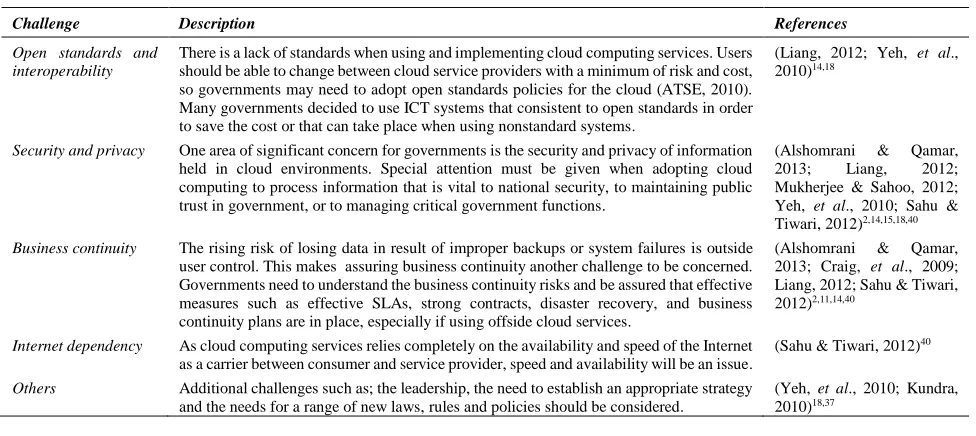
On the other hand, cloud computing like other Internet applications has challenges. Many challenges of cloud computing for e-government implementation come from its newness and the
relative development of the market for cloud services. Table 2 discusses the challenges to migrate e-government services to the cloud.
Table 2 Cloud computing challenges for e-government
The Benefit Description References
Ease of Implementation Public sector organizations can easily deploy cloud computing without the need to have heavy hardware, buy software licenses, or implement applications.
(Alshomrani & Qamar, 2013; Das, et al., 2011; Liang, 2012; Rastogi, 2010; Chandra & Bhadoria, 2012; R. Sharma, et al., 2012; Bellamy, 2013; Bhisikar, 2011; Kundra, 2010; Zwattendorfer & Tauber, 2013)2,12,14,17,21,34-38
Cost Savings Organizations can save or even eliminate ICT capital costs and decrease operational costs by paying only for the used services and reducing or redeploying ICT staff.
(Alshomrani & Qamar, 2013; Bansal, et al., 2012; Craig, et al., 2009; Das, et al., 2011; Liang, 2012; Rastogi, 2010; R. Sharma, et al., 2012; Bellamy, 2013; Kundra, 2010; Zwattendorfer & Tauber, 2013; Rashmi Sharma,
2011)2,3,11,12,14,17,34,35, 37-39
Scalability When a user loads increase, organizations need not to fulfil additional hardware and software, but can instead add and subtract network load capacity.
(Alshomrani & Qamar, 2013; Tripathi & Parihar, 2011; Das, et al., 2011; Liang, 2012; Rastogi, 2010; R. Sharma, et al., 2012; Bhisikar, 2011; Zwattendorfer & Tauber, 2013)2,5,12,14,17,34, 36,38
Accessibility Cloud computing can increase staff mobility by enabling access to information and services from anywhere and a wide range of devices.
(Alshomrani & Qamar, 2013; Das, et al., 2011; Liang, 2012; Rastogi, 2010; R. Sharma, et al., 2012; Bellamy, 2013; Bhisikar, 2011; Zwattendorfer & Tauber, 2013)2,12,14,17,34-36,38
Access to IT Capabilities
Cloud computing allows smaller organizations to access powerful hardware, software, and ICT staff.
(Bansal, et al., 2012; Liang, 2012; Bellamy, 2013; Zwattendorfer & Tauber, 2013)3,14,35,38
IT Staff Redeployment and Focusing on Core Competencies
Cloud computing can make it easier to reduce or shed functionalities like running data centers and developing and managing software applications, allowing organizations to focus on critical issues like policy development and public services design and delivery.
(Yeh, et al., 2010; Kundra, 2010; Rashmi Sharma, 2011)18, 37,39
Green computing Cloud computing is good for the environment as it uses very less amount resources. So, it requires very less power consumption.
(Bansal, et al., 2012; Das, et al., 2011; R. Sharma, et al., 2012; Kundra, 2010)3,12,34,37
Challenge Description References
Open standards and interoperability
There is a lack of standards when using and implementing cloud computing services. Users should be able to change between cloud service providers with a minimum of risk and cost, so governments may need to adopt open standards policies for the cloud (ATSE, 2010). Many governments decided to use ICT systems that consistent to open standards in order to save the cost or that can take place when using nonstandard systems.
(Liang, 2012; Yeh, et al., 2010)14,18
Security and privacy One area of significant concern for governments is the security and privacy of information held in cloud environments. Special attention must be given when adopting cloud computing to process information that is vital to national security, to maintaining public trust in government, or to managing critical government functions.
(Alshomrani & Qamar, 2013; Liang, 2012; Mukherjee & Sahoo, 2012; Yeh, et al., 2010; Sahu & Tiwari, 2012)2,14,15,18,40
Business continuity The rising risk of losing data in result of improper backups or system failures is outside user control. This makes assuring business continuity another challenge to be concerned. Governments need to understand the business continuity risks and be assured that effective measures such as effective SLAs, strong contracts, disaster recovery, and business continuity plans are in place, especially if using offside cloud services.
(Alshomrani & Qamar, 2013; Craig, et al., 2009; Liang, 2012; Sahu & Tiwari, 2012)2,11,14,40
Internet dependency As cloud computing services relies completely on the availability and speed of the Internet as a carrier between consumer and service provider, speed and availability will be an issue.
(Sahu & Tiwari, 2012)40
Others Additional challenges such as; the leadership, the need to establish an appropriate strategy and the needs for a range of new laws, rules and policies should be considered.
4.0 CLOUD GOVERNMENT MODELS
In the literature, there is relatively few studies investigated cloud computing in the context of e-government. Most of these studies mainly discussed the benefits and challenges of cloud computing to e-government. A few of these studies proposed a model or a framework to adopt cloud computing in e-government. Here, we review the most related studies found in the literature.
Rastogi, (2010)17, by investigating problems with the present
architecture of e-government, proposed a model based framework to implement cloud computing in e-governance. The proposed model was based on the prototyping model of the software engineering. From traditional computing to cloud computing is the continuous improvement process till attaining objectives. The model comprises four steps, learning, organizational assessment, cloud prototype, cloud assessment and cloud rollout strategy. Chanchary and Islam, (2011)20, by considering e-governance
of Saudi Arabia as a case study, proposed a modification in the existing model of e-governance to improve its features and efficiency. Based on the current e-government system, a model was presented to efficiently distribute the workload and make the system more user friendly. This model was built on cloud computing and a rational inference agent. In this model, the existing e-government system outsources critical data and process to the public cloud, while keeping total control centrally. In the proposed system, a toolkit in the software layer of the existing e-government system is deployed so that can act like a rational inference agent to facilitate users by providing them decisions based on predefined facts, rules, and conditions on various problem areas according to their queries.
Mukherjee and Sahoo, (2012)15 proposed a new framework of
e-governance based on cloud computing paradigm, which could be intelligent as well as accessible by all. The proposed e-governance framework has three layers. Firstly, the knowledge base layer, which comprises of a series of rules and facts about the particular problem area from which the system draws its expertise. Secondly, the inference engine layer, which scans facts and rules, and provides answers to the queries given to it by the user. Finally, the user interface layer, which includes the channels by which the user communicates with the system using human understandable languages.
Khan et al., (2011)22 analyzed the potential of cloud
computing for the implementation of e-government in general and particularly, its leapfrogging potential for developing countries. They proposed cloud environment for e-government in Pakistan for supply and demand side. Researchers in this study suggested establishing a government private cloud for critical and sensitive government information. However, for general services, where government has less control over how the services are provided, the public cloud model was proposed. On the demand side, they suggested that the Universal Service Fund can be utilized to exploit the potential advantages of cloud computing for addressing the digital divide problem within the country.
Liang, (2012)14, by pointing out insufficiencies of current
e-government and key benefits of cloud computing, put forward architecture, deployment and service model selection strategies. The architecture of cloud government comprises of five layers; the infrastructure layer (Physical resources and Kernel software), the application platform layer, the application layer, the management layer and the client layer. In related to the deployment model, Liang, (2012)14 compared (in terms of security and cost) between
four models, government private cloud, community cloud, public service cloud and hybrid cloud. Then, he identified the target departments for each model. In addition, by analysis the
characteristics of the service models of cloud computing (IaaS, PaaS, and SaaS), the appropriate target businesses were identified. Ahmad and Hasibuan, (2012)19 proposed a cloud based
e-government architecture, which consists of six layers: infrastructure, virtualization, management, user, access, service and layers. This architecture enables greater information and resource sharing, and promotes more standardization in the government’s resources. in addition, for deployment model, the hybrid cloud model was recommended based on the special characteristics of e-government in Indonesia. The initial results pointed out that implementing cloud based e-government architecture can significantly reduce costs of ICT investment. For Indonesia, it was predicted to enable the government to make an investment efficiency of 45.8%. Further, researchers compared Net Present Value (NPV) between the cloud and non-cloud and fount that the cloud is more profitable.
Das et al., (2011)12 described how to adopt cloud computing
in e-government applications to reduce cost of infrastructure, increase security and scalability as well as accelerate implementation. Researchers in this study proposed a model for e-revenue system, which helps G2G, G2E, G2B and G2C applications to benefit from the available services on the cloud. In this model, revenue inspector, higher officers revenue collector, collectors, Revenue Divisional Commissioner (RDC) and public can access the data in different formats. The revenue inspectors enter the data using his own interface in a web based system. So, it is easy for the revenue inspector to access the interface anywhere from the locations. Then, the revenue collector checks the data entered by the revenue inspectors for further computations and sends it to the district office for the collector approval. The district data centre on the cloud collects the data from different revenue collector of the district for necessary processing. The data, in form of reports, are sent to the RDC for review purposes and for governmental activities as well as for future plans and developments.
Khare, Raghav & Sharma, (2012)41 discussed the similarities
between the traditional government processes and services, and the use of cloud computing services. Then, they analyzed the main issues in implementing service oriented grids for governmental organization. They proposed a model based framework to implement cloud computing for rural area e-governance services. In this model, a simple cloud architecture is built to be highly flexible and modular, and can integrate with other systems. It offers the three layers of abstraction, so e-governance services can be offered using cloud computing layers, IaaS, PaaS and Saas. Mukherjee and Sahoo, (2010)42 proposed a framework for
e-governance based on cloud computing. The cloud in this model consists of grids of commodity servers and a software layer (Hadoop). It is responsible for transferring data through the servers, managing application execution across the servers, and detecting and recovering from server failures. The Hadoop consists of four components, user interface, authentication check, computational web service mapping and job scheduler. The role of each component was specified. The model was introduced based on cloud computing, where Hadoop is at the top to be accessible by thin clients.
Kurdi et al., (2011)13 developed a comprehensive framework,
network infrastructure, security infrastructure required to exchange data and IS infrastructure, information quality, system quality, and service quality. The organizational block, which comprises organization (Structure, Culture, Size, Strategy and Vision), strategy and planning (Leadership Support, IS Strategy, Funding/Budget, BPR, Legislations, and Data Sharing), and human resources (Training, Staff Motivation). The people/stakeholders block includes citizens, business, and government. Finally, the environment and society block, which comprises demographic characteristics, country profile, social/cultural, political, and economic. The output helps authorities to understand the key issues that affect the implementation of e-government systems as well as assessing the readiness to migrate to cloud computing.
Naser et al., (2012)4 proposed a new model for e-government
development, called ‘Before Cloud E-government Model’, which satisfies the migration to cloud computing. The model composed of five stages; assessment stage, re-construct the applications of services according to Service Oriented Architecture (SOA), classification of services, aggregation and legal contract. In the assessment stage the e-government is assessed according to specific scientific basis to determine the current state of e-government by suggesting several domains and make some indicators for every domain. In the next stage, the applications of services are reconstructed according to Service Oriented Architecture SOA. So, the application is constructed as independent units and services. Then, in the classification stage, the services are classified into a lot of main classes; static services, dynamic services, inquiry services, interactive services, procedural services, costly services, cheap services, secret (privacy) services, and less secret services. Next, by aggregating these services according to the functional purposes, and re-constructing the applications with SOA, the redundancy can be reduced. So, we can get one united functional SOA application with all optimization services, and distribute this application to local governments with little customizations according to the privacy and requirements of local governments. Finally, in the legal contract stage, the law texts should carefully be set. This law demonstrates the ownership of information, and puts specific penalty to the leak of any governmental transaction.
H. Singh, (2012)24 proposed a technology transfer model to
moving e-governance from traditional to cloud computing. The proposed model was built on prototyping model. The model explains step by step the migration process of e-governance from present traditional computing to cloud computing. It includes six steps; learning, requirement specifications, cloud prototype development, data and application migration, cloud rollout, and cloud advancement. This is a continuing process of improvement starting from an initial prototype until fulfilling requirements. Naseem, (2012)43 analyzed cloud computing and examined its
application in the context of e-government. He suggested cloud computing as an ideal solution to e-government challenges. He proposed a framework of e-governance based on cloud computing. Naseem, (2012)43 put forward the different components of Haloop
and then specified the role of each component. Haloop is at the top which is being accessed by thin clients or commodity hardware. Further, commodity hardware consists of active commodity hardware and idle commodity hardware. The idle commodity hardware plays the role of volunteer node. An intelligent layer that helps the Haloop to behave as an expert system on a specific domain is also initiated.
Song, Shin & Kim, (2013)44 presented a framework to
efficiently deploy government service through the cloud in Korea. The framework includes three main phases; policy, technology and service introduction system. It identifies a procedure of developing
an introduction system by considering policy and technology factors. These factors should be accounted when identifying the service and presenting the development guidelines for each area. The service introduction system is configured in such a way that cloud services can be classified from various viewpoints, and the procedures and guidelines needed for the implementation of each service is identified.
Chandra and Bhadoria, (2012)21 investigated the role of cloud
computing in the effective implementation of National e-Governance Plan (NeGP) of government in India. They stated that the Indian population database is very huge and grows rapidly and it needs a robust, dynamic and scalable computing environment. Therefore, they suggested that the national database can be built using the cloud computing model. Then, the Mission Mode Projects (MMP) of the NeGP at different levels can connect to the database and provide services using different community clouds.
P. Wang and Hua, (2011)45 constructed a model for
government information value-added exploitation using cloud computing concepts. The model components include user group, organizer (cloud service provider and internet service provider) and participator (solution supplier, application and content supplier, software and hardware, terminal provider, advertisement agent). The user group is in the most inner ring and form the core of this model. The user group includes individual consumer and enterprise providing customized information products and services. The organizers provide the cloud computing services after identifying the requirements of the user group. The participators are essential to join main bodies in the model of information value-added development. The solution provider offers personalized solution for users by integrating resources. Application and content provider develops applications and contents personalized requirements from customers. Software and hardware equipment provider is an indispensable participator in the IT area. The advertising agency has a very important role, especially for the user of the free application for personal service. Cloud computing service provider in this model identifies users’ requirements and integrates resources and functions. The participator based on analyzing and studying user group, builds the platform of the integration and utilization of resources. This model fully mobilizes other participators through integrating platform and provides perfect information and value-added services to users on the basis of users’ requirements.
Nir Kshetri, (2010)46 evaluated the attractiveness of the cloud
computing with reference to developing countries' capabilities, requirements and competitive positions. He presented a framework for exploiting cloud computing benefits in line with developing world needs. The proposed framework explains contexts, mechanisms and processes associated with the development of the cloud industry in the developing world in terms of three interconnected flows; value, performances and determinants. It represents how these three components are related. Impacts of the cloud reflect the ‘value’ created by the cloud, which are the ultimate objectives that policy makers want to accomplish. Cloud related performances are actions of various economic factors that are instrumental in delivering the impacts of the cloud. Determinants are key factors that affect cloud related performances.
Hana, (2013)47 presented a model to enable a national
entity cluster. Members of that cluster are the only legitimate users. It provides IaaS, PaaS and SaaS services to a specific cluster with a vast focus on back-office functionality and services. IntraCloud computing model enclouse all efforts towards a unified automated system available by national agencies in different geographic areas. Extra-Cloud computing is a community cloud that enables entities from different clusters to integrate and aggregate their work as required. There are two types of Extra-Cloud computing. The first type connects multiple IntraCloud computing of a specific national entity cluster. The second type connects different national entity clusters that differ in their functions and services. Extra-Cloud computing provides IaaS, PaaS and SaaS services which are responsible to enable communication, collaboration and cooperation between/among similar/different national entities. Inter-Cloud computing is a public cloud that enables any user (Citizen, Guest, Organizations) to require specific requests and receives responses or outcomes. In Inter-Cloud computing, it is expected to store the least sensitive data and to run the related application software. Inter-Cloud computing provides IaaS, PaaS and SaaS services that are responsible to enable a wide range of functions and services, high variability interests in applications and data, and unpredictable loads. The proposed model enables each of the three clouds to set a number of constraints and restrictions to permit maximum integration, communication and collaboration among them.
Mohammed, F., & Ibrahim, O., (2013)48 investigated the
impact of cloud computing on e-government readiness indexes. By analysing the benefits and challenges of cloud computing and thier impact on each indicator, they proposed a framework that refines e-government index indicators according to the cloud computing characteristics. The framework reflects the effect of cloud computing on e-government readiness indices. It shows that by cloud computing indicators like, ICT infrastructure and human capital will get less weight, while indicators such as, connectivity and regulations will acquire more weight.
Li, Zhang, Wang, and Feng, (2013)49, by analyzing the current
situation of China’s e-government and existing cloud computing technologies, discussed the importance of cloud computing to e-government. Further, by combining with the practical issues of implementing cloud e-government, they analyzed existing factors of e-government and proposed an influence factor model of implementing e-government cloud in China. Based on Gil-Garcia model, which identifies 5 classes of critical factors for e-government implementation, Li, et al., (2013)49 divided influence
factors of implementing e-government into five classes and 22 indicators. Cloud computing factor class comprises three indicators; security, complexity and skills. Project factor class includes business needs, maturity of existing systems, project size and implementation difficulty indicators. Subjective factors class comprises two factors managers’ attitudes and behaviour, and ordinary people’s attitude. The organizational environment class includes seven factors; business function, privacy concerns, management ability of information department, informatization plan, existing informatization level, one year budgets, and autonomy of units. Finally, the external environment factor class includes laws and regulations, policy and political pressures, development state abroad, degree of public support, push of superior departments, and push of departments’ indicators. Decman and Vintar, (2013)50, by reviewing the literature in
the area of digital preservation and analysing the current state of this subject, investigated a three-level digital preservation framework with more focus on the public sector. They linked this framework with the cloud computing concept. They aimed to suggest a solution for long-term digital preservation for the public
administration sector, in the form of a centralised intermediate repository based on the concept of cloud computing. Decman and Vintar, (2013)50 mapped the factors of digital preservation to the
three levels of digital preservation. They showed that using the appropriate steps, supported by suitable strategies and policies, enables the public administration sector to take advantage of cloud computing to solve the demanding and critical problem of digital preservation. They suggested a new solution for short- and long-term digital preservation for the public sector with the idea of a centralised digital preservation repository in the form of a community cloud which is available to all public administration organisations. It links the ideas of cloud computing with the concept of digital preservation levels (defined by Thibodeau (2002)51) presenting new potential for efficient digital preservation.
The centralised repository would be built and managed by the government or an appointed public organisation within the government cloud. Each institution could therefore connect its own Electronic Document and Records Management System (EDRMS) to this centralised repository in order to transfer documents in both directions and use the services provided by the cloud or even use the central solution as a primary EDRMS.
Shin, (2013)52 examined the adoption of cloud computing
services in government agencies by focusing on the key characteristics that affect behavioural intent. He explored the factors influencing user perception of cloud computing to theorize its acceptance model. Shin, (2013) applied the theory of reasoned action (TRA) and modifies the technology acceptance model (TAM) to propose a new model that can be used to examine the acceptance of cloud computing. The model is built upon the existing TAM by integrating specific influencing factors such as availability, access, security, and reliability. These factors are driven by underlying some perceived beliefs such as benefits, availability, access, and security as enhancing constructs to predict user acceptance of cloud computing technologies. The research model was empirically verified by investigating the perception of users working in public institutions. Results showed that user intention and behaviour were influenced by the perceived features of cloud services.
Trivedi, (2013)53 proposed a model for cloud computing
adoption in governments and large enterprises. The proposed cloud computing adoption model helps organizations understand what capabilities they need to develop, when they want to adopt cloud computing and how much time it take to go to the cloud. Trivedi, (2013)53 applied TOE framework to identify technological,
organizational and environmental factors for cloud computing adoption by governments and large enterprises. The factors were identified from analysing of case studies and reviewing the literature on TOE framework. The case studies highlight salient aspects of cloud adoption. They point to key elements of readiness, discernible patterns, characteristics of organizations at different stages of adoption and also indicative timelines for a full scale move to the cloud.
Taher, Haque, Nquyen and Van den Heuvel, (2011)54
service repository where providers can query and find reusable services. For the vertical view, the users can customize the generic public services as they want by using the reference guideline. The reference guideline serves as the guiding principle for public administrators or service providers, accommodating the customization of generic services without the need of having intense knowledge on processes as well as its related technologies. This cloud based solution facilitates migrating the excessive complexity in in-house service development infrastructure. This encourages much wider adoption of IT within public service domain, promotes the development of innovative public services, and reduces the time to deliver services to customer (e.g., citizen). In addition, the proposed platform includes guideline that will enable the public service organizations to develop and deliver services without requiring experts. This implies that public service organizations can reduce the service development cost significantly since they will be able to lower their budget on experts.
V. J. Singh and Chandel, (2014)55 investigated the benefits of
using latest technologies, such as reduce the operating costs, provide greater reliability, transparency and sustainability. They proposed a cloud framework for the Indian National eGovernance Plan (NeGP) to ensure interoperability functionality among different states. Mainly, the proposed cloud framework integrates
the various department's operations among the different states under the Indian National e-Governance Plan. The state data centers in the various states can be integrated together logically over the cloud so that the concerned authorities may be provided with instant access to the desired information without any delays and barriers to communication across the states. This provides fast and efficient resolution to the governance related matters without causing inconvenience to the consumer. By using cloud based technology, the state Wide Area Networks (WAN) for all the states can be integrated together at a national level so that the consumers can get uninterrupted access to the information they seek instantly.
5.0 ANALYSIS AND DISCUSSION
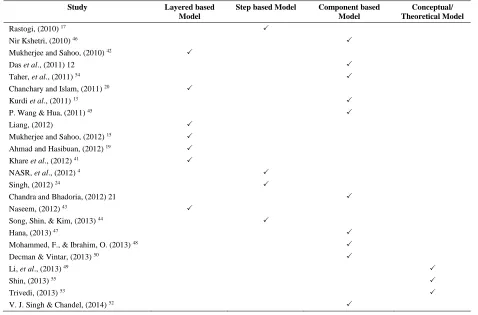
Analyzing the reviewed studies shows that cloud government models can be classified into several types. To identify these types, two points were considered. The first point is the keywords used to describe each model. The second one is the purpose of model. Four main types can be identified; layered, step-based, component-based and conceptual/theoretical models. Table 3 shows the reviewed studies with corresponding model type.
Table 3 Types of models proposed in the reviewed studies
Study Layered based
Model
Step based Model Component based
Model
Conceptual/ Theoretical Model
Rastogi, (2010) 17
Nir Kshetri, (2010) 46
Mukherjee and Sahoo, (2010) 42
Das et al., (2011) 12
Taher, et al., (2011) 54
Chanchary and Islam, (2011) 20
Kurdi et al., (2011) 13
P. Wang & Hua, (2011) 45
Liang, (2012)
Mukherjee and Sahoo, (2012) 15
Ahmad and Hasibuan, (2012) 19
Khare et al., (2012) 41
NASR, et al., (2012) 4
Singh, (2012) 24
Chandra and Bhadoria, (2012) 21
Naseem, (2012) 43
Song, Shin, & Kim, (2013) 44
Hana, (2013) 47
Mohammed, F., & Ibrahim, O. (2013) 48
Decman & Vintar, (2013) 50
Li, et al., (2013) 49
Shin, (2013) 55
Trivedi, (2013) 53
V. J. Singh & Chandel, (2014) 52
Chanchary and Islam, (2011) 20 , Mukherjee and Sahoo, (2010) 42, Liang, (2012), Ahmad and Hasibuan, (2012)19 , Khare et al.,
(2012)41, Mukherjee and Sahoo, (2012)15 and Naseem, (2012)43
proposed layered base models. These models either totally built on cloud computing architecture service model, or kept the traditional architecture of e-government by introducing cloud computing in
some manner. These models mainly concentrate on examining how e-government can benefit from cloud computing advantages, but did not give adequate attention to the challenges.
On the other hand, Rastogi, (2010) 17 , NASR, et al., (2012)4,
Singh, (2012) 24 , and Song, Shin, & Kim, (2013) 44 suggested step
e-government system or migrate e-e-government services to the cloud. These models were mainly limited to identifying the process by which the existing systems migrate to the cloud by introducing a model based on the prototyping model of the software engineering, or integrating new steps with any of the existing e-government development models.
Das et al., (2011) 12 , Kurdi et al., (2011) 13 , Chandra and
Bhadoria, (2012) 21 , P. Wang & Hua, (2011) 45 , Nir Kshetri, (2010) 46 , Hana, (2013) 47 , Decman & Vintar, (2013) 50 , Taher, et al.,
(2011) 54,Mohammed, F., & Ibrahim, O. (2013) 48 , and V. J. Singh
& Chandel, (2014) 52 presented component based models. Proposed
component models are static models that integrate the e-government components with cloud computing to show the potential benefits of cloud computing.
Finally, Li, et al., (2013) 49 , Shin, (2013) 55 , and Trivedi,
(2013) 53 , developed conceptual/theoretical models. These models
identify the influencing factors on cloud computing adoption in e-government context.
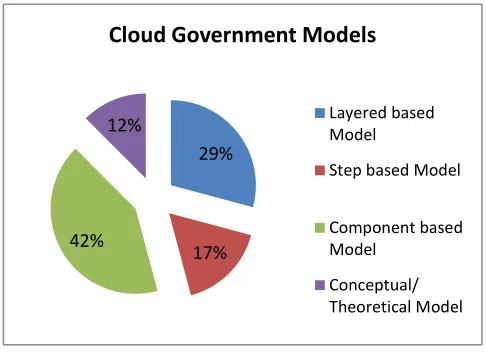
Figure 1 Cloud Government Model’s Types
The statistical analysis (Figure 1) shows that most of the proposed models in the reviewed literature are component models with 42% of the reviewed studies. The number of studies that suggested a layered based model is also relatively large, seven studies which represents 29% of the total reviewed studies. On the other hand, there are few studies suggested a step based model (17%). There is a lack of theoretical models that empirically investigate the influencing factors on applying cloud computing in the e-government context. Figure 1 shows that only 12% (3 studies) of the reviewed studies proposed conceptual/theoretical models.
6.0 CONCLUSION
The unique characteristics of cloud computing motivated many researchers to propose and discuss the benefits and challenges of introducing this technology to e-government environment. Other researchers proposed framework/model for adopting cloud computing in e-government services development. However, most of these models are proposed models and researchers did not conduct any empirical study. Further, most of the proposed models (component based, layer based and step based) considered the process of integrating cloud computing for e-government systems implementation. However, as a new technology, to successfully
adopting cloud computing to implement e-government services, investigating the influencing factors is critical. Thus, to help government agencies to make the decision to adopt cloud computing for their operations and service provision, more theoretical models and empirical investigations are recommended.
Reference
[1] Mariuchi, Y., 2001. E-government. Global Business Dialogue on
Electronic Commerce, 41-49.
[2] Alshomrani, S., & Qamar, S., 2013. Cloud Based E-Government: Benefits and Challenges. International Journal of Multidisciplinary Sciences and Engineering, 4(6), 1-7.
[3] Bansal, K. L., Sharma, S. K., & Sood, S., 2012. Impact of Cloud Computing in Implementing Cost Effective E-governance Operations.
GIAN JYOTI E-JOURNAL, 1(2).
[4] NASR, O., Ali, A., & Galal-Edeen, G. H., 2012. Proposed Development
Model Of E-Government To Appropriate Cloud Computing. International
Journal of Reviews in Computing, 9.
[5] Tripathi, A., & Parihar, B., 2011. E-governance challenges and cloud benefits. Paper presented at the Computer Science and Automation Engineering (CSAE), 2011 IEEE International Conference on.
[6] Stevens, H., & Pettey, C., 2008. Gartner says cloud computing will be as influential as e-business. Gartner Newsroom, Online Ed.
[7] Sharma, M., & Thapliyal, M., 2011. G-Cloud–(e-Governance in Cloud).
International Journal Engg. TechSci, 2(2), 134-137.
[8] ATSE. , 2010. Cloud Computing: Opportunities and Challenges for
Australia, report of a study by the Australian academy of Technological sciences and engineering (ATSE).
[9] Bhardwaj, S., Jain, L., & Jain, S., 2010. Cloud computing: A study of infrastructure as a service (IAAS). International Journal of engineering and information Technology, 2(1), 60-63.
[10] Chandrasekaran, A., & Kapoor, M., 2011. State of Cloud Computing in the Public Sector–A Strategic analysis of the business case and overview of initiatives across Asia Pacific. Frost & Sullivan.
[11] Craig, R., Frazier, J., Jacknis, N., Murphy, S., Purcell, C., Spencer, P., et al., 2009. Cloud Computing in the Public Sector: Public Manager’s Guide
to Evaluating and Adopting Cloud Computing. White Paper. Cisco
Internet Business Solutions Group.
[12] Das, R. K., Patnaik, S., & Misro, A. K., 2011. Adoption of cloud
computing in e-governance Advanced Computing (pp. 161-172): Springer.
[13] Kurdi, R., Taleb-Bendiab, A., Randles, M., & Taylor, M., 2011. E-Government Information Systems and Cloud Computing (Readiness and Analysis).Paper presented at the Developments in E-systems Engineering (DeSE), 2011.
[14] Liang, J., 2012. Government cloud: enhancing efficiency of e-government
and providing better public services. Paper presented atthe Service sciences (IJCSS), 2012 international joint conference on.
[15] Mukherjee, K., & Sahoo, G., 2012. A novel methodology for security and privacy of cloud computing and its use in e-Governance.Paper presented
at theInformation and Communication Technologies (WICT), 2012 World
Congress on.
[16] Paquette, S., Jaeger, P. T., & Wilson, S. C., 2010. Identifying the security
risks associated with governmental use of cloud computing. Government
Information Quarterly, 27(3), 245-253.
[17] Rastogi, A., 2010. A model based approach to implement cloud computing
in e-Governance. International Journal of Computer Applications, 9(7), 15-18.
[18] Yeh, C., Zhou, Y., Yu, H., & Wang, H., 2010. Analysis of E-government service platform based on cloud computing. Paper presented at the Information Science and Engineering (ICISE), 2010 2nd International Conference on.
[19] Ahmad, M., & Hasibuan, Z. A., 2012. Government services integration based on cloud technology.Paper presented at the Proceedings of the 14th International Conference on Information Integration and Web-based Applications & Services.
[20] Chanchary, F., & Islam, S., 2011. E-government based on cloud computing with rational inference agent. Paper presented at the High Capacity Optical Networks and Enabling Technologies (HONET), 2011. [21] Chandra, D. G., & Bhadoria, R. S., 2012. Cloud Computing Model for
National E-governance Plan (NeGP). Paper presented at the
Computational Intelligence and Communication Networks (CICN), 2012 Fourth International Conference on.
29%
17% 42%
12%
Cloud Government Models
Layered based Model
Step based Model
Component based Model
[22] Khan, F., Zhang, B., Khan, S., & Chen, S., 2011. Technological leap
frogging e-government through cloud computing.Paper presented at the
Broadband Network and Multimedia Technology (IC-BNMT), 2011 4th IEEE International Conference on.
[23] Prasad, A., Chaurasia, S., Singh, A., & Gour, D., 2010. Mapping cloud computing onto useful e-governance. arXiv preprint arXiv:1009.2314.
[24] Singh, H., 2012. Technology Transfer Model To Migrate E-Governance
To Cloud Computing. International Journal of Advanced Technology & Engineering Research (IJATER), 2(4), 6.
[25] Smitha, K., Thomas, T., & Chitharanjan, K., 2012. Cloud based
e-governance system: A survey. Procedia Engineering, 38, 3816-3823.
[26] Tsaravas, C., & Themistocleous, M., 2011. Cloud computing and Egovernment: a literature review. Paper presented at the European, Mediterranean & Middle Eastern Conference on Information Systems. [27] Vats, K., Sharma, S., & Rathee, A., 2012. A review of cloud computing
and e-governance. International journal of Advanced Research in
Computer science and Software engineering, 2(2).
[28] Foster, I., Zhao, Y., Raicu, I., & Lu, S., 2008. Cloud computing and grid
computing 360-degree compared. Paper presented at the Grid Computing
Environments Workshop, 2008. GCE'08.
[29] Pokharel, M., & Park, J. S., 2009. Cloud computing: future solution for e-governance.Paper presented at the Proceedings of the 3rd international conference on Theory and practice of electronic governance.
[30] Mell, P., & Grance, T., 2011. The NIST definition of cloud computing (draft). NIST special publication, 800(145), 7.
[31] Wang, L., Tao, J., Kunze, M., Castellanos, A. C., Kramer, D., & Karl, W., 2008. Scientific Cloud Computing: Early Definition and Experience.
Paper presented at the HPCC.
[32] Zhang, S., Zhang, S., Chen, X., & Huo, X., 2010. Cloud computing research and development trend.Paper presented at the Future Networks, 2010. ICFN'10. Second International Conference on.
[33] Jadeja, Y., & Modi, K., 2012. Cloud computing-concepts, architecture and challenges.Paper presented at the Computing, Electronics and Electrical Technologies (ICCEET), 2012 International Conference on.
[34] Sharma, R., Sharma, A., & Singh, R. R., 2012. E-Governance & Cloud
Computing: Technology Oriented Government Policies. IJRIM 2(2).
[35] Bellamy, M., 2013. Adoption of Cloud Computing Services by Public
Sector Organisations.Paper presented at the Services (SERVICES), 203
IEEE Ninth World Congress on.
[36] Bhisikar, A., 2011. G-Cloud: New Paradigm Shift for Online Public Services. International Journal of Computer Applications, 22(8), 24-29. [37] Kundra, V., 2010. State of public sector cloud computing. Washington,
DC.
[38] Zwattendorfer, B., & Tauber, A., 2013. The public cloud for
e-government. International Journal of Distributed Systems and
Technologies (IJDST), 4(4), 1-14.
[39] Rashmi Sharma, A. S. a. D. U. S. P., 2011. E-Governance: A Successful
Implementation of Government Policies using Cloud Computing. . IJCA
Proceedings on International Conference on Web Services Computing
(ICWSC) ICWSC(1):27-29, November 2011.
[40] Sahu, B. L., & Tiwari, R,. 2012. A comprehensive study on Cloud computing. International journal of Advanced Research in Computer science and Software engineering, 2(9).
[41] Khare, A. B., Raghav, V., & Sharma, P., 2012. Cloud computing based rural e-governance model. Amrapali Institute, Haldwani, Birla Institute of
Technology, Kingdom of Bahrain.
[42] Mukherjee, K., & Sahoo, G., 2010. Cloud Computing: Future Framework
for e-Governance. International Journal of Computer Applications, 7(7), 31-34.
[43] Naseem, S., 2012. Cloud Computing and E-Governance. International
Journal of Scientific & Engineering Research, 3(8), 1-6.
[44] Song, S.-h., Shin, S. Y., & Kim, J.-y., 2013. A Study on method deploying efficient Cloud Service Framework in the Public Sector. Paper presented at the Advanced Communication Technology (ICACT), 2013 15th International Conference on.
[45] Wang, P., & Hua, H., 2011. A model of government information
value-added exploitation based on cloud computing.Paper presented at the Business Management and Electronic Information (BMEI), 2011 International Conference on.
[46] Kshetri, N., 2011. Cloud Computing in the Global South: drivers, effects and policy measures. Third World Quarterly, 32(6), 997-1014.
[47] Hana, M. A., 2013. E-government cloud computing proposed model:
Egyptian E_Government Cloud Computing. Paper presented at the
Advances in Computing, Communications and Informatics (ICACCI), 2013 International Conference on.
[48] Mohammed, F., & Ibrahim, O., 2013. Refining E-government Readiness
Index by Cloud Computing. Jurnal Teknologi, 65(1).
[49] Li, G., Zhang, Q. P., Wang, W., & Feng, Z. Q., 2013. Analysis on Influence
Factors of Implementing E-Government Public Cloud. Applied Mechanics
and Materials, 411, 2157-2160.
[50] Decman, M., & Vintar, M., 2013. A possible solution for digital preservation of e-government: A centralised repository within a cloud computing framework.Paper presented at the AslibProceedings. [51] Thibodeau, K., 2002. Overview of technological approaches to digital
preservation and challenges in coming years. The state of digital preservation: an international perspective, 4-31.
[52] Singh, V. J., & Chandel, A., 2014. Evolving E-Governance through Cloud
Computing based environment. computing, 3(4).
[53] Trivedi, H., 2013. Cloud computing adoption model for governments and
large enterprises.Massachusetts Institute of Technology.
[54] Taher, Y., Haque, R., Nquyen, D. K., & Van den Heuvel, W.-J., 2011. Designing and delivering public services on the cloud.