ON BEHAVIORAL INTENTION TO USE INTERNET BANKING SYSTEM
BESTOON ABDULMAGED OTHMAN
A thesis submitted in fulfillment of the
requirements for the award of the degree of
Master of Science (Management-Technology)
Faculty of Management
Universiti Teknologi Malaysia
In the name of Allah, the Most Beneficent, the Most Merciful. All praise and thanks to Allah, lord of the universe and all that exists. Prayers and peace be upon His prophet Mohammad, the last messenger of all humankind.
First I would like to express my sincere gratitude and thanks to Almighty ALLAH. I am deeply thankful to my parents for their continuous support and love throughout my study.
CHAPTER TITLE PAGE
DECLARATION ii
DEDICATION iii
ACKNOWLEDGEMENTS iv
ABSTRACT v
ABSTRAK vi
TABLE OF CONTENTS vii
LIST OF TABLE xi
LIST OF FIGURE xii
LIST OF ABBREVIATIONS xiii
LIST OF APPENDIX xiv
1 INTRODUCTION
1.0 Introduction 1
1.1 Research Background 5
1.2 Statement of problem 7
1.3 Objectives of the Study 10
1.4 Research questions 10
1.5 Scope of the Study 11
1.6 Structure of the Study 11
2.0 Introduction 14
2.1 Internet Banking System: Definition 15
2.1.1 Definition of User Acceptance 16
2.2 Internet Banking Acceptance in the Developed Countries 17 2.3 Internet Banking Acceptance in the Developing Countries 20
2.3.1 Internet Banking Acceptance in Malaysia “Developing Country”
23
2.4 Information System Acceptance Model 24
2.4.1 Theory of Reasoned Action Model (TRA) 24
2.4.2Theory of Planned Bahaviour Model (TPB) 25
2.4.3 Model of Personal Computer Utilisation (MPCU) 26
2.4.4 Motivational Model (MM) 27
2.4.5 Social Cognitive Theory (SCT) 28
2.4.6 Innovation Diffusion Theory (IDT) 29
2.4.7 Technology Acceptance Model (TAM) 30
2.5 Limitations of the Seven Previously Established Models 34 2.6 Behavioral Intention to Use Internet Banking System 36 2.7 Attitude towards Using Internet Banking System 37
2.8 Research Gaps in Internet Banking Literature 38
2.9 Conclusion 40
3 RESEARCH METHODOLOGY
3.0 Introduction 41
3.1 Research Model 42
3.2 Research Design 43
3.3 Hypotheses 44
3.3.1 Hypotheses testing and Descriptive Analysis 44
3.5.1 Secondary Data 49
3.5.2 Primary Data 49
3.6 Data Collection Method 51
3.7 Research Instrument 51
3.7.1 Instruments Test 53
3.7.1.1 Reliability Test 53
3.7.1.2 Validity Test 54
3.8 Data Processing 54
3.9 Statistic and Data Analysis 55
3.9.1 Factor Analysis 55
3.9.2 Descriptive Analysis 55
3.10 Correlation Analysis 56
3.11 Regression Analysis 56
3.12 Conclusion 57
4 DATA ANALYSIS
4.0 Introduction 59
4.1 The Profiles of Survey Respondents 61
4.2 Respondent’s Response of Technology Acceptance In Internet Banking
65
4.3 Respondent’s Response of Consumer Behavior Intention 68
4.4 Missing Data, Normality and Outliers 69
4.5 Factor Analysis 72
4.6 Reliability Analysis 75
4.7 Validity Analysis 76
4.8 Correlations analysis 77
4.9 Hypotheses testing 79
4.10 Model analysis 82
REFERENCES 93
APPENDIX 125
5.0 Introduction 85
5.1 Finding 85
5.2 Research implication 87
5.3 Contribution to Knowledge 89
5.4 Limitation 90
5.5 Future Research 91
TABLE NO TITLE PAGE
1.1 Internet Banking Service in Malaysia 3
1.2 Chronological summary of Significant Factors Affecting Internet Banking Acceptance and various researchers from 2000- 2012
13
2.1 Internet Banking Acceptance in European Countries 18 2.2 Summary of Established Models and Theories of Technology
Acceptance
33
3.1 Determining Sample Size 45
3.2 Past researchers and applied questionnaires for data extraction 47 3.3
3.4
Likert Scale for section B Research instrument
50 52
4.1 Questionnaire Response Rate 60
4.2 Profiles of respondents (n = 375) 62
4.3 How long the respondents banking with CIMB 64
4.4 Customers’ Rating on CIMB bank service 64
4.5.1 Respondent’s Response of perceived usefulness(n=375) 65 4.5.2 Respondent’s Response of perceived ease of use (n=375) 66 4.5.3 Respondent’s Response of perceived credibility (n=375) 67 4.6 Respondent’s Response of Consumer Behavior Intention(n=375) 68 4.7
4.8
Skewness and Kurtosis Total Variance Explained
71 73
4.9 KMO and Component Matrix 73
4.10 Items Dropped 73
4.11 Component Matrix 74
4.12 Reliability Test 76
4.13 Correlations analysis 78
4.14 Model Summary for Multiple Regressions 80
4.15 ANOVA 80
4.16 Regression coefficient 80
FIGURE NO TITLE PAGE
2.1 Diffusion of Innovation Model 30
2.2 Modified Technology Acceptance Model 31
3.1 Proposed Research framework 42
3.2 Research Design 43
4.1 Monthly Salary (Us-$) of Respondents 63
4.2 Histogram Regression Standardize Residual 69
4.3 Normal P-P plots 70
4.4 Scatter plot of Regression 72
BAFIA Banking and Financial Institution Act May Bank Malaysian Bank Berhad
HLB Hong Leong Bank
RHB Rashid Hussain Bank Berhad
M Am Bank Berhad
BNM Bank Negara Malaysia
TAM Technology Acceptance Model IDT Innovation Diffusion Theory
BAI-BCG Bank Administration Institute-The Boston Consulting Group PEU Perceived Ease of Use
PU Perceived Usefulness PU Perceive Credibility
ICT Information Communication Technology
WWW World Wide Web
BI Behavioral Intention UAE United Arab Emirates TRA Theory of Reasoned Action TPB Theory of Planned Behaviour
MPCU Model of Personal Computer Utilisation
MM Motivational Model
SCT Social Cognitive Theory IDT Diffusion of Innovation Model
IS Information System
ATM Automated Teller Machines UTM University Technology Malaysia CIMB Commerce Investment Merchant Bank EFA Exploratory Factor Analysis
IBT Internet Banking Technology
APPENDIX TITLE PAGE
CHAPTER 1
INTRODUCTION
1.0 Introduction
Internet banking is considered as an online banking revolution of the traditional banking services which offers customers the greatest usefulness to perform banking transactions through the Internet (Furst et al., 2002; Ratnasingam, Gefen, & Pavlou, 2005; Yakhlef, 2001; Yuen, 2010). Most of the banks, especially the large banks and mutual banks, have slowly increased their number of Internet banking services available to target customers over the past several decades (Ratnasingam et al., 2005; Rayport & Sviokla, 1994; Yuen, 2010). The most prevalent Internet banking services are viewing balances and transactions, fund transfers and payment of bills (Giordani, Floros, & Judge, 2009). Other Internet banking services such as statement aggregation have also gained a growing popularity (Yang, Whitefield, & Bhanot, 2005; Yuen, 2010).
local branches and complain to the manager face-to-face. Instead, they have to contact representatives of the virtual bank (Furst et al., 2002; Yuen, 2010).
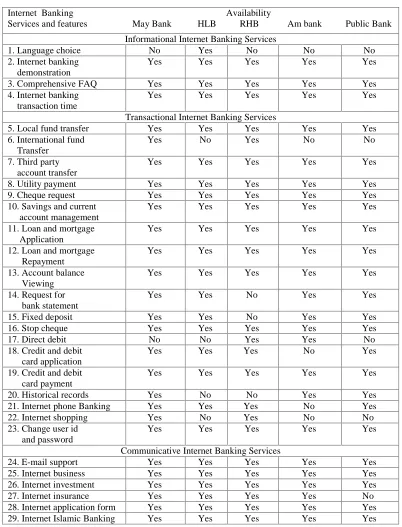
The practices of internet banking in Malaysia that allowed Malaysian banks to establish Internet banking services starting 1st June 2000 (Hamid et al., 2007). Banking and Financial Institution Act 1989 (BAFIA) and Islamic Banking Act 1983 allowed licensed banks to offer Internet banking services in Malaysia (Hamid et al., 2007). To date, there are 13 bank institutions in Malaysia offering Internet banking
services (Hamid et al., 2007).
Table 1.1 Internet banking services in Malaysia
Internet Banking Availability
Services and features May Bank HLB RHB Am bank Public Bank Informational Internet Banking Services
1. Language choice No Yes No No No
2. Internet banking demonstration
Yes Yes Yes Yes Yes
3. Comprehensive FAQ Yes Yes Yes Yes Yes
4. Internet banking transaction time
Yes Yes Yes Yes Yes
Transactional Internet Banking Services
5. Local fund transfer Yes Yes Yes Yes Yes
6. International fund Transfer
Yes No Yes No No
7. Third party account transfer
Yes Yes Yes Yes Yes
8. Utility payment Yes Yes Yes Yes Yes
9. Cheque request Yes Yes Yes Yes Yes
10. Savings and current account management
Yes Yes Yes Yes Yes
11. Loan and mortgage Application
Yes Yes Yes Yes Yes
12. Loan and mortgage Repayment
Yes Yes Yes Yes Yes
13. Account balance Viewing
Yes Yes Yes Yes Yes
14. Request for bank statement
Yes Yes No Yes Yes
15. Fixed deposit Yes Yes No Yes Yes
16. Stop cheque Yes Yes Yes Yes Yes
17. Direct debit No No Yes Yes No
18. Credit and debit card application
Yes Yes Yes No Yes
19. Credit and debit card payment
Yes Yes Yes Yes Yes
20. Historical records Yes No No Yes Yes
21. Internet phone Banking Yes Yes Yes No Yes
22. Internet shopping Yes No Yes No No
23. Change user id and password
Yes Yes Yes Yes Yes
Communicative Internet Banking Services
24. E-mail support Yes Yes Yes Yes Yes
25. Internet business Yes Yes Yes Yes Yes
26. Internet investment Yes Yes Yes Yes Yes
27. Internet insurance Yes Yes Yes Yes No
28. Internet application form Yes Yes Yes Yes Yes
29. Internet Islamic Banking Yes Yes Yes Yes Yes
Notes: *yes–service is available ** - service is not available
Although most Malaysian bank might intent to use information technology on internet banking to obtain strategic advantages, Clemons (1986); Khairul (1999) assert that achieving or sustaining technology advantages is difficult. Once customers accept one of form internet banking information technology, other banks are quickly to follow the technology acceptance. It appears that information technology in internet banking system enable system quickly become survival issue if banks not keeping up with the technology innovation (Khairul,1999). The new internet banking technologies were introduced was not easy for people to accept until they feel too secure about its use. It needs special step by step process to make the new technology able to be accepted by people.
Technology acceptance model (TAM) on internet banking system proposes that perceived ease of use and perceived usefulness of technology are predictors of user attitude towards using the technology, subsequent behavioral intentions and actual usage. Perceived ease of use was also considered to influence perceived usefulness of technology. In TAM, perceived usefulness refers to the degree to which the user believes that using the technology will improve his or her work performance, while perceived ease of use refers to how effortless he or she perceives using the technology will be. Both are considered distinct factors influencing the user’s attitude towards using the technology, though perceived ease of use is also hypothesized to influence perceived usefulness and attitude towards using the technology (A. Sanayei & A. Ansari, 2010).
specifically was meant to provide an explanation, prediction, and identification of the determinants of computer acceptance or explanation of why a particular system was unacceptable (Davis, Bagozzi, & Warshaw, 1989). It provides theoretical linkages among users’ internal beliefs, attitudes, intention, and usage behavior, to determine how individuals accept or reject a new technology (Davis, 1989; Yanika, 2000)). This study focus on technology acceptance model (TAM) on internet banking system and its relationship to banking customer behavioral intention to use internet banking system. TAM in this study focus on perceived usefulness, perceive ease of use and perceived credibility (Venkatesh & Davis, 1996).
1.1 Research Background
Technology in Internet banking system has been conducted to computerize essential bank process since 1960s (Eriksson, Kerem, & Nilsson, 2005; Yuen, 2010). Internet banking technology is started by Security First Network Bank in the United States in 1995 (Gandy, 1995; Liao, Shao, Wang & Chen, 1999). One year later, it is introduced in Estonia (Eriksson et al., 2005) and South Africa (Singh, 2004), followed by Australia in 1997 (Sathye, 1999), Turkey in 1997 (Polatoglu & Ekin, 2001), Singapore in 1997 (Gerrard & Cunningham, 2003), China in 1997 (Laforet & Li, 2005), England in 1998 (White & Nteli, 2004), Hong Kong in 1999 (Wan, Luk, & Chow, 2005), Romania in 1999 (Gurau, 2002), Thailand in 1999 (Jaruwachirathanakul & Fink, 2005) and Malaysia in 2000 (Bank Negara Malaysia, 2009). Enhanced technology is deployed to enable the banking industry to offer their
services via the Internet (Yuen, 2010).
(Evans & Wurster, 1997; Yuen, 2010). Internet banking is particularly well-practiced in the developed countries such as Korea, Spain, and Austria, where more than 75 percent of all banks offer transactional services via the Internet (Maenpaa, 2006). The development of the Internet banking as a service and marketing channel has breached the geographical and industrial barriers, creating new products, services
and market opportunities (Liao & Cheung, 2002; Yuen, 2010).
Technology in Internet banking is used to help banks deliver services and products better, faster, and cheaper compared to traditional bank services. Internet banking system enables target customers to look around essential bank products and services through their personal computers (Polatoglu & Ekin, 2001) thus allows target consumers to perform banking transactions over the Internet anywhere and anytime (Polatoglu & Ekin, 2001, Yuen, 2010). There are three basic types of Internet banking services, the informational, communicative and transactional Internet banking services (Bank Indonesia, 2004; Reserve Bank of India, 2007; Yuen, 2010).
Finally, the global acceptance of TAM as a result of the presence of basic infrastructural facilities, education autonomous, establishment of various research institutes, improved economic standard, increase awareness, positive attitudinal behaviour to international students in Malaysia orchestrated the research impetus. The choice of respondent for this study is borne out of the passion for the influx of the international students to Malaysia and their survival in term of banking transaction as they depends primarily on money transfer through internet banking system from their various countries for their sustenance. However, the effectiveness of internet banking from their respective countries is not in the scope of this study but their behavioural intent of using internet banking system at their destination (Malaysia). The lopsidedness in internet banking system usually in the third World Countries have proven to have negative influence on the intention to use therefore the premise of this study will substantiate the veracity of behavioural intention to use
1.2 Statement of problem
The study of information technology acceptance in internet banking system within the context of developing countries, such as Malaysia, is even more scarce. Almost all studies on internet banking technology acceptance were conducted in developed countries, such as Australia ( Arthur, 1989; Marr & Prendergast, 1990; Prendergast & Marr, 1994), Europe (Child & Loveridge, 1990; Preece, 1995), and the US (Bank Administration Institute-The Boston Consulting Group (BAI-BCG), 1995; Hannan & McDowell, (1984); Morone & Berg (1993), therefore, Malaysia and other Asian countries should abridge this dichotomy judging from their heavy spending on information technology (Leung & Johnson, 1996). Malaysian banks have spent a lot of resources on information technology, especially since 1991 (BNM, 1995). Although BNM (1995) has pointed out that most of these spending were on automated retail banking operation, little is known about what triggered
this bank’s decision to adopt information technology (Leung & Johnson, 1996).
Technology acceptance, defined as the extent to which an individual believes that utilizing a specific system will enhance job performance (Davis, 1989).
Because our lives today are governed to a large extent by complex technologies creation and comprehension of circumstances that facilitate individual’s embracing information technology continues to be an issue of high priority (Venkatesh & Davis, 2000; Bandura, 2002). In an era that is highly dependent on technology, many organizations are turning to virtual interface as either the principal or even the sole point of customer contact (Balasubramanian, Konana & Menon, 2003). The banking industry has been equally affected by the significant impact technology has made on service delivery (Durkin, 2004). It is no surprise then that technology revolutionized this industry (Moutinho & meidan, 1989), and this impact will continue to increase over the next decade (Durkin, 2004).
traditional branch banking to e-banking system with its challenges, opportunities and the impact on service delivery (Souranta, Mattilla, & Munnukka, 2005). Further to this point, the advent of the Internet served to further propel the banking industry into the arena of virtual interactions, making a significant impact on service provision (Hirtle & Metli, 2004).
Technology acceptance model (TAM) has been customized to model an internet banking acceptance of technology. The main purpose of TAM is to; a) explicate the factors that determine computer acceptance in a manner that is general, b) explain behavior across a wide array of end users computing technologies and user populations (Chan & Lu, 2004), and c) retain its meanness while warranting theoretical justification (Davis, et al., 1989). The theoretical framework of TAM has been utilized extensively as a predictor of user acceptance, based on an individual’s determination of perceived usefulness (PU), perceived ease of use (PEU) and perceive credibility (PC) of a specific technology (Adams, Nelson, & Todd, 1992). TAM encompasses participative or situational, as well as intrinsic features of involvement with an IT system (Jackson, et al. 1997).
According to Moorman, Zaltman & Deshpande, (1992); Shumaila et., (2009) perceived credibility refers to user keenness to rely on internet banking service provider by taking into consideration the bank’s reliability. However, this study defines perceived credibility as the bank user trust in providing sensitive information while using technology in internet banking service.
Davis (1989) introduced and established the soundness of a new scale to measure the constructs of perceived usefulness (PU) and perceive ease of use (PEU). PU refers to an individual’s belief that use of a particular technology leads to enhanced performance, whereas PEU is the belief that use of a determined technology will be effortless (Davis, et al., 1989). According to Wang (2003) TAM suggests three beliefs, which consist of perceived usefulness, perceived ease of use and the perceived credibility. To the extent that one technology is easier to use than another, it will probably be more accepted by users (Davis, 1989).
The extent to which a user believes a particular technology will be an enhancement to his or her task is defined as perceived usefulness (PU) (Venkatesh, 2000), and is based on the users’ subjective perceptions. Perceived Ease of use determines the extent to which a person perceives use of a technology to be effortless. PU, PEU and PC are considered antecedents to TAM. These two variables play an important role in an individual’s decision to adopt technology (Plouffe, Hulland, & Vandenbosch, 2001). This study focus on perceive usefulness (PU), perceive ease of use (PEU) and perceive credibility (PC).
Since Davis’s (1989) development of TAM, numerous researchers have extended the model to examine World Wide Web (WWW) acceptance (Glassberg, 2002); users’perception of resources (Mathieson, Peacock, & Chin, 2001); effect of computer attitude and self-efficacy on actual use (Chau & Hu, 2001); single and multifunction technologies (Taylor & Todd, 1995); users’ perception of resources (Szajna, 1996); computer playfulness (Moon & Kim, 2001); cognitive absorption (Agarwal & Karahana, 2000); and perceived enjoyment and product development (Koufaris, 2002).
internet banking system findings from developed countries are not directly transferable to developing countries (Dewan and Kraemer, 2000; Duncombe and Molla, 2006) and that differences in country-contexts can lead to different ICT use and impact patterns (Clarke, 2007).
1.3 Objectives of the Study
The main objectives of this study is to examine the impact of internet banking technology acceptance on behavioral intention to use internet banking
system. In more detail, the objectives of this research are as follow:
(a) To examine impact of perceived usefulness of internet banking technology on behavioral intention.
(b) To evaluate the impact of Perceived ease to use internet banking technology on behavioral intention.
(c) To investigate the impact of perceived credibility of internet banking technology on behavioral intention.
1.4 Research questions
(Q1) Is there any impact of perceived usefulness of internet banking technology on behavioral intention to use internet banking system?
(Q2) Is there any positive impact of Perceived ease to use internet banking technology on behavioral intention to use internet banking system?
(Q3) Is there any impact of perceived credibility of internet banking
1.5 Scope of the Study
This research focuses on internet banking technology acceptance and behavioral intention to use internet banking system in Malaysian banking industry, especially on CIM Bank in UTM Skudai Johor Bahru. The objective of this study focused on perceived usefulness (PU), perceived ease of use (PEU) and perceived credibility (PC) of technology acceptance as independent variables and behavioral
intention (BI) to use internet banking system as dependent variable.
1.6 Structure of the Study
This proposal consists of frive chapters. The first chapter introduced the background of study, research problems, and objectives, significance of the study, scope of the study and limitation of the study. Chapter 2 reviews related literature, Chapter 3 presents the conceptual framework and method adopted in collecting data for the study while chapter 4 deals extentively with data analysis, data stratification and interpretation, finally, chapter 5 comprises of detail summary of findings based on result of each hypotheses, research implication contribution to knowledge, research limitation, future research and conclusion.
1.7 Significance of the Study
Technology acceptance in Internet banking system is considered as one of efficient marketing channels that allows banks to extend their customer base, is of no use for banks to invest in technology in Internet banking if the technology are not accepted by their target customers (Bhattacherjee, Perols, & Sanford, 2008; Jih, 2002; Yuen, 2010). Consequently, it is important for banks to understand the important factors that lead to the acceptance of technology in Internet banking services. This would help banks to maximise return on their investments and
Most studies on technology acceptance on internet banking system focused narrowly on the positive aspects of Internet banking services. For example, AbuShanab and Pearson (2007), Eriksson et al. (2005), Polatoglu and Ekin (2001), Um rani and Ghadially (2008) and Yazan (2008) focused on the effects of trust, relative advantage and attitude toward using Internet banking services. Other studies mainly concentrated on the influence of perceived security on Internet banking acceptance (Bandyopadhyay, 2009; Dauda & Santhaparraj, 2008; Khalil & Pearson, 2007). Literature such as Gerrard and Cunningham (2003) and Saythe (1999) did not test the validity and reliability of constructs. Sathye (1999) stated that 70 percent of customers were concerned about the security of using Internet banking services and Gerrard and Cunningham (2003) identified economic benefits of Internet banking acceptance without providing further statistical analysis to confirm the reliability and validity of the collected data. In this research study, therefore, the examination of the influence of TAM on behavioural intention ton use internet banking system were
carried out. Please refer to Chapter 2 (Section 2.8) of this thesis for further details.
Most of Internet banking studies focused on specific countries such as Australia (Lichtenstein & Williamson, 2006; Sathye, 1999; Yeow, Yuen, Tong, & Lim, 2008), Malaysia (Dauda & Santhapparaj, 2007; Yeow & Yuen, 2008; Yuen, 2010) Singapore (Gerrard & Cunningham, 2002; Liao & Cheung, 2002), Finland
(Pikkarainen, Pikkarainen, Karjaluoto, & Pahnila, 2004) and Taiwan (Jih, 2002).
Table 1.2 Chronological summary of Significant Factors Affecting Internet Banking Acceptance and various researchers from 2000- 2012
N Significant Factors Literature
1* Customer Behavioral Intention to Use Internet Banking
Davis, 1989; Black et al., 2001; Karjaluoto et al., 2002; Shih & Fang, 2004; Khalil & Pearson, 2007; Mohezar et al., 2007; Dinev
Alsajjan, B. et al 2010. et al., 2009; Zolait et al.,2009.
2* Perceived Usefulness Schunk, 2000; Lim, 2001; Eastin, 2002; Wang et al.,2003; Chan and Lu, 2004; Ndubisi, 2005; Martinez,2006;Dinev et al., 2009. 3* Perceived Ease
of Use
Compeau & Higgins,1995; Mols, 1998; Bernstel, 2000; So &
Speece, 2000; Conditions Bhattacherjee, 2001; Jun & Cai, 2001;
Ribbink et al., 2001; Srijumpa et al., 2002; Coner, 2003; Howcroft
& Durkin, 2003; Floh & Treiblmaier, 2006; Kholoud, 2007;
Salim& Breck, L 2009. Chai, C. S. et al 2010. Ahn,
Tatnall, 2008. J. et al., 2011.
4* Perceived Credibility 1999; Jones et Gefen & Silver, 1999; Greaves et al., 1999; Sathye, al., 2000; Reichheld & Schefter, 2000; Black et al., 2001; Bryant
& Colledge, 2002; Mukherjee & Nath, 2003; Floh & Treiblmaier,
2006; Khalil & Pearson, 2007; Bandyopadhyay, 2009; Goles et al.,
, M. S. et al.,2010. Featherman
2009; Shumaila et al., 2009. Kubiszewski, I. et al.,2011. 5 Performance
Expectancy
Huang, 2000; Kotler, 2000; Lederer et al. 2000;Venkatesh & Morris, 2000; McKenzie,2001; Ma‟ruf et al., 2002; Miles, 2002;
Gerrard & Cunningham, 2003; Hughes & Hughes, 2004;AlSukkar,
2005; Lassar et al., 2005; Lee et al., 2005; Karahanna et al., 2005;
Laforet & Li, 2005; Rotchanakitumnuai, 2005; Yang et
al., 2005;
Laukkanen ,2006; AbuShanab & Pearson, 2007; Kholoud, 2007;
Calisir & Gumussoy, 2008; Gounaris & Koritos, 2008;
. Curtis, L. et al.,2010. Chen, J. L 2011 Karjaluoto et al., 2009.
6 Anxiety Cody et al., 1999; Venkatesh & Morris, 2000; Durndell & Haag,2002; Chou, 2003; Barbiete & Weiss, 2004; Dauda &
Nagel, K.et al.,2008. al., 2007.
; Joiner et Santhaparraj, 2007
Samuel, M. O. et al.,2009. Bashir, U.,et al., 2010. Sowmya, K. R. et al 2011.
7 Social Influence Basu et al., 2002; Kamel & Hassan, 2003; AbuShanab& Pearson, 2007; Herington & Weaven, 2007; Hernandez & Mazzon, 2007;
Kholoud, 2007; Rugimbana,2007; Solomon, 2007; Kashier et al., 2009; Khan & Mahapatra, 2009; Yang et al., 2009. Tarde, G. 2010.
.,2011. Bond, R. M. et al.,2012. l
Lorenz, J. et a
8 Effort Expectancy Evans & King, 1999; Joseph et al., 1999; Hechinger 2001; Jun & Cai,2001; Mateos et al., 2001; Howcroft et al., 2002;Ma‟ruf et al., 2002; Ramayah et al., 2003; Wang et al.., 2003; AlSukkar, 2005; Ndubisi, 2005; Yang et al., 2005; Floh & Treiblmaier, 2006; Guriting & Ndubisi, 2006; Miranda et al., 2006; Wu et al., 2006; AbuShanab & Pearson, 2007; Chen & Barnes, 2007; Hernandez & Mazzon, 2007; Kholoud, 2007; Gounaris & Koritos, 2008; Yazan,
Wang, H. Y. et al.,2010. Im, I., 2008; Karjaluoto et al., 2009.
REFERENCES
` AbuShanab, E., and Pearson, J. M. (2007). Internet banking in Jordan: The unified theory of acceptance and use of technology (UTAUT) perspective. Journal of Systems and Information Technology, 9(1), 78-97.
AC Nielsen Australia. (2008). Online banking continues despite security concerns [Online].Available:http://www.acnielsen.com.au/news.asp?newsID=301 [2008, April 1].
AC Nielsen. (2008). The retail banking evolution: Battle of the banks hots up as smaller players take on the ‘big four’ [Online]. Available: http://au.nielsen.com/site/documents/RetailBankingReleaseJune30.pdf [2009, May 15].
Adams, d.a., nelson, r.r., & todd, p.a. (1992). Perceived usefulness, ease of use, and usage information. [electronic version]. Mis quarterly, 16(2), 227-248.
Adebowale, O. F., Adediwura, A. A., & Bada, T. A. (2008). Correlates of computer
attitude among secondary school students in Lagos State, Nigeria.Int. J.
Comput. Info. Commun. Technol. Res, 3(2), 20-30.
Adebowale, O.F, Adediwura, A. A., Bada, T. A. (2009). Correlates of computer attitude among secondary school students in Lagos State, Nigeria. International Journal of Computing and ICT Research, 3(2), 20 - 30.
Agarwal, R., and Prasad, J. (1998). A conceptual and operational definition of personal innovativeness in the domain of information technology. Information Systems. Research, 9(2), 204-301.
Ahn, J., Khandelwal, A. K., & Wei, S. J. (2011). The role of intermediaries in
facilitating trade. Journal of International Economics, 84(1), 73-85.
Aiken, L. S., West, S. G., & Pitts, S. C. (2003). Multiple linear regression.Handbook
of psychology.
Ajzen, I. (1991). The theory of planned behaviour. Organisational Behaviour and Human Decision Processes, 50(2), 197-211.
Ajzen, I. (2001). Nature and operation of attitudes. Annual Review of Psychology, 52(1), 27-58.
Ajzen, I., and Fishbein, M. (1980). Understanding attitudes and predicting social behaviour. Englewood Cliffs, NJ: Prentice-Hall.
Ajzen, I., and Madden, T. (1986). Prediction of goal-directed behaviour: Attitudes, intentions, and perceived behavioural control. Journal of Experimental Social Psychology, 22(1), 453-474.
Ajzen, I., Timko, C., and White, J. B. (1982). Selfmonitoring and the attitude -behaviour relation. Journal of Personality and Social Psychology, 42(3), 426-435.
Aladwani, A. M. (2001). Change management strategies for successful ERP
implementation. Business Process management journal, 7(3), 266-275.
Al-Gahtani, S. (2001). The applicability of TAM outside North America: an
empirical test in the United Kingdom. Information Resources Management
Journal (IRMJ), 14(3), 37-46.
Allen, M., Titsworth, S., and Hunt, S. K. (2008). Quantitative research in communication. Thousand Oaks, CA: Sage.
Alsajjan, B., & Dennis, C. (2010). Internet banking acceptance model: Cross-market
examination. Journal of Business Research, 63(9), 957-963.
AlSukkar, A. (2005). The application of information system in the Jordanian banking sector: A study of the acceptance of the Internet. Unpublished doctoral thesis, University of Wollongong, New South Wales, Australia.
Anderson, E. W., and Sullivan, A. W. (1993). The antecedents and consequences of customer satisfaction for firms. Marketing Science, 12(2), 125-143.
Angie, N. K.., and Chow, W. S. (2006). A study of trust in e-shopping before and after first-hand experience is gained. Journal of Computer Information Systems , 46(4), 125-130.
Aral, S., Brynjolfsson, E., and Van Alstyne, M. (2007). Productivity effects of information diffusion in networks. Paper presented at the Proceedings of the 28th Annual International Conference on Information Systems. December 10-12 (1-25., Montreal, CA.
Arjen. Boin, "’t Hart, P., Stern, E. and Sundelius, B.(2005)."The politics of crisis
management: Public leadership under pressure.
Armitage, P., Berry, G., & Matthews, J. N. S. (2008). Statistical methods in medical
Arthur anderson and co. (1989)qdt in prendergast, g.p.& marr, n.e.(1994).the future of self-service technologies in retail banking, the service industries journal,14(1),january, 94-114.
Balanchandran and Balachandher Krishnan Guru (2002).E-Banking Developments in Malaysia: prospects and problems, Journal of International Banking Law,Vol.15NO.10, PP. 250-256.
Balasubramanian, S., Konana, P., & Menon, N. M. (2003). Customer satisfaction in virtual environments: A study of online investing. Management Science, 49(7), 871-889.
Bandura A. (1977). Self-efficacy: Towardaunifying theory of behavioral change, Psycho/. Rev. 84, 191-215.
Bandura, A. (2002). Social cognitive theory in cultural context. Applied Psychology, 51(2), 269-290.
Bandyopadhyay, S. (2009). Dual factor authentication.
Bank Administration Institute and Boston Consulting Group. 1995. “Putting It Together: Convergence Strategies for Banking, Insurance, and Investments.”
Bank Indonesia. (2004). Risk management application to bank services through Internet (Internet banking) (No.6/ 18 /DPNP). Jakarta: Bank Indonesia.
Bank Negara Malaysia. (2009). Monthly statistical bulletin. Kuala Lumpur: Bank Negara Malaysia.Bankers Online. (2003). Technology and e-Banking [Online].
Baron, R. M., & Kenny, D. A. (1986). The moderator–mediator variable distinction
in social psychological research: Conceptual, strategic, and statistical
Baronti, P., Pillai, P., Chook, V. W., Chessa, S., Gotta, A., & Hu, Y. F. (2007).
Wireless sensor networks: A survey on the state of the art and the 802.15. 4
and ZigBee standards. Computer communications, 30(7), 1655-1695.
Basel Committee Report on Banking Supervision. (1998). Risk management for electronic banking and electronic money activities. Switzerland: bank of International settlements.
Bashir, U., & Ramay, M. I. (2010). Impact of stress on employees job performance a
study on banking sector of Pakistan. International Journal of Marketing
Studies, 2(1), P122.
Bayona Jimnez, C.R.(2011). An analysis on Renaults Consumer Satisfaction trough its Post-Sale service on the Colombian industry.
Bhattacharya, A.(2011).Preeminent Analysis Of Customer Relationship Management (CRM).Int.J.RMT,(1) -1:45-51.
Bhattacherjee, A. (2001a). Understanding information systems continuance: An expectationconfirmation model. MIS Quarterly, 25(3), 351-363.
Bhattacherjee, A. (2001b). An empirical analysis of the antecedents of electronic commerce service continuance. Decision Support Systems, 32(2), 201-214.
Bhattacherjee, A., Perols, J., and Sanford, C. (2008). Information technology continuance: A theoretic extension and empirical test. Journal of Computer Information Systems, 49(1), 17-26.
Bian, X., & Moutinho, L. (2011). Counterfeits and branded products: effects of
counterfeit ownership. Journal of Product & Brand Management, 20(5),
379-393.
Black, N. J., Lockett, A., Winklhofer, H., and Ennew, C. (2001). The adoption of Internet financial services: A qualitative study. International Journal of Retail & Distribution Management, 29(8), 390- 398.
Bond, R. M., Fariss, C. J., Jones, J. J., Kramer, A. D., Marlow, C., Settle, J. E., &
Fowler, J. H. (2012). A 61-million-person experiment in social influence and
political mobilization. Nature, 489(7415), 295-298.
Breck, L., Zoob, J., Salow, G., Bishop, F., Schwarz, W., Glazer, E., ... & Chow, C.
(2009). U.S. Patent No. 7,627,531. Washington, DC: U.S. Patent and
Trademark Office.
Burdenski, T. (2000). Evaluating univariate, bivariate, and multivariate normality
using graphical and statistical procedures. Multiple Linear Regression
Viewpoints, 26(2), 15-28.
Burr, D. C., Morrone, M. C., & Ross, J. (1994). Selective suppression of the
magnocellular visual pathway during saccadic eye
movements. Nature,371(6497), 511-513.
Capgemini, European Financial Management and Marketing Association,
Hewlett-Packard, Microsoft and Novamétrie. (2004). A new wave of Internet
banking? White paper. European Financial Marketing and Management
Association (EFMA) Newsletter, 191, 33-47.
Carmines, E. G., & Zeller, R. A. (Eds.). (1979). Reliability and validity
assessment Vol. 17. Sage.
Chai, C. S., Koh, J. H. L., & Tsai, C. C. (2010). Facilitating Preservice Teachers'
Development of Technological, Pedagogical, and Content Knowledge
Chan, S.C., & Lu, M. (2004). Understanding Internet banking adoption and use behavior: A Hong Kong perspective. [Electronic version]. Journal of Global Information, 12(3), 21-44.
Chang, M. K., & Cheung, W. (2001). Determinants of the intention to use
Internet/WWW at work: a confirmatory study. Information &
Management,39(1), 1-14.
Chau, P. Y. K. (1996). An empirical investigation on factors affecting the acceptance of CASE by systems developers. Information & Management, 30(6), 269-280.
Chau, P. Y. K., and Lai, V. A. K. (2003). An empirical investigation of the
determinants of user acceptance of online banking. Journal of Organisational
Computing and Electronic Commerce, 13(2), 123-145.
Chau, P. Y., & Hu, P. J. H. (2001). Information Technology Acceptance by Individual Professionals: A Model Comparison Approach*. Decision Sciences,32(4), 699-719.
Chen, I. ,Zhu, F. X., Wymer, W., & (2002). IT-based services and service quality in consumer banking. International Journal of Service Industry Management,13(1), 69-90.
Chen, J. L. (2011). The effects of education compatibility and technological
expectancy on e-learning acceptance. Computers & Education, 57(2),
1501-1511.
Child, J., & Loveridge, R. (1990). Information technology in European services: towards a microelectronic future. Oxford: Blackwell.
Clarke, G., Cull, R., Peria, M. S., and Sanchez, S. M. (2003). Foreign bank entry: Experience, implications for developing economies, and agenda for further research. The World Bank Research Observe, 18(1), 25-60.
Clemons, E. K. (1986). Information systems for sustainable competitive advantage. Information & Management, 11(3), 131-136.
Comscore Financial Services Solutions Group. (2009). Number of U.S. online banking customers continues to grow despite challenging financial environment [Online]. Available: http://finance.yahoo.com/news/Number-of-US-Online-Banking-prnews-14987245.html?.v=1[2009, August 19].
Comscore Media Metrix. (2009). Comscore reveals top 15 online banking properties in Europe [Online].Available:http://www.comscore.com/press/release.asp? press=2777 [2009, August 19].
Cooper, J., and Weaver, K. D. (2003). Gender and computers: Understanding the digital divide (1st ed.). Mahwah, NJ: Lawrence Erlbaum Associates.
Creative Research Systems. (2005). The survey system's tutorial [Online]. Available: http://www. surveysystem.com [2009, February 20].
Creswell, J. W. (2002). Educational research: Planning, conducting, and evaluating
quantitative.
Curtis, L., Edwards, C., Fraser, K. L., Gudelsky, S., Holmquist, J., Thornton, K., &
Sweetser, K. D. (2010). Adoption of social media for public relations by
nonprofit organizations. Public Relations Review, 36(1), 90-92.
Daniel, E. (1999). Provision of electronic banking in the UK and Republic of Ireland.International Journal of Bank Marketing, 17(2), 72-82.
Danowitz, A., Nassef, Y., and Goodman, S. (1995). Cyberspace across the Sahara:
Dauda, Y., and Santhapparaj, A. S. (2007). The impact of e-commerce security, and national environment on consumer adoption of Internet banking in Malaysia and Singapore. Journal of Internet Banking and Commerce, 12(2), August 2007.
David, Norton (1995), Managing Benefits from information technology, Information Management & Computer Security, Vol 3 No.5 PP. 29-35.
Davis, F. D., and Venkatesh, V. (2000). A Theoretical extension of the technology acceptance model: four longitudinal field studies. Management Science, 45(2), 186-204.
Davis, F.D, Bagozzi, R.P, Warshaw, P.R (1993), User acceptance of computer technology: A comparison of two theoretical models, management science, Vol. 35.No.8.PP.982-1003.
Davis, F.D., Bagozzi, R.P., & Warshaw, P.R. (1989). User acceptance of computer technology: A comparison of two theoretical models [Electronic version]. Management Science, 35(8), 982-1003.
Dewan, S., & Kraemer, K. L. (2000). Information technology and productivity: evidence from country-level data. Management Science, 46(4), 548-562.
Dillon, A., and Morris, M. G. (1996). User Acceptance of information technology: Theories and models. Annual Review of Information Science and Technology, 31(1), 3-32.
Dinev, T., and Hart, P. (2006). Internet privacy concerns and social awareness as determinants of intention to transact. International Journal of Electronic Commerce, 10(2), 7-29.
Durkin, M. (2004). In search of the Internet-banking customer: Exploring the use of decision styles. [Electronic version]. The International Journal of Bank Marketing, 22(6/7), 484-500.
Encart MSN.(2007). Internet banking [Online].
http://encarta.msn.com/dictionary_701706860/Internet banking.html [2007, October 5].
Eriksson, K., Kerem, K., and Nilsson, D. (2005). Customer acceptance of Internet banking in Estonia. International Journal of Bank Marketing, 23(2), 200-216.
Evans, P. B., and Wurster, T. S. (1997). Strategy and the new economics of information. Harvard Business Review, September-October, 71-82.
Fagan, M., Neill, S., and Wooldridge, B. (2004). An empirical investigation into the relationship between computer self- efficacy, anxiety, experience, support and usage. Journal of Computer Information Systems, 44(2), 95-104.
Featherman, M. S., Miyazaki, A. D., & Sprott, D. E. (2010). Reducing online privacy
risk to facilitate e-service adoption: the influence of perceived ease of use and
corporate credibility. Journal of Services Marketing, 24(3), 219-229.
Fishbein, M., and Ajzen, I. (1975). Belief, attitudes, intention and behavior: An
introduction to theory and research. Reading, MA: Addison-Wesley.
Flanigan, M. (2008). Innovative banking solutions [Online]. Available:
Fox, S. (2006).Online banking jumps 47% in 2 years. Pew Internet and American life project [Online]. Available:http://www.pewInternet.org/pdfs/PIP_
Online_Banking_2005.pdf [2009, August1].
Friedman, M. (1991). Consumer boycotts: A conceptual framework and research agenda. Journal of Social Issues, 47, 149-168
Furst, K., Lang, W. L., and Nolle, D. E. (2002). Internet banking. Journal of Financial Services Research, 22(1/2), 95-117.
Gall, M. D., Borg, W. R., and Gall, J. P. (2003). Educational research: An introduction (7th ed.).White Plains, New York: Longman.
Gandy, T. (1995). Banking in e-space. The banker, 145(December), 74-75.
Gefen, D. (2003). Trust and TAM in online shopping: An integrated model. MIS Quarterly, 27(1), 51-99.
Gentry, L., and Calantone, R. (2002). A comparison of the three models to explain shop-bot use on the web. Psychology & Marketing, 19(11), 945-956.
Gerrard, P., and Cunningham, J. B. (2003). The diffusion of Internet banking among Singapore consumers. The International Journal of Bank Marketing, 21(1), 16-28.
Ghnia, A., Iles, P., and Li, H. R. (2004). Examining HRM aspects of knowledge transfer in the Libyan oil industry. Paper presented at the British Academy of Management (BAM) Annual Conference, St. Andrews, 30 August - 1 September.
Ghosh, A. K. (1997). Securing e-commerce: A systematic approach. Journal of Internet Banking and Commerce, 4(4), November 1997.
Glanz, K., Rimer, F. M., and Lewis, B. K. (2002). Health behaviour and health education: Theory, research, and practice (3rd ed.). San Francisco: Jossey-Bass.
Goi, C. L. (2005). E-banking in Malaysia: opportunity and challenges. Journal of Internet Banking and Commerce, 10(3), December 2005.
Goi, C. L. (2006). Factors influence development of e-banking in Malaysia. Journal of Internet Banking and Commerce, 11(2), August 2006.
Gounaris, S., and Koritos, C. (2008). Investigating the drivers of Internet banking adoption decision: A comparison of three alternative frameworks. International of Bank Marketing, 26(5), 282- 304.
Greenland, S. (1989).Randomization, Statistics, and causal inference.Epidemilogy 1 421-429.
Gupta, D. (1999) ‘Internet banking: where does India stand?’, Journal of Contemporary Management, December, Vol. 2, No. 1
Gurau, C. (2002). Online banking in transition economies: The implementation and developmentof online banking systems in Romania. International Journal of Bank Marketing, 20(6), 285-296.
Hair Jr, J. F., Anderson, R. E., Tatham, R. L., & William, C. (1995). Black (1995),
Multivariate data analysis with readings. New Jersy: Prentice Hall.
Hair, J. F., Jr., Anderson, R. E., Tatham, R. L., and Black, W. C. (1998). Multivariate data analysis with reading (5th ed.). Englewood Cliffs, NJ: Prentice Hall.
Han, N., Shon, S. H., Joo, J. Ok., & Kim, J. M. (2006). Spectrum sensing method for
increasing the spectrum efficiency in wireless sensor network. InUbiquitous
Systems. Springer Berlin Heidelberg. pp. 478-488
Hannan, T. H., & McDowell, J. M. (1984). The determinants of technology adoption: The case of the banking firm. The RAND Journal of Economics, 328-335.
Harrison, P. &Han, S. C., (1997). Myofascial pain syndrome and trigger-point
management. Regional Anesthesia and Pain Medicine, 22(1), 89-101.
Herington, C., and Weaven, S. (2007). Can banks improve customer relationships with highquality online services? Managing Service Quality, 17(4), 404-427.
Hernandez, J. M. C., and Mazzon, J. A. (2007) Adoption of Internet banking: Proposition and implementation of an integrated methodology approach. International Journal of Bank Marketing, 25(2), 72-88.
Hill, T., & Lewicki, P. (2006). Statistics: methods and applications: a comprehensive
reference for science, industry, and data mining. StatSoft, Inc..
Hirtle, B., & Metli, C. (2004). The evolution of U.S bank branch networks: Growth, consolidation, and strategy. [Electronic version]. Current Issues in Economics and Finance. 10(8), 1-7.
Homburg, C., and Giering, A. (2001). Personal characteristics as moderators of the relationship between customer satisfaction and loyalty. Psychology and Marketing, 18(1), 43-66.
Horton, R. P., Buck, T., Waterson, P. E., and Clegg, C. W. (2001). Explaining Intranet use with the technology acceptance model. Journal of Information Technology, 16 (2), 237-249.
http://www.bankersonline.com/technology/gurus_tech08103d.html[2008,October 5].
http://www.expresscomputeronline.com/20090427/itinbanking02.shtml[2009, August 12].
http://www.yodlee.com/2008_09_30.shtml [2009, August 19].
Igbaria, M., Guimaraes, T., and Davis, G. B. (1995). Testing the determinants of microcomputer usage via a structural equation model. Journal of Management Information Systems, 11(4), 87-114.
Im, I., Hong, S., & Kang, M. S. (2011). An international comparison of technology
adoption: Testing the UTAUT model. Information & Management,48(1), 1-8.
Internet World Stats. (2009). Internet usage stats and telecommunications market report [Online]. Available: www.Internetworldstats.com/pacific.htm ([2009, June 27].
Jackson, C.M., Chow, S., & Leitch, R.A. (1997). Toward an understanding of the Behavioral intention to use an information system. [Electronic version]. Decision Sciences, 28(2), 357-390.
Jaruwachirathanakul, B., and Fink, D. (2005). Internet banking adoption strategies for a developing country: The case of Thailand. Internet Research, 15(3), 295-311.
Jensen, E. (2008). Enriching the brain: How to maximise every learner's potential (1st ed.).United States: John Wiley and Sons.
Jiang, J. J., Shu, M. K., Klein, G., and Lin, B. (2000). E-commerce user behaviour model: An empirical study. Human Systems Management, 19(4), 265–276.
Jones J. W. (1989) Personality and epistemology: Cognitive social learning theory as a philosophy of science. Zygon, 24(1), 23-38.
Jones, D., Lloyd- Adams, R., Carnethon, M., De Simone, G., Ferguson, T. B., Flegal,
K., ... & Hong, Y. (2009). Heart disease and stroke statistics—2006 update a
report from the American Heart Association Statistics Committee and Stroke
Statistics Subcommittee. Circulation, 119(3), 480-486.
Jun, M., and Cai, S. (2001). The key determinants of Internet banking service quality: A content analysis. International Journal of Bank Marketing, 19 (7), 276-291.
Kamarulzaman, A. , Hezlin, H. and Mariati N.(2011).University research , Development &commercialization management: A Malaysia best practice case study. World review of business research, Vol.1.No.2. PP.179-192.
Kamel, S., and Hassan, A. (2003). Assessing the introduction of electronic banking in Egypt using the technology acceptance model. Annals of Cases on Information Technology, 5(1), 1-25.
Kang, Y. S., and Lee, H. S. (2006). Exploring the role of computer self-efficacy and computer anxiety in the formation of e-satisfaction. Republic of Korea: Korea Advanced Institute of Science and Technology (KAIST).
Karahanna, E., Straub, D. W., and Chervany, N. L. (1999). Information technology adoption across time: A cross-sectional comparison of pre-adoption and post-adoption beliefs. MIS Quarterly, 23(2), 183-213.
Kashier, D. E., Ashour, A. S., and Yacoult, O. M. (2009). Factors affecting continued usage of Internet banking among Egyptian customers. Communications of the IBIMA, 9(29), 252-263.
Kasipillai, J., and Mithani, D., (2000), “Banking and Environment in Malaysia: Issues, Policy and Perception”, BORNEO REVIEW, Journal of the Institute for Development Studies (Sabah), Vol X, No 2.
Kennedy, J. (2009). Half of Irish population now using online banking [Online]. Available: http://mobi.siliconrepublic.com/news/article/12693/half-of-irish-population-now-using-onlinebanking[2009, August 19].
Khairul, Z. M., & Hashim, K. (1999). Cation exchange membranes by radiation‐induced graft copolymerization of styrene onto PFA copolymer films. I. Preparation and characterization of the graft copolymer. Journal of applied polymer science, 73(11), 2095-2102.
Khalil M. N., and Pearson, J. N. (2007). The influence of trust on Internet banking acceptance. Journal of Internet Banking and Commerce, 12(2), August 2007.
Khan, M. S., and Mahapatra, S. S. (2009). Service quality evaluation in Internet banking: An empirical study in India. International. Journal of Indian Culture and Business Management, 2(1), 30-46.
Kim, S. S., and Malhotra, N. K (2005). A logitudial model of continued IS use: An integrative view of four mechanisms underlying post-adoption phenomena. Management Science, 51(5), 741- 755.
King, W. R., and He, J. (2006). A meta-analysis of the technology acceptance model. Information & Management, 43(6), 740-755.
Kline, R.B. (2005), Principles and Practice of Structural Equation Modeling (2nd Edition ed.). New York: The Guilford Press.
Kolekofski, K. E., and Heminger, A. R. (2003). Beliefs and attitudes affecting intentions to share information in an organisational setting. Information & Management, 40(6), 521-532.
Kolodinsky, J. M., Hogarth, J. M., and Hilgert, M. A. (2004). The adoption of electronic banking technologies by US consumers. The International Journal of Bank Marketing, 22(4/5), 238-245.
Koufaris, M. (2002). Applying the technology acceptance model and flow theory to online.consumer behaviour. Information Systems Research, 13(2), 205-223.
Krejcie, R. V., & Morgan, D. W. (1970). Determining sample size for research activities. Educ Psychol Meas.
Kubiszewski, I., Noordewier, T., & Costanza, R. (2011). Perceived credibility of
Internet encyclopedias. Computers & Education, 56(3), 659-667.
Kulkarni, M. (2007). “Predicting contraceptive behavior in India using attitude
theories.” Journal of Applied SocialPsychology, 37(11), pp. 2475-2495.
Laforet, S., and Li, X. (2005). Consumers‟ attitudes towards online and mobile banking inChina. International Journal of Bank Marketing, 23(5), 362-380.
Lau, T. Y., Kim, S. W., & Atkin, D. (2002). An examination of factors contributing to South Korea’s global leadership in broadband adoption.Telematics and Informatics, 22(4), 349-359.
Lawrence, D. (1996). Enhancing self-esteem in the classroom (2nd ed.). London: PCP Ltd.
Lee, E-J., Kwon, K.N., & Schumann, D.W. (2005). Segmenting the non-adopter category in the diffusion of Internet banking. [Electronic version]. The International, Journal of Bank Marketing, 2394/5), 414-438.
Lee Y., Kozar, K. A. and Larsen, K .R. T. (2003). The technology acceptance model: Past, present and future. Communications of the Association of Information Systems, 12(50), 752-780.
Leggatt, H. (2007). Young consumers shun online banking [Online]. Available:http://www.bizreport.com/2007/03/young_consumers_shun_online _banking.html [2009, April, 3].
Leung, S. F., & Johnson, P. J. (1996). Prognosticators determining survival subsequent to distant metastasis from nasopharyngeal carcinoma. Cancer, 77(12), 2423-2431.
Liao, S. H. (2003). Knowledge management technologies and applications—
literature review from 1995 to 2002. Expert systems with applications, 25(2),
155-164.
Liao, S., Shao, Y., Wang, H., and Chen, A. (1999). The adoption of virtual banking: An empirical study. International Journal of Information Management, 19(1), 63-74.
Liao, Z., and Cheung, M. T. (2002). Service quality in Internet e-banking: A user-based core framework. Paper presented at IEEE International Conference on e-Technology, e-Commerce and e-Service (IEEE‟05), 628-631.
Liker, J.K., and Sindi, A.A. (1997). “User acceptance of expert systems: A test of the theory of reasoned action.” Journal of Engineering and Technology Management, 14, pp 147-173.
Liu, C. C. (2008). The relationship between digital capital of Internet banking and business performance. International Journal of Electronic Finance, 2(1), 18-30.
Llevwellyn, D. T. (1997). Banking in the 21st century: The transformation of an industry.Bulletin Economic and Finance, 49(11), 5-27.
Loiacono, E. T., Watson, R. T., and Goodhue, D. L. (2007). Webqual: An instrument for consumer evaluation of web sites. International Journal of Electronic Commerce, 11(3), 51-87.
Lorenz, J., Rauhut, H., Schweitzer, F., & Helbing, D. (2011). How social influence
can undermine the wisdom of crowd effect. Proceedings of the National
Academy of Sciences, 108(22), 9020-9025.
Lu, J., Yu, C. S., Liu, C., and Yao, J. E. (2003). Technology acceptance model for wireless Internet. Internet Research: Electronic Networking Application and Policy, 13(3), 206-222.
Maenpaa, K. (2006). Clustering the consumers on the basis of their perceptions of the Internet banking services. Internet Research, 16(3), 304-322.
Malhotra, P., & Singh, B. (2006). The impact of internet banking on bank’s
performance: the Indian experience’.South Asian Journal of
Management,13(4), 25-54.
Mathieson, K. (1991). Predicting user intentions: Comparing the technology acceptance model with theory planned behaviour. Information Systems Research, 2(3), 192-222.
Mathieson, K., Peacock, E., and Chin, W. W. (2001). Extending the technology acceptance model: The influence of perceive user resources. The Database for Advances in Information Systems, 32 (3), 86-112.
McClelland, G. H., & Judd, C. M. (1993). Statistical difficulties of detecting
interactions and moderator effects. Psychological bulletin, 114(2), 376.
McElroy, J. C., James, C., Hendrickson, A. R., Townsend, A. M., and Samuel, M. D. (2007). Dispositional factors in Internet use: Personality versus cognitive style. MIS Quarterly, 31(4), 809- 820.
Methlie, L. B. (1998). A business model for electronic commerce (1st ed.). Bergen, Norway:Norwegian School of Economics and Business Administration.
Miles, M. B., and Huberman, A. M. (1994). Qualitative data analysis (2nd ed.). Newbury Park, CA: Sage.
Mohezar, S., Ainin S., and Noor, I. J. (2007). An overview of mobile banking adoptions among, urban community. International Journal of Mobile Communications, 5(2), 157-168.
Molla, A. and R. Heeks (2006): Exploring E-Commerce Benefits for Businesses in a Developing Country. Working Paper , pp. 1–22.
Molla, A., and Licker, P. (2001). E-commerce systems success: An attempt to extend and respecify the Delone and McLean model of information systems success. Journal of Electronic Commerce Research, 2(4), 1-11.
Moore, G. C., and Benbasat, I. (1991). "Development of an Instrument to Measure the Perceptions of Adopting an Information Technology Innovation." Information Systems Research (3): pp 192-222.
Moorman, C., Zaltman, G., and Deshpande, R (1992) Relationship between providers and user of market research. The dynamics of trust within and between organization. Journal of Marketing Research, 24 (August), 314-328)
Moutinho, L., & Meidan, A. (1989). Bank customers' perceptions, innovations and new technology. International Journal of Bank Marketing, 7(2), 22-27.
Mukherjee, A., and Nath, P. (2003). A model of trust in online relationship banking, International Journal of Banking Marketing, 21(1), 5-15.
Nagel, K., Wizowski, L., Duckworth, J., Cassano, J., Hahn, S. A., & Neal, M.
(2008). Using plain language skills to create an educational brochure about
sperm banking for adolescent and young adult males with cancer. Journal of
Pediatric Oncology Nursing, 25(4), 220-226.
Ndubisi, N. O., and Jantan, M. (2003). Evaluating IS usage in Malaysian small and mediumsized firms using the technology acceptance model. Logistics Information Management, 16(6), 440- 450.
NetValue. (2001). Singapore net users now more open to online banking
[Online].Available:http://www.Internetnews.com/bus-news/article.php/802541[2009, August 19].
Nunnally, J. C. (1978). Psychometric Theory. New York, NY: McGraw-Hill.
Ong, H. B., and Cheng, M. Y. (2003). Success factors in e-channels: The Malaysian banking scenario. International Journal of Bank Marketing, 21 (6/7), 369-377.
Ong, P. Y. (2003). Survey says: Internet the most preferred means to e-bank [Online].Available:http://bworldonline.com/OnlineExclusives/ebank/inside.p hp?id=010 [2009, August 19].
Ongkasuwan, M., and Tantichattanon, W. (2002). A comparative study of Internet banking in Thailand. Paper presented at the Proceedings of the First National Conference on ElectronicBusiness, Bangkok, Thailand, October, 2002, 24-25.
Pikkarainen, T., Pikkarainen, K., Karjaluoto, H., and Pahnila, S. (2004). Consumer acceptance of online banking: An extension of the technology acceptance model. Internet Research, 14(3), 224-235.
Plouffe, C. R., Hulland, J. S., & Vandenbosch, M. (2001). Research report: richness
versus parsimony in modeling technology adoption decisions—understanding
merchant adoption of a smart card-based payment system.Information
systems research, 12(2), 208-222.
Polatoglu, V. N., and Ekin, S. (2001). An empirical investigation of the Turkish consumers‟ acceptance of Internet banking services. International Journal of Bank Marketing, 19(4), 156-165.
Preece, M. A. (1995). Body mass index reference curves for the UK, 1990. Archives of disease in childhood, 73(1), 25-29.
Prendergast, G., & Marr, N. (1994). Towards a branchless banking society?.International Journal of Retail & Distribution Management, 22(2), 18-26.
Ramayah, T., Jantan, M., Mohd Noor, M. N., Razak, R. C., and Koay, P. L. (2003). Receptiveness of Internet banking by Malaysian consumers: The case of Penang. Asian Academy of Management Journal, 8(2), 1-29
Rao, G. R. & Prathima, K. (2003), “Online banking in India”, Mondaq Business Briefing, 11 April 2003.
Ratnasingam, P., Gefen, D., and Pavlou, P. A. (2005). The role of facilitating conditions andinstitutional trust in electronic marketplaces. Journal of Electronic Commerce in Organisations, 3(3), 69-82.
Ravi, N., Paul, S., and Monica, P. (2001). Bankers' perspectives on Internet banking. E-Service Journal, 1(1), 21-36.
Rayport, J. E., and Sviokla, J. J. (1994). Managing in the market space. Harvard Business Review, 72(November-December), 141-150.
Reichheld, F. F. (1993). Loyalty-based management. Harvard Business Review, 71 (2), 64-73.
Reichheld, F. F. (1996). Learning from customer defections. Harvard Business Review, 74 (March-April), 56-69.
Rensel, A. D., Abbas, J. M., and Rao, H. R. (2006). Private transactions in public places: An exploration of the impact of the computer environment on public transactional web site use. Journal of the Association for Information Systems, 7(1), 19-51.
Roca, J. C., Chiu, C. M., and Martinez, F. J. (2006). Understanding e-learning continuance intention: An extension of the technology acceptance model. International Journal of Human- Computer Studies, 64(8), 683-696.
Rogers, E. M. (1962). Diffusion of innovation. New York: Free Press
Rogers, E. M. (1995). Diffusion of innovations (4th ed.). New York: The Free Press.
Rogers, E. M. (2003). Diffusion of innovations (5th ed.). New York: The Free Press.
Rotchanakitumnuai, S., and Speece, M. (2003). Barriers to Internet banking adoption: A qualitative study among corporate customers in Thailand. International Journal of Bank Marketing, 21(6/7), 312-323.
Rugimbana, R. (2007). Youth based segmentation in the Malaysian retail banking sector: The relationship between values and personal e-banking service preferences. International Journal of Bank Marketing, 25(1), 6-21
Sachoff, M. (2008). Canadians lead in online banking usage [Online]. Available:http://www.webpronews.com/topnews/2008/07/10/canadians-lead-in-online-banking-usage [2009,August 19].
Samuel, M. O., Osinowo, H. O., & Chipunza, C. (2009). The relationship between
bank distress, job satisfaction, perceived stress and psychological well-being
of employees and depositors in Nigeria’s banking sector.African Journal of
Business Management, 3(11), 624-632
Sathye, M. (1999). Adoption of Internet banking by Australian consumers: An empirical investigation. International Journal of Bank Marketing, 17(7), 324-334.
Schepers, J., and Wetzels, M. (2007). A meta-analysis of the technology acceptance model: Investigating subjective norm and moderation effects. Information and Management, 44(1), 90-103.
Sekaran U. (2003), Research Methods for Business- A skill building Approach, John Wiley &Sons. US.
Sekaran, U. (2006). Research methods for business: A skill building approach.
Wiley. com.
Sheridan, S. M., Swanger-Gagne, M., Welch, G. W., Kwon, K., & Garbacz, S. A.
(20096). Fidelity measurement in consultation: Psychometric issues and
preliminary examination. School Psychology Review, 38(4), 476.
Shih, Y. Y., and Fang, K. (2004). The use of a decomposed theory of planned behaviour to study Internet banking in Taiwan. Internet Research: Electronic Networking Applications and Policy, 14(3), 213-223.
Shih, Y. Y., and Fang, K. (2006). Effects of network quality attribute on customer adoption intentions of Internet banking. Total Quality Management, 17(1), 61-77.
Shumaila, Y., Pallister. J., and Foxall, G. (2009). Multi-dimensional role of trust in Internet banking adoption. The Service Industries Journal, 29 (5), 591- 605.
Siaw, I., & Yu, A. (2004). An Analysis of the Impact of the Internet on Competition in the Banking Industry, using Porter's Five Forces Model. [Electronic version]. International Journal of Management, 21(4), 514 -524.
Singh, A. (2004). Trends in South African Internet banking, ASLIB proceedings. New Information Perspectives, 56(3), 187-196.
Snellman and Vithkari. (2003).customer Complaining Behaviour in Technology based services encounters, International Journal of service Industry Mangement, Vol.14 No.2 PP.217-231.
Sowmya, K. R., & Panchanatham, N. (2011). Job burnout: An outcome of
organizational politics in banking sector. J. Psychol. Bus, 2(1), 49-58.
Spanier, G. B. (1976). Measuring dyadic adjustment: New scales for assessing the
quality of marriage and similar dyads. Journal of Marriage and the Family,
pp.15-28.
Sparks, P, Hedderly, D., and Shepherd, R. (1992). An investigation into the relationship between perceived control, attitude variability, and the consumption of two common foods. European Journal of Social Psychology, 22(1), 55-71.
Spathis, C., & Ananiadis, J. (2005). Assessing the benefits of using an enterprise
system in accounting information and management. Journal of Enterprise
Information Management, 18(2), 195-210.
Srivastava, R. K. (2007). Customer's perception on usage of Internet banking. Innovative Marketing, 4(1), 66-72.
Stoel,L., and H.Y.Kyu .(2003). “Modeling the effect of experience on student acceptance of Web-based courseware”. Internet Research: Electronic Networking Apllications and Policy.13(5),364-374.
Straub, E. (2009). Understanding technology adoption: Theory and future directions for informal learning. Review of Educational Research, 79(2), 625-649.
Sudarraj, R. P., and Wu, J. (2005). Using information-systems constructs to study online and telephone banking technologies. Electronic Commerce Research and Applications, 4(4), 427-443.
Suh, B., & Han, I. (2002). Effect of trust on customer acceptance of Internet
banking. Electronic Commerce research and applications, 1(3), 247-263.
Sun, H., and Xiao, X. (2006). User acceptance of virtual technologies [Online]. Available: http://web.syr.edu/~hesun/papers/encyclopedia.pdf [2009, October 3].
Sun, H., and Zhang, P. (2004). A methodological analysis of user technology acceptance. Paper presented at the Proceeding of the 37th Hawaii International Conference of System Science, Big Island, HI.
Suoranta, M., Mattilla, M., & Munnukka, J. (2005). Technology-based services: A study on the drivers and inhibitors of mobile banking. [Electronic Version].International Journal of Management and Decision Making, 6(1) 33.
Szajna, B. (1996). Empirical evaluation of the revised technology acceptance model. Management science, 42(1), 85-92.
Tarde, G. (2010). Gabriel Tarde on communication and social influence: Selected
papers. University of Chicago Press.