LOH MUN YEE
LOH MUN YEE
A thesis submitted in fulfilment of the requirements for the award of the degree of
Master of Science (Computer Science)
Faculty of Computer Science and Information Systems Universiti Teknologi Malaysia
ABSTRACT
ABSTRAK
TABLE OF CONTENTS
CHAPTER TITLE PAGES
DECLARATION ii
DEDICATION iii
ACKNOWLEDGEMENT iv
ABSTRACT v
ABSTRAK vi
TABLE OF CONTENTS vii
LIST OF TABLES xiv
LIST OF FIGURES xix
LIST OF ABBREVIATION xxi
LIST OF APPENDICES xx
1 INTRODUCTION 1
1.1 Background of the Problem 2
1.2 Motivation of Research 4
1.3 Problem Statement 7
1.4 Goal 8
1.5 Objectives 8
1.6 Scope 9
1.7 Significance of the research 9
1.9 Thesis Organization 12
2 LITERATURE REVIEW 14
2.1 Speaker Identification 16
2.2 Speaker Verification 18
2.3 Front-end Processing/Feature Extraction 19 2.3.1 Mel Frequency Cepstral Coefficients
(MFCC) 22
2.3.1.1 Frame Blocking 23
2.3.1.2 Windowing 24
2.3.1.3 Fast Fourier Transform 24
2.3.1.4 Mel-Frequency Wrapping 25
2.3.1.5 Cepstrum 25
2.4 Back-end Processing/ Pattern Classification 26 2.4.1 Evolution of Pattern Classification
Technique in Speaker Identification 28
2.4.2 Dynamic Time Warping (DTW) 30
2.4.2.1 DTW in Speaker Identification 31
2.4.3 Hidden Markov models (HMM) 32
2.4.3.1 HMM in Speaker Identification 33
2.4.4 Vector Quantization (VQ) 36
2.4.4.1 VQ in Speaker Identification 37 2.4.5 Gaussian Mixture Models Classification
Model 39
2.4.5.1 GMM in Speaker Identification 40 2.4.6 Neural Networks for Classification 41
2.4.6.1 Neural Networks in Speaker
Identification 43
2.4.7 Support Vector Machines (SVM) 44
2.4.7.1 SVM in Speaker Identification 45 2.5 Evaluation on Several Pattern Classification
2.6 Comparison on Several Pattern Classification
Approaches 51
2.7 Recent Work Progress on GMM in Speaker
Identification 53
2.8 Recent Work on Hybrid Modeling 56
2.9 Summary 59
3 RESEARCH METHODOLOGY 60
3.1 The Incentive of Hybrid VQ/GMM Model 60 3.2 Recent Works on Hybrid VQ/GMM Modeling 63 3.2.1 Constrain of Hybrid VQ/GMM Modeling 66 3.2.2 Review of VQ Problem Solutions 66
3.2.3 Distributed VQ Training 68
3.3 Operational Framework of Research Model 69
3.4 Design Methodology 71
3.4.1 Data Collection (Speech Corpus) 73 3.4.2 Distributed Data Pre-processing Phase 75
3.4.2.1 Rules of Decision Tree –
Pitch Analysis 76
3.4.2.2 Subgroup Data Distribution 76
3.4.2.3 Level of Decision Tree 79
3.4.2.4 Process Flow of Data Distribution 80
3.4.3 Distributed VQ Training Model 81
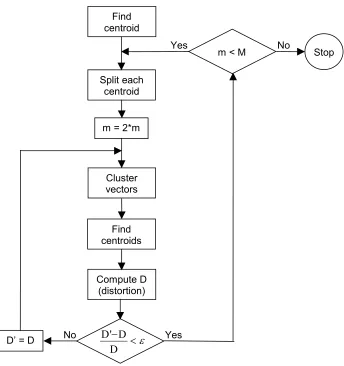
3.4.3.1 LBG Algorithm 82
3.4.4 Applying Distributed VQ Clustering as
Pre-classifier for GMM 83
3.4.4.1 Data Selection for Initial Test Set 85 3.4.5 Speaker Identification using GMM
Likelihood Ratio Algorithm 87
4 HYBRID DISTRIBUTED VQ/GMM MODELING 90
4.1 Overview of the Design Framework 91
4.2 Hybrid Training Phase I: Distributed Data Pre-Processing Phase 91
4.2.1 Pitch Analysis Process 92 4.2.2 Threshold Analysis 95 4.2.3 Distributed Data Process 95 4.3 Hybrid Training Phase II: Distributed VQ Training Model 97 4.4 Hybrid Testing Phase I: Distributed VQ Classification Model 99
4.4.1 Nearest Neighbour Search and Distance Calculation 101
4.4.2 Best Speaker Model Selection 101
4.5 Hybrid Testing Phase II: GMM Identification Model 102
4.6 Summary 104
5 RESULTS AND ANALYSIS 105
5.1 Evaluation Measures 106
5.2 Experimental Setup and Condition 107
5.3 Amount of Data Chosen in Experiments 108
5.4 Experiment I: Conventional Baseline System 108
5.4.1 GMM Baseline Speaker Identification Performance 109
5.4.2 VQ Baseline Speaker Identification Performance 112
5.4.3 Comparison between VQ and GMM Performance 114
5.5 Experiment II: Hybrid VQ/GMM Modeling 116
5.5.2 Computational Time for Hybrid VQ/GMM Model (without Distributed
Training) 120
5.5.3 The Performance of Hybrid Distributed VQ/GMM Model 121
5.5.4 Computational Time for Hybrid Distributed VQ/GMM Model 124
5.6 Experiment III: Evaluation on Hybrid Model Vs Baseline Model 124
5.6.1 Evaluation on Processing Time 125
5.6.2 Evaluation on Accuracy Rates 126
5.7 Experiment IV: Evaluation on Other Hybrid VQ/GMM Model 127
5.7.1 VQ Pre-classifier for Gaussian Selection Model 128
5.7.2 Evaluation on VQ Pre-classifier for Gaussian Selection Model 131
5.7.3 LBG Training for GMM Model 133
5.7.4 Evaluation on LBG Training for GMM Model 135
5.8 Summary 137
6 CONCLUSION AND FUTURE WORK 138
6.1 Summary 138
6.2 Future Works 140
REFERENCES 143
LIST OF TABLES
TABLE NO. TITLE PAGE
2.1 Comparison on several pattern classification approaches 51
3.1 Dialect distribution of speakers 74
5.1 Time use for training and testing for GMM (seconds) 111 5.2 Time use for training and testing for VQ (seconds) 114 5.3 Time use for training /testing for VQ and GMM on
full TIMIT data 115
5.4 Computational time use for full TIMIT data
training /testing for VQ, GMM and hybrid VQ/GMM
model (without distributed data training) 120 5.5 Computational time use for full TIMIT data
training /testing on 2 hybrid VQ/GMM model 124 5.6 Processing time for VQ, GMM and hybrid distribute
VQ/GMM on full set data 125
LIST OF FIGURES
FIGURE NO. TITLE PAGE
2.1 The basic structure for speaker identification 17
2.2 The basic structure for speaker verification 18
2.3 Mel Frequency Cepstral Coefficients Process 23
2.4 DTW model 31
2.5 HMM finite state generators 35
2.6 Conceptual diagram illustrating Vector Quantization
codebook formation 38
2.7 A multilayer perceptron 42
2.8 Steps for Binary Linear Decision Boundary 45
3.1 Hybrid distributed VQ/GMM speaker identification
process 69
3.2 Design methodology for hybrid distributed VQ/GMM
model 72
3.3 Rules for decision tree to distribute speaker dataset 79
3.4 Flow diagram of the LBG algorithm 83
3.5 Centroids and its code vectors 84
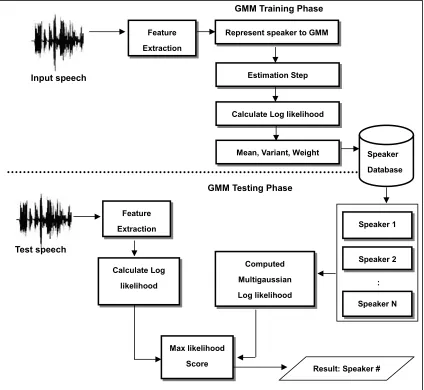
3.6 A process flow of GMM approach in training and
testing phase for speaker identification system 88 4.1 Hybrid distributed VQ/GMM modeling - Training phase I 92
4.2 Pseudo code for low pass filtering 93
4.4 Hybrid distributed VQ/GMM modeling - Training Phase II 97
4.5 Distributed VQ algorithm for training data 98
4.6 Hybrid distributed VQ/GMM modeling - Testing Phase I 99
4.7 Pseudo code for decision tree to assign speakers’ data into groups 100
4.8 Selection of 6 best speaker models 102
4.9 Hybrid distributed VQ/GMM modeling - Testing Phase II 103
4.10 Algorithm of GMM test on 6 initial data 103
5.1 GMM baseline speaker identification performance 110
5.2 VQ baseline speaker identification performance 112
5.3 Comparisons of VQ and GMM baseline speaker identification performance 115
5.4 Performance of hybrid VQ/GMM model (without distributed data training) 119
5.5 Performance of hybrid distributed VQ/GMM model 123
5.6 The Performance of 3 type of pattern classification models 127
5.7 Structure of VQ pre-classifier for Gaussian selection model 129
5.8 Performance of VQ pre-classifier for Gaussian selection 131
5.9 Comparison of hybrid distributed VQ/GMM model with VQ pre-classifier for Gaussian selection model 132
5.10 Performance of LBG Training for GMM model 135
LIST OF ABBREVIATIONS
VQ - Vector Quantization
GMM - Gaussian Mixture Model
DTW - Dynamic Time Warping
HMM - Hidden Markov Models
FFT - Fast Fourier Transform
LPC - Linear Prediction Coding
SVM - Support Vector Machine
MFCC - Mel-Frequency Cepstrum Coefficients PLP - Perceptual Linear Predictive
MAP - Maximum A Posterior
VQPGS - VQ Pre-classifier for Gaussian Selection LBG-GMM - LBG Training for GMM Model
ZCR - Zero Crossing Rate
EM - Expectation Maximization
LIST OF APPENDICES
APPENDIX TITLE PAGE
A List of Publication Related with the Research 163 B The Result of VQ Pre-classifier for Gaussian
Selection Model 167
C The Result of LBG Training for GMM Model
INTRODUCTION
Speaker recognition is a process where a person is recognized on the basis of his/her voice signals (Doddington, 1985). Evolution of speaker recognition is quantum jump in artificial intelligence and forensic science technologies because it endows machines with the human-like abilities to distinguish people's identity from one another (Judith, 2000). Speaker recognition technologies are currently applying in many daily applications. For example, access control system, security control for confidential information, transaction authentication and telephone banking.
The success of speaker recognition system depends largely on how to classify a set of feature used to characterize speaker specific information (Jiuqing and Qixiu, 2003; Sorensen and Savic, 1994). However, pattern classification from speech signal remains as a challenging problem encountered in general speaker recognition system, including speaker verification and speaker identification.
Recent development in classifying speaker data from a group of speakers is still insufficient to provide a satisfying result in achieving high performance pattern classification. There are two main difficulties in pattern classification field: how to maintain accuracy under incremental amounts of training data and how to reduce the processing time as real time systems regarding efficiency and simplicity of calculation (He and Zhao, 2003; Campbell, 2002). This research aims to solve the aforementioned problems.
1.1 Background of the Problem
Pattern classification plays as a crucial part in speaker modeling component chain. The results of pattern classification strongly affect the speaker recognition engine to decide whether to accept or reject a speaker. Early pattern classification is produced by Dynamic Time Warping (DTW) (Sakoe and Chiba, 1978; Jingwei et al., 2002) and Hidden Markov Models (HMM) (Lawrence, 1989). These techniques are not really efficient for real time application due to characteristic of text dependent recognition. As an alternative to solve the problem, Vector Quantization (VQ) (Vlasta and Zdenek, 1999), Gaussian mixture model (GMM) and Support Vector Machine (SVM) (Solera et al., 2007) were introducing for speaker recognition. GMM is focus of research after Reynolds and Rose (1995) prove its effective performances in text independent speaker identification.
Previous studies have reported GMM technique of pattern classification appears to have several advantages. However, in practice the process does not always produce satisfied result due to the long computational time (Hong et al., 2004; Reynolds and Campbell, 2007). Consequently, alternative methods must be sought in order to reduce processing time problem for GMM technique.
Performance of speaker recognition systems in term of accuracy rates has been significantly improved over hybrid conditions. However, Moon et al., (2003) declare that when speaker recognition is adopted in real-world application, processing time issue is often observed. Meanwhile, current works for the hybrid production of speaker recognition are directed more towards accuracy problems, not processing time problems. Therefore, it is encouraging if a speaker recognition task can be conducted in a "good" pattern classification machine.
1.2 Motivation of Research
This research is intended to ascertain and enhance GMM pattern classification approach via hybrid modeling for speaker identification. This pattern classification approach should be able to handle large speaker database in short time limit, whereas the accuracy rate is still maintained or even higher than the conventional GMM pattern classification technique.
A survey is done to investigate suitable solution for reducing GMM technique processing time. Tae et al. (2002) claims by reducing learning data can improve training speed for speaker identification. Similarly, Tomi et al. (2003) reveals a speaker pruning algorithm for real time speaker identification which is based on reducing training data. Meanwhile, Xiaodan et al. (2006) declares decision tree approach is effective for solving large data problem which can divide the whole set of data into separable classes. However, in order to obtain better accuracy rates for speaker identification system, several hybrid pattern classification attempts need to be conducted. (Qiguang et al., 1996; Fine et al., 2001; Minghui et al., 2006).
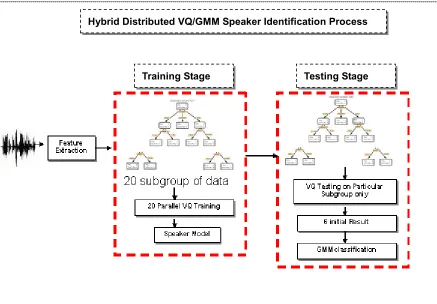
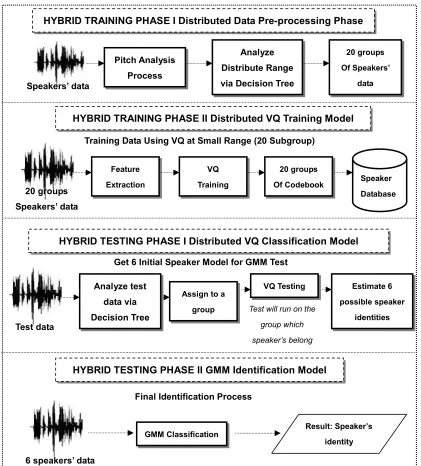
Due to above factors, a novel hybrid method which takes the advantage of 2 typical pattern classification approaches for text independence speaker identification is constructed. These two techniques are Vector Quantization (VQ) and Gaussian Mixture Models (GMM). The primary reason of deriving hybrid idea is VQ is able to provide shorter processing time (Vlasta and Zdeněk, 1999). The subsequently reason is GMM shows it is effective and gains a stable accuracy while handling large speaker data (Auckenthaler et al., 1999; Daniel, 2004). In the first focus of proposed method, VQ are used as pre-training pattern classification approach to initialize a small set of speaker model which have closer distance measure in identification training phase. These initial speaker models are used for GMM testing in identification testing phase to calculate the log likelihood score. This is mainly for leading GMM engine testing on possible speaker models instead of comparing all speaker models in database.
for VQ approach. Guangyu and Michael (2005) suggested an Adaptive Discriminative VQ technique to divide feature vector space into subspace before training. Acero et al. (1996) suggested a Sub-partitioned vector quantization technique to indicate a significant reduction in memory for speech processing. From the result of these reviews, VQ is not able to process a large set of data without any pre-processing technique directly. Therefore, it brings another focus for this research.
The second focus of the research introduced a process of distributing data by classifying data into smaller subgroup depending on speaker's pitch, which given name "distributed data training". The research hypothesis claims that training data in small subgroup will lead towards the time efficiency compared to run searching under whole set of data. Thus, a decision tree function which separates the speech signal according to their gender information via pitch analysis is added as pre-processing stage for hybrid VQ/GMM approach.
1.3 Problem Statement
Based on the analysis on the usage of VQ and GMM pattern classification approach in speaker identification, VQ and GMM moderately applied in text independent environments successful, but it is still suffer from several problems:
(i) Large training set of GMM result in long computational time. It compare the entire speaker models in speaker database via maximum log likelihood score. (ii) VQ is only suitable for classifying small range of data because of its template
matching characteristic.
(iii) Accuracy rates will decrease along with the increasing of training data for VQ pattern classification; it generates an unstable solution when dealing with large date set.
1.4 Goal
This research intended to improve time consuming issue in conventional GMM approach. It constructs a pre-processing stage; distributed data training on VQ modeling and pass the pre-processing result to GMM model for identification task. The efficiency is evaluated in term of computational time and accuracy for the whole speaker identification process in achieving accurate result compared to VQ and GMM baseline model. Besides, a comparison is conducted against other hybrid VQ/GMM models which focus on speedup speaker identification system.
1.5 Objectives
(i) To develop a novel hybrid distributed VQ/GMM model for text-independent speaker identification.
(ii) To reduce the computational time for conventional GMM speaker identification process and maintain high accuracy rate.
1.6 Scope
This research is bound to the following scopes:
(i) The work reported here focus on the closed-set text-independent speaker identification task. A hybrid model, distributed Vector Quantization and Gaussian Mixture Model is applied on speaker identification pattern classification.
(ii) TIMIT speech corpus is used as speech database for evaluation purpose. Besides, experiments are conducted in clean speech environment for standard evaluation. The selective of 10 sets, 50 sets and 100 sets data from this corpus are used to go thru all phase of experiments in order to show the impact of data increasing. Finally, the experiments is conducted on full set TIMIT data to show how proposed model handle large datasets.
(iii) Comparison is made between proposed technique, baseline VQ and GMM techniques and other hybrid VQ/GMM models on enhancing speed for speaker identification system.
(iv) Performance measurement is evaluated by computational time and percentage of accuracy rate, which is a number of correctly identified speakers against the total number of tested speaker.
1.7 Significance of the research
algorithm with less computational time and capable to works on large dataset are developed.
The principal contribution of this study is to propose a method to reduce time consuming issue for conventional GMM modeling successfully. Besides, it presents a transformed criterion for conventional hybrid VQ/GMM classifier. Conventional hybrid VQ/GMM classifier is employed using VQ as pre-classifier directly without any pre-processing. However, the proposed method concern about distributing data into smaller range in order to reduce computational time while the accuracy rate is still maintained.
1.8 Research Contributions
The work addressed in this study has contributed to the following aspects: (i) Distributed VQ model distribute speaker model in smaller subgroup and
train data in following subgroup only, hence minimize the accuracy error for pre-processing phase.
(ii) By initializing hybrid Distributed VQ/GMM model in speaker identification task, smaller computational times were needed for testing speaker data. This study discloses a competent and less computational hybrid model in handling pattern classification task, whilst result is reliable for speaker identification.
This research can be considered as an applied research, which can benefit the following agencies:-
(i) Access Control System - To help provide faster identification process (ii) Forensic Science Agencies - Proposed model is capable of handling
large dataset and provide better accuracy rates which can help to convict a criminal or discharge an innocent in court.
1.9 Thesis Organization
This thesis consists of six chapters as following:
Chapter 1 briefly introduces speaker recognition pattern classification approach and some research background. Motivations of research and problem statement are also defined. Goal, objectives and scopes of research are stated clearly. Finally, research contributions are discussed.
Chapter 2 conducts a review to previous work; consist of the general speaker recognition framework, some pattern classification approach in speaker recognition, the need of a hybrid modeling and problem over hybrid modeling. Besides, this chapter also analyze some techniques focus on minimize processing time and distributed VQ classification, as well as discuss several existing process for hybrid VQ/GMM model.
Chapter 3 presents the methodology and theoretical framework of this study. It consists of following procedures: analyze the ability of the distributed VQ, design methodology, data collection and finally the output which is the hybrid distributed VQ/GMM design framework.
GMM model identification phase. This chapter illustrates how workflow and progress has been carried out in details for this study.
Chapter 5 presents and discusses the results of conducted experiments based on the proposed approach in this study. Several experiments are carried out on increasing data environment and comparisons are made between this study and several existing hybrid VQ/GMM application.
LITERATURE REVIEW
Biometric systems are automated method of verifying or recognizing the identity of the person on the basis of some physiological characteristic, such as a finger print or face pattern and human voice (Kung et al., 2005).
Human voice conveys information about the language being spoken and the emotion, gender and, generally, the identity of the speaker. Speaker recognition is the computing task of validating a user's claimed identity using characteristics extracted from their voices. (Campbell, 1997; Sadaoki, 2004). Voice of a person has many prominent characteristics like pitch, tone which can be used to distinguish a person from the other (Atal, 1976).
person is unknown. Speaker verification is defined as deciding if a speaker is whom he claims to be. This is different than the speaker identification problem, which is deciding if a speaker is a specific person or is among a group of persons. In speaker verification, a person makes an identity claim (e.g., by entering an employee number or presenting his smart card) (Rosenberg, 1976; Rosenberg and Soong, 1992; Doddington, 1985).
Speaker recognition can be based on text-dependent or text-independent utterances, depending on whether the recognition process is constrained to a pre-defined text or not (Gish and Schmidt, 1994). The text-dependent systems require a user to re pronounce some specified utterances, usually containing the same text as the training data. There is no such constraint in text independent systems, where the classification is done without prior knowledge of what the speaker is saying. In the text-dependent system, the knowledge of knowing words or word sequence can be exploited to improve the performance. Thus, text-dependent speaker recognition usually gives better performance than text-independent recognition for small amounts of training and testing data (on the order of ten seconds) (Sachin et al., 2008). However, text-independent systems have drawn the attention of the researchers due to its flexibility and practical in real time system. As some researchers have pointed out, the researcher's influence is diffused by the very fact of the demand of forensic science technologies (Meng et al., 2008). Voice recognition for smart voice mail systems and voice identification for building access are two general usages on text-independent systems.
Speaker recognition system basically involves two main phases, the training stage and the testing stage(Richard and Daryl, 1990). These phases involve two main parts:
• Pattern Classification.
At the time of training, speech sample is acquired in a controlled and supervised manner from the user. The speaker recognition system has to process the speech signal in order to extract speaker discriminatory information from it. This discriminatory information will form the speaker model, which is a process of enrollment speaker data. At the time of testing a speech sample is acquired from the user. The speaker recognition system has to extract the features from this sample and compare it against the models already stored before hand. This is a pattern matching or classification task.
2.1 Speaker Identification
Speaker identification determines which registered speaker provides a given utterance from a set of know speaker. There are two cases in speaker identification which are called “close-set” identification and “open-set” identification (Tomi et al., 2004). In close-set speaker identification system it will choose a speaker in the training set who most matches the unknown speaker as the identification decision without regarding whether he/she is in the training set or not. While in open-set speaker identification system the reference model of the unknown speaker may not exist in the training set, thus an additional decision alternative (the unknown does not match any of the models in the training set) is required.
it is assumed the unknown voice must come from a fixed set of known speakers, thus the task is often referred to as closed-set identification
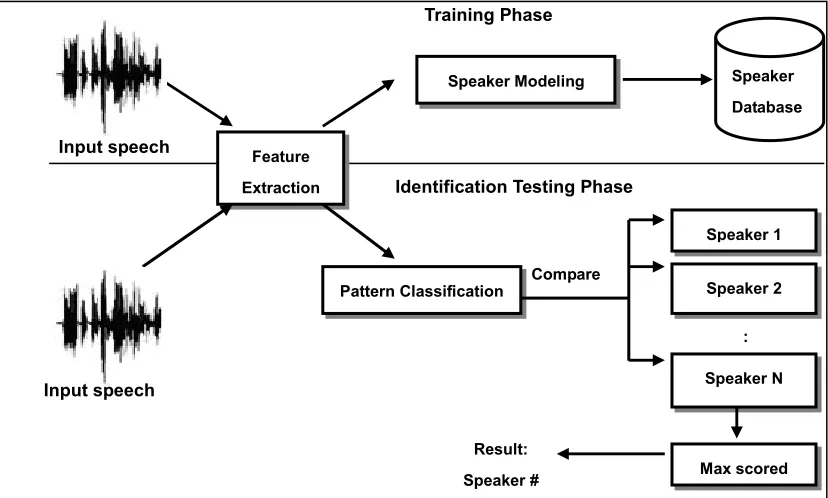
The basic structure for speaker identification is shown in Figure 2.1. The speech signal is first processed to extract features conveying speaker information. In the identification system these features are compared to a bank of models, obtained from previous training processes, representing the speaker set from which we wish to identify the unknown voice. For closed-set identification, the speaker associated with the most likely, or highest scoring model is selected as the identified speaker. This is simply a maximum likelihood classifier (O'Shaughnessy, 1986).
Figure 2.1 The basic structure for speaker identification
The more general problem, speaker identification, may be stated as follows. Out of a total population of N speakers, find that speaker whose reference pattern is most similar to the sample pattern of an unknown speaker. Since the sample pattern is compared to each of the N reference patterns and since there is a finite probability
Speaker Modeling Speaker Database Training Phase
Feature Extraction
Pattern Classification
Speaker 1 Compare
Identification Testing Phase
Speaker 2
Speaker N
Max scored Result:
Speaker # Input speech
:
of an incorrect decision for each comparison, it is apparent that the overall probability of an incorrect decision must be a monotonically increasing function of N (Rosenberg, 1976).
2.2 Speaker Verification
For the case of speaker verification, the speaker is classified as having the purported identity or not. That is, the goal is to automatically accept or reject an identity that is claimed by the speaker (Doddington, 1998). In this case, the user will first identify herself/himself (e.g., by introducing or uttering a PIN code), and the distance between the associated reference and the pronounced utterance will be compared to a threshold that is determined during training.
Figure 2.2 The basic structure for speaker verification Speaker Modeling Speaker
Database Input speech
Training Phase
Feature Extraction
Pattern Classification
Speaker Database
Decision Logic
Result (True/false) Verification Testing Phase
Zi
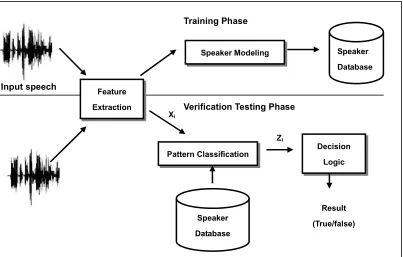
The general approach to speaker verification consists of five steps: digital speech data acquisition, feature extraction, pattern matching, making an accept/reject decision, and enrollment to generate speaker reference models (Campbell, 1997). A block diagram of this procedure is shown in Figure 2.2. Feature extraction maps each interval of speech to a multidimensional feature space. (A speech interval typically spans 10–30 ms of the speech waveform and is referred to as a frame of speech.) This sequence of feature vectors Xi is then compared to speaker models by
pattern classification. This results in a match score Zi for each vector or sequence of
vectors. The match score measures the similarity of the computed input feature vectors to models of the claimed speaker or feature vector patterns for the claimed speaker. Last, a decision is made to either accept or reject the claimant according to the match score or sequence of match scores, which is a hypothesis testing problem.
2.3 Front-end Processing/Feature Extraction
Speech front-end processing consists of transforming the speech signal to a set of feature vectors (Moretto, 1995). The aim of this process is to obtain a new representation which is more compact, less redundant, and more suitable for statistical modeling (Premakanthan and Mikhad, 2001). Feature extraction is the key to front-end process; it mainly consists in a coding phase.
as Linear Prediction Coding (LPC) (Atal and Hanauer, 1971), Mel-Frequency Cepstrum Coefficients(MFCC), Perceptual Linear Predictive (PLP) and others.
Mel Frequency Cepstral Coefficients (MFCC) (Davis and Mermelstein, 1980) and Perceptual Linear Prediction (PLP) (Hermansky, 1990) are the most popular acoustic features used in speaker recognition. Often it depends on the task, which of the two methods leads to a better performance. Currently, researchers are focusing on improving these two cepstral features (Premakanthan and Mikhad, 2001) or appending new features on them (Waleed, 2007). In fact, it is generally believed that the spectrum smoothing done by MFCC and PLP has some sort of speaker normalization effect.
The selection of feature determines the separability of the speaker, and it also has large influence on the classification step, since the classifier must be turned to the given feature space. Thus, the selection of the features should be carefully considered in the system design. Several analyses have been done for feature extraction technique in order to observe the best technique for transforming the speech signal. Davis and Mermelstein (1980) reviewed the literature of a few feature extraction methods and compared in a syllable-oriented speaker dependent speech recognition system. The experiments were made in a noise-free environment and the segmentation was done manually. They found that features derived using cepstrum analysis outperform those that does not use it and that filter bank methods outperform LPC methods (PLP methods were not included). Best performance was achieved using MFCC.
methods seem to be performing well in most studies. Besides, a theoretical comparison of MFCC and PLP analysis is given in by Milner (2002). The theoretical comparison in (Milner, 2002) continues with a practical implementation. The spectral analysis is followed by channel normalization (both RASTA and CMN are tried) and extraction of dynamic features. The best results are reported for MFCC with RASTA filtration.
Similarly, Schmidt and Thomas (2000) has point out the state-of-the-art speaker recognition systems typically employ the MFCC as representative acoustic feature and GMM as pattern classification method has achieved very good performance which even better than recognition by human. Florian et al. (2005) have substantiated Schmidt and Thomas (2000) argumentation via some experiments. They reports that under clean conditions and when there is no significant mismatch, MFCC features lead to a performance that slightly superior to PLP.
All these facts suggest that any speaker identification system based on MFCC can possibly be improved. Based on above declare, this research has decided to employ MFCC method as the feature extraction part in order to obtain most advantageous feature vector to adapted in the proposed hybrid pattern classification model.
2.3.1 Mel Frequency Cepstral Coefficients (MFCC)
Figure 2.3 Mel Frequency Cepstral Coefficients process
2.3.1.1 Frame Blocking
2.3.1.2 Windowing
The next step in the processing is to window each individual frame so as to minimize the signal discontinuities at the beginning and end of each frame. The concept here is to minimize the spectral distortion by using the window to taper the signal to zero at the beginning and end of each frame. If define the window, where N is the number of samples in each frame, then the result of windowing is the signal.
y1(n) = x1(n)w(n), 0≤ n ≤ N-1 (2.1)
Typically the Hamming Window is used, which is of the form
1 0 , 1 2 cos 46 . 0 54 . 0 ) ( ≤ ≤ − − −
= n N
N n n
w π (2.2)
2.3.1.3 Fast Fourier Transform
Next step is the Fast Fourier Transform (FTT) which converts each frame of N
samples in time domain to frequency domain. The frame blocking step that was
previously done was to enable the ease of performing of the FFT. The normal FFT
equation is given below:
1 ,..., 2 , 1 , 0 , / 2 1 0 − = = − − =
∑
x e n Nn jkn N
N
k k
2.3.1.4 Mel-Frequency Wrapping
The spectrum obtained from the above step is Mel Frequency Wrapped. The
Mel-frequency scale is linear frequency spacing below 1000 Hz and a logarithmic
spacing above 1000 Hz. As a reference point, the pitch of a 1 kHz tone, 40 dB
above the perceptual hearing threshold, is defined as 1000 Mels. Therefore it is
possible to use the following approximate formula to compute the Mels for a given
frequency f in Hz:
Mel (f) =2595*log10 (1+f / 700) (2.4)
The major work done in this process is to convert the frequency spectrum to
Mel spectrum. Psychophysical studies have shown that human perception of the
frequency contents of sounds for speech signals does not follow a linear scale.
Thus for each tone with an actual frequency, f, measured in Hz, a subjective pitch is
measured on a scale called the ‘Mel’ scale.
2.3.1.5 Cepstrum
The final step is converting the log Mel spectrum back to time. The result is
called the Mel frequency Cepstrum coefficients (MFCC). The cepstral
representation of the speech spectrum provides a good representation of the local
spectral properties of the signal for the given frame analysis. Mel spectrum
coefficients are real numbers. Therefore, is possible to convert them to the time
K n K k n coz S C K k k
n , 1,2,..,
2 1 ) (log 1 ~ ~ = − =
∑
=π
(2.5)Where Skis the Mel Scaled Signal got after wrapping. Cnis the Cepstral Coefficient.
2.4 Back-end Processing/ Pattern Classification
Duda et al. (2001) pointed that pattern classification classify data (patterns)
based on a priori knowledge or statistical information extracted from the patterns.
The patterns classified are usually group of measurements or observations, defining
points in an appropriate multidimensional space (Schlesinger and Hlavác, 2002).
The pattern classification task of speaker identification involves computing a
match score, which is a measure of the similarity of the input feature vectors to some
model (Bo et al., 2006). Speaker models are constructed from the features extracted
from the speech signal. To register users into the system, a model of the voice,
based on the extracted features, is generated and stored (possibly on an encrypted
smart card). Then, to authenticate a user, the matching algorithm compares the
incoming speech signal with the model of the claimed user.
The different of modeling approaches may be divided into two distinct
categories: discriminative and generative model. Discriminative models are
optimized to minimize the error on a set of training samples (Hong and Kwong, 2004;
perceptions and support vector machines.
Generative models are probability density estimators that attempt to capture all
of the underlying fluctuations and variations of the data (in this case the speaker's
voice) (Raina et al., 2004). Generative models include Gaussian mixture models,
hidden Markov models (Jaakkola and Haussler, 1998). Template models are
subsets for generative model. For template models, the pattern classification is
deterministic. The template model and its corresponding distance measure is
perhaps the most intuitive method. The template method can be dependent or
independent of time. An example of a time-independent template model is Vector
Quantization modeling. Besides, Dynamic Time Warping also one of the famous
models applied in template model.
This research will focus on the design of distributed VQ as pre-processing for
GMM model. The next section gives a brief overview on evolution of pattern
classifier. It explains the pattern classification techniques and briefly discusses the
improvement done in previous research. An analysis of the literature has done in
order to emerge the design of hybrid distributed VQ/GMM model. This report also
reviews some of the previous hybrid VQ/GMM model and its. Next, remarks on
some of the idea for solving similar problems have discussed and the adequate
solution observed. Finally, distributed data training is proposed on VQ as a
2.4.1 Evolution of Pattern Classification Technique in Speaker Identification
Research in automatic speech and speaker identification by machines has
attracted a great deal of attention for five decades. From the historic perspective,
Lawrence kersta from Bell Labs made the first major step towards speaker
identification by computers in the early 1960s where he introduced the term
voiceprint for a spectrogram, which was generated by a complicated
electro-mechanical device. The voiceprint was matched with a verification
algorithm that was based on visual comparison (Kersta, 1978).
An older technique that has fallen out of favor since the advent of Hidden
Markov Model is Dynamic Time Warping (DTW). The technique, DTW, was
introduced to the speech community by Sakoe and Chiba (1971). The DTW
algorithm is able to find the optimal alignment between two time series. It is often
used to determine time series similarity, classification, and to find corresponding
regions between two time series (Sakoe and Chiba, 1978).
In the 1970s, the use of pattern recognition ideas was introduced by Veichito
and Zagoruyko(1970) in Russia. As an alternative to the template-matching
approach for text-dependent speaker identification, the Hidden Markov technique
(HMM) was introduced and it was a focus of research in the 1980s (Ferguson, 1980).
At the same time, an algorithm named LBG algorithm for vector quantizes design
was first carried out by Linde et al., (1980). Vector Quantization (VQ) in processing
speaker data was develops by Tremain (1982). He led research in low bit rate
speech coding designs by developing vector quantization approaches using split
codebooks and tree-based algorithms for fast search of large codebooks. These
(Campbell., 1996; Tremain, 1982). Later on, Soong et al. (1985) have successfully
applied VQ method into text-independent speaker identification system in short-time
spectral features.
In the 1990s, a number of innovations took place in the field of pattern
recognition. The idea of single-state HMM, which is now called Gaussian mixture
model (GMM) was investigated to solve text-independent speaker identification
problems. GMM was the focus of the research trends of enhancing speaker
identification system after Reynolds (1992) proves its effective performance in
text-independent speaker identification. Besides, the problem of pattern recognition
was transformed into an optimization problem solution involving minimization of the
empirical identification error (Doddington et al, 2000).
After years 2000, a family of new classification techniques has recently been
proposed. These bring a development of artificial neural network (ANN) as a
replacement for pattern classification technique (Farrell et al., 1994). Recently,
support vector machine (SVM) developed by Vapnik et al. (1997) have become an
alternative solution for classification speaker data. This is due to the implement of
binary classifier that claims as more simple in calculation (Vincent, 2003).
However, GMM still act as the main character in pattern classification for speaker
identification by due to its stability of maintaining large speaker data. Although
many new technological promises have been offered, a number of practical
2.4.2 Dynamic Time Warping (DTW)
Dynamic time warping (DTW) is an algorithm for measuring similarity
between two sequences which may vary in time or speed (Sadaoki, 1991a). It is a
successful isolated-word processing technique often associated with small
fixed-vocabulary speech recognition. This technique was first applied by Sadaoki
(1981) in speaker verification.
Text dependent with a predefined password
Text dependent with a specific password for each customer
The first two points above can be summarized as fixed phrase verification,
where a predefined phrase is used both during the training and the verification
periods. For these cases the DTW approach is mostly used. According to Gold et al.
(1999) "... the password of each user is simply represented as a small number of
acoustic sequence templates corresponding to pronunciation of the password. ... the
score associated with a new utterance of the password is computed by means of
dynamic programming ... against the reference model(s)..."
DTW is a classification approach based on distances in feature space, makes
use of the fact that in training, the same pass phrase is spoken as in test (Shahin and
Botros, 1998). DTW compares the test vector sequence to a stored sequence from
training directly, taking into account that two utterances of the same word or phrase
are never exactly identical as distinct phonemes can be spoken shorter or longer. In
order to cope with that, a time alignment of test and training sequences is found
overall distance and fulfilling certain restrictions from training directly, taking into
account that two utterances of the same word or phrase are never exactly identical as
distinct phonemes can be spoken shorter or longer (Ravi et al, 2002).
2.4.2.1 DTW in Speaker Identification
According to Sadaoki (1991b) teory , in a speaker identification system, the
training data are used as a initial template, and the testing data is time aligned by DTW.
DTW is a method that allows a computer to find an optimal match between two given
sequences. The average of the two patterns is then taken to produce a new template to
which a third utterance is time aligned. This process is repeated until all the training
utterances have been combined into a single template. The idea of the DTW
technique is to match a test input represented by a multi-dimensional feature vector T=
[ t1, t2…tI] with a reference template R= [ r1, r2…rj]. While aim of DTW is to find the
function w(i). as shown in figure 2.5. (Aronowitz, 2006).
2.4.3 Hidden Markov models (HMM)
Since 1975 the Hidden Markov Modeling (denoted as HMM) is a technique
that has become popular in speech recognition research, introduced by the Russian
mathematician A.A. Markov. With HMM-based methods, the statistical variation of
spectral features is measured (Doddington, 1998).
HMM is a statistical model in which the system being modeled is assumed to
be a Markov process with unknown parameters, and the challenge is to determine the
hidden parameters from the observable parameters. The extracted model
parameters can then be used to perform further analysis (Kristie, 1999).
HMM has the same advantage for speaker identification as they do for speech
recognition (Rabiner, 1989). Remarkably robust models of speech events can be
obtained with only small amounts of specification or information accompanying
training utterances (Ephraim and Merhav, 2002). Speaker identification systems
based on an HMM architecture used speaker models derived from a multi-word
sentence, a single word, or a phoneme.
Some experiments have been done by Jarre and Pieraccini (1987) to
investigate HMM when apply in speaker identification engine. They reported over
the HMM speaker identification application, it uses HMM to encode the temporal
evolution of the features and efficiently model statistical variation of the features, to
provide a statistical representation of how a speaker produces sounds. During
training HMM parameters are estimated from the speech using established automatic
computed against the speaker’s HMM. Generally, it applies to text-dependent
application.
2.4.3.1 HMM in Speaker Identification
The hidden Markov model (HMM) formulation by Baum (1974) may be
described as a finite state generator (figure 2.5). In speaker identification, each
state, (q1…qm) of the HMM may represent phones or other larger units of speech.
Temporal information is encoded by moving from state to state along the allowed
transitions illustrated. Therefore, the temporal modeling is piecewise stationary.
The amount of time spent in each state varies depending upon the data. This allows
for variability in speaking rate.
The operation of an HMM is straightforward. Let M denote an HMM such
as the one illustrated in figure 2.5a. Consider an utterance, X = {x1…xN}, to be
processed by M. Let qln identify the lth state in the Markov chain occupied at time
n (i.e. corresponds to the nth frame in X). At time n = 0, the begin state, qI, is
occupied. This state is a non-emitting state (that is, no feature vector is associated
with it).
At time n =1 a transition is made to the first state, q1, and the first feature
certain probability (figure 2.5c). At time n = 2 a transition must be made to state q2
or back to q1, and the feature vector, x2, emitted. This process continues until n = N +1 at which time the end state, qF, another non-emitting state, must be reached.
The probabilities of the HMM process are accumulated to obtain the utterance
2.4.4 Vector Quantization (VQ)
Data compression techniques have been developed to make the information
occupy a small space, thus reducing memory and transmission costs, while at the
same time preserving the quality as much as possible. Compression is classified
into lossless or lossy, depending on whether or not the reconstruction is an exact
replica or an approximation of the input signal, respectively.
Gray (1984) establish in a new method for data compression by using Vector
Quantization. According to Gray (1984), Quantization is a lossy source coding
technique, where the design of the quantizer determines the loss incurred, subject to
certain constraints. It is a technique where the input samples are represented with
reduced precision. If the samples of the source are quantized individually, it is
scalar quantization; if blocks of samples are quantized together, it becomes Vector
Quantization (VQ).
VQ is a data compression technique, producing a reconstruction with as small
a distortion as possible. The quality of the reconstruction depends on the amount of
data that is discarded. The samples of a source output are grouped into a
k-dimensional vector, which is the input to a vector quantizer (Gersho, 1986).
The main component of a VQ is a code book that consists of representative
vectors called code vectors (Gersho et al., 1992). The elements of the code vector
are quantized values of the input samples. The same code book must be maintained
both at the transmitter and the receiver. The code book is searched to find the code
the selected code vector, which is its address in binary form, is transmitted to the
receiver. The receiver requires a simple table lookup; the index received is used to
select the reproduction code vector that approximates the input vector of k samples
(Sabin and Gray, 1984; Cuperman, 1986).
2.4.4.1 VQ in Speaker Identification
Vector Quantization (VQ) is a pattern classification technique applied to
speech data to form a representative set of features. This set or codebook can be
used to represent a given speaker. Among the first apply this technique to speaker
identification were Soong et al. (1985) and Buck et al. (1985).
VQ is a process of mapping vectors from a large vector space to a finite
number of regions in that space. Each region is called a cluster and can be
represented by its center called a codeword. The collection of all code words is
called a codebook.
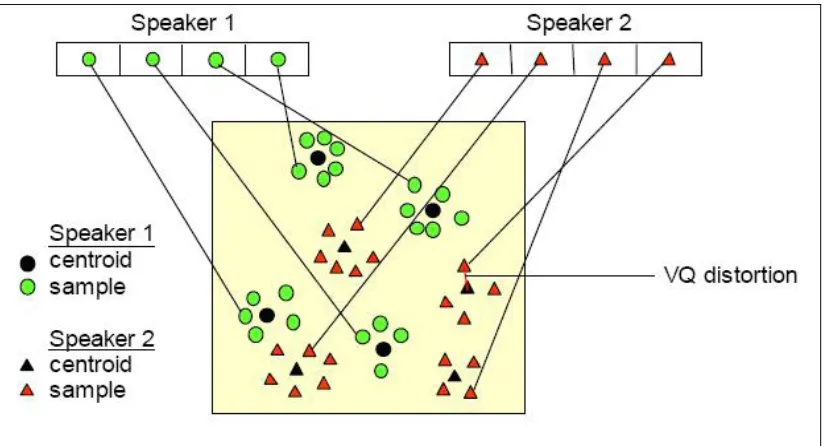
In the training phase, a speaker-specific VQ codebook is generated for each
known speaker by clustering his/her training acoustic vectors. The result code
words (centroids) are shows in Figure 2.6 by black circles and black triangles for
speaker 1 and 2, respectively. The distance from a vector to the closest codeword of
a codebook is called a VQ distortion. In the identification phase, an input utterance
of an unknown voice is “vector-quantized” using each trained codebook and the total
the smallest distortion is identified.
Figure 2.6 Conceptual diagram illustrating Vector Quantization codebook formation
The quality of speech coding with a code book is highly dependent on the
similarity between the training set and the coded material can serve as a motivation
for the use of code books for speaker identification (Sadaoki, 1991a). In this case,
for each speaker, a code book is estimated in training. This code book can be
thought of as containing those features as mean vectors which are characteristic for
that speaker. Classification of unknown signals is based on the mean quantization
error of test feature vectors in regard to the appropriate speaker specific code books,
2.4.5 Gaussian Mixture Models Classification Model
The Gaussian mixture model (GMM) is a density estimator and is one of the
most commonly used types of classifier. The mathematical form of an m
component Gaussian mixture for D dimensional input vectors is,
(2.6)
Where P(x|M) is the likelihood of x given the mixture model, M. The mixture
model consists of a weighted sum over m unimodal Gaussian densities each
parameterized by the mean vectors, , and covariance matrices, . The
coefficients, , are the mixture weights, which are constrained to be positive and
must sum to one. The parameters of a Gaussian mixture model, , and for
i = 1m may be estimated using the maximum likelihood criterion via and the iterative
Expectation Maximization (EM) algorithm (Paalanen et al., 2006). In general,
fewer than ten iterations of the EM algorithm will provide sufficient parameter
convergence.
Training GMM using maximum likelihood leads to a generative model.
GMM are analogous to vector quantization in that the mean of each Gaussian density
can be thought of as a codebook vector. The GMM combines the robust parametric
approach of Gaussian density modeling with the arbitrary data modeling approach of
2.4.5.1 GMM in Speaker Identification
A detailed discussion on applying GMM to speaker modeling can be found in
(Reynolds, 1992). The basic method is straightforward. GMM with diagonal
covariance matrices are generally used. Although full covariance matrices may be
used if desired, the simplification leads to a model with fewer parameters without
sacrificing accuracy. Empirical evidence indicates that the accuracy of a full
covariance mixture model can be achieved by a diagonal covariance model with a
larger number of mixture components.
In speaker identification, each trained speaker is represented by a GMM model.
GMM is trained using maximum likelihood, to estimate the probability density
function, P(xi|M), of the client speaker. The probability, P(X|M) , that an utterance,
X = {x1…xN}, is generated by the model, M, is used as the utterance score. It is
estimated by the mean log likelihood over the sequence,
(2.7)
The speaker’s identity is defined by the model that produced the maximum
probability, i.e.
(2.8)
where ns is the total number of trained speakers. The identification error rate (IER) is
a measure of how well an identification system can identify speakers. It is simply
defined as
(2.9)
identifications performed. A system can be assumed to be good at identifying
speakers if the IER is relatively low (approaching zero). On the other hand if the
IER approached one then the system performs poorly in an identification role. The
ability of an identification system relies heavily on the number of speakers in the
enrolled population. As the number of enrolled speakers increases, the ability of the
system to differentiate speakers decreases. This results in an increase in the IER.
2.4.6 Neural Networks for Classification
An artificial neural network is a powerful tool for regression and classification
(Bishop, 1995). There are many types of neural network but in this literature
review only focus on Multilayer Perceptron (MLP) that has been applied to speaker
identification. MLP is a feed-forward network that incorporates little or no
temporal information.
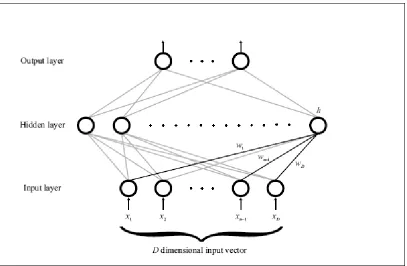
The architecture of an MLP with one input layer, one hidden layer and one
output layer is illustrated in figure 2.7. Each node computes a linear weighted sum
over its input connections, where the weights of the summation are the adjustable
parameters. A transfer function is applied to the result to compute the output of that
node. Commonly used transfer functions include linear, tanh, sigmoid and softmax
functions. The weights of the network are estimated by gradient descent in a
process called back-propagation. It is well known that an MLP with a non-linear
transfer function and sufficiently large number of nodes in the hidden layer may
approximate any functional mapping from input to output. This is why MLP are
be used to estimate posterior probabilities directly (Baum and Wilczek, 1988; Gish,
1990; Bishop, 1995).
Figure 2.7 A multilayer perceptron
An MLP for speaker identification would have only one output node since the
task is only to score the frames of an utterance. In the same fashion as the GMM,
the utterance score is the mean classifier output over the complete utterance (Oglesby
2.4.6.1 Neural Networks in Speaker Identification
MLP was applied to speaker identification as following step. First, the
feature vectors are gathered for all speakers in the population. The feature vectors
for one speaker are labeled as "one", and the feature vector for remaining speakers
are labeled as "zero". An MLP is then trained for that speaker using these feature
vectors. The MLP's for all speakers in the population are trained using this method.
Ideally, test vectors for a specific speakers should have a "one" response for
that speaker's MLP, whereas test vectors from different speakers should have a "zero"
response. For speaker identification, all test vectors are applied to each MLP, and
outputs of each are accumulated. The speaker is selected as corresponding to the
MLP with the maximum accumulated output (Lung, 2007).
One problem that is encountered during MLP training for large speaker
populations is that the majority of the training vector have inhibitory (zero) labels,
and only a small percentage of the training vectors have excitatory (one) labels.
Hence, the classifier tends to learn "everything" in inhibitory. One method to
alleviate this problem add noisy duplicates of excitatory vector to the training set to
even out the distribution of excitatory and inhibitory vectors. However, for a large
number of speakers, this results in an unwieldy amount of training data that can
hinder the convergence of the classifier (Ouzounov, 2006).
The second problem encountered was the optimal MLP architecture, number
of notes and hidden layers. To solve a particular problem, MLP architecture must
required to solve large dataset problems can be excessive, and the algorithm is
vulnerable to converging to a local minima instead of the global optimum (Ouzounov,
2007).
2.4.7 Support Vector Machines (SVM)
Another alternative approach to develop classifier is Support Vector Machines
(SVM). SVM is state-of-the-art tools for linear and nonlinear knowledge discovery
(Scholkopf and Smola, 2002; Vapnik, 1995). The powers of SVM lie in their ability
to transform data to a higher dimensional space and to construct a linear binary
classifier in this space (Vincent and Steve, 2003). Unlike others, such as ANN or
some modifications of HMM that minimize the empirical risk on the training set,
SVM also minimize the structural risk (Vapnik, 1995), which results in a better
generalization ability. In other words, given a learning problem and a finite training
database, SVM generalize better than similar ANN because they properly weigh the
learning potential of the database and the capacity of the machine (Solera et al.,
2007).
SVM is a binary classification method that finds the optimal linear decision
surface based on the concept of structural risk minimization (Raghavan et al., 2006).
The decision surface is a weighted combination of elements of a training set. These
elements are called support vectors, which characterize the boundary between the
For the purpose to characterize the boundary between the two classes,
maximizing the margin is needed. Maximizing the margin are the process find the
"middle-line" consider two parallel lines both of which separate the two classes
without error. Several steps need to be determining the linear separator (Figure 2.8a,
2.8b, 2.8c) (Burges, 1998):
• Find closest points in convex hulls
• Plane bisect closest points
• Maximize distance between two parallel supporting planes
Figure 2.8 Steps for Binary Linear Decision Boundary
2.4.7.1 SVM in Speaker Identification
During speaker identification process, classifying the feature which derived
from the transformation of feature extraction directly will not immediately works
when using SVM (Campbell et al., 2006). It is because SVM only can process (a)
(b)
fixed-length input, whereas speech signals are non-stationary. Therefore, some
pre-processing need to done for categorizes the feature and scaling them.
SVM requires that each data instance is represented as a vector of real numbers.
Hence, if there are categorical attributes, the first step is convert them into numeric
data. Vincent and Steve (2003) recommend using m numbers to represent an
m-category attribute. Only one of the m numbers is one, and others are zero. For
example, a two-category attribute such as {speaker, imposter} can be represented as
(0,1) and (1,0).
Scaling them before applying SVM is very important. The main advantage is
to avoid attributes in greater numeric ranges dominate those in smaller numeric ranges.
Another advantage is to avoid numerical difficulties during the calculation. Because
kernel values usually depend on the inner products of feature vectors, e.g. the linear
kernel and the polynomial kernel, large attribute values might cause numerical
problems (Wan and Renals, 2005; Osuna and Girosi, 2005). Wan and Renals (2005)
recommend linearly scaling each attribute to the range [−1, +1] or [0, 1].
2.5 Evaluation on Several Pattern Classification Techniques
The aim of this section is to provide an evaluation of the usage of several
pattern classification techniques that applied in speaker identification. The
forward in the enhancement for pattern classification which has been done in the
past.
DTW is an algorithm for measuring similarity between two sequences which
may vary in time or speed. It is a first pattern classification technique has been
applied in automatic speaker identification, to cope with different speaking speeds
(Myers and Rabiner, 1981). As stated as Sadaoki (1997), DTW is a simple and less
computation method because it allows a computer to find an optimal match between
two given sequences (e.g. time series) with certain restrictions. However, because
of it characteristic of aligning two templates at equivalent point in time, it only
suitable applies in text-dependent speaker identification.
Another text-dependent speaker identification technique is HMM. A HMM
can be considered as the simplest dynamic Bayesian network. Kristie et al. (1999)
declare that one of the most important advantages of HMM is that they can easily be
extended to deal with classification tasks. Rabiner (1989) prove the HMM
effectiveness via an experiment on speech data. He comments that because each
HMM uses only positive data, they scale well; since new words can be added without
affecting learnt HMM. It is also possible to set up HMM in such a way that they
can learn incrementally. The basic theory of HMM is also very elegant and easy to
understand. This makes it easier to analyze and develop implementations for
(Ephraim and Merhav, 2002). However, Dymarski and Wydra (2008) disputed
Ephraim and Merhav (2002) idea due to the number of parameters that need to be set
in an HMM is huge. For example, for the very simple three-state HMM, there are a
total of 15 parameters that need to be evaluated. For a simple four-state HMM,
with five continuous channels, there would be a total of 50 parameters that would
Notwithstanding DTW and HMM shows considerable advantage in
classification, yet these two techniques are suitable in text-dependent environment.
In fact, real time system always request flexible and adaptable for the input speech in
order to make the user convenient. Thus, pattern classification methods for
text-independent speaker identification become a demand.
VQ is a classical quantization technique from signal processing which allows
the modeling of probability density functions by the distribution of prototype vectors.
It was originally used for data compression. Soong et al. (1985) are the first
research group trying to adapt VQ for text-independent speaker identification system.
They are success with achieved over 98% accuracy rates for speaker identification.
VQ procedure is not guaranteed to find the best set of clusters but in practice it
work very fast and can get good result in short-time acoustic feature classification.
Nevertheless, VQ are based on short-time acoustic feature, when the feature set
become large, it become hard to computed the distance between codebook, thus it
cannot get very accurate result (Karpov et al, 2004).
It has been shown that VQ is very effective for speaker recognition.
Although the performance of VQ is not as good as that of GMM (Reynolds and Rose,
1995), VQ is computationally more efficient than GMM. The advantages of using a
GMM as the likelihood function are that it is computationally inexpensive, is based
on a well understood statistical model, and, for text-independent tasks, is insensitive
to the temporal aspects of them speech, modeling only the underlying distribution of
acoustic observations from a speaker. GMM provides a probabilistic model of the
underlying sounds of a person’s voice. It is computationally more efficient than