The Analysis & Design of Energy Efficient Wireless Sensor Networks
Dr. K. P. Yadav, Director, MIET, Gr. Noida
Poonam Yadav, Research Scholar Singhania University, Rajasthan
1. Introduction
Mobile Ad Hoc Networks (MANET) propose a dynamic model to support this paradigm: devices setup
temporary connections as they want to communicate, without the need of any previously deployed
infrastructure. Mobile Ad Hoc Network is a infrastructure less network where there is no need of any
base station where Every node is responsible to handle the data & transmit the data. Each & Every node
utilize a protocol to transmit the data and maintain the collision . This critical lack calls for cooperative
behavior of all devices to allow communication beyond the wireless coverage of a single node. In fact, in
case the receiver is located outside the radio range of the sender, intermediate relay nodes are needed
to route messages (multi-hop communications). Thus participant devices, even if with different
capabilities and widely heterogeneous as for the set of locally available resources, are functionally
equivalent, i.e., they are required to carry analogous tasks such as packet routing. The traditional
distinction between routers and end-points faints, since all nodes undertake both tasks. Finally, in
common cases, MANET nodes are carried by humans or embedded in moving objects, e.g., vehicles. On
the one hand, mobility increases model dynamicity; on the other hand, it aggravates communication
issues, since recipient mobility may complicate message delivery.
Wireless Sensor Networks are generally self-organized wireless ad hoc networks which incorporate a
huge number of sensor nodes that have characteristics of sensing, computing, data transferring and
wireless communication capabilities. Normally, the wireless sensor and adhoc networks has possibility of
huge applications which are based on the following equation: Processing Unit Functions + Sensing
Capacity + Radio Signal. The core issue in wireless sensor networks (WSN) is the energy consumption and
usage. In WSN, to design a node energy model that can perfectly reveal the energy consumption of
sensor nodes is one of the best part of protocol development, system design and performance
evaluation. Wireless Sensor Network technique’s development in the computation capability needs the
sensor nodes to be used more to deal with more complex functions. Each and every sensor is mainly
Figure1. Active nodes in a wireless sensor network
The main components in a WSN are as follows:
a) an assembly of sensors that covers the particular region,
b) an interconnecting wireless network,
c) a central point of information clustering, and
d) a set of computing devices at the main point to solve data correlation, event trending, queuing
status and data mining.
One of the core design issues for a sensor network is conservation and optimal use of the energy stored
at each sensor node. The lifetime of the sensor network can be divided into equal periods of time known
as rounds. All base stations are identified at the beginning of a round. The basic method uses an integer
linear program to find out new dimesions for the base stations and a flow based routing protocol to
ensure energy efficient routing during each round. The applications of wireless sensor network have
drastically improved by the rapid advances in Micro-Electro-Mechanical System based sensor technology
coupled with low power, low cost digital signal processor and radio frequency circuits.
Enhancing the network lifetime is also based on the better managing of sensing node energy resource.
Recent development in Micro Electro Mechanical System (MEMS) technology has given us the
development of low cost and low power utilizing micro sensor nodes in this area. Wireless Sensor
network is a power consuming scheme because nodes executes on restricted power batteries which
reduces its lifetime. Energy efficient routing protocol has been found very effective techniques in
researchers have designed different routing protocol for sensor networks, specially routing protocols
which are based on cluster protocols. This is reason that’s why usage of cluster based routing has many
advantages like optimum control messages, bandwidth re-usability and high power control.
As we know, the energy matter is of much importance in wireless ad hoc and sensor networks. This
energy can be very expensive, difficult and even impossible to regenerate till now. Energy efficient
strategies are required in such type of networks to maximize network lifetime. We have divided into four
categories of strategies: 1. Energy efficient routing, 2. Node activity charting, 3. Topology control by
tuning node transmission power, and 4. Reduction of the volume of information transferred.
The one of solutions called Energy efficient Optimized Link State Routing Protocol is based on the link
state OLSR routing protocol which shows by modelling and simulation that outperforms the solution
that selects routes minimizing the end-to-end energy consumption, as well as the solution that builds
routes based on node residual energy. Information provided by the Media Access Control layer improves
the re-scheduling of the routing protocol and robustness of routes. Further, taking into account the
specificities of some applications like collection of data allows the routing protocol to reduce its
overhead by maintaining routes only to the sink nodes.
In general, sensor nodes gather sensor readings and use several signal processing techniques to get
meaningful results from the raw data. The applications envisioned for sensor networks vary from
monitoring hostile habitats and disaster areas to operating indoors for intrusion detection and
monitoring of equipments. In such kind of situations, the signal-processing techniques require better
synchronization among sensor node clocks, so that a right chronology of every event can be detected.
On the other side, the sensor network applications such as detecting brushfires, gas leaks, etc., the time
of occurrence of an event is itself a very significant parameter. For such kind of applications, the
synchronization of complete network with all the nodes that maintain a unique global time scale
becomes more important.Time synchronizing protocol to maintain global time is the Time Synchronous
Protocol for Sensor network. Low duty cycle approach has been found one of the best consideration for
energy efficient WSNs.
Fairness in scheme and operation is also an important attribute to be achieved in a wireless sensor
network and it should be guaranteed for all computing nodes. So, while deferring transmission through a
poor quality link in an attempt to optimize energy efficiency, the traffic load should be considered. Thus,
scheme [2]. This protocol integrates different aspects, incorporates the cross layer interaction of the
channel adaptive MAC layer and network layer; thus making it channel adaptive DPM scheme. Thus,
both energy efficiency and fairness in wireless sensor networks traffic are aimed here.
Figure2. Sensor Network Architecture
2. Catagories of Sensor Networks
A wireless sensor network receives challenges and constraints according to the environment in which it
is deployed. Wireless sensor networks are deployed on land, air, underground, and underwater. There
are usually five categories found in the wireless sensor networks:
1. Mobile Wireless sensor network
2. Multi-media Wireless sensor network
3. Areal Wireless sensor network
4. Underground Wireless sensor network
5. Underwater Wireless sensor network
2.1 Applications
WSN applications can be classified into two major categories:
a) Monitoring, and b) Tracking.
wellness monitoring, power monitoring, inventory status monitoring, factory and process automation,
and seismic/non-seismic and structural monitoring.
Tracking applications include moving objects, humans, animals, and vehicles and other similar kind of
applications.
The applications like sensing information in remote locations, military purpose in spy work, national
security and so on are also the part of wireless sensor networks.
For example, the underwater acoustic sensor networks can enable a vide range of applications, like: Ocean Sampling Networks, Environmental Monitoring, Undersea Explorations, Disaster Prevention, Assisted Navigation, Distributed Tactical Surveillance, Mine Reconnaissance, etc.
1. Energy Scavenging
Transmitter power/energy consumption of n bits is defined as follows:
Amplifier power: Pamp = amp + amp Ptx
Where, Ptx = radiated power , and
amp, amp are constants depending on model
Highest efficiency ( = Ptx / Pamp ) at maximum output power
Transmitter electronics needs power = PtxElec
Where, R = nominal data rate, Rcode = coding rate
To leave sleep mode
Time Tstart, average power Pstart
Etx = Tstart Pstart + n / (R x Rcode) (PtxElec + amp + amp Ptx)
The above shown description of limitations has motivated us for recent research in the energy efficient
discovery for wireless sensor networks. Fading dip disturbs wireless communication and its promise to
enable a wide varieties of application by providing a revolution in the areas of distribution, both remote
and wireless sensing. Nodes in WSNs are generally heavily energized and also limited in computation and
memory constrained. It creates a requirement for research and development into low computation
resource aware algorithms for WSN. Targeting small, heavily resource constrained, embedded sensor
nodes. One of the main important constraints on sensor nodes is the low power consumption
requirement. Some protocols focus primarily on power conservation. They did not have inbuilt trade-off
mechanisms that give the end user option of prolonging network lifetime without affecting the
throughput or transmission delay. Deep performance even during the rare, unpredicted situation dips
the transmitter and it needs to use an output power that is much larger than a non-fading channel.
Therefore, to overcome these problems and to develop an effective, reliable and energy efficient
wireless sensor networks, we get motivated to focus on these constraints.
2. Vehicular Sensor Networks
3. MobEyes for opportunistic dissemination in Vehicular Sensor Networks
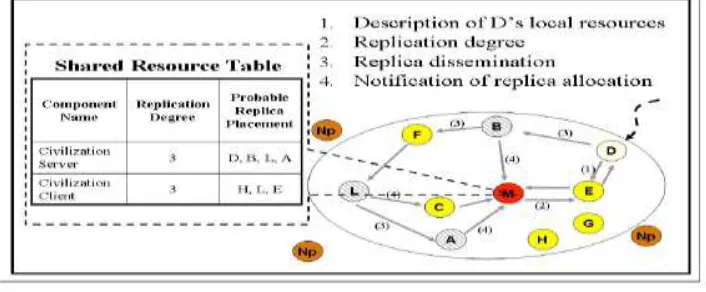
REPLICA IN DMANET middleware component running on D’s device sends the descriptions of D’s resources to the REPLICA IN DMANET replica manager M, running in another node of the dense MANET . The replica manager is in charge of enforcing the needed replication degree and of maintaining information about other resources replicated in the dense region. For any shared resource, the corresponding SRT entry may have some target replication degree and poor consistent information.
Figure 4. Replica in DMANET-based application under Civilization server
The methodology involved in these research may have three phases, like:
i) Deep investigation
ii) Analysis, Designing and Implementation
iii) Modeling and Simulations : Simulation is a process of mechanism of designing a model of a real
system and conducting experiments with this model for the purpose either of understanding the
working of the system or evaluating various strategies for the operation of the system. Hence,
mathematical modeling & simulation is the main part of the research in which application of
different simulation techniques will be developed with the help of simulators like NS-2, OMNET,
Tossim, WSNSim, Jsim, etc.
4. Future Scope
Finally, the development of new improved schemes of WSNs model and the efficiency of a
network can be achieved by selecting the best suitable clustering algorithms based on the sensor
network requirement after comparing the existing algorithms in WSNs.
Our futuristic scenarios bring out the two key requirements of sensor networks: i) support for
very large numbers of unattended autonomous nodes, and ii) energy efficient adaptive to
environment and task dynamics.
5. References
*1+ Giljae Lee, Jonguk Kong, Minsun Lee, and Okhwan Byeon, “A Cluster-Based Energy-Efficient Routing Protocol without Location Information for Sensor Networks ”, International Journal of Information Processing Systems Vol.1, No.1, ISSN 1738-8899, pp. 49-54, 2005.
*2+ Ilker Demirkol, Cem Ersoy, and Fatih Alagöz, “MAC Protocols for Wireless Sensor Networks: A Survey”, IEEE Communications Magazine, pp.115-121, April 2006.
*3+ Wei Ye, Fabio Silva and John Heidemann, “Ultra-Low Duty Cycle MAC with Scheduled Channel Polling”, SenSys’06, Boulder, Colorado, USA, pp.321-334, 2006.
[4] Bing Liang , Qun Liu , “A Data Fusion Approach for Power Saving in Wireless Sensor Networks.”, IEEE Computer and Computational Sciences, IMSCCS 2006. First International Multi-Symposiums on (Volume:2 ), ISBN: 07695-2581-4, pp 582 – 586.
*5+ A. Tiwari, P. Ballal, and F. L. Lewis, “Energy-efficient wireless sensor network design and implementation for condition-based maintenance”, ACM Trans. Sensor Netww (TOSN), vol. 3, no. 1, pp. 1–23, 2007.
Wireless Sensor Networks”. IEEE Mobile Data Management, International Conference 2007. ISBN:1-4244-1241-2 , pp 24 – 29.
*7+ Gowrisankar S., T.G. Basavaraju, Manjaiah D.H, Subir Kumar Sarkar, “Issues in Wireless Sensor Network”, Proceeding of the World Congress on Engineering, Vol. I, WCE, London, UK, 2008.
[8] Ching-Wen Chen, Chuan-Chi Weng and Chang-Jung Ku, “Design of a Low power and Low Latency MAC Protocol with Node Grouping and Transmission Pipelining in Wireless Sensor Networks”, Computer Communications 31, pp.3725–3738, 2008.
*9+ Jennifer Yick, Biswanath Mukherjee, Dipak Ghosal, “Wireless sensor network survey”. Journal of Elsevier for Computer Networks 52, ISSN 2292–2330, pp. 2292-2330, 2008.
*10+ Rajesh Yadav, Shirshu Verma and N. Malviya, “A Survey of MAC Protocols for Wireless Sensor Networks”, UbiCC Journal, Vol.4, No.3, pp.827-833, Aug 2009.
*11+ Veluppillai Mahinthan, Humphrey Rutagemwa, Jon W. Mark and Xuemin (Sherman) Shen, “Cross-Layer Performance Study of Cooperative Diversity System with ARQ”, IEEE Transaction on Vehicular Technology, Vol.58, No.2, pp.705-719, Feb 2009.
*12+ Yuedong Xu, Xiaoxin Wu and John C.S. Lui, “Cross Layer QoS Scheduling for Layered Multicast Streaming in OFDMA Wireless Networks”, Wireless Pers . Communications, pp.51:565-591, 2009.
[13] E. Niewiadomska-Szynkiewicz, P. Kwaśniewski, and I. Windyga, “Comparative study of wireless sensor networks energy-efficient topologies and power save protocols”, J. Telecom. Inform. Technol., no. 3, pp. 68–75, 2009.
[14] Shio Kumar Singh, M P Singh, D K Singh, “A Survey of Energy-Efficient Hierarchical Cluster-Based Routing in Wireless Sensor Networks”, International Journal of Advanced Networking and Applications, Vol.02, Issue.02, pp.570-580, 2010.
[15] Binu G S and Dr. K Poulose Jacob, “Channel Adaptive MAC Protocol with Traffic Aware Distributed Power Management in Wireless Sensor Networks- Some Performance Issues”, International Journal of Computer Science and Network Security, IJCSNS, Vol.10, No.7, pp.14-21, July 2010.
[16] Xianghui Fan, Shining Li, Zhigang Li and Jingyuan Li, “Sensors Dynamic Energy Management in WSN”, Wireless Sensor Network, doi:10.4236/wsn.2010.29084, pp.698-702, Published Online September 2010.
*17+ S.R. Boselin Prabhu and S. Sophia, “A Survey of Adaptive Distributed Clustering Algorithm for Wireless Sensor Networks”, International Journal of Computer Science & Engineering Survey, Vol.2, No.4, pp.165-176, Nov. 2011.
[18] Hai-Ying, Dan-Yan Luo, Yan Gao, De-Cheng Zuo, “Modeling of node Energy Consumption for Wireless Sensor Networks”, International Journal of Scientific Research, vol.3, pp. 18-23, 2011.
Enhanced Base Station controlled Dynamic Clustering Protocol”. International Journal of Computer Applications, ISSN 0975 – 8887, Volume 13– No.4, pp. 44-49, 2011.
*20+ Ahmed Abed Alhameed Alkhatib and Gurvinder Singh Baicher, “Wireless Sensor Network Architecture”, International Conference on Computer Networks and Communication System, IPCSIT Vol.35, pp.11-15, 2012 .
*21+ Joseph Kabara and Maria Calle, “MAC Protocols Used by WSNs and General Method of Performance Evaluation”, International Journal of Distributed Sensor Networks, Vol. 2012, Article Id-834784, 11 pages, doi:10.1155/2012/Id-834784, 2012.
*22+ Diwakar Meenakshi and Sushil Kumar, “Energy Efficient Hierarchical Clustering Routing Protocol for Wireless Sensor Network”, Advances in Computer Science and Information Technology. Networks and communication Lecture notes of the Institute for Computer Sciences, Social informatics and Telecommunications engineering Vol. 84, pp.409-420, 2012.
*23+ Muhammad Mahtab Alam, Olivier Berder, Daniel Menard and Olivier Sentieys, “TAD-MAC: Traffic Aware Dynamic MAC Protocol for Wireless Body Area Sensor Network”, IEEE Journal on Emerging and Selected Topics in Circuits and System, 2012.
*24+ Chongmyung Park, Harksoo Kim and Inbum Jung, “Traffic-aware routing protocol for Wireless Sensor Networks”, Cluster Comput 15:27–36 doi.10.1007/s10586-010-0146-3, pp.27-36, 2012.
*25+ Bhawnesh Kumar and Vinit Kumar Sharma, “Distance based Cluster Head Selection Algorithm for Wireless Sensor Network”, International Journal of Computer Applications, ISSN 0975-887, Vol.57, No.9, pp.41-45, Nov 2012.
*26+ Weitao Xu, Xiaohong Hao and Ping Zhang, “OFDMA Simulation Study for Wireless Sensor Network”, International Conference on Ecology, Waste Recycling and Environmental Advances in Biomedical Engineering, Vol.7, pp.55-59, 2012 .
[27] Krzysztof Daniluka and Ewa Niewiadomska-Szynkiewicz, “A Survey of Energy Efficient Security Architectures and Protocols for Wireless Sensor Networks”, Journal of Telecommunications and Information Technology, Polland, pp-64-72, 2012.