Traditional Communication Media in Rural Information Service Delivery to Adolescents of Selected Communities in OBIO/AKPOR Local Government Area of
Rivers State, Nigeria
BY
Chidi Onuoha Kalu, CLN Institute Library,
National Institute of Construction Technology (NICT), Uromi, Edo State, Nigeria
[email protected] 08034173045
Ijeoma Ann Achi Okidi, CLN Institute Librarian,
National Institute of Construction Technology (NICT), Uromi, Edo State, Nigeria
[email protected] 08033744543
Esther Chidi -Kalu, CLN School Librarian, Safehands Schools, FCT, Abuja, Nigeria [email protected]
08067975292
Prof. Amanze O. Unagha, CLN Senior Lecturer
Department of Library and Information Science, Abia State University, Uturu
Abstract
This research work examined the various communication media used in the rural areas for the purpose of conveying messages to Adolescents in the selected communities in Obio/Akpor Local Government Area of Rivers State, Nigeria - Woji, Rumuigbo, Rumuola, Rumuokwuta and Elelenwo communities. The Taro Yammane Statistical formula for determination of sample size was used in drawing a sample of 363 respondents from a population of 3,630 Adolescents. The simple random sampling method was used in the distribution of the questionnaire to target respondents in the selected communities. Two hundred and eighty two (282) copies of the questionnaire were returned valid, and data from them was analysed and interpreted with the use of frequency tables and percentages. The result shows that traditional communication media is still relevant in the dissemination of information to rural dwellers in general and to Adolescents in particular. The agencies that make use of these media are; village authority, age groups, etc. The research work recommend among others that the government and rural dwellers should hold our traditional and cultural values in high esteem through the use of these media, harmonizing the use of traditional communication media and modern media for effective rural information service delivery.
Keywords: Traditional; Communication; Media; Rural; Information Service Delivery; Adolescent
Communication is what gives social interaction a meaning and it arose from peoples desire to share their internal state of being through some overt expressions. It is an everybody’s affair and encompasses all works of life, and people have further devised methods of transmitting and receiving information. One of such method is the traditional media of communication which encompasses the use of town criers, talking drums, wooden gongs, drama presentation, folk tales etc to disseminate information to the people more especially rural people.
Traditional communication media is defined as the way or means of passing messages or information within a community or rural area. According to Wilkipedia (2017), traditional communication media is defined as means or communication that has existed since before the advent of the new media or the Internet. Chiovoloni (1993) sees traditional communication media as all organized processes of production and exchange of information managed by rural communities. Traditional communication media is as old as civilization, although new media has invaded every walk of life, yet in traditional societies or rural areas interpersonal communication which is part of traditional communication media still commands the supreme place. Interpersonal communication will continue to dominate and it is difficult to provide any other substitutes (Yadav, 2009).
OBJECTIVES OF THE STUDY The objectives of this study are to:
(ii) Find out the effectiveness of traditional communication media in information service delivery to Adolescents of the area studied.
(iii) To ascertain the agencies that employ traditional communication media in information service delivery to Adolescents in the area studied.
(iv) Verify the relevance of traditional communication media to Adolescents of the area studied in this modern age.
(v) Find out the factors militating against traditional communication media in the area studied.
RESEARCH QUESTIONS
(i) What are the traditional communication media in use in the selected communities of Obio/Akpor L. G. A.?
(ii) How effective are the traditional communication media in information service delivery to Adolescents of the selected communities in Obio/Akpor L. G. A.?
(iii) Which agencies employ traditional communication media in information service delivery to Adolescents of the selected communities in Obio/Akpor L. G. A.?
(iv) How relevant is traditional communication media to Adolescents of the selected communities of Obio/Akpor L. G. A. in this modern age.?
(v) What are the factors militating against traditional communication media of the selected communities in Obio/Akpor L. G. A.?
Traditional communication media are vehicles which are rich in variety, and are readily and economically viable. They are tools or channel use in passing information or messages to the people in rural communities. Traditional communication media include the following; talking drums, wooden gongs, folk tales, drama presentation in village square, story-telling, wrestling contest (most especially when a wrestler died, there will be a wrestling contest during his burial signifying that he was a wrestler), dancing, religious rituals, myths, theatrical elements, songs, proverbs, puppet theatre etc. Majmudari (2000) opined that these traditional communication media have capacity to change and adopt the socio-political situation in the rural community and they are the most effective tools in information dissemination in rural area, tribal area and among illiterates as they do not understand the language of modern communication.
songs, used as mass motivators and have played a significant role in the freedom movement, they are tools used in helping to reveal individual talents on the people as well as the collective traditions and characters of the community and love for rhythm through songs and drama presentation and are used by community heads and elders to communicate knowledge and in conveying real messages of technology, crop cultivation and home making. They are used to signal danger in the community such as enemy invasion, death of a prominent individual, summons to take up arms, declaration of war and the approach of foreigners through the beating of talking drum.
Traditional communication media are very useful tools in rural communication and information service delivery. Their uses and functions include; passing on of knowledge and experience, conveyance of moral concepts, give answers to questions of vital significance to human beings, gives information concerning historical events, educating, rural people on the danger of some sexual transmitted diseases through dances and songs (Stichele, 2000). They are useful for rural development and education (Kamlongera, 1999). Live drama, puppet theatre and other popular and traditional media have been used and still in use in top-down way, supporting educational campaigns aiming to convince sedentary farmers and nomadic herdsmen to adopt new techniques for their occupation. In this case, traditional communication media are used much more as an extension tool than as an interactive communication channel (Chiovoloni, 1993).
songs, drama and music make messages on social issues like child labour, individual differences, environment and health issues, women etc motivates viewers and leave an unforgettable impact. According to Onwubiko (2006), oral tradition as part of traditional communication media is the culture of the people, the way of life of the people that is being transmitted from one generation to another by mere words of mouth. Oral tradition being the totality of the peoples way of life and the people’s tradition includes; their native political system, fashion, teaching, farming system, the worship of their God, festival and their ceremonies. Forms of oral tradition are; poetry, prose narrative, drama, tales songs. These traditional communication media serve as reliable channel of news and information gathering, processing and dissemination in many rural communities, and often address local interests and concerns in local languages and cultural contests which the community members can easily understand and with which they can identify.
entertainment, dance, song etc) through modern media. Furthermore, the advent of television and other modern mass media and the non-teaching of these traditional communication media in our schools and universities are causing the rapid disappearing of these media.
METHODOLOGY
The research design used for this study is survey research method. In deriving the sample size, the sampling technique adopted was the Taro Yamenne’s statistical formula use in deriving a known population. The sample size of 363 was derived from 3,630 population size of the Adolescents of the selected communities in Obio/Akpor Local Government Area of Rivers State, Nigeria - Woji, Rumuigbo, Rumuola, Rumuokwuta and Elelenwo communities. A well-structured questionnaire and interview was used as the instrument for data collection. A total of 363 copies of questionnaires were distributed, 73 copies each to Elelenwo, Rumuokwuta and Rumuola communities, while 72 copies each to Woji and Rumuigbo communities. But only 348 (95.9%) copies were returned, and 15 (4.1%) copies were not returned. Out of 348 (95.9%) copies returned, 282 (77.7%) copies were validly filled while 66 copies (18.2%) were invalidly filled.
Table 1: Distribution and returned of questionnaire
Questionnaire Frequency Percentage
Distributed 363 100
Validly returned 282 77.7
Not returned 15 4.1
RESULTS AND DATA PRESENTATION Table 2: Response Rate
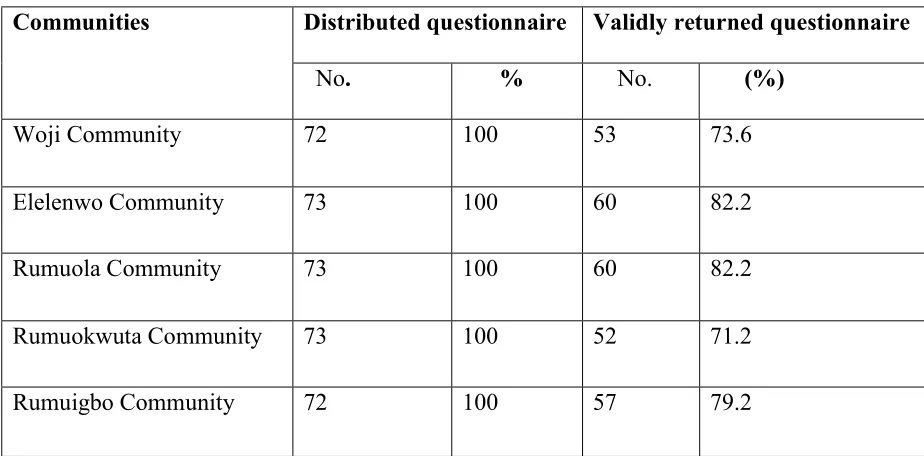
Table 2 shows that 72 copies of questionnaire were distributed to Woji community in which 53 (73.6%) were validly returned, Elelenwo community had 73 copies of questionnaire, 60 (82.2%) were validly returned, Rumuola community had 60 copies of questionnaire, 60 (82.2%) were validly returned, while Rumuokwuta and Rumigbo communities received 73 and 72 copies of questionnaire and 52 (71.2%) and 57 (79.2%) were validly returned respectively.
Table 3: Traditional Communication Media available in the selected communities
Items W E R/ola R/Okwuta R/Igbo
Communities Distributed questionnaire Validly returned questionnaire
No. % No. (%)
Woji Community 72 100 53 73.6
Elelenwo Community 73 100 60 82.2
Rumuola Community 73 100 60 82.2
Rumuokwuta Community 73 100 52 71.2
No % No % No % No % No %
Gong 7 13.2 5 8.3 3 5.0 8 15.4 3 5.3
Talking drum 5 9.4 7 11.7 4 6.7 5 9.6 6 10.5
Drama presentation - - - -
Traditional dance 1 1.9 3 5.0 5 8.3 - - 2 3.5
Folk tales/ songs 10 18.9 11 18.4 13 21.7 10 19.2 12 21.1
Wrestling contest 4 7.5 2 3.3 5 8.3 - - 2 3.5
Religious ritual 10 18.9 3 5.0 - - 3 5.8 6 10.5
Town crier 16 30.2 29 48.3 30 50.0 26 50.0 26 45.6
Total 53 100 60 100 60 100 52 100 57 100
(Note: W = Woji, E = Elelenwo, R/Ola = Rumuola, R/Okwuta = Rumuokwuta, R/Igbo =
Rumuigbo)
crier recorded the highest number of respondents who indicated its availability with 30(50%). Gong had 3(5%) respondents, as those indicated for traditional dances are 5(8.3%) respondents. 13(21.7%) indicated the availability of folk tales/songs, 5(8.3%) said wrestling contest, while religious rituals had none. In Rumuokwuta community, gong had 8(15.4%) of the respondents, 5(9.6%) indicated the availability of talking drum, 10(19.2%) agreed on folk tales/songs. While 3(5.8%) and 26(50%) of the respondents indicated the availability of religious rituals and town crier respectively. In Rumuigbo community, 3(5.3%) of the respondents indicated the availability of gong in their area, 6(10.5%) indicated talking drum, traditional dances had 2(3.5%) respondents, folk tales/songs had 12(21.1%). Wrestling contest recorded 2 (3.5%) of the respondents, while religious rituals and town crier had 6910.5%) and 26(45.6%) of the respondents respectively.
Table 4: Traditional Communication Media often used in information dissemination in the selected communities
Items W E R/Ola R/Okwuta R/Igbo
No % No % No % No % No %
Gong - - - 12 23.1 8 14.0
Talking drum - - - -
Drama presentation - - - -
Traditional dance - - - -
Wrestling contest - - - -
Religious ritual - - - -
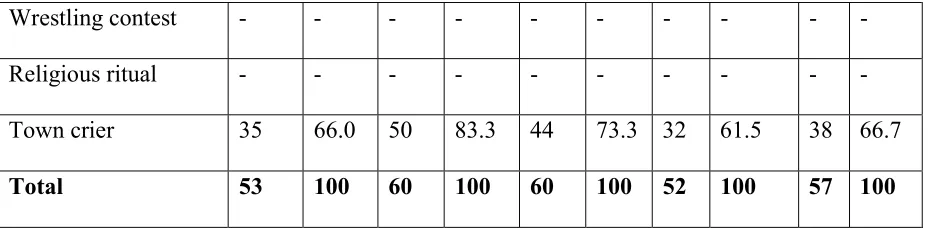
Town crier 35 66.0 50 83.3 44 73.3 32 61.5 38 66.7
Total 53 100 60 100 60 100 52 100 57 100
(Note: W = Woji, E = Elelenwo, R/Ola = Rumuola, R/Okwuta = Rumuokwuta, R/Igbo =
Rumuigbo)
In Table 4, 12(23.1%) of the respondents indicated that gong is often used in information dissemination in Rumuokwuta community, 8(15.4%) agreed on folk tales/songs in the same Rumuokwuta, while 32(61.5%) respondents said town crier is often used in Rumuokwuta community. In Woji community, 18(34%) respondents said that folk tales/songs are often used whereas 35(66%) respondents indicated town crier. Folk tales/songs and town crier had 10(16.7%) and 50(83.3%) respondents respectively who said that they are often used for information dissemination in Elelenwo community. In Rumuola community, 16(26.7%) respondents indicated that folk tales/songs are often used in information dissemination in that area while town crier had 4(73.3%) and in Rumuigbo community, 8(14%) indicated often use of gong for information dissemination, folk tales/songs had 11(19.3%) of the respondents and 38(66.7%) of the respondents indicated town crier respectively.
Remark
Communities / No of Respondents
W E R/Ola R/Okwuta R/Igbo Total %
Excellent 10 12 6 10 5 41 14.5
Good 20 18 29 20 24 111 39.4
Fairly good 9 17 18 12 21 77 27.3
Bad 6 9 5 7 5 33 11.7
Very bad 8 4 2 3 2 20 7.1
Total 53 60 60 52 57 282 100
(Note: W = Woji, E = Elelenwo, R/Ola = Rumuola, R/Okwuta = Rumuokwuta, R/Igbo =
Rumuigbo)
The data on table 5 shows that 41 (14.5%) of the respondents rated the effectiveness of Traditional Communication Media excellently. 111 (39.4%) rated its effectiveness good, 77 (27.3%) respondents said they are fairly good, while 33 (11.7%) and 20 (7.1%) respondents disagreed with the other respondents as they rated the effectiveness of Traditional Communication Media in their various communities bad and very bad respectively.
Table 6: The factors that militate against Traditional Communication Media in the selected communities
Items W E R/Ola R/Okwuta R/Igbo
Government attitude towards the use of these media in information dissemination
9 17 12 20 7 11.7 10 19.2 14 24.6
Peoples’ attitude /perception of traditional media
7 13.2 3 5 5 8.3 7 13.5 9 15.8
Influence of modern media 17 32.1 32 53.3 30 50 20 38.5 20 35 Semi or total urbanization 20 37.7 13 21.7 18 30 15 28.8 14 24.6
Total 53 100 60 100 60 100 52 100 57 100
(Note: W = Woji, E = Elelenwo, R/Ola = Rumuola, R/Okwuta = Rumuokwuta, R/Igbo =
Rumuigbo)
communication media in their area and semi or total urbanization had 13(21.7%) of the respondents. The data from Rumuola community indicated that 7(11.7%) of the respondents agreed that government attitude towards the use of these media is a factor that militate against it in that area, 5(8.3%) agreed that it is peoples’ attitude and perception of traditional media, while 30(50%) and 18(30%) said it is influence of modern media and semi or total urbanization respectively. In Rumuokwuta community, 10(19.2%) and 7(13.5%) of the respondents indicated that government attitude toward the use of traditional communication media in information dissemination and peoples’ attitude /perception of traditional media respectively are factors militating against its use in their area, while those agreed on influence of modern media and semi or total urbanization are 20(38.5%) and 15(28.8%) respectively. Furthermore, in Rumuigbo community, 14(24.6%) of the respondents agreed on government attitude towards the use of these media in information dissemination, 9(15.8%) said it is people’s attitude /perception of traditional media. While influence of modern media had 20(35%) of the respondents and 14(24.6%) agreed on semi or total urbanization.
Table 7: The extent to which Traditional Communication Media is still striving in the selected communities in spite of ever-increasing rate of new communication media
Extent
Communities & No of Respondents
W E R/Ola R/Okwuta R/Igbo Total %
High Extent 10 5 10 7 11 43 15.2
Average Extent 12 7 15 19 10 63 22.3
Low Extent 12 23 16 10 20 81 28.7
Very Low Extent 11 15 9 11 10 56 20
Total 53 60 60 52 57 282 100
(Note: W = Woji, E = Elelenwo, R/Ola = Rumuola, R/Okwuta = Rumuokwuta, R/Igbo =
Rumuigbo)
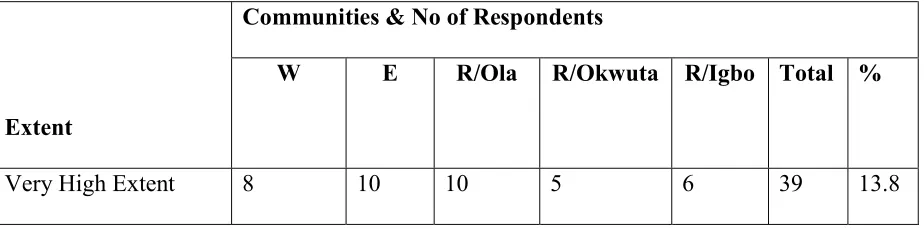
Table 7 shows that 39 (13.8%) of the respondents affirmed that the extent at which traditional communication media is still striving in Obio/Akpor Local Government Area in spite of ever-increasing rate of new communication media is very high. The respondents that agreed on high extent are 43 (15.2%), 63 (22.3%) respondents said it is average, while 81 (28.7%) and 56 (20%) respondents rated it low and very low respectively.
Table 8: The information dissemination agencies that make use of the Traditional Communication Media
Agencies
Communities & No of Respondents
W E R/Ola R/Okwuta R/Igbo Total %
Lib. & Inf. Centre - - - -
Age Groups 10 12 15 15 12 64 22.7
Village Authority 23 34 26 18 22 123 43.6
Parents/ Elderly ones 15 10 11 7 18 61 21.6
Total 53 60 60 52 57 282 100
(Note: W = Woji, E = Elelenwo, R/Ola = Rumuola, R/Okwuta = Rumuokwuta, R/Igbo =
Rumuigbo)
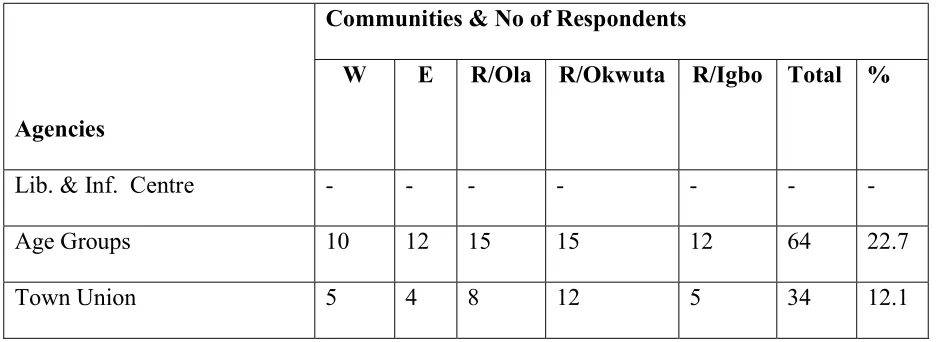
From the table 8, it shows that Library and Information centres do not have anything to do with traditional communication media, 64 (22.7%) of the respondents indicated that age groups make use of traditional communication media. Also, 34 (12.1%) opted for town union, village authority had 123 (43.6%) respondents, while 61 (21.6%) indicated that their parents and elderly ones make use of the traditional communication media in the area of folk tales and songs in passing information to them.
DISCUSSION
study exposed that traditional communication media is making an impact in the lives of the people in the area as it is the major means of information dissemination in the rural areas. It was revealed that influence of modern media like television, radio and cell phones, and semi or total urbanization of the area are major factors militating against its use, but despite that the respondents agreed that the modern media do not have much effect on the use of these traditional communication media as the they rated the extent at which the traditional media is still striving in their area as been considerate.
CONCLUSION
Traditional communication media is still a veritable tool in rural information service delivery to Adolescents in spite of the ever-increasing new media in this global age. It is obvious that the rural dwellers cannot do away with traditional communication media if there must be proper dissemination of information as these media are what they inherited from their fore-fathers. Also, these traditional media are used to call for meetings of Adolescents when the need arises. Parents and elderly ones use folk tales and songs to convey important messages to the Adolescents during moon light hours. Village authorities used the media to call on the Adolescents for important issues in the community which concerns them, the list is inexhaustible. Town crier, use of gongs, folk tales and songs etc cannot be relegated to the background when it comes to an effective dissemination of information in rural areas.
RECOMMENDATIONS
1 The government should create an atmosphere where there should be exhibition of these traditional communication media and how they can be used effectively.
2 The government should help in harmonizing traditional communication media and modern media to achieve greater rural information service delivery.
3 The rural dwellers, urban dwellers and the government should hold our traditional and cultural values in high esteem through the use of traditional communication media in rural information service delivery.
4 The use traditional communication media should be taught in our post –primary schools and universities, and the government should be involved in preserving our culture through proper harnessing of these traditional communication media by using them often in mobilizing and educating the rural populace on government programmes, developmental issues etc.
5 There should be an establishment of community library and information service centres by government in which these traditional communication media can be captured and documented by barefoot librarian or information animator in a tape or video tape or other means suitable for him.
REFERENCES
2. Frank, D and Gohla, P. H. (1998). Aspect of traditional communication. Germany: Catholic Media Council Publication.
3. Infospace.com (2017). Communication through traditional media. Retrieved from
http://wsclick.infospace.com on June 29, 2010.
4. Kamlongera, C. (1999). Folk Media in Communication for development. FAO publication.
5. Majmudari, J. (2000). Traditional Media: An effective communication tool to sustain rural agriculture through organic farm. India: Department of Home Management. 6. Onwubiko, C. P. C. (2006). Introduction to Oral Literature I: Unpublished lecture
note. Department of Library and Information Science, Abia State University, Uturu. 7. Stichele, V. P. (2000). Folk and traditional media for rural development. A workshop
organised by Sustainable development Department (SDD), Food and Agricultural Organisation (FAO), Malawi: FAO publication.
8. Wikipedia (2017) The definition of Traditional Media of Communication. Retrieved from www.answer.com on 24th June 2010.