Article
“On-the-fly” calculation of the Vibrational
Sum-frequency Generation Spectrum at the Air-water
Interface
Deepak Ojha1and Thomas D. Kühne1,2*
1 Dynamics of Condensed Matter and Center for Sustainable Systems Design, Chair of Theoretical Chemistry,
Department of Chemistry, Paderborn University, Warburger Str. 100, 33098 Paderborn, Germany; [email protected]
2 Paderborn Center for Parallel Computing and Institute for Lightweight Design, Paderborn University,
Warburger Str. 100, D-33098 Paderborn, Germany; [email protected] * Correspondence: [email protected];
Version July 14, 2020 submitted to Molecules
Abstract:In the present work, we provide an electronic structure based method for the “on-the-fly” 1
determination of vibrational sum frequency generation (v-SFG) spectra. The predictive power of 2
this scheme is demonstrated at the air-water interface. While the instantaneous fluctuations in 3
dipole moment are obtained using the maximally localized Wannier functions, the fluctuations in 4
polarizability are approximated to be proportional to the second moment of Wannier functions. The 5
spectrum henceforth obtained captures the signatures of hydrogen bond stretching, bending, as well 6
as low-frequency librational modes. 7
Keywords:vSFG; Air-water interface ; On-the-fly; AIMD 8
1. Introduction 9
Vibrational spectroscopy provides microscopic fingerprints of the structure and dynamics at the molecular level in condensed phase systems.[1–3] However, theoretical interpretation and peak characterization of vibrational spectra predominantly relies on molecular dynamics simulations.[4–9] Nevertheless, the success of simulations also depends largely on the forcefield employed to describe the interatomic interactions. In this regard, ab-initio molecular dynamics (AIMD) has proven to be extremely useful as the interatomic forces are obtained from accurate electronic structure calculations.[10,11] For periodic systems, the overall electronic state within the AIMD framework is generally expressed in the terms of Bloch oribtals
Ψ(r,k) =e(ik·r)ui(r,k), (1a)
where
ui(r,k) =ui(r+R,k), (1b)
withΨ(r,k)being the electronic wavefunction,ui(r,k)the Bloch function andRa translational lattice parameter.[12] An alternative representation, which is more suited for chemical problems, is provided by so-called maximally localized Wannier functions (MLWFs), i.e.wn(r−R)that are obtained by a unitary transformation of the Bloch orbitals.[13,14] The construction of this Wannier representation
Submitted toMolecules, pages 1 – 8 www.mdpi.com/journal/molecules
enables to split the continuously varying total electronic density into contributions originating from localized fragments of the system. Mathematically, MLWFs are expressed as
wn(r−R) = V 2π3
Z
BZdke
−ik·R
∑
J m=1Umn(k)ψmk(r), (2)
where R is the lattice vector of the unit cell and V is the real-space primitive cell volume. The J×JmatrixUmn(k)is the unitary transformation matrix andψmk(r)are the eigenstates of the system computed by density function theory (DFT). The corresponding MLWFs are then obtained by the unitary transformationUmn(k)that minimizes the spread functional
S=
∑
nSn=
∑
n(Dwn
r
2 wn
E
− hwn|r|wni2). (3)
Therein,
r2
is the second moment, whereashri2is the squared first moment of the Wannier centers. This unitary transformation based localization can be readily implemented on the position operator ˆr within the Wannier representation to obtain localized orbitals for a given periodic system of arbitrary symmetry.[15–17] As a result, the scheme can be used to compute the electronic contributions to the polarization of a system. Moreover, it also allows to calculate instantaneous fluctuations in the molecular dipole moment and within the linear-response regime, obtain the linear as well as nonlinear infrared spectrum using time-correlation function formalism.[18–24] In this regard, Raman and higher nonlinear analogs like v-SFG, 2D-vSFG and 2D-Raman can also be computed by applying a constant periodic electric field using the Berry phase formalism[25–27], or by calculating the polarizability tensorA
Aij=− δMi(E)
δEj
, (4)
where Mis the total dipole moment andE is an externally applied electric field. This scheme of 10
computing the polarizability tensor has been utilized to obtain isotropic Raman spectrum by means of 11
density functional perturbation theory.[28–31] 12
In this paper, we present a novel computational method to obtain the v-SFG spectrum of the 13
air-water interface. This anisotropic Wannier Polarizability (WP) method is based on a technique of 14
computing the fluctuations within the dipole moment and polarizbaility “on-the-fly” during an AIMD 15
simulation without any additional computational cost.[32] For that purpose, the fluctuations in the 16
dipole moment are obtained using the Wannier centers, whereas the components of the polarizability 17
tensor are approximated using the second moment of the Wannier centers. However, it is noteworthy 18
to mention that several other computational studies have obtained the vSFG spectrum using empirical 19
maps[33–40], velocity correlations[41–44], as well as directly from AIMD simulations[45–48]. 20
2. Results 21
2.1. Anisotropic Wannier Polarizability Method 22
the fluctuations of the volume of the Wannier centers instead of the overall molecular volume. As a result, the net isotropic polarizability can be expressed as
¯ A= 1
3 NWF
∑
i=1 Ai =
β 3
NWF
∑
i
S3i, (5)
whereSiis the spread of theithWannier center,NWFis the number of MLWFs andβis a proportionality 23
constant. The isotropic Raman spectrum is then obtained as the Fourier transform of the polarizability 24
time-correlation function. 25
On similar lines, the v-SFG spectrum of a non-centrosymmetric system is given as
χ2abc(ω) =
Z ∞
0 dte iωt ˙
Aab(0)·M˙c(t), (6)
whereχ2abcis the second order susceptibility, whereasAabis theabthcomponent of the polarizability tensor andMciscthcomponent of the dipole moment.[33,36,45] In contrast to Raman spectroscopy, the computation of v-SFG spectra requires the diagonal elements of the polarizability tensor. In this regard, we note that the second moment, i.e.
wnr2
wnand the polarizability are tensors of same size. Accordingly, we have approximated that the component specific fluctuations in the polarizability are proportional to the second moment of the Wannier centers, i.e.
Aab∝
D wn r 2 ab wn E . (7)
The strength of the anisotropic WP method is that for each set of an electron pair, we have a unique 26
Wannier center and its corresponding moments. As a result, the method can be used to specifically 27
study the contributions from the different fragments of the system. Moreover, it is also computationally 28
less expensive as the polarizability is determined "on-the-fly" from the second moments of Wannier 29
centers, which is in contrast with existing approaches, where the polarizability is obtained by numerical 30
differentiation of the total dipole moment with respect to an externally applied electric field. This is 31
to say that a simple minimization of the spread functional provides the Wannier centers and their 32
corresponding moments, which are used to obtain the dipole and the polarizability, respectively. Thus, 33
a single AIMD-based Wannier center calculation is sufficient to obtain the dipole moment, as well as 34
the polarizability. 35
2.2. Application to the Air-water interface 36
To demonstrate the predictive power of the present anisotropic WP method, we have computed 37
the v-SFG of at the air-water interface. For the sake of simplicity, we have assumed that the 38
contributions originating from Wannier centers, which are associated with the lone pair of electrons, to 39
the overall polarizability can be safely neglected. The spectral dynamics is predominantly governed 40
by the dynamical evolution of the Wannier centers corresponding to the bonded electron pairs. The 41
average molecular dipole moment of the water molecules obtained using the Wannier centers, whose 42
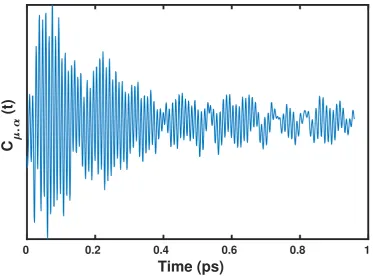
distribution is shown in Fig.1, was found to be 2.46 Debye. The dipole-polarizability cross-correlation 43
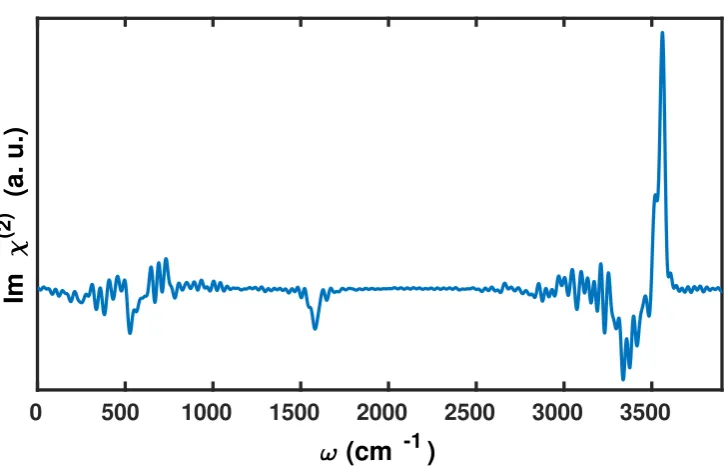
function and the v-SFG spectrum computed based on the fluctuations within the dipole moments 44
obtained by using the Wannier centers and polarizabilities by means of the second moment are 45
shown in Figs.2and3, respectively. We find that the v-SFG spectrum obeys characteristic peaks 46
corresponding to librational, bending, OH stretching, as well as free OH modes. Since there are 47
various previous experimental and simulation based studies analysing the stretching, bending and 48
librational modes within the v-SFG spectrum at the air-water interface, we only briefly highlight our 49
findings in light of the existing literature. First, we will focus on the spectral region of 3000-3800 50
cm−1, which is predominantly attributed to OH stretching modes. More precisely, earlier simulation 51
1.5
2
2.5
3
3.5
(Debye)
Figure 1. Distribution of molecular dipole moment (µ) of water molecules at ambient conditions, as
computed using the maximally localized Wannier centers.
0
0.2
0.4
0.6
0.8
1
Time (ps)
C
.
(t)
0
500
1000
1500
2000
2500
3000
3500
(cm
-1)
Im
(2)
(a. u.)
Figure 3. The v-SFG spectrum of interfacial water molecules computed by the present anisotropic WP method.
around 3700cm−1.[33,34,36,37,45] Using our anisotropic WP method, we also find a broad negative 53
peak at 2900-3500cm−1and sharp positive peak around∼3600cm−1. The former broad negative 54
peak contribution originates from hydrogen-bonded water molecules with the overall dipole aligned 55
towards the bulk, whereas the latter sharp positive peak is connected with the free and dangling OH 56
modes of the interfacial water molecules. The observed red-shift within the peak positions can be most 57
likely attributed to the choice of XC functional and employed pseudopotentials in the present study. 58
Earlier experimental and simulation studies of the bending mode have reported a broad negative peak 59
around 1650cm−1and a positive shoulder around 1750cm−1.[43,46] Here, using the anisotropic WP 60
method, we also observe a broad negative peak between 1400 and 1650cm−1, which is governed by the 61
free and dangling OH modes. However, at variance to these earlier studies,[43,46] we can not confirm 62
any positive shoulder in our calculations. Finally, we observe a negative peak at around 450-650cm−1 63
that is governed by the librational motion of water molecules. Apart from a consistent red-shift within 64
the peak positions, our results are in good agreement with earlier results that have also reported a 65
negative peak in the region of 700-800cm−1.[42] 66
3. Computational Methods 67
Ab initiomolecular dynamics simulations were performed by using the method of Car and 68
Parrinello,[10,50] as implemented in the CPMD code[51]. Simulations of the air-water interface 69
comprising of 80 H2Omolecules were performed at 300 K in a cubic box of edge length 12.43 Å 70
corresponding to the density at ambient conditions. [52] The air-water interface was generated by 71
increasing the edge length of the box to 37.2 Å in the z-direction. The Kohn-Sham formulation of 72
density functional theory was applied to represent the electronic structure of the system within a plane 73
wave basis set.[11] In order to represent the core-shell electrons, Vanderbilt ultra-soft pseudopotentials 74
were used and the plane wave expansion of Kohn-Sham orbitals was truncated at a kinetic energy 75
cutoff of 25 Ry.[53] The electronic orbitals were assigned a fictitious mass of 400 a.u. and equations of 76
motion were integrated with a time step of 4 a.u. 77
In the present work, we have used the dispersion corrected BYLP-D exchange and correlation 78
(XC) functional,[54–56] since previous AIMD studies have shown that inclusion of London dispersion 79
diagram of"ab initio"water and aqueous solutions in better agreement with experiment.[48,57–60] 81
The initial configuration was generated using classical molecular dynamics simulations. Subsequently, 82
the production run was carried out in the canonical NVT ensemble using Nose-Hoover thermostats 83
for 50 ps. 84
The identification of interfacial water molecules at the air-water system was conducted using the 85
algorithm for the identification of truly interfacial molecules ITIM.[61,62] This scheme uses a probe 86
sphere to detect the molecules at the surface. The radius of the probe sphere was set to 2 Å which has 87
been proven to be a good value for water.[62] A cutoff-based cluster search was also performed using 88
3.5 Å as a cut-off, which corresponds to the first minimum of the O· · ·O radial distribution function 89
in liquid water. 90
4. Conclusions 91
To summarize, we have proposed a computationally efficient “on-the-fly” method to determine 92
the v-SFG spectrum for interfacial systems. This anisotropic WP method utilizes the second moment 93
of the Wannier centers to estimate the polarizability fluctuations. The major strength of this 94
method is that it captures the spectral signatures of the system for the collective, as well as highly 95
localized modes. Furthermore, it can be directly applied to spectral decomposition by computing 96
fragment-specific contributions from the Wannier centers and their second moment to assist the 97
interpretation of the experimental measurements. Moreover, the algorithm employed here can be 98
easily extended to other spectroscopic techniques like two-dimensional v-SFG,[65] time-dependent 99
v-SFG,[66] 2D-Raman-Thz,[67] pump-probe Thz[68] and 2D-Raman,[69] to name just a few. From 100
the application perspective, interfacial reactivity, “on-water” catalysis, and other interfacial chemical 101
processes can also be studied using our anisotropic WP-based method. Nevertheless, for greater 102
agreement with the experiment, it would be important to better understand the role of simulation 103
protocols and the approximations made, which we propose as an extensions for future works. 104
Author Contributions:D.O. and T.D.K. conceived the methodology, D.O. conducted the simulations, D.O. and
105
T.D.K. reviewed the manuscript.
106
Funding:The authors would like to thank the Paderborn Center for Parallel Computing (PC2) for the generous
107
allocation of computing time on FPGA-based supercomputer “Noctua”. This project has received funding from the
108
European Research Council (ERC) under the European Union’s Horizon 2020 research and innovation programme
109
(grant agreement No 716142).
110
Conflicts of Interest: “The authors declare no conflict of interest.”
111
References 112
1. S. Nihonyanagi, S. Yamaguchi, T. Tahara,Chem. Rev.16, 10665 (2017).
113
2. Q. Du, R. Superfine, E. Freysz, and Y. R. Shen,Phys. Rev. Lett.70, 2313 (1993).
114
3. Y. R. Shen and V. Ostroverkhov,Chem. Rev.106, 1140 (2006).
115
4. H. J. Bakker and J. L. Skinner,Chem. Rev.110, 1498 (2010).
116
5. G. L. Richmond,Chem. Rev.102, 2693 (2002).
117
6. G. L. Richmond,Annu. Rev. Phys. Chem.52, 357 (2001).
118
7. F. Perakis, L. D. Marco, A. Shalit, F. Tang, Z. R. Kann, T. D. Kühne, R. Torre, M. Bonn, and Y. NagataChem. 119
Rev.,116, 7590 (2016).
120
8. D. Ojha, K. Karhan, and T. D. Kühne,Sci. Rep. 8, 16888 (2018).
121
9. C. John, T. Spura, S. Habershon, and T. D. Kühne,Phys. Rev. E93, 043305 (2016).
122
10. D. Marx and J. Hutter,Ab InitioMolecular Dynamics: Basic Theory and Advanced Methods, Cambridge
123
University Press, Cambridge, 2009.
124
11. T. D. Kühne,WIREs Comput. Mol. Sci.4, 391 (2014).
125
12. I. Souza, N. Marzari and D. Vanderbilt,Phys. Rev. B 65, 035109 (2001).
126
13. N. Marzari and D. Vanderbilt,Phys. Rev. B 56, 12847 (1997).
127
14. N. Marzari, A. A. Mostofi, J. R. Yates, I. Souza, D. Vanderbilt,Rev. Mod. Phys. 84, 1419 (2012).
15. P. L. Silvestrelli,Phys. Rev. B 59, 9703 (1999).
129
16. G. Berghold, C. J. Mundy, A. H. Romero, J. Hutter, and M. Parrinello,Phys. Rev. B 61, 10040 (2000).
130
17. R. Resta,Phys. Rev. Lett. 80, 1800 (1998).
131
18. W. Chen, M. Sharma, R. Resta, G. Galli, and R. CarPhys. Rev. B 77, 245114 (2008).
132
19. Marie-Pierre Gaigeot and M. Sprik,J. Phys. Chem. B 107, 10344 (2003).
133
20. M. Heyden, J. Sun, S. Funkner, G. Mathias, H. Forbert, M. Havenith and D. Marx,Proc. Nat. Acad. Sci.107,
134
12068 (2010).
135
21. C. Zhang, R. Z. Khaliullin, D. Bovi, L. Guidoni, and T. D. Kühne,J. Phys. Chem. Lett.4, 3245 (2013).
136
22. D. Ojha, A. Henao, and T. D. Kühne,J. Chem. Phys.148, 102328 (2018).
137
23. D. Ojha and A. Chandra,Phys. Chem. Chem. Phys.,21, 6485 (2019).
138
24. D. Ojha and A. Chandra,Chem. Phys. Lett.,751, 137493 (2020).
139
25. R. Resta,Rev. Mod. Phys. 66, 899 (1994).
140
26. R. D. King-Smith and D. Vanderbilt,Phys. Rev. B 47, 1651 (1993).
141
27. P. Umari and A. PasquarelloPhys. Rev. Lett. 89, 157602 (2002).
142
28. S. Baroni, S. De Gironcoli, A. Dal Corso, and P. Giannozzi,Rev. Mod. Phys. 73, 515 (2001).
143
29. A. Putrino and M. Parrinello,Phys. Rev. Lett. 88, 176401 (2002).
144
30. S. Luber, M. Iannuzzi, and J. Hutter,J. Chem. Phys. 141, 094503 (2014).
145
31. T. D. Kühne et al.,J. Chem. Phys.152, 194103 (2020).
146
32. P. Partovi Azar and T. D. Kühne,J. Comput. Chem. 36, 2188 (2015).
147
33. A. Morita and J. T. Hynes,Chem. Phys.258, 371 (2000).
148
34. A. Morita and J. T. Hynes,J. Phys. Chem. B106, 673 (2002).
149
35. T. Ishiyama, T. Imamura, and A. MoritaChem. Rev.114, 8447 (2014).
150
36. P. A. Pieniazek, C. J. Tainter, and J. L. Skinner,J. Amer. Chem. Soc.133, 10360 (2011).
151
37. Y. Li and J. L. Skinner,J. Chem. Phys.,145, 124509 (2016).
152
38. Y. Li and J. L. Skinner,J. Chem. Phys.,145, 03110 (2016).
153
39. P. A. Pieniazek, C. J. Tainter, and J. L. Skinner,J. Chem. Phys.135, 044701 (2011).
154
40. Y. Li, M. Gruenbaum and J. L. Skinner,Proc. Nat. Acad. Sci.110, 1992 (2013).
155
41. T. Ohta, K. Usui, T. Hasegawa, M. Bonn and Y. Nagata,J. Chem. Phys.143, 124702 (2015).
156
42. R. Khatib, T. Hasegawa, M. Sulpizi, E. H. G. Backus, M. Bonn, and Y. Nagata, J. Phys. Chem. C120, 18665
157
(2016).
158
43. Y. Nagata, C-S Hsieh, T. Hasegawa, J. Voll, E. H. G. Backus, and M. Bonn,J. Phys. Chem. Lett.11, 1872 (2013).
159
44. N. K. Kaliannan, A. Henao, H. Wiebeler, F. Zysk, T. Ohto, Y. Nagata, and T. D. Kühne,Mol. Phys.118, 1620358
160
(2020).
161
45. M. Sulpizi, M. Salanne, M. Sprik, and M. Pierre GaigeotJ. Phys. Chem. Lett.4, 83 (2013).
162
46. R. Khatib and M. SulpiziJ. Phys. Chem. Lett.8, 1310 (2017).
163
47. C. Liang , J. Jeon, and M. Cho,J. Phys. Chem. Lett.10, 1153 (2019).
164
48. T. Ohto, M. Dodia, J. Xu, S. Imoto, F. Tang, F. Zysk, T. D. Kühne, Y. Shigeta, M. Bonn, X. Wu, and Y. Nagata,J. 165
Phys. Chem. Lett.10, 4914 (2019).
166
49. P. Partovi-Azar, T. D. Kühne, and P. Kaghazchi,Phys. Chem. Chem. Phys.17, 22009 (2015).
167
50. R. Car and M. Parrinello,Phys. Rev. Lett.,55, 2471 (1985).
168
51. J. Hutter, A. Alavi, T. Deutsch, M. Bernasconi, S. Goedecker, D. Marx, M. Tuckerman, and M. Parrinello,
169
CPMD Program, MPI für Festkörperforschung and IBM Zurich Research Laboratory. See www.cpmd.org.
170
52. D. R. Lide,CRC Handbook of Chemistry and Physics, 84th Edition. Taylor & Francis, 2003.
171
53. D. Vanderbilt, Phys. Rev. B,41, 7892 (1990).
172
54. A. D. Becke,Phys. Rev. A,38, 3098 (1988).
173
55. C. Lee, W. Yang, and R. G. Parr,Phys. Rev. B,37, 785 (1988).
174
56. S. Grimme,J. Comput. Chem.,27, 1787 (2006).
175
57. M. J. McGrath, I. F. Kuo, and J. I. Siepmann,Phys. Chem. Chem. Phys.,13, 19943 (2011).
176
58. T. D. Kühne, T. A. Pascal, E. Kaxiras, and Y. Jung,J. Phys. Chem. Lett.2, 105 (2011).
177
59. M. J. McGrath, I. F. Kuo, J. N. Ghogomu, C. J. Mundy, and J. I. Siepmann,J. Phys. Chem. B,115, 11688 (2011).
178
60. Y. Nagata, T. Ohto, M. Bonn, and T. D. Kühne,J. Chem. Phys.144, 204705 (2016).
179
61. L. B. Pártay, G. Hantal, P. Jedlovszky, Á. Vincze, and G. Horvai,J. Comp. Chem.29, 945 (2008).
180
62. M. Sega, S. S. Kantorovich, P. Jedlovszky, and M. Jorge,J. Chem. Phys.138, 044110 (2013).
63. K. E. Laidig and R. F. W. BaderJ. Chem. Phys93, 7213 (1990).
182
64. R. F. W. Bader, Atoms in Molecules: A Quantum Theory, Oxford University Press:Oxford (1990)
183
65. J. Bredenbeck, A. Ghosh, H-K Nienhuys, and M. Bonn,Acc. Chem. Res.42, 1332 (2009).
184
66. D. Ojha, N. K. Kaliannan, and T. D. Kühne,Commun. Chem.2, 116 (2019).
185
67. J. Savolainen, S. Ahmed, and P. Hamm,Proc. Nat. Acad. Sci.110, 20402 (2013).
186
68. H. Elgabarty, T. Kampfrath, D. J. Bonthuis, V. Balos, N. K. Kaliannan, P. Loche, R. R. Netz, M. Wolf, T. D.
187
Kühne, and M. Sajadi,Sci. Adv.6, eaay7074 (2020).
188
69. Y. Tanimura and S. Mukamel,J. Chem. Phys.,999496 (1993).
189
c
2020 by the authors. Submitted toMoleculesfor possible open access publication under the terms and conditions
190
of the Creative Commons Attribution (CC BY) license (http://creativecommons.org/licenses/by/4.0/).