ISSN: 2319-8753
I
nternational
J
ournal of
I
nnovative
R
esearch in
S
cience,
E
ngineering and
T
echnology
(An ISO 3297: 2007 Certified Organization)
Vol. 2, Issue 10, October 2013
Copyright to IJIRSET www.ijirset.com 5617
Process Intensification of an Intermediate
Stage of Cypermethrin Synthesis
Shriraj Shetty
1*, Kavita Kulkarni
2PG Student, Chemical Engineering Department, Bharati Vidyapeeth University, College of Engineering, Pune, India1 Associate Professor, Chemical Engineering Department, Bharati Vidyapeeth University, College of Engineering, Pune,
India2
Abstract: Cypermethrin has a growing demand in India. It is a cyclopropane carboxylate derivative which can be synthesized using 2-(2,2-dichlorovinyl)-3,3-dimethylcyclopropanecarboxylic acid chloride, sodium cyanide and meta-phenoxy benzaldehyde. But, the cyclopropane carboxylate derivative is produced from 4-Chloro-3,3-dimethyl-2-(2,2,2-trichloroethyl)cyclobutanone. The cyclobutanone derivative is made through isomerization of 2-Chloro-3,3-dimethyl-2-(2,2,2-trichloroethyl)cyclobutanone. An attempt has been made to study this isomerization process, through a set of trials at laboratory scale. The 2-chloro cyclobutanone derivative is subjected to a combination of varied catalyst concentrations and temperature conditions to determine an optimum combination for maximum output of the desired isomer.
Keywords : 2-Chloro-3,3-dimethyl-2-(2,2,2-trichloroethyl)cyclobutanone, 4-Chloro-3,3-dimethyl-2-(2,2,2-trichloroethyl)cyclo-butanone, Lewis acid, triethylamine.
I. INTRODUCTION
Pesticide consumption in India has been on the rise over the past few years. In 2005-06, it was recorded at 39.77 thousand tons, while 2011-12 records show a consumption of 50.58 thousand tons [1]. Cypermethrin is a synthetic pyrethroid used to control pests in domestic, agricultural and industrial situations. Cypermethrin is one of the commonly used pesticides. Cypermethrin has been one of the highly consumed pesticides in India. Its consumption in India was known to be 2473 metric tons in 2009-10 [2].
Thomas A. Unger reported four different routes to synthesize Cypermethrin in his book Pesticide Synthesis Handbook (1996) [3]. Over the years, there have been several modifications in the synthesis routes. The synthesis route studied for this paper comprises of multistage reactions involving key compounds like carbon tetrachloride, acrylonitrile,
Scheme 1- Isomerization of 2CB to 4CB
O
Cl Cl
Cl
Cl
CH3
CH3
2CB
O
Cl Cl
Cl
Cl
CH3
CH3
ISSN: 2319-8753
I
nternational
J
ournal of
I
nnovative
R
esearch in
S
cience,
E
ngineering and
T
echnology
(An ISO 3297: 2007 Certified Organization)
Vol. 2, Issue 10, October 2013
Copyright to IJIRSET www.ijirset.com 5618 isobutylene, sodium cyanide and meta-phenoxy benzaldehyde. Some of the crucial reactions in this process are cyclization, isomerization, Favorskii rearrangement and Hoffman elimination.
In this process, 2-Chloro-3,3-dimethyl-2-(2,2,2-trichloroethyl)cyclobutanone (2CB) is an intermediate product used in cypermethrin synthesis [4-6]. The subsequent step of the process involves isomerization of 2CB to 4-Chloro-3,3-dimethyl-2-(2,2,2-trichloroethyl)cyclobutanone (4CB), wherein the chlorine atom on cyclobutanone group changes its position as shown in scheme 1. This reaction is catalyzed by Cat-IV (a Lewis Acid) and triethylamine.
II. EXPERIMENTAL
Materials and Methods
The experiments and analysis were performed at the R&D Department at Heranba Industries Limited, Vapi. At room temperature, 2CB exists in the form of solid crystals. Molten 2CB was obtained at a temperature above 60°C. 1mol of 2CB (Mol. Wt. 264), taken in a reactor flask of 2-litre capacity, was heated to 85-90°C using an electric heater. As soon as the temperature was attained, 0.025mol triethylamine (TEA) was added drop-wise to the system. Immediately after, drop-wise addition of 0.01mol Cat-IV is initiated. After the completion of Cat-IV addition, the blend was heated to 130°C and maintained with continuous stirring for 2 hours while the progress of the reaction was analyzed using a FID-Gas Chromatograph of Shimadzu. The result was logged in for different reaction conditions. At the end of 2 hours, the reaction mixture was cooled to ambient temperature.
For analysis, 0.5 gm. of the sample retrieved from the mixture was introduced into a solution of 10ml chloroform and 50ml distilled water and mixed vigorously. Upon leaving the solution to settle, two distinct layers were formed. The heavier solvent i.e. chloroform, which dissolves the organic molecules was separated out for analysis. 2 gms. of Na2SO4 was added in order to absorb any traces of water molecule. The sample was then injected into the
chromatograph.
The chromatograph analysis is generally performed in a 2-metre glass column containing 10% OV-225 material for separation. The column oven temperature is maintained at 160°C. The detector temperature is 250°C and injection volume is 1μL. The graph that is produced in 20 minutes through the Gas Chromatograph, decodes the contents of the sample. Since the analysis procedure takes about 40-45 minutes to produce the complete report, the reaction mixture was analyzed in intervals of 1 hour. The reaction progress was observed for different catalyst quantities and different temperature conditions in 11 batches with different permutations.
III. RESULTS AND DISCUSSIONS
A. Effect of Catalyst Quantity
Batches 1 & 2: The procedure was carried out with a constant Cat-IV (0.01mol) quantity while varying the quantity of TEA for two batches. After addition of Cat-IV and TEA, the temperature was taken as 130°C for each trial. At the end of 1.5 hours of blending at 130°C, it was observed that the conversion of 2CB was nearly equivalent as shown in Table 1. In both the batches, 4CB conversion had reached approximately 87% in 1.5 hours at 130°C.
Table I: Study of effect of TEA quantity variation on conversion after 1.5 hours
Batch Moles of Cat-IV Moles of TEA Conversion to 4CB (%)
1 0.01 0.01 87
ISSN: 2319-8753
I
nternational
J
ournal of
I
nnovative
R
esearch in
S
cience,
E
ngineering and
T
echnology
(An ISO 3297: 2007 Certified Organization)
Vol. 2, Issue 10, October 2013
Copyright to IJIRSET www.ijirset.com 5619 Batch 3: In this batch, only TEA (0.025mol) was added to the reactant followed by stirring for a period of 2 hours, keeping temperature conditions unchanged. The analysis, which was performed thereafter, did not show any concentration of 4CB in the mixture indicating that no reaction had occurred. Even after 2 hours of maintaining, 2CB concentration remains unaltered.
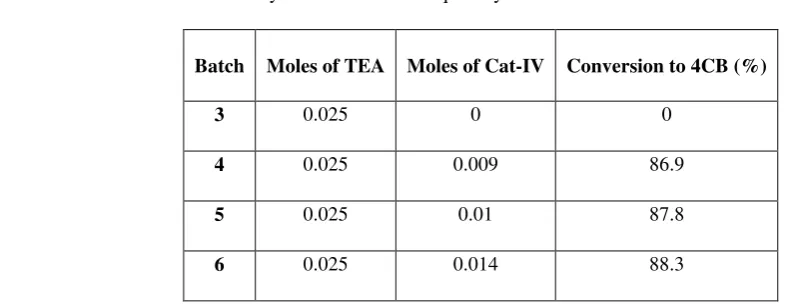
Batch 4, 5 & 6: Similarly, the procedure was followed with different volumes of Cat-IV, while keeping the quantity of TEA (0.025mol) constant, along with a constant maintaining temperature (130°C) for the same duration (2 hours). The final conversion for each batch was monitored and it was noticed that at the end of 2 hours, the difference between the conversions of the 3 batches was not substantial, as seen in Table 2. In other words, change in Cat-IV quantity did not have a significant effect on the final value of conversion.
Table II: Study of effect of Cat-IV quantity variation on conversion after 2 hours
Batch 7: In this batch, addition of higher amount of Cat-IV (0.02mol) with 0.025mol of TEA, maintained with steady mixing at 130°C for 3 hours did not lead to any 4CB generation.
B. Effect of Temperature
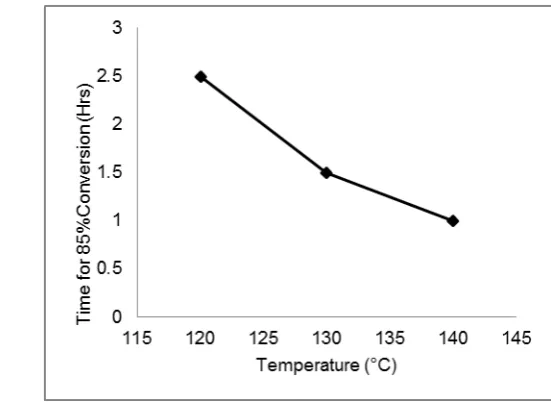
Batch 8, 9 & 10: The reaction mixture was then maintained with constant stirring at 120°C, 130°C and 140°C for batches 8, 9 and 10 respectively. The catalyst conditions were kept constant for all three batches; 0.025 mol TEA and 0.01 moles Cat-IV. The progress of the reaction was observed and ensuing results were produced (Fig. 1).
The graph in Fig. 1 indicates that, initially all the reactions have nearly the same pace. However, this common pace gradually breaks up. Maintaining the temperature at 140°C, the reaction attains 85% conversion sooner than the other batches. The conversion rate is slowest at 120°C taking more than 2 hours to reach 85% conversion mark. Though, initially the conversion rate is found to be higher at 140°C, the rate drops sharply after 85% conversion. The rate of conversion was almost same for all the 3 temperatures after 85% conversion. The conversion finally approaches a maximum of 89% during the next 2-3 hours of stirring the reaction mixture.
Batch Moles of TEA Moles of Cat-IV Conversion to 4CB (%)
3 0.025 0 0
4 0.025 0.009 86.9
5 0.025 0.01 87.8
ISSN: 2319-8753
I
nternational
J
ournal of
I
nnovative
R
esearch in
S
cience,
E
ngineering and
T
echnology
(An ISO 3297: 2007 Certified Organization)
Vol. 2, Issue 10, October 2013
Copyright to IJIRSET www.ijirset.com 5620 Fig. 1: Conversion of 2CB against the duration of reaction at 120°C, 130°C and 140°C
Fig. 2: Time taken for 85% conversion at temperatures 120°C, 130°C and 140°C
After the required maintaining was performed, the heating was suspended. As the reaction mixture was cooled and analyzed, it was observed that the conversion% increased by 1.5 to 2% when the temperature was lowered to below 50°C for any batch.
ISSN: 2319-8753
I
nternational
J
ournal of
I
nnovative
R
esearch in
S
cience,
E
ngineering and
T
echnology
(An ISO 3297: 2007 Certified Organization)
Vol. 2, Issue 10, October 2013
Copyright to IJIRSET www.ijirset.com 5621 1.5 hours followed by 0.5 hour of cooling, while the mixture is kept under continuous stirring throughout till it is cooled to 50°C. The analysis, after cooling, displayed a 2CB conversion of 91.3%.
IV. CONCLUSION
The organic 2CB solution has a very low pH (below 2). In order to initiate the formation of 4CB using the Lewis acid, a favorable higher pH has to be attained. Hence, corresponding amount of triethylamine is added to the system to suffice this condition. The amine creates an alkali environment favoring the 2CB to react in the presence of the Lewis acid. The minimum quantity of TEA required to favor the reaction was found to be 0.01 moles for each mole of 2CB. Thus, TEA supports the 2CB reaction catalyzed by the Lewis acid.
The isomerization process depends on the Lewis acid to 2CB mole ratio and temperature conditions. From the batches 4, 5, 6 & 7, it was deduced that Cat-IV quantity that can favor a steady reaction is not more than 0.014 moles per mole of 2CB.
The temperature also plays a vital role in this process. The reaction is initiated at a temperature above 115°C. Batches 8, 9 & 10 and figure 2 indicate that higher the maintaining temperature, faster is the initial rate of reaction, although, temperatures above 140°C degrade the 4CB material gradually and permanently. Higher the temperature, faster is the damage caused. Though the initial rates of reaction vary with temperature, after nearly 85% conversion, there is a steep fall in the rate in every batch. Following this change in rate, the reaction approaches an equilibrium conversion of 88-89% with nearly the same rate. We infer that after an approximate conversion of 85%, maintaining at the different high temperatures does not have significant effect on the reaction rate. On the contrary, the high temperature can cause slow charring of the organic materials 2CB and 4CB, resulting in loss of material.
After maintaining at high temperature, when the product mixture was cooled down to a temperature below 50°C, the 4CB concentration showed a rise of 2-3%. It can be implied that lowering the temperature may propel the equilibrium conversion bar by a considerable extent. Hence, batch 11 was set in motion.
In figure 1, there appear to be 2 phases of reaction for each batch. The first phase delivers maximum conversion whereas the second phase has a much slower conversion rate. However, the conversion observed during the cooling period can be considered as a third phase of reaction. The second phase comprising of prolonged exposure to high temperature may be the cause for loss in material.
In batch 11, the process was allowed to run through the first phase and as the process began to enter the second phase, the reaction mixture was cooled down to subject it directly to the third phase. Skipping the second phase lowered the loss of important compounds and also reduced the time consumed in the process without lowering the equilibrium conversion. Also, a couple of hours of energy saved are an added bonus for any industry.
The chemical name of the catalyst ‘Cat-IV’ has been withheld on request by the company.
ACKNOWLEDGEMENT
I am greatly thankful to Mr. B. K. Bhat (R&D, Unit-II, Heranba Ind. Ltd., Vapi) for his support in the experiments conducted. I also thank Mr. Madhav Raikar (Unit-II, Heranba Ind. Ltd., Vapi) and Mr. Sharad Sankhe (Unit-II, Heranba Ind. Ltd., Vapi) for their co-operation and guidance.
REFERENCES
[1] Indian Ministry of Agriculture, “State of Indian Agriculture 2011-12”(India Offset Press, New Delhi, 2012).
[2] Chandra Bhushan, Avimuktesh Bhardwaj and Savvy Soumya Misra, “State of Pesticide Regulations in India”, Centre for Science and Environment, 2013.
[3] Thomas A. Unger, “Pesticide Synthesis Handbook” (Noyes Publications, 1996).
[4] Martin et al., “Process for the preparation of 2-(2',2',2'-trihalogenoethyl)-4-halogenocyclobutan-1-ones”, US 4242278, 1980. [5] Martin et al., “2,4,4,4-Tetrahalobutanoic Acid Halide”, US 4322374, 1982.