Education data:
harnessing the
potential
Mitchell Institute submission to the
Productivity Commission Inquiry into the
National Education Evidence Base
ii
About the Mitchell Institute
The Mitchell Institute at Victoria University is an independent policy think tank that works to improve the connection between evidence and policy reform. We actively promote the principle that high-quality education and training is fundamental to individual wellbeing and to a prosperous and successful society. Our goal is an education system that equips all young people to be creative, entrepreneurial, resilient and capable learners. We believe that a key role of government is to create conditions within which everyone can live a life they value and develop the capability to fully participate as a member of Australian society.
The Mitchell Institute is working actively with communities, governments and institutions to build an education system that is oriented towards the future, creates pathways for individual success, and meets the needs of a globalised economy. We put emerging policy issues at the heart of our research agenda and promote sustainable policy changes that address Australia’s most challenging education issues. We do this through evidence-based inquiry, public debate and the development of practical, workable change at both the local and system-wide levels.
1
Table of contents
Executive Summary ... 3
Key challenges and priorities ... 4
The purpose of education and the role of data ... 4
Core principles and foundational assumptions... 6
The role of data in education ... 7
Knowledge gaps and pressing questions ... 8
Overarching priorities ... 10
Nationally consistent data and implementing existing plans for data linkage ... 10
Prioritising data analysis, dissemination and use ... 11
National early childhood data strategy ... 13
Administrative data ... 15
Data linkage ... 17
Early childhood research plan ... 18
Data literacy and information dissemination ... 19
Coordinating agency ... 19
Unified tertiary education data ... 20
Teacher workforce data ... 23
Initial teacher education ... 23
Teacher workforce ... 24
Measuring capabilities and wellbeing ... 25
What are capabilities ... 26
2
Possibilities and directions for system-level measurement of capabilities ... 28
Measuring wellbeing and school climate ... 31
Next steps for adopting broader measures in education ... 32
References ... 33
3
Executive Summary
There are too many questions in education that remain unanswered, and this
is holding us back from providing meaningful educational opportunities for all
young people.
The Mitchell Institute warmly welcomes the Productivity Commission’s Inquiry into the National Education Evidence Base. The Inquiry is an opportunity to set Australia up for innovative, responsive and effective education policy into the future.
A robust information infrastructure must be considered a core element of Australia’s investment in education. The Mitchell Institute strongly supports maximising the usefulness and impact of existing data and advocates for the development of more expansive measures of educational progress and attainment.
Harnessing the potential of existing data requires improving the quality and consistency of current collections, systematising and streamlining data linkage, addressing significant gaps in information and building the systems and capacity for collecting, analysing, disseminating and using data. As such, Mitchell suggests that the two overarching priorities for enhancing the National Education Evidence Base are:
enhanced capacity for data linkage (especially the ability to track young people’s outcomes from
early childhood to tertiary education); and
explicit strategies for improved data analysis, dissemination and use.
The Mitchell Institute’s four core recommendations stem from early childhood to tertiary education.
A National Early Childhood Data Strategy that progressively strengthens the quality and
consistency of administrative data, accelerating data linkage, addresses knowledge gaps through a policy-relevant research agenda, and a coordinating agency to drive data analysis,
dissemination and use.
A tertiary education dataset that integrates university and vocational education sectors, and
tracks pathways into and out of tertiary education.
A teacher workforce dataset that addresses current gaps, especially around the impact of initial
teacher education.
The introduction of nationally consistent wellbeing and engagement measures in the middle
4
Key challenges and priorities
Robust, comprehensive and nationally consistent data is an essential
prerequisite for informed and effective policy and investment decisions. The
Mitchell Institute warmly welcomes the Productivity Commission’s Inquiry into
the National Education Evidence Base. The Inquiry is an opportunity to
recommend the establishment of an information infrastructure that will set
Australia up for innovative, responsive and effective education policy into the
future.
In this submission, the Mitchell Institute strongly supports maximising the usefulness and impact of existing data and advocates for the development of more expansive measures of educational progress and attainment. In particular, the Mitchell Institute recommends:
A National Early Childhood Data Strategy that progressively strengthens the quality and
consistency of administrative data, accelerating data linkage, addresses knowledge gaps through a policy-relevant research agenda, and a coordinating agency to drive data analysis,
dissemination and use.
A tertiary education dataset that integrates university and vocational education sectors, and
tracks pathways into and out of tertiary education.
A teacher workforce dataset that addresses current gaps, especially around the impact of initial
teacher education.
The introduction of nationally consistent wellbeing and engagement measures in the middle
years (as young people transition from primary to high school), and a plan to begin measuring a broader set of core skills and capabilities, beyond literacy and numeracy.
The Mitchell Institute suggests that the two overarching priorities for enhancing the National
Education Evidence Base are enhanced capacity for data linkage (especially the ability to track young people’s outcomes from early childhood to tertiary education) and explicit strategies for improved data analysis, dissemination and use.
The purpose of education and the role of data
5
Education systems need to be rebuilt around a new vision of what education is for and to be grounded in a clear view of the capabilities, knowledge and skills that all young people should have the opportunity to develop through their participation in education.
To be at the forefront of this change, to ensure Australia is prepared to meet the challenges of the future, we need an information infrastructure that provides the data and analysis that measures what matters, answers the difficult policy questions and guides investment decisions.
Australia’s current approach to education data collection, analysis and dissemination has developed over time, generally in silos, in response to specific jurisdictional and sectorial needs and priorities, and before modern analytical and technical capacities were developed.
This fragmented data and evidence base is no longer sufficient. At the moment, we do not have sufficient robust data for:
measuring the range of factors that matter for children’s educational outcomes;
tracking the impact of policy and practice changes and answering crucial questions around ‘what
works, for whom, and in what circumstances’; and
making informed decisions about where to target investment to maximise impact.
We are only able to measure some aspects of our progress against our core national statement of educational objectives, the Melbourne Declaration on Educational Goals for Young Australians (ACARA, 2015). Australia’s national conversation about education has tended to focus on the few elements for which we do have national data (i.e. NAPLAN).
Education is central to national productivity and prosperity. The Mitchell Institute has argued that Australia’s education system is not adequately preparing young people for the economy of the future, and it is not doing enough to mitigate the impact of disadvantage on educational opportunity and outcomes (Foundation for Young Australians, 2016; Lamb, Jackson, Walstab, & Huo, 2015; Lucas & Hanson, 2016; O'Connell, Fox, Hinz, & Cole, 2016).
We cannot respond to these challenges effectively without quality data – to understand the nature of the problem and the effectiveness of our responses.
This information infrastructure must be considered as a core element of Australia’s investment in education.
The Mitchell Institute welcomes the Productivity Commission’s comprehensive approach to the Inquiry and acknowledges their work in articulating clearly the key policy and technical issues involved in this complex space.
Harnessing the potential of educational data requires …
•
Improving the quality and consistency of current collections
•
Systematising and streamlining data linkage
•
Addressing significant gaps in information
6
Core principles and foundational assumptions
The Mitchell Institute’s goal is an education system that equips all young people to be creative, entrepreneurial, resilient and capable learners. Our submission to the Productivity Commission (PC) Inquiry is informed by two core principles:
An expansive understanding of the purpose of education: The critical importance of broader
capabilities and character (‘non-cognitive’) skills for learning and life outcomes has been firmly established (Garcia, 2014; Gutman & Schoon, 2013; J. J. Heckman, 2008; Kautz, Heckman, Diris, Weel, & Borghans, 2014; OECD, 2015; Reeves, Venator, & Howard, 2014). These skills (which include perseverance, motivation, creativity, curiosity, self-control and interpersonal and communication skills) are a strong predictor of educational attainment, and are the attributes demanded both by employers and the future needs of the economy (Brunello & Schlotter, 2011; Foundation for Young Australians, 2016; Garcia, 2014; J. Heckman, Stixrud, & Urzua, 2006; Humphries, Heckman, & Veramendi, 2016; Lucas & Hanson, 2016; Nagaoka, Farrington, Ehrlich, & Heath, 2015). The current privileging of academic indicators of educational success risks narrowing the focus of educators and policy makers, and neglecting crucial contributing factors to young people’s ability to benefit from their participation in education.
A commitment to extending educational opportunity to all: Education data collection, analysis
and use must be attuned to the young people most at risk of missing out on educational opportunity, including children not attending early education and care, children disengaging early from school, young people in flexible learning settings or moving between schools, and children and young people.
Additionally, Mitchell’s submission is informed by the following foundational assumptions:
An ecological approach to conceptualising and measuring educational outcomes: Educational
outcomes cannot be separated from the range of other factors that influence children and young people’s development, and education ought to contribute to more than just narrowly-defined academic outcomes. As such, comprehensive measurement of learning, wellbeing and health drivers and outcomes from birth is critical.
The importance of understanding young people’s pathways through education: Understanding
how young people move through the education system – from early childhood education through to tertiary studies – and then into employment is necessary for understanding the effectiveness of the system and for understanding which young people are missing out, especially at transition points.
Ensuring data is available, accessible, linked, local, timely and usable: Beyond the important
questions around what data to collect and how, the critical issue is ensuring that data is made available and accessible to the range of people who will benefit from it (educators, school leaders, governance bodies, researchers, policy-makers, families), in a form and timeframe that meets their needs. Localised data, in particular, can catalyse collaboration and inform planning, investment and evaluation. The potential of linking datasets is enormous and under-utilised in Australia. The Australian Bureau of Statistics (ABS) and the Australian Institute for Health and Welfare (AIHW) and partner agencies have done significant work to support improved linkage, and this work needs to be taken forward and implemented as a priority.
Maintaining and enhancing existing data sources: Key resources like the Australian Early
7
The role of data in education
Mitchell notes that, appropriately, the primary focus of this inquiry is population and system level data that can be used to measure impact and outcomes of our education system.
A concurrent priority for education is enhancing the use of data in classrooms (from early childhood through to tertiary education) to better understand individual patterns of learning progress, and better align teaching approaches and strategies with the needs and interests of each young person. There are significant opportunities to strengthen teacher effectiveness and student learning through the use of formative assessment and responsiveness to data.
8
Knowledge gaps and pressing
questions
As the Productivity Commission’s Issues Paper makes clear, the purpose of strengthening education data is to improve education outcomes (although Mitchell suggests that these outcomes must be broadly conceptualised).
The importance of strengthening existing collections, addressing information gaps and systematising data linkage is highlighted by the range of critical policy questions we are currently unable to answer adequately.
The most critical gaps are:
Our inability to track students throughout their educational journeys – to analyse pathways
from early education, through primary and secondary school, onto tertiary education and into employment. Understanding those pathways is particularly crucial for the quarter of students missing out at each critical milestone (Lamb et al., 2015) and for re-designing our education system so that it adequately meets the needs of all young people.
Insufficient information about non-academic drivers and outcomes – to better understand the
social determinants of educational outcomes and to ensure policy and practice gives equal priority to the broader range of capabilities and skills that young people need to gain through education.
Currently, there are many policy-relevant questions we are not well-equipped to answer. Some of these overarching policy-relevant questions include:
The pathways of the children who enter school developmentally vulnerable, especially the
conditions under which children overcome initial vulnerability.
The impact of different approaches (between schools, regions or jurisdictions) on a range of
outcomes, including the ability to recognise the strengths of existing policies or practices.
The specific strengths, needs and priorities of communities, to help schools identify the
additional needs of students and families in their communities and use data to prioritise preventive-interventions.
More effective use of existing data, and addressing data gaps, would also address specific policy and information gaps in early childhood, schooling and tertiary education, and in relation to workforce and labour outcomes.
Early childhood
Total numbers, proportions and patterns of enrolment and attendance in early education and
care (including across long daycare, family daycare and/or preschool settings), especially local data on the number of children not enrolled or attending for the optimal number of hours.
9
• The optimum dose (hours) and intensity (frequency) of participation in quality early
education and care, especially for different cohorts of children, thus informing decisions about public investment in early education and optimising return on investment.
• Australian data on the relationship between quality provision and children’s outcomes,
including nuanced data on the multiple elements of quality (structural and process), to ensure national regulatory standards are set at an adequate level.
• The impact of early education on a range of long-term outcomes.
The characteristics of children not in early childhood education and care.
Supply and demand information to guide planning decisions (for places for children and for the
workforce) Schooling
The extent to which schools are equipping students with range of capabilities they need to
succeed in subsequent levels of schooling and throughout life.
The wellbeing of young people in the middle years and in adolescence, and the impact of various
markers of wellbeing on education engagement and attainment.
Australian data on the impact and predictive power of key capabilities on children’s achievement
and longer-term outcomes.
Early indicators of students at risk of early disengagement from school and the effectiveness of
various approaches to re-engaging them, including the impact of flexible learning models on short and longer-term outcomes.
Tracking young people moving between schools and states.
The impact of different approaches to professional learning for teachers on student outcomes. The extent and impact of family engagement in young people’s learning and the effectiveness of
various parent and community engagement strategies. Tertiary
Understanding barriers to participation, non-traditional pathways and the impact of episodic
engagement in higher education and VET (especially for young people with interrupted schooling experiences or re-engage with higher education at an older age).
The post-education outcomes of students, especially disadvantaged young people participating
in higher education.
The impact of broader factors, such as individual and family aspirations and expectations,
income support, access to housing and transport, peer and community influences and mental and physical health on participation, engagement, attainment and outcomes in tertiary education.
Workforce and labour outcomes
Understanding education outcomes and productivity, including labour force participation,
income, occupation and housing patterns.
Assessing the impact of initial teacher education on classroom readiness and student outcomes. Tracking issues of supply and demand and understanding the profile of teachers in the pipeline.
10
Overarching priorities
Nationally consistent data and implementing existing plans for data linkage
The overriding priority for a ‘National Education Evidence Base’ is addressing the lack of nationally consistent administrative data and the lack of progress on data linkage.To address the under-utilisation of the data that is already collected, the ABS and AIHW have progressed much of the necessary preparatory groundwork to forge greater consistency and better link existing education datasets. This work should be implemented as a matter of priority.
The approaches set out in the ABS’s Australian Longitudinal Learning Database (ALLD) concept paper and the AIHW’s National Early Childhood Development Researchable Data Set (NECD RDS) and the development of a National Education and Training Data Standards Strategy and Implementation Plan (NETDSSI) provide a clear rationale for improving linkage, a synthesis of the key issues to be
resolved, and a path forward (while also acknowledging the complexity involved).
These approaches do not fully address key information gaps around wellbeing and capabilities, but collectively they provide a fairly comprehensive indication of the key datasets that need to be linked to form a useful, comprehensive and enduring database of important information for education research, policy and practice.
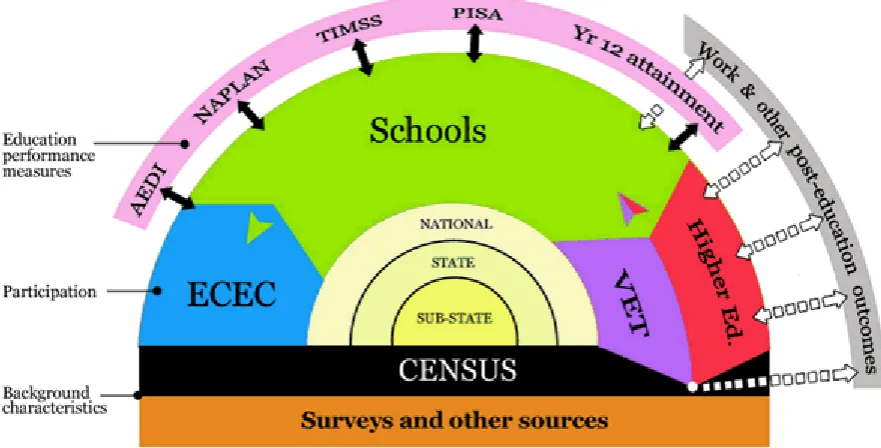
The ALLD model (Figure 1), noted in the Issues Paper, is a good starting point and appears to form the basis of the implementation analysis provided by the NETDSSI.
Strengths: It delivers on the objective of linking data from early childhood through to work and
tertiary education; highlights the importance of reporting data at national, state and small area levels; and includes employment and post-education outcomes (which ought to be in-scope for the Inquiry).
Limitations: It does not adequately capture the other relevant datasets in the early years (i.e.
perinatal data, maternal and child health data, ACECQA data) and in health and social services (i.e. Medicare, income support recipiency, justice), and remains very focused on narrow academic outcomes, including very few measures of wellbeing or broader capabilities. Over time, the ability to link student outcomes to measures of quality provision will be important. The proposed NECD RDS establishes a limited but core set of early childhood data, and goes some way to addressing the gap in early childhood in the ALLD. As such, it should not be progressed separately from the ALLD, as together they form a more comprehensive picture of student pathways through the education system.
The Conceptual Paper for the ALLD notes a number of the key benefits of this type of enduring, linked statistical database, including better understanding the impact of early education and improved data on priority cohorts of students.
11
Figure 1: Proposed Australian Longitudinal Learning Database (National Centre for Education and Training Statistics, 2012)
Prioritising data analysis, dissemination and use
While the Mitchell Institute believes that there are significant gaps in the data currently collected, Australia nonetheless collects an enormous wealth of relevant data – across a broad range of
research and administrative datasets. However, there are often substantial barriers to accessing and using this data.
“Different systems protect their own data far too jealously. They restrict access when it could provide a rich source of wider insight and analysis” (Bentley & Cazaly, 2015).
Some data and analysis that should be made available routinely, as a matter of course, as a core element of what enables an education system to function effectively, can be nearly impossible to access. It may not be:
provided in a sufficiently timely fashion;
provided in a format or language that is usable by the people who would benefit from it; and/or of sufficient quality, comparability, granularity, localisation to be meaningful.
Beyond the necessary questions of what data to collect, and the important technical and ethical questions around how to collect it, the analysis, dissemination and use of data are the crucial issues for the impact of data.
“Many school systems are moving towards more specialised and flexible data
12
Analysis, dissemination and use of data is what drives the return on investment in a national information infrastructure.
The Mitchell Institute supports calls for an independent, publically funded body to collect, link, analyse and disseminate data (either through the creation of a new agency or the expansion of existing agencies). This agency should:
be jointly funded by all levels of government;
have a mandate to produce data and analysis in the public interest and to inform agreed priority
policy questions;
have a focus on making data accessible and usable, and as far as possible, making data available
national, state and territory, local and small area levels; and
lead a collaborative approach to identifying priorities for a policy-relevant research agenda,
including strategies to capitalise on the additional capacity created by data linkage.
Appendix A outlines several national and international approaches to expanding accessibility and usability of education data.
Making data accessible and meaningful
Education Counts (NZ)
A central website with education statistics and research from early childhood
to post-education pathways, including accessible data, regional breakdowns
and analytical pieces.
NCVER (Australia)
A central coordinating agency that makes high-quality data and analysis
available for the VET sector.
Consortium on Chicago School Research (US)
A university-based centre established to support education system reform,
producing high-quality, long-term, policy and practice relevant data and
research.
NationalMap (Australia)
A platform for the collation and presentation of a broad range government
spatial data
13
National early childhood data strategy
As Australian Early Development Census data shows, the cognitive, social and
emotional and health influencers of children’s readiness to learn and ability to
thrive at school are established long before their first year of schooling. Early
childhood must be a core component of the National Education Evidence Base.
Early childhood experiences are highly relevant to educational outcomes. Achieving sustained improvements in education and wellbeing outcomes at the population level requires sophisticated understanding of the life experiences of all young people, especially the impact of various forms and patterns of disadvantage. There is a wealth of research that demonstrates the impact of early experiences on children’s life outcomes (Australian Instittue of Health and Welfare, 2015; Centre on the Developing Child, 2007, 2010; National Scientific Council on the Developing Child, 2007).
An information infrastructure that can track children’s outcomes from birth to adulthood is a key strategy for better targeting interventions and better enabling the education system to cater for the diverse needs of students.
This needs to be more than a point-in-time exercise. Ongoing tracking and monitoring of children’s experiences, pathways and outcomes, from early childhood through to post-tertiary outcomes, is needed so that the impact of policy decisions can be assessed, trends can be recognised and changing social and economic circumstances can be identified.
To maximise impact and usefulness, the education evidence base should include data on all children (including those not in early education and care programs) and children younger than 4 (ideally from birth). This data should be reported at local, regional, state and national levels, including more comprehensive and timely provision of relevant data directly to schools.
In Quality Early Education for All, the Mitchell Institute calls for a National Early Childhood Data Strategy to outline a long-term plan to build the necessary information infrastructure to strengthen the collection, analysis and use of data on children’s early experiences (O'Connell et al., 2016).
Quality Early Education For All
Recommendation 4 - A national data strategy and coordinating
agency
14
The Mitchell Institute recommends the development of a collaborative, co-designed, long-term strategy that identifies the key policy questions, identifies the data and analysis required, and develops an appropriate sequencing for the progressive implementation of the required infrastructure.
Early childhood data should not be considered in isolation from the broader education dataset, but there are a number of specific issues related to early education data in particular that will require a dedicated focus.
A National Early Childhood Data Strategy would need to consider a range of factors – including improved administrative data, systematic data linkage, a policy-relevant research agenda, and strategies for building data literacy and information dissemination.
There are a number of core priorities for strengthening administrative data and progressing data linkage, and key features that should drive the development of a research plan to make best use of existing data and address key knowledge gaps (Figure 2).
Robust and consistent
administrative data
systematic data linkage
Comprehensive and
National research
agenda
Committment to
dissemination and
accessibilty
National
15
Figure 2: Immediate and subsequent priorities for strengthening administrative data, data linkage and a national research plan
Administrative
data
Data linkage
Research plan
• National consistency for core items
• High-quality data, including standardised instruments where appropriate
• Collected at unit-record level
• Designed for multiple purposes
• Comprehensive – health/education/ wellbeing/family context • Systematic and sustained • Informed by an outcomes
framework
• Policy-relevant research • Addressing agreed
knowledge gaps • Longitudinal studies to
add depth and breadth • Experimental studies to
assess impact and efficacy
Immediate priority
Attendance data that is consistent, unit-record level,
real-time
Implementing the proposed National Early Childhood
Researchable Data Set
Committing to ongoing funding for the AEDC and a new birth cohort study with strong early education focus
Subsequent priorities
Embedding standardised instruments in NQS
assessments
Progressively linking in additional datasets, prioritising ACECQA data,
maternal and child health/medicare data, and setting up systems to track outcomes across all stages of
education
Rigorous study of the link between attendance, quality
and outcomes for different cohorts of children The pattern and sequence of interventions needed for the
most vulnerable children
Administrative data
There are significant limitations to existing administrative data collections in early education and care. Progressively improving the consistency, quality, scope and ease of collecting a core set of standard data items in early childhood education and care is a key priority.
Current issues are well documented in the Deloitte review of the data system established to monitor progress against the National Partnership Agreement (NPA) on Universal Access to Early Childhood Education, the National Early Childhood Education and Care Collection (‘the Collection’), and are highlighted in the PC’s Issues Paper for this inquiry.
16
limited by access to unit record level data which is not available to researchers outside the ABS” (Australian Instittue of Health and Welfare, 2014).
The key issues highlighted in the review of the Collection provide the rationale and critical lessons for a stronger, more consistent and more comprehensive approach to administrative data collection. Some of these lessons are:
Data collection with broad applications: The Collection was established for a narrow purpose
(assessing compliance with the NPA) which significantly limits its usefulness – especially its ability to inform future policy and its accessibility to researchers.
Prioritise consistency: The extent of the variability in what and how data is collected across
jurisdictions and across private and public sectors (as well as different levels of capacity and investment in data).
Unit records are critical for assessing impact: The lack of unit-record data significantly inhibits
the usefulness of the data, for answering key research questions and, importantly, for assessing the impact of policy decisions.
Resourcing and planning are needed to improve quality: The challenge of lack of stable and
adequate resourcing for strengthening data quality.
The most critical policy question in relation to early childhood education relates to the links between attendance, quality and outcomes.
Without robust, up-to-date Australian-specific data on these links, it is difficult to determine the optimum dose and intensity of access to quality early childhood education for different ages and cohorts of children. As a result, governments have struggled to determine the most appropriate and impactful settings for targeting their investment in early childhood education.
There are a number of changes to administrative data collection that would facilitate this:
More accurate and more frequent collection and reporting of enrolment and attendance data–
ideally moving away from collecting enrolment and attendance in a ‘reference week’ to real-time tracking, using the same system/methodology across service types, and making data more available, more quickly to jurisdictions and researchers.
More robust and frequent collection of data relating to quality (i.e. through the adoption of
standardised instruments as part of the NQS assessment process).
Unit record information tracking and linking hours of attendance (dose), pattern/frequency of
attendance (intensity) and type of program or environment (quality).
Ensuring all relevant demographic information is collected, and is collected consistently across
jurisdictions and settings, to enable more granular analysis of the impact of socio-economic circumstances on experiences and outcomes in early childhood.
Systematising data linkage with perinatal, child health and education datasets to address
questions around impact and wellbeing.
More comprehensive workforce data, including staff training, qualifications, professional
learning, leadership and management, pay and conditions, and their links with service quality, family engagement and child outcomes.
Another critical policy question is the issue of how to engage the families of children currently not enrolled in or attending early childhood education.
Identifying and understanding the circumstances of families not participating in early education,
17 A key strategy here is knowing which families in a local area have an eligible child and are not
attending (and having appropriate outreach strategies in place). Matching early childhood enrolment/attendance data against child and family health databases and/or Australian Government Department of Human Services databases could facilitate this.
More regular and accurate enrolment and attendance data would also facilitate the
development of targeted local strategies where attendance rates/hours are low.
Data linkage
Data linkage is a way to make the most of the data that is already collected. More systematic, streamlined, accessible linked data will enable a more rigorous and long-term tracking of the impact of investments in early education, especially by providing granular data that enables an assessment of ‘what works, for whom, and in what circumstances’.
The AIHW’s proposal for a National Early Childhood Development Researchable Data Set (NECD RDS) clearly establishes the rationale for and the benefits of more systematic data linkage. The particular strength of the AIHW’s proposal is that the NECD RDS would be a permanently linked collection, available on an ongoing basis and regularly updated.
The types of research and policy questions the AIHW indicates improved data-linkage would address include:
How do the quantity, quality and the starting age of child care impact on early child
development and educational outcomes, and do they differ for children from different backgrounds or who live in different areas of Australia?
For vulnerable children (for example, children with a low birthweight, children who have a
disability, or children from disadvantaged backgrounds), does attending an early childhood education program lead to better developmental and educational outcomes at school?
International use of unique identifiers in early childhood
Some states in the US have introduced unique child identifiers that they are using to track
children through early learning and child health systems. Some of these systems include
service quality information, attendance data, results of validated child development
screening instruments and connections to education databases (The Early Childhood Data
Collaborative, 2014).
In Pennsylvania, this approach is being developed with a focus on understanding dose and
response, strategies for targeting children, the combination of services that produce the
best outcomes for at-risk children, and program characteristics associated with improved
outcomes for all children (OMG Center for Collaborative Learning, 2010; Stedron, 2010).
The development and maintenance costs are estimated at $4.5m for feasibility
assessment and development, $0.8m for ongoing monitoring, $0.9m for training and
$650m to conduct validating screening three times a year for approximately one million
children (Stedron, 2010).
18 What are the long-term outcomes for children who are not participating in formal child care or
preschool, compared to those who do? A particular focus may be on children from disadvantaged households.
What are the key individual, familial, contextual, and policy factors that lead to better
developmental and educational outcomes for Indigenous children?
Do educational outcomes differ for children who move between Australian states and territories
(Australian Instittue of Health and Welfare, 2014, p. 7)?
The NECD RDS would be a strong firm initial base, a substantial improvement on current data availability. However it could be strengthened by:
More comprehensive data linkage: The datasets proposed by the AIHW would be the minimum required to be useful, and should be broadened as soon as feasible.
Clear plans for analysis, dissemination and use: The development of the dataset needs to be accompanied by an analysis plan and clear strategies for ensuring the data is made available and accessible to a broad audience.
The AIHW proposes following data sets are proposed for inclusion in the NECD RDS:
Health: perinatal/midwives data (health outcomes for mothers and babies), birth registration
data (required for linking data sets only)
Early education: Child Care Management System (CCMS) data (child care data, such as long day
care attendance, whether a preschool program is offered by the day care centre, hours in care), preschool data that are collected by jurisdictions and contribute to the ABS’s National ECEC data collection (preschool enrolment and attendance)
Education: AEDC data (child development measures at first year of school), NAPLAN data
(literacy and numeracy in years 3 and 5)
There is scope to broaden the impact of data linkage by including:
Assessments of the quality of the service children attend and early childhood workforce
information;
State and territory child and family health service data;
Australian Government Department of Human Services data, especially families receiving Family
Tax Benefit Part B;
ABS data including the Census of Population and Housing; and
the broader range of educational engagement, attainment and wellbeing data proposed through
this Inquiry.
Early childhood research plan
Along-term research strategy would provide both direction and funding for crucial, policy-relevant research. It would maximise the benefits of investing in strengthened data linkage, but would also require more comprehensive studies to address the questions that cannot be answered by ‘big data’ alone.
19
Research priorities should be negotiated between policy-makers, researchers and providers, but areas for consideration include:
Comprehensive longitudinal data through a new birth cohort study, which includes a specific and
intensive focus on the impact of early education and care, to provide Australian data equivalent to the UK’s Effective Provision of Preschool Education (EPPE) study.
Rigorous (experimental) evaluation of high-intensity programs targeted at vulnerable children to
understand the optimal dose, intensity, components and sequencing of interventions to maximise their impact.
The most effective strategies for delivering professional learning and lifting the quality of the
system.
Data literacy and information dissemination
Concurrent investment in making research findings and data available, accessible and meaningful, to both policy-makers and early childhood practitioners, is crucial. As noted previously, the return on investment in data infrastructure comes through the use of data to inform better policy decisions, more targeted investment, and the ability to better match intervention/investment to the specific needs of individuals, cohorts or communities. Similarly, there is a need to build data literacy and capacity to interpret and use data.
Coordinating agency
A national, jointly-funded and independent coordinating agency should be established to collect, link, analyse and disseminate early childhood data. This body could be established either as a standalone body or as a consolidated responsibility of an existing organisation.
A clear mandate and commitment from all levels of government would be necessary and potentially legislative arrangements to create appropriate authority to access the necessary data.
This body should not focus on early childhood education data in isolation from broader education (or health) data – indeed, streamlined and systematic data linkage must be a core priority – but the Mitchell Institute recognises that there are specific issues around early childhood education data that require a dedicated focus.
20
Coherent tertiary education data
Tertiary education is an increasingly necessary bridge between school
education and workforce particiatpion. Yet nearly a quarter of 24 year olds are
not fully engaged in education or training or employment (Lamb et al., 2015)
and drop-out rates are high in both VET and higher education. The current
tertiary system is not meeting the needs of a large proprtion of young people,
and data can help identify the reasons why, priorities for change and the
effectiveness of current and future strategies.
The Mitchell Institute argues that addressing the limitations of the tertiary education system must be a major policy priority for Australian governments, not just for equity reasons, but because of the consequences of tens of thousands of Australians being locked out of meaningful and sustained economic and social participation (Noonan, 2015a).
We advocate for the reconceptualisation of tertiary education in Australia, through:
Establishing tertiary education as a universal system that complements and aligns with
secondary school; and
The development of higher education and VET as distinctive sectors that operate within an
overall coherent funding framework and with better linkages.
The Bradley Review identified the need to move away from two disjointed sectors to a “continuum of tertiary skills … which delivers skills development in ways that are efficient, fit for purpose and meet the needs of individuals and the economy” (Bradley, Noonan, Nugent, & Scales, 2008). A more consistent and outcomes focused data system – that linked with early childhood and school education data and tracked pathways into and out of both VET and higher education – would support and enable greater coherence across sectors. It would also strengthen our capacity to ensure all young people receive a quality education that prepares them for engagement in the workforce.
Like other parts of the education system, there is a great deal of potentially powerful data generated through the VET and higher education systems, the impact of which is limited by the lack of
systematic data linkage and insufficient resourcing/capacity for ongoing analysis and dissemination. Data is often held by governments, but not used comprehensively or strategically.
21
There are a range of issues that current disjointed data systems do not allow us to answer:
Tracking and monitoring finance data within and across the sectors, especially the capacity to
look at investment in tertiary education as a whole (across sectors and including public and private provision), and understanding trends between the sectors (Noonan, 2015a).
Projecting and modelling future demand, which inhibits our capacity to guarantee a tertiary
education place for all young people in the future.
Specific barriers to participation in VET and higher education and the relative weight of those
barriers, including fees and access to income contingent loans.
The impact of aspirations on young people’s engagement with tertiary education, and influences
on those aspirations (including the role of families and career education).
The effectiveness of interventions intended to make higher education more accessible to young
people from low socio-economic backgrounds.
The post-education outcomes of young people and longer-term workforce participation
outcomes, including whether they are within the field of study undertaken.
Understanding pathways into and out of tertiary education for young people who have
experienced disrupted education, including the effectiveness of these pathways.
How valid and reliable current higher education entry mechanisms are, the extent to which they
act as a barrier or facilitator of higher education participation/attainment, and their predictive capacity (and therefore what other entry mechanisms may be viable).
Robust quality measures for both higher education and VET. Provider-level and course-level
data of quality and impact/outcomes data would support a better regulatory system, but also provide the information to enable better student decisions in a market-based system.
There are also critical pieces of analysis that can be undertaken using and linking existing data, but which tend to rely on academics or consultants to initiate and publish. This information is often critical for assessing the effectiveness of the system and should be considered routine publications rather than ad-hoc analysis. For example,
Tracking individual student participation in schooling, entry into tertiary education and
attainment of qualifications.
Basic modelling of the proportion of the population engaged in tertiary education.
Linking tertiary education participation with the Census and other data to understand graduate
pathways and outcomes.
There are areas in which greater consistency and clarity would be beneficial:
The way enrolment is measured is different in VET and higher education, in part reflecting
different patterns and types of provision. However, there are opportunities to establish more consistent protocols about how enrolment is measured (for example, identifying core
substantive/professional courses and excluding minor courses, or through learner intention questions that link intent to outcome).
The level of government subsidy provided per course, by sector and level of qualification. More granular data about the types of courses young people are studying (for example,
distinguishing between trainees and apprentices and by trade and non-trade occupations).
Data on young people who are enrolled in both VET and higher education, and understanding
22 Many ABS surveys ask highest level of qualification rather than all qualifications attained, which
limits our ability to understand pathways and outcomes of engagement in VET and higher education.
The data that we collect on our tertiary education system needs to be used to drive more efficient and effective policy settings. As Mitchell Professorial Fellow, Peter Noonan, argues,
23
Teacher workforce data
Teacher quality is a priority and key area of focus in national education policy.
The impact of teachers on student outcomes is clearly established in research,
yet there are significant gaps in the national collection of data related to the
training, experience and impact of teachers in Australia.
Initial teacher education
Currently, we have limited ability to systematically track the impact of initial teacher education, including its impact on key outcomes around: teacher employment; teacher satisfaction with their pre-service training and their early career induction; employer and mentor views of teacher classroom readiness; and student learning.
Strengthening initial teacher education data would provide highly relevant and useful data for understanding the relative success of initial teacher education programs and early career mentoring strategies, as well as enabling assessment of initiatives intended to improve them.
Initial teacher education data is also required to better understand teacher supply and demand and plan for an appropriate mix of skill and specialisation in the profession. There is currently limited information about new teachers in the pipeline, especially granular data around specific
specialisations, teachers that are registered but not teaching, graduate pathways and movements through school sectors and locations, and patterns of early career teacher attrition. This is a key policy and planning issue, but would also better inform beginning teachers about career choices. The priorities for strengthening initial teacher education include:
Increasing the amount of data available: The collection of both administrative and survey data
at the time of initial registration and at registration renewal and the introduction of a survey of teaching graduates attached to the Graduate Outcomes Survey to provide outcome data in the first year following graduation
Facilitating data linkage: Creating a unique teacher identifier to link data from initial teacher
education to employment outcomes (by connecting Higher Education Student Data Collection data with early career teacher data), generating unit record data and the ability to link pathways and outcomes at the individual level.
Improving quality: Nationally consistent data definitions and collection methods, collection of
data for at least the first three years of teaching, and reporting regularly.
Understanding impact: Generating reliable data on:
• the extent to which existing initial teacher education and early career professional learning
strategies are effective in ensuring classroom readiness,
• the impact of student background, training and mentoring on perceived classroom
24
• the success of different approaches to training and mentoring students, particularly around
improving teachers’ perceptions of professional competence and self-efficacy;
• tracking the rate of improvement in the preparation of classroom ready teachers; and • identifying locations where particular strategies have been more or less effective, to guide
future direction and strategies. These initiaves would have a range of benefits:
A more informed dialogue between stakeholders and jurisdictions on initial teacher education, A more comprehnsive picture of patterns, trends and priorities and national and cross-sectoral
perspectives on key issues,
Addressing key gaps in current knowledge on employment outcomes and areas of supply and
demand, and
Creating capacity to undertake longitudinal research and predictive modelling.
Teacher workforce
Australia has made advances in the collection of data on the teacher workforce, but there remain opportunities to develop a more comprehensive picture of teachers. In particular, a unique identifier would make it possible to track teachers across the their professional lifecycle - from entry to initial teacher education, graduation, registration as a teacher, employment as an early career teacher, and progress in the profession at later years.
The Teacher Education Ministerial Advisory Group report recommended that teacher regulatory authorities play a greater role in collecting robust workforce data on a nationally consistent basis.
Engaging teacher regulatory authorities to survey teachers as a core part of their registration requirements would generate a robust set of regular, nationally consistent, unit record data with complete coverage of the teacher workforce. Developing one national survey instrument and platform, embedding it within existing processes and IT systems would efficiently support a national minimum dataset.
25
Measuring capabilities and wellbeing
One of the Mitchell Institute’s core commitments is to an expansive view of
education, where all young people have the opportunity to become creative,
entrepreneurial, resilient and capable learners. Our education systems do not
currently achieve this for all young people (Lamb et al., 2015) and need to
change to ensure Australia and its young people are ready to meet the
challenges of the future.
Broader measures of educational success are a key element of achieving a more effective education system. Professor Bill Lucas, an International Advisor for the Mitchell Institute, writes that
“knowledge is crucial, of course, but young people need to understand how to find it, how to interpret it, how to utilise it and how and when to act on it” (Lucas & Claxton, 2009). Capabilities (or ‘non-cognitive skills’) are the broader set of skills and dispositions that enable individuals to translate knowledge into meaningful analysis and action, and that employers are increasingly calling for (Foundation for Young Australians, 2016; Lucas & Hanson, 2016).
Currently, education policy and national data collections prioritise a fairly narrow set of cognitive indicators (i.e. literacy and numeracy) at the expense of capabilities. The OECD makes the point that:
“IQ tests and achievement tests do not adequately capture non-cognitive skills, personality traits, goals, character, motivations and preferences that are valued in the labour market, in school, and in many other domains. For many outcomes, their predictive power rivals or exceeds that of cognitive skills” (Kautz et al., 2014)
As a result, they caution against relying on achievement tests as the sole indicator of the effectiveness of educational systems.
However, there is not yet consensus on how to effectively measure capabilities at a system level, although work in this space is accelerating rapidly, including through PISA. The Mitchell Institute recommends that Australia monitor international developments closely and commence work on developing and prototyping approaches that will be fit for purpose in an Australian context.
Key recommendations
•
Implementing nationally consistent measures of wellbeing and school climate
in the middle years, either through adjusting existing measures for
consistency or through the introduction of a new standard data collection.
26
What are capabilities
Garcia (2014) identifies a core set of capabilities relevant to education policy and practice, including
There are numerous approaches to identifying and grouping these capabilities, and a proliferation of key terms. The Demos Character Inquiry brought together experts from developmental psychology, neuroscience, child psychiatry, and youth development and identified four key themes:
Application – the ability to stick with tasks and see things through.
Self-direction – the ability to see one’s life as under one’s control and to effectively shape its
future course; the ability to understand one’s strengths and weaknesses accurately; the ability to recognise one’s responsibilities towards others.
Self-control – the ability to monitor and regulate one’s emotions appropriately.
Empathy – the ability to put oneself in other people’s shoes and be sensitive to their needs and
views (Lexmond & Grist, 2011).
Other studies add conscientiousness, perseverance, commitment, the ability to collaborate, self-efficacy, self-control, the ability to defer gratification and the concepts of ‘mental toughness’ and ‘grit’ (Paterson, Tyler, & Lexmond, 2014), and Mitchell’s
International Advisor, Professor Bill Lucas, writes of the Seven Cs in his influential book, Educating Ruby (Claxton & Lucas, 2015). These are confidence, curiosity, collaboration, communication, creativity, commitment and craftsmanship.
Confidence
Curiosity
Collaboration
Communication
Creativity
Commitment
Craftsmanship
Guy Claxton and Bill Lucas in
Educating Ruby: What our Children Really Need to Learn
Critical thinking skills Problem solving skills Emotional health Social skills Work ethic
Community responsibility
Factors affecting personal relationships
between students and teachers
Self-control Self-regulation Persistence
Academic confidence Teamwork
Organisational skills Creativity
27
Research on the impact of capabilities on educational and life outcomes
International research on capabilities has identified strong links between these capabilities and young people’s education and employment outcomes (Gabrieli et al., 2015). J. Heckman and Kautz (2012) contend that capabilities predict success in life and causally produce that success, and therefore need to be a core focus for public policy.There is convergence between multiple disciplines. Economics, psychology, child development, education and labour researchers are all highlighting the importance of capabilities. Key findings from this literature include:
Capabilities may be more effective than traditional cognitive measures in predicting
meaningful life outcomes (including educational attainment). J. Heckman and Kautz (2012) note that cognitive measure do not predict much of the variance in educational attainment, labour market success, crime and health. They highlight the growing evidence that ‘non-cognitive’ measures may have greater predictive power than traditional ‘‘non-cognitive’ measures. For instance, they show that conscientiousness rivals IQ in predicting educational attainment, job performance, and health (J. Heckman & Kautz, 2014), and is as effective in predicting college grades as the SAT (Almlund, Duckworth, Heckman, & Kautz, 2011).
Capabilities and cognitive ability are interrelatedand interdependent. Cognitive and
‘non-cognitive’ skills are mutually reinforcing, and young people’s ability to apply and make meaning out of knowledge is mediated through their broader capabilities (Gutman & Schoon, 2013). Garcia (2014) suggests that “we may fail to boost cognitive skills unless we pay closer attention to noncognitive skills. In other words, focusing on noncognitive skills may actually further improve reading, writing, and mathematics performance.”
Capabilities can be developed over the lifecourse. Studies show that capabilities are more
malleable over the lifecourse than IQ (Almlund et al., 2011; J. Heckman & Kautz, 2013). J. Heckman and Kautz (2013) argue that “during the early years, both cognitive and non-cognitive skills are highly malleable. During the adolescent years, non-cognitive skills are more malleable than cognitive skills.” Indeed, Heckman suggests that the primary driver (or ‘active ingredient’) of the impact of early childhood interventions is the strengthening of core capabilities – with optimal outcomes seen when these early foundations are enhanced and reinforced throughout young people’s development (J. Heckman & Kautz, 2013).
Capabilities are influenced by socio-economic status and may contribute to reducing the
28
Possibilities and directions for system-level measurement of capabilities
While there is strong and growing consensus about the importance of capabilities, research has not kept up with the demand from policy and practice to develop reliable system-level measurement tools to support impact assessment, benchmarking, accountability or system-level monitoring (Duckworth & Yeager, 2015; Mellor & Griffith, 2015; Schwartz, Hamilton, Stecher, & Steele, 2011; M. West, 2016). Existing measures were mostly developed in the context of basic psychologicalresearch, and are not suitable for broader application.
Responding to the well-evidenced connections between capabilities and outcomes, school systems internationally are attempting to embed capability measures in national accountability frameworks, but in practice are struggling to assess capabilities and to develop standardised, system-level measures of core capabilities:
“there is little agreement on which skills are most important, how they can be reliably measured, and their malleability in school settings. Absent consensus on these points, educators cannot rely on available measures of non-cognitive skills or their underlying theories of personal development to assess and support individual students or to evaluate the success of schools, teachers, or interventions” (M. R. West et al., 2015).
Duckworth and Yeager (2015) are leading experts on capabilities, but caution that “enthusiasm for these factors should be tempered with appreciation for the many limitations of currently available measures.” They point to the impact of reference bias on the accuracy of self-report and teacher-report, particularly in relation to the kinds of dispositions and skills relevant to the capabilities
Academic, career and wellbeing impacts of ‘non-cognitive’ skills:
Summary of the research evidence
1.
Non-cognitive skills predict high school and college completion.
2.
Students with strong non-cognitive skills have greater academic achievement
within K–12 schooling and college.
3.
Fostering non-cognitive skills as early as preschool has both immediate and
long-term impact.
4.
Employers value non-cognitive skills and seek employees who have them.
5.
Higher non-cognitive skills predict a greater likelihood of being employed.
6.
Stronger non-cognitive skills in childhood predict higher adult earnings and greater
financial stability. Well-Being
7.
Adults with stronger non-cognitive skills are less likely to commit a crime and be
incarcerated.
8.
Strong non-cognitive skills decrease the likelihood of being a single or unplanned
teenage parent.
29
agenda. For instance, several research studies have shown that students at schools with higher academic performance tend to self-assess factors like ‘hard work’ or preparedness for class lower than poorly performing schools.
As such, Duckworth and Yaegar note that there are currently no suitable questionnaires for between-school comparison. They are particularly wary of linking capabilities assessment to performance and accountability regimes, although they argue for the development of additional measures that are fit for purpose, including:
practical measures to support program evaluation and practice improvement; and
new and innovative approaches to measurement (capitalising on technological advances).
Importantly, much of the hesitation around the adoption of broader measures of academic success relates to their use to measure accountability – with concern that the problematic incentives that high-stakes academic testing has fostered will apply to capabilities as well.
A number of innovative approaches to measuring capabilities are underway in Australia and internationally.
United States – embedding capabilities in accountability frameworks
The new Every School Succeeds Act (ESSA) in the United States requires all schools to include at least one ‘non-cognitive’ measure to be eligible for federal funding (in response to the unanticipated consequences of the exclusive focus on narrow academic achievement indicators under No Child Left Behind). ESSA does not mandate specific measures, but the requirement to begin embedding broader measures in all accountability systems is likely to drive a rapid and significant expansion of research and practice evidence in what works.
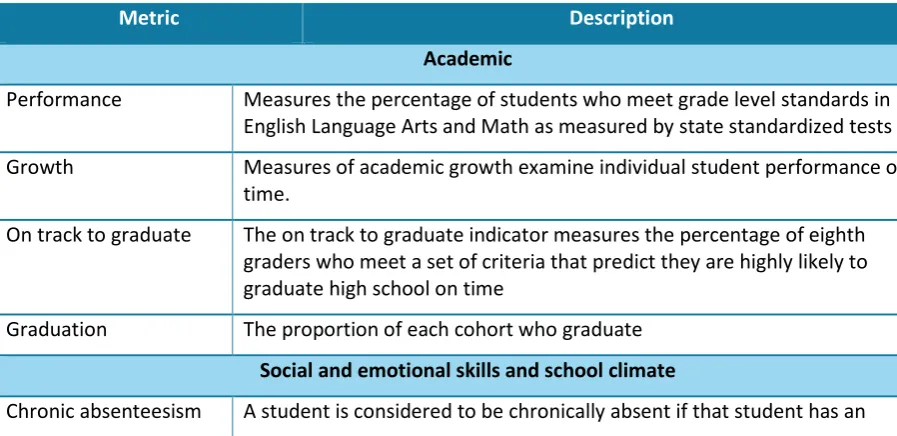
For example, California’s CORE districts (a collaboration of school districts representing around 20% of California’s students) are implementing a progressive strategy trailing a new accountability framework that moves beyond academic indicators to include indicators of school quality and students’ social and emotional skills (Table 1) (M. West, 2016).
Initial field tests have found positive correlation between social and emotional skills and indicators of student behaviour and academic achievement, although some evidence of reference bias was still evident. The CORE approach has been somewhat controversial, but the districts intend to continue testing and refining their approach over time.
Table 1: School Quality Improvement Index, California CORE districts (CORE, 2015, 2016)
Metric Description
Academic
Performance Measures the percentage of students who meet grade level standards in English Language Arts and Math as measured by state standardized tests Growth Measures of academic growth examine individual student performance over
time.
On track to graduate The on track to graduate indicator measures the percentage of eighth graders who meet a set of criteria that predict they are highly likely to graduate high school on time
Graduation The proportion of each cohort who graduate
Social and emotional skills and school climate
30
attendance rate of less than 90%. Student/ Staff/ Parent
Culture Climate Surveys Students in grades five to twelve, teachers and staff, and parents, guardians and caregivers will participate in surveys to assess their perceptions of school culture-climate
Suspension/ Expulsion
Rates The percent of students suspended and/or expelled. Social and emotional
skills Students in grades five to twelve will be asked to self-report on a series of behaviors (e.g., coming to class prepared, following directions) and beliefs (e.g., whether it is more important to be talented or to put forth a lot of effort), that, taken together, have been validated as indicators of social-emotional skills such as self-management and growth mindset.
Australia – assessing capabilities
Australia has been at the forefront of innovation in embedding capabilities in the curriculum (Lucas & Claxton, 2009). For instance, the Victorian Curriculum and Assessment Authority (VCAA) – in partnership with the Mitchell Institute – is involved in a world-leading project to develop teaching and assessment strategies around the four key capabilities in the Victorian curriculum, personal and social development, intercultural and ethical capability, and critical and creative thinking.
OECD – fostering and assessing creativity and critical thinking
The OECD is working with the Centre for Real World Learning at the University of Winchester to prototype new approaches to measuring creativity in schools. The objectives of this project are to:
Take stock of how countries or institutions explicitly assess creative and critical thinking skills; Prototype and pilot an assessment tool that will help teachers and students monitor their
acquisition; and
Produce a set of pedagogical activities and exemplars of student work describing what students
at different levels of mastery of these skills could do and thus give concrete examples of progression (or standards) in these skills (Vincent-Lancrin, 2015).
The project is intended to support countries to develop and monitor the implementation of a skills-based curriculum and “incentivise both teachers and students to develop the creative and critical thinking skills that will nurture innovation in their society”.
The first stage of this work is similar in focus to the Mitchell Institute’s work with the VCAA and aims to produce resources to support the teaching and assessment of creativity and critical thinking. However, the project is also intended to inform future development of PISA, reflecting international interest and demand for stronger measures of these skills and capabilities:
“The conceptual framework developed in the project may contribute to the
development of a possible module on creativity for PISA 2021. The project is aligned with the long-standing interest of the PISA Governing Board in in higher order skills and the plan to expand the learning outcomes that PISA assesses internationally” (Centre for Educational Research and Innovation, 2016)
PISA – collaborative problem solving