FPGA Binary Addition & Carry Tree Adders Using Prefix Computation or
Addition
Mr. M. MAHABOOB BASHA1&DADA PEERIAH KALLURI2
1
Associate Professor Dept. of ECE, Svr Engineering College Nandyal Mail: - [email protected]
2
PG-Scholar Dept. of ECE, Svr Engineering College Nandyal
Abstract
Adders are basic functional units in computer
arithmetic. Binary adders are used in
microprocessor for addition and subtraction
operations as well as for floating point
multiplication and division. Therefore adders
are fundamental components and improving
their performance is one of the major challenges
in digital designs. Variable latency adders have
been recently proposed in literature. A variable
latency adder employs speculation: the exact
arithmetic function is replaced with an
approximated one that is faster and gives the
correct result most of the time, but not always.
The approximated adder is augmented with an
error detection network that asserts an error
signal when speculation fails. Speculative
variable latency adders have attracted strong
interest thanks to their capability to reduce
average delay compared to traditional
architectures. This paper proposes a novel
variable latency speculative adder based on
Han-Carlson parallel-prefix topology that
resulted more effective than variable latency
Kogge-Stone topology. The paper describes the
stages in which variable latency speculative
prefix adders can be subdivided and presents a
novel error detection network that reduces error
probability compared to previous approaches.
Keywords: FPGA, Binary addition, Carry tree
adders, Prefix computation, Prefix addition.
1.
Introduction
VLSI binary adders are critically important
elements in processor chips, they are used in
floating-point arithmetic units, ALUs, and
memory addresses program counter update and
magnitude comparator [1, 2]. Adders are
extensively used as a part of the filter such as
DSP lattice filter [3]. Ripple carry adder is the
first and most fundamental adder that is capable
of performing binary number addition. Since its
latency is proportional to the length of its input
operands, it is not very useful. To speed up the
addition, carry look ahead adder is introduced.
Parallel prefix adders provide good results as
compared to the conventional adders. The
adders with the large complex gates will be too
slow for VLSI, so the design is modularized by
breaking it into trees of smaller and faster
large adders the delay of passing the carry
through the look-ahead stages becomes
dominated and therefore tree adders or parallel
prefix adders are used. High speed adders
depend on the previous carry to generate the
present sum. In integer addition any decrease in
delay will directly relate to an increase in
throughput. In nanometer range, it is very
important to develop addition algorithm that
provide high performance while reducing
power. Parallel prefix adders are suitable for
VLSI implementation since they rely on the use
of simple cells and maintain regular connection
between them. We can define each prefix
Structures in terms of logic levels, fan-out and
wiring tracks. Zero or more inverters are added
to each prefix cell output to minimize the delay
based on this model, buffers are individually
sized to minimize the delay, buffers are used to
minimize the fan-out and loading on gates since
high fan-out causes poor performance. we
design an extremely fast unreliable adder that
produces correct results for the vast majority of
input combinations. For brevity, we will call
this adder an Almost Correct Adder (ACA).
Fig 1. Graph representation of 16-bit Hybrid
Han-Carlson Adder.
Fig 2. Taxonomy of prefix networks.
2.
Related Work
Design the Speculative Han-Carlson Adder. It
differs from other adder in that it can be used for
large word sizes. The proposed design reduces
the number of prefix operation by using more
number of Brent-Kung stages and lesser number
of Kogge-Stone stages. This also reduces the
complexity, silicon area and power consumption
significantly. Variable latency speculative prefix
adders can be subdivided
in five stages: pre-processing, speculative
prefix-processing, post-processing, error
detection and error correction. The error
correction stage is off the critical path, as it has
two clock cycles to obtain the exact sum when
speculation fails.
Consider the n-bit addition of two numbers: A =
an−1, an−2, a0 and B = bn−1, bn−2, b0
resulting in the sum, S = sn−1, sn−2, s0 and a
carry, Cout. The first stage in CLA computes
the bit generate and bit propagate as follows:
gi = ai · bi
Where gi is the bit generates and pi is the bit
propagate. The schematic of gi and pi using
CMOS and transmission gates design style.
These are then utilized to compute the final sum
and Carry bits, in the last stage as follows:
Ci+1 = gi + pi · ci, (2)
Where ·, + and ⊕represent AND,OR, and XOR
operations. It is seen that the first and last stages
are intrinsically fast because they involve only
simple operations on signals local to each bit
position. However, intermediate stages embody
the long-distance propagation of carries, as a
result of which the performance of the adder
hinges on this part [10]. These intermediate
stages calculate group generate and group
propagate to avoid waiting for a ripple which, in
turn, reduces the delay. These group generate
and propagates are given by
Pi: j = Pi:k · Pk−1: j ,
Gi: j = Gi:k + Gk−1: j · Pi:k.
(3)
There are many ways to develop these
intermediate stages, the most common being
parallel prefix. Many parallel prefix networks
have been described in the literature, especially
in the context of addition. In this paper, we have
used the Kogge-Stone implementation,
Hans-Carlson, Sklansky, Brent-Kung implementation
of CLA, and Kogge- Stone implementation of
Ling adder. PG logic in all adders is generally
represented in the form of cells. These diagrams
known as cell diagrams will be used to compare
a variety of adder architectures in the following
sections. Here two cells are used for
implementation of all the adders: grey cell and
the black cell.
Han-Carlson Adder: The Han-Carlson trees
are a family of networks between Kogge-Stone
and Brent-Kung. The logic performs
Kogge-Stone on the odd numbered bits and then uses
one more stage to ripple into the even positions.
Kogge-Stone Adders: The main difference
between KoggeStone adders and other adders is
its high performance. It calculates carries
corresponding to every bit with the help of
group generate and group propagates. In this
adder the logic levels are given by log2N, and
fan-out is 2.
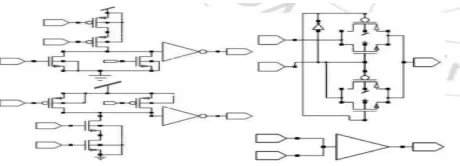
Figure 3: Block generate and propagate (Ling
carry) using CMOS and transmission gate.
Now, instead of utilizing traditional carries, a
new of carry, known as Ling carries, is
produced where the ith Ling carry in [11] is
Where
If we assume that all input gates have only two
inputs, we can see that calculation of c4 requires
5 logic levels, whereas that for H4 requires only
four. Although the computation of carry is
simplified, calculation of the sum bits using
Ling carries is much more complicated. The
sum bit, when calculated by using traditional
carry, is given to be
Substituting (5) into (9), we get that
However, according to [12] the computation of
the bits si can be transformed as follows:
Equation (11) can be implemented using a
multiplexer with Hi− 1 as the select line, which
selects either di or (di ⊕ pi− 1). No extra delay
is added by Ling carries to compute the sum
since the delay generated by the XOR gate is
almost equal to that generated by the
multiplexer and that the time taken to compute
the inputs to the multiplexer is lesser than that
taken to compute the Ling carry.. Here, for n-bit
addition, Ling carry Hi and Hi+1 is given by
This can be then further reduced by using the “.”
operator to
This allows the parallel prefix computation of
Ling adders using a separate tree [9] for even
and odd indexed positions. Using this
methodology, we implemented a 16-bit adder
using the Kogge-Stone tree and then utilized
that block to develop 32 and 64-bit adders. The
gates and blocks used for this implementation
were then modified using transmission gates.
Cells other than gray and black cell that are used
as components in Ling adder.
Verilog descriptions of the proposed variable
latency speculative adders, and of their
non-speculative counterpart. It is not easy to
compare performances (in terms of power,
speed, and area) of different designs, since they
strongly depend on timing constraint used
during synthesis.
3.1 The Optimal K Choice
Comparison between variable latency adder and
the nonspeculative Han-Carlson topology reveal
that variable latency adders allow to reduce the
minimum achievable delay. For instance, in the
64 bit case, the minimum achievable delay is
about 280 ps for the non-speculative adder and
reduces up to 225 ps in the variable latency
architecture.
3.2Comparison with Kogge-Stone
Variable Latency Speculative Adder:
Fig. 7 shows the comparison between proposed
speculative adder and Kogge-Stone one. Also in
this case, we report the performance of
non-speculative adders, in order to identify the
region where the speculative approach is
effective. As an example, focusing on 64-bit
adders, for lower than 350 ps, the proposed
Han-Carlson speculative adder is the best choice
in terms of silicon area and power consumption.
Moreover, it allows reducing the minimum
achievable to 225 ps, with a 18% improvement
respect to Kogge-Stone no speculative adder
and a 11% improvement respect to KoggeStone
speculative adder. For , proposed speculative
adders offer 45% area reduction and 35% power
saving compared to Kogge-Stone
non-speculative adder.
4(b)
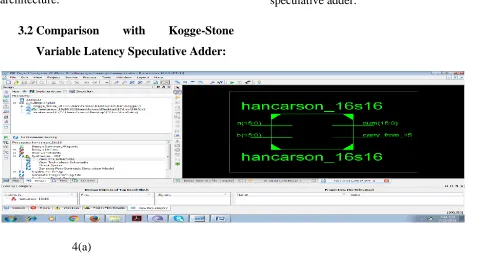
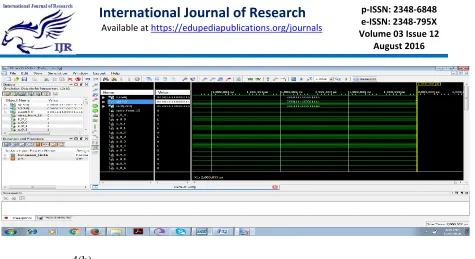
Fig. 4(a). Area report of Han-Carlson Adder, 4(b). error correction report of Han- Carlson Adder
4. Conclusion
The variable latency Han-Carlson parallel prefix
speculative adder for high-speed application is
proposed. A new, more accurate, error detection
network is introduced, which allows reducing
the error probability compared to the other
approaches. Compared with traditional,
non-speculative, adders, our analysis demonstrates
that variable latency Han-Carlson adders show
sensible improvements when the highest speed
is required; otherwise the burden imposed by
error detection and error correction stages
overwhelms any advantage. This can be used in
various applications like digital signal
processing, satellite and mobile phones. The 16
Bit Existing and Proposed adders are
implemented. In the future work, proposed
architecture will be converted into 32 bit Adders
and analyzes the area and speed. This adder will
be done by using our verilog and the Adder
design will implemented into FPGA
5. References
[1] O. J. Bedrij, .Carry-select adder,. IRE Trans.
Electron. Comput., pp. 340.346, June 1962.
[2] R. P. Brent and H. T. Kung, .A regular
layout for parallel adders,. IEEE
Trans.Computers, vol. C-
31, no. 3, pp. 260.264, Mar. 1982.
[3] J. Chen and J. E. Stine, .Optimization of
bipartite memory systems for multiplicative
divide and square root,. 48th IEEE International
Midwest Symp. Circuits and Systems, vol. 2,
[4] A. Cilardo, “A new speculative addition
architecture suitable for two's complement
operations,” in Proc. Design, Autom., Test Eur.
Conf. Exhib, (DATE'09), Apr. 2009, pp. 664–
669.
[5] K. Du, P. Varman, and K. Mohanram, “High
performance reliable variable latency carry
select addition,” in Proc. Design, Autom., Test
Eur. Conf. Exhib.(DATE '12), Mar. 2012, pp.
1257–1262.
[6] D. Goldberg, .What every computer scientist
should know about floating point arithmetic,.
ACM Computing surveys, vol. 23, no. 1, pp.
5.48, 1991.
[7] T. Han and D. Carlson, .Fast area-efficient
VLS Adders,. in Proc. 8th Symp. Comp. Arith.,
Sept. 1987, pp. 49.56.
[8] D. Harris, .A taxonomy of parallel prefix
networks, in Record of the Thirty-Seventh
Asilomar Conference on Signals, Systems and
Computers, Nov. 2003, pp. 2213.2217.
[9] S. Knowles, .A family of adders,. in Proc.
15th IEEE Symp. Comp. Arith., June 2001, pp.
277.281.
[10] P. Kogge and H. Stone, .A parallel
algorithm for the efficient solution of a general
class of recurrence relations,. IEEE Trans.
Computers, vol. C-22, no. 8, pp. 786.793, Aug.
1973.
[11] I. Koren, Computer Arithmetic Algorithms.
Natick, MA, USA: A K Peters, 2002.
[12] H. Ling, .High speed binary adder,. IBM
Journal of Research and Development, vol. 25,
no. 3, pp.156.166, 1981.
[13] R. Ladner and M. Fischer, .Parallel prefix
Computation,.J. ACM, vol. 27, no. 4, pp.
831.838,
Oct. 1980.
[14] J. Sklansky, .Conditional sum addition
logic,. IRE Trans. Electron. Comput., pp. 226.
231, June
1960.
[15] S. M. Nowick, “Design of a low-latency
asynchronous adder using speculative
completion,”
IEE Proc. Comput. Digit. Tech., vol. 143, no. 5,
pp. 301–307, Sep. 1996.
[16] V. G. Oklobdzija, B. Zeydel, H. Dao, S.
Mathew, and R. Krishnamurthy, Energy delay
estimation technique for high-performance
Symp. Computer Arithmetic (ARITH-16’03), p.
272, June 2003.
[17] A. K. Verma, P. Brisk, and P. Ienne,
“Variable Latency Speculative Addition: A New
Paradigm for Arithmetic Circuit Design,” in
Proc. Design, Autom., Test Eur. (DATE '08),
Mar. 2008, pp. 1250–1255.
[18] S. Winograd, .On the time required to
perform addition,.J. ACM, vol. 12, no. 2,pp.
277.285, 1965.
[19] R. Zimmermann, “Binary adder
architectures for cell-based VLSI and their
synthesis,” Ph.D. thesis, Swiss Federal Institute
of Technology, (ETH) Zurich, Zurich,