Education Maintenance
Allowance: The First Year
A Quantitative Evaluation
Centre for Research in Social Policy:
Karl Ashworth, Jay Hardman, Woon-Chia Liu,
Sue Maquire and Sue Middleton
Institute for Fiscal Studies:
Research Report No 257
Education Maintenance
Allowance: The First Year
A Quantitative Evaluation
Centre for Research in Social Policy: Karl Ashworth, Jay Hardman, Woon-Chia Liu,
Sue Maguire and Sue Middleton
Institute for Fiscal Studies:
Lorraine Dearden, Carl Emmerson, Christine Frayne, Alissa Goodman, Hidehiko Ichimura and Costas Meghir
CONTENTS
Page
EXECUTIVE SUMMARY i
1 INTRODUCTION 1
1.1 Policy Context 1
1.2 Education Maintenance Allowance 4
1.3 The EMA Evaluation 4
1.3.1 Implementation of EMA 5
1.3.2 The context of EMA 6
1.3.3 Direct experiences of EMA 6
1.3.4 Leeds and Inner London 7
1.4 Design of the Statistical Evaluation of EMA 7
1.4.1 Sample sizes and source 8
1.4.2 Fieldwork and response rates 9
1.4.3 Weighting 9
1.4.4 Analytic strategy 9
2 YOUNG PEOPLE EMA AND EDUCATION 12
2.1 Introduction 12
2.2 Matching Pilot and Control Areas 13
2.3 Characteristic of Young People and their Parents 13
2.3.1 Young people 14
2.3.2 Parents’ and families’ circumstances 16
2.4 Post-16 Destinations 18
2.4.1 Post-16 destinations in the pilot and control areas 20
2.4.2 Destinations in the rural and urban areas 22
2.4.3 Destinations in the different EMA variant areas 25
2.4.4 Summary and conclusions 29
2.5 EMA Applications and Awards 30
2.5.1 Awareness 30
2.5.2 Applications 32
2.5.3 Application outcomes 34
2.5.4 Amount awarded 35
2.5.5 Learning agreements 37
2.5.6 Summary and conclusions 40
2.6 Year 11 Qualifications 40
2.6.1 Qualifications of young people in full-time education 43
2.6.2 Summary and conclusions 44
2.7 Post-16 Courses 45
2.8 Education and Part-time Work 47
2.8.1 Combining post-16 education and part-time work 47
2.8.2 Working part-time during year 11 49
2.8.3 Changes in young people’s working behaviour 50
2.8.4 Working in year 11 and qualifications 52
2.9 Young People’s Pocket Money 55
2.9.1 Receipt of pocket money 55
2.9.2 Amounts of pocket money 57
2.9.3 Summary and conclusion 59
2.10 Young People’s Spending 59
2.10.1 Housekeeping 60
2.10.2 Contributions to personal spending 65
2.10.3 Main expenditure 68
2.10.4 Summary and conclusions 70
3 INTENTIONS, DESTINATIONS AND DECISIONS: WHAT TO DO 72
AFTER COMPULSORY EDUCATION?
3.1 Intentions and Destinations 74
3.2 Young People Not in Education, Employment or Training 77
3.2.1 The NEET groups 77
3.2.2 Decision-making in Year 11 79
3.2.3 Reasons for not entering post-16 education 82
3.2.4 Awareness of EMA 85
3.2.5 Financial barriers: is EMA the key? 86
3.3 Influences on Decisions 87
3.3.1 Sources of advice for Year 11 decisions 87
3.3.2 Influence of the Careers Services 91
3.3.3 School experiences 93
3.4 Summary and Conclusions 95
4 METHODOLOGICAL APPROACH 100
4.1 Introduction 100
4.2 One-way Matching at the Individual Level 101
4.3 Placing More Structure on the Model 104
4.4 Difference-of-Difference Estimators 105
4.4.1 Using ineligibles 106
4.4.2 Using older siblings 109
4.5 Conclusion 110
5 THE IMPACT OF EMA 112
5.1 Introduction 114
5.2 One-way Matching 115
5.2.1 Sample sizes and characteristics 115
5.2.2 Comparing propensity scores 117
5.2.3 Impact of EMA on participation in full-time education among 117 young people eligible for EMA: one-way matching results
5.3 Refinements of the Matching Methodology and Policy Simulation 125
5.3.1 How does varying the amount of EMA impact on 125
participation?
5.3.2 Comparing different variants 132
5.4 Two-way Matching: Pilots and Controls, and Eligibles and 134
Non-eligibles
5.4.1 Sample sizes and mean characteristics 136
5.4.2 Propensity scores 138
-way matching results using eligibles and ineligibles
5.5 Two-way Matching Across Pilots and Controls, and Older 141
Siblings
5.5.1 Sample sizes and mean characteristics 143
5.5.2 Propensity scores 145
5.5.3 Impact of the EMA on educational participation: two 145
-way matching results using eligibles and their older siblings
5.6 Conclusions and the Continuing Evaluation 150
BIBLIOGRAPHY 152
APPENDIX A1 THE SAMPLE FOR ANALYSIS
APPENDIX A2 METHODOLOGICAL APROACH
APPENDIX A3 VARIABLES USED IN THE ANALYSIS
APPENDIX A5 MATCHING STATISTICS
Executive Summary
Chapter 1 Introduction
One of the main aims of the Government’s Connexions Strategy is to provide
financial support for young people who might otherwise be unable to remain in
full-time education post-16; that is, after the end of compulsory schooling. EMA is a
means-tested allowance available to 16 to 19 year olds. It aims to encourage
participation, retention and achievement among young people, particularly those from
low-income families. Section 1.1.
This evaluation focuses on the four models of EMA that were introduced into the
original 15 pilot LEAs in September 1999. The pilots have subsequently been
extended to a further 41 LEA areas. Section 1.2.
As well as evaluating the impact of EMA on participation, retention and achievement,
the evaluation must also make recommendations on the level at which EMA should
be set; the effectiveness of bonuses for retention and achievement; and to whom EMA
should be paid (parent or young person). The evaluation will also address a range of
subsidiary issues relating to the effect of EMA on young people’s lives.
The evaluation has four main elements, which combine both qualitative and
quantitative research methods. This report focuses on the impact of EMA on those
most directly affected, young people and their parents. It describes quantitative
findings from the first wave of interviews with the first cohort of young people
potentially eligible for EMA; those who completed compulsory education in summer
1999. Section 1.3.
Large samples of young people and their parents were interviewed in ten of the EMA
pilot areas and eleven matched control areas. The selection of LEA areas to
participate in the EMA pilot was not random – areas were chosen where there was
most scope for EMA to have an impact (for example, they were known to have
low levels of attainment in Year 11 examinations). In order to estimate the effect of
EMA it was necessary to find similar areas where no EMA was available (a
‘counterfactual’). This was achieved by using matching techniques at both the LEA
and individual level. Section 1.4.
Chapter 2 Young People, EMA and Education
Following a description of how LEA areas were selected to act as controls, or
‘matched’ to the rural and urban pilot areas, basic characteristics of the young people
and their parents are described. Sections 2.1 - 2.3. The remainder of the chapter
examines what young people were doing in the months immediately following the end
of compulsory education to provide a context for the statistical modelling in Chapter
5.
Although firm conclusions cannot be drawn from this descriptive analysis, there are
two patterns in the data that are consistent with a possible EMA effect. The first is
participation rates in post-16 education amongst income eligible young people in
those areas where EMA is being piloted. These were higher than amongst young
people in the control areas who would have been eligible on income grounds if EMA
had been available in these areas. The second is that this pattern was reversed
amongst those young people who were not eligible for EMA. This is important for
two reasons: (1) it suggests that estimates of increases in participation in full-time
education among young people eligible for EMA in this analysis are on the low side
(also confirmed by later results); and, (2) it shows that differences in participation
rates amongst EMA eligible young people between the pilot and control areas may
genuinely be the result of EMA, rather than because of other differences between the
areas not measured in the survey.
The only setting where the second pattern was not observed was in rural areas where
participation rates (which were the highest of any variant) were higher in those areas
where EMA is being piloted for both groups: eligible and ineligible.
seems to be the rural pilot area, where the difference between destinations in the pilot
and controls suggest that EMA has drawn most young people from work/training.
Section 2.4.
In general LEAs had been very successful in promoting EMA to eligible young
people and their parents, particularly in the light of the late announcement of EMA.
Levels of awareness of EMA were high, particularly among eligible young people in
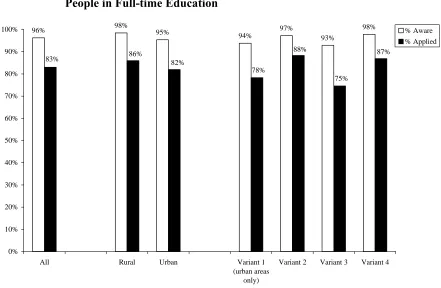
full-time education (overall, 96% were aware of EMA). Eligible young people not in
full-time education were much less likely to have heard of EMA. Section 2.5.1.
Overall, 63% of young people in lower income families in the pilot areas had applied
for EMA and, despite some differences between LEAs, the vast majority of
applications had been successful, and almost all young people had taken up their
award by the time of interview. More than half of EMA awards were for the
maximum amount of EMA. However, less than one per cent were for the minimum
amount, which allows young people to access retention and achievement bonuses that
are available to all EMA recipients, irrespective of the level of weekly payment.
Sections 2.5.1 – 2.5.4.
Almost all young people reported that a learning agreement had been signed. Parents
were said to have signed less often than young people or the school or college, except
in variant 3 areas where EMA is paid to parents. Almost three-quarters (72%) of
young people had retained a copy of their learning agreement. Almost all young
people recalled at least one specific commitment that it contained, particularly
attendance requirements and learning goals. Section 2.5.5.
Qualifications attained at the end of Year 11 by young people in the sample were
lower than the national average. Confirming the findings of earlier research on the
relationship between socio-economic status and examination performance, young
people eligible for EMA on income grounds had much lower qualifications than the
more affluent ineligible young people in both pilot and control areas. Young people
in the pilot areas were slightly less well qualified than those in the control areas. This
young people in these areas having achieved more or better examination passes in
Year 11. Section 2.6.
Young people in full-time education in the pilot areas were more likely to be studying
for vocational qualifications than those in the control areas. Section 2.7.
Part-time work is associated more with socio-economic circumstances than receipt of
EMA. Young people eligible for EMA on income grounds were less likely to work
part-time than those who were ineligible. However, there were differences in levels
of part-time work among EMA recipients across the variant areas. In particular, EMA
recipients in the variant 3 areas, where EMA is paid to the parent, were more likely to
be working than EMA eligible young people in the variant 3 control areas. Section
2.8.1.
EMA appears to have had very little effect in encouraging young people to give up
part-time work. There was almost no difference between recipients and
non-recipients who had given up work since Year 11, although EMA non-recipients in variant
3 areas were less likely to have stopped work than non-recipients. As with
participation in part-time work it seems that eligibility for EMA is more important
than receipt in explaining giving up work in Year 12. Section 2.8.3
EMA recipients were less likely to have worked part-time in Year 11 than
non-recipients, but those who did work achieved better exam results at the end of Year 11
than those who did not. The same picture emerged for all EMA eligible young people
who worked part-time, in both the pilot and control areas – better results were
associated with part-time work during Year 11. Section 2.8.4.
EMA recipients were less likely to get pocket money from their parents than either
non-EMA recipients or eligible young people in the control areas and, when they did,
received lower average monthly amounts. Non-recipients in the pilot areas who were
eligible on family income grounds for EMA were more likely to get pocket money
and received larger amounts than recipients. In variant 3 areas, where EMA is paid
other variants; in addition, when young people in variant 3 did receive pocket money,
they received the highest average amounts. It may be that when young people receive
EMA directly, parents take the opportunity to stop giving pocket money or to reduce
the amount given. Section 2.9.
It seems that, on these measures, EMA is not being used to supplement young
people’s spending on entertainment. Young people who were receiving EMA were
more likely than other groups of eligible young people to be making a contribution to
housekeeping costs, transport and books and equipment for school. They were also
more likely to say that transport or books and equipment was their main item of
expenditure. The exception seems to be recipients in the variant 3 areas where EMA
is paid to parents. EMA ‘recipients’ in these areas had patterns of expenditure more
similar to those of non-recipients and eligible young people in the control areas than
to EMA recipients in other variant areas. Section 2.10.
Chapter 3 Intentions, Destinations and Decisions: What to do after
Compulsory Education?
EMA seems to have influenced EMA eligible young people who had intended, during
Year 11, to remain in education post-16. Their participation rate was significantly
higher in the pilot areas than in the controls. It is also possible that young people in
urban areas who had originally intended not to participate had also been influenced by
EMA to remain in education. Section 3.2.
The group of young people who are not involved in education, employment or
training (NEET) are of major concern to policy makers. One of the main objectives
of EMA is to provide financial support to young people in low-income families who
are disproportionately represented in the NEET group. Evidence from the survey
suggests that fewer EMA eligible young people in the urban pilot than the urban
control areas were in the NEET group following the introduction of EMA. Section
3.3.1.
work or training. However, some eligible young people in the economically inactive
NEET group found their decision very easy. Mainly these were young people who
were carers, or sick or disabled. Similarly, young people in the NEET groups were
less likely than those in employment, work or training to think they had made the
right post-16 decision. Section 3.3.2.
Financial reasons were a major factor in the decisions of EMA eligible young people
in the NEET group not to continue in post-16 education. Other reasons included poor
exam results, a dislike of their previous school and difficulties in accessing courses or
a suitable institution. This suggests that financial incentives offered by EMA may
need to be supplemented by other policy responses. Section 3.3.3.
EMA eligible young people in the NEET groups were much less likely to be aware of
EMA than other eligible groups. Awareness was generally lower among eligible
young people who had not intended to remain in education. Promoting the EMA
more thoroughly to these young people might have influenced their decision-making.
Section 3.3.4.
Further evidence for this was found in the substantial proportions of eligible young
people not in post-16 education who said that a financial incentive would have made
them consider staying-on. Section 3.3.5.
EMA eligible young people who were in the NEET groups were less likely to have
had any source of advice to assist them in deciding their post-16 destinations. When
they did have sources of advice, they had fewer advisors (Section 3.4.1). Young
people in the NEET groups also reported less individual and group contact with the
Careers Services. Overall, the majority of young people reported that Careers
Services had little or no influence on their decision-making. However, one-quarter
also said that they had played a major role (Section 3.4.2).
Eligible young people in the NEET groups reported more problems with their school
experience. Their attendance rates had been lower and exclusions, truancy, bullying
Chapter 4 Methodological Approach to Estimating The Effect of EMA
The main set of estimates of the impact of EMA were derived using a matching
approach. Carefully matching pilot area individuals to their closest counterparts in
the controls solves the problem that the pilot and control areas may be quite different
in their demographic composition. This approach is valid so long as all relevant
differences between pilots and controls can be accounted for by characteristics of
individuals which are observable in the survey data. Once individuals have been
matched, the impact of EMA is measured by taking the difference in participation
rates between pilots and their relevant controls. Section 4.1 and 4.2.
A regression model is used to obtain further understanding of important policy issues
relating to the design of EMA, such as the effectiveness of each of the different
variants being tested. This allows estimates of the impact of incremental changes in
the amount of EMA offered. Section 4.3.
The final methodology contends with the problem that the pilot and control areas may
differ from one another in ways that are not directly observable in the survey data, but
which may be important for explaining differences between them in post-16
participation in education. For example, the labour market opportunities available to
young persons could be different in our pilot and control areas. A methodology is
outlined based on a matching and difference of differences approach designed to deal
with this potentially serious evaluation issue. Section 4.4.
Chapter 5 The Impact of EMA
The first set of results using one-way matching techniques to show the overall impact
of EMA on participation in post-16 full-time education among young people eligible
for EMA showed that:
• The best estimate of the overall impact of EMA, before taking into account any
comparison to the control areas, amongst eligible young people, by around 5.0
percentage points;
• The estimated impact of EMA is larger in rural areas than in urban areas. In
rural EMA areas the estimated gain in participation in post-compulsory
education is 9.2 percentage points, compared with an estimated gain of 3.8
percentage points in urban areas;
• EMA is estimated to have had a larger effect on young men than on young
women in both the urban and rural areas, which suggests that EMA may go
some way towards closing the gap between males and females in participation
in post-16 education;
• EMA has had a significantly larger effect on young people who are eligible for
the full amount of EMA available compared to those who are eligible for a
partial amount, although these results vary between urban and rural areas and by
gender. Taking all areas together, the overall effect of EMA is a gain in
participation amongst those eligible for the full EMA by seven percentage
points, compared to 2.9 percentage points for those on the taper. Section 5.2.
Taking into account differences according to gender, area and the amount of EMA
allowance received, these findings suggest that in the first year of EMA, there has
been a gain in participation in full-time education in the pilot areas, amongst eligible
young people, of 3 to 11 percentage points.
The next set of results that used regression analysis to estimate the effects on
participation in education of each extra £1 per week of EMA offered found that:
• Each additional £1 per week of EMA, ignoring the effects of bonuses, is
associated with a 0.42 percentage point increase in post-16 school participation
for rural men, and 0.12 percentage points increase for rural women. For urban
males this figure is 0.21 percentage points and for urban females 0.13
percentage points. The estimated impact for urban variant 3 where EMA is paid
directly to the parent is not significantly different than for the other urban
variants. Taking into account the additional retention bonuses paid does not
alter these results significantly.
additional 1.2 percentage points amongst eligible young people over and above
the participation rate obtained under variants 1 and 3. Section 5.3.
The final results tested the robustness of these estimates by using several two-way
matching techniques. These techniques allowed further unobserved differences
between pilots and controls which may affect educational participation, (referred to as
‘area specific effects’), to be taken into account. Although the results do not provide
a clear-cut picture of the size and direction of possible area specific effects, the
overall picture was as follows:
• Although not significant, most of the estimates suggest that the overall impact
of EMA may be somewhat higher than the results presented above once area
specific effects are taken into account. Estimates of the additional overall
impact of EMA range from -1.7 percentage points to 6.6 percentage points once
these effects are considered.
• Again, although not statistically significant, when urban and rural areas are
considered separately, it appears that the impact of EMA in urban areas may be
somewhat higher than the main set of estimates suggests, but somewhat lower in
rural areas. This result for the rural areas accords with Careers Services data
which show that school participation was higher in the rural pilot area than in its
control areas before EMA was introduced. Sections 5.4 and 5.5.
The findings presented in this report cover just one aspect of the first phase of the
evaluation of the EMA. Further data to be collected and refinements to the analysis
mean that these findings must be regarded as interim only. Indeed, while all of the
results reported from the one-way matching are found to be statistically significant, at
least at the five per cent level, it is important to remember that the true effect of EMA
1
Introduction
The Department for Education and Employment (DfEE) has commissioned a consortium of
organisations to evaluate the piloting of Education Maintenance Allowances (EMAs). The
consortium, led by the Centre for Research in Social Policy (CRSP), includes the National
Centre for Social Research, the Institute for Fiscal Studies (IFS) and the Institute for
Employment Research (IER).
This report contains results from the first wave of quantitative interviews with young people
and their parents following the introduction of EMA. This chapter first describes the policy
context for EMA and its structure and coverage. This is followed by a brief description of the
overall evaluation and of the design of the quantitative element. Chapter 2 then contains
descriptive analysis of some of the characteristics of young people in the survey. In addition
to providing information about previously under-researched areas, this chapter also provides
a context for the analyses in Chapter 5. Chapter 3 continues the descriptive theme,
examining young people’s intentions about their future after the end of compulsory schooling
and their actual destinations. It focuses on the group of young people who, at the time of
interview, were not in education, employment or training (NEET) – a group currently of
major concern to policy makers and on whom it was hoped EMA might have a major impact
(see further, below). Chapter 4 describes in detail the methodological approach adopted to
estimate the effect of EMA on participation in post-16 education. Finally, Chapter 5 contains
the results of the statistical modelling of the effect of EMA on participation rates, amongst
eligible young people in full-time education.
1.1 Policy Context
The education and training needs of young people continue to be a key issue within
government policy. An integral part of this agenda is to expand learning opportunities for all
young people in order to improve economic competitiveness and success at two levels. First,
to meet the need for a stronger vocational education and training system in order to fill the
skills gap in relation to technical and associate professional skills. This has been identified as
an area in which the UK lags behind its European competitors (National Skills Task Force;
education, research evidence has highlighted the influence of social class differences on
levels of participation and attainment rates. Young people from lower socio-economic
groups appear to be much less likely than other young people to remain in full-time education
after the age of 16 (Newburn, 1999; Dearden, 1998). Recent policy initiatives have been
designed to overcome recognised barriers to participation in learning and in so doing, to
transform education into a tool to tackle social exclusion and economic disadvantage. As the
Prime Minister stated in his forward to the Social Exclusion Unit’s (SEU) report ‘Bridging
the Gap: New Opportunities for 16 - 18 year olds not in education, training or employment’:
‘The best defence against social exclusion is having a job, and the best way to get a job is to have a good education, with the right training and experience.’
(CM4405/SEU, 1999b)
In order to achieve these policy objectives, the Government intends to move to a more
integrated model of education and training for 14-19 year olds. This is to be implemented
under the Connexions Strategy (SEU, 1999a; DfEE, 2000), which will ensure the
development of:
• Information, advice, support and guidance services, including outreach facilities, to
connect and reconnect young people with learning;
• An appropriate, flexible curriculum that engages all young people and leads to relevant,
sought-after qualifications by young people and employers;
• High-quality provision in school sixth forms, in FE colleges and in work-based
training; and,
• The targeting of financial support for young people in learning.
While the strategy covers all young people, it is particularly focused on ensuring inclusion for
young people who are vulnerable - that is those who may be at risk of long-term exclusion
This will therefore include those young people who are defined in policy terms as the NEET
(not in education, employment or training) group. One component of the strategy is the
Learning Gateway, which aims to identify young people at school who are at risk of
underachieving and of failing to participate in post-16 education and training, as well as
There are links between a young person’s family and school background and their
participation in post-16 education. Young people who have been excluded from school are at
least twice as likely to be non-participants in post-16 education as young people who have
attended school on a regular basis. There is also a clear link “between disadvantaged family
circumstances and difficult school backgrounds (a history of bullying, truancy and exclusion,
and poor attainment pre-16) on the one hand and lower participation and performance post-16
and other problems such as crime, drug misuse and ill-health on the other” (DfEE, 2000,
p.14).
One barrier to remaining in post-compulsory education for many young people is lack of
financial support. Indeed, many disaffected young people perceive one of the key obstacles
to participation in further and higher education to be a lack of money (Istance, Rees and
Williamson, 1994; Wilkinson, 1995). In addition, post-16 student support is subject to
variations in local decision-making, so that where a student lives will determine how much or
how little financial support they will receive (Herbert and Callender, 1997; Kennedy, 1997).
The current system of financial support was criticised by the Social Exclusion Unit as being
unable to offer disadvantaged young people sufficient incentives to participate in learning, as
opposed to moving into employment (Cm 4405/SEU, 1999b). Moreover, a lack of financial
support for young people in post-16 education may also impact on retention rates, in that
young people from disadvantaged backgrounds may be forced to abandon full-time
education, in favour of the ‘guaranteed’ financial incentives offered within employment or
government-supported training.
The Education Maintenance Allowance (EMA) provides young people, in particular those
from low-income families, with some financial support to encourage them to remain in
post-16 learning. The purpose of EMA is to encourage participation, retention and achievement in
post-16 learning amongst young people who otherwise could not afford to remain in
education, who may be at risk of disaffection, or who might opt for the short-term financial
1.2 Education Maintenance Allowance
The EMA is an allowance paid to 16-19 year olds (or in some areas to their parents),
eligibility for which is dependent on parental income. The pilot provision started in
September 1999.
There are four models of the EMA, which are being tested in 15 pilot Local Education
Authorities (LEAs) (see Box 1). Variations exist in terms of the weekly amount of EMA
available, to whom it is paid (either the young person or their parents), and in the amounts
which are paid for retention and achievement bonuses. The full weekly allowance is payable
if the total parental taxable income does not exceed £13,000, while for those with a total
parental income of between £13,000 and £30,000 (£20,000 for the London pilot), EMA is
progressively tapered, down to a minimum weekly allowance of £5. From September 2000,
the availability of EMA was extended to young people living in an additional 41 LEAs.
Box 1.1 The Four Variants of EMA
Variant 1: £30 per week plus £50 retention and £50 achievement bonus;
Variant 2: £40 per week plus £50 retention and £50 achievement bonus;
Variant 3: £30 per week paid to the parent plus £50 retention and £50 achievement bonus;
Variant 4: £30 per week plus £80 retention and £140 achievement bonus.
1.3 The EMA Evaluation
The main aim of the evaluation is to assess the impact of EMA on 16-19 year olds’
participation, retention and achievement in full-time education. In addition, the evaluation
must also make recommendations on:
• The level at which EMA should be set;
• The effectiveness of bonuses for retention and achievement; and, • To whom EMA should be paid (young person or to parents).
There are other subsidiary questions that will be addressed in the course of the evaluation,
• What is the take-up rate for EMA?
• Does EMA affect Year 11 decision-making?
• Does EMA reduce reliance on part-time work and/or increase expenditure?
• Does the availability of EMA improve attendance, retention and achievement in
post-16 education?
• Does EMA reduce post-Year 11 participation rates in employment and training? • Does EMA reduce the number of young people not in education, employment or
training (NEET)?
• Does EMA affect the transfer of money within households?
• Does EMA affect education and work decisions made at the age of 18 or 19? • How are EMA allowances spent?
The evaluation started in 1999 and will be completed in 2003 and is being undertaken with
the first 15 pilot areas. It has four main elements, each of which has been designed to inform
and be informed by the other three. This report presents the findings from interviews with
young people and parents in Cohort 1 Wave 1 of the quantitative evaluation (1.3.3). Further
reports are produced by the EMA evaluators on the implementation of EMA, the contextual
data relating to EMA pilot areas, a statistical evaluation of LEA and Careers Services’
databases in Leeds and London and the qualitative research with young people and parents.
Additional evaluations of transport provisions and flexibilities to the scheme for vulnerable
groups are also being conducted.
1.3.1 Implementation of EMA
The evaluation will need to provide advice to policy makers on good practice in
implementing EMA if the decision is made to roll out the policy nationally. Interviews with
administrators of EMA in each pilot LEA are being undertaken annually throughout the life
of the pilot. These usually take the form of round table discussions with members of the
Implementation Groups that have been set up in each pilot LEA to oversee the administration
of EMA. Implementation Groups are made up of representatives from the Local Education
Authority (LEA), schools and colleges, and local careers service companies.
Also, in 1999, individual interviews were undertaken with key informants such as
ensure that the full range of opinions about, and experiences of, EMA are represented in the
evaluation.
1.3.2 The context of EMA
In order to measure the effect of EMA across the pilot areas it is vital to understand the
context in which it is operating. Contextual information is being collated for each area on an
annual basis to provide essential data about variations in education, labour market and
socio-economic factors.
1.3.3 Direct experiences of EMA
Qualitative and quantitative methods are being used to evaluate the impact of EMA on those
most directly affected - young people and their parents. The quantitative design is a
longitudinal cohort study involving large surveys of random samples of young people in both
the pilot and control areas. A fuller description of the quantitative design is given below
(Section 1.4) and details of how the control areas were selected can be found in Annex A1.
Two cohorts will be studied; young people who completed Year 11 (the end of compulsory
schooling) in summer 1999 and those completing Year 11 in summer 2000. The first round
of interviews with each cohort is conducted face-to-face and includes an interview with a
parent or guardian of the young person. Findings from these interviews with the first cohort
are the subject of this report. Two subsequent waves of telephone interviews are to be
undertaken at annual intervals and, for the first cohort, a fourth wave in 2002 to assess any
longer term effects of EMA on labour market and other outcomes for young people.
Box 1.2 Survey Design
Cohort 1
Wave 1 Wave 2 Wave 3 Wave 4
Face-to-face Telephone Telephone Telephone
1999 2000 2001 2002
Cohort 2
Wave 1 Wave 2 Wave 3
Face-to-face Telephone Telephone
A small sub-sample of young people and their parents from the first cohort (in each pilot
area) are also taking part in a qualitative study. The purpose of these interviews is to
understand more about the processes underlying the decisions which young people make
about post-compulsory education and, specifically, about the impact of EMA on their lives.
A sub-sample of these young people will be re-interviewed in 2001.
1.3.4 Leeds and Inner London
The Local Education Authorities (LEAs) in Leeds and Inner London (Lambeth, Southwark,
Lewisham and Greenwich) were allocated EMA in the first year of pilot provision using
different local arrangements. They could not, therefore, be included in the main evaluation.
Instead a smaller-scale statistical evaluation, based on data which is available from the LEAs
and local careers services, is being undertaken on an annual basis. This will provide some
limited information about the impact of EMA on participation rates in post-compulsory
education. In addition, using a case study approach, a number of schools and colleges will be
visited each year to assess the effect of EMA pilot provision on local attendance and retention
rates.
1.4 Design of the Statistical Evaluation of EMA
The basis of the statistical evaluation is surveys with young people and their parent(s) in ten
EMA pilot areas and eleven control areas. The sample for this first cohort was of young
people who completed Year 11 in the summer of 1999. Two questionnaires were designed in
consultation with the DfEE.
A household and parent or guardian’s questionnaire to provide information about:
• Household composition, relationships, tenure, income and ethnicity; • Education decisions and current activities of the young person’s siblings; • Parent’s occupation and educational qualifications;
• Involvement of parents in the young person’s decisions about what to do at the end of
Year 11;
• The young person’s childhood; • Parent’s attitudes to education; and,
A young person’s questionnaire which covers:
• Activities since Year 11 and at the time of interview, including courses being studied
and part-time work for those in full-time education;
• Experiences during Years 10 and 11 at school, including qualifications entered for and
obtained;
• Year 11 decisions about what to do next, sources of advice and help, and reasons for
decisions;
• Sources and amounts of income, including EMA; and, • Expenditure patterns and amounts.
1.4.1 Sample sizes and source
Sample sizes drawn for the first wave of interviews were chosen to be sufficiently large to:
• Allow statistically significant differences of approximately five percentage points in
participation, retention and achievement between pilots and controls and between the
different EMA variants to be measured; and,
• Take account of the proportion of young people who would inevitably drop out of the
evaluation in subsequent waves of interviews (sample attrition).
The sample was drawn by the Department for Social Security (DSS) from Child Benefit
records, following specifications provided by the National Centre for Social Research.
Eligible young people were those who were born between 01 September 1982 and 31 August
1983 and lived in one of the 21 pilot and control LEA areas covered by the study, as defined
by postcode. A small proportion of ‘cases in action’, that is cases where special arrangements
were being made by the Benefit Office, were excluded by the DSS.
The National Centre specified a random method for selecting the required number of young
people for each LEA, to form a total sample of 17,000. The additional sample above target
was to allow for attrition arising from ‘opt-out’ (see below) and non-response.
The target number differed between LEAs according to whether they were pilot or control
areas. For urban LEAs a simple random sample of eligible young people was drawn. For
rural LEAs, which covered larger distances, a two stage sampling method was followed with
a first stage of selecting postcode sectors with probability according to their populations of
Following selection of the sample, an opt-out mailing was administered by the DSS at the
start of October 1999. The letter was addressed to the parent or guardian who received Child
Benefit for the young person. Eight per cent of the original sample opted out, leaving 15,704
young people to be contacted for the main stage. The remainder of the sample was then
provided to the National Centre, which was then clustered into sample points containing
approximately 20 records each.
The total target sample size was 11,169. A detailed breakdown of the target sample sizes for
each area is provided in Appendix A1.1.
1.4.2 Fieldwork and response rates
Fieldwork was undertaken by the National Centre for Social Research between November
1999 and April 2000 using Computer Assisted Personal Interviewing (CAPI). Of the original
target sample size of 11,169 interviews with young people, 10,646 were achieved. A post
opt-out response rate of 72 per cent was achieved. This increased to 78 per cent when young
people who had moved or those who could not be contacted because details of the address
provided were insufficient were excluded from the issued sample. In 96 per cent of cases a
successful interview was also obtained with the parent.
Details of the achieved sample size in each area are compared with the original target sample
size in Appendix A1.2.
1.4.3 Weighting
Weights were constructed to correct for potential sources of bias. In what follows, all data
are weighted unless stated otherwise.
1.4.4 Analytic strategy
The selection of LEA areas to participate in the EMA pilot was not random. Urban areas
were chosen that were known to have relatively high levels of deprivation, low participation
rates in post-16 education and low levels of attainment in Year 11 examinations. In short,
areas were chosen where there was most scope for EMA to have a positive impact. In
addition, one pilot area was selected to enable the potential impact of EMA in rural areas to
between individuals in pilot and control areas could have led to observed differences in
participation that might incorrectly be attributed to an EMA effect. Conversely, depending
on the direction of such ‘confounding’ differences, an EMA effect could exist but be masked
and not identified. For example, if young people in the pilot areas were more likely than
those in the control areas to have characteristics known to be associated with low
participation in post-16 education, results of the area matching would under-estimate the
effect of EMA.
In order to obviate potential problems with such confounding, statistical techniques were
used to ensure that individuals in the pilot areas were as alike as possible in terms of their
characteristics that are known to be related to participation in post-16 education. In other
words, differences were controlled statistically using matching procedures. This ‘matched
statistical control’ design was a two-stage process, the first matching pilots and controls at an
area level, and the second matching at an individual level. Each stage is discussed more fully
below (see also Chapter 4 and Appendix A2).
LEA matching and descriptive analysis
The first stage matched the pilot areas as closely as possible to control areas. This is the basis
of the findings reported in Chapters 2 and 3. Chapter 2 also describes this matching process
in greater detail.
The descriptive analysis in these chapters plays a number of important roles in the evaluation,
the most significant of which for this report are:
• To provide a unique statistical account of young people in the initial period following
the end of compulsory schooling;
• To compare individuals in the pilot and control areas in order to detect any differences
which may confound the evaluation of the effect of EMA; and,
• To set the scene for the more sophisticated statistical modelling in Chapters 4 and 5.
Individual matching and statistical modelling
The second and subsequent stage of matching was at the individual level. Each individual in
the pilot area was matched with an individual in the control area on a range of characteristics,
pilot with control areas, there remained the possibility that the areas were different in ways
that might effect the decisions of young people about their future after compulsory education.
Normal regression techniques are a form of individual matching, but these will only produce
unbiased estimates of the EMA effect under certain assumptions. If the range of important
characteristics in both pilot and control areas are the same, then regression techniques will
provide unbiased and efficient estimates of the EMA effect. If, however, the range of
important characteristics vary between control and pilot areas, then regression estimates may
be seriously biased (see Heckman, Ichimura and Todd, 1998). In order to overcome this
potential problem, more sophisticated individual matching techniques need to be used and
this is the approach taken in the report.
Initial matching at the individual level allowed comparisons only between the pilot and
control areas. Further matching exercises were undertaken to allow more sophisticated
modelling of the differential impact of EMA in urban and rural areas, in the different variants
of EMA, and on young men and young women. Estimates were also made of the effect on
participation in post-16 education of setting EMA at different levels and of retention bonuses.
Further details of this matching process can be found in Chapter 4 with a more detailed
2
Young people, EMA and education
2.1 Introduction
This chapter provides background information about young people included in the
quantitative survey of the first cohort of the EMA evaluation. The aim is to provide a context
for analysis contained in later chapters. Therefore, the focus is on evidence that provides
interesting and useful information about young people and their experiences, rather than
seeking to identify direct EMA effects that are the subject of the econometric modelling
contained in Chapter 5.
The chapter begins by explaining how the LEA control areas were chosen and subsequently
matched to the pilot areas (Section 2.2). Some of the personal and family characteristics of
the young people and their parents are then described (Section 2.3). Next, what young people
were doing at the time they were interviewed – their ‘post-16 destination’ – is examined
(Section 2.4). This is followed by an exploration of awareness of EMA and levels of EMA
applications and awards (Section 2.5). The qualifications gained by young people at the end
of Year 11 are described in Section 2.6 and the courses chosen by young people who had
remained in full-time education in Section 2.7. The extent to which young people combined
full-time education with part-time work is the subject of Section 2.8. Finally, Section 2.9
reports on young people’s receipt of pocket money and, in Section 2.10, how young people
were spending their money.
Throughout this chapter the general approach is to distinguish first between all young people
in the pilot and control areas as a whole, then between urban and rural pilot areas and finally
between young people in each of the variants. In terms of EMA, the chapter divides young
people between those who are potentially eligible for EMA on income grounds and those
who are not. This division can be done for all young people in the sample, both in the pilot
and control areas. Second, eligible young people in the pilot areas in full-time education are
divided into those who had been awarded EMA at the time of interview and those who had
not. (For simplicity, young people who had been awarded EMA at the time of interview are
referred to as EMA recipients, although a small number of them had not actually received
2.2 Matching Pilot and Control Areas
Chapter 1 has explained the need to find LEAs that could act as control areas for the pilot
LEAs. These control areas had to match the pilot LEAs as closely as possible. This
matching was undertaken in two stages. First, data from the two most recent Youth Cohort
Studies (YCS) were used to select LEA control areas for the EMA evaluation which were as
similar as possible to the pilot LEAs. On the basis of this analysis, LEAs that could
potentially serve as control areas were provisionally assigned to each of the four variants. A
number of these LEAs were intended to serve as control areas for more than one variant.
There were, however, a number of problems in using YCS for this analysis that limits the
accuracy of the matching. Therefore, once data from the EMA survey were available, the
analysis originally undertaken on the YCS data was repeated on the EMA data, to improve
the matching at the LEA level and finalise the allocation of control LEAs to pilots.1 This enabled basic descriptive analysis to be undertaken at a very early stage and the findings of
this analysis are reported in this chapter and Chapter 3. However, the quality of the matching
varies to some extent by variant, with the best results being for urban Variant 3. This needs
to be borne in mind when interpreting the analysis in these chapters.
2.3 Characteristics of young people and their parents
This section provides basic information about the characteristics of young people and their
parents. Throughout, comparisons are made between samples in the pilot and control areas.
(Further details of the sample and its characteristics can be found in Appendix 2).
2.3.1 Young people
Box 2.1 Summary
The overall sample contained:
• Equal numbers of young men and women; • 8 per cent from non-white ethnic backgrounds;
• 14 per cent with some form of special educational needs;
• 73 per cent who lived with two parents and 26 per cent with a lone parent;
• 147 young people who were not living with a parental figure, of whom 10 per cent were
teenage parents; and,
• Only 56 per cent who lived with two parents at least one of whom was in full or
part-time work.
In addition,
• 48 per cent in pilot areas lived in families with annual incomes of £13,000 or less and
so were eligible for the maximum award of EMA; and,
• 31 per cent were eligible for a partial EMA award.
As would be expected from a randomly drawn sample, there were equal numbers of young
men and women in both the pilot and control samples. All young people in the sample were
aged either 16 (64 per cent) or 17 (36 per cent). Approximately eight per cent were from
non-white ethnic backgrounds and the largest proportion of these were of Indian or Pakistani
origin (Table 2.1). The proportion of non-white young people in each ethnic group was
slightly larger in the pilot areas. Fourteen per cent of the overall sample had some form of
special educational needs. Five per cent of young people had a statement of special
educational needs, and a further seven per cent had special educational needs but were not
statemented. Two per cent had special needs but did not know whether they were
Table 2.1 Characteristics of the Young People
Column per cent within categories
Overall Pilot Control
Age Last Birthday
16 years 64 63 66
17 years 36 37 35
Ethnicity
White 92 91 94
Indian 2 2 2
Pakistani 3 3 3
Bangladeshi <1 <1 <1
Black <1 1 <1
Other 2 2 1
Special Needs
No 87 87 86
Yes – statemented 5 5 5
Yes - not statemented 7 7 8
Yes – don’t know if statemented 2 2 1
Living with Parent(s) or Parental Figures
Lone parent 26 27 26
Two parents 73 72 74
Guardian/foster parents/grandparents 1 1 1
Not Living with Parent(s) or Parental Figures
With partner (with or without child) 30 29 31
With child but no partner (10) (4) (17)
Without partner/child 60 68 51
Base: All young people
Note: Percentages in ( ) represent less than 20 cases.
The vast majority of young people were still living with their parent(s) or a parental figure
such as a grandparent. Of those living with their parents or a parental figure, almost
three-quarters lived with two parents and more than one quarter lived with a lone parent. Among
the 147 young people who were not living with a parental figure at the time of interview, the
largest proportion (60 per cent) were living without a partner or child and ten per cent were
Just under one third of young people not living with their parents had formed new
relationships and were living with a partner, with or without a child.
2.3.2 Parents’ and families’ circumstances
The pilot and control areas were selected by the DfEE to provide a sample that
over-represented young people who were least likely to stay on in education, to have lower levels
of achievement at GCSE and higher levels of deprivation. It would therefore be expected that
young people in the sample might display these and other characteristics known to be
associated with low participation rates in full-time education post-16: low family income,
living in rented housing, living in workless households and with parents themselves having
low or no educational qualifications (participation rates in post-16 education and levels of
achievement at GCSE are described later in this chapter).
Almost half of young people were living in families with annual incomes of £13,000 per
annum or less, and therefore met the income eligibility criteria for the maximum award of
EMA (Table 2.2). Just under one-third were eligible for a partial EMA award, and less than
one quarter were not eligible for EMA because their family income was too high – more than
£30,000 per annum. The income profile shows small differences between the pilot and
control areas, with families in the control areas being slightly better off than those in the pilot
areas. A similar pattern of slightly lower deprivation in the control areas also emerges for
housing tenure, with young people slightly less likely to be living in rented housing in the
control than in the pilot areas. Overall, 70 per cent of young people lived in owner-occupied
housing and 28 per cent in rented accommodation.
The young people in the sample also experienced relatively high levels of labour market
inactivity among their parents. Only just over half of young people lived with two parents
where at least one was in full-time work. Almost one-quarter of the young people’s parents
had no educational qualifications; again, slightly more had no qualifications in the pilot than
Table 2.2 Characteristics of Parents and Family Circumstances
Column per cent within categories
Overall Pilot Control
Family Income
£13,000 and less 46 48 43
£13,001 - £21,500 18 17 18
£21,501 - £30,000 14 14 15
> £30,000 23 21 25
Tenure
Owned outright 12 12 12
Buying with a mortgage 58 57 60
Rent 28 30 26
Other 2 1 2
Parent’s Economic Activity
2 parents – at least one in full-time work 52 51 54
2 parents – at least one in part-time work 4 4 3
2 parents – both inactive 7 8 6
1 parent – in full-time work 13 13 14
1 parent – in part-time work 10 10 10
1 parent – inactive 15 15 13
Highest Parental Qualification
Degree and above 15 14 16
Higher education below degree 12 11 12
A level/vocational level 3 13 12 13
Trade apprenticeship 7 6 7
GCSE/O level A-C/vocational level 2 21 21 21
Vocational level 1 and below 7 8 7
Other 3 3 3
No qualifications 24 25 22
Base: All young people. Unweighted N=9804
This section has provided a brief snapshot of young people and their family circumstances. It
has suggested that young people in the pilot areas were slightly less affluent than in the
control areas. This should be borne in mind in comparisons between the pilot and control
areas in what follows. In the remainder of the chapter, the focus is on young people’s lives in
2.4 Post-16 Destinations
Box 2.2 Summary
Although firm conclusions cannot be drawn from the following descriptive analysis, there are
two patterns in the data that are consistent with a possible EMA effect:
• Participation rates in post-16 education amongst income eligible young people in the
pilot areas are higher than among income eligible young people in the control areas;
• This pattern is reversed amongst those young people who are not eligible for EMA.
This suggests that: Estimates for young people eligible for EMA in this analysis may be on
the low side (see Chapter 5); and that differences in participation rates amongst EMA eligible
young people between the pilot and control areas may genuinely be the result of EMA, rather
than of other differences between the areas not measured in the survey.
EMA appears to have drawn young people into education from work/training, unemployment
and ‘other’ destinations, except in the rural pilot area where EMA seems to have drawn
young people mostly from work/training.
This section describes young people’s activities once they had finished compulsory schooling
and how these ‘destinations’ varied between young people:
• In pilot and control areas; • In rural and urban areas;
• In differing EMA variant areas;
• Who were or were not eligible for EMA on income grounds; and, • Who were or were not receiving EMA.
Amongst all 16 and 17 year olds in the sample – eligible and ineligible, pilot and control –
approximately three-quarters (73 per cent) said that they were in full-time education at the
time of interview. Slightly less than one-fifth (17 per cent) said they were in work and/or
training, and the remaining tenth described themselves as either unemployed and looking for
‘Other activities’ include part-time education; looking after the home or family; taking a
break or on holiday; voluntary work; joining the armed forces; waiting to start a new job or
training course or education course; or another, unspecified activity. This destination
category also covers those young people who report an absence from education, employment
or training on the grounds of disability, illness or pregnancy.
Participation rates for all young people in the survey (i.e. irrespective of eligibility for EMA)
were compared with those produced by the Careers Services (CS) for the same LEA areas.
The rates for the EMA sample were higher by on average six to seven percentage points
(Figure 2.1). There are at least two possible explanations for this. First, the data were
collected over different periods. CS data will have been collected earlier than the survey data
- between August and November 1999 - whereas the survey fieldwork ran from November
1999 to April 2000. It may be that in the intervening period some young people changed
their minds and decided to enter education after all. Second, the survey sample was drawn in
October when at least some young people might have already left Child Benefit records if
they went into work. Therefore, the sample might over-represent those who stayed on. Steps
have been taken to try and ensure that this does not recur in the Cohort 2 survey.
Figure 2.1 Comparison of EMA and Careers Services Participation Statistics
73% 72% 84% 78% 70% 68% 73%
68% 68% 68% 72%
68% 69% 67% 64% 64% 62% 66% 63% 65% 65% 67% 63% 66% 71% 78% 65% 67% 0% 10% 20% 30% 40% 50% 60% 70% 80% 90% 100% All:pilot All:control Rural:pilot
Rural:controlUrban:pilotUrban:control Variant1:pilot
Variant1:controlVariant2:pilotVariant2:controlVariant3:pilotVariant3:controlVariant4:pilotVariant4:control
Nevertheless, the patterns in participation rates are encouragingly similar between the two
sets of data. CS data show overall participation rates to be two percentage points higher in
the pilot areas than the controls (compared to a one percentage point difference in the survey
data), seven points higher in the rural variant (compared to six points in the survey), and three
points higher in the urban variants (two in the survey).
2.4.1 Post-16 destinations in the pilot and control areas
The effect of EMA will have been limited for this first cohort because of the short time
between the announcement of the scheme and the start of the academic year. Many young
people would therefore already have decided upon their post-16 destination before EMA was
announced. Nevertheless, as Chapter 5 will show, EMA has had a significant effect on
participation, which is partly masked in the results of this and the next chapter by differences
in the distribution of socio-demographic and other characteristics between the pilot and
control areas.
The proportion of young people eligible for EMA who were participating in full-time
education was much lower (69.4 per cent) than for young people ineligible for EMA (83.9
per cent) (Figure 2.2). This pattern of lower participation rates among EMA eligible young
people was found in both the pilot and control areas, urban and rural areas and in each of the
four EMA variants (see below). This is as expected, given that eligibility for EMA is
dependent on having family income below £30,000 per annum and that young people from
low-income families are less likely to remain in post-16 education (Pearce and Hillman,
1998).
Almost four percentage points more young people who were eligible for EMA in the pilot
areas were in full-time education at the time of the survey than in the control areas (Figure
Figure 2.2 Destinations: EMA Eligible and Ineligible Young People 67.1 82.9 85.2 70.8 83.9 69.4 19.6 12 12.9 17.6 12.5 18.4 8.5 1.6 2.9 7.8 2.3 8.1 1.3 1.3 4.7 3.8 1.3 4.1 0% 10% 20% 30% 40% 50% 60% 70% 80% 90% 100%
EMA Eligible EMA Ineligible Eligible - Pilot Eligible - Control Ineligible Pilot Ineligible Control
Other
Unemployed
Work/Training
Full-Time Education
The four percentage point difference in participation between young people from lower
income families in the pilot and control areas is lower than estimates of the effect of EMA
described in Chapter 5. This is because the full effect of EMA is being partially masked by
differences in socio-demographic and other characteristics between the pilot and control areas
that are controlled for in the analysis in Chapter 5. Among those young people not eligible
for EMA, a smaller proportion of young people in the pilot areas were in full-time education
(82.9 per cent) than in the control areas (85.2 per cent). This also seems to suggest that the
full effect of EMA may be masked here, in that young people in the pilot areas may have
been less likely to remain in education than in the control areas before the introduction of
EMA. Evidence from Careers Services data from previous years confirms that this is the case
– on average participation rates in the pilot areas were slightly lower than in the control areas
prior to the introduction of EMA.
The Government’s aim of encouraging all young people completing compulsory education to
continue in learning is supported by the establishment of the Connexions Services. This will
focus in particular on young people who might otherwise drop out of learning. One objective
of the EMA is to encourage young people from the NEET (not in education, employment or
which of the alternative post-16 destinations - of work and training, unemployment or ‘other’
- EMA seems to have drawn young people.
It seems that EMA may have drawn young people into education from each of the other three
destinations:
• Two percentage points fewer EMA eligible young people were in work/training in the
pilot than in the control areas;
• Unemployment was very slightly lower among EMA eligibles in the pilot areas (0.7
percentage points); and,
• 0.9 percentage points fewer eligible young people in the pilot areas were in the ‘other’
destination.
Comparing young people in the pilot and control areas who were not eligible for EMA shows
that those in the control areas were less or as likely to be in each of these three destinations as
those in the pilot areas. Again, the effect of EMA may be masked by unobserved differences
between the pilot and control areas.
2.4.2 Destinations in the rural and urban areas
Structural factors, such as the availability of opportunities in the local labour market, the
range and accessibility of education providers, and transport will all have an impact on young
people’s decisions about what to do at the end of Year 11. The contrast between rural and
urban areas reflects many of these structural factors and is therefore useful in comparing
young people’s post-16 destinations.
Overall, a larger proportion of young people were participating in post-16 education in rural
areas (81 per cent) than in urban areas (70 per cent). As a result, smaller proportions in rural
areas were in each of the other three destinations, especially work or training and
unemployment. Only 13 per cent were in work or training in the rural areas compared with
18 per cent in the urban areas. The corresponding figures for unemployment were three per
cent and eight per cent respectively.
In the rural areas, among young people who were eligible for EMA, almost eight percentage
historically in the rural pilot area than in its controls and 3.3 percentage points more ineligible
young people in the rural pilot area were in full-time education than in the control areas.
Therefore, the figure of eight percentage points may be an over estimate of the impact of
EMA. Nevertheless, although this figure is slightly lower than the initial estimate of the
effect of EMA in rural areas of 9.2 percentage points shown in Chapter 5, it is much closer to
the estimates of between 6.4 and 7.8 per cent that attempt to take account of area differences
such as these (Table 5.15).
The impact of EMA in urban areas has apparently been smaller than in the rural areas. Four
percentage points more eligible young people were in full-time education in the urban pilot
areas than in the urban controls. As with the overall impact of EMA, this may be an
under-estimate given that 2.5 percentage points fewer ineligible young people were in education in
the urban pilots than in the urban controls. This is confirmed by evidence from the
econometric modelling described in Chapter 5. Whilst the initial EMA effect in urban areas
is estimated at 3.8 percentage points, more sophisticated analysis which controls for
unobserved area effects suggests that the ‘true’ figure is somewhat higher (Table 5.15).
Entrance to destinations other than post-16 education in the urban and rural areas inevitably
mirrors the figures for participation in full-time education. More young people in the urban
areas, both eligible and ineligible, pilot and controls, are in work/training, unemployed or in
some ‘other’ destination than in the rural areas (Figure 2.3). Young people from low-income
families who are eligible from EMA were more likely to be in each of these three destinations
than young people from higher income families who are ineligible for EMA.
In the rural areas, although work/training was the destination of 3.5 percentage points more
EMA ineligible young people in the control than the pilot areas, the difference for eligible
young people was very much greater. 7.2 percentage points fewer EMA eligible young
people were in work/training in the pilot than in the control areas. In contrast, in the urban
areas the proportion in work/training in the pilot areas was only 0.7 percentage points lower
among EMA eligible young people than in the control areas. It seems that EMA may have