Lo¨ıs Huguenin-Dumittan and Iraklis Leontiadis
LASEC, EPFL, Switzerland
{lois.huguenin-dumittan, iraklis.leontiadis}@epfl.ch
Abstract. We pursue to formalize and instantiate a secure bidirectional channel with message franking properties. Under this model a sender may send an abusive message to the receiver and the latter wish to open it in a verifiable way to a third party. Potential malicious behavior of a sender requires message franking protocols resistant to sending messages that cannot be opened later by the receiver. An adversary impersonated by the receiver may also try to open messages that have not been sent by the sender. Wrapping a message franking protocol in a secure channel requires a more delicate treatment in order to avoid drops or replay of messages and out-of-order delivery. To the best of our knowledge we are the first to model the security of a message franking channel, which apart from integrity, confidentiality, resistance to drops, relays and out-of-order delivery issender andreceiver binding: a sender cannot send a message which cannot be opened in a verifiable way later by the receiver, and the receiver cannot claim a message that had not been truly sent by the receiver. Finally, we instantiate a bidirectional message franking channel from symmetric primitives and analyze its security.
Keywords: message franking channel, secure communication, channel security, abusive verifiable reports
1
Introduction
work Dodis, Grubbs, Ristenpart and Woodage [DGRW18] revealed a flaw in Facebook message franking protocol for attachment delivery. The authors showed compromisation of sender binding, letting a malicious sender to send messages that cannot be reported. To circumvent that flaw they suggest a new design for message franking based on hashing encryption which provides the requiring commitment properties on the ciphertext with only one pass.
The security of communication protocols though depends not only on the underlying cryptographic primitives but also on the behavior of the protocol itself. For instance, a protocol based on secure primitives accepting out-of-order messages or an adversary being able to drop or replay messages renders commu-nication between two end points vulnerable to such malicious behaviors. More generally, traditional cryptographic primitives cannot model real-world attacks beyond basic confidentiality and integrity. In particular, the integrity of the com-munication channel (e.g. security against out-of-order messages, message drops or replay attacks) is not captured by traditional security definitions. These rea-sons led to the study of communication protocols as stateful encryption schemes, so called: cryptographic channels [BKN02,KPB03,Mar17,PR18].
Cryptographic channel.Consider a messaging protocol where several par-ticipants share a key with each other and want to send and receive end-to-end encrypted messages. Once all the keys are fixed, a channel with confidentality, integrity–which includes resistance to replay attacks, out-of-order delivery and drops–must be established between each pair of participants. The cryptographic primitive that models the channels and the interaction between the participants is called a cryptographic channel. A channel where the only actions available to the clients are send and receive (i.e. as in a traditionnal message exchange protocol) will be referred to as astandard cryptographic channel.
A standard cryptographic channel Ch = (init,snd,rcv) is a tuple of three efficient algorithms that allows the participants to send and receive encrypted messages. If there are two participants and only one can send and only one can receive, the channel is unidirectional while if both can send and receive, the channel is bidirectional.
One could imagine that a bidirectional channel made up of two secure unidi-rectional channels should be secure. However, as shown in [MP17] this does not hold. In the same paper, the authors show several security results on bidirec-tional channels constructed from unidirecbidirec-tional channels in a special construction called thecanonic composition. The more interesting ones concerning confiden-tality, are the following:
IND-1CPA + IND-1CPA ⇐⇒ IND-2CPA (1)
IND-1CCA + IND-1CCA ⇐= IND-2CCA (2)
IND-1CCA + IND-1CCA =6⇒ IND-2CCA (3)
bidirectional channel can be constructed. On the other hand, two CCA secure unidirectional channels are not sufficient to create a CCA secure bidirectional channel. Intuitively, one can understand this result by considering the following example. We consider a bidirectional channel made up of two independent confi-dential unidirectional channels that do not guarantee integrity. Let the protocol be such that if an adversary sends a special ciphertextc0 to Alice, she sends her password to Bob without a handshake. Note that this contradicts integrity but not condidentiality. Then, since Bob does not expect this message, he outputs the message (i.e. the password) in clear for everyone. Obviously, this does not contradict the confidentiality of theB→Achannel. Now, we assume that Alice sends her password to Bob without a handshake if and only if she receives c0. Then, theA→B channel can still be confidential since unidirectional confiden-tiality (IND-1CCA) does not model the fact that Alice can receive messages in theA→B channel, in particularc0. Thus, these results show the importance of considering protocols in bidirectional cryptographic channels.
Recent results analyze security of secure communication channel over TLS [BHMS15,BH17,GM17], but without sender and receiver binding guarantees. In this work we aim to close the gap in the existing literature with the definitions, design and analysis of a secure communication channel with message franking properties: sender and receiver binding.
Our contributions.The contributions of this work are summarized as fol-lows:
1. We first define a message franking channel (MFC) that models a messaging protocol where users can report abusive messages.
2. Then, we present unidirectional and bidirectional security definitions for our construction. The most challenging are the uni/bi-directional sender and receiver binding notions, which were introduced by Grubbs et al. [GLR17]. Specifically, binding definitions guarantee that a delivered message can be reported and a forged message cannot be reported.
3. We prove that a special construction called hereafter the canonical compo-sition, made from two binding unidirectional MFC, is sufficient to build a secure binding bidirectionalMFC.
4. Finally we present an instantiation of a message franking channel made from a secure committing AEAD scheme and a message authentication code.
2
Notation
A participant is referred to interchangeably as a client, a user or a party. We write A k B to denote the concatenation of A with B and |A| to denote the length of A. We write Pr[G⇒x] to denote the probability sa game Goutputs
x. IfX is a set, thenX←$X means that X is uniformly sampled fromX. IfG
is a randomized algorithm, we writex←$Gto denote the fact thatxtakes the value output byG. IfGis deterministic, we writex←G.
In the different games, we denote the initialization of an arrayAbyA←[]. At each position i, an array can be assigned a single value x or a tuple of values (x1, . . . , xn). We denote these events by A[i] ← x and A[i] ← (x1, . . . , xn),
respectively. We writeabortfor ”Stop the game and return 0 as a failure”. IfG
is a game that returns a value n, we denote by Pr[G⇒n] the probability that
Greturnsn.
Finally, when this is clear from the context, we denote by∗any value that could fit. For example, if T ∈ X × Y is a tuple of two values andX ∈ X, we write
T == (X,∗) to denote the event that there exists some Y ∈ Y such thatT is equal to (X, Y).
3
Message franking protocols
3.1 Facebook’s scheme
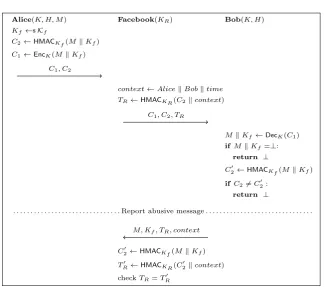
Facebook recently proposed an abuse-report mechanism (cf. Figure 1) for their messaging service, referred to as message franking [Fac16]. The idea is that a client sends a commitment for the message along with the encrypted message. The router (i.e. Facebook’s server) then tags the commitment and forwards everything to the receiving party. Then, if the client wants to report the message as abusive, it sends to Facebook the message, the commitment, the opening key and the router tag. As such, Facebook can check that the message reported as abusive was indeed a message sent to the receiver by a specific sender.
LetM be the message and Kthe secret key shared between Alice and Bob. The sending party samples a one-time keyKf (i.e. a nonce) from the key space
and computes the HMAC C2 of M k Kf using the one-time keyKf. One can
observe thatC2is a commitment on the message. Then, the messageM and the HMAC key Kf are encrypted with the secret keyK. Let C1 be the resulting ciphertext. Then, both the ciphertext C1 and the commitment C2 are sent to Facebook. The latter computes a HMACTR (i.e. a tag) onC2and some context value (e.g. sender/receiver, timestamp), with its secret keyKR. This will allow
Facebook to verify the commitmentC2in case of message report, without storing every commitmentC2.
If the receiver wants to report an abusive messageM, it sends the opening keyKf, the messageM, Facebook’s tagTR and the context data to Facebook.
Then, Facebook can reconstruct the commitmentC2from the received data and can verify this commitment by computing its HMAC with KR and comparing
Alice(K, H, M) Facebook(KR) Bob(K, H)
Kf ←$Kf
C2←HMACKf(MkKf)
C1←EncK(MkKf)
C1, C2
context←AlicekBobktime TR←HMACKR(C2kcontext)
C1, C2, TR
MkKf←DecK(C1) if MkKf=⊥:
return ⊥
C20←HMACKf(MkKf) if C26=C02:
return ⊥
. . . Report abusive message . . . .
M, Kf, TR, context
C02←HMACKf(MkKf)
TR0 ←HMACKR(C20kcontext) checkTR=TR0
Fig. 1.Facebook message franking scheme whereKfis the space for the one-time keys
Kf.
3.2 Commiting AEAD
Grubbs et al. [GLR17] formalized the concept of message franking into the def-inition of committing AEAD. Roughly, the idea is to define a cryptographic primitive that creates a ciphertext and a commitment on the plaintext. Then, one can decrypt to retrieve the plaintext and an opening key, which is used to verify the commitement on the plaintext. We present here the definition of com-mitting AEAD where all randomness is defined by a public nonce. Formally, a nonce-based committing AEAD is defined as follows:
Definition 1 (Nonce-based Committing AEAD). A nonce-based commit-ting AEAD scheme nCE = (init,enc,dec,vrf) is a set of four algorithms. Asso-ciated to this scheme is a key spaceK, a header space H, a message spaceM, a ciphertext space C, an opening spaceKf, a franking tag space T and a nonce
spaceN. An error symbol⊥is also required. The four algorithms are as follows:
– K←$init: The initialization algorithminit outputs a random keyK∈ K. – (C1, C2)←encK(N, H, M): The encryption algorithm enc takes a keyK ∈
– (M, Kf) ← decK(N, H, C1, C2): The decryption algorithm dec takes a key
K ∈ K, a nonce N ∈ N, a header H ∈ H, a ciphertext C1 ∈ C and a franking tag C2 ∈ T, and it outputs a message M ∈ M and an opening
Kf ∈ Kf or an error symbol⊥.
– b←vrf(H, M, Kf, C2): The verification algorithmvrftakes a headerH∈ H, a messageM ∈ M, an opening value Kf ∈ Kf and a franking tag C2∈ T, and it outputs a verification bit b, regarding the correctness of the reporting procedure.
The first procedure init is randomized while the others are deterministic, since the randomness is defined by the nonce valueN.
Correctness.For the correctness of the scheme, we require that for anyK∈ K,
N ∈ N,H∈ HandM ∈ Mand (C1, C2) =encK(N, H, M)
Pr[decK(N, H, C1) = (M, Kf)] = 1
for someKf ∈ Kf.
Also, if we let (C1, C2) = encK(N, H, M) and (M, Kf) = decK(N, H, C1, C2) then we require that
Pr[vrf(H, M, Kf, C2) = 1] = 1
for anyK∈ K,N ∈ N, H∈ HandM ∈ M.
Finally, we require the length of the ciphertexts (C1, C2) to be deterministic givenH andM. In other words, there is a deterministic functionlen(H, M) s.t. (|C1|,|C2|) =len(H, M).
3.3 Security of committing AEAD
Multi and single opening security. In some cases, one would like to encrypt multiple ciphertexts with the same key and keep all ciphertexts secure even if an opening is known. This notion is called multi-opening security. For example, if the key used for encryption is the same as the opening key (i.e.K=Kf), the
scheme would not be multi-opening secure since the knowledge of one opening
Kf would compromise all ciphertexts encrypted with the key K. On the other
hand, if the secret key is meant to be used only once (e.g. Signal protocol), we can require only single-opening security. In this paper, we focus solely on multi-opening secure schemes.
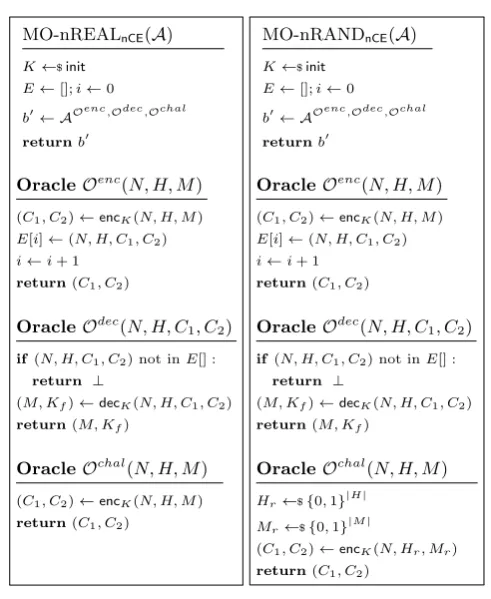
Confidentiality.The multiple-opening confidentality of nonce-based committing AEAD is defined in MO-nREAL and MO-nRAND games (cf. 2). In these games an adversaryA tries to differentiate between ciphertexts (C1, C2) derived from a legit message and ciphertexts derived from random bitstrings. Observe that in both games, the adversary can query the decryption oracle Odec only with
ciphertexts that were output by the oracleOenc. This avoids simple wins, where
the adversary submits the ciphertexts obtained from the Ochal oracle to the
Odec oracle. Also, to avoid trivial wins, we require the adversary playing these
MO-nREALnCE(A)
K←$init
E←[];i←0
b0← AOenc ,Odec ,Ochal
returnb0
OracleOenc
(N, H, M)
(C1, C2)←encK(N, H, M)
E[i]←(N, H, C1, C2)
i←i+ 1
return(C1, C2)
OracleOdec(N, H, C 1, C2)
if(N, H, C1, C2) not inE[] :
return ⊥
(M, Kf)←decK(N, H, C1, C2)
return(M, Kf)
OracleOchal
(N, H, M)
(C1, C2)←encK(N, H, M) return(C1, C2)
MO-nRANDnCE(A)
K←$init
E←[];i←0
b0← AOenc ,Odec ,Ochal
returnb0
OracleOenc
(N, H, M)
(C1, C2)←encK(N, H, M)
E[i]←(N, H, C1, C2)
i←i+ 1
return(C1, C2)
OracleOdec(N, H, C 1, C2)
if(N, H, C1, C2) not inE[] :
return ⊥
(M, Kf)←decK(N, H, C1, C2)
return(M, Kf)
OracleOchal
(N, H, M)
Hr←${0,1}|H|
Mr←${0,1}|M|
(C1, C2)←encK(N, Hr, Mr) return(C1, C2)
Fig. 2.Confidentality games for nonce-based committing AEAD
encryption oracle with the same nonceN more than once (i.e. it cannot query Oenc or Ochaltwice with the sameN nor can it queryOenc andOchalwith the
same N).
We define the nonce-based multiple opening real-or-random (MO-nROR) ad-vantage of any adversaryAas
Advmo-nrornCE (A) =|Pr[MO-nREALnCE(A)⇒1]−Pr[MO-nRANDnCE(A)⇒1]|
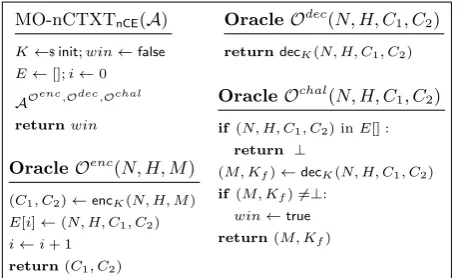
Integrity. The multiple-opening integrity of nonce-based committing AEAD is defined with the MO-nCTXT game (cf. Figure 3). In this game, an adversary can query an encryption oracle Oenc and a decryption oracleOdec. Then, it sends a
header, a nonce and ciphertexts (N, H, C1, C2) to a challenge oracleOchal. If the decryption is successful and the input values were not previously output byOenc,
the adversary wins. Informally, the adversary wins if it can forge a valid tuple (N, H, C1, C2). We define the nonce-based multiple opening ciphertext integrity (MO-nCTXT) advantage of any adversary Aplaying the MO-nCTXT game as
MO-nCTXTnCE(A)
K←$init;win←false
E←[];i←0
AOenc ,Odec ,Ochal
returnwin
OracleOenc
(N, H, M)
(C1, C2)←encK(N, H, M)
E[i]←(N, H, C1, C2)
i←i+ 1
return(C1, C2)
OracleOdec
(N, H, C1, C2)
returndecK(N, H, C1, C2)
OracleOchal
(N, H, C1, C2)
if(N, H, C1, C2) inE[] :
return ⊥
(M, Kf)←decK(N, H, C1, C2)
if(M, Kf)6=⊥:
win←true
return(M, Kf)
Fig. 3.Integrity game for nonce-based committing AEAD
Binding security. In addition to the standard security definitions (i.e. confi-dentiality and integrity), Grubbs et al. [GLR17] defined two binding security notions, namely sender binding andreceiver binding.
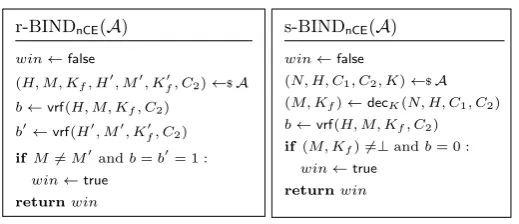
The intuition behind sender binding is that a participant cannot send a message which cannot be reported later. The s-BIND game in Figure 4 defines this security notion. An adversary wins if it can find a ciphertext and a franking tag such that a receiving participant can decrypt but the verification of the franking tag with the obtained message fails. For any adversary A playing s-BIND and any committing AEADnCE, we define the advantage ofAas
Advs-bindnCE (A) = Pr[s-BINDCE(A)⇒true]
The idea of receiver binding is that a malicious receiver should not be able to accuse another client of sending an abusive message that was never sent (i.e. it should not be able to report a message that was not sent). The game r-BIND in Figure 4 defines this security notion. An adversary wins if it can find two different messages such that their commitments are the same. For any adversary A playing the r-BIND game and any committing AEAD nCE, we define the advantage ofAas
Advr-bindnCE (A) = Pr[r-BINDCE(A)⇒true]
4
Cryptographic channel for message franking (MFC)
r-BINDnCE(A)
win←false
(H, M, Kf, H0, M0, Kf0, C2)←$A
b←vrf(H, M, Kf, C2)
b0←vrf(H0, M0, Kf0, C2)
ifM6=M0andb=b0= 1 :
win←true
returnwin
s-BINDnCE(A)
win←false
(N, H, C1, C2, K)←$A (M, Kf)←decK(N, H, C1, C2)
b←vrf(H, M, Kf, C2)
if(M, Kf)6=⊥andb= 0 :
win←true
returnwin
Fig. 4.Games for committing AEAD binding notions.
franking case, the participants do not only exchange messages but they also report them as abusive to a third entity, which we refer to asrouter. Therefore, we need to define a new model for a cryptographic channel, which we call a message franking channel (MFC). Informally, we raise the nonce-based committing AEAD concept to the channel level, in the context of message franking.
We define a message franking channel (MFC), using the syntax used by Mar-son et al. [MP17]:
Definition 2 (Message Franking Channel). A message franking channel
Ch= (init,snd,tag,rcv,rprt)is a five-tuple of algorithms. Associated to this chan-nel is a key spaceK, a nonce space N, a header space H, a message space M, a ciphertext spaceC, an opening spaceKf, a franking tag spaceT, a router tag
space TR and a state space S. The participants space is P ={A, B} (for Alice
and Bob). We also require a special rejection symbol⊥∈/ (Kf× M)∪ S. The five
procedures are defined as follows:
– (stA, stB, stR)←$init: The initialization algorithminit samples a keyK∈ K
and a keyKR∈ K, and it outputs initial statesstA, stB, stR∈ S. K is the
shared key resulting from a secure and authenticated key exchange protocol between both clients andKR is the secret key of the router.
– (st0u, H, C1, C2) ← snd(stu, N, M): The sending algorithm snd takes the
sender’s state stu ∈ S, a nonce N ∈ N and a message M ∈ M, and it
outputs an updated statest0u ∈ S, a headerH ∈ H and a pair of ciphertext
and franking tag(C1, C2)∈ C × T. – (st0
R, TR)←tag(stR, ids, H, C2): The router tagging algorithmtag takes the router’s statestR∈ S, the sender’s identityids∈ P, a headerH∈ Hand a
franking tagC2 ∈ T, and it outputs an updated state st0R ∈ S and a router
tagTR∈ TR.
– (st0u, M, Kf)←rcv(stu, N, H, C1, C2): The receiving algorithmrcvtakes the receiver’s state stu ∈ S, a nonce N ∈ N, a header H ∈ H , a ciphertext
C1 ∈ C and a franking tag C2 ∈ T, and it outputs an updated state st0u ∈
S ∪ {⊥}, and an opening value pair(M, Kf)∈ M × Kf or ⊥. We require
– (st0R, b) ← rprt(stR, idr, H, M, Kf, C2, TR) : The router’s verification
algo-rithmrprt takes the router’s state stR ∈ S, the reporter’s identity idr ∈ P,
a headerH ∈ H, a message M ∈ M, an openingKf ∈ Kf, a franking tag
C2 ∈ T and a router tag TR ∈ TR, and it outputs an updated router’s state
st0R∈ S ∪ {⊥}and a verification bitb∈ {0,1}. We requirest0R=⊥ifb= 0.
We assume the channel is stateful, i.e. the participants save their state between send/tag/receive/report calls. The rcv procedure can verify the commitment
C2 and outputs ⊥ if the verification fails. Also, note that the rprt procedure does not depend on the nonce N nor on the ciphertext C1. In particular, this means that the router must be able to verify the validity of the router tagTR
given only its state stR, the header H and the franking tag C2. The channel
uses ⊥ to indicate an error. Once a state is marked as bogus (i.e. st =⊥), it cannot be used anymore in the invokation of the functionssnd,rcvandrprt, since ⊥∈/ S. This corresponds to the reasonable behaviour of an application refusing to process any more data once an error has been detected. Error management in channels is a full topic in itself (e.g. [BDPS13]) and can lead to vulnerabilities (e.g. padding oracle attack [Vau02]). Here, we assume that an adversary does not learn anything from an error apart from the failure of the corresponding procedure. The randomness is uniquely determined by public noncesN. Nonces can be used to perform randomized encryption but also to generate a random opening key Kf, as in Facebook’s scheme. The role of the nonce is determined
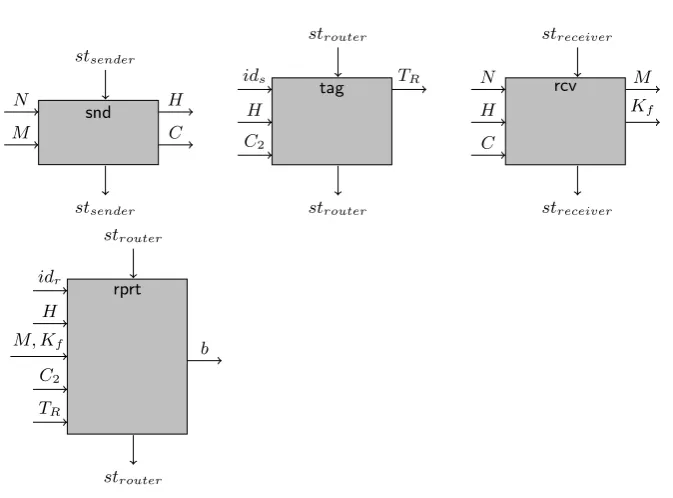
by the underlying schemes used by the different algorithms. Finally, we give a visualization of the channel in Figure 5.
Remarks. The key KR is the router’s secret key that can be used to generate
the router tags TR. In a real-life message franking protocol, all messages go
through the router, where they get tagged. Otherwise, clients could bypass the tagging procedure and messages would not be reportable. Therefore, one could imagine that a unique procedure for sending and tagging would be sufficient. While making theMFCdefinition simpler, this would render the instantiation of a real MFCdifficult. Indeed, snd is meant to be executed by a client while tag
is run by the router. Thus, such a simplification would be impractical. However, in the oracles of adversarial models used in the following sections,snd and tag
procedures will sometimes be considered as one operation, to model the fact that a message sent is always seen by the router.
It is important for the security of the scheme, in particular for the receiver-binding property, that the router knows the identity of the sender and the iden-tity of the receiver. This is why these identitiesids andidr are passed as
client-to-snd N
M
H
C stsender
stsender
tag ids
H
C2
TR
strouter
strouter
rcv N
H
C
M
Kf
streceiver
streceiver
rprt idr
H
M, Kf
C2
TR
b strouter
strouter
Fig. 5. Visualization of the message franking channel where C stands for the pair (C1, C2).
router communications with TLS and it used to authenticate the client with the phone number concatenated with some secret key [FMB+14]. Whatsapp
en-crypts communications to its servers with the Noise Protocol Framework and it stores the client’s Curve25519 public key, allowing the router to authenticate the user during the Diffie-Hellman key exchange protocol [Per18,Wha17].
4.1 Correctness of the channel.
As in a standard bidirectional channel [MP17], we require a MFC to have cer-tain properties. In short, we want messages sent by a client to be decryptable by the other participant without errors, assuming that the ciphertexts are not modified in the channel and that the order of the messages is preserved. Also, a message sent by a honest participant in the channel and correctly deciphered at the receiving end should be reportable, assuming that all messages sent on the channel are not modified (i.e. no active adversary).
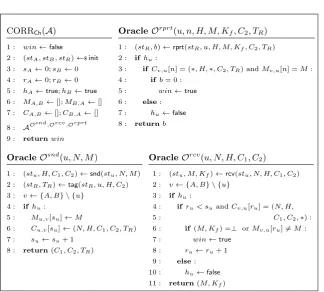
Such requirements can be represented as a game, where only passive external adversaries (i.e. adversaries that can only see and relay messages) are allowed and where the participants are honest. The adversary can schedulesnd/tag,rcvand
rprtprocedures and it wins if a message sent can not be decrypted or reported (i.e. rprt fails). This game is represented in Figure 6. We assume u ∈ {A, B},
variablessA, sB, rA, rB keep track of the number of messages sent and received
by each participant. The variables hA and hB keep track of the state of each
participant (whether it has received modified/out-of-order messages). Note that an adversary can be external and try to modify the messages on the channel or it can be a participant who communicates with the other benign participant and/or the router. If a participantureceives out-of-order/modified data, (i.e. if the adversary actively attacks u), its variablehu is set to false. Ifhu=truewe
say thatuis clean. Observe that the adversary can win only if the participantu
used in the oracle query is clean.MA,B[], MB,A[], CA,B[] andCB,A[] record the
messages and ciphertexts exchanged. The adversary has access to three oracles:
– Osnd(u, N, M): TheOsndoracle takes the client identityu, a message and a
nonce, and it calls thesnd and tagprocedures on behalf of the participant
u. Then, it records the resulting ciphertext and franking/router tags, if the client is still clean. This prevents the adversary from winning if the clientu
had previously received out-of-order/modified messages. – Orcv(u, N, H, C
1, C2): With the oracleOrcv, an adversary can make a useru receive (i.e. decrypt). Now, if this participant is still clean and the ciphertext is delivered without modification (and in the right order) compared to the one sent (condition in line 4), then the message recovered should be the one sent. If this is not the case (condition in line 6), then the adversary wins. Otherwise, if the condition at line 4 is not respected, then the ciphertext/tags have been modified and the participant is flagged as not clean.
– Orprt(u, n, H, M, K
f, C2, TR): The adversary can use also theOrprtoracle to
report a given message on behalf of a useru, by providing the message along with the tags. It also must specify the index nof the message (we assume the adversary records the number of messages sent). As before, if the user is clean and the header, the franking tag, the router tag and the message were not modified compared to the one sent (conditions at lines 2-3), then the participant/adversary should be able to report the message. If this is not the case, the adversary wins. Otherwise, if the condition in line 3 is not respected (i.e. the message, ciphertext or tags have been tampered with), the participant is flagged as not clean.
Now, for any adversaryA playing CORR and any channelCh, we denote the advantage ofAas
AdvcorrCh (A) = Pr[CORRCh(A)⇒true]
Definition 3 (Bidirectional Message Franking Channel Correctness). We say that a message franking bidirectional channel Ch is correct if for any adversaryAplaying the CORR game
CORRCh(A)
1 : win←false
2 : (stA, stB, stR)←$init
3 : sA←0;sB←0
4 : rA←0;rB←0
5 : hA←true;hB←true
6 : MA,B←[];MB,A←[]
7 : CA,B←[];CB,A←[]
8 : AOsnd ,Orcv ,Orprt 9 : returnwin
OracleOrprt
(u, n, H, M, Kf, C2, TR)
1 : (stR, b)←rprt(stR, u, H, M, Kf, C2, TR)
2 : ifhu:
3 : ifCv,u[n] = (∗, H,∗, C2, TR) andMv,u[n] =M:
4 : if b= 0 : 5 : win←true 6 : else:
7 : hu←false
8 : returnb
OracleOsnd
(u, N, M)
1 : (stu, H, C1, C2)←snd(stu, N, M)
2 : (stR, TR)←tag(stR, u, H, C2) 3 : v← {A, B} \ {u}
4 : ifhu:
5 : Mu,v[su]←M
6 : Cu,v[su]←(N, H, C1, C2, TR)
7 : su←su+ 1
8 : return(C1, C2, TR)
OracleOrcv
(u, N, H, C1, C2)
1 : (stu, M, Kf)←rcv(stu, N, H, C1, C2) 2 : v← {A, B} \ {u}
3 : ifhu:
4 : ifru< suandCv,u[ru] = (N, H,
5 : C1, C2,∗) :
6 : if(M, Kf) =⊥ orMv,u[ru]6=M:
7 : win←true 8 : ru←ru+ 1
9 : else:
10 : hu←false
11 : return(M, Kf)
Fig. 6.Correctness game for a bidirectional message franking channel.
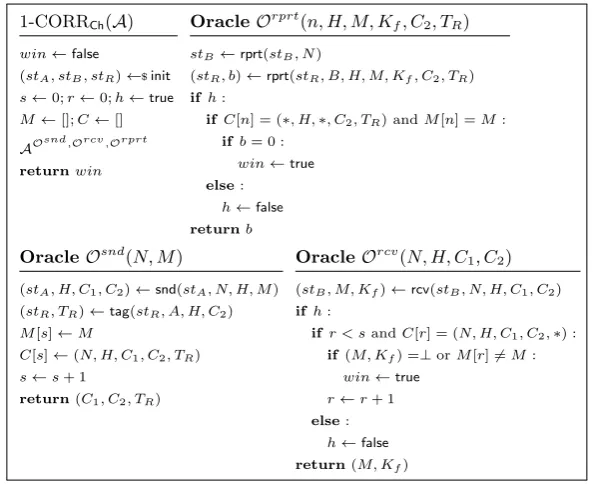
Unidirectional correctness. Finally, for a unidirectional channel (i.e. only Alice sends messages to Bob), the game of correctness is equivalent to the bidirectional game of correctness as we see in Figure 7. The main differences are that the participants are fixed in each oracle, the sender is always clean (since it cannot receive messages) and we need less variables (only one copy of s, r, h, M and
C).
5
Security for message franking channel
5.1 Confidentiality
1-CORRCh(A)
win←false
(stA, stB, stR)←$init
s←0;r←0;h←true
M←[];C←[]
AOsnd ,Orcv ,Orprt
returnwin
OracleOrprt
(n, H, M, Kf, C2, TR)
stB←rprt(stB, N)
(stR, b)←rprt(stR, B, H, M, Kf, C2, TR) ifh:
ifC[n] = (∗, H,∗, C2, TR) andM[n] =M: ifb= 0 :
win←true
else:
h←false
returnb
OracleOsnd(N, M)
(stA, H, C1, C2)←snd(stA, N, H, M)
(stR, TR)←tag(stR, A, H, C2)
M[s]←M
C[s]←(N, H, C1, C2, TR)
s←s+ 1
return(C1, C2, TR)
OracleOrcv(N, H, C 1, C2)
(stB, M, Kf)←rcv(stB, N, H, C1, C2)
if h:
if r < sandC[r] = (N, H, C1, C2,∗) :
if(M, Kf) =⊥orM[r]6=M:
win←true
r←r+ 1
else:
h←false
return(M, Kf)
Fig. 7.Correctness game for a unidirectional message franking channel.
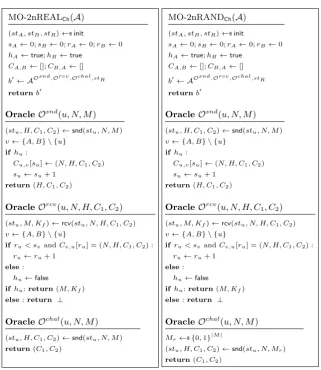
While in a standard channel the adversary is external to the participants, in the message franking case the adversary can also be the router. Therefore, in the following games we give the adversary access to the router’s statestR. This
means the adversary does not need a tag and report oracle, as it is able to run these procedures on its own.
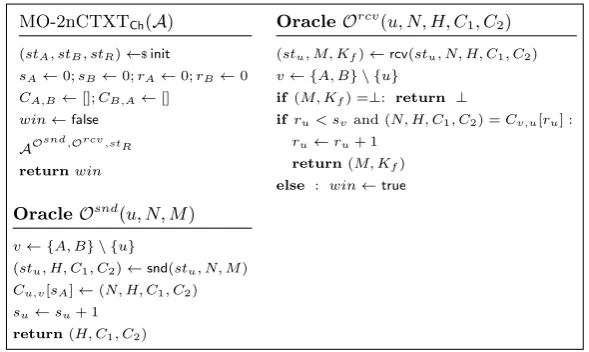
The MO-2nREAL and MO-2nRAND games of Figure 8 are adapted from the MO-nREAL and MO-nRAND games of Section 3.3. In both games, we assume the adversary is nonce-respecting (i.e. it cannot queryOsnd orOchaltwice with
the same nonceN.
The adversary wins if it can differentiate with non-negligible probability be-tween the encryption of a messageM and the encryption of a random bitstring. The hu variables, as in the correctness games, let the adversary decrypt
ci-phertexts as long as it remains passive: the adversary only relays messages. In particular, this prevents the adversary from winning by decrypting the cipher-texts obtained from theOchaloracle.
For a bidirectionalMFCchannelCh, we define the nonce-based multiple open-ing real-or-random (MO-2nRoR) advantage of any algorithmAas
MO-2nREALCh(A)
(stA, stB, stR)←$init
sA←0;sB←0;rA←0;rB←0
hA←true;hB←true
CA,B←[];CB,A←[]
b0← AOsnd ,Orcv ,Ochal ,stR returnb0
OracleOsnd
(u, N, M)
(stu, H, C1, C2)←snd(stu, N, M)
v← {A, B} \ {u}
ifhu:
Cu,v[su]←(N, H, C1, C2)
su←su+ 1 return(H, C1, C2)
OracleOrcv(u, N, H, C 1, C2)
(stu, M, Kf)←rcv(stu, N, H, C1, C2)
v← {A, B} \ {u}
ifru< svandCv,u[ru] = (N, H, C1, C2) :
ru←ru+ 1 else:
hu←false
ifhu:return(M, Kf) else:return ⊥
OracleOchal
(u, N, M)
(stu, H, C1, C2)←snd(stu, N, M) return(C1, C2)
MO-2nRANDCh(A)
(stA, stB, stR)←$init
sA←0;sB←0;rA←0;rB←0
hA←true;hB←true
CA,B←[];CB,A←[]
b0← AOsnd ,Orcv ,Ochal ,stR returnb0
OracleOsnd
(u, N, M)
(stu, H, C1, C2)←snd(stu, N, M)
v← {A, B} \ {u}
ifhu:
Cu,v[su]←(N, H, C1, C2)
su←su+ 1 return(H, C1, C2)
OracleOrcv(u, N, H, C 1, C2)
(stu, M, Kf)←rcv(stu, N, H, C1, C2)
v← {A, B} \ {u}
ifru< svandCv,u[ru] = (N, H, C1, C2) :
ru←ru+ 1 else:
hu←false
ifhu:return(M, Kf) else:return ⊥
OracleOchal
(u, N, M)
Mr←${0,1}
|M|
(stu, H, C1, C2)←snd(stu, N, Mr) return(C1, C2)
Fig. 8.Confidentality games for nonce-based bidirectional message franking channels.
5.2 Integrity
We adapt the MO-nCTXT integrity notions of committing AEAD to the bidi-rectional MFC. Ciphertext integrity means that a receiver can only receive and decrypt in-order and legitimate ciphertexts, which have been sent by another participant. As in the MO-2nROR confidentiality notion, the adversary can be the router and thus we give access to the statestR.
Let MO-2nCTXT be the game in Figure 9. By observing the Orcv oracle,
MO-2nCTXTCh(A)
(stA, stB, stR)←$init
sA←0;sB←0;rA←0;rB←0
CA,B←[];CB,A←[]
win←false
AOsnd ,Orcv ,stR
returnwin
OracleOsnd
(u, N, M)
v← {A, B} \ {u}
(stu, H, C1, C2)←snd(stu, N, M)
Cu,v[sA]←(N, H, C1, C2)
su←su+ 1 return(H, C1, C2)
OracleOrcv
(u, N, H, C1, C2)
(stu, M, Kf)←rcv(stu, N, H, C1, C2)
v← {A, B} \ {u}
if (M, Kf) =⊥: return ⊥
if ru< sv and (N, H, C1, C2) =Cv,u[ru] :
ru←ru+ 1 return(M, Kf) else : win←true
Fig. 9.Integrity game for nonce-based committing AEAD
of any algorithm Aplaying the MO-2nCTXT game as
Advmo-2nctxtCh (A) = Pr[MO-2nCTXTCh(A)⇒true]
5.3 Binding security notions
In order to guarantee verifiable reporting of abusive messages, aMFCshould ad-here to sender and receiver binding notions as with message franking protocols [Fac16,GLR17]. One difference between the committing AEAD binding defini-tions and the ones defined here, is that in a channel the participants are stateful and their behavior may evolve over time, whereas such concepts do not exist in the security definitions of cryptographic primitives like committing AEAD. The threat in such security definitions is a malicious participant and not an ex-ternal adversary. Therefore, in all the binding games of this section, we assume that the adversary can modify the states of the participants (Alice and Bob). In particular, this allows the adversary to control sthe encryption keyK.
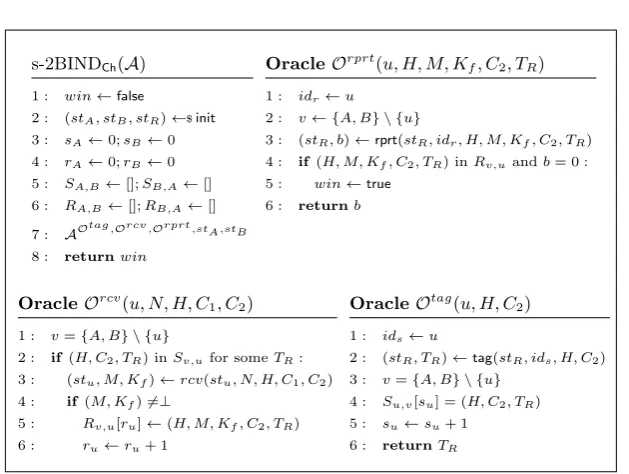
Sender binding. Sender binding for MFCguarantees that any message received without error by a client can be successfully reported to the router. This notion is defined with the game s-2BIND presented in Figure 10.
The adversary has access to three oracles in addition to the states of Alice and Bob. Here is a description of the s-2BIND game:
– s-2BINDCh(A): TherA, rB, sA, sBvariables keep track of the number of
mes-sages received and sent by each party. The arrays SA,B[], SB,A[] store the
franking tagsC2, the headersH and the associated router tagsTRsent from
Ato B and from B to A, respectively. The arraysRA,B[] andRB,A[] store
s-2BINDCh(A)
1 : win←false
2 : (stA, stB, stR)←$init
3 : sA←0;sB←0
4 : rA←0;rB←0
5 : SA,B←[];SB,A←[]
6 : RA,B←[];RB,A←[]
7 : AOtag ,Orcv ,Orprt ,stA ,stB
8 : returnwin
OracleOrprt
(u, H, M, Kf, C2, TR)
1 : idr←u
2 : v← {A, B} \ {u}
3 : (stR, b)←rprt(stR, idr, H, M, Kf, C2, TR)
4 : if(H, M, Kf, C2, TR) inRv,uandb= 0 :
5 : win←true 6 : returnb
OracleOrcv(u, N, H, C 1, C2)
1 : v={A, B} \ {u}
2 : if(H, C2, TR) inSv,ufor someTR:
3 : (stu, M, Kf)←rcv(stu, N, H, C1, C2) 4 : if(M, Kf)6=⊥
5 : Rv,u[ru]←(H, M, Kf, C2, TR)
6 : ru←ru+ 1
OracleOtag(u, H, C 2)
1 : ids←u
2 : (stR, TR)←tag(stR, ids, H, C2) 3 : v={A, B} \ {u}
4 : Su,v[su] = (H, C2, TR)
5 : su←su+ 1
6 : returnTR
Fig. 10.Game for message franking channel sender-binding security definition.
– Otag(u, H, C2): This oracle is used to modify the router state st
R and to
obtain a router tag for a tuple (H, C2), with uas the sender. The header
H, the franking tag C2 and the router tag obtained TR are stored in the
corresponding array Su,v[] (line 4). This array is needed to ensure that a
router tagTRreally corresponds to a header,franking tag pair (H, C2). Then,
the number of messages sent by the participant is incremented (line 5). Finally, the router tag is returned to the adversary (line 6).
– Orcv(u, N, H, C
1, C2): The Orcv oracle first checks that H and C2 corre-sponds to a router tag TR (line 2) computed for a message sent by client
v. If this is the case, the rcvprocedure is called and it outputs a plaintext, opening key pair (M,Kf). If this pair is valid (i.e. not equal to⊥), it is stored
in the appropriate array Rv,u alongside with the header and the tags (C2,
TR) (line 5). This means that these values correspond to a ciphertext that
decrypts to a valid message. Finally, the number of valid messages received byuis incremented (line 6).
– Orprt(u, H, M, K
f, C2, TR): The oracleOrprt calls therprtprocedure on the
the header, the message, the opening key and the tags, withuas the reporter. This allows an adversary to update the router statestR. Then, if the input
values correspond to some ciphertext that outputs a valid message but the report procedure fails (line 4), the adversary wins.
The adversary can use theOrprtoracle to report a message on behalf of a useru.
If the message was actually sent and correctly decrypted byuthen it is inRv,u
r-2BINDCh(A)
1 : win←false
2 : (stA, stB, stR)←$init
3 : sA←0;sB←0
4 : MA,B←[];MB,A←[]
5 : AOsnd ,Orprt ,stA ,stB
6 : returnwin
OracleOsnd
(u, N, H, M)
1 : ids←u
2 : (stu, , C1, C2)←snd(stu, N, M)
3 : (stR, TR)←tag(stR, ids, H, C2)
4 : v={A, B} \ {u} 5 : Mu,v[su]←M
6 : su←su+ 1
7 : return(C1, C2, TR)
OracleOrprt(u, H, M, K
f, C2, TR)
1 : idr←u;v={A, B} \ {u}
2 : (stR, b)←rprt(stR, idr, H, M, Kf, C2, TR)
3 : ifM notinMv,uandb= 1 :
4 : win←true 5 : returnb
Fig. 11.Game for franking channel receiver-binding security definition.
therprtprocedure fails, the adversary wins. Indeed, we ask an adversary to win if the decryption is successful but the report procedure fails. We need to use a second pair of arrays (SA,B, SB,A) to store the router tag TR corresponding
to a pair (H, C2). Otherwise, one could not storeTR in the array Rv,u at line
5 of Orcv. Indeed, if T
R was not stored in Rv,u, the adversary could specify a
randomTRwhen reporting with legit values, making the verification fail. Finally,
we note that despite the fact the adversary has access to both user states, in a real-life threat model the adversary would be only one of the participants (e.g. Alice). However, since both participants share everything, it does not matter if the adversary has access to one or both states. For any adversary A playing s-2BIND and any channelCh, the advantage ofAis:
Advs−2bindCh (A) = Pr[s-2BINDCh(A)⇒true]
Receiver binding. We recall that receiver binding assures that a malicious par-ticipant cannot report an abusive message that was never sent. Receiver binding for message franking channels is defined with the game r-2BINDCh presented in Figure 11. In this game, the adversary represents two colluding participants that can schedulesnd/tag/rprtoperations for message exchanges and then one of the participants tries to report a message never sent to her/him. Since the adversary controls the users states, it would need only access totag/rprtoracles since it can run the other algorithms by itself. However, the game should store the sent messages (i.e. the ones the adversary requested a router tag for) in order to compare them with the reported message in the Orprt oracle. Therefore, we
let theOsnd oracle run thesnd procedure as well as thetagprocedure. Here is
Ar-2BIND
1 : M←$M;N←$N
2 : compute nextKf from (N, H, M, stA)
3 : (H, C1, C2, TR)← Osnd(A, N, M)
4 : Orprt(A, H, M, K
f, C2, TR)
Fig. 12.Attack on r-BIND game.
– r-2BINDCh(A): The sA, sB variables keep track of the number of messages
sent by each party. They are used as indexes for the arraysMA,B[], MB,A[]
that store all messages sent byAtoB andB to A, respectively.
– Osnd(u, N, H, M): In theOsnd oracle, the message sentM is recorded in the
corresponding array (line 5) and the number of messages sent by the partici-pant is incremented (line 6). The ciphertext, franking tag and router tag are returned to the adversary (line 7). In short, this oracle allows an adversary to obtain the router tag for any header/message tuple, while recording the message. We let the adversary pass the headerH as an argument since we want the adversary to be able to get a router tag for any header.
– Orprt(u, H, M, K
f, C2, TR): TheOrprt takes a headerH, the message to be
reportedM, an opening keyKf, a franking tagC2, a router tagTRand the
identity of the reporteru. At line 3, the condition checks that the submitted message was not sent to the reporting participant and that the message passes therprtprocedure. If this is the case, the adversary wins.
In order to respect this receiver binding notion, the router must be able to check the sender and receiver of a message. Indeed, if this is not the case, one can construct an adversaryAr-2BIND that always wins, as shown in Figure 12. Let Alice be the malicious participant. She picks a random message and a random nonce and sends the corresponding ciphertext to Bob using the sending oracle. Thus, the message is in the arrayMA,B. Note that Alice can compute the
opening key Kf since she controls stA, N, H and M. Finally, she reports Bob
as the sender of the message by calling the Orprt oracle. Since the message is
in MA,B but not in MB,A, the first part of the condition in line 3 of Orprt is
fulfilled. Thus, since all values used to report are legitimate, the report procedure will succeed unless the router knows the message was actually sent by Alice to Bob.
One solution to this problem is to incorporate the receiver/sender identities in the router tag TR. This is done in the Facebook protocol by putting the
sender and receiver identities in some context data. The router tagTRbecomes
TR =HMACKR(C2k senderk receiver) and the router can check whether the
For any adversaryA playing r-2BIND and any channel Ch, we write the ad-vantage ofAas
Advr−2bindCh (A) = Pr[r-2BINDCh(A)⇒true]
In other words, in addition to the control of participants’ states, the adversary must be able to modify the state of the router, as in a real exchange of messages. Unidirectional binding notions. We present in Figure 13 the games r-1BIND and s-1BIND defining unidirectional receiver and sender binding notions, re-spectively. These games are similar to their bidirectional equivalent. However, in a unidirectionalMFC, if A is the sender andB is the receiver, then snd(stu,∗)
fails if u6=A , tag(stR, ids,∗) fails if ids 6=A, rprt(stR, idr,∗) fails if idr 6=B
and rcv(stu,∗) fails if u 6= B. Therefore, the adversary can query Osnd,Otag
only with u=Aand Orcv,Orprt only with u=B. For simplicity we omit the
argumentuin all oracles.
6
Binding notions in the canonic composition
A bidirectional standard cryptographic channel made of two secure unidirec-tional channels is not necessarily secure [MP17]. Therefore, it is of interest to study the binding security of such constructions adapted to the MFC. More precisely, we want to analyze the relations between unidirectional and bidirec-tional receiver/sender binding, in a special channel called thecanonic composi-tion[MP17]. This channel captures the idea that real-life communication proto-cols are often designed to be the composition of two independent unidirectional secure channels.
6.1 Message franking canonic composition
The canonic construction is the straightforward composition of two unidirec-tional MFC, when one party sends and the other receives and reports. Let
Ch = (init,snd,tag,rcv,rprt) be a unidirectional MFC with a participants space P, a key spaceK, a nonce space N, a header space H, a message space M, a ciphertext spaceC, an opening key spaceKf, a franking tag spaceT, a router
tag spaceTRand a state spaceS. The canonic composition will use one instance
of Ch for the communication from Alice to Bob (→) and another for the com-munication from Bob to Alice (←).
LetCh0= (init0,snd0,tag0,rcv0,rprt0) be the bidirectionalMFCresulting from the canonical composition ofCh described in Figure 14. Associated to this channel
Ch0 is a participants space P0 = P, a key space K0 = K × K, a nonce space N0=N, a header spaceH0=H, a message spaceM0 =M, a ciphertext space C0 =C, an opening key space K0
f =Kf, a franking tag space T0 =T, a router
tag spaceT0
R=TR and a state spaceS0=S × S.
r-1BINDCh(A)
win←false
(stA, stB, stR)←$init
s←0;M←[] AOsnd ,Orprt ,stA ,stB
returnwin
OracleOsnd
(N, H, M)
ids←A
(stu, , C1, C2)←snd(stu, N, M)
(stR, TR)←tag(stR, ids, H, C2)
M[s]←M s←s+ 1
return(C1, C2, TR)
OracleOrprt
(H, M, Kf, C2, TR)
idr←B
(stR, b)←rprt(stR, idr, H, M, Kf, C2, TR) ifM notinM[] andb= 1 :
win←true
returnb
s-1BINDCh(A)
win←false (stA, stB)←$init
stR←$initR
s←0;r←0
S←[];R←[]
AOtag ,Orcv ,Orprt ,stA ,stB
returnwin
OracleOtag
(H, C2)
ids←A
(stR, TR)←tag(stR, ids, H, C2)
S[s] = (H, C2, TR)
s←s+ 1
returnTR
OracleOrcv
(N, H, C1, C2)
if(H, C2, TR) inSfor someTR:
(stB, M, Kf)←rcv(stB, N, H, C1, C2)
if(M, Kf)6=⊥
R[r]←(H, M, Kf, C2, TR)
r←r+ 1
OracleOrprt
(H, M, Kf, C2, TR)
idr←B
(stR, b)←rprt(stR, idr, H, M, Kf, C2, TR) if(H, M, Kf, C2, TR) inRandb= 0 :
win←true
returnb
Fig. 13.Games for receiver and sender binding security definitions in the unidirectional MFCcase.
the → channel and another for the ← channel. Then, when a party wants to send a message, snd0 extracts the sending state and uses it as the state in the
snd call. The sender and reporter’s identities ids and idr are used intag0 and
rprt0 to determine the direction of the communication (i.e. → or ←). This is necessary for choosing the right router statestR, which is itself needed to invoke
init0
(st→snd, st→rcv, st→R)←$init (st←snd, st←rcv, st←R)←$init
stA←(st→snd, st
←
rcv)
stB←(st←snd, st
→
rcv)
stR←(st→R, st
←
R) return(stA, stB, stR)
snd0(st, N, M) (stsnd, strcv)←st
(stsnd, H, C1, C2)←snd(stsnd, N, M)
st←(stsnd, strcv) return(st, H, C1, C2)
tag0(stR, ids, H, C2)
(st→R, st←R)←stR ifids=A:
(st→R, TR)←tag(st→R, H, C2) else :
(st←R, TR)←tag(st←R, H, C2)
stR←(st→R, st
←
R) return(stR, TR)
rcv0(st, N, H, C1, C2)
(stsnd, strcv)←st
(strcv, M, Kf)←rcv(strcv, N, H, C1, C2)
if(M, Kf)6=⊥:
st←(stsnd, strcv) else :
st←⊥
return(st, M, Kf)
rprt0(stR, idr, H, M, Kf, C2, TR)
(st→R, st←R)←stR ifidr=B:
(st→R, b)←rprt(st→R, H, M, Kf, C2, TR) else :
(st←R, b)←rprt(st←R, H, M, Kf, C2, TR)
stR←(st
→
R, st
←
R) ifb= 1 : return(stR,1) else :return(⊥,0)
6.2 Security analysis
LetChbe a unidirectionalMFCandCh0be the bidirectionalMFCresulting from the canonic composition of two channels Ch. We study the relations between the bidirectional binding notions r-2BIND, s-2BIND and their equivalent in the unidirectional case r-1BIND, s-1BIND. We prove the two following results:
r-1BIND + r-1BIND ⇐⇒ r-2BIND (4)
s-1BIND + s-1BIND ⇐⇒ s-2BIND (5)
The⇐direction is trivial in both cases, as if one is able to break the binding security of one of the two channels composingCh0, thenCh0 will not be binding either. Therefore, we state only the =⇒ relations.
Theorem 1 (Receiver binding). Let Ch be a receiver binding unidirectional
MFC (r-1BIND). Then, its canonic composition Ch0 is receiver binding (r-2BIND). More precisely, for any adversary A playing r-2BIND against Ch0, there exists a r-1BIND adversary Bagainst Chs.t.
Advr-2bindCh0 (A)≤2·Advr-1bindCh (B)
Theorem 2 (Sender binding).LetChbe a sender binding unidirectionalMFC
(r-1BIND). Then, its canonic composition Ch0 is sender binding (s-2BIND). More precisely, for any adversary A playing s-2BIND against Ch0, there exists a s-1BIND adversaryB againstCh s.t.
Advs-2bindCh0 (A)≤2·Advs-1bindCh (B)
Due to space contraints proofs for Theorem 1 and 2 are deffered in the appendix section.
6.3 Generic Composition
Both Theorem 1 and Theorem 2 hold in the case of the canonic composition but not for any composition. For example, one can easily design a bidirectional
MFCwhich is not r-2BIND from two r-1BIND unidirectionalMFC. Consider the canonic composition of Figure 14 but we modify it such that the communication keys and the router keys are the same in both directions (i.e. K→ =K← and
KR→ =KR←). That can be achieved by making only one call to init in init0 and making each state equal in both directions. These modifications do not change the r-1BIND security of the channel. In particular, if the unidirectional MFC
used in the composition is r-1BIND, then the composition is still r-1BIND in each direction.
new composition. Indeed, it is interesting to observe that the original canonic composition is r-2BIND secure because the router keys KR→ and KR← are likely to be different. Therefore, they prevent Ar-2BIND from winning since the router key from the→channel is used to generate the router tagTR but the adversary
tries to report a message in the ←channel. In fact, the router keys act as the identifiers of the sender/receiver in the router tag. Hence, if the router keys are the same for both directions (as in the modified composition), the resulting bidirectional MFCwill not be r-2BIND secure.
7
MFC Instantiation
Now that the security properties of aMFChave been defined, we wish to instan-tiate a practical MFC that fulfills these properties. Our construction is based on two cryptographic primitives, namely a committing AEAD and a message authentication code (MAC) scheme. We show how to combine these primitives with some message counters to obtain a practical bidirectionalMFC.
7.1 Message Authentication Code (MAC)
We recall the definition of MAC:
Definition 4. A message authentication code (MAC) scheme is a tuple of three algorithms MAC = (initmac,tagmac,vrfymac). Associated to the scheme is a key spaceK, a message spaceMand a tag spaceT. The three procedures of a MAC scheme operate as follows:
– K←$initmac: The initialization procedure samples a new key K←$K and returns it.
– T ←tagmac(K, M): The tagging procedure tagmac takes a keyK ∈ K and a messageM ∈ M, and it outputs a tagT ∈ T.
– b ∈ vrfymac(K, M, T): The verification algorithm vrfymac takes a K ∈ K, a message M ∈ M and a tag T ∈ T, and it outputs a result bit b ∈ {0,1}. It is required that vrfymac(K, M, T) outputs 1 if T = tagmac(K, M) and 0 otherwise.
The usual security property for a MAC scheme MAC is unforgeability under chosen-message attack (UF-CMA). It is defined by the game UF-CMA presented in Figure 15. In this game, the adversary can query tags for any message and verify any tag given a message. The adversary wins if the verification is successful in Ovrf y but the message was not queried to the tag oracle Otag. For a given
MAC scheme MAC, we define the UF-CMA advantage of any adversaryAas
UF-CMAMAC(A)
win←false;K←$K
i←0;S←[]
AOtag ,Ovrf y
returnwin
OracleOtag
(M)
S[i]←M i←i+ 1
T←tagmac(K, M) returnT
OracleOvrf y
(M, T)
b←vrfymac(K, M, T) ifb= 1 andM /∈S[]
win←true returnb
Fig. 15.Unforgeability under chosen-message attack game.
7.2 Construction
LetnCE= (initnCE,enc,dec,vrfynCE) be a secure nonce-based committing AEAD and MAC = (initmac,tagmac,vrfymac) be a secure MAC scheme. Our MFC con-struction is given in Figure 16. We refer to it as MF. The channel operates as follows:
– (stA, stB, stR)←$init: The initialization procedure samples the keys and
cre-ates the stcre-ates. Alice and Bob stcre-ates are made of their identity, the secret key and the send and receive counters. The router’s state is made of the router key.
– (st, H, C1, C2)←snd(st, N, M): The sending procedure computes the header
Has the identity concatenated with the number of sent messages. Then, the ciphertexts are computed, the sent counter is incremented and the values are returned.
– (stR, TR)←tag(stR, ids, H, C2): The router tag is computed as a MAC on the sender/receiver identities, the header and the franking tag, with the router keyKR.
– (st, M, Kf) ← rcv(st, N, H, C1, C2): The sender identity and the message sequence number are extracted from the header and the ciphertext is de-crypted. If this fails or if the number of received messages is not equal to the message sequence number, an error is returned. Otherwise, the number of received messages is incremented and the new state, the plaintext and the opening key are returned.
– (stR, b)←rprt(stR, idr, H, M, Kf, C2, TR): The reporter’s identityuand the
alleged sender’s identityvare extracted. Then, the router’s tagTRis verified
with the identitiesv and u along with the headerH and the franking tag
C2. Finally, the message is verified to be legit using the franking tag and the opening keyKf. If everything is successful, the procedure returns 1, as
a success.
7.3 Security analysis
init
K←$K;KR←$K
sA←0;sB←0
rA←0;rB←0
stA←A||K||sA||rA
stB←B||K||sB||rB
stR←KR
return(stA, stB, stR)
snd(st, N, M)
u||K||su||ru←st;H←u||su
(C1, C2)←encK(N, H, M);
su←su+ 1;st←u||K||su||ru return(st, H, C1, C2)
tag(stR, ids, H, C2)
KR←stR;u←ids ifu /∈ {A, B}:
return(⊥,⊥)
v← {A, B} \ {u}
TR←tagmac(KR, u||v||H||C2) return(stR, TR)
rcv(st, N, H, C1, C2)
u||K||su||ru←st;v||sv←H
(M, Kf)←decK(N, H, C1, C2)
ifru6=sv or (M, Kf) =⊥: return(⊥,⊥)
ru←ru+ 1
st←u||K||su||ru return(st, M, Kf)
rprt(stR, idr, H, M, Kf, C2, TR)
KR←stR;u←idr ifu /∈ {A, B}:
return(⊥,0)
v← {A, B} \ {u}
ifvrfymac(KR, v||u||H||C2, TR) = 0 : return(⊥,0)
ifvrfynCE(H, M, Kf, C2) = 0 :
return(⊥,0)
return(stR,1)
Fig. 16.Instantiation of a realMFC.
MF is MO-2nRoR secure. We state this formally in Theorem 3, skipping the proof that simply follows from the observation given above.
Theorem 3 (MF confidentiality). Let MF be the MFC given in Figure 16, based on a secure committing AEAD scheme nCE. Then, for any adversary A playing the MO-2nRoR game there exists an adversaryB such that
Advmo-2nrorMF (A)≤Advmo-nrornCE (B)
Integrity. The integrity property ofMFfollows from the use of send and receive counters and from the integrity ofnCE. Formally, the following theorem holds:
Theorem 4. Let MF be the MFC given in Figure 16, based on a committing AEAD schemenCE. Then, for any adversaryAplaying the MO-2nCTXT game there exists an adversary Bsuch that
Advmo-2nctxtMF (A)≤Advmo-nctxtnCE (B)
Proof. We give here a sketch of the proof. We consider the MO-2nCTXT game of Figure 9. For Ato win either sv ≤ru or (N, H, C1, C2)6=Cv,u[ru] in Orcv.
Bboth cannot happen sinceCv,u[ru] is not defined ifru≥sv.
Therefore,cond1 happens only if thercvprocedure of Figure 16 is invoked with
H0 = v||s0v, where s0v is greater or equal than the actual sent messages, and the decryption was successful. Therefore, we know that the adversary found (N0, H0, C10, C20) that decrypts successfully, with H0 different from all headers previously sent.
Now, letcond2be the event that the adversary wins and the second condition is satisfied, which implies thatcond1 is false. As for the first condition, one can deduce by inspection that if cond2 is true, then the adversary found a tuple (N0, H0, C10, C20) that was not output by the Osnd oracle before. Hence, these
two arguments mean that one can construct an adversary B playing the MO-nCTXT game with nCE, which wins with a probability at least Pr[Awins ] = Pr[{cond1} ∪ {cond2}].
Sender binding. The sender binding property follows directly from the sender binding property ofnCE. Formally, we state the following theorem:
Theorem 5. Let MF be the MFC given in Figure 16, based on a committing AEAD scheme nCE. Then, for any adversary A playing the S-2BIND game there exists an adversary Bsuch that
Advs-2bindMF (A)≤Advs-bindnCE (B)
Proof. In the s-2BIND game (Figure 10), the adversary wins if the values (H, M, Kf, C2, TR) were successfully received by user u (i.e. it is in the Rv,u
array) but therprtprocedure fails. In the MFconstruction,rprtcan fail for two reasons:
1. The first reason is that the verification of the router tag TR failed. Now, in
the s-2BIND game, if the adversary wins by queryingOrprtas clientu, then
the tuple (H, C2, TR) is in theRv,uarray. This means that this tuple was
pre-viously in theSv,u array and therefore, TR was output bytag(stR,v,H,C2), withv ={A, B} \ {u}. Thus,TR =tagmac(KR, v||u||H||C2) and the router tag verification algorithm outputs the result ofvrfymac(KR, v||u||H||C2, TR),
which can only be a success if we assume the MAC scheme to be correct. Hence, if the adversary wins, that contradicts the failure of the router tag verification procedure.
2. The second reason is that the franking tag verificationvrfynCE(H, M, Kf, C2)
fails. Since the input values are inRv,u (assuming AqueriedOrprt as user
u), it means that rcvwas successful, implying that decK(N, H, C1, C2) was successful. This means thatAfound a tuple (N, H, C1, C2, K) such that the decryption is successful but the verification fails.
Hence, given an adversaryAwho plays s-2BIND, it is trivial to construct an adversary B that wins the s-BIND game with at least the same probability as
Receiver binding. The receiver binding property of our construction is a conse-quence of the receiver binding property of the committing AEAD scheme and of the security against forgery of the MAC scheme used. We state the following theorem:
Theorem 6. Let MF be the MFC given in Figure 16, based on a committing AEAD schemenCEand a MAC schemeMAC. Then, for any adversaryAplaying the S-2BIND game there exists an adversary Band an adversary C such that
Advr-2bindMF (A)≤Advr-bindnCE (B) +Advuf-cmaMAC (C)
Proof. We proceed with the game hopping technique. Let the gameG0in Figure 17 be the r-2BIND game played by adversaryAagainstMF, except that therprt
procedure has been made explicit inOrprt and that the router tags T
R output
by the Osnd oracle are stored in an array T[] along with the corresponding
(u, v, H, C2) tuple.
Now, consider the modified game G1 (modifications boxed in Figure 17), which aborts if the router tag verification is successful butTR was not obtained
from a tag query with (v, u, H, C2) in the sending oracle Osnd. Let this con-dition be f orge. Then, we have |Pr[G0 ⇒ 1]−Pr[G1 ⇒ 1]| ≤ Pr[f orge]. By inspection, we see that if f orge happens, it means that the adversary found a message m0 =v||u||H||C2 and a corresponding tag TR, without having queried
tagmac(KR, m0). Hence, given A one can construct a straightforward UF-CMA
adversaryC againstMACthat achieves an advantage of Pr[f orge].
LetG2be the gameG1butOrprtis modified such that it aborts if everything
is successful, but the messageM is not inMv,u(modifications in grey in Figure
17). In other words, we modify G1 such that the adversary never wins. If this condition is fulfilled in line 11 ofOrprt, we know that (v, u, H, C
2, TR) was
ob-tained from a query toOsndwith some messageM0 because line 7 ofOrprt was
not executed. Therefore, M0 is in M
v,u and thusM 6=M0. If this condition is
satisfied, it means that the adversary found a tuple (H, M, M0, Kf, Kf0, C2) with
M 6=M0 such that vrfnCE(H, M, Kf, C2) = vrfnCE(H, M0, Kf0, C2) = 1. Hence, given the adversary A, one can construct a straightforward r-BIND adversary BagainstnCEsuch that|Pr[G1⇒1]−Pr[G2⇒1]| ≤Advr-bind
nCE (B). Finally, we have Pr[G2⇒1] = 0, which concludes the theorem. ut
8
Conclusion
G0(A), G1
(A), G2(A)
1 : win←false
2 : (stA, stB, stR)←$init
3 : sA←0;sB←0
4 : MA,B←[];MB,A←[]
5 : AOsnd ,Orprt ,stA ,stB
6 : t←0;T←[] 7 : returnwin
OracleOsnd(u, N, H, M)
1 : ids←u
2 : (stu, , C1, C2)←snd(stu, N, M)
3 : (stR, TR)←tag(stR, ids, H, C2)
4 : v={A, B} \ {u} 5 : Mu,v[su]←M
6 : T[t]←(u, v, H, C2, TR);t←t+ 1
7 : su←su+ 1
8 : return(C1, C2, TR)
OracleOrprt(u, H, M, K
f, C2, TR)
1 : idr←u;v={A, B} \ {u}
2 : KR←stR;u←idr
3 : ifu /∈ {A, B}: 4 : stR←⊥; return0
5 : ifvrfymac(KR, v||u||H||C2, TR) = 0 :
6 : stR←⊥; return0
7 : if(v, u, H, C2, TR)notinT:abort
8 : ifvrfynCE(H, M, Kf, C2) = 0 : 9 : stR←⊥; return0
10 : ifMnotinMv,u:
11 : abort
12 : win←true 13 : return1
Fig. 17.Games for proof of Theorem 6.
properties in the canonic composition of two unidirectionalMFC. In particular, we proved that two unidirectional receiver bindingMFCare sufficient to create a bidirectional receiver bindingMFC. In addition, we stressed that these results do not necessarily hold in general but only in the canonic composition. Finally, we gave an instantiation of a bidirectional MFC given a secure nonce based committing AEAD [GLR17] and a message authentication code.
References
BDPS13. Alexandra Boldyreva, Jean Paul Degabriele, Kenneth G Paterson, and Mar-tijn Stam. On symmetric encryption with distinguishable decryption fail-ures. InInternational Workshop on Fast Software Encryption, pages 367– 390. Springer, 2013.
BH17. Colin Boyd and Britta Hale. Secure channels and termination: The last word on tls. Cryptology ePrint Archive, Report 2017/784, 2017. https: //eprint.iacr.org/2017/784.
BHMS15. Colin Boyd, Britta Hale, Stig Frode Mjolsnes, and Douglas Stebila. From stateless to stateful: Generic authentication and authenticated encryption constructions with application to tls. Cryptology ePrint Archive, Report 2015/1150, 2015. https://eprint.iacr.org/2015/1150.
BKN02. Mihir Bellare, Tadayoshi Kohno, and Chanathip Namprempre. Authenti-cated encryption in ssh: provably fixing the ssh binary packet protocol. In
DGRW18. Yevgeniy Dodis, Paul Grubbs, Thomas Ristenpart, and Joanne Woodage. Fast message franking: From invisible salamanders to encryptment. In Ad-vances in Cryptology - CRYPTO 2018 - 38th Annual International Cryp-tology Conference, Santa Barbara, CA, USA, 2018.
Fac16. Facebook. Messenger secret conversations, 2016. https://fbnewsroomus. files.wordpress.com/2016/07/secret_conversations_whitepaper-1. pdf.
FMB+14. Tilman Frosch, Christian Mainka, Christoph Bader, Florian Bergsma, Joerg Schwenk, and Thorsten Holz. How secure is textsecure? Cryptology ePrint Archive, Report 2014/904, 2014. https://eprint.iacr.org/2014/904. GLR17. Paul Grubbs, Jiahui Lu, and Thomas Ristenpart. Message franking via
committing authenticated encryption. Cryptology ePrint Archive, Report 2017/664, 2017. https://eprint.iacr.org/2017/664.
GM17. Felix G¨unther and Sogol Mazaheri. A formal treatment of multi-key channels. Cryptology ePrint Archive, Report 2017/501, 2017. https: //eprint.iacr.org/2017/501.
KPB03. Tadayoshi Kohno, Adriana Palacio, and John Black. Building secure cryp-tographic transforms, or how to encrypt and mac. Cryptology ePrint Archive, Report 2003/177, 2003. https://eprint.iacr.org/2003/177. Mar17. Giorgia Azzurra Marson.Real-World Aspects of Secure Channels:
Fragmen-tation, Causality, and Forward Security. PhD thesis, Technische Universit¨at Darmstadt, 2017.
MP17. Giorgia Azzurra Marson and Bertram Poettering. Security notions for bidi-rectional channels. Cryptology ePrint Archive, Report 2017/161, 2017.
https://eprint.iacr.org/2017/161.
Per18. Trevor Perrin. The noise protocol framework. http://noiseprotocol. org/noise.html, 2018. Accessed: 2018-09-03.
PR18. Bertram Poettering and Paul R¨osler. Ratcheted key exchange, revisited. Cryptology ePrint Archive, Report 2018/296, 2018.https://eprint.iacr. org/2018/296.
Vau02. Serge Vaudenay. Security flaws induced by cbc padding — applications to ssl, ipsec, wtls... In Lars R. Knudsen, editor,Advances in Cryptology — EUROCRYPT 2002, pages 534–545, Berlin, Heidelberg, 2002. Springer Berlin Heidelberg.
A
Supplementary Material
A.1 Proofs
Theorem 1 (Receiver binding). Let Ch be a receiver binding unidirectional
MFC (r-1BIND). Then, its canonic composition Ch0 is receiver binding (r-2BIND). More precisely, for any adversary A playing r-2BIND against Ch0, there exists a r-1BIND adversary Bagainst Chs.t.
Advr-2bindCh0 (A)≤2·Advr-1bindCh (B)
Proof. In order to prove this statement, we follow the same method used to prove Theorem 2 in [MP17]. Letwin→ be the event thatA wins the r-2BIND game by queryingOrprt(u,∗) withu=B. In other words,win→happens when line 4 ofOrprt in Figure 11 is executed andu=B. Similarly,win←is the event that line 4 ofOrprt in Figure 11 is executed andu=A.
Now, we consider a sequence of games. LetG0be the r-2BIND game played by adversary Aagainst the channel Ch0. LetG1 be the same game as G0 but the game returnsfalsewhenwin→happens. LetG2be the same asG1but the game returnsfalsewhenwin←happens. We deduce the following results:
|Pr[G0⇒true]−Pr[G1⇒true]| ≤Pr[win→] |Pr[G1⇒true]−Pr[G2⇒true]| ≤Pr[win←]
Pr[G2⇒true] = 0
Also,
Advr-2bindCh0 (A) = Pr[G0⇒true]
≤ |Pr[G0⇒true]−Pr[G1⇒true]| +|Pr[G2⇒true]−Pr[G1⇒true]| + Pr[G2⇒true]
Hence,
Advr-2bindCh0 (A)≤Pr[win→] + Pr[win←] (6)
Now, given the adversary A, we construct a r-1BIND adversary B→ (respec-tivelyB←) against channelChthat wins with probability Pr[win→] (respectively Pr[win←]). Consider the adversary B→ playing the r-1BIND game with chan-nel Chin Figure 18. It has access to theOsnd andOrprt oracles and the states
st→snd, st→rcv (i.e.stAandstB in the r-1BIND game in Figure 13). The adversary
B→ creates its own instance of Ch by sampling the necessary states randomly (line 1-4). Then,B→ runs A. The latter calls Osnd
A and O
rprt
A oracles. In both of these oracles, A’s queries in the → direction (Alice sends/Bob reports) are relayed toB→’s own oracles (line 3 inOsnd
A andO
rprt
A ).A’s queries in the other direction are answered by B→ running its own channel (lines 5-8 in Osnd
line 5 in OArprt). Overall,B→ creates a canonic composition of its own channel for the←direction and of the channel created in the r-1BIND game for the→ direction.Aruns exactly as in theG0game, except when it wins. Now, consider A winning in theG0 game with a→ report query (i.e.win→ event). Then, in the r-1BIND game, the winning query is forwarded toOrprt byB→and line 5 of Orprt in the r-1BIND game of Figure 13 is executed, makingB→ win.B→ wins because the arrayM in the r-1BIND game played byB→ is modified exactly as the arrayMA,B in the gameG0played byA. Thus, ifwin→ happens, then the
condition allowingB→to win in r-1BIND (line 4 ofOrprtin Figure 13) evaluates
to true. Therefore, we obtain
Advr-1bindCh (B→)≥Pr[win→]
Similarly, one can construct an adversaryB←by inverting the directions accord-ingly in Figure 18, obtaining
Advr-1bindCh (B←)≥Pr[win←]
Finally, we construct an adversary Bthat chooses uniformly at random to run B→ orB←, achieving a total advantage of
Advr-1bindCh (B)≥ 1 2Pr[win
→] +1 2Pr[win
←]
Hence, by Eq. (6), we conclude that
Advr-2bindCh0 (A)≤Pr[win→] + Pr[win←]≤2·Advr-1bindCh (B)
u t
Theorem 2 (Sender binding).LetChbe a sender binding unidirectionalMFC
(r-1BIND). Then, its canonic composition Ch0 is sender binding (s-2BIND). More precisely, for any adversary A playing s-2BIND against Ch0, there exists a s-1BIND adversaryB againstCh s.t.
Advs-2bindCh0 (A)≤2·Advs-1bindCh (B)