Analysis of Impossible, Integral and
Zero-Correlation Attacks on Type-II Generalized
Feistel Networks using the Matrix Method
C´eline Blondeau1 and Marine Minier2
1 Department of Computer Science, School of Science, Aalto University, Finland. 2
Universit´e de Lyon, INRIA, INSA-Lyon, CITI, France.
Abstract. While recent publications have shown strong relations be-tween impossible differential and zero-correlation distinguishers as well as between zero-correlation and integral distinguishers, we analyze in this paper some relations between the underlying key-recovery attacks against Type-II Feistel networks. The results of this paper are build on the rela-tion presented at ACNS 2013. In particular, using a matrix representarela-tion of the round function, we show that we can not only find impossible, integral and multidimensional zero-correlation distinguishers but also find the key-words involved in the underlined key-recovery attacks. Based on this representation, for matrix-method-derived strongly-related zero-correlation and impossible distinguishers, we show that the key-words involved in the zero-correlation attack is a subset of the key-words in-volved in the impossible differential attack. Other relations between the key-words involved in zero-correlation, impossible and integral attacks are also extracted. Also we show that in this context the data complexity of the multidimensional zero-correlation attack is larger than that of the other two attacks.
Keywords: block ciphers, Feistel like ciphers, impossible differential, zero-correlation, integral, key-recovery attacks, matrix method.
1
Introduction
Impossible differential (ID) [2,21], integral (INT) [22] and multidimensional zero-correlation (ZC) [11] attacks are efficient attacks for word-oriented block ciphers such as Feistel-like ciphers.
Classically,ID distinguishers take advantage of differentials which never occur for the studied permutations. The security of word-oriented block ciphers is evaluated with respect to this attack. As early as in 2003, based on a matrix representation of the round function, automated methods to find IDs have been proposed [20].
either cover more rounds than the ID attacks, or perform in less time than the ID attacks on the same number of rounds.
In INT attacks, attackers look for particular subsets of chosen plaintexts where some parts of the input are equal to constant whereas the other parts take all possible values. The interesting subsets are the ones such that the sum taken on all the input values after a certain number of rounds is equal to a known value, to another sum or to zero at some particular locations. This attack, also known as saturation or square attack was originally proposed by Knudsen as a dedicated attack against Square [17].
Recently, mathematical and structural relations between the underling dis-tinguishers have been discussed in the literature. In 2012, Bogdanov et al. [10] showed that the existence of a particular type of integral distinguisher, called zero-correlation integral distinguisher, implies the existence of a zero-correlation distinguisher. Among other relations, in [6,7] it is shown that in some particular cases, ZC distinguishers and ID distinguishers are mathematically equivalent. While this condition is not often verified in practice, it is shown in [3] that for many Feistel-type ciphers, ID and ZC distinguishers which are build using a matrix method can be derived from each other. The results of [3] are derived from a matrix representation of the cipher [1] and from the fact that ID and ZC distinguishers can be derived from this representation using the so-called
U-method [20].
Motivation. In practice, the security regarding these three attacks is often analyzed independently and key-recovery attacks in the ID, ZC and INT contexts are part of different publications. As illustrated in Table 1 usually the number of attacked rounds in all these contexts is similar. When the attacks cover the same number of rounds, it often seems that the relation between these attacks can be seen as a kind of data/time/memory trade-off. While depending of the cipher, different tricks can be used to improve the time and memory complexity of the attacks, we observe that the number of key-words involved in the attack is usually independent of the method used to perform the key-recovery attack. Our Contributions.
Relation between ZC and INT distinguishers. From the preliminary link between ZC and integral ZC distinguishers presented in [10], we derive a general relation between ZC and INT distinguishers. In particular we discuss cases where derived INT distinguishers cover less or more rounds than matrix-method-derived ZC distinguishers.
Relation between the data complexities of ID, ZC and INT attacks. When the distinguishers are matrix-method-related the same number of differential and linear approximations are involved in the attack. In such a case, we can compare the data complexity of ID and ZC. In particular we show that the data complexity of a ZC attack is in that case larger than that of an ID attack. A similar comparison with INT attacks is also studied.
Cipher Attacked Rounds Type Data Time Memory Ref. Rounds Dist.
HIGHT 27 16 (10-25) ID 258
CP 2126.6
2120
[16] HIGHT 27 16 (10-25) ZC 262.79
DKP 2120.78
243
[33] Camellia-128 11 8 (2-8) ID 2118.4
CP 2118.43
292.4
[15] Camellia-128 11 7 (3-8) ZC 2125.3
KP 2125.8
2112
[8] SIMON-32/64 19 11 (5-15) ID 232
CP 262.56
244
[15] SIMON-32/64 20 11 (6-16) ZC 232
KP 256.96
241.42
[30] SIMON-32/64 21 15 (1-15) INT 231
CP 263
254
[30]
LBlock 22 15 (1-14) INT 261
CP 270.00
263
[25]
LBlock 22 14 (5-18) ID∗ 258
CP 279.28
268
[19] LBlock 22 14 (5-18) ZC† 264
DKP 270.54
264
[27]
LBlock 22 14 (5-18) ID† 260
CP 271.53
259
[14]
LBlock 23 14 (6-19) ID† 259
CP 275.36
274
[14] LBlock 23 14 (6-19) ZC 263.87
DKP273.94
260
this paper
Table 1: Best attacks on some well known ciphers.∗: In [27], it is mentioned that the attack applies to an old version of the cipher.†: parameters provided in the original article for the lowest time complexity. CP: Chosen plaintexts. KP: Known plaintexts. DKP: Distinct known plaintexts.
In particular, we show that when the matrix-method-derived distinguishers are strongly related then the key-words involved in a ZC attack on a Type-II GFN correspond to a subset of the key-words involved in an ID attack.
Attack on LBlock.For illustration purposes, we present a ZC attack on 23 rounds of LBlock. The time and memory complexities of this attack are smaller than those of the recent ID attack [14] on this cipher.
Outline.Some preliminary notations are defined in Section 2. In Section 3, we describe how the matrix method can be used to find ID, ZC and INT distinguishers on Feistel ciphers and recall the relations between these different distinguishers. In Section 4, we compare the data complexity of these attacks and illustrate on LBlock the strong relation between the key-words involved in the different attacks. In Section 5, we explain how we can use the matrix method to determine the key-words involved in the key-recovery part of the attack. In Section 6, we present an attack on LBlock. Section 7 concludes this paper.
2
Preliminaries
The structural link between ID and ZC distinguishers described in [3] is relevant for Feistel-like ciphers commonly referred as Generalized Feistel Network (GFN) [28]. More precisely, the roundi+1 of a GFN inputs a blockXiofnbits divided inb≥2
blocks ofc bits each and outputs a blockXi+1. We denote byXi[0],· · ·, Xi[b−
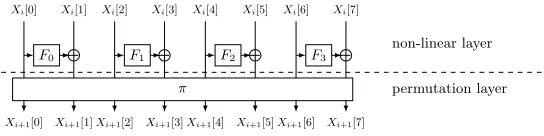
1] the b input blocks of a GFN round and by Xi+1[0],· · ·, Xi+1[b−1] the corresponding output blocks. A GFN can be separated into two successive layers, as done in [28,1]: a non-linear layer and a permutation layer, as shown in Figure 1. The non-linear layer is made of key-dependent functionsFi which input some
Xi[0]
Xi+1[0]
Xi[2]
Xi+1[2]
Xi[4]
Xi+1[4]
Xi[6]
Xi+1[6]
Xi[1]
Xi+1[1]
Xi[3]
Xi+1[3]
Xi[5]
Xi+1[5]
Xi[7]
Xi+1[7]
F0 F1 F2 F3
π
non-linear layer
permutation layer
Fig. 1: One round of a Type-II GFN withb= 8 blocks.
A generic method that uses a matrix representation and captures the previous definition of GFNs is presented in [1]. This representation could be useful to find ID, ZC and INT distinguishers as well as to show some links between them as began in [3]. Definition 1 sums up this approach for the Type-II GFNs.
Definition 1. Omitting key and constant addition, the round function of a Type-II GFN withb branches,b even, can be matricially represented as a combination of twob×b matricesF, P with coefficients {0,1, Fi}where the {Fi}i≤b/2 denote the internal non-linear functions.
• Representing the non-linear layer (F-layer), the non-zero coefficients of the matrix F are equal to 1 in the diagonal and have coefficient Fi in row j and
column`if the input of the function Fi is given by the`-th branch and the output
is Xor-ed to the j-th branch. Meaning that, for a Type-II GFN,F have oneFi
on each even row and even column.
• Representing the permutation of the branches (P-layer), the matrix P is a permutation matrix with only one non-zero coefficient per line and column. From these two matrices, a Type-II GFN round function can be represented by a b×b
matrixRasR=P · F, the inverse of the round function isR−1=F · P−1. As observed in [28], optimal diffusion block permutations have the property that any input block with an even number is mapped to a block with an odd number, and vice versa. A Feistel cipher with this property is calledalternating Type-II GFN (AGFN). Some of the results of this paper assume alternating Type-II
GFNs.
In [27,3], another matrix representation is used to find ZC distinguishers on Feistel-like ciphers. TheU-method used to find ZC distinguishers relies on the mirror representation of the round function.
Definition 2. For a Feistel-like cipher given the matrix representation of the round function R=P · F, we call mirror function the round function described by the matrixM=P · FT, whereFT denotes the transposition of the matrixF.
3
Distinguishers
between partial linear masks. To show the similarities between ID, ZC and INT attacks, the same notations will be used in the different contexts. These notations are summed up in Table 2. For instance, for a givena value, the quantityAa
denotes respectively a non-zero difference in the ID context, a non-zero mask in the ZC context and symbolizes a permutation of the elements of Fc2 in the INT context. While for type-1 distinguishers (see Definition 3 in Section 3.2) ˜Aa
does not have to be differentiated fromAa, such distinction is necessary to find
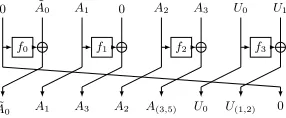
type-2 and type-3 distinguishers. Using these notations, the state of ab-branches GFN can be represented as a vector ofbelements of the form given in Table 2. When necessary, thisb-word vector will be denoted byViID,ViZC orViIN T. For example, in Figure 2 we have :ViID−1= (0,A˜0, A1,0, A2, A3, U0, U1). The vector
ViID is computed using the rules given in Table 3.
ID ZC INT
0 Zero difference Zero mask Constant value∗ ˜
Aa Known non-zero difference Known non-zero mask Known permutation Aa Non-zero difference Non-zero mask Permutation Uu Unknown difference Unknown mask Unknown
Aa⊕Aa0 =Uu =Uu Known sum
Table 2: General notations representing a partial-state. a anduare some counters.
∗
: Usually denoted byC in the INT context.
0
˜ A0
˜ A0
A1
A1
A3
0
A2
A2
A(3,5)
A3
U0
U0
U(1,2)
U1
0
f0 f1 f2 f3
Fig. 2: An example of passing one round of a classical Type-II GFN in the ID context using the previous notations and the rules of Table 3.
3.1 The Matrix Method on GFNs
ID Distinguisher. In [20,24], the matrix method which allows to efficiently find ID distinguishers for Feistel-type ciphers is described. The algorithm mainly implements the rules given in Table 3 to propagate a partial difference through the rounds of a cipher. The valuesaanduare arbitrary values starting at 0. As explained in [35], these indexes allow simplifications of typeAa⊕Aa = 0.
Using the matrix representation of the round function, we can derive an ID distinguisher on a GFN.
Proposition 1. GivenVID
0 andW0ID a representation of the input and output differences, we have an ID distinguisher (VID
0 , W0ID) on s0+s1 rounds if we have an inconsistency betweenX =Rs0·VID
Rules to pass anFfunction
F 0 A˜i Ai UjorAi⊕Aj
0 A(maxa)+1 A(maxa)+1 U(maxu)+1
Rules to pass a⊕
⊕ 0 A˜i Ai Ui
0 0 A˜i Ai Ui
Aj Aj A˜i⊕Aj Ai⊕Aj Aj⊕Ui
˜
Aj A˜j A˜i⊕A˜j Ai⊕Aj Aj⊕Ui
Uj Uj A˜i⊕Uj Ai⊕Uj Uj⊕Ui
Table 3: Propagation rules in the ID, ZC and INT context when using the matrix method.
More details on inconsistencies in the ID and ZC contexts are provided later in this section.
ZC Distinguisher. In [27], the matrix method to find ZC distinguishers is presented. The main difference with the method used in the ID context comes from the fact that the mirror matrixM(see Definition 2) must be used instead of the round function matrixR.
Proposition 2. GivenVZC
0 andW0ZC a representation of the input and output linear masks, we have a ZC distinguisher (VZC
0 , W0ZC)on s0+s1 rounds if we have an inconsistency betweenMs0·VZC
0 andM−s1·W0ZC.
INT Distinguisher. In [35], the authors proposed an algorithm to automatically find INT distinguishers. The algorithm uses the same rules and the same matrix representation R as in the ID context, only the termination rules differ. For Type-II GFNs, these rules can be expressed as follows.
Corollary 1. Given a representative vector ZIN T, for a GFN as given in Defi-nition 1, we have an INT distinguisher ons0+s1 rounds if the following rules are fulfilled:
• Termination at the end of an INT distinguisher: If WIN T
0 = Rs1 ·ZIN T is such that there exists i < b and a set J with WIN T
0 [i] = ⊕j∈JAj and for
˜
W =Rs1+1·ZIN T, for all iandJ, we haveW˜[i]6=⊕j ∈JAj.
• Termination at the beginning of an INT distinguisher: IfVIN T
0 =R−s0·ZIN T is such that∃i∈ {0,· · · ,(b−1)}withV0IN T[i] = 0(with classical notation=C).
Throughout this paper, we assume that the ID, ZC and INT distinguishers are derived from the matrix method.
3.2 Equivalence between Matrix-Method-Derived ID and ZC Distinguishers
In [3], a condition of equivalence between matrix-method-derived ID and ZC distinguishers is given.
Theorem 1 ([3]). Let Rbe the matrix representation of the round function of a GFN and Mbe the matrix representation of its mirror function as given in Section 2. If there exists a b×b permutation matrixQ such that
we deduce that: an impossible differential distinguisher onr rounds involving a number of differentials equal toM exists if and only if a zero-correlation linear distinguisher onr rounds involvingM linear masks exists.
As shown in [3], most of the Feistel networks verify this condition. In the remainder of this paper, we say that a Feistel-like cipher has matrix-method-derivedrelated ID and ZC distinguishers when the relation is derived from the previous property. Lemma 1. Given the matrices R=P · F andM=P · FT,
• If the condition R=Q · M · Q−1 of (1) is fulfilled and P · Q=Q · P we have
F =Q · FT· Q−1.
• If the conditionR=Q · M−1· Q−1 of (1) is fulfilled we haveF=Q
1· FT· Q2 with Q1=P−1· QandQ2=P−1· Q−1.
Proof. We haveP ·F =Q·P ·FT·Q−1or equivalentlyF=P−1·Q·P ·FT·Q−1=
Q·FT·Q−1. For the second point, we haveP ·F=Q·FT·P−1·Q−1or equivalently
F =P−1· Q · FT · P−1· Q−1.
Remark 1. For a Type-II GFN as given in Definition 1, there always exists a permutation matrixQsuch thatFT =Q · F · Q−1. This matrixQcorresponds to the permutationσ: (0,· · · ,(b−1))→(1,0,3,2,· · · ,(b−1),(b−2)).
While in [13] improved ID distinguishers are presented, using the matrix method for Type-II GFNs we can observe three types of ID and ZC distinguishers [24]. Definition 3. GivenX =Rs0·VID
0 andY =R−s1·W0ID orX =Ms0·V0ZC and Y =M−s1·WZC
0 . Following the work of [13,24], for a Type-II GFN, we define three types of distinguishers. Let p∈ {0,· · ·,(b−1)} denote the index of the studied stateY and Y[p] the status of thisp-th word.
•An ID (resp. ZC) distinguisher of type-1 denoted by ID1 (resp. ZC1) is a distinguisher with independent input and output differences (resp. masks). For these distinguishers, the inconsistency is usually:
∃p∈ {0,· · ·,(b−1)} |(Y[p] = 0andX[p] =Aa)or(Y[p] =Aa andX[p] = 0).
• An ID (resp. ZC) distinguisher of type-2 denoted by ID2 (resp. ZC2) is a distinguisher where a non-zero output-difference word (resp. output-mask word) should be different from an input one. Given A˜a0 a word of V0 and W0, the inconsistency is:
∃p∈ {0,· · · ,(b−1)} |Y[p] =X[p] = ˜Aa.
• An ID (resp. ZC) distinguisher of type-3 is a distinguisher where non-zero input- and output-difference words (resp. output-mask words) should be equal. GivenA˜a0 a word ofV0 andW0, we have an ID distinguisher of type-3 (ID3) on
s0+s1+ 1 rounds if:
∃p∈ {0,· · ·,(b−1)} |(F ·X)[p] = ˜Aa0⊕Aa1 and(P
−1·Y)[p] = ˜A
a0. (2)
Clearly, our matrix method captures the distinguishers found using the matrix method described in [24] as in the rules given in Table 3 used to define the transitions of our matrix method, we have: F( ˜Ai) = A(maxa)+1 and ˜Ai⊕
Aj is kept as ˜Ai ⊕Aj when crossing a xor operation. For example, the ID
distinguisher presented in [24] on 16-round of Gen-Skipkack is of type ID2 and the ID distinguisher on 19-round of Gen-CAST256 is of type ID3. The link between ZC and ID distinguishers thus depends of Theorem 1. However, our matrix method does not capture the distinguishers of [13] which depend on differential transition properties of the involved S-boxes.
3.3 Comparison with INT Distinguishers
A zero-correlation integral distinguisher is defined in [10] as an integral distin-guisher with balanced output words. In Section 3 of [10] a direct relation between zero-correlation integral distinguisher and ZC distinguisher of type-1 is extracted.
As a zero-correlation integral distinguisher is stronger than a general integral distinguisher with sum over an output word equal to zero, we can see that in general, one more round could be added to the zero-correlation integral distinguisher to transform it into an INT distinguisher because if the partial outputs of the zero-correlation integral distinguisher occur equally often, the last linear transformation maps it into an integral distinguisher. More precisely for Type-II GFNs, we deduce that the number of rounds on which an INT distinguisher applies, is greater than or equal to the number of rounds on which a ZC distinguisher of type-1 applies. More precisely for an alternating Type-II GFN, we can show the following lemma.
Lemma 2. For an alternating GFN of Type-II, given sZC1
max(resp. sIN Tmax) the maximum number of rounds on which a matrix-method-derived ZC distinguisher of type-1 (resp. an INT distinguisher) applied, we have sZC1
max =sIN Tmax orsZCmax1=
sIN T
max −1.
Proof. The preliminary relation between INT and ZC1 distinguishers extracted in [10] is based on the following termination rules for an INT distinguisher: If
W0IN T = Rs1 ·Z0 is such that there exists a set I ⊂ {0,· · · ,(b−1)} and an indexj0 such that ⊕i∈IW0IN T[i] =Aj0 and for ˜W0IN T =Rs1+1·Z0, for all set
I⊂ {0,· · · ,(b−1)} and for allj1, we have⊕i∈IW˜[i]6=Aj1.
Let (V0IN T, W0IN T) be an INT distinguisher onsIN T rounds. If the termination of the INT distinguisher is∃p∈ {0,· · ·,(b−1)} such thatW0IN T[p] =Aa then
the number of rounds of which the INT and the ZC distinguishers apply are the same.
Otherwise this means that there exists an INT distinguisher (VIN T
0 , Z0IN T) on s0 rounds fulfilling, for a given p, ZIN T
0 [2p] =Ai andZ0IN T[2p+ 1] = Aj
whereW0IN T is obtained fromZ0IN T byW0IN T =Rs
IN T−s0
·Z0IN T.
According to [10], this INT distinguisher can be converted into a ZC distin-guisher of type-1, (VZC
0 , Z0ZC) with ∀i6={2p,2p+ 1}we have Z0ZC[i] = 0, and
ZZC
From this distinguisher, we obtainXZC
0 =FT ·Z0ZC satisfyingX0ZC[2p] =Ai
andXZC
0 [2p+ 1]∈ {Uj}as well asX0IN T =F ·Z0IN T satisfyingX0IN T[2p] =Ai
andXZC
0 [2p+ 1] =Ai⊕Aj.
Given that for the ciphers of Definition 1, we haveFT =Q · F · Q−1 withQ as in Remark 1, we deduce that ˜XZC
0 =Q ·X0ZC is such that ˜X0ZC[2p+ 1] =Aj
and ˜X0ZC[2p]∈ {Ui}. For an alternating Type-II GFN, no round could be added
in the ZC context and one in the INT context.
Remark 2. In practice, for the Type-II GFNs of [28], we observed (see for instance Table 4) and proved3, that the number of rounds on which matrix-method-derived INT and ID distinguishers apply issIN T =sID,sIN T =sID−1 orsIN T =sID+1.
This relation follows by the relation between the ZC and ID distinguishers.
Name π sIDsIN T
Type-II{7,0,1,2,3,4,5,6} 17 16 Nyberg{2,0,4,1,6,3,7,5} 14 15 No.1 {3,0,1,4,7,2,5,6} 11 11 No.2 {3,0,7,4,5,6,1,2} 10 11
Table 4: GFNs of [28] withb= 8. For these ciphers based on the results of [3], we can show thatsID=sZC.πdefines the permutation of the branches.
Remark 3. According to Prop. 1 and Cor. 1, the same matrix representation is used to derive ID and INT distinguishers. GivenZIN T as in Cor. 1, we denote by
˜
X =Rs0·ZIN T and ˜Y =R−s1·ZIN T. Now for a Type-II alternating GFN, we
can find the different types of impossible differential distinguishers by analyzing the different inconsistency cases between ˜X and ˜Y or a permutation of ˜Y.
4
The Key-Recovery: Notations and Examples
The time and memory complexities of ID, ZC and INT key-recovery attacks are dependent on the number of key-words involved in the attacks. In ID attacks, a distinction is classically made between the key-words which lead to a reduction of the number of pairs and the key-words which are just helping in the partial encryption/decryption without reducing the number of involved pairs ([14], Figure 2). While the first ones are usually calledsieving key-wordsleading to a so calledsieving step, we calledguessed key-wordsthe latter ones. Theinvolved key-words corresponds to the sieving key-words and guessed key-words.
Similar concepts can be observed in ZC and INT attacks, where most of the involved key-words lead to a reduction of the size of the table storing the partial distribution. To simplify the description and the comparison, the same terminology will be used in these three contexts. In the ZC and INT contexts, a sieving key-word corresponds to a key-word leading to a reduction of the size of the stored distributions. The number of key-words involved in a key-recovery
3
attack ons+rrounds is denoted by|K|. The number of key-words leading to a sieving step is denoted by|S|and the number of guessed key-words is denoted by
|G|. To compute the complexity of a key-recovery attack we denote byHW(V), the weight of ab-word vectorV asHW(V) =b− |{`∈ {0· · ·(b−1)}|V[`] = 0}|. To illustrate this concept, we discuss the examples of ID, ZC and INT attacks on a 4 branches Feistel as well as on LBlock [34].
4.1 Example of Attacks on a 4 Branches Feistel Network
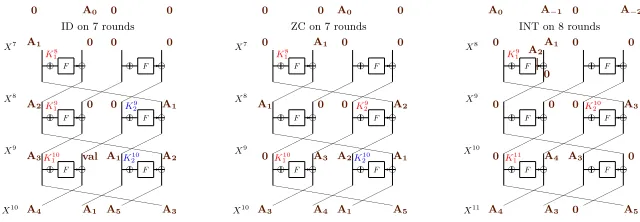
In Figure 3, we illustrate ID, ZC and INT key-recovery attacks on the last three rounds of a classical type-II GFN with 4 branches. While some of the notations will be defined later, we illustrate the meaning of guessed and sieving key-words in the ID and ZC context by providing some steps of the key-recovery algorithms. For instance some steps of the generic ZC attack on this structure could be:
• Store the distribution of [X0[2], X10[0,1,2,3]] (5 words)
•Try the sieving keyK110and compute the distribution of [X0[2], X11[1], X12[1,2]] (4 words)
• Try the guessed keyK210 and compute the distribution of [X0[2], X9[1,2,3]] (4 words)
The last step consists at studying the distribution of [X0[2], X7[1]].
F-g gF-g
g hhhhhh hhhhhh hhh
F-g gF-g
g hhhhhh hhhhhh hhh
F-g gF-g
g hhhhhh hhhhhh hhh
0 A0 0 0
A1 0 0 0
A2 0 0 A1
A3 val A1 A2
A4 A1 A5 A3
K8 1 K9 1 K 9 2 K10 1 K 10 2 X7 X8 X9 X10
ID on 7 rounds
F-g gF-g
g hhhhhh hhhhhh hhh
F-g gF-g
g hhhhhh hhhhhh hhh
F-g gF-g
g hhhhhh hhhhhh hhh
0 0 A0 0
0 A1 0 0
A1 0 0 A2
0 A3 A2 A1
A3 A4 A1 A5
K8 1 K9 2 K10 1 K 10 2 X7 X8 X9 X10
ZC on 7 rounds
F-g gF-g
g hhhhhh hhhhhh hhh
F-g gF-g
g hhhhhh hhhhhh hhh
F-g gF-g
g hhhhhh hhhhhh hhh
A0 A−1 0 A−2
0 A1 0 0 A2
0
0 0 0 A3
0 A4 A3 0
A4 A3 0 A5
K9 1 K10 2 K11 1 X8 X9 X10 X11
INT on 8 rounds
Fig. 3: Key-recovery in the ID and ZC context and the first partial sum in the INT context. The key-words in red are sieving key-words, the blue ones are guessed key-words.
4.2 Relation between the Involved Key-Words on LBlock
LBlock is a new lightweight block cipher designed by Wu and Zhang in 2011 [34]. It uses 80-bit keys and 64-bit blocks seen at nibble level and is based on a modified 32-round Feistel structure. We denote byP =L0||R0 the 64-bit plaintext, where
L0andR0are 32-bit vectors. The encryption process is as follows:Ri=Li−1and
[34] for a complete description of the S-boxes). Finally, the resulting nibbles are permuted as shown on Figure 4.
Li−1
Ki Ri−1
≪8
Li Ri
Fig. 4: A round of LBlock.
The key-schedule takes as input a master keyKseen as a key register denoted at bit level asK =K79K78· · ·K0 and outputs round-subkeyski of 32 bits. It
repeats the following steps fori= 1 to 31 knowing thatk1is initialized with the 32 leftmost bits of the key registerK:
1. K≪29
2. [K79K78K77K76] =S9[K79K78K77K76] whereS9 is the tenth S-box. 3. [K75K74K73K72] =S8[K75K74K73K72] whereS8 is the ninth S-box. 4. [K50K49K48K47] = [K50K49K48K47]⊕[i]2
5. ki+1is selected as the leftmost 32 bits of the key registerK.
For this cipher which can be seen, as described in [27], as a Type-II GFN, ID and ZC distinguishers can be derived from each other [3] and can be applied on 14 rounds [34]. INT distinguishers reach 15 rounds [34].
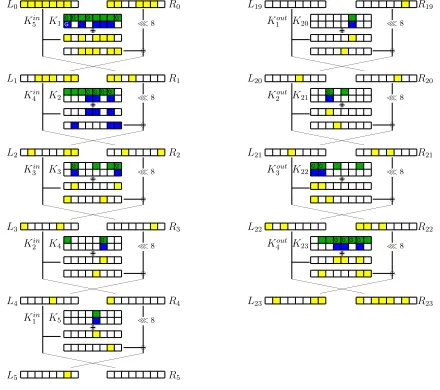
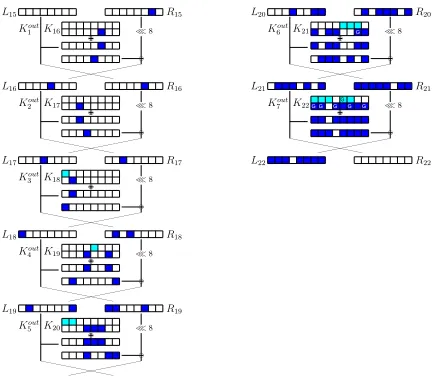
Derived from these distinguishers, ID and ZC attacks on 22 rounds [19,14,27] as well as ID attacks on 23 rounds [14,15] have been performed. An INT attack on 22 rounds has also been presented [25]. For the illustration purpose of this section, we assume that the round-keys are independent. As the attacks of [19,14,27,25] depend on the key-schedule more details on these attacks will only be presented in Section 6. In this example represented in Figure 5 and in Figure 6, we observe a strong relation between the key-words involved in the different attacks, when the distinguishers are, what we will call, strongly related (the same key-words are involved in a key-recovery attack on 1 +s+ 1 rounds). For this illustration we use as reference the ID attack of [14] derived from the ID distinguisher: [((0,0,0,0,0,0,0,0),(0,0,0,0,∗,0,0,0))9((0,0,0,0,0,∗,0,0),(0,0,0,0,0,0,0,0))].
For the ZC distinguisher we use:
[((0,0,0,0,0,0,∗,0),(0,0,0,0,0,0,0,0))9((0,0,0,0,0,0,0,0),(0,0,0,0,0,0,∗,0))].
The keysK5[3] and K20[2] are involved in both attacks, meaning that the chosen ID and ZC distinguishers are strongly related. We also observe that in that case, as for the classical type-II GFN given in Figure 3, the key-words involved in the ZC attack corresponds to a subset of the key-words involved in the ID attack. We also compare this attack, with an INT attack derived from the following INT distinguisher on 15 rounds:
Before providing in Section 5 a proof regarding the relations between the different involved key-words, we analyze in the next section, relations between the data complexities of these different attacks.
G G G G
G
G G G G
G G G `````` ``````` ```````` ````` ```` `````` ``` `````` ``````` ```````` ````` ≪8 ≪8 ≪8 ≪8 ≪8 g g g g g g g g g g L0 L1 L2 L3 L4 L5 R0 R1 R2 R3 R4 R5 K1 K2 K3 K4 K5 Kin 5 Kin 4 Kin 3 Kin 2 Kin 1 G G G
G G G G
```````` ````` ```` `````` ``` `````` ``````` ```````` ````` ≪8 ≪8 ≪8 ≪8 g g g g g g g g L19 L20 L21 L22 L23 R19 R20 R21 R22 R23 K20 K21 K22 K23 Kout 1 Kout 2 Kout 3 Kout 4
In blue (bottom): the key-words involved in the ZC attack In green (top): the key-words involved in the ID attack G: a guessed key-word (non-sieving key-word) In yellow: the state-words involved in the ZC attack
Fig. 5: The key-recovery part of ID, ZC attacks on LBlock.
4.3 Data Complexity of a Key-Recovery Attack
ZC Attack. We denote byM the number of linear approximations which have correlation zero and which are evaluated in the attack. Improving the estimate of [10], it has been proven in [9] that the data complexityNZC of a
distinct-known-plaintext ZC key-recovery attack is
NZC ≈(2
n−1) [z
1−α+z1−β] p
M/2 +z1−α
+ 1, (3)
wherezxis obtained from the inverse of the cumulative distribution functionΦof
the normal distribution:zx=Φ−1(x), 1−αcorresponds to the success probability
of the attack and−log2(β) to the advantage of the attack. As the manipulation of the normal distribution makes the comparison between attacks difficult, in the remainder of this paper we use an approximation of it. In particular, we can show (see for instance [29]) that forβ <2−5,z
1−β=Φ−1(1−β)≈ p
−2 log(β). While an approximation of z1−α can also be used, in many ZC attacks, the success
probability is fixed to 1−α= 1−2−2.7≈0.85 such thatz
`````` ``````` ```````` ````` ```` `````` ``` `````` ``````` ```````` ````` ≪8 ≪8 ≪8 ≪8 ≪8 g g g g g g g g g g L15 L16 L17 L18 L19 R15 R16 R17 R18 R19 K16 K17 K18 K19 K20 Kout 1 Kout 2 Kout 3 Kout 4 Kout 5 G G G G G G G
`````` ``````` ```````` ````` ≪8 ≪8 g g g g L20 L21 L22 R20 R21 R22 K21 K22 Kout 6 Kout 7
In dark blue (bottom): the key-words involved in the first partial sum In light blue (top): the key-words involved in the second partial sum G: a guessed key-word (non-sieving key-word)
In dark blue: the state-words involved in the first partial sum
Fig. 6: The key-recovery part of an INT attack on LBlock.
approximation, the data complexity of a ZC key-recovery attack becomes
NZC ≈
2nhz
1−α+ p
2·log(1/β)i
p
(M −1)/2 +z1−α
+ 1. (4)
ID Attack. For most of the attacks in the differential context, the data complex-ity of an ID key-recovery attack is computed as a function of the structure of the input and output differences but also of the different sieves performed during the attack. In an ID attack, if at least one key remains at the end of the key-recovery part we are certain that the correct key is among them. In statistical terms [4], this particularity means that the success probability 1−αof the attack is equal to 1. Given structures of size 2tand given 2mstructures used in an ID attack, the data complexity isNID= 2m+t.
In the ID cryptanalysis context [2,15], it is commonly assumed that the false alarm probability, denotedβ in this paper is determined byβ= (1−2−q)2m+2t−1−p≈ e2m+2t−p−q−1, where 2−p corresponds to the product probabilities discarding
plaintext-pairs and 2q corresponds to the probability of discarding a key. Thus, we have
NID≈2p+q−t·2·log(1/β). (5) When the data complexity is smaller than the maximal size of a structure or if the ID attack can be done in the known plaintext model, we have NID = p
we can show that 2p+q+n−t= 22n/M, wherenis the size of the encrypted blocks.
In the case where more than one structure is used, we have
NID≈ 2
n
M ·2·log(1/β). (6)
From a direct comparison between (4) and (6) we deduce that:
Lemma 3. Given two related ID and ZC distinguishers, involvingM differentials or linear approximations, if the success probability of the ZC attack is 50% (z1−α = 0), we have NID ≤ NZC as long as log(1/β) ≤ M. This relation
remains true, for larger success probabilities since the data complexity of the ZC attack will, in that case, be larger too.
INT Attack. GivenV0IN T as defined in Cor. 1, the data complexity of an INT attack is proportional to the numbervof active words inV0IN T:NIN T =O(2c·v). For this attack, false alarm occurs when the sum on a word is randomly equal to 0. As this event occurs with probability 2−c, we can derive in a time/memory
trade-off way, the success of an INT attack withβ = (1−2−c)2c|K| where|K|is the number of key-words involved in the key-recovery part of the attack. The overall data complexity of an INT attack is:
NIN T ≈2c·v·2·log(1/β). (7)
Remark 4. For many Feistel-like ciphers, the number M of differences involved in an ID distinguisher of type-1, is M = 22·c (see examples in [24]) and the
weightv ofVIN T
0 isb−1. In this case, a comparison between (7) and (5) gives
NID1=NIN T/2c.
This relation stays about to be true in the case of an ID distinguisher of type-2 (in this case,M = (2c−1)2). When comparing an ID distinguisher of type-3 with
M = 2c to an INT distinguisher withv=b−1 we obtain thatNIN T =NID3. Remark 5. Assuming as in many attacks thatHW(VZC1
0 ) =HW(W0ZC1) and
HW(VIN T
0 ) =b−HW(V0ZC1) and given a success probability 1−αof 50% in the ZC context, we obtain that NIN T/NZC1≈p
2 log(1/β). Thus, the data complexity of an INT attack is greater than the one of a ZC1 attack. For larger success probability, this is no more true and in generalNIN T ≤NZC.
5
Key-Words Involved in a Key-Recovery Attack
From a matrix representation of Type-II GFN ciphers, we analyze in this section the key-recovery part of these attacks. This analysis is done for related and strongly relatedmatrix-method-derived ID, ZC and INT distinguishers.
We say that the ZC and INT distinguishers are strongly relatedif the same key-words are involved in a key-recovery attack over one round of partial decryption. In this section, strongly related INT and ZC distinguishers do not necessary apply on the same number of rounds.
We say that the ZC and ID distinguishers are strongly relatedif the same key-words are involved in a key-recovery attack over one round of partial encryption and one round of partial decryption.
For instance, for the Nyberg constructions, the matrix-method derived ID and ZC distinguishers are related but are not strongly related. This can be proven by observing that for this non-alternating cipher, P · Q 6=Q · P for Qdefined as in Remark 1. But, for this cipher, the distinguishers are related in the sense of Theorem 1.
5.1 A Matrix Representation for Analyzing Key-Recovery Attacks
In the same way, we can derive ID, ZC and INT distinguishers of a Feistel cipher using a matrix representation of the round function, we show in this section how we can find the key-words involved in the attack using a matrix method. In this section, the vectorsV0andW0represent respectively the input and output of the distinguishers. The vectorsVi andWj represent the state wheni≤rin rounds are added at the beginning of a distinguisher andj ≤rout rounds are added at the end of this distinguisher. The knowledge of the value of the vectors{Vi}i<rin
and{Wj}j<rout will be necessary to compute the number of attacked rounds in
the ID, ZC and INT contexts. The operations on these vectors correspond to those given in Section 2.
In that case, the vectorsVi, Wj ∈ {(0,A˜a, Aa, val)}b where Ai,A˜i denote a
difference-word or a state-word which has to be computed and 0 denote words with no difference or a state-word with value unnecessary for the attack. We use the following arithmetic similar to the one given in Table 2: 0⊕Aa =Aa,
Aa⊕Aa0 =Aa00, F(0) = 0 and F(Aa) = Aa0. The description of val is given
later in this section and is only used in the ID context. As explained in Section 3, the notation ˜Aa is necessary for the type-2 and type-3 ID and ZC distinguishers,
which hold when the input and output differences (masks) should be respectively strictly different or strictly equal.
attack. In all the cases, considering only the primary branch of the partial sum technique, we show that the number of involved key-words in the INT context is always lower than the number of key-words involved in the ZC context and in the ID context considering only the rout direction.
Moreover, as all the INT distinguishers obtained using the matrix method are in fact higher order integral distinguishers withb−1 orb−2 active words in input, the computational cost to pay when trying to add one round at the beginning of this distinguisher is really high (except when some particular tricks such as the ones described in [18] could be considered which is not always the case) and to stay as generic as possible, we only consider a key-recovery attack onrout rounds at the end of the INT distinguisher.
xi 0
xi+1 0
xi 1
xi+1 1
xi 0
xi+1 0
xi 1
xi+1 1
F F
•
• • zi
Test ifP xi
1 ?
= 0 Test ifP
xi+1 0
?
=P zi
Fig. 7: On the left, the test to perform without the partial sum. On the right, the test to perform with the partial sum divides the computations into two steps.
Illustrated by the example provided in Figure 3, the sieving and guessed key-words can be found as follows.
Lemma 4. In the ZC context,
– Given the vectorVi−1. Let VA=P−1·Vi−1.
• The key-wordKi[p]is a sieving key-word ifVA[2p+1]6= 0andVA[2p] = 0.
• The key-wordKi[p]is a guessed key-word ifVA[2p+1]6= 0andVA[2p]6= 0.
• The vector Vi is computed asVi=FT ·VA=FT · P−1·Vi−1. • The number of active words corresponds to the weight ofVi.
– Given the vectorWj−1.
• The key-word Kj[p] is a sieving key-word if Wj−1[2p+ 1] 6= 0 and
Wj−1[2p] = 0.
• The key-word Kj[p] is a guessed key-word if Wj−1[2p+ 1] 6= 0 and
Wj−1[2p]6= 0.
• The vector Wj is computed as Wj =M ·Wj−1=P · FT·Wj−1. • The number of active words corresponds to the weight ofWj.
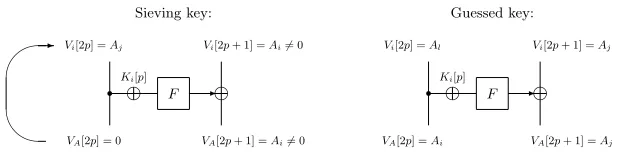
Proof. The proof of the first point is illustrated in Figure 8. In the left figure, the notationVi[2p] =Ai means that the value ofVi[2p] =Ai should be known to
be able to computeVA[2p+ 1]. After partial encryption the value ofVA[2p] is
F
r g -g
VA[2p] = 0 VA[2p+ 1] =Ai6= 0
Vi[2p] =Aj Vi[2p+ 1] =Ai6= 0
Ki[p] Sieving key:
'
&
-F
r g -g
VA[2p] =Ai VA[2p+ 1] =Aj
Vi[2p] =Al Vi[2p+ 1] =Aj
Ki[p]
Guessed key:
Fig. 8: ZC context: Determining if an involved key-word is a guessed or a sieving key.
Usually in the ID context the matrix method allows us to only study the propagation of the differences. However, in the partial encryption/decryption process there are cases where even if the difference is equal to 0, the knowledge of the value is necessary to complete the key-recovery. We introduce the notationval, to represent such a word with difference 0. The weight of a vectorV corresponds to the number of non-zero differences.
Lemma 5. In the ID context,
– Given the vectorVi−1 andVA=P−1·Vi−1.
• The key-wordKi[p]is a sieving key-word ifVA[2p]6= 0and VA[2p+ 1] =
0 or val .
• The key-wordKi[p] is a guessed key-word ifVA[2p+ 1]6= 0.
• In the case where VA[2p+ 1]6= 0 andVA[2p] = 0, updateVA[2p]to val.
• The vector Vi is computed asVi=F ·VA.
• The number of active words corresponds to the weight ofF ·VA.
– Given the vectorWj−1.
• The key-wordKj[p] is a sieving key-word ifWj−1[2p]6= 0andWj−1[2p+ 1] = 0 or val .
• The key-wordKj[p]is a guessed key-word ifWj−1[2p+ 1]6= 0.
• In the case where Wj−1[2p+ 1]6= 0andWj−1[2p] = 0, updateWj−1[2p] to val.
• The vector Wj is computed as Wj =P · F ·Wj−1.
• The number of active words corresponds to the weight ofP · F ·Wj−1. Proof. The proof is similar to the one in the ZC case but the reasoning is done with differentials instead of with the state-values. The difficult case corresponds to the third point. Indeed, whenVA[2p+ 1]6= 0 and VA[2p] = 0, it means that
the valueVA[2p] needs to be known even if the difference is 0 and thus for that
purpose, we decide to use theval notation.
Lemma 6. In the INT context, only the output direction on rout rounds is considered. Given the distinguisher (VIN T
0 , Y0IN T) we define W0IN T such that
WIN T
0 [p] = 0 if Y0IN T[p] = Uu and W0IN T[p] = Aa if Y0IN T[p] = Aa or
YIN T
0 [p] =⊕iAi.
– The key recovery is similar to the one in the ZC context, starting from the vectorWIN T
0 .
– The partial sum technique, can be applied from writingWIN T
1 =W1IN T,1 +
WIN T
5.2 Relations between the Key-Words of the Different Attacks
From the rules expressed in the previous section, we can derive the following relations between the key-words involved in the different attacks for related and strongly related matrix-method-derived distinguishers.
Lemma 7. For a Type-II GFN, given a matrix-method-derived ZC distinguisher and its strongly related ID distinguisher, the words involved in a ZC key-recovery attack is a subset of the key-words involved in an ID key-key-recovery attack. The number of sieving key-words is identical.
Proof. In this proof, we define the matrixQ such thatFT =Q · F · Q−1 (see Remark 1). According to the hypothesis made in the beginning of this section in order to have the same key-words involved in an attack on 1+1 rounds, the vectors
V0ID andV0ZC are such that V0ZC =Q ·V0ID. We denote by ˜ViZC =Q ·V ZC
i . In
this case the first part of Lemma 4 can be rewritten as:
•The key-wordKi[p] is a sieving key-word if ˜VAZC[2p]6= 0 and ˜V ZC
A [2p+ 1] = 0.
•The key-wordKi[p] is a guessed key-word if ˜VAZC[2p]6= 0 and ˜V ZC
A [2p+ 1]6= 0.
• The vectorVi is computed asVi=FT ·VA=Q · F ·V˜AZC.
From the relationVZC
0 =Q ·V0IDand the previous observations, we deduce that the number of sieving key-words among the keyKin
1 is the same in both ZC and ID attacks. The same observation can be done onWZC
0 andW0ID.
Note that ifViZC =Q ·ViID then the number of guessed key-words in the ID context is larger than in the ZC context since the rule to determine if a key is a guessed key in the ZC context are more restrictive than the one in the ID context. Remain to analyze the general relation betweenViZC andViID. Assume thatViZC−1 =Q ·ViID−1 (this is true fori= 1), meaning that ˜VAZC =VAID
before update of this one. According to the third bullet of Lemma 5, after update ofVID
A , we have ˜V ZC
A =V
ID
A +V0 whereV0 is a vector ofbelements all equal to
0 orval. We conclude from the fact that operations on the matrix are additive.
Lemma 8. For Type-II GFNs fulfilling one of the conditions given in Theorem 1 and for related ZC and ID distinguishers, the key-words involved in the encryption (resp. decryption) side of the ZC attack correspond to a subset of the key-words involved in the encryption (resp. decryption) side of the ID attack.
Proof. The proof is similar to the one of Lemma 7 using the tools of the proof of Theorem 1.
Lemma 9. Given a ZC distinguisher and a strongly related INT distinguisher, without the partial sum technique, the key-words involved in the two attacks on
rout rounds added at the end of the distinguisher KZCrout and K IN T
rout are, modulo
the round index, the same. For an alternating Type-II GFN, when considering the dominant part of the partial sumP Stechnique , we have:|KIN TP S
rout+1|=|K
IN T
rout |+ 1.
When considering the partial sum technique, assuming that the cost for the second branch is negligible, we only have to consider the first branch and the associated vectorWIN TP S
·,1 . By induction, at round 1, we have |KIN T1 |= 1 and
W1IN T =M·W0IN T. AsW1IN T =W
IN TP S
1,1 +W0we obtain|K
IN TP S
2,1 |= 1+|K
IN T
1 |. As it exists a permutationσof the branches with matrix representationQsuch thatWIN TP S
1,1 =Q ·W0IN T. Givenπthe permutation of branches represented by the matrixP andpsuch thatWIN T
0 [2p+1]6= 0, we defineσa permutation of theb branches asσ[i] =ifori=6 {2p+ 1, π[2p]}andσ[2p+ 1] =π[2p],σ[π[2p]] = 2p+ 1. The remainder of the proof follows directly for an alternating Type-II GFN comparing WIN T
i = Mi ·W0IN T and W
IN TP S
i+1 = M
i·Q·WIN T
0 . From the definition of Q, we deduce that|SIN TP S
rout+1|=|S
IN T
rout |+ 1 and |G IN TP S
rout+1|=|G
IN T rout |.
Lemma 10. Given a ZC distinguisher, for an alternating Type-II GFN, denoting by|KZCin
i |(resp.|K
ZCout
j |) the number of key-words involved in theifirst rounds
(resp. in the j last rounds) of the attack we have|KZCout rout | ≥ |K
ZCin
i |+|K
ZCout
j |
with i+j = rout. If HW(W0IN T) = HW(W0ZC) = 1, for rout ≥ 3, we have
|KIN TP S rout+1| ≥ |K
ZC
i |+|K
ZC
j |.
Proof. As the cipher is alternating, according to the rules given in Lemma 4, we have|{p|WZC
i+1[2p+ 1]6= 0}|=|{p|WiZC[2p]6= 0}|and|{p|WiZC+1[2p]6= 0}| ≤
|{p|WZC
i [2p+ 1]6= 0}|+|{p|WiZC[2p]6= 0}|.
The inequality occurs when the key-word Ki+1[2p] is a guessed key-word. For an alternating cipher with w = HW(W0ZC) = 1 this can only occurs for i > 2. The same reasoning can be done for the vector ViZC. We have
|KZCout
rout | =
P
0≤i<rout|{p|W ZC
i [2p+ 1] 6= 0}| = 4 + P
3≤i<rout|{p|W ZC
i [2p+
1]6= 0}|.Also assuming that |KZCin
i |+|K
ZCout
j |=
P
0≤r<i|{p|W
ZC
r [2p+ 1]6=
0}|+P
0≤r<j|{p|V ZC
r [2p+ 1]6= 0}| ≤3 +
P
3≤r<i P
1≤t≤r|{p|W ZC
t [2p+ 1]6=
0}|+|{p|VZC
r−t[2p+ 1]6= 0}|.
6
A ZC Attack on LBlock
In Section 4 we show a relation between the key-words involved in a key-recovery attack on LBlock. In this section we present a ZC attack on 23 rounds of this cipher when taking into consideration the key-schedule of this cipher.
In the INT attack of [25], 69 key-bits are involved and among them, 55 are sieving key-bits. The ZC attack of [27] requires to guess 24·14 = 256 keys. Complexities of the best attacks on LBlock are resumed in Table 1.
In the analysis provided in [14], using a different ID distinguisher leads to only guess 71 key-bits in the attack on 22 rounds. A similar analysis shows that only 2 extra bits need to be guessed in the attack on 23 rounds. As done in [14] and [25] in the ID and INT context, from an analysis of the key-schedule we can derive a ZC attack on 23 rounds of LBlock.
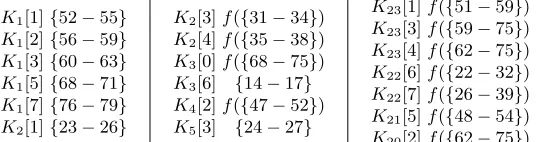
described in Figure 6 whereas Table 6 gives all the steps of the attack considering thatM = 28 and the corresponding complexities. From this table, givenT
0= [L0[1,2,3,4,5,6,7], R0[1,2,3,6,7], L23[0,1,6], R23[1,3,4,5,7]] q(this table is not stored), the different steps of the attack can be described as follows: In the first step of Table 6 when guessing the 17 required key-bits we obtain the table T1 (stored in memory) by removing the distributions of the nibblesL0[1,2,3,5], R0[1,2,6,7] andL23[0], R23[1] fromT0 (“Need” column) and adding the distributions of the nibblesL1[0,1,3,4] andR22[6] to it (“Get” column).
K1[1]{52−55} K1[2]{56−59} K1[3]{60−63} K1[5]{68−71} K1[7]{76−79} K2[1]{23−26}
K2[3]f({31−34}) K2[4]f({35−38}) K3[0]f({68−75}) K3[6] {14−17} K4[2]f({47−52}) K5[3] {24−27}
K23[1]f({51−59}) K23[3]f({59−75}) K23[4]f({62−75}) K22[6]f({22−32}) K22[7]f({26−39}) K21[5]f({48−54}) K20[2]f({62−75})
Table 5: The keys involved in our attack on 23 rounds of LBlock and their dependency to the master key. See [34] for more details. The notationf({i−j}) means dependent of the keys bititojof the master key.
Step Masterkey bits Involved Keys Need Get #key-bit log2(|Tt|) Time
1 {51−63,68−71} K1[1,2,3,5] L0[1,2,3,5], R0[1,2,6,7]L1[0,1,3,4] 17 60 N·217·
5
K23[1] L23[0], R23[1] R22[6]
2 {23−26} K2[1] L1[1], R1[6] =L0[6] L2[0] 4 56 260+17+4(281)
3 {72−75} K3[0] L2[0], R2[0] =L1[0] L3[2] 4 52 256+21+4(281)
4 {64−67} K23[3] R23[3], L23[1] R22[7]
4 44 252+25+4·2 (282)
K23[4] R23[4], L23[6] R22[4]
5 {31−34} K2[3] L1[3], R1[7] =L0[7] L2[1],L0[7] 4 44 244+29+4(277)
6 {49,50} K4[2] L3[2], L2[1] L4[3] 2 40 244+33+2(281)
7 {76−79} K1[7] L0[7], R0[3] L1[5] 4 36 240+35+4(279)
8 {35−38} K2[4] L1[4], R1[4] =L0[4] L2[6] 4 32 236+39+4(279)
9 {14−17} K3[6] L2[6], R2[5] =L1[5] L3[7] 4 28 232+43+4(279)
10 {27} K5[3] L4[3], R4[7] =L3[7] L5[1] 1 24 228+47+1(276)
11 {22,28−30} K22[6] R22[6], L22[7] =R23[7] R21[5] 4 20 224+48+4(276)
12 {39} K22[7] R22[7], L22[5] =R23[5] R21[3] 1 16 220+52+1(273)
13 {48} K21[5] R21[5], L21[4] =R22[4] R20[2] 1 12 216+53+1(270)
14 - K20[2] R20[2], L20[3] =R21[3] R19[1] 0 8 212+54(266)
Table 6: The different steps of the ZC attack on 23 rounds of LBlock forM = 28.
T imecorresponds to the number of Sbox encryptions. The total time complexity is ((283.58+N·217·5)·1/23·1/8) + 280−a23-round encryptions.
In the recent ID attack on LBlock [14] different data and time trade-offs are suggested. For a complete comparison, we suggest here also different trade-offs depending of the advantage obtained in the distillation phase of the attack but also using smaller multidimensional linear spaces.
Instead of taking advantage of the ZC approximation
([(0,0,0,0,0,0, u,0),(0,0,0,0,0,0,0,0)]6→[(0,0,0,0,0,0,0,0),(0,0,0,0,0,0, v,0)]) where u ∈ F42 and v ∈ F42, we consider the ZC linear approximations where
u∈F42−b1 andv ∈F 4−b2
2 for 0 ≤b1, b2 ≤3. If the 4−b1 most significant bits of uare fixed to 0, the attack can be performed without knowing the b1 most significant bits of L5[1], meaning, as shown in Table 6 without knowing theb1 most significant bits ofR0[3]. In the same way,b2 bits ofR23[3] do not need to be stored. In this case, the size of the involved tables are divided by 2b1+b2 and
the time complexity of the Steps 2 to 14 of Table 6 are divided by 2b1+b2.
Table 7 gives an alternative attack whenM = 24. The memory complexity is larger (260 instead of 256) than with the previous method, nevertheless the time complexity is smaller.
Step Masterkey bits Involved Keys Need Get #key-bits log2(|Tt|) T ime
1a {51−63} K1[1,2,3] L0[1,2,3], R0[1,6,7]L1[0,1,3]
13 60 N·213·4
K23[1] L23[0], R23[1] R22[6]
1b {68−71} K1[5] L0[5], R0[2] L1[4] 4 56 260+13+4(277)
2 {23−26} K2[1] L1[1], R1[6] =L0[6] L2[0] 4 52 256+17+4(277)
3 {72−75} K3[0] L2[0], R2[0] =L1[0] L3[2] 4 48 252+21+4(277)
The following steps are the same than in Table 6. The time complexity of these steps is divided by 24
.
Table 7: Alternative approach whenM = 24. The total time complexity is ((279.78+
N·213·4)·1/23·1/8) + 280−a23-round encryptions.
In Table 8, we provide the complexity for a numberMof linear approximations between 24 and 28.The results show that even if the key-dependency is stronger in the ID context we can also take advantage of this key-dependency in a ZC attack to obtain an attack with a better time complexity. Due to the use of tricks to reduce the time complexity, the memory complexity of the ID attack of [14] is larger than the one of the ZC attack.
ID on 23 rounds from [14] Data Time Memory
257 278.58 272
259 275.36 274 261 276.48 276
263 278.48 278
ZC on 23 rounds Data Time Memory a M
261.90 276.78 260 5 28
262.16 276.47 260 7 28 262.61 275.95 259 7 27
263.87 276.51 256 7 24 263.87 273.94 260 7 24
Table 8: Data/Time trade-offs: comparison of the complexities of the ID attack of [14] and of the new ZC attack.M is the number of linear masks involved in the attack.a
7
Conclusion
In this paper, we show how we can use the matrix method to analyse the key-recovery of Feistel-like ciphers. Based on a matrix representation of the round function we determine the key-words involved in ID, ZC or INT key-recovery attacks. In particular we illustate, that in many cases, when the matrix-method-derived distinguishers are related the number of involved key-words is smaller in the ZC and INT context than in the ID context. Nevertheless, our analysis also show that when the same number of differential and linear approximations are used, the data complexity of a ZC attack is larger than the one of a related ID attack.
While most of the results of this paper are dedicated to Type-II GFN, similar results can be obtained for other ciphers. For example, ID and ZC attacks behave similarly against the Feistel-like ciphers, HIGHT [16,32] and SIMON [30] (see Table 1) which contain modular additions, AND and rotation operations. Whereas the INT distinguisher is less efficient for HIGHT than ZC and ID distinguishers, it is more efficient, at bit level, in the case of SIMON.
Acknowledgment. The authors would like to thank the anonymous referees for their helpful comments. We also wish to thank the Aalto Science Institute (AScI) for funding the research visit of Marine Minier at Aalto University.
References
1. T. P. Berger, M. Minier, and G. Thomas. Extended Generalized Feistel Networks Using Matrix Representation. InSAC’13, LNCS 8282, pages 289–305, 2013. 2. E. Biham, A. Biryukov, and A. Shamir. Cryptanalysis of Skipjack Reduced to 31
Rounds Using Impossible Differentials. InEUROCRYPT’99, LNCS 1592, pages 12–23, 1999.
3. C. Blondeau, A. Bogdanov, and M. Wang. On the (In)Equivalence of Impossible Differential and Zero-Correlation Distinguishers for Feistel- and Skipjack-Type Ciphers. InACNS’14, LNCS 8479, pages 271–288, 2014.
4. C. Blondeau, B. G´erard, and J.-P. Tillich. Accurate estimates of the data complexity and success probability for various cryptanalyses. Des. Codes Cryptography, 59(1-3):3–34, 2011.
5. C. Blondeau and M. Minier. Relations between Impossible, Integral and Zero-correlation Key-Recovery Attacks (extended version). Cryptology ePrint Archive, Report 2015/?, 2015. http://eprint.iacr.org/.
6. C. Blondeau and K. Nyberg. New Links between Differential and Linear Crypt-analysis. InEUROCRYPT’13, LNCS 7881, pages 388–404, 2013.
7. C. Blondeau and K. Nyberg. Links Between Truncated Differential and Multidi-mensional Linear Properties of Block Ciphers and Underlying Attack Complexities. InEUROCRYPT’14, LNCS 8441, 2014.
8. A. Bogdanov, H. Geng, M. Wang, L. Wen, and B. Collard. Zero-Correlation Linear Cryptanalysis with FFT and Improved Attacks on ISO Standards Camellia and CLEFIA. InSelected Areas in Cryptography - SAC 2013, LNCS 8282, pages 306–323, 2013.
10. A. Bogdanov, G. Leander, K. Nyberg, and M. Wang. Integral and Multidimensional Linear Distinguishers with Correlation Zero. InASIACRYPT’12, LNCS 7658, pages 244–261, 2012.
11. A. Bogdanov and V. Rijmen. Zero-Correlation Linear Cryptanalysis of Block Ciphers. IACR Cryptology ePrint Archive, 2011:123, 2011.
12. A. Bogdanov and M. Wang. Zero Correlation Linear Cryptanalysis with Reduced Data Complexity. InFSE’12, LNCS 7549, pages 29–48, 2012.
13. C. Bouillaguet, O. Dunkelman, P.-A. Fouque, and G. Leurent. New insights on impossible differential cryptanalysis. InSelected Areas in Cryptography - SAC 2011, LNCS 7118, pages 243–259, 2011.
14. C. Boura, M. Minier, M. Naya-Plasencia, and V. Suder. Improved Impossible Differential Attacks against Round-Reduced LBlock. Cryptology ePrint Archive, Report 2014/279, 2014. http://eprint.iacr.org/.
15. C. Boura, M. Naya-Plasencia, and V. Suder. Scrutinizing and Improving Impossible Differential Attacks: Applications to CLEFIA, Camellia, LBlock and Simon. In
ASIACRYPT 2014, LNCS 8873, pages 179–199, 2014.
16. J. Chen, M. Wang, and B. Preneel. Impossible Differential Cryptanalysis of the Lightweight Block Ciphers TEA, XTEA and HIGHT. In AFRICACRYPT’12, LNCS 7374, pages 117–137, 2012.
17. J. Daemen, L. R. Knudsen, and V. Rijmen. The Block Cipher Square. InFSE’97, LNCS 1267, pages 149–165, 1997.
18. N. Ferguson, J. Kelsey, S. Lucks, B. Schneier, M. Stay, D. Wagner, and D. Whiting. Improved Cryptanalysis of Rijndael. InFSE’00, LNCS 1978, pages 213–230, 2000. 19. F. Karako¸c, H. Demirci, and A. Harmanci. Impossible Differential Cryptanalysis of
Reduced-round LBlock. InWISTP’12, LNCS 7322, pages 179–188. 2012.
20. J. Kim, S. Hong, J. Sung, C. Lee, and S. Lee. Impossible Differential Cryptanalysis for Block Cipher Structures. InINDOCRYPT’03, LNCS 2904, pages 82–96, 2003. 21. L. Knudsen. DEAL-a 128-bit block cipher. complexity, 258(2), 1998.
22. L. R. Knudsen and D. Wagner. Integral Cryptanalysis. InFSE’02, LNCS 2365, pages 112–127, 2002.
23. J. Lu, Y. Wei, J. Kim, and E. Pasalic. The higher-order meet-in-the-middle attack and its application to the Camellia block cipher. Theor. Comput. Sci., 527:102–122, 2014.
24. Y. Luo, X. Lai, Z. Wu, and G. Gong. A Unified Method for Finding Impossible Differentials of Block Cipher Structures. Inf. Sci., 263:211–220, 2014.
25. Y. Sasaki and L. Wang. Comprehensive Study of Integral Analysis on 22-Round LBlock. InICISC’12, LNCS 7839, pages 156–169, 2012.
26. Y. Sasaki and L. Wang. Meet-in-the-Middle Technique for Integral Attacks against Feistel ciphers. InSAC’12, LNCS 7707, pages 234–251, 2012.
27. H. Soleimany and K. Nyberg. Zero-Correlation Linear Cryptanalysis of Reduced-round LBlock. Des. Codes Cryptography, 73(2):683–698, 2014.
28. T. Suzaki and K. Minematsu. Improving the Generalized Feistel. InFSE’10, LNCS 6147, pages 19–39, 2010.
29. P. M. Voutier. A New Approximation to the Normal Distribution Quantile Function.
ArXiv e-prints, February 2010.
30. Q. Wang, Z. Liu, K. Varici, Y. Sasaki, V. Rijmen, and Y. Todo. Cryptanalysis of Reduced-round SIMON32 and SIMON48. Cryptology ePrint Archive, Report 2014/761, 2014. http://eprint.iacr.org/.
32. L. Wen, M. Wang, A. Bogdanov, and H. Chena. Multidimensional Zero-Correlation Attacks on Lightweight Block Cipher HIGHT: Improved Cryptanalysis of an ISO Standard. Information Processing Letters, 114(6):322–330, 2014.
33. L. Wen, M. Wang, A. Bogdanov, and H. Chena. Multidimensional Zero-Correlation Attacks on Lightweight Block Cipher HIGHT: Improved Cryptanalysis of an ISO Standard. Information Processing Letters, 114(6):322–330, 2014.
34. W. Wu and L. Zhang. LBlock: A Lightweight Block Cipher. InACNS’11, LNCS 6715, pages 327–344, 2011.
![Table 1: Best attacks on some well known ciphers. ∗: In [27], it is mentioned that theattack applies to an old version of the cipher](https://thumb-us.123doks.com/thumbv2/123dok_us/7945509.1318809/3.612.178.440.99.252/table-attacks-ciphers-mentioned-theattack-applies-version-cipher.webp)
![Table 4: GFNs of [28] with b = 8. For these ciphers based on the results of [show that sID = sZC](https://thumb-us.123doks.com/thumbv2/123dok_us/7945509.1318809/9.612.237.381.273.328/table-gfns-b-ciphers-based-results-sid-szc.webp)