Simpler Constructions of Asymmetric Primitives
from Obfuscation
Pooya Farshim1,2, Georg Fuchsbauer2,1, and Alain Passel`egue3
1
DI/ENS, CNRS, PSL, Paris, France
2
Inria, Paris, France
3
UCLA, Los Angeles, USA
[email protected] [email protected] [email protected]
Abstract. We revisit constructions of asymmetric primitives from ob-fuscation and give simpler alternatives. We consider public-key encryp-tion, (hierarchical) identity-based encryption ((H)IBE), and predicate encryption. Obfuscation has already been shown to imply PKE by Sahai and Waters (STOC’14) and full-fledged functional encryption by Garg et al. (FOCS’13). We simplify all these constructions and reduce the necessary assumptions on the class of circuits that the obfuscator needs to support. Our PKE scheme relies on just a PRG and does not need any puncturing. Our IBE and bounded HIBE schemes convert natural key-delegation mechanisms from (recursive) applications of puncturable PRFs to IBE and HIBE schemes. Our most technical contribution is an
unbounded HIBE, which uses (public-coin) differing-inputs obfuscation for circuits and whose proof relies on a recent pebbling-based hybrid ar-gument by Fuchsbauer et al. (ASIACRYPT’14). All our constructions are anonymous, support arbitrary inputs, and have compact keys and ciphertexts.
Keywords.Obfuscation, public-key encryption, identity-based encryp-tion, hierarchical IBE, predicate encrypencryp-tion, puncturable PRF, pebbling.
1
Introduction
Indistinguishability obfuscation [BGI+12, GGH+13] has rekindled interest in the search for a unified approach to constructions of cryptographic primitives. It has been proven sufficient to build almost every primitive, from the most basic such as public-key encryption or short signatures, to powerful ones such as functional encryption for all circuits. Indistinguishability obfuscation has been used extensively as a building block for many other constructions [GGH+13, SW14,HSW14,BZ14, BLR+15, HW15,CLP15, PPS15,AS16].
1.1 Motivation
constructions based on indistinguishability obfuscation (iO) presents multiple interests. iO for NC1, and even for smaller classes, can be extended to iO for P/poly via bootstrapping theorems [GGH+13, CLTV15, Lin16] at the cost of strong assumptions such as sub-exponentially secure pseudorandom generators in NC0 or the sub-exponential hardness of the learning with errors problem. On the other hand, certain simple circuits, such as those with logarithmic input lengths or point functions, can be easily obfuscated, and more advanced cir-cuits such as “compute-and-compare” programs (of the form “if C(x) =z then output m,” where xis the input,C a circuit, ma string and z a long pseudo-random secret string) can be obfuscated assuming only the learning with errors assumption [WZ17,GKW17,CVW18].
Therefore, depending on the class of circuits, assuming the existence of iO can be either a weak or an extremely strong assumption. In particular, there seems to be an enormous gap between assuming the existence of iO for P/poly or “bootstrappable” classes of circuits and those for small sets of circuits. Hence, understanding the minimal class of circuits that one needs to obfuscate in order to build various cryptographic primitives is an interesting theoretical measure of their “cryptographic complexity”, and constructing primitives using indistin-guishability obfuscation for a small enough class of circuits could lead to efficient constructions based on standard assumptions.
1.2 Contributions
In this work, we study public-key encryption (PKE), (hierarchical) identity-based encryption (IBE) and predicate encryption with the goal of minimizing the required class of obfuscatable circuits.
Our PKE scheme, which we sketch below, will demonstrate the core (con-ceptual) idea behind all schemes that we study in this work: using iO we can convert a (trivial) key-delegation mechanism for a single user (namely a single secret key for that user) to an asymmetric encryption scheme that supports this key delegation.
We show that this idea lends itself to natural generalizations. The key dele-gation underlying an IBE can be seen as a tree of height one with the trusted authority sitting at the root and the users at its leaves. Keys are derived by applying a pseudorandom function (PRF) to leaf identities under the root key. A hierarchical delegation generalizes this to trees of arbitrary height with a PRF iteratively applied to identities along a path. We show the technique underlying our PKE can convert these key-delegation schemes to encryption schemes that support them respectively.
at the expense of introducing stronger primitives.4We see this result as the main technical contribution of the paper.
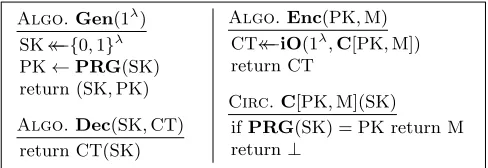
Public-key encryption. Following [GGSW13, BNPW16], we start by con-structing a simple public-key encryption scheme. The secret key of the scheme is a random seedsk∈ {0,1}λ and the corresponding public key isG(sk) whereG is a length-doubling pseudorandom generator (PRG). Encrypting a message M underpkconsists of obfuscating a circuit that takes as input somesk0∈ {0,1}λ, and checks ifG(sk0) =pk, in which case it outputs the message M, and ⊥ oth-erwise. To decrypt, a user runs the ciphertext (which is an obfuscated circuit) on input the secret keysk. Ifskcorresponds to the public key, the check passes and the message M is returned; the scheme is thus correct.
A similar idea was also used in [BZ14] to construct n-party non-interactive key-exchange: Intuitively, the setup outputs a public obfuscated program that allows to evaluate a hardwired PRF Fk on inputs x1, . . . , xn, s if and only if
xi = G(s) for some i for a PRG G. A group key is then obtained via each party publishing a PRG evaluation G(si) for a private seed si and running the obfuscated program on inputsG(s1), . . . , G(sn), si.
Security of our PKE follows from the security of the PRG, which ensures the public keyG(sk) is indistinguishable from a random bit string of the same length. Now, if pk is outside of the range of G, there is nosk0 for which G(sk0) =pk
and encryptions under pk are (obfuscated) circuits thatalways output ⊥. By the security of the obfuscator, this circuit reveals no more information than a circuit that is independent of the message and always returns⊥. This arguably very simple construction can also be shown to be anonymous, meaning that its ciphertexts do not reveal their intended recipients.
Due to its simplicity, we show that our construction can beefficiently instan-tiated based on the standard DDH assumption. In particular, we give a PRG and an indistinguishability obfuscator based on DDH, that when used within the construction result in an anonymous (and lossy) version of ElGamal.
Identity-based encryption.We now apply the idea to key-delegation mech-anism for IBEs. In our scheme the secret key of an identityid is the output of a pseudorandom functionF(K, id), whereKis the master secret key. The mas-ter public key is an obfuscated circuit that on input idoutputs its public key
pkid:=G(F(K, id)). Encryption and decryption workas in the PKE scheme. To prove the security of the scheme, similarly to our PKE, we need to switch the public key of the challenge identity id∗ from G(F(K, id∗)) to a random value. Intuitively, this should follow from the pseudorandomness of F. But the IBE game also contains an obfuscated circuit depending on the master key K, and furthermore key extraction for identities id 6= id∗ should be simulated. This restriction in the IBE security game precisely matches the functionality and security of puncturable PRFs: from K we can derive a punctured keyK∗
that allows evaluating the PRF everywhere except at id∗ and F(K, id∗) is
in-4
distinguishable from random even in the presence of K∗. (Such PRFs can be based on the GGM [GGM86] construction only assuming the existence of PRGs [BW13,BGI14,KPTZ13].) As for our PKE, since ciphertexts are indistinguish-able from obfuscations of a constant circuit, they hide both their underlying plaintexts and recipient identities, giving rise to an IBE that isanonymous and can therefore be used, for example, in the context of public-key encryption with keyword search [ABC+05].
We leave it as an interesting open problem to instantiate the IBE construction based on standard assumptions (as we did for PKEs via ElGamal). Doing so could shed further light on the construction of these primitives and conceptually clarify the rationale behind them through their lens of obfuscation.
Bounded HIBE. In an HIBE, identities take the form id= (id1, . . . , idi) and a key for (id1, . . . , idi) allows deriving keys for (id1, . . . , idi+1) for any idi+1. By recursively applying the PRF to identities along a path we arrive at a hierarchical key-delegation mechanism. Following the PKE construction, we can then convert this to an HIBE scheme as follows. Our scheme defines the master secret key as a random value sk0 =K, and sets the key forid1 to sk1 :=F(K, id1), that for (id1, id2) to sk2 := F(sk1, id2), and so on. We follow the encryption and decryption procedures of the PKE scheme to arrive at a full scheme. When the puncturable GGM PRF is used, it is easy to see how the puncturability of the PRF maps to the ability to extract keys for identities that are not parents of the challenge identity.
This HIBE only supports an a priori bounded number of levels. To prove se-curity, we need to replace the public key for the challenge identityid∗, computed as
pk∗=G(F(. . . F(F(K, id∗1), id∗2). . . , id∗n)),
by a random value. To this end, we first define a game where we change the master circuit (used to compute public keys) and hardwire all values that we will change later in the proof. In more detail, we replaceK byK∗punctured at
that accepts identities of arbitrary lengths and carries out the recursive PRF evaluation to derive its public key. Using the TM-obfuscator of Ishai, Pandey, and Sahai [IPS15], we could then obfuscate this TM. However, when using punc-turing, we still need tohardwire random values in the circuit in the proof, which would result in a TM whose description size is not a priori bounded. The prob-lem seems to stem from the fact that in order to replace key sk∗n corresponding to (id∗1, . . . , id∗n) with a random value, we first need to replaceall intermediate valuessk∗1:=F(K, id∗1),sk∗2:=F(sk∗1, id∗2), . . . with random.
While it is true that we can only replace a value sk∗i = F(sk∗i−1, id∗i) by random ifsk∗i−1 is already random (since the reduction would not knowsk∗i−1), the previous values do not have to be random for this specific game hop. Let Si⊆ {1, . . . , n}denote the set of indicesjfor whichsk∗jis random in hybridi. In the proof of the bounded HIBE, thei-th hybrid replacessk∗i by a random value, so we have Si :={1, . . . , i}. For the proof to go through, the sequence of sets S0,S1, . . . ,S`needs to have the following properties: (A)S0=∅andn∈ S`, and (B) every two consecutive sets differ in exactly one elementj, andj−1 belongs to both sets. SetS0with no random values corresponds to the original game and S` makes the last value corresponding to sk∗n random. To go from one hybrid to the next, we can replace an additional value by random, since its ancestor is already random (by property (B)).
Similarly to the pebbling strategy used in the context of reversible com-putation in [Ben89], Fuchsbauer et al. [FKPR14] give such a sequence where
` =nlog23 and with the property that |Si| ≤logn (this corresponds to a
peb-bling of a path in the GGM tree with logarithmically many pebbles). Lettingn
be an upper bound on the length of the challenge identity the adversary chooses (which is polynomial in the security parameterλ), we would have a polynomial number `of hybrids, while in each hybrid step we only need to hardwire a log-arithmic number of values. It seems that we can thus pad the actual scheme to support an exponential number of levels in the hierarchy.
Alas, this approach does not work: we also need to hardwire the positions
(id∗1, . . . , id∗n) of these values for which there is no upper bound. We therefore use a different approach andhashthe identities to obtain compact representations of them. We define the secret key foridasF(K, H(id)). The problem now is that hashing completely destroys the hierarchical relationship between the identities and we thus need to implement key delegation differently. We do this by adding a second functionality to the public parameters that given a valid secret keysk
for a identity idand a value id0 returns a secret key sk0 =F(K, H(id, id0)) for (id, id0).
Rather than relying on TM-obfuscators, which can be constructed from public-coin differing-input obfuscation (pc-diO) for circuits5 [IPS15], we devise
circuitsfor computing public keys and delegating secret keys so that we directly rely on pc-diO for circuits. One benefit of this approach is that any (natural) iO for circuits is conjecturally also a public-coin differing-input obfuscator for
5
circuits. Hence we avoid the overheads associated with the complex construc-tions of [IPS15]. Computing public keys can easily be done by defining a circuit
Cgen(h) that returnsG(F(K, h)) and to get a public key foridwe simply run
Cgen(H(id)).
The delegation circuitCdel, on the other hand, needs to ensure it only works for descendants. If we relied on pc-diO forTuring machines, we could defineCdel on input (sk, id, id0) to check whetherG(sk) =G(F(K, H(id))), and if so return
F(K, H(id, id0)). This results in a fairly simple construction of an unbounded HIBE (whoseproof is nevertheless somewhat involved). At the expense of slightly increasing the complexity of the scheme, we modify this construction so as to only rely on pc-diO for circuits (as discussed above). To do this, we require a user to compactly prove (to the circuit) that two hash values (h, h0) correspond to (id, id0) with h=H(id) andh0 =H(id, id0). For this we use a succinct non-interactive argument of knowledge (SNARK) system and defineCdel as follows: On input (sk, h, h0, π) the delegation circuit checks the validity of the proof π
for (h, h0), then checks thatG(sk) =G(F(K, h)), and if so returnsF(K, h0). To bound the number of hardwired values, our proof strategy follows the above ideas. For a set system S0, . . . ,S` satisfying properties (A) and (B), we define game Gi as one that replaces the valuespk∗j =G(F(K, H(id
∗
1, . . . , id
∗
j))) by random values for all j ∈ Si. That is, these values are hardwired into the circuitsCgenandCdel. Games G
iand Gi+1 differ in thatpk∗j is random in only one of them, withjdefined as{j}:=Si4 Si+1(where4denotes the symmetric difference). To show that these games are indistinguishable, we punctureK at
H(id∗1, . . . , id∗j) and use this K∗ in Cgen and Cdel. Since we can first hardwire
pk∗j, this does not change the behavior of Cgen, and thus we can rely on iO security.
The behavior ofCdel, on the other hand,doeschange, which is why we require (public-coin) differing-inputs obfuscation and must show that it is hard to actu-ally find a differing input. Suppose an adversary finds an input (sk, h, h0, π) for whichCdel behaves differently when using the punctured key. This meansh0=
H(id∗1, . . . , id∗j); but π (together with the collision-resistance of H) guarantees thath=H(id∗1, . . . , id∗j−1). By property (B) of our set system:j−1∈ Si; thus the valuepk∗j−1corresponding toG(F(K, H(id∗1, . . . , id∗j−1))), and thusG(F(K, h)), was replaced by random, and hence no skwill satisfy G(sk) =pk∗j−1. But this means thatCdel returns⊥, which contradicts (sk, h, h0, π) being a differing
in-put. Consistently, we requireH to be public-coin and collision-resistant [HR04] and the SNARK to be in the common-random-string model [IPS15].6
We observe that if identities are restricted to be of bounded length, the hash function can be replaced with the identity function, and the SNARK with a trivial one that simply outputs the witness. These in turn allow us to rely on iO (for circuits) in theCdel circuit.
6
Predicate encryption.Predicate encryption (PE) [BW07,KSW08] is a pow-erful type of public-key encryption that can support, for example, searching for complex queries on encrypted data and encompasses other forms of PKE such as attribute-based encryption [GPSW06,LOS+10]. A natural construction of a PE scheme also falls out from our techniques. Intuitively, we identify attributes with identities. A secret keyskP for a predicatePis then an obfuscated circuit with
K and Phardwired that on input an attribute γ outputs F(K, γ) if P(γ) = 1 and⊥otherwise. We defer the details of the construction to AppendixF. Complexity of circuits. All of our constructions except PKE obfuscate a puncturable PRF. Thus, the classes of circuits used in these constructions are potentially amenable to further simplifications. However, it is worth noting that the obfuscated circuits corresponding to a ciphertext in all of our constructions (specifically, a circuit that evaluates a PRG and possibly a puncturable PRF and outputs a message if the evaluation matches a certain value z) fall into the class of “compute-and-compare” functionalities. Unfortunately, in our case, the string z is a public (pseudorandom) string, while obfuscation of compute-and-compare programs from standard assumptions [WZ17, GKW17, CVW18] is, for now, only known when z is secret. Yet, these recent works show that certain classes of programs that appear non-trivial to obfuscate can actually be obfuscated under standard assumptions. This strengthens our belief that simpler constructions based on special-purpose obfuscation is an interesting direction to pursue.
We finally note that puncturing is only required in the proofs. Thus, it would be interesting to devise new PRFs that are easily obfuscatable even though neither puncturing them nor obfuscating their punctured evaluation procedures are efficient. For example, assuming one can obfuscate AES, we either obtain a secure AES-based IBE, or deduce that either AES cannot be punctured or its punctured circuit cannot be obfuscated.
1.3 Related works
Canetti, Rothblum, and Varia [CRV10] adopt a similar approach for building leakage-resilient one-time signatures by first constructing a special-purpose ob-fuscator for testing hyperplane membership. Similarly, Matsuda and Hanaoka [MH14] propose a construction of CCA-secure encryption based on rerandomiz-able and composrerandomiz-able point function obfuscators.
non-interactive commitment scheme implies (key-policy) attribute-based encryp-tion. In particular, their scheme does not guarantee privacy of the attributes, while our predicate encryption scheme does. Garg et al. [GGH+13] also show that full-fledged functional encryption is implied by iO and non-interactive zero-knowledge proofs (and hence so is predicate encryption). Our construction is conceptually simpler, avoids NIZKs, and relies on iO and one-way functions only.
A simple construction of a (semi-adaptive) functional encryption from indis-tinguishability obfuscation is also described in [Wat15], but it relies on the full power of obfuscation, since a functional secret key forf is an obfuscated circuit that evaluatesf (amongst other things). Our PE construction follows a different path and obfuscates constrained PRFs. Obfuscating the latter could imply the existence of iO that can be bootstrapped to full iO. Thus our PE construction should be seen as an alternative route to more expressive primitives.
Finally, Brakerski et al. in recent work [BCG+17] construct a hierarchical notion of functional encryption. This implies bounded HIBEs from LWE or low-complexity PRGs and public-key encryption (for their constant-depth and poly-nomially bounded width delegation structure), and a construction of unbounded HIBE based on unbounded-collusion functional encryption (which implies iO for P/poly assuming subexponential security). Their construction is fairly simple, which is not surprising as functional encryption is powerful enough to subsume IBEs. Since their construction relies on re-encryption techniques, it is inherently public-key. Our construction takes a very different route and relies on poten-tially weaker special-purpose obfuscation, while re-encryption techniques lead to indistinguishability obfuscation for any circuit supported by the underlying functional encryption scheme [BV15].
As we aim at using special-purpose obfuscation, we do not discuss recent advances in constructions and cryptanalysis of candidate general-purpose indis-tinguishability obfuscators and refer the reader to discussions in [AS17, LT17, CGH17,MZ17,ADGM17] for details.
Paper Organization.The rest of the paper is organized as follows. We present the main cryptographic tools used throughout the paper in Section2. Then we successively introduce our constructions of PKE, IBE, and unbounded HIBE in Sections 3,4, and 5 respectively. Additional cryptographic notions used locally as well as proofs and constructions of bounded HIBE and PE are detailed in the Appendix.
2
Preliminaries
Algo.Gen(1λ)
SK←←{0,1}λ PK←PRG(SK) return (SK,PK)
Algo.Dec(SK,CT)
return CT(SK)
Algo.Enc(PK,M) CT←←iO(1λ,C[PK,M]) return CT
Circ.C[PK,M](SK) ifPRG(SK) = PK return M return⊥
Fig. 1.Public-key encryption scheme from a PRG and an obfuscator.
its random coins. We will assume public-coin hash functions that are collision-resistant.
A puncturable pseudorandom function (PPRF) is a tuple (CPRF,Cons), whereCPRF(K,x) evaluates the PRF on inputx under key K. For a setS, let
C[S](x) denote the circuit that returns 1 iff x 6∈S. Algorithm Cons(K,C[S]) outputs aconstrainedkey KC[S]that allows evaluating the PRF anywhere except on setS. Given KC[S], PRF evaluations on points insideS should be indistin-guishable from uniform.
An obfuscator is an algorithmObf that on input a circuitCoutputs an ob-fuscated circuitC. Perfect correctness requires that for allC←←Obf(1λ,C) and allx ∈ {0,1}λ:C(x) =C(x). Indistinguishability obfuscation requires the out-puts of the obfuscator on twofunctionally equivalent(and equal-size) circuits to be indistinguishable. Public-coin differing-input obfuscation requires this same for circuits sampled from a public-coin distribution and for which it is hard to find an input on which the outputs of the circuits differ.
3
Public-Key Encryption
We start by presenting our simple PKE construction based on iO and a pseudo-random generator with sparse image. Our construction uses an obfuscator that only needs to support simple circuits. In particular, we show this class is simple enough to be instantiated based on the DDH assumption. We will prove the scheme IND-CPA as well as anonymous, meaning that ciphertexts do not reveal their intended recipients.
3.1 Construction
We now formalize our public-key encryption scheme, for which we have given a high-level description in the introduction. The details of the construction are shown in Figure1. The proof of the following theorem follows the ideas outlaid in the introduction and can be found in Appendix B.
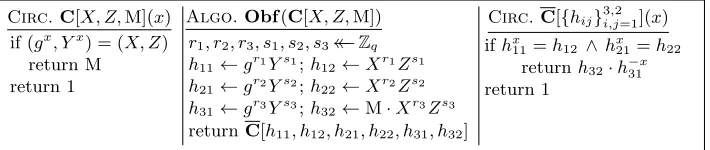
Circ.C[X, Z,M](x) if (gx, Yx) = (X, Z)
return M return 1
Algo.Obf(C[X, Z,M])
r1, r2, r3, s1, s2, s3←←Zq
h11←gr1Ys1;h12←Xr1Zs1
h21←gr2Ys2;h22←Xr2Zs2
h31←gr3Ys3;h32←M·Xr3Zs3
returnC[h11, h12, h21, h22, h31, h32]
Circ.C[{hij}3i,j,2=1](x)
ifhx11=h12 ∧ hx21=h22
returnh32·h−31x
return 1
Fig. 2. Left: Circuits that are obfuscated in encryption. Middle: An obfuscator for this class.Right: The obfuscated circuits.
anypptadversaryAagainstPKEthere arepptadversariesB1 andB2 against
PRGandObf, respectively, such that
Advai-cpaPKE,A(λ)≤2·AdvindPRG,B1(λ) +AdvindObf,B2(λ).
Algorithm B2 places the same number of queries to its (obfuscation) LR oracle asA does to its (encryption)LRoracle.
3.2 A DDH-based instantiation
In this section we show that the above construction can be instantiated under the standard DDH assumption. That is, we provide a DDH-based PRG and an indistinguishability obfuscator for the class of circuits used in the above con-struction. The resulting PKE scheme is defined over the message spaceG− {1} where we identify the element 1 with the error symbol⊥.
We now describe our construction, which is basically alossy version of the El-Gamal PKE scheme [ElG84], meaning that one can define lossy public keys, which are indistinguishable from regular ones, but for which ciphertexts statis-tically hide all information about their underlying plaintexts.
A DDH-based PRG.Let Gdenote a cyclic group of order q generated byg. The public parameters are (G, q, g, Y) with Y a random element in G∗. Algo-rithmPRG: Z∗q −→(G∗)2 is defined asPRG: x7→(gx, Yx). Under the DDH assumption, the outputs of PRG are computationally indistinguishable from uniformly random elements in (G∗)2. Plugging this into our PKE construction in Section3, secret keys take the formx∈Z∗
q and public keys PK = (gx, Yx). The circuit class. We next define an indistinguishability obfuscator for the class of circuitsC[PK,M] associated with the PRG above. This class consists of circuits defined in Figure 2 (left) for PK = (X, Z)∈(G∗)2
and M∈G∗, where we identify the identity group element 1 with the error symbol⊥.
(h11, h12) and (h21, h22) are encryptions of 1, which letCcheck whether (X, Z) is in the range ofPRG. If this is the case then the obfuscated circuit is functionally equivalent to C[X, Z,M]. However, if (X, Z) is not in the range ofPRG then
C[X, Z,M] always returns 1, whereas with negligible probability over the coins of Obf, for C there is one input on which it returns a different value (since
h11, h12, h21, h22 are uniformly random, the probability that there existsxwith
hx
11=h12 andhx21=h22 is negligible7).
Lemma 1. The obfuscator described in Figure 2 is an indistinguishability ob-fuscator with statistical correctness and statistical indistinguishability.
Consider an adversary outputting two functionally equivalent circuitsC[X, Z,M] andC[X0, Z0,M0]. Both of them always return 1 iff (X, Z) and (X0, Z0) are not in the range of PRG, in which case the obfuscator returns a random tuple (h11, h12, h21, h22, h31, h32). If X =gx and Z =Yx then C[X, Z,M] returns M on input x and 1 otherwise. ForC[X0, Z0,M0] to be functionally equivalent to
C[X, Z,M], we must thus have X0 =X, Z0 =Z and M0 = M. This shows the iO security of the obfuscator. A formal proof is given in AppendixC.
4
Identity-Based Encryption
We now present a simple construction of identity-based encryption, again based on an indistinguishability obfuscator and a pseudorandom generator. In addition, we will use a pseudorandom function, which we assume to be puncturable. We prove that our scheme is both IND-CPA secure and anonymous in the selective-ID model. Anonymity means that ciphertexts do not leak the identity of the intended recipients; a property that can be leveraged to construct public-key encryption with keyword search [ABC+05].
4.1 Construction
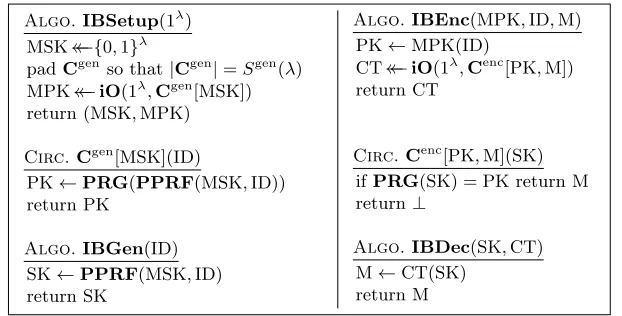
Our IBE construction generalizes the PKE scheme as follows. The master secret key MSK is a random PRF key. The secret key for user ID is simply the PRF evaluated at the identity, that is PRF(MSK,ID). The master public key MPK is an obfuscation of a circuit Cgen that computes a public key PKID for ID by computing PRG(PRF(MSK,ID)), as in our PKE scheme. Hence we use a PRF to “compress” exponentially many public keys into the master public key MPK (by generating their secret key using the PRF). A message is encrypted by first deriving PKID for the identity using MPK and then obfuscating the same circuit as the PKE scheme. Decryption is identical to the PKE. The details of the scheme are shown in Figure3(withSgen defined below).
In our security analysis we will rely on the puncturability of the PRF to sim-ulate key-extraction queries. That is, we use a PRF key punctured at{ID0,ID1} to derive keys for all other users. We will use the indistinguishability security of
7
Note that this is not the case if we only use one encryption of 1 (i.e. if we remove
Algo.IBSetup(1λ)
MSK←←{0,1}λ
padCgen so that|Cgen|=Sgen(λ) MPK←←iO(1λ,Cgen[MSK])
return (MSK,MPK)
Circ.Cgen[MSK](ID)
PK←PRG(PPRF(MSK,ID)) return PK
Algo.IBGen(ID)
SK←PPRF(MSK,ID) return SK
Algo.IBEnc(MPK,ID,M) PK←MPK(ID)
CT←←iO(1λ,Cenc[PK,M]) return CT
Circ.Cenc[PK,M](SK) ifPRG(SK) = PK return M return⊥
Algo.IBDec(SK,CT)
M←CT(SK) return M
Fig. 3.Identity-based encryption from a PRG, a puncturable PRF, and an iO.
the obfuscator in conjunction with this to form the master public key. Hence we need to pad the circuitCgenso that its size matches that of the modified circuit used in the proof. We defineSgen(λ) as (an upper bound on) the maximum size of circuits defined by
e
Cgen[K, r, x0, x1](x) :=
PRG(PPRF(Cons(K,C[{x0, x1}];r), x)) ifx6∈ {x0, x1}
PRG(PPRF(K, x0)) ifx=x0
PRG(PPRF(K, x1)) ifx=x1
Here the maximum is taken over (K, r, x0, x1)∈ {0,1}λ×{0,1}tCons(λ)×{0,1}m(λ) × {0,1}m(λ), wheret
Cons is the polynomial bounding the runtime ofCons. We recall thatCons denote the puncturing algorithm of the puncturable PRF.
Theorem 2. Scheme IBE in Figure 3 is Sel-AI-CPA secure if the underlying pseudorandom generator PRG, the puncturable pseudorandom functionPPRF, and the obfuscator Obf are secure. More precisely, for any ppt adversary A
against IBE there are ppt adversaries B1, B2, and B3 against PRG, PPRF, andObf respectively such that
Advsel-ai-cpaIBE,A (λ)≤2·AdvindObf,B
1(λ) +Adv
ind
PPRF,B2(λ) + 2·Adv
ind
PRG,B3(λ). AlgorithmB1places at most the same number of queries to its (obfuscation)LR
oracle thatA does to its (encryption)LR oracle.
The proof is detailed in AppendixD.
ID space. The ID space IDSpλ of the construction matches the input space {0,1}m(λ) of PPRF. An IBE with IDSp
with an indistinguishability obfuscator. However, such PRFs with unbounded domain cannot have compact punctured keys (as a punctured key information-theoretically determines the punctured point). This means that there is no a priori bound on the size of the circuitCegen used in the security proof in G1. We note, however, that the GGM PRF can be turned into a PRF with unbounded input length [Gol01], whose keys can be punctured in the same way as those of the original construction.
Adaptive security. We have established the selective security of the IBE based on the selective security of the puncturable PRF. This raises the question if the theorem naturally extends to the adaptive-ID model under the adaptive
security of the puncturable PRF. This turns out not to be the case: during the proof we need to puncture the MPK, which is given to the adversary at the onset. It is unclear at which point the underlying MSK should be punctured, even with a reduction down to the adaptive security of the PPRF. On the other hand, adaptive security can be obtained with a sub-exponential loss (on all underlying primitives) through complexity leveraging, or with only a polynomial loss in the random-oracle model. The recent work of Zhandry [Zha16] on extremely lossy functions (ELFs) proposes a generic selective-to-adaptive transformation for IBEs in the standard model that also results in a polynomial loss in security from asingleexponential assumption. This transformation can be also applied to our IBE and we obtain an adaptive IBE with only a polynomial loss in security.
4.2 Extensions to bounded HIBE and predicate encryption
Bounded HIBE. Our IBE construction generalizes that for PKEs by using a PRF, instead of a single secret corresponding to the PRG seed, to derive many secret keys. Similarly, we can further generalize the IBE construction to a hierarchal IBE by considering atree of (puncturable) PRFs (as in the GGM construction). The secret key for a vector of identities ID := (ID1, . . . ,IDn) cor-responds to the iterative PRF applications via SKi←PRF(SKi−1,IDi) where SK0 is the master secret key. We can then use the puncturing property of the PRF to replace, via a sequence of hybrids, the PRF value corresponding to any identity (ID1, . . . ,IDn) with random values one at a time. This then allows us to apply the PRG game hop (as for IBEs) at the leaf nodes to conclude the proof. We formalize this construction and prove its security in AppendixE. We refer the reader to the introduction for why this construction does not yield an unbounded HIBE.
constrained keys. Luckily, a natural construction of a constrained PRF from a puncturable PRF due Boneh and Waters [BW13] already enjoys this property. We formalize this construction and prove its security in AppendixF.
5
Unbounded HIBE
A hierarchal IBE (HIBE) [GS02] generalizes IBEs to a setting where a user with a secret key for identity ID can derive secret keys for child identities with prefix ID. In this section we present a construction of anunbounded HIBE, where key delegation can be carried out for an exponential number of prefixes.
As before, we use a PRG and a puncturable PRF. We however also rely on a public-coin differing-inputs obfuscator (pc-diO) forcircuits, an indistinguisha-bility obfuscator, a public-coin collision-resistant (pc-CR) hash function, and a SNARK proof system with a common random string.
Given a public-coin hash function H, we rely on SNARKs for the relation
Rel(1λ,(k, h
1, h2),(w1, w2)) that checks
|k|=λ ∧ H(k, w1) =h1 ∧ H(k, w1|w2) =h2 ∧ w26=ε
.
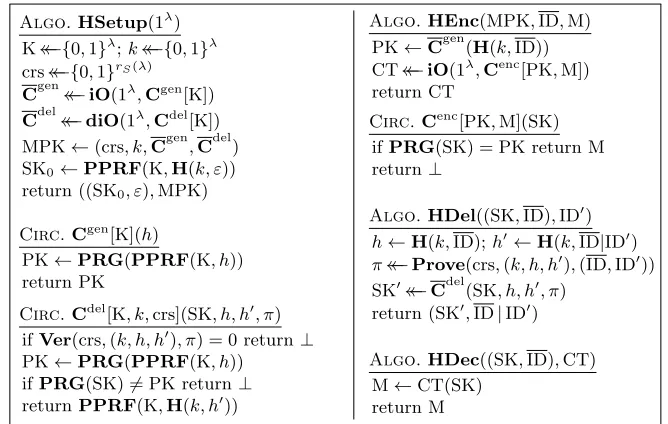
In our construction, the obfuscation of a delegation circuitCdel with a hard-wired master key will be made public. This circuit takes as input a user secret key SK, two hash valuesh0, h, and a SNARK proofπ. The circuit checks that the proof πverifies (and hence proves knowledge of ID,ID such that h=H(k,ID) and h0 =H(k,ID|ID)). This is done explicitly by computing apublic key forh
using the master key and checking if the result matches the one derived from SK. (Comparison with the public key rather than the secret key is needed as in the security proof we have to forget the SK at some point). If all checks pass, a secret key forh0 (i.e., the hash of child identity ID|ID) is returned. The other algorithms operate as in the IBE scheme on hashed identities. The details of the construction are shown in Figure4. As for our IBE construction in Figure3, we pad the circuitsCgen andCdel respectively to the maximum size of any circuit
e
Cgen and Cedel used in the proof (and argue that these sizes are polynomially
bounded).
Theorem 3. Scheme HIBE in Figure 4 is Sel-AI-CPA secure if PRG and
PPRF are secure, H is public-coin collision-resistant, the obfuscator iOis an indistinguishability obfuscation, and the obfuscatordiO is public-coin differing-input secure. More precisely, for anypptadversaryAagainstHIBEthere exist
ppt adversaries B1 against iO, diO-legitimate B2 against diO, B3 against H,
B4 against PPRFandB5 againstPRGsuch that
Advsel-ai-cpaHIBE,A (λ)≤(4p(λ) + 1)·AdvindiO,B1(λ) + 4p(λ)·AdvinddiO,B2(λ) + 4p(λ)·AdvcrH,B
3(λ) + 2p(λ)·Adv
ind
PPRF,B4(λ) + 2p(λ)·Adv
ind
Algo.HSetup(1λ) K←←{0,1}λ;k←←{0,1}λ crs←←{0,1}rS(λ)
Cgen←←iO(1λ,Cgen[K]) Cdel←←diO(1λ,Cdel[K])
MPK←(crs, k,Cgen,Cdel) SK0←PPRF(K,H(k, ε))
return ((SK0, ε),MPK)
Circ.Cgen[K](h)
PK←PRG(PPRF(K, h)) return PK
Circ.Cdel[K, k,crs](SK, h, h0, π) ifVer(crs,(k, h, h0), π) = 0 return⊥
PK←PRG(PPRF(K, h)) ifPRG(SK)6= PK return⊥
returnPPRF(K,H(k, h0))
Algo.HEnc(MPK,ID,M) PK←Cgen(H(k,ID)) CT←←iO(1λ,Cenc[PK,M])
return CT
Circ.Cenc[PK,M](SK) ifPRG(SK) = PK return M return⊥
Algo.HDel((SK,ID),ID0)
h←H(k,ID);h0←H(k,ID|ID0)
π←←Prove(crs,(k, h, h0),(ID,ID0)) SK0←←Cdel(SK, h, h0, π)
return (SK0,ID|ID0)
Algo.HDec((SK,ID),CT) M←CT(SK)
return M
Fig. 4. Unbounded HIBE from a PRG, a puncturable PRF, a pc-CR hash function and a pc-diO.
We refer the reader to the introduction for a high-level overview of the proof. The detailed proof of Theorem 3is provided in AppendixH.
Remark.Suppose we defineH(k,ID) := ID for allk,ID andProve(crs,(h, h0), w) :=w. Then there are no collisions forHand the SNARK proofs are perfectly extractable. This means that the diO adversary we constructed when showing that Gi,δ,1 and Gi,δ,2in the proof of Theorem3are indistinguishable is actually
iO-legitimate. It then suffices to use an indistinguishability obfuscator to obtain a bounded-depth HIBE from the above construction.
Acknowledgments Farshim was supported by the European Research Council under the European Community’s Seventh Framework Programme (FP7/2007-2013 Grant Agreement no. 339563 - CryptoCloud). Fuchsbauer was supported by the French ANR Project ANR-16-CE39-0002 EfTrEC. Passel`egue was supported in part from a DARPA/ARL SAFEWARE award, NSF Frontier Award 1413955, NSF grants 1619348, 1228984, 1136174, and 1065276, BSF grant 2012378, a Xerox Faculty Research Award, a Google Faculty Research Award, an equipment grant from Intel, and an Okawa Foundation Research Grant.
References
ABC+05. Michel Abdalla, Mihir Bellare, Dario Catalano, Eike Kiltz, Tadayoshi
relation to anonymous IBE, and extensions. In Victor Shoup, editor,
CRYPTO 2005, volume 3621 ofLNCS, pages 205–222. Springer, Heidel-berg, August 2005.
ADGM17. Daniel Apon, Nico D¨ottling, Sanjam Garg, and Pratyay Mukherjee. Crypt-analysis of indistinguishability obfuscations of circuits over GGH13. In Ioannis Chatzigiannakis, Piotr Indyk, Fabian Kuhn, and Anca Muscholl, editors,44th International Colloquium on Automata, Languages, and Pro-gramming, ICALP 2017, July 10-14, 2017, Warsaw, Poland, volume 80 of
LIPIcs, pages 38:1–38:16. Schloss Dagstuhl - Leibniz-Zentrum fuer Infor-matik, 2017.
AS16. Prabhanjan Vijendra Ananth and Amit Sahai. Functional encryption for turing machines. In Eyal Kushilevitz and Tal Malkin, editors,TCC 2016-A, Part I, volume 9562 of LNCS, pages 125–153. Springer, Heidelberg, January 2016.
AS17. Prabhanjan Ananth and Amit Sahai. Projective arithmetic functional encryption and indistinguishability obfuscation from degree-5 multilinear maps. In Jean-S´ebastien Coron and Jesper Buus Nielsen, editors,Advances in Cryptology - EUROCRYPT 2017 - 36th Annual International Confer-ence on the Theory and Applications of Cryptographic Techniques, Paris, France, April 30 - May 4, 2017, Proceedings, Part I, volume 10210 of Lec-ture Notes in Computer Science, pages 152–181, 2017.
BBDP01. Mihir Bellare, Alexandra Boldyreva, Anand Desai, and David Pointcheval. Key-privacy in public-key encryption. In Colin Boyd, editor, ASI-ACRYPT 2001, volume 2248 of LNCS, pages 566–582. Springer, Heidel-berg, December 2001.
BCG+17. Zvika Brakerski, Nishanth Chandran, Vipul Goyal, Aayush Jain, Amit Sa-hai, and Gil Segev. Hierarchical functional encryption. InProceedings of the 2017 ACM Conference on Innovations in Theoretical Computer Sci-ence, Berkeley, CA, USA, January 9-11, 2017, 2017.
Ben89. Charles H. Bennett. Time/space trade-offs for reversible computation.
SIAM J. Comput., 18(4):766–776, 1989.
BGI+12. Boaz Barak, Oded Goldreich, Russell Impagliazzo, Steven Rudich, Amit Sahai, Salil Vadhan, and Ke Yang. On the (im)possibility of obfuscating programs. J. ACM, 59(2):6:1–6:48, May 2012.
BGI14. Elette Boyle, Shafi Goldwasser, and Ioana Ivan. Functional signatures and pseudorandom functions. In Hugo Krawczyk, editor, PKC 2014, volume 8383 ofLNCS, pages 501–519. Springer, Heidelberg, March 2014.
BLR+15. Dan Boneh, Kevin Lewi, Mariana Raykova, Amit Sahai, Mark Zhandry,
and Joe Zimmerman. Semantically secure order-revealing encryption: Multi-input functional encryption without obfuscation. In Elisabeth Os-wald and Marc Fischlin, editors,EUROCRYPT 2015, Part II, volume 9057 ofLNCS, pages 563–594. Springer, Heidelberg, April 2015.
BNPW16. Nir Bitansky, Ryo Nishimaki, Alain Passel`egue, and Daniel Wichs. From cryptomania to obfustopia through secret-key functional encryption. In Martin Hirt and Adam D. Smith, editors,TCC 2016-B, Part II, volume 9986 ofLNCS, pages 391–418. Springer, Heidelberg, October / November 2016.
BSW16. Mihir Bellare, Igors Stepanovs, and Brent Waters. New negative results on differing-inputs obfuscation. In Marc Fischlin and Jean-S´ebastien Coron, editors,EUROCRYPT 2016, Part II, volume 9666 ofLNCS, pages 792– 821. Springer, Heidelberg, May 2016.
BV15. Nir Bitansky and Vinod Vaikuntanathan. Indistinguishability obfuscation from functional encryption. In Venkatesan Guruswami, editor,56th FOCS, pages 171–190. IEEE Computer Society Press, October 2015.
BW07. Dan Boneh and Brent Waters. Conjunctive, subset, and range queries on encrypted data. In Salil P. Vadhan, editor, TCC 2007, volume 4392 of
LNCS, pages 535–554. Springer, Heidelberg, February 2007.
BW13. Dan Boneh and Brent Waters. Constrained pseudorandom functions and their applications. In Kazue Sako and Palash Sarkar, editors, ASI-ACRYPT 2013, Part II, volume 8270 of LNCS, pages 280–300. Springer, Heidelberg, December 2013.
BZ14. Dan Boneh and Mark Zhandry. Multiparty key exchange, efficient traitor tracing, and more from indistinguishability obfuscation. In Juan A. Garay and Rosario Gennaro, editors, CRYPTO 2014, Part I, volume 8616 of
LNCS, pages 480–499. Springer, Heidelberg, August 2014.
CGH17. Yilei Chen, Craig Gentry, and Shai Halevi. Cryptanalyses of candidate branching program obfuscators. In Jean-S´ebastien Coron and Jesper Buus Nielsen, editors,Advances in Cryptology - EUROCRYPT 2017 - 36th An-nual International Conference on the Theory and Applications of Crypto-graphic Techniques, Paris, France, April 30 - May 4, 2017, Proceedings, Part III, volume 10212 ofLecture Notes in Computer Science, pages 278– 307, 2017.
CLP15. Kai-Min Chung, Huijia Lin, and Rafael Pass. Constant-round concurrent zero-knowledge from indistinguishability obfuscation. In Rosario Gennaro and Matthew J. B. Robshaw, editors,CRYPTO 2015, Part I, volume 9215 ofLNCS, pages 287–307. Springer, Heidelberg, August 2015.
CLTV15. Ran Canetti, Huijia Lin, Stefano Tessaro, and Vinod Vaikuntanathan. Ob-fuscation of probabilistic circuits and applications. In Yevgeniy Dodis and Jesper Buus Nielsen, editors,TCC 2015, Part II, volume 9015 ofLNCS, pages 468–497. Springer, Heidelberg, March 2015.
CRV10. Ran Canetti, Guy N. Rothblum, and Mayank Varia. Obfuscation of hyper-plane membership. In Daniele Micciancio, editor,TCC 2010, volume 5978 ofLNCS, pages 72–89. Springer, Heidelberg, February 2010.
CVW18. Yilei Chen, Vinod Vaikuntanathan, and Hoeteck Wee. Ggh15 beyond permutation branching programs: Proofs, attacks, and candidates. IACR Cryptology ePrint Archive, 2018:360, 2018.
ElG84. Taher ElGamal. A public key cryptosystem and a signature scheme based on discrete logarithms. In G. R. Blakley and David Chaum, editors,
CRYPTO’84, volume 196 ofLNCS, pages 10–18. Springer, Heidelberg, Au-gust 1984.
FKPR14. Georg Fuchsbauer, Momchil Konstantinov, Krzysztof Pietrzak, and Van-ishree Rao. Adaptive security of constrained PRFs. In Palash Sarkar and Tetsu Iwata, editors,ASIACRYPT 2014, Part II, volume 8874 ofLNCS, pages 82–101. Springer, Heidelberg, December 2014.
GGHW14. Sanjam Garg, Craig Gentry, Shai Halevi, and Daniel Wichs. On the implau-sibility of differing-inputs obfuscation and extractable witness encryption with auxiliary input. In Juan A. Garay and Rosario Gennaro, editors,
CRYPTO 2014, Part I, volume 8616 ofLNCS, pages 518–535. Springer, Heidelberg, August 2014.
GGM86. Oded Goldreich, Shafi Goldwasser, and Silvio Micali. How to construct random functions.Journal of the ACM, 33(4):792–807, October 1986. GGSW13. Sanjam Garg, Craig Gentry, Amit Sahai, and Brent Waters. Witness
en-cryption and its applications. In Dan Boneh, Tim Roughgarden, and Joan Feigenbaum, editors,45th ACM STOC, pages 467–476. ACM Press, June 2013.
GKW17. Rishab Goyal, Venkata Koppula, and Brent Waters. Lockable obfuscation. In Umans [Uma17], pages 612–621.
Gol01. Oded Goldreich. Foundations of Cryptography: Basic Tools, volume 1. Cambridge University Press, Cambridge, UK, 2001.
GPSW06. Vipul Goyal, Omkant Pandey, Amit Sahai, and Brent Waters. Attribute-based encryption for fine-grained access control of encrypted data. In Ari Juels, Rebecca N. Wright, and Sabrina De Capitani di Vimercati, editors,
ACM CCS 06, pages 89–98. ACM Press, October / November 2006. Avail-able as Cryptology ePrint Archive Report 2006/309.
GS02. Craig Gentry and Alice Silverberg. Hierarchical ID-based cryptography. In Yuliang Zheng, editor,ASIACRYPT 2002, volume 2501 of LNCS, pages 548–566. Springer, Heidelberg, December 2002.
GVW15. Sergey Gorbunov, Vinod Vaikuntanathan, and Hoeteck Wee. Predicate encryption for circuits from LWE. In Rosario Gennaro and Matthew J. B. Robshaw, editors, CRYPTO 2015, Part II, volume 9216 of LNCS, pages 503–523. Springer, Heidelberg, August 2015.
HR04. Chun-Yuan Hsiao and Leonid Reyzin. Finding collisions on a public road, or do secure hash functions need secret coins? In Matthew Franklin, editor,
CRYPTO 2004, volume 3152 ofLNCS, pages 92–105. Springer, Heidelberg, August 2004.
HSW14. Susan Hohenberger, Amit Sahai, and Brent Waters. Replacing a random oracle: Full domain hash from indistinguishability obfuscation. In Phong Q. Nguyen and Elisabeth Oswald, editors,EUROCRYPT 2014, volume 8441 ofLNCS, pages 201–220. Springer, Heidelberg, May 2014.
HW15. Pavel Hubacek and Daniel Wichs. On the communication complexity of secure function evaluation with long output. In Tim Roughgarden, editor,
ITCS 2015, pages 163–172. ACM, January 2015.
IPS15. Yuval Ishai, Omkant Pandey, and Amit Sahai. Public-coin differing-inputs obfuscation and its applications. In Yevgeniy Dodis and Jesper Buus Nielsen, editors, TCC 2015, Part II, volume 9015 of LNCS, pages 668– 697. Springer, Heidelberg, March 2015.
KPTZ13. Aggelos Kiayias, Stavros Papadopoulos, Nikos Triandopoulos, and Thomas Zacharias. Delegatable pseudorandom functions and applications. In Ahmad-Reza Sadeghi, Virgil D. Gligor, and Moti Yung, editors,ACM CCS 13, pages 669–684. ACM Press, November 2013.
Lin16. Huijia Lin. Indistinguishability obfuscation from constant-degree graded encoding schemes. In Marc Fischlin and Jean-S´ebastien Coron, editors,
EUROCRYPT 2016, Part I, volume 9665 ofLNCS, pages 28–57. Springer, Heidelberg, May 2016.
LOS+10. Allison B. Lewko, Tatsuaki Okamoto, Amit Sahai, Katsuyuki Takashima,
and Brent Waters. Fully secure functional encryption: Attribute-based encryption and (hierarchical) inner product encryption. In Henri Gilbert, editor,EUROCRYPT 2010, volume 6110 ofLNCS, pages 62–91. Springer, Heidelberg, May 2010.
LT17. Huijia Lin and Stefano Tessaro. Indistinguishability obfuscation from trilin-ear maps and block-wise local prgs. In Jonathan Katz and Hovav Shacham, editors, Advances in Cryptology - CRYPTO 2017 - 37th Annual Inter-national Cryptology Conference, Santa Barbara, CA, USA, August 20-24, 2017, Proceedings, Part I, volume 10401 of Lecture Notes in Computer Science, pages 630–660. Springer, 2017.
LW11. Allison B. Lewko and Brent Waters. Unbounded HIBE and attribute-based encryption. In Kenneth G. Paterson, editor,EUROCRYPT 2011, volume 6632 ofLNCS, pages 547–567. Springer, Heidelberg, May 2011.
MH14. Takahiro Matsuda and Goichiro Hanaoka. Chosen ciphertext security via point obfuscation. In Yehuda Lindell, editor,TCC 2014, volume 8349 of
LNCS, pages 95–120. Springer, Heidelberg, February 2014.
MZ17. Fermi Ma and Mark Zhandry. New multilinear maps from CLT13 with provable security against zeroizing attacks. IACR Cryptology ePrint Archive, 2017:946, 2017.
NY90. Moni Naor and Moti Yung. Public-key cryptosystems provably secure against chosen ciphertext attacks. In22nd ACM STOC, pages 427–437. ACM Press, May 1990.
PPS15. Omkant Pandey, Manoj Prabhakaran, and Amit Sahai. Obfuscation-based non-black-box simulation and four message concurrent zero knowledge for NP. In Yevgeniy Dodis and Jesper Buus Nielsen, editors,TCC 2015, Part II, volume 9015 ofLNCS, pages 638–667. Springer, Heidelberg, March 2015. SBC+07. Elaine Shi, John Bethencourt, Hubert T.-H. Chan, Dawn Xiaodong Song, and Adrian Perrig. Multi-dimensional range query over encrypted data. In2007 IEEE Symposium on Security and Privacy, pages 350–364. IEEE Computer Society Press, May 2007.
SW14. Amit Sahai and Brent Waters. How to use indistinguishability obfuscation: deniable encryption, and more. In David B. Shmoys, editor, 46th ACM STOC, pages 475–484. ACM Press, May / June 2014.
Uma17. Chris Umans, editor. 58th IEEE Annual Symposium on Foundations of Computer Science, FOCS 2017, Berkeley, CA, USA, October 15-17, 2017. IEEE Computer Society, 2017.
Wat15. Brent Waters. A punctured programming approach to adaptively secure functional encryption. In Rosario Gennaro and Matthew J. B. Robshaw, editors,CRYPTO 2015, Part II, volume 9216 of LNCS, pages 678–697. Springer, Heidelberg, August 2015.
WZ17. Daniel Wichs and Giorgos Zirdelis. Obfuscating compute-and-compare pro-grams under LWE. In Umans [Uma17], pages 600–611.
A
Definitions
Here we define the different notions involved in this paper. We first define the basic tools that are common to all our constructions, and then the more specific notions.
A.1 Basic tools
We introduce basic cryptographic primitives that we use as tools throughout the paper. In particular, we recall the notions of pseudorandom generator, con-strained (and puncturable) pseudorandom functions, and indistinguishability ob-fuscation. Definitions of various public-key primitives are deferred to the corre-sponding subsections.
GameINDAPRG(λ):
b←←{0,1};x←←{0,1}λ
y←←{0,1}λ+s(λ)
ifb= 1,y←PRG(x)
b0←← A(1λ,y) return (b0=b) PRG.A pseudorandom generator is a deterministic
algorithmPRG(x) that takes as input anx ∈ {0,1}λ and outputs a string y ∈ {0,1}λ+s(λ) for a (positive) polynomials(·). We sayPRGis secure if for allpptA
AdvindPRG,A(λ) := 2·Pr
INDAPRG(λ)
−1∈Negl.
Constrained PRFs. A constrained pseudorandom function (C-PRF) for a boolean circuit family CSp := {CSpλ}λ∈N, where each C ∈ CSpλ has input space{0,1}m(λ)for a polynomialm(·), is a tuple of algorithms (CPRF,Cons) as follows. Algorithm CPRF(K,x) is deterministic and on input a key K ∈ {0,1}λ and x ∈ {0,1}m(λ) outputs a string y ∈ {0,1}n(λ) for a polynomial
n(·). Algorithm Cons(K,C) takes a key K and a boolean circuit C ∈ CSpλ
and outputs a constrained key KC. We require that for any K ∈ {0,1}λ, any
C∈CSpλ and anyx ∈ {0,1}m(λ)
C(x) = 1 =⇒ CPRF(K,x) =CPRF(Cons(K,C),x).
We say that CPRF is a secure constrained PRF if for allpptA
AdvindCPRF,A(λ) := 2·Pr
INDACPRF(λ)
−1∈Negl,
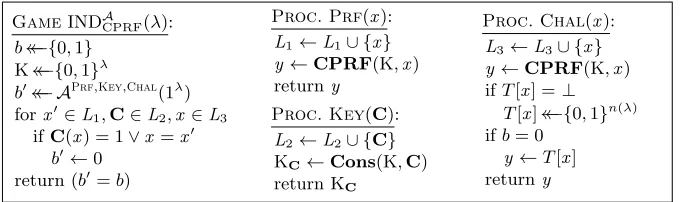
where game INDACPRF(λ) is shown in Figure 5.8 We say a constrained PRF is selectively secure ifChalis queried at the onset and beforePrfand Key. Puncturable PRFs. A puncturable pseudorandom function (PPRF) for a family of sets SSp := {SSpλ}λ∈N, where SSpλ is a set of polynomial-size sets (i.e., a set system), is a constrained PRF that supports the circuit familyCSp:= {CSpλ}λ∈NwhereCSpλ consists of all circuits of the formC[S](x) forS ∈SSpλ
8 For simplicity, tableT in Figure5is formally defined as a table of size 2m(λ) which
GameINDACPRF(λ):
b←←{0,1}
K←←{0,1}λ
b0←← APrf,Key,Chal(1λ ) forx0∈L1,C∈L2,x ∈L3
ifC(x) = 1∨x =x0
b0←0 return (b0=b)
Proc. Prf(x):
L1←L1∪ {x}
y←CPRF(K,x) returny
Proc. Key(C):
L2←L2∪ {C}
KC←Cons(K,C)
return KC
Proc. Chal(x):
L3←L3∪ {x}
y←CPRF(K,x) ifT[x] =⊥
T[x]←←{0,1}n(λ)
ifb= 0
y←T[x] returny
Fig. 5.Security of a constrained PRF.
that return 1 iffx 6∈S. The class of circuits consisting of singleton setsSSpλ:= {{x} : x∈ {0,1}m(λ)} correspond to singly puncturable PRFs and those con-sisting ofSSpλ:={{x1, x2}:x1, x2∈ {0,1}m(λ)} to doubly puncturable PRFs. In this work, we will rely on selectively secure singly and doubly puncturable PRFs. Such puncturable PRFs can be based on a PRG via the GGM construc-tion [BW13,BGI14,KPTZ13].
GameCRAH(λ): k←←{0,1}λ (x0, x1)←← A(1λ,k)
return (x06=x1∧
H(k, x0) =H(k, x1))
Public-coin hashing.A public-coin hash function with key space {0,1}λ and message space {0,1}∗ is
an algorithm H(k,x) that takes a key k ∈ {0,1}λ and an input x ∈ {0,1}∗ and outputs a string y ∈
{0,1}n(λ) for some polynomial n(·). The public-coin hash function is collision resistant if for allpptA
AdvcrH,A(λ) := Pr
CRAH(λ)
∈Negl.
Obfuscators. A ppt algorithm Obf is called an obfuscator for the (deter-ministic) circuit classCSp:={CSpλ}λ∈N, where eachC∈CSpλhas input space {0,1}λ, ifObfon input the security parameter 1λand the description of a circuit
C ∈CSpλ outputs a (deterministic) circuit C. We require Obf to be perfectly correct in the sense that for allλ∈N, all C∈CSpλ, all C←←Obf(1λ,C) and allx ∈ {0,1}λ we have thatC(x) =C(x).
In order to formalize security, we say an adversaryAisdiO-legitimateif for every pptextractor E we have
AdveqObf,A,E(λ) := Pr
EQEObf,A(λ)
∈Negl,
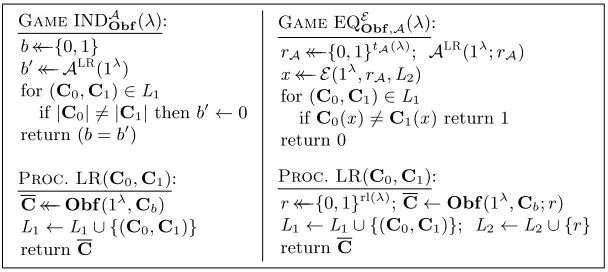
where game EQEA(λ) is shown in Figure6(right). AlgorithmAis said to be iO-legitimate if the same holds for everyunbounded extractorE.9An obfuscatorObf is a public-coin differing-input obfuscator if any diO-legitimatepptadversaryA we have
AdvindObf,A(λ) := 2·Pr
INDAObf(λ)
−1∈Negl, 9
GameINDAObf(λ):
b←←{0,1}
b0←← ALR(1λ) for (C0,C1)∈L1
if|C0| 6=|C1|thenb0←0
return (b=b0)
Proc. LR(C0,C1):
C←←Obf(1λ,Cb)
L1←L1∪ {(C0,C1)}
returnC
GameEQEObf,A(λ):
rA←←{0,1}tA(λ); ALR(1λ;rA) x←← E(1λ, r
A,L2)
for (C0,C1)∈L1
ifC0(x)6=C1(x) return 1
return 0
Proc. LR(C0,C1):
r←←{0,1}rl(λ)
;C←Obf(1λ,Cb;r)
L1←L1∪ {(C0,C1)}; L2←L2∪ {r}
returnC
Fig. 6. Left: Indistinguishability game for an obfuscator. Right: The functional-equivalence game. Here tA denotes a polynomial upper-bounding the runtime of A
and rl(·) denotes the length of the random input ofObf.
where game INDAObf(λ) givesAaccess to a left/right (LR) oracle and is shown in Figure 6. We denote such an obfuscator by diO. An obfuscator Obf is an indistinguishability obfuscator ifAdvindObf,A(λ) is negligible for any iO-legitimate pptadversaryA. We denote such an obfuscator byiO.
GameDDHAG(λ):
(G, q, g)←← G(1λ)
b←←{0,1}
Y, Z←←G∗;x←←Z∗q;X←gx
T0←Yx;T1←Z
b0←← A(G, q, g, X, Y, Tb) return (b=b0)
The DDH assumption.LetG(1λ) be a group generation algorithm that outputs the descrip-tion of a cyclic group G of order q generated byg. LetG∗:=G\ {1}. The decisional Diffie– Hellman (DDH) assumption forGrequires that for anypptadversaryA,
AdvddhG,A(λ) := 2·Pr
DDHAG(λ)
−1∈Negl.
A.2 Public-key encryption
A public-key encryption (PKE) scheme for message space MSp:= {MSpλ}λ∈N
is a tuple ofpptalgorithms PKE := (Gen,Enc,Dec).
Gen(1λ): This is the key-generation algorithm, which outputs a key pair (SK,PK).
Enc(PK,M): This is the encryption algorithm, which on input a public key PK and a message M outputs a ciphertext CT.
Dec(SK,CT): This is the deterministic decryption algorithm, which on input a secret key SK and a ciphertext CT outputs a message M or the error symbol⊥.
The correctness of a PKE scheme requires that for anyλ∈N, any (SK,PK)←←
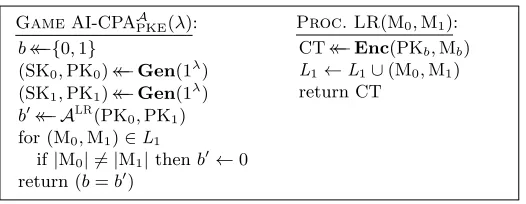
Gen(1λ), any M∈MSpλ, and CT←←Enc(PK,M) we haveDec(SK,CT) = M. The anonymous and indistinguishable security of a PKE scheme under chosen-plaintext attacks (AI-CPA) [BBDP01] requires that for anypptadversaryA,
Advai-cpaPKE,A(λ) := 2·Pr
AI-CPAAPKE(λ)
GameAI-CPAAPKE(λ):
b←←{0,1}
(SK0,PK0)←←Gen(1λ)
(SK1,PK1)←←Gen(1λ)
b0←← ALR(PK 0,PK1)
for (M0,M1)∈L1
if|M0| 6=|M1|thenb0←0
return (b=b0)
Proc. LR(M0,M1):
CT←←Enc(PKb,Mb)
L1←L1∪(M0,M1)
return CT
Fig. 7.The AI-CPA security of a PKE scheme.
where game AI-CPAAPKE(λ) is shown in Figure7. Besides anonymity, this defini-tion implies the standard IND-CPA definidefini-tion. To see this note that by AI-CPA security, Enc(PK0,M0) is indistinguishable from Enc(PK1,M1). Furthermore
Enc(PK1,M1) is also indistinguishable from Enc(PK0,M1) as the adversary can set M1 = M0. Combining the two we get that Enc(PK0,M0) is indistin-guishable fromEnc(PK0,M1), as required.
A.3 Identity-based encryption
An identity-based encryption (IBE) scheme for message spaceMSp:={MSpλ}λ∈N
and identity space IDSp := {IDSpλ}λ∈N is a tuple of ppt algorithms IBE :=
(IBSetup,IBEnc,IBGen,IBDec) as follows:
IBSetup(1λ): This is the master key generation which outputs a key pair (MSK,MPK).
IBGen(MSK,ID): This is the key-generation algorithm, which on input a mas-ter secret key MSK and an identity ID outputs a (user) key SK.
IBEnc(MPK,ID,M): This is the encryption algorithm, which on input a master public key MPK, an identity ID, and a message M outputs a ciphertext CT.
IBDec(SK,CT): This is the deterministic decryption algorithm that on input an SK and a ciphertext CT outputs a message M or the error symbol⊥.
Correctness requires that for any λ ∈ N, any (MSK,MPK)←←IBSetup(1λ), any ID∈IDSpλ, any SK←←IBGen(MSK,ID), any M∈MSpλ and any CT←←
IBEnc(MPK,ID,M), we have thatIBDec(SK,CT) = M.
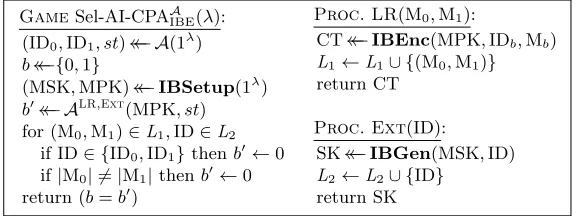
The selective anonymous and indistinguishable security of IBE under chosen-plaintext attacks [ABC+05] (Sel-AI-CPA) requires that for any
pptadversaryA,
Advsel-ai-cpaIBE,A (λ) := 2·PrSel-AI-CPAAIBE(λ)−1∈Negl,
GameSel-AI-CPAAIBE(λ):
(ID0,ID1, st)←← A(1λ)
b←←{0,1}
(MSK,MPK)←←IBSetup(1λ)
b0←← ALR,Ext(MPK, st)
for (M0,M1)∈L1,ID∈L2
if ID∈ {ID0,ID1}thenb0←0
if|M0| 6=|M1|thenb0←0
return (b=b0)
Proc. LR(M0,M1):
CT←←IBEnc(MPK,IDb,Mb)
L1←L1∪ {(M0,M1)}
return CT
Proc. Ext(ID):
SK←←IBGen(MSK,ID)
L2←L2∪ {ID}
return SK
Fig. 8.Selective AI-CPA security of an IBE scheme.
A.4 Hierarchical IBE
Hierarchical IBE.In HIBE schemes, identities are of the form ID = (ID1, . . . , IDn) ∈ IDSpnλ for some n ∈ N. For m ≤n we write ID[m] for (ID1, . . . ,IDm). An (unbounded) HIBE scheme for message space MSp:={MSpλ}λ∈N, identity
spaceIDSp:={IDSpλ}λ∈Nand depthd(·) is a tuple of pptalgorithms HIBE :=
(HSetup,HEnc,HDel,HDec) as follows.
HSetup(1λ): The master key-generation algorithm outputs a pair (SK0,MPK).
HEnc(MPK,ID,M): The encryption algorithm, on input a master public key MPK, a vector of identities ID and a message M, outputs a ciphertext CT.
HDel(SK,ID): The delegation algorithm, on input a secret key SK and an iden-tity ID, outputs a (user) key SK0.
HDec(SK,CT): The deterministic decryption algorithm, on input a secret key SK and a ciphertext CT, outputs a message M or the error symbol⊥.
We require correctness of the HIBE scheme: For any λ ∈ N, d := d(λ), any (SK0,MPK)←←HSetup(1λ), any M∈MSpλ, any ID = (ID1, . . . ,IDd)∈IDSpdλ, any CT←←HEnc(MPK,ID,M), any SKi←←HDel(SKi−1,IDi) for i= 1, . . . , d we have thatHDec(SKd,CT) = M. We call an HIBEboundedif correctness (and security; see below) hold for a polynomiald(λ). We call the HIBEunbounded if this holds ford(λ) = 2λ.
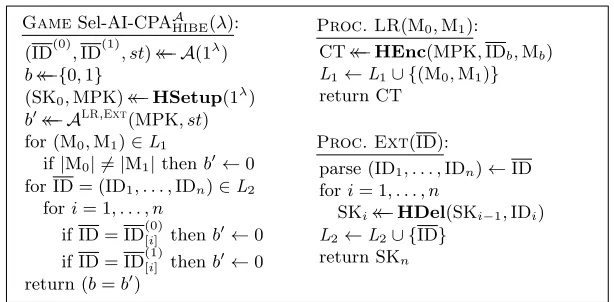
The Sel-AI-CPA security of HIBE requires that for any legitimate ppt adver-saryA,
Advsel-ai-cpaHIBE,A (λ) := 2·Pr
Sel-AI-CPAAHIBE(λ)
−1∈Negl,
GameSel-AI-CPAAHIBE(λ):
(ID(0),ID(1), st)←← A(1λ)
b←←{0,1}
(SK0,MPK)←←HSetup(1λ)
b0←← ALR,Ext(MPK, st)
for (M0,M1)∈L1
if|M0| 6=|M1|thenb0←0
for ID = (ID1, . . . ,IDn)∈L2 fori= 1, . . . , n
if ID = ID(0)[i] thenb 0
←0 if ID = ID(1)[i] thenb
0←
0 return (b=b0)
Proc. LR(M0,M1):
CT←←HEnc(MPK,IDb,Mb)
L1←L1∪ {(M0,M1)}
return CT
Proc. Ext(ID):
parse (ID1, . . . ,IDn)←ID fori= 1, . . . , n
SKi←←HDel(SKi−1,IDi)
L2←L2∪ {ID}
return SKn
Fig. 9.The selective AI-CPA security of a (possibility unbounded) HIBE scheme.
GameExtESNARKA ,A(λ):
crs←←{0,1}pS(λ);r←←{0,1}pA(λ)
(η, π)← A(crs;r);w←← EA(1λ,crs, r)
return (Ver(crs, η, π) = 1∧Rel(1λ, η, w) = 0)
Fig. 10.The extraction game for a SNARK.
A.5 SNARKs
Relations. A relation Rel(1λ, η, w) is a ppt Turing machine in the length of its inputs (rather than the security parameter) which on input the security parameter, a statement η ∈ {0,1}∗, and a witness w ∈ {0,1}∗ outputs 0 or 1.
We sayη∈Relλ if there existsw∈ {0,1}∗ such thatRel(1λ, η, w) = 1.
SNARKs. A succinct non-interactive argument of knowledge (SNARK) is a non-interactive proof-of-knowledge system whose proofs lengths and verification time are independent of the witness size and only bounded by an a priori fixed polynomial in the statement length. Formally a SNARK for a relation Relis a pair ofpptalgorithms (Prove,Ver) such thatProve(crs, η, w) outputs a proof
π andVer(crs, η, π) outputs 0 or 1. We call the SNARK complete (or correct) if for any λ ∈ N, any (η, w) with Rel(1λ, η, w) = 1, any crs←←{0,1}pS(λ) and
any π←←Prove(crs, η, w) we have thatVer(crs, η, π) = 1. We call the SNARK
succinct if there exist polynomials p(·), l(·) and q(·) such that for any λ∈ N, any crs←←{0,1}pS(λ), any (η, w)∈ {0,1}∗× {0,1}∗ withRel(1λ, η, w) = 1, and
anyπ←←Prove(crs, η, w) we have that|π| ≤l(λ+|η|),Prove(crs, η, w) runs in timeq(λ+|η|), andVer(crs, η, π) runs in timep(λ+|η|).
We call the SNARK (adaptively)extractable if for any pptA there exists a ppt extractor EA such that AdvextSNARK,A,EA(λ) := Pr
ExtEA
SNARK,A(λ)
∈
GameSel- W AI-CPAAPE(λ):
(γ0, γ1, st)←← A(1λ); b←←{0,1}
(MSK,MPK)←←PSetup(1λ)
b0←← ALR,Ext(MPK, st)
for (M0,M1)∈L1,P∈L2
if|M0| 6=|M1|thenb0←0
ifP(γ0)6=P(γ1) thenb0←0
ifP(γ0)6= 0∨P(γ1)6= 0 thenb0←0
return (b=b0)
Proc. LR(M0,M1):
CT←←PEnc(MPK,(γb,Mb))
L1←L1∪(M0,M1)
return CT
Proc. Ext(P): SK←←PGen(MSK,P)
L2←L2∪P return SK
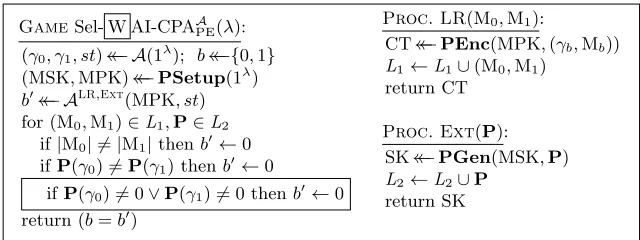
Fig. 11. The Sel- W AI-CPA security of a predicate encryption scheme. The Sel-WAI-CPA game includes the boxed statement.
A.6 Predicate encryption
A predicate encryption (PE) scheme for message space MSp := {MSpλ}λ∈N
and predicate space PSp := {PSpλ}λ∈N is a tuple of ppt algorithms PE :=
(PSetup,PGen,PEnc,PDec) as follows:
PSetup(1λ): The master key-generation algorithm outputs a pair (MSK,MPK).
PGen(MSK,P): The key-generation algorithm, on input a master secret key MSK and a boolean circuit (predicate)P, outputs a key SK.
PEnc(PK, γ,M): The encryption algorithm, on input a master public key MPK, an attributeγ and a message M, outputs a ciphertext CT.
PDec(SK,CT): The deterministic decryption algorithm, on input an SK and a ciphertext CT, outputs a message M or the error symbol⊥.
The correctness of a PE scheme requires that for anyλ∈N, any (MSK,MPK)←←
PGen(1λ), anyP∈PSpλ and any SK←←PGen(MSK,P), any M∈MSpλ, any
γ ∈ ASpλ, and any CT←←PEnc(MPK, γ,M), we have that if P(γ) = 1 then
PDec(SK,CT) = M.
In an attribute-hiding PE scheme, on top of plaintexts, the ciphertexts should not reveal the attributes used in encryption. Formally, the selective attribute-hiding (Sel-AI-CPA) security of an PE scheme requires that for anypptA,
Advsel-ai-cpaPE,A (λ) := 2·Pr
Sel-AI-CPAAPE(λ)
−1∈Negl,
where game Sel-AI-CPAAPE(λ) is shown in Figure11. We define the selective and
weakattribute-hiding security similarly through game Sel-WAI-CPA that is also shown in Figure 11. In this game the adversary is restricted to only query keys for predicates that evaluate to 0 on the challenge attributes.
B
Proof of Theorem
1
G0: This is the AI-CPA game with respect to PKE in Figure 1. By definition we have
2·Pr[GA0]−1 =Advai-cpaPKE,A(λ).
G1: This game replaces PK0 with a truly random bit string of length{0,1}2λ. We justify this transition based on the security of PRG. LetAbe any adver-sary that distinguishes G0 from G1. Consider the following PRG adversaryB. AlgorithmB receives a challenge PRG value y, sets PK0:=y, generates a key pair (SK1,PK1), picks a random bitb, and runsA(PK0,PK1). WhenAqueries LRon (M0,M1) algorithmBuses PKb to encrypt Mb and obtains a ciphertext CT, which it sends toA. WhenAoutputs a bitb0, algorithmBreturns (b=b0). Wheny is a PRG output,Ais run with respect to G0; wheny is truly random, A is run with respect to G1. Furthermore, B outputs a bit that matches the output of G0 or G1when run withA. Hence
Pr[GA0]−Pr[GA1]≤AdvindPRG,B(λ).
G2: This game replaces PK1 with a truly random bit string of length{0,1}2λ. Using a virtually identical reduction to that in G1 for PK1we get that for any Adistinguishing G1 from G2 there is an adversaryBsuch that
Pr[GA1]−Pr[GA2]≤AdvindPRG,B(λ).
G3: This game generates the challenge ciphertexts by obfuscating C[PK0,M0] (irrespective of the bitb).
We justify this transition based on the security of Obf as follows. Suppose an adversaryAdistinguishes game G2from G3. Consider adversaryBagainstObf as follows. AdversaryB generates two randomy0,y1←←{0,1}2λ, sets PKi :=yi, fori= 0,1, and runsA(PK0,PK1) (as in G2).Bpicks a random bitband when-everAqueries itsLRon two messages (M0,M1), it queries its own (obfuscation) LR oracle on (C[PKb,Mb],C[PK0,M0]) and receives an obfuscated circuit CT, which it sends to A. When A terminates outputting a bitb0, algorithmB2 re-turns (b =b0). It is clear that according to the challenge bit in the obfuscation game algorithm B runs Aaccording to either game G2 or G3. Furthermore, B outputs a bit that matches the output of G2 or G3 when run withA. Hence
Pr[GA2]−Pr[GA3]≤AdvindObf,B(λ).
It remains to show that the circuitsC[PKb,Mb] andC[PK0,M0] thatB queries to its obfuscation LR oracle are functionally equivalent and of the same size. Since PK0 and PK1 are truly random bit strings of length 2λ, for each value of SK andb we have that Pr[PRG(SK) = PKb] = 1/22λ. Hence by the union bound
Pr[∃SK∈ {0,1}λ, b∈ {0,1}:PRG(SK) = PK