IoT based Forest Surveillance
Priya.G.Kapse
1, Laxmikant Shevada
2P.G. Student, Department of Electronics and Telecommunication Engineering, Deogiri Institute of Engineering &
Management Studies, Aurangabad, Maharashtra, India1
Associate Professor, Department of Electronics and Telecommunication Engineering, Deogiri Institute of Engineering
& Management Studies, Aurangabad, Maharashtra, India2
ABSTRACT: IoT is one of the dominant position all over the world in technological development. It is another information industry following computer, Internet and mobile communication. In Internet of Things technology the fire-fighting, fire monitoring and safety management system are an important applications[1]. Forest play very important role in the nature cycle so it is necessary to protect it in each and possible way. Arduino platform based IoT enabled fire detector and monitoring system is the solution to this problem. In this project, we have built fire detector using Arduino Uno which is interfaced with a ultrasonic sensor, LDR, humidity/ temperature sensor DHT11, a smoke sensor, Accelerometer sensor and buzzer. The temperature sensor senses the heat and smoke sensor senses any smoke generated due to burning or fire. Buzzer connected to Arduino gives us an alarm indication. Whenever fire triggered, it burns objects nearby and produces smoke. A fire alarm can also be triggered due to small smoke from candlelight or oil lamps used in a household. Also, whenever heat intensity is high then also the alarm goes on. Buzzer or alarm is turned off whenever the temperature goes to normal room temperature and smoke level reduces. We have also interfaced LCD display to the Arduino board with the help of IoT technology, we have tried to make it smarter by connecting the whole monitoring process to the webpage naming created by the PHP tool and controlled by the Arduino programming done in the software- Arduino . Arduino fire monitoring system serves for industrial purpose as well as for household purpose. Whenever it detects fire or smoke then it instantly alerts the user about the fire through the ethernet module. For this purpose, we are using Arduino Uno which is from Arduino family. Also, the Arduino interfacing with LCD display is done to display the status of the system whether the Smoke and Overheat is detected or not. And Arduino interfacing with Ethernet module is done so that user get to know about the prevailing condition message. It intimates the user about the fire detection. This system is really useful whenever the user is not in the proximity of control centre. Whenever a fire occurs, the system automatically senses and alerts the user by sending an alert to an app installed on user's Android mobile or webpage accessible through internet.
KEYWORDS:Forest, ARDUINO, SENSORS, IoT.
and commercial companies or even individuals have to recognize the importance of the resources contained in the forest environment - not only from the perspective of the biodiversity, but also from the point of view of the economic resources which forests enclose. Therefore, any major threat posed to this essential component of the environment should be identified, studied and fought through the most efficient and modern economic policies and technological means. One of the most dangerous phenomena, which jeopardize forests, is represented by forest fires.[3]
II. LITERATURE SURVEY
Forest Survey of India (FSI) is an organization under the Ministry of Environment & Forests, Government of India Its principal mandate is to conduct survey and assessment of forest resources in the country. It started as an organization called Pre- Investment Survey of Forest Resources (PISFR) in 1965 as FAO/UNDP/GOI Project. The changing information needs resulted in enlarging the scope of activities of PISFR and it was re- organized as Forest Survey of India in 1981. Forest fires are a regular phenomenon in our country often observed during the fire season. A number of 37,059 fires were detected in year 2018 using MODIS (Moderate Resolution Imaging Spectro -radiometer) sensor data. Every year large areas of forests are affected by fires of varying intensity and extent. Based on the forest inventory records, 54.40% of forests in India are exposed to occasional fires, 7.49% to moderately frequent fires and 2.405 to high incidence levels while 35.71% of India’s forests have not yet been exposed to fires of any real significance. Precious forest resources including carbon locked in the biomass is lost due to forest fires every year, which adversely impact the flow of goods and services from forests. Satellite based remote sensing technology and GIS tools have been effective in better prevention and management of fires through creation of early warning for fire prone areas, monitoring fires on real time basis and estimation of burnt scars. Satellite based remote sensing technology and GIS tools have been effective in better prevention and management of fires through creation of early warning for fire prone areas, monitoring fires on real time basis and estimation of burnt scars.[3]
III. SYSTEM DEVELOPMENT
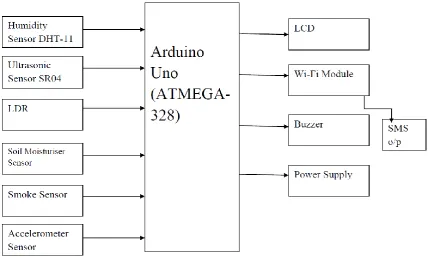
1) Hardware Component.
ARDUINO UNO MICROCONTROLLER
Wi-Fi MODULE
HUMIDITY ANDTEMPRATURE SENSOR
LCD(16*2)
BUZZER
LDR
ULTRASONIC RANGE SENSOR
SOIL MOISTURISER SENSOR
SMOKE SENSOR
ACCELEROMETER SENSOR
1) Sensors Functions:-
i) LDR.
A light dependent resistor, or LDR, varies resistance in a circuit based on how much light shines on it. When fully illuminated, the LDR has no resistance and current flows freely, but with darkness the resistance increases and current flow stops. In most circuit designs, the LDR acts like an on/off switch based on how much light shines on it.
Fig.b.LDR sensor. ii) DHT11.
DHT11 is a Humidity and Temperature Sensor, which generates calibrated digital output. DHT11 can be interface with any microcontroller like Arduino, Raspberry Pi, etc. and get instantaneous results.
iii) Ultrasonic sensor.
Fig.d. Ultrasonic Sensor.
An ultrasonic sensor is an instrument that measures the distance to an object using ultrasonic sound waves. An ultrasonic sensor uses a transducer to send and receive ultrasonic pulses that relay back information about an object’s proximity. High-frequency sound waves reflect from boundaries to produce distinct echo patternsi
iv) Soil moisture.
v) Smoke sensor.
Fig.f. Smoke sensor
The smoke sensor has a built-in potentiometer that allows you to adjust the sensor sensitivity according to how accurate you want to detect gas.
Sensors used in system such as temperature sensor and smoke sensor are employed that need to be placed at certain distances so that a look can be kept on the entire forest area in order to detect the ignition alarming temperature and the level of carbon di oxide or carbon mono oxide gas. These sensors will send the signal or the information to the microcontroller. These will all sense changes in the environment and react automatically in the event of an emergency. New innovations in automatic initiating devices use cameras and computer algorithms to analyse visible effects of fire and movement in ways that other detection devices can't. Number of fire sensors are to be employed in practical situation that are needed to be placed at certain distances so that a look can be kept on the entire forest area.
2) IC and Arduino interfacing:-The IC ATMega 328( microcontroller) embedded in arduino platform present in thetransmitter circuit receive the data sensed and collected by the temperature sensor and gas sensor and other given sensors.Then, the controller performs the programmed action to it and pass them to the transmitter for transmitting the data to the receiving station.
3) Display of output on SMS and webpage:-
Apart from the above, an alarm circuit has been made just to facilitate the fire security team to locate the vulnerable part as soon as possible. This fire alarm circuit will give alarm when any activity happens corresponding to the given sensors.
IV. PERFORMANCE ANALYSIS
Sensors Rang Values Fault Detection
1 DHT11 Temp:- 0-40C Humidity:- 0-90Rh Greater or equal to 40C
2 Ultrasonic 0-20cm Greater or equal to 20cm
3 LDR 80 adc Greater or equal to 80 adc
4 Soil Moisture 10 adc Greater or equal to 10 adc
5 Smoke 0-450ppm Greater or equal to 450ppm
V. CONCLUSION
In this work the system is designed and evaluated for its effectiveness as well as scalability due to the improvement of sensor technology In this work, the latest technology can help to reduce catastrophic accidents caused due to fire. With the improvement of IoT sensor technology, the system is more efficient and useful. Quick and reliable detection and localization of fire are important goals of forest surveillance. It is much easier to suppress a fire when the starting location is known, and while it is in its early stages. Information about the progress of fire is also highly valuable for managing the fire during all its stages. Based on this information, the fire fighting staff can be guided on target to block the fire before it reaches cultural heritage sites and to suppress it quickly by utilizing the required fire fighting equipment and vehicles.
V. FUTURE SCOPE
4.1.The monitoring and detection techniques used by fire authorities are as follows:- i) Weather forecast and estimation of fuel moisture.
ii) Watch towers. iii) Spotter Planes. iv) Use of water tankers.
v) Education through fire watch or similar schemes for house owners.
vi) Video-camera, sensitive to visible spectrum of smoke recognizable during the day and a fire recognizable at night.
REFERENCES
[1] An Inconvenient Truth Directed by Davis Guggenheim about former United States Vice President Al Gore's campaign [Document ary]Los Angeles, NY, USA.
[2] Mathews, S., Ellis, P., Hurle, J.H.Evaluatuion of Three Systems 2010 Australia Bushfire Cooperative Research Centre.
[3] Priya G.Kapse, Laxmikant Shevada, "Parametric Analysis of Forest Surveillance using IoT,'' International Journal of Innovative Research in Computer and Communication Engineering, Vol. 7, Issue 6, June 2019
[4] http://www.fsi.nic.in/brief-history
[5] International Journal of Pure and Applied Mathematics Volume 119 No. 12 2018, 16295-16304.
[6] Fernández-Berni J, Carmona-Galán R, Carranza-González L (2008) A vision-based monitoring system for very early automatic detection of forest fires. In ‗First Int. Conf. on Modeling, Monitoring and Management of Forest Fires.
[7] International Journal of Current Trends in Engineering and Research (IJCTER) Volune-03, Issue-05.
[8] Zanella, N. Bui, A. Castellani, L.Vangelista, and M. Zorzi, “Internet of Things for Smart Cities,” IEEE Internet of Things, vol. 1, no. 1, pp. 22– 32, 2014.