Clinical Interventions in Aging
Dove
press
R e v I e w
open access to scientific and medical research
Open Access Full Text Article
Successful aging: considering non-biomedical
constructs
Lisa F Carver1
Diane Buchanan2
1Department of Sociology, Queen’s
University Kingston, ON, Canada;
2School of Nursing, Queen’s
University Kingston, ON, Canada
Objectives: Successful aging continues to be applied in a variety of contexts and is defined using a number of different constructs. Although previous reviews highlight the multidimen-sionality of successful aging, a few have focused exclusively on non-biomedical factors, as was done here.
Methods: This scoping review searched Ovid Medline database for peer-reviewed English-language articles published between 2006 and 2015, offering a model of successful aging and involving research with older adults.
Results: Seventy-two articles were reviewed. Thirty-five articles met the inclusion criteria. Common non-biomedical constructs associated with successful aging included engagement, optimism and/or positive attitude, resilience, spirituality and/or religiosity, self-efficacy and/or self-esteem, and gerotranscendence.
Discussion: Successful aging is a complex process best described using a multidimensional model. Given that the majority of elders will experience illness and/or disease during the life course, public health initiatives that promote successful aging need to employ non-biomedical constructs, facilitating the inclusion of elders living with disease and/or disability.
Keywords: successful aging, resilience, gerotranscendence, engagement, optimism
Introduction
Aging is a journey over time. Although it could be argued that we begin to age the moment we are born, generally awareness of aging is triggered by the first signs of weak-ness, serious illweak-ness, or the death of an elderly loved one.1 Some changes will have been
easy; others painful and challenging. Given that life expectancy is increasing,2 there are
a large number of people seeking to integrate their life experiences and come to terms with the inevitability of death. Understanding older adults’ beliefs about successful aging can be a valuable tool for the provision of support to elders engaged in this pro-cess and for the creation of public health interventions.3 This scoping review examines
the factors involved in successful aging. It did not review articles that were concerned with similar constructs, such as healthy aging or aging well, since they “struggle with similar conceptual and methodological limitations”4 without the benefit of the decades
of research that exists for successful aging. Successful aging was first conceptualized as the circumstance in which an older person or elder experiences life satisfaction.5
However, research has long since abandoned life satisfaction as the criterion for suc-cessful aging and replaced it with a biomedical model,6 as shown in several reviews
of the literature. For example, Depp and Jeste7 reviewed 28 articles describing large
quantitative studies on successful aging published from 1978 to 2005 and discovered that 90% of the models used were at least in part biomedical. Similarly, Cosco et al8
Correspondence: Lisa F Carver Department of Sociology, D410 Mackintosh-Corry, Queen’s University Kingston, ON K7L 3N6, Canada email [email protected]
Journal name: Clinical Interventions in Aging Article Designation: Review
Year: 2016 Volume: 11
Running head verso: Carver and Buchanan
Running head recto: Successful aging: non-biomedical constructs DOI: http://dx.doi.org/10.2147/CIA.S117202
Clinical Interventions in Aging downloaded from https://www.dovepress.com/ by 118.70.13.36 on 20-Aug-2020
For personal use only.
Number of times this article has been viewed
This article was published in the following Dove Press journal: Clinical Interventions in Aging
Dovepress
Carver and Buchanan
reviewed 84 articles published between 1979 and 2011, in which 92% included biomedical factors. Non-biomedical constructs found in these reviews included positive psycho-logical traits such as resilience, optimism, sense of purpose, positive attitude toward aging,7 engagement, life
satisfac-tion, and external factors, such as finances.8 Depression was
negatively correlated with successful aging.9
In the biomedical model, successful aging requires that the elder is disease free, disease-related disability free and engaged in activities with family and/or community.6,10
This biomedical model of successful aging is discrimina-tory, excluding the majority of elders. For example, in one study, only 11% of Americans were aging successfully using biomedical criteria.11 Similar results were found in
a European research where 8.5% of Europeans were suc-cessfully aging.12 Why does the presence of illness preclude
successful aging?13–15 Many elders living with illness perceive
themselves as aging successfully.16–18
Is it really efficacious to assess successful aging using a biomedical model and create policies around the results if they only apply to a small portion of those aging and exclude the majority of the population? The goal of this article was to review the non-biomedical constructs used in recent suc-cessful aging qualitative and quantitative research and to identify non-biological constructs that could be used in a model of successful aging that would include all elders, even those living with illness.
Methods
Search strategy
A scoping review19 of recent successful aging literature
published between 2006 and 2015 was performed. Scoping studies “aim to map rapidly the key concepts underpinning a research area and the main sources and types of evidence available”.8 Ovid Medline database was used for the search.
The MEDLINE(R) database includes research from ~4,600 international journals in fields such as medicine, nursing,
dentistry, veterinary medicine, allied health, and pre-clinical sciences from 1950 to the present. Since we were interested in articles written about successful aging that included a specific model, the search terms used were “successful aging” AND “model”. The search was restricted to peer-reviewed English-language articles that offered a model or, at mini-mum, an operational definition of successful aging. To be included, the articles had to involve research with adults 40 years and older. Potentially relevant articles from the reference lists of identified publications were used if they met the inclusion criteria. All titles and abstracts from the search strategy were reviewed for eligibility. Reference lists were also examined for relevant articles. Components of successful aging were identified and categorized.
Inclusion criteria
The participants were human beings and older adults, the article was published in the English language between 2006 and 2015, successful aging was the central topic of the article, and a model or operational definition was provided.
exclusion criteria
Articles that discussed successful aging exclusively with regard to a physiological process (eg, allostatic load), phe-notypes and/or gephe-notypes, a particular disease (eg, athero-sclerosis), and a single component (eg, good cognition, diet, obesity or physical exercise) were excluded. Articles were also excluded if, despite having the term successful aging in the title, there was no discussion of successful aging in the body of the article or no definition of successful aging.
Results
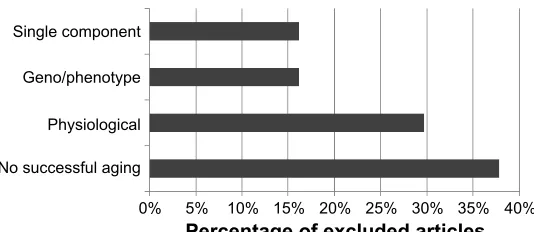
Seventy-two articles resulted from this search. Abstracts were reviewed, and 35 articles met the inclusion criteria. Thirty-seven articles were excluded according to the exclu-sion criteria; the subject matter of excluded articles is shown in Figure 1.
6LQJOHFRPSRQHQW
*HQRSKHQRW\SH
3K\VLRORJLFDO
1RVXFFHVVIXODJLQJ
3HUFHQWDJHRIH[FOXGHGDUWLFOHV
Figure 1Subject of excluded articles.
Clinical Interventions in Aging downloaded from https://www.dovepress.com/ by 118.70.13.36 on 20-Aug-2020
Dovepress Successful aging: non-biomedical constructs
Fifty-four percent of the retained articles were quantitative studies, 37% were qualitative studies, and 9% were mixed methods design. The majority of articles (63%) involved participants aged 60 years or older. Twenty-nine percent of articles included participants aged 50 years or older. Six per-cent of studies included participants older than 70 years. One article included participants who were 40 years and older. The oldest participants included were 90–100 years old.
All the articles reviewed employed multidimensional models of successful aging. For the majority of the articles reviewed (71%), successful aging was synonymous with being physically healthy or disability free. Other common biomedical components employed to describe success-ful aging were mental health (43%) and cognitive func-tion (32%). Thirty-seven percent of the included articles employed a version of the biomedical MacArthur model created by Rowe and Kahn6,10 which includes: 1) a low
probability of disease and disease-related disability; 2) high cognitive and physical functional capacity (no problems with activities of daily living); and 3) active engagement with life (measured by an individual’s interpersonal rela-tions and participation in productive activity, not including time spent in solitary activity). The majority of these articles added non-biomedical constructs to Rowe and Kahn’s bio-medical model.
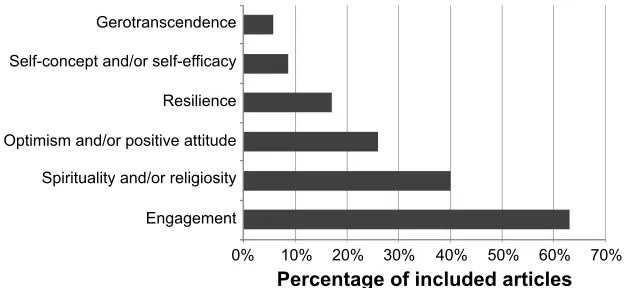
Non-biomedical constructs used in the included articles are reviewed and shown in Figure 2. Similar constructs, although not identical, are discussed together under a single heading (eg, social engagement, social support, and social contact are all discussed under the heading “engagement”). Some of the articles included constructs that could also be considered outcome measures (eg, self-rated success-ful aging, well-being, life satisfaction) in their successsuccess-ful aging models. These constructs were not categorized as non-biomedical constructs here. Health protective behaviors
(eg, non-smoking, frequent exercise) were also excluded from this discussion.
Non-biomedical constructs of successful
aging
Non-biomedical constructs associated with successful aging included engagement,12,20–32 optimism and/or positive
attitude,33–36 resilience (including coping),37–40 self-efficacy
and/or self-esteem,41–43 and gerotranscendence.44,45
Spiritual-ity and/or religiosSpiritual-ity were included as an important factor in more than one-third of articles,14,26,43,46–49 but not necessarily
in the models of successful aging.
engagement
Engagement was the most frequently used construct. Sixty-three percent of articles reviewed included engage-ment in their successful aging models (Figure 2). In the articles reviewed, engagement was expressed as active engagement,20–22 caring engagement (CE) and productive
engagement (PE),23 and social activity dimensions.12,31
Active engagement was defined as including ,35 hours per week in solitary activities (eg, video gaming, reading), community membership, and volunteering.20 In the study
by Weir et al,20 the majority (83%) of the 14,749
partici-pants, elders older than 60 years, had one or more chronic conditions and therefore could not be classified as success-ful agers within the constraints of the biomedical model. However, 69% were actively engaged in life. Using a bivari-ate logistic regression analysis, they found that increased age was significantly related to engagement with life. In fact, participants who were between 70 and 74 years were more engaged than those between 60 and 64 years (odds ratio 0.92, 95% confidence interval 0.916–0.933). Weir et al20 suggest
that it is important to note the changes in engagement over the lifespan.
Self-concept and/or self-efficacy
Optimism and/or positive attitude Gerotranscendence
Resilience
Spirituality and/or religiosity
Engagement
0% 10%
Percentage of included articles20% 30% 40% 50% 60% 70%
Figure 2 Components of successful aging articles included in scoping review.
Clinical Interventions in Aging downloaded from https://www.dovepress.com/ by 118.70.13.36 on 20-Aug-2020
Dovepress
Carver and Buchanan
CE and PE is defined as support given to significant others (eg, friends, family), and PE is represented by activities that contributed to others (individuals such as family, organiza-tions such as workplace or the community). In one study, results among 2,120 participants indicated that the means on CE (η=0.383, P,0.001) and PE (η=0.343, P,0.001) were predictive of successful and unsuccessful aging.23
Social activity was the third conceptualization of engage-ment used to explain successful aging. The social activity/ engagement dimension was defined as involving participation in volunteer work and/or care in the form of babysitting grand-children or interaction in the last month with family, spouse, or community.12 Using data combined from 14 European
countries and Israel, Hank12 used a logistic model to
exam-ine successful aging and found a weak relationship between engaged and physically healthy elders (R2=0.05). Overall,
using the biomedical criteria, successful aging was found in only 8.5% of the 21,493 participants. Hank12 concluded that
there was a lack of engagement among a large number of older adults with good health.
Community engagement is another component of suc-cessful aging. Qualitative studies among Alaska Natives found that successful aging was defined by participants as achieving a respected role in one’s community.22 Unsuccessful
aging was defined as low activity, alcohol consumption, and loss of faith in oneself.21 Younger participants believed that
their current physical health was a predictor of the ability to age successfully, whereas elders linked successful aging to the ability to maintain mental health and participate within their community.21
In the majority of the reviewed articles, engagement seemed to have a significant association with age,20 and in
some cases, could be used to discriminate between those aging successfully and those who were not.21–23 Some
participants indicated that engagement was the expression of a decision to maintain involvement in activities and with others, despite the challenges of health crises.29 In
one study, engagement and physical health were weakly correlated,12 suggesting that physical health may not
be a good predictor of successful aging within a non-biomedical model.
Optimism and/or positive attitude
Optimism and positive attitude are similar psychological char-acteristics that involve the expectation that events will resolve with the best possible outcome.50 In 26% of the articles,
optimism and/or positive attitude were proposed as important constructs in the understanding of successful aging.
Optimism and positive attitude have been associated with life satisfaction and have similar effects on individuals irrespective of socioeconomic status or physical health.51
Optimism and positive attitude can be integral in the transi-tion from poor health to better, possibly because they are believed to support resilience.36 The presence of optimism
and positive attitude is associated with the ability to man-age later life adversity36 and is integral to the experience of
successful aging.14
Resilience
A number of researchers have proposed that successful aging requires psychological resources to enable individu-als to adapt in the face of the challenges created by illness, loss of loved ones, and changes in functional ability.39,40,52
Resilience is a psychological resource that facilitates adap-tation and is associated with characteristics of successful aging.39,40 As shown in Figure 2, 17% of the articles included
here employed resilience as a component of their successful aging model.
Resilience was significantly correlated with the compo-nents of successful aging, including well-being (r=0.494,
P,0.001), optimism (r=0.438, P,0.001), self-rated suc-cessful aging (r=0.425, P,0.001), and to a lesser extent, physical function (r=0.116, P,0.001).39 In a sample of
older adults, many of whom were living with illness, older age was associated with higher self-rated health.52 In this
research, resilience, depression, and physical health had similar impacts on successful aging.52
Resilience is not just a psychological trait; it can also be considered as a process. Resilience as a process is a compensatory response to adversity or risk. Aging brings many forms of adversity, including potential loss of loved ones, illness, and decline in functional abilities. In this study,40
qualitative interviews with two individuals were used to explore resilience and successful aging among older adults living with dementia, a major source of adversity. The results indicated that resilience can be present among people living with dementia and that they can live meaningful lives. Harris40
suggests that there is an:
‘Ordinary magic’ of human beings present within us, regard-less of age, the resilience of the human spirit, the human capacity to adapt and survive in the face of adversity
Rather than considering successful aging as a consequence of perfect health, it could be considered a reflection, at least in part, of resilience in the face of the adversity that life presents – a far more obtainable goal for most older adults.
Clinical Interventions in Aging downloaded from https://www.dovepress.com/ by 118.70.13.36 on 20-Aug-2020
Dovepress Successful aging: non-biomedical constructs
In the reviewed articles, successful agers exhibited resilience in the presence of physical and mental health challenges.53 Higher resilience among those living with
illness was associated with successful aging levels similar to those of healthy adults.52 It must be noted that resilience
in older adults does not apply to life in a unified manner and may be manifested in some areas of life and not others.40
These associations between resilience and successful aging suggest that it is a valuable predictive construct and useful to be included in successful aging models.39,52
Spirituality and/or religiosity
In this context, spirituality can include, but is not limited to, religious activities and experiences such as serenity, appreciation of life, and altruistic activities;14
encompass-ing meanencompass-ingful interactions with a supreme beencompass-ing, art, culture, nature, family, and/or animals. Spirituality is not constrained by institutions or formal rituals. Religiosity is “used to describe a formal system of worship that is based on social interaction with others who share similar beliefs”.54 As a broad construct, spirituality and/or
religi-osity and/or religion were hypothesized to be important aspects of successful aging in 40% of the articles, but only a few researchers included them in their successful aging model.14,15
Spirituality, defined as including religious/spiritual activ-ity and motivation,15 was significantly correlated with
demo-graphic variables, including education, income, marital status, and ethnicity. Spirituality was also significantly correlated with the Connor–Davidson Scale for Resilience score55 (ρ=0.282,
P,0.001), Life Events Scale score (ρ=0.118, P,0.001), and Life Orientation Test score (ρ=0.106, P,0.001).15 Spirituality
was not significantly correlated with age (ρ=0.005, P=0.840), depression (ρ=-0.018, P=0.4768), physical health (ρ=0.036,
P=0.128), mental health (ρ=0.042, P=0.071), or self-rated successful aging (ρ=0.064, P=0.499).15
Religion can be considered intrinsic (eg, religion is for personal comfort) and extrinsic (eg, religion provides membership in a social group).51 Extrinsic religiosity
sig-nificantly correlated with well-being (r=-0.34, P,0.01), health (r=-0.31, P,0.05), and education (r=-0.27,
P,0.05).54 Intrinsic religiosity significantly correlated with
age (r=0.28, P,0.05), education (r=-0.28, P,0.05), and internal religiosity (r=0.57, P,0.01).54
Weak associations have been found, in some cases, between spirituality and/or religiosity and hypothesized components of successful aging,43,48,54 suggesting that
although spirituality and/or religiosity may be important for
some elders,47 this construct is not necessarily predictive of
successful aging when included in a model.
Self-efficacy and/or self-esteem
Self-esteem, self-efficacy, interpersonal relationships, and self-achievement have been shown to contribute to a significant predictive model (F=159.09, P,0.001), explain-ing 69% of the variance in successful agexplain-ing.51 Self-esteem
had the greatest influence in the model (β=0.38, standard error (SE) =0.06, P,0.001), followed by self-achievement (β=0.25, SE =0.07, P,0.001), interpersonal relationships (β=0.22, SE =0.07, P,0.001), and self-efficacy (β=0.21, SE =0.08, P,0.001).56 Successful aging was also related
to acceptance, contentment, engagement, and self-growth.41
Self-efficacy, self-esteem, and/or self-acceptance appear to have value as predictors of successful aging.41–43,57
How-ever, more research is required to better understand the role of different aspects of self-efficacy, such as self-esteem, in successful aging.
Gerotranscendence
Gerotranscendence involves a shift in perspective and the recognition that the task at hand is self-awareness and preparation for death.58,59 The elders may desire an increase
in close relationships45 or prefer to spend more time in
solitude. Gerotranscendence includes an acceptance of life as meaningful, purposeful, and coherent, as well as feelings of connection to earlier generations.60 It may also involve the
acceptance of religion or just peace of mind.59
Gerotranscendence is the ability to be positive as life is ending61 and to take time for retrospection. Engagement in
career has generally ended and the past is revisited.58 The
goal is the attainment of wisdom and pursuit of meaning, and elders’ lived experiences reflect this.41 This notion of a
resilient self in older age,62 which develops wisdom through
gerotranscendence, was proposed by Erikson63 and confirmed
in later research.44,59
Associations between gerotranscendence and outcome measures frequently associated with successful aging were confirmed in significant correlations between the Successful Aging Inventory and the measures of life satisfaction (r=0.263, P,0.01) and purpose in life (r=0.361, P,0.000).44
This relationship was also confirmed in a Japanese study when gerotranscendence was significantly correlated with life satisfaction (coherence subscale r=0.40, P,0.001; solitude subscale r=-0.32, P,0.001).60 The negative
cor-relation between the solitude subscale and life satisfaction
Clinical Interventions in Aging downloaded from https://www.dovepress.com/ by 118.70.13.36 on 20-Aug-2020
Dovepress
Carver and Buchanan
may reflect the rejection of social interaction, a component of life satisfaction.60
Gerotranscendence includes, but is not limited to, aspects of spirituality and has shown some predictive ability in suc-cessful aging research.64 It is a promising construct that needs
to be further explored in the context of successful aging.
Discussion
The multidimensionality of successful aging is now acknowl-edged in the literature.28,39 However, little agreement exists
on the relevant dimensions of successful aging. The goal of this article was to review recent literature on successful aging and identify the non-biomedical constructs most fre-quently employed. Like other reviews of successful aging constructs,8,9 a majority of the articles included similar
bio-medical constructs in their models but were heterogeneous in terms of their non-biomedical constructs. Non-biomedical constructs of successful aging found in this review included engagement,12,20,23 optimism and/or positive attitude,33,35,36
resilience,38–40 spirituality and/or religiosity,14,15 self-efficacy
and/or self-esteem,41–43 and gerotranscendence.41,44
The biomedical model, employed by the majority of arti-cles reviewed, discriminates against elders who feel that they are aging successfully with disease and/or disability.20,33,65,66
The biomedical model also perpetuates the myth that illness/ physical health results in unsuccessful aging.6,10,66 In order to
reframe successful aging as an inclusive process, the models need to include concepts outside biomedical criteria such as the non-biomedical constructs found in this review: engage-ment, optimism and/or positive attitude, resilience, spiritual-ity and/or religiosspiritual-ity, self-efficacy and/or self-esteem, and gerotranscendence.
Limitations
The limitations of this review included the restricted search criteria. Examining the various models built around specific perspectives (eg, feminist) or disease-related groups were beyond the scope of this article as was the inclusion of the terms healthy aging or aging well. The number of articles found would have been greater if we had included these perspectives and related terms such as aging well. It is also important to recognize that the choice of both successful aging model and outcome measures profoundly impacts the results.12 Another limitation is the lack of consistency in the
operational definitions of these constructs (eg, engagement), which results in an inability to compare the study results accurately. Measurement tools selected in each research project reflected the models proposed within, and therefore,
it is difficult to compare results from one study to another because each includes and measures different constructs.
Clinical implications
Over the last several decades, there has been a move to con-sider the whole patient when designing treatment protocols. This scoping review suggests that by stepping away from the definition of success in aging as non-diseased and embracing the idea that people with illness can continue to self-define as successful agers, we can build a clinician–patient interface that acknowledges the patient as a person who happens to have an illness. Knowing that patients/clients are aging successfully with illness may relieve some pressure on clinicians in situ-ations when a cure is impossible. In the context of chronic disease, it may be appropriate for clinicians to focus on the quality of life, in terms of both pharmaceutical and behavioral prescriptions. It may be possible, by inquiring about patient engagement with his/her social network, optimism or positive attitude, resilience, spirituality, elements of gerotranscendence, and self-esteem and self-efficacy that the clinician can ascer-tain the potential for successful aging with a particular diag-nosis. Furthermore, many of these constructs (eg, resilience, self-esteem) can be fostered through education. Successful aging could be bolstered by suggesting programs to build skills in these areas along with the usual treatment modalities.
Conclusion
This is not the first article to call for modifications to the biomedically based MacArthur model of successful aging. In fact, according to a recent article by Rowe and Kahn,66
at least 100 variations to this model have been suggested. The unique element of this study is that we compiled the non-biomedical constructs used in the recent research. As suggested in another recent article:
The task ahead is to agree on key concepts and definitions, understand plausible pathways, and develop comprehensive multisector and intersectoral approaches to support healthy ageing and in particular older adults.67
Our scoping review provides contemporary constructs that can be used in successful aging model building in the hopes of encouraging future successful aging research that is inclu-sive of those aging with illness. This list of non-biomedical constructs can also be utilized by clinicians to help assess the internal resources that clients/patients have and identify the skills and services they may need in order to age successfully with a diagnosis of illness.
The right to participate as active members of society and community and to engage in self-determination are vital
Clinical Interventions in Aging downloaded from https://www.dovepress.com/ by 118.70.13.36 on 20-Aug-2020
Dovepress Successful aging: non-biomedical constructs
components of meaningful life for all elders, regardless of physical health and (dis)ability.68,69 Clinical initiatives
and public health programs that seek to increase successful aging, including enhancing elders’ engagement in life and community, must be inclusive of all elders, not just the healthy ones. In the clinical context, we need to consider that non-biomedical components of successful aging are often modifiable and engage in referrals to public programs designed to enhance these modifiable characteristics. By developing skills related to constructs that are predictive of successful aging, there is the potential for improvement in the quality of life and possibly better health outcomes for a broad population of elders.
Disclosure
The authors report no conflicts of interest in this work.
References
1. Shin KR, Kim MY, Kim YH. Study on the lived experience of aging.
Nurs Health Sci. 2003;5(4):245–252.
2. Cho J, Martin P, Poon LW. The older they are, the less successful they become? Findings from the Georgia Centenarian Study. J Aging Res. 2012;2012:1–8.
3. Phelan EA, Anderson LA, LaCroix AZ, Larson EB. Older adults’ views of “successful aging” – how do they compare with researchers’ definitions? J Am Geriatr Soc. 2004;52(2):211–216.
4. Pruchno RA. Successful aging: contentious past, productive future.
Gerontologist. 2015;55(1):1–4.
5. Havighurst RJ. Successful aging. Gerontologist. 1961;1:8–13. 6. Rowe JW, Kahn RL. Successful aging. Gerontologist. 1997;37(4):
433–440.
7. Depp CA, Jeste DV. Definitions and predictors of successful aging: a comprehensive review of larger quantitative studies. Am J Geriatr
Psychiatry. 2006;14(1):6–20.
8. Cosco TD, Prina AM, Perales J, Blossom CM, Brayne S, Brayne C. Operational definitions of successful aging: a systematic review. Int
Psychogeriatr. 2014;26(3):373–381.
9. Jeste DV, Depp CA, Vahia IV. Successful cognitive and emotional aging. World Psychiatry. 2010;9(2):78–84.
10. Rowe JW, Kahn RL. Successful Aging. New York, NY: Pantheon Books; 1998.
11. McLaughlin SJ, Connell CM, Heeringa SG, Li LW, Roberts JS. Successful aging in the United States: prevalence estimates from a national sample of older adults. J Gerontol B Psychol Sci Soc Sci. 2010; 65B(2):216–226.
12. Hank K. How “Successful” do older Europeans age? Findings from SHARE. J Gerontol B Psychol Sci Soc Sci. 2011;66B(2):230–236. 13. Donnellan C, Hevey D, Hickey A, O’Neill D. Adaptation to stroke using
a model of successful aging. Aging Neuropsychol Cogn. 2012;19(4): 530–547.
14. Iwamasa GY, Iwasaki MA. New multidimensional model of successful aging: perceptions of Japanese American older adults. J Cross Cult
Gerontol. 2011;26(3):261–278.
15. Vahia IV, Depp CA, Palmer BW, et al. Correlates of spirituality in older women. Aging Ment Health. 2011;15(1):97–102.
16. Knight T, Ricciardelli LA. Successful aging: perceptions of adults aged between 70 and 101 years. Int J Aging Hum Dev. 2003;56(3): 223–245.
17. Strawbridge WJ, Wallhagen MI, Cohen RD. Successful aging and well-being: self-rated compared with Rowe and Kahn. Gerontologist. 2002;42(6):727–733.
18. Montross LP, Depp C, Daly J, et al. Correlates of self-rated successful aging among community-dwelling older adults. Am J Geriatr Psychiatry. 2006;14(1):43–51.
19. Arksey H, O’Malley L. Scoping studies: towards a methodological framework. Int J Soc Res Methodol. 2005;8(1):19–32.
20. Weir PL, Meisner BA, Baker J. Successful aging across the years: does one model fit everyone? J Health Psychol. 2010;15(5):680–687. 21. Lewis JP. Successful aging through the eyes of Alaska Native elders:
exploring generational differences among Alaska Natives. J Cross Cult
Gerontol. 2010;25(4):385–396.
22. Lewis JP. Successful aging through the eyes of Alaska Native elders. What it means to be an elder in Bristol Bay, AK. Gerontologist. 2011; 51(4):540–549.
23. Ng SK, Cheung C-K, Chong AML, Woo J, Kwan AYH, Lai S. Aging well socially through engagement with life: adapting Rowe and Kahn’s model of successful aging to Chinese cultural context. Int J Aging Hum Dev. 2011;73(4):313–330.
24. Parslow RA, Lewis VJ, Nay R. Successful aging: development and testing of a multidimensional model using data from a large sample of older Australians. J Am Geriatr Soc. 2011;59(11):2077–2083. 25. Liu JL, Richardson PK. Successful aging in older adults with disability.
OTJR. 2012;32(4):126–134.
26. Troutman-Jordan M, Nies MA, Davis B. An examination of successful aging among Southern Black and White older adults. J Gerontol Nurs. 2013;39(3):42–52.
27. Cohen CI, Pathak R, Ramirez PM, Vahia I. Outcome among community dwelling older adults with Schizophrenia: results using five conceptual models. Community Ment Health J. 2009;45(2):151–156.
28. Young Y, Frick KD, Phelan EA. Can successful aging and chronic illness coexist in the same individual? A multidimensional concept of successful aging. J Am Med Dir Assoc. 2009;10(2):87–92.
29. Rossen EK, Knafl KA, Flood M. Older women’s perceptions of successful aging. Act Adapt Aging. 2008;32(2):73–88.
30. Duay DL, Bryan VC. Senior adults’ perceptions of successful aging.
Educ Gerontol. 2006;32(6):423–445.
31. Flood M, Scharer K. Creativity enhancement: possibilities for successful aging. Issues Ment Health Nurs. 2006;27(9):939–959.
32. Hsu HC. Gender disparity of successful aging in Taiwan. Women Health. 2005;42(1):1–21.
33. Bowling A. Lay perceptions of successful ageing: findings from a national survey of middle aged and older adults in Britain. Eur J Ageing. 2006;3(3):123–136.
34. Torres S, Hammarström G. Successful aging as an oxymoron: older people with and without home-help care talk about what aging well means to them. IJAL. 2009;4(1):23–54.
35. Bowling A, Iliffe S. Psychological approach to successful ageing pre-dicts future quality of life in older adults. Health Qual Life Outcomes. 2011;9(13):1–10.
36. Van Wagenen A, Driskell J, Bradford J. “I’m still raring to go”: suc-cessful aging among lesbian, gay, bisexual and transgender older adults.
J Aging Stud. 2013;27(1):1–14.
37. Wagnild G. Resilience and successful aging: comparison among low and high income older adults. J Gerontol Nurs. 2003;29(12): 42–49.
38. Kahana E, Kelley-Moore J, Kahana B. Proactive aging: a longitudinal study of stress, resources, agency, and well-being. Aging Ment Health. 2012;16(4):438–451.
39. Lamond AJ, Depp CA, Allison M, et al. Measurement and predictors of resilience among community dwelling older women. J Psychiatr Res. 2009;43(2):148–154.
40. Harris PB. Another wrinkle in the debate about successful aging: the undervalued concept of resilience and the lived experience of dementia.
Int J Aging Hum Dev. 2008;67(1):43–61.
41. Reichstadt J, Sengupta G, Depp C, Palinkas LA, Jeste DV. Older adults’ perspectives on successful aging: qualitative interviews. Am J Geriatr
Psychiatry. 2010;18(7):567–575.
42. Cha H, Seo EJ, Sok SR. Factors influencing the successful aging of older Korean adults. Contemp Nurse. 2012;41(1):78–87.
Clinical Interventions in Aging downloaded from https://www.dovepress.com/ by 118.70.13.36 on 20-Aug-2020
Clinical Interventions in Aging
Publish your work in this journal
Submit your manuscript here: http://www.dovepress.com/clinical-interventions-in-aging-journal Clinical Interventions in Aging is an international, peer-reviewed journal focusing on evidence-based reports on the value or lack thereof of treatments intended to prevent or delay the onset of maladaptive correlates of aging in human beings. This journal is indexed on PubMed Central, MedLine,
CAS, Scopus and the Elsevier Bibliographic databases. The manuscript management system is completely online and includes a very quick and fair peer-review system, which is all easy to use. Visit http://www.dovepress. com/testimonials.php to read real quotes from published authors.
Dovepress
Dove
press
Carver and Buchanan
43. Vahia IV, Thompson WK, Depp CA, Allison M, Jeste DV. Developing a dimensional model for successful cognitive and emotional aging.
Int Psychogeriatr. 2012;24(4):515–523.
44. Troutman M, Nies MA, Small S, Bates A. The development and test-ing of an instrument to measure successful agtest-ing. Res Gerontol Nurs. 2011;4(3):221–232.
45. Troutman-Jordan M, Staples J. Successful aging from the viewpoint of older adults. Res Theory Nurs Pract. 2014;28(1):87–104.
46. Liu H, Byles JE, Xu X, Zhang M, Wu X, Hall JJ. Evaluation of suc-cessful aging among older people in China: results from China health and retirement longitudinal study. Geriatr Gerontol Int. Epub 2016 Aug 10.
47. Pruchno RA, Wilson-Genderson M, Rose M, Cartwright F. A two-factor model of successful aging. Gerontologist. 2010;50(6):821–833. 48. Vance DE, Brennan M, Enah C, Smith GL, Kaur J. Religion, spirituality,
and older adults with HIV: critical personal and social resources for an aging epidemic. Clin Interv Aging. 2011;6:101–109.
49. Nagalingam J. Understanding successful aging: a study of older Indian adults in Singapore. Care Manag J. 2007;8(1):18–25.
50. Carver CS, Scheier MF, Segerstrom SC. Optimism. Clin Psychol Rev. 2010;30(7):879–889.
51. Alarcon GM, Bowling NA, Khazon S. Great expectations: a meta-analytic examination of optimism and hope. Pers Individ Dif. 2013; 54(7):821–827.
52. Jeste DV, Savla GN, Thompson WK, et al. Association between older age and more successful aging: critical role of resilience and depression.
Am J Psychiatry. 2013;170(2):188–196.
53. Moore RC, Eyler LT, Mausbach BT, et al. Complex interplay between health and successful aging: role of perceived stress, resilience, and social support. Am J Geriatr Psychiatry. 2015;23(6):622–632. 54. Hilton JM, Child SL. Spirituality and the successful aging of older
Latinos. Couns Values. 2014;59:17–34.
55. Connor K, Davidson JRT. Development of a new resilience scale: the Connor-Davidson Resilience Scale (CDRISC). J Depress Anxiety. 2003;18(2):76–82.
56. Coyne JC, Tennen H, Ranchor AV. Positive psychology in cancer care: a story line resistant to evidence. Ann Behav Med. 2010;39(1):35–42.
57. Araújo L, Ribeiro O, Teixeira L, Paúl C. Successful aging at 100 years: the relevance of subjectivity and psychological resources. Int
Psycho-geriatr. 2016;28(2):179–188.
58. Erikson JM. The Lifecycle Completed: Erik H. Erikson. New York, NY: W.W. Norton; 1997.
59. Tornstam L. Gerotranscendence: A Developmental Theory of Positive
Aging. New York, NY: Springer; 2005.
60. Hoshino K, Zarit SH, Nakayama M. Development of the gerotrans-cendence scale type 2: Japanese version. Int J Aging Hum Dev. 2012; 75(3):217–237.
61. Nystrom A, Andersson-Segesten K. Peace of mind as an important aspect of old people’s health. Scand J Caring Sci. 1990;4(2):55–62. 62. Baltes PB, Baltes MM. Successful Aging: Perspectives from the
Behav-ioral Sciences. New York, NY: Cambridge University Press; 1990.
63. Erikson EH. Childhood and Society. New York, NY: W.W. Norton; 1963. 64. Melin-Johansson C, Eriksson U, Segerback I, Bostrom S. Reflections
of older people living in nursing homes. Nurs Older People. 2014; 26(1):33–39.
65. Dillaway HE, Byrnes M. Reconsidering successful aging. A call for renewed and expanded academic critiques and conceptualizations.
J Appl Gerontol. 2009;28:702–722.
66. Rowe JW, Kahn RL. Kahn successful aging 2.0: conceptual expansions for the 21st century. J Gerontol B Psychol Sci Soc Sci. 2015;70(4): 593–596.
67. Sadana R, Blas E, Budhuwani S, Koller T, Paraje G. Healthy ageing: rais-ing awareness of inequalities, determinants, and what could be done to improve health equity. Gerontologist. 2016;56(suppl 2):S178–S193. 68. Ontario Human Rights Commission. Time for Action. Advancing Human
Rights for Older Ontarians; 2001. Available from: http://www.ohrc. on.ca/en/time-action-advancing-human-rights-older-ontarians. Accessed October 17, 2016.
69. United Nations General Assembly Resolution 46/91. Implementation of the International Plan of Action on Ageing and Related Activities. U.N. GAOR, 46th Sess., 74th plen.mtg., Annex 1 paras.1–18, U.N. Doc.A/RES/46/91. New York: United Nations; 1991.
Clinical Interventions in Aging downloaded from https://www.dovepress.com/ by 118.70.13.36 on 20-Aug-2020