ISSN(Online): 2320-9801
ISSN (Print): 2320-9798
I
nternational
J
ournal of
I
nnovative
R
esearch in
C
omputer
and
C
ommunication
E
ngineering
(An ISO 3297: 2007 Certified Organization)
Vol. 3, Issue 5, May 2015
A New Efficient Algorithm for Removal of
High Density Salt and Pepper Noise Using
Modified DBUF Median Filter for Video
Restoration
M.Muni Sankar, M.Suresh, Dr.G.Suresh Babu
Academic Consultant, Dept. of E.C.E, School of Engineering & Technology, SPMVV, Tirupati, India
Academic Consultant, Dept. of E.C.E, School of Engineering & Technology, SPMVV, Tirupati, India
Lecturer, Dept. of Physics, N.T.R Govt. Degree College, Vayalpadu, Chittoor, A.P, India
ABSTRACT: A New Efficient Algorithm for Remaining of High Density Salt and Pepper Noise through Modified
DBUF Median Filter for Video Restoration. The proposed filter (MDBUMF) replaces the noisy pixel by median value
when some of the elements with values 0‟s and 255‟s are present in the selected window. If all the pixel values in the
selected window are 0‟s and 255‟s means then the noisy pixel is replaced by mean value of all the elements present in
that selected window. The throughput of MDBUMF is a partial noise removed image. Simulation results show the feasibility of the proposed method. The proposed method is tested against different color images and it gives excellent Peak Signal-to-Noise Ratio (PSNR) than the Median Filter (MF), Switching Median Filter (SMF), Boundary Discriminative Noise Reduction Algorithm (BDNRA), Decision Based Algorithm (DBA), and Decision Based Un symmetric Median Filter (DBUMF).
KEYWORDS: Switching Median Filter (SMF), Boundary Discriminative Noise Reduction Algorithm (BDNRA),
Decision Based Algorithm (DBA), and Decision Based Un symmetric Median Filter (DBUMF).
I. INTRODUCTION
Digital images are often corrupted by impulse noise also known as salt and pepper noise due to channel transmission errors or introduced during the signal acquisition stage. The goal of impulse noise removal is however achieved by means of filters. The most commonly used filters are the Median Filter (MF), Switching Median Filter (SMF), Boundary Discriminative Noise Reduction Algorithm (BDNRA), Decision Based Algorithm (DBA), and Decision Based Un symmetric Median Filter (DBUTMF). Among these the Median Filter (MF) is used widely There are two kinds of impulse noise, they are salt and pepper noise and random valued noise. Salt and pepper noise can damage the images where the tainted pixel takes either maximum or minimum gray level. Many nonlinear filters have been projected for restoration of images infected by salt and pepper noise. Among these standard median filter has been established as consistent method to remove the salt and pepper noise without damaging the edge details. However, the major drawback of standard Median Filter (MF) is that the filter is effective only at low noise densities [1].When the noise level is over 50% the edge details of the original image will not be conserved by standard median filter. Adaptive Median Filter (AMF) [2] performs well at low noise densities. But at high noise densities the window size has to be increased which because of its effective noise suppression capability [1]. However MF has a drawback that is, it modify both noise and noise-free pixels. To conquer this disadvantage Adaptive Median Filter (AMF) [2] is proposed. AMF perform well at low noise densities. But at high noise densities the window size has to be increased which leads to blurring the image. In switching median filter [3], [4] the decision is based on a pre-defined threshold value.
ISSN(Online): 2320-9801
ISSN (Print): 2320-9798
I
nternational
J
ournal of
I
nnovative
R
esearch in
C
omputer
and
C
ommunication
E
ngineering
(An ISO 3297: 2007 Certified Organization)
Vol. 3, Issue 5, May 2015
defined threshold value. In the Transmission of images over channels, Images are tainted by salt and pepper noise, due to faulty communications. Salt and Pepper noise is also referred to as Impulse noise. The objective of filtering is to remove the impulses
So that the noise free image is fully recovered with minimum signal distortion. The best-known and most widely used nonlinear digital filters, based on order statistics are median filters. Median filters are known for their capability to remove impulse noise without damaging the edges. Median filters are known for their capability to eliminate impulse noise as well as preserve the edges. The efficient removal of impulse often leads to images with blurred and hazy features. Ideally, the filtering should be applied only to corrupted pixels while leaving uncorrupted pixels intact. Applying median filter unconditionally across the entire image as practiced in the conventional schemes would inevitably alter the intensities and remove the signal details of uncorrupted pixels. Therefore, a noise-detection process to discriminate between uncorrupted pixels and the corrupted pixels prior to applying nonlinear filtering is highly desirable. Adaptive Median is a “decision-based” or “switching” filter that first identifies possible noisy pixels and then replaces them using the median filter or its variants, while leaving all other pixels unchanged. This filter is good at detecting noise even at a high noise level. The adaptive structure of this filter ensures that most of the impulse noises are detected even at a high noise level provided that the Window size is large enough. The existing nonlinear filter like Standard Median Filter (SMF), Adaptive Median Filter (AMF), Decision Based Algorithm (DBA) and Robust Estimation Algorithm (REA) shows better results at low and medium noise densities. At high noise densities, their performance is poor. A new algorithm to remove high-density salt and pepper noise using modified sheer sorting method and Decision Based Un symmetric Median Filter (DBUTM) is proposed.
This filter is good at detecting noise even at a high noise level. The adaptive structure of this filter ensures that most of the impulse noises are detected even at a high noise level provided that the window size is large enough. The performance of AMF is good at lower noise density levels, due to the fact that there are only fewer corrupted pixels that are replaced by the median values [6], [7], [8]. At higher noise densities, the number of replacements of corrupted pixel increases considerably; increasing window size will provide better noise removal performance; however, the corrupted pixel values and replaced median pixel values are less correlated. As a consequence, the edges are smeared significantly recently. The DBA processes the corrupted image by first detecting the impulse noise. The detection of noisy and noise-free pixels is decided by checking whether the value of a processed pixel element lies between the maximum and minimum values that occur inside the selected window [9], [10]. This is because the impulse noise pixels can take the maximum and minimum values in the dynamic range (0, 255).
If the value of the pixel processed is within the range, then it is an uncorrupted pixel and left unchanged. If the value does not lie within this range, then it is a noisy pixel and is replaced by the median value of the window or by its neighborhood values. At higher noise densities, the median value may also be a noisy pixel in which case neighborhood pixels are used for replacement; this provides higher correlation between the corrupted pixel and neighborhood pixel. Higher correlation gives rise to better edge preservation. In addition, the DBA uses simple fixed length window of size 3X3, and hence, it requires significantly lower processing time compared with AMF and other algorithms. The main drawback of decision based algorithm is that streaking occurs at higher noise densities due to replacement with the neighborhood pixel values. Hence, details and edges are not recovered satisfactorily, especially when the noise level is high.
II. PROPOSED ALGORITHM
ISSN(Online): 2320-9801
ISSN (Print): 2320-9798
I
nternational
J
ournal of
I
nnovative
R
esearch in
C
omputer
and
C
ommunication
E
ngineering
(An ISO 3297: 2007 Certified Organization)
Vol. 3, Issue 5, May 2015
III. MDBUMF ILLUSTRATION
MDBUMF is a recently proposed algorithm to remove salt and pepper noise. In MDBUMF each Pixel is processed for de noising using a 3 X 3 window. During processing if a pixel is ‘0’ or ‘255’ then it is processed else it is left unchanged. In MDBUMF the corrupted pixel is replaced by the median of the window. At higher noise densities the median itself will be noisy, and, the processing pixel will be replaced by the neighborhood processed pixel. This repeated replacement of neighborhood pixels produces streaking effect. In DBUTM, the corrupted pixels are identified and processed. The DBUTM algorithm checks whether the left and right extreme values of the sorted array obtained from the 3x3 window are impulse values. The corrupted processing pixel is replaced by a median value of the pixels in the 3X3 window after trimming impulse values. The corrupted pixel is replaced by the median of the resulting array.
3.1 Implementation for video sequence
The video sequence is first converted into frames and frames into images. Then MDBUMF algorithm is applied to the images which are separated from frames. After the filtering process, the frames are converted back to the original movie
Fig.1. Block Diagram for Video Sequence
IV.SIMULATION RESULTS
The performance of the proposed algorithm is tested with different grayscale and color images. The noise density (intensity) is varied from 10% to 90%. Denoising performances are quantitatively measured by the PSNR and IEF as defined in (1) and (3), respectively:
Where MSE stands for mean square error, IEF stands for image enhancement factor, MXN is size of the image, Y represents the original image, denotes the denoised image, represents the noisy image. The PSNR and IEF values of the proposed algorithm are compared against the existing algorithms by varying the noise density from 10% to 90% and are shown in Table I and Table II. From the Tables I and II, it is observed that the performance of the proposed algorithm (DBUF) is better than the existing algorithms at both low and high noise densities. A plot of PSNR and IEF against noise densities for Lena image is shown in Fig. 2. The qualitative analysis of the proposed algorithm against the existing algorithms at different noise densities for Baboon image is shown in Fig. 3. In this figure, the first column
Input Video
Frames to Videos
Video to frames
Frames to Images
Noise Addition Filtering
Algorithm
ISSN(Online): 2320-9801
ISSN (Print): 2320-9798
I
nternational
J
ournal of
I
nnovative
R
esearch in
C
omputer
and
C
ommunication
E
ngineering
(An ISO 3297: 2007 Certified Organization)
Vol. 3, Issue 5, May 2015
represents the processed image using MF at 80% and 90% noise densities. Subsequent columns represent the processed images for AMF, PSMF, DBA, MDBA and MDBUTMF. The proposed algorithm is tested against images namely Cameraman, Baboon and Lena and videos. The images are corrupted by 70% “Salt and Pepper” noise. The PSNR values of these images using different algorithms are given in Table III. From the table, it is clear that the DBUF gives better PSNR values irrespective of the nature of the input image and video.
The DBUF is also used to process the color images that are corrupted by salt and pepper noise. The color image taken into account is Baboon. In Fig. 4, the first column represents the processed image using MF at 80% and 90% noise densities. Subsequent columns represent the processed images for PSMF, DBA, MDBA and DBUF. From the figure, it is possible to observe that the quality of the restored image using proposed algorithm is better than the quality of the restored image using existing algorithms.
Fig. 2. Results of different algorithms for Baboon image. (a) Output of MF. (b) Output of AMF. (c) Output of PSMF. (d) Output of DBA. (e) Output
of MDBA. (f) Output of DBUF.
Row 1 and Row 2 show processed results of various algorithms for image corrupted by 80% and 90% noise densities,
respectively.
Fig. 3. Results of different algorithms for color Baboon image. (a) Output of MF. (b) Output of AMF. (c) Output of PSMF. (d) Output of DBA. (e) Output of MDBA. (f) Output of DBUF.
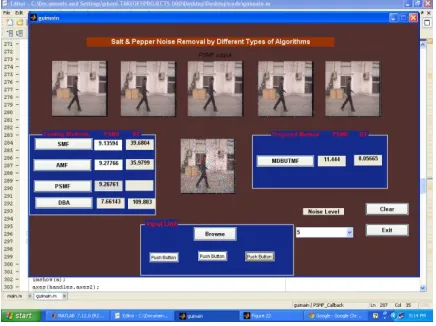
Filter applied on videos:
Rows 1 and 2 show processed results of various algorithms for color image corrupted by 70% and 80% noise densities,
ISSN(Online): 2320-9801
ISSN (Print): 2320-9798
I
nternational
J
ournal of
I
nnovative
R
esearch in
C
omputer
and
C
ommunication
E
ngineering
(An ISO 3297: 2007 Certified Organization)
Vol. 3, Issue 5, May 2015
V.CONCLUSION
In this paper, a new algorithm (DBUF) is proposed which gives better performance in comparison with MF, AMF and other existing noise removal algorithms in terms of PSNR and IEF. The performance of the algorithm has been tested at low, medium and high noise densities on both gray-scale and color images and videos. Even at high noise density levels the DBUF gives better results in comparison with other existing algorithms. Both visual and quantitative results are demonstrated. The proposed algorithm is effective for salt and pepper noise removal in images and videos at high noise densities.
REFERENCES
1. J. Astola and P. Kuosmaneen, Fundamentals of Nonlinear Digital Filtering. Boca Raton, FL: CRC, 1997.
2. H. Hwang and R. A. Hadded, “Adaptive median filter: New algorithms and results,” IEEE Trans. Image Process., vol. 4, no. 4, pp. 499– 502, Apr. 1995.
3. S. Zhang and M. A. Karim, “A new impulse detector for switching median filters,” IEEE Signal Process. Lett., vol. 9, no. 11, pp. 360– 363, Nov. 2002.
4. P. E. Ng and K. K. Ma, “A switching median filter with boundary discriminative noise detection for extremely corrupted images,” IEEE Trans. Image Process., vol. 15, no. 6, pp. 1506–1516, Jun. 2006.
5. K. S. Srinivasan and D. Ebenezer, “A new fast and efficient decision based algorithm for removal of high density impulse noise,” IEEE Signal Process. Lett., vol. 14, no. 3, pp. 189–192, Mar. 2007.
6. V. Jayaraj and D. Ebenezer, “A new switching-based median filtering
7. Scheme and algorithmfor removal of high-density salt and pepper noise in image,” EURASIP J. Adv. Signal Process., 2010.
8. K. Aiswarya, V. Jayaraj, and D. Ebenezer, “A new and efficient algorithm for the removal of high density salt and pepper noise in images and videos,” in Second Int. Conf. Computer Modeling and Simulation, 2010, pp. 409–413.
9. T.S. Huang, G.J. Yang, and G.Y. Tang, "Fast two dimensional Median Filtering algorithm" , IEEE Transactions on Acoustics, Speech and Signal Processing,1(1995), pp. 499-502.
10. Pok, G. Jyh-Charn Liu, "Decision based median filter improved by predictions", ICIP 99(1999) proceedings vol 2 pp 410-413.