ISSN(Online): 2319-8753 ISSN (Print): 2347-6710
I
nternational
J
ournal of
I
nnovative
R
esearch in
S
cience,
E
ngineering and
T
echnology
(A High Impact Factor, Monthly, Peer Reviewed Journal)
Visit:
www.ijirset.com
Vol. 8, Issue 9, September 2019
Filter Optimization
MIMO Signal Processing
Techniques based on SDM Transmissions
for
5G Technologies
Anuradha Thapa
1, Dr. Vikas Gupta
2M. Tech. Scholar, Department of Electronics and Communication, TIT, Bhopal, India1
Head of Dept., Department of Electronics and Communication, TIT, Bhopal, India 2
ABSTRACT: -In this paper, we portray ongoing advancement in space-division multiplexed (SDM) transmission, and our proposition and showing of thick space-division multiplexing (DSDM), which offers the likelihood of ultra-high limit SDM transmission frameworks with high spatial thickness and spatial channel tally of more than 30 for each fiber. We present the SDM transmission grid, which cross files the different kinds of multi-center multi-mode transmissions as indicated by the sort of light engendering in optical strands and how the spatial diverts are taken care of in the system. For every classification in the framework, we present the most recent advances in transmission ponders, and assess their transmission execution by phantom and spatial efficiencies.
KEYWORDS: - Filter Bank Multicarrier (FBMC), Filter Bank, MIMO System, 5G Technology
I. INTRODUCTION
To accommodate the interest for future energy efficient fiber-optic correspondence frameworks with very high limit, space division multiplexing (SDM) transmission advances utilizing multicore (MC) as well as multimode filaments (MMFs) have been seriously created in ongoing years. Explicit outcomes incorporate SDM transmission with Pb/s-class limit over MCF [1]–[3], and MC-MMFs [4], [5]. SDM transmissions can be arranged into two systems: non-coupled and non-coupled transmission. Transmission over an MCF is a non-non-coupled transmission system in which impedance spilled from different centers is all around stifled by methods for fiber as well as framework plan. In this system, minimal sign preparing adjustment would be required regarding transmission over a conventionalSMF. The coupled transmission, on the other hand, requests the utilization of multi-input multi-yield (MIMO) signal preparing to counter the coupling between spatial channels, particularly for transmission separates in overabundance of the connection length [6]. All through this work we allude to a SDM transmission that utilizes MIMO sign preparing as a MIMO-SDM transmission.
ISSN(Online): 2319-8753 ISSN (Print): 2347-6710
I
nternational
J
ournal of
I
nnovative
R
esearch in
S
cience,
E
ngineering and
T
echnology
(A High Impact Factor, Monthly, Peer Reviewed Journal)
Visit:
www.ijirset.com
Vol. 8, Issue 9, September 2019
Nonlinear MIMO identification plans, which for the most part give higher transmission execution, are likewise relevant to optical MIMO-SDM transmission, in spite of the fact that their exhibition have been examined in just a couple SDM transmission tests/reenactments with regards to optical MIMO-SDM transmission with in excess of two spatial channels (i.e., polarization channels) [7], [10].
II. SPATIAL DIVISION MULTIPLEXING IN OPTICAL FIBERS
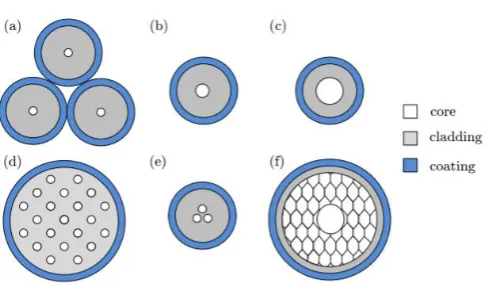
However, the key requirement for MIMO transmission to work is spatial diversity, i.e. the condition number of the transmission matrix H has to be low (near 1 to maximize transmission capacity). A key advantage of optical transmission systems is that transmission medium, the optical fiber itself, can be engineered to the designer‟s liking for increasing the number of spatial transmission channels. The most obvious and simplest method of spatial diversity is by employing multiple SSMFs, as shown in Fig. 1. The main advantage of this approach is that all components are readily available, and accordingly, no research is required, and the capacity crunch can be alleviated. However, employing single mode fibers scales the cost per transmitted bit linearly. Key to reducing costs is the sharing of components in a transmission system. To this end, multiple solutions have been proposed over the last few years
Few-mode fibers (FMFs)
Multimode fibers
Multi-core fibers (MCFs)
Coupled-core fibers (CCFs)
Hollow-core photonic bandgap fiber
Fig. 1: Schematic representation of the suggested optical fiber types for SDM
III. FBMC TECHNIQUE
ISSN(Online): 2319-8753 ISSN (Print): 2347-6710
I
nternational
J
ournal of
I
nnovative
R
esearch in
S
cience,
E
ngineering and
T
echnology
(A High Impact Factor, Monthly, Peer Reviewed Journal)
Visit:
www.ijirset.com
Vol. 8, Issue 9, September 2019
communications (5G) is ambitious by more spectral efficient wave-forms. FBMC has gained a high degree of interest to provide flexibility for 5G mobile communications system, as a 5G waveform candidate. In the advancement in digital signal processing (DSP) capabilities, research has been carried out to identify alternative to existing multicarrier modulation technique for next generation communication system.
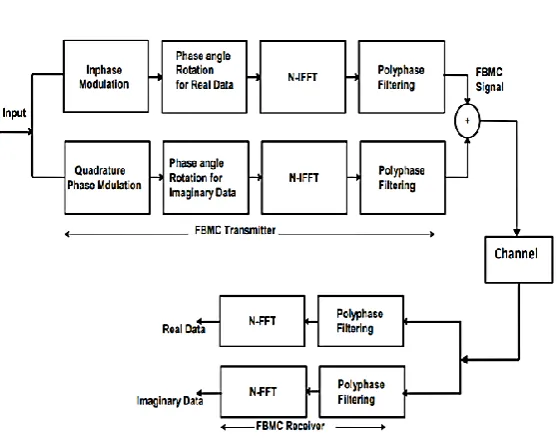
Due to the finite transition region at the end of the FIR pass band, small gaps are produced between the sub-bands, which avoid crosstalk and spectral leakage. Analysis filter bank is used at transmitter for sub-band processing of higher band into several lower band signals with the help of decimation filter.After processing of signals, Synthesis filter bank is used at receiver to form a replica of the original signal, using interpolator based on the sub-band channels. Finally, sub-band channels are recombined into a full band output signal.
Fig. 2: Time domain response of FBMC prototype filter and OFDM technique
IV. BLOCK DIAGRAM OF FBMC
ISSN(Online): 2319-8753 ISSN (Print): 2347-6710
I
nternational
J
ournal of
I
nnovative
R
esearch in
S
cience,
E
ngineering and
T
echnology
(A High Impact Factor, Monthly, Peer Reviewed Journal)
Visit:
www.ijirset.com
Vol. 8, Issue 9, September 2019
Fig. 3: Block diagram of FBMC transceiver
V. PROPOSED METHODOLOGY
ISSN(Online): 2319-8753 ISSN (Print): 2347-6710
I
nternational
J
ournal of
I
nnovative
R
esearch in
S
cience,
E
ngineering and
T
echnology
(A High Impact Factor, Monthly, Peer Reviewed Journal)
Visit:
www.ijirset.com
Vol. 8, Issue 9, September 2019
stage and NK-FFT to recover data. In order to retrieve the original signal back, pipelined FFT Architecture is used. By using pipelined FFT Architecture it is easy to compute higher FFT point by making short variations in the code. Therefore, with this architecture, the complexity level and area utilization get reduces while the speed of communication system improves.
VI. SIMULATION RESULTS
MIMO-OFDM 2×1 System with filter optimization based FBMC technique discussed in this research work in term of attenuation (dB). From the above graphical representation it can be inferred that the proposed algorithm gives the best performance for FBMC technique.
Fig. 5: Attenuation Graph of 2×1 MIMO system based Optimization Filter
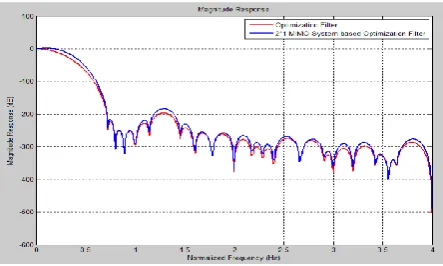
MIMO-OFDM 2×1 System with filter optimization based FBMC technique discussed in this research work in term of magnituderesponse (dB) is shown in figure 6.
Fig. 6: Magnitude Response of 2×1 MIMO system based Optimization Filter
ISSN(Online): 2319-8753 ISSN (Print): 2347-6710
I
nternational
J
ournal of
I
nnovative
R
esearch in
S
cience,
E
ngineering and
T
echnology
(A High Impact Factor, Monthly, Peer Reviewed Journal)
Visit:
www.ijirset.com
Vol. 8, Issue 9, September 2019
Fig. 7: BER Analysis of 2×1 MIMO system based Optimization Filter
MIMO-OFDM 2×2 System with filter optimization based FBMC technique discussed in this research work in term of attenuation (dB) is shown in figure 7.
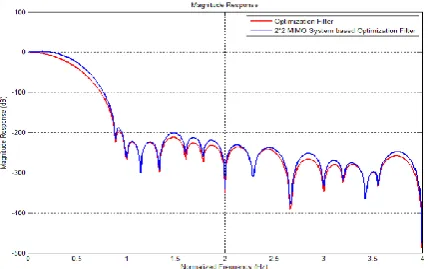
Fig. 8: Attenuation Graph of 2×2 MIMO system based Optimization Filter
ISSN(Online): 2319-8753 ISSN (Print): 2347-6710
I
nternational
J
ournal of
I
nnovative
R
esearch in
S
cience,
E
ngineering and
T
echnology
(A High Impact Factor, Monthly, Peer Reviewed Journal)
Visit:
www.ijirset.com
Vol. 8, Issue 9, September 2019
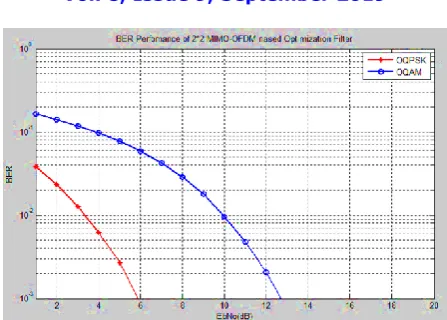
Fig. 10: BER Analysis of 2×2MIMO system based Optimization Filter
MIMO-OFDM 2×2 System with filter optimization based FBMC technique discussed in this research work in term of bit error rate (BER) is shown in figure 10. The offset quadrature amplitude modulation (OQAM) is increase signal to noise ratio (SNR) compared to OQPSK.
VII.CONCLUSION
Both OFDM and FBMC strategies depend on the basic working principles of IFFT/FFT computational engines. However, the procedure of adding CP in OFDM prompts an overhead that adversely impacts on the transmission bandwidth efficiency. Though cyclic prefix is absent in case of FBMC and blend of filter banks prompts greatest productivity and information transmission speed. A similar channel bank can be utilized for transmission and reception in FBMC transceiver architecture which ensures low BER and high performance compatibility in terms latency and throughput. The out-of-band reduction of the prototype filter amplitude curve in FBMC system assures spectral preservation of other subscribers which leads to new physical layer containment for future communication system.
REFERENCES
[1] Kohki Shibahara , Takayuki Mizuno , OSA, Doohwan Lee, and Yutaka Miyamoto,” Advanced MIMO Signal Processing Techniques Enabling Long-Haul Dense SDM Transmissions”Journal of Lightwave Technology, Vol. 36, No. 2, January 15, 2018.
[2] K. Shibahara, T. Mizuno, D. Lee, and Y. Miyamoto, “Signal processing techniques for DMD and MDL mitigation in dense SDM transmission,” in Proc. 40th Opt. FiberCommunication. Conf. Exhib., Los Angeles, CA, USA, Mar. 2017.
[3] Zongmiao He, Lingyu Zhou, Yiou Chen, Xiang Ling, “Filter Optimization of Out-of-Band Emission and BER Analysis for FBMC-OQAM System in 5G”, 2017 9th IEEE International Conference on Communication Software and Networks.
[4] Mawlawi, B., Dore, J.B., Berg, V. “Optimizing contention based access methods for FBMC waveforms, Int. Conf. on Military Commun. and Information Systems,” Cracow, Poland, May 2015, pp.1-6.
[5] E. Awwad, G. R.-B. Othman, and Y. Jaou‟en, “Space-time coding and optimal scrambling for mode multiplexed optical fiber systems,” in Proc.IEEE Int. Conf. Communication., Jun. 2015, pp. 5228–5234.
[6] H. Takara et al., “120.7-Tb/s (7 SDM/180 WDM/95.8 Gb/s) MCF-ROPA unrepeatered transmission of PDM-32QAM channels over 204 km,” in Proc. 40th Eur. Conf. Opt. Commun., Cannes, France, Sep. 2014.
[7] K. Igarashi et al., “1.03-Exabit/skm Super-nyquist-WDM transmission over 7,326-km seven-core fiber,” in Proc. 39th Eur. Conf. Exhib. Opt.Communication, London, U.K., Sep. 2013.
[8] T. Kobayashi et al., “2×344 Tb/s propagation-direction interleaved transmission over 1500-km MCF enhanced by multicarrier full electric-field digital back-propagation,” in Proc. 39th Eur. Conf. Exhib. Opt. Communication, London, U.K., Sep. 2013.
[9] Viholainen, A.,Ihalainen, T., Stitz, T.H., Renfors, M., and Bellanger “Prototype filter design for filter bank based multicarrier transmission,” 17 th Euro. Signal Process Conf., Glasgow, Scotland, August 2009, pp. 24-28.
[10] Chen, D., Qu, D.M., and Jiang, T. “Novel prototype filter design for FBMC base cognitive radio systems through direct optimization of filter coefficients,” IEEE Int. Conf. Wirel. Commun. &Signal Proc., Suzhou, China, October 2010, pp. 21-23.