PATTERNS OF NAMING OBJECTS AND ACTIONS IN CHILDREN WITH WORD
FINDING DIFFICULTIES12
Julie E. Dockrell,3
Psychology and Special Needs, Institute of Education,
20 Bedford Way, London WC1H 0AL
David Messer, Psychology Division, University of Hertfordshire, College Lane, Hatfield AL10
Rachel George
Division of Psychology,
University of Central Lancashire Preston, Lancashire PR1 2HE
1 The work reported here was funded by a Wellcome Trust grant to Julie Dockrell and David Messer. We are grateful to Gillie Wilson for collecting part of the data presented here and all the children who participated. Two anonymous reviewers and the editor have provided detailed and constructive criticisms.
Abstract
INTRODUCTION
There is increasing appreciation of the important role of the lexicon in language development and the acquisition of literacy abilities (Catts & Kamhi, 1999). Difficulties in accessing the lexicon are likely to compromise children's communication and their ability to acquire academic skills (Snyder & Godley, 1992), and these problems are especially likely to be experienced by children who are described as having Word Finding Difficulties (WFDs). These children are characterised as having long delays in word retrieval, a high occurrence of circumlocutions and word substitutions (German & Simon, 1991). However, the causes of WFDs remain uncertain because of the variety of samples studied and the limited types of comparison groups that are employed. Therefore, this investigation has been designed to address two key issues, (1) the selection of an objectively identified sample of children with WFDs who are compared with an appropriate set of matched comparison groups to determine the nature of WFDs, and (2) the use of a range of systematically identified targets to extend our understanding of WFDs across a larger range of lexical items.
1979, 1985; Wiig & Semel, 1975) and with dyslexia (Rudel, Denckla & Broman, 1981; Swan & Goswami, 1997; Wolf & Segal, 1992).
Investigations that are concerned with WFDs in special populations usually do not identify whether or not children have WFDs with the use of objective standardised tests. As a result, there often is uncertainty about the proportion of children with or without WFDs in such samples and there are, therefore, difficulties in drawing conclusions about the nature of WFDs per se. If one is interested, as we were, in the general characteristics of a group of children who all have objectively defined WFDs then an alternative method of selection is needed. For these reasons two selection procedures were instituted. First, speech and language therapists and teachers identified children in language support services who had marked WFDs. Then the children were assessed using the Test of Word Finding Difficulties (TWF, German, 1989) to confirm the therapists' diagnosis. This test allows both the identification of word finding difficulties in relation to age matched peers and where necessary a procedure to prorate performance in relation to the child’s level of lexical comprehension. Additional entry criteria were average non-verbal intelligence, no major articulation problems that could have affected word production, and no other hearing or neurological disabilities. These selection criteria resulted in the identification of a clearly delineated sample of children with WFDs who possessed average non-verbal abilities and no articulation problems.
vocabulary than their peers (Leonard, 1988; Rescorla & Schwartz, 1990; Rice, 1991), it is important to consider their word-finding skills in relation to this and other indicators of language capacity. If children with WFDs perform significantly worse than language matched controls on a task this will identify an area of performance where they experience difficulties beyond that expected for their language level (Dockrell, Messer & George, 2000). Such comparisons should help to identify the essential characteristics of WFDs and help understand the causes of WFDs by, for example, allowing differentiation between ‘developmental immaturities’ in word-finding and alternative explanations in terms of phonological or semantic factors (McGregor, 1997). Thus, in this study we chose the following matches: (i) a chronological age comparison group (CA) that was controlled for non-verbal ability, (ii) a naming age comparison group (NA) who were at a similar level of picture naming ability as the children with WFDs, and (iii) a group matched for syntactic comprehension who were at a similar level of receptive grammar (RG) as the children with WFDs. In all cases, reliable and valid measures standardised on the local population were chosen to identify controls. By employing an objective measure of WFDs and a greater range of comparison groups, we aimed to identify the language difficulties of a well defined population of children with WFDs. In addition information about the phonological skills of the WFDs group were collected to provide descriptive information about these skills. Our particular interest was the identification of differential performance across tasks with the aim of elucidating patterns of delay and difference in the performance of children with WFDs.
Nippold, 1992 for ideas about retrieval problems). The view that WFDs are caused by semantic deficits has involved the suggestion that the lack of elaborate semantic representations makes it more difficult for children to retrieve words (Kail & Leonard, 1986; Lahey & Edwards, 1996, 1999; McGregor & Leonard, 1989; McGregor & Windsor, 1996). In contrast, other accounts suggest that phonological representations are more difficult to access and/or that the transfer of information between the semantic and phonological systems is impaired (Constable et al., 1997). To address these issues and to extend the range of lexical items employed in the study of WFDswe presented children with tasks that involve: (i) naming objects (as in most previous studies); (ii) naming actions; (iii) naming single-numerals and letters, and (iv) naming both high and low frequency items. The rationale for these choices is set out below.
Studies of WFDs have rarely considered children’s naming of actions even though there are indications that naming actions involves different processes to the naming of objects. Gentner (1981) suggests that the naming of verbs is delayed relative to that of objects, although the differential advantage for naming objects above actions has been called into question by Davidoff and Masterson, (1995/6). McGregor (1997), in one of the few studies of the naming of actions in children with WFDs, compared their performance with age matched peers using the sub-tests from the Test of Word Finding Difficulties (TWF, German, 1989). The
unavailability of associated representations might make retrieval of intransitive verbs more difficult than transitive verbs. As there is evidence that the semantics of verbs differ from those of nouns, and that verbs may be a particular problem area for children with generallanguage problems, these items may pose greater problems for children with WFDs. Given these concerns and findings it was decided to investigate the naming of actions and employ both transitive and intransitive items.
The nature of semantic representations is likely to vary across conceptual domains (Braisby & Dockrell, 1999; Markman, 1989; Soja, 1994) and by corollary across lexical items. Actions and objects denote complex concepts, whereas single numerals and alphabetic letters involve concepts with low semantic complexity. We, therefore, also investigated the naming of letters and single numerals, as well as the naming of objects and actions. By selecting these different types of lexical items, we aimed to investigate whether children with WFDs, in comparison to language age matches, find certain types of lexical items especially difficult to produce. Furthermore, the presence of differences between word class could provide support for the idea that the impoverished nature of children's representations contributes to WFDs. Difficulties in naming objects and actions and not letters and numerals would suggest that the semantic complexity of the items were critical.
contrast, a lack of a frequency effect would implicate more general problems with access irrespective of the nature of the representations.
A similar argument can be developed that the age when a lexical item is acquired has an influence on children’s naming. Earlier acquired lexical items are likely to be betterestablished than later acquired ones. Unfortunately there are insufficient data about the age of acquisition of lexical items to construct the appropriate stimuli sets. However, data about the age of
acquisition of the lexical items used in the current study are presented where available in the methods section.
Studies of word frequency that involvechildren with naming difficulties have produced contradictory findings. On a picture naming task, Denckla and Rudel (1976) reported that with low-frequency words, children with dyslexia produce more errors and longer response times than children with language difficulties. German (1979, 1984) published similar findings for children with language difficulties and children with learning disabilities. In contrast, Wiig et al (1982) reported that the picture naming of high frequency words differentiated normal and language disordered children but Wolf (1980) found no frequency effects. All these findings point to the importance of considering this dimension in relation to WFDs. However,
estimating word frequency for children’s oral language is complex. Studies with adults tend to use estimates of printed word frequency; such a measure would be inappropriate for young children who cannot read, children who are at the early stages of literacy acquisition or children whose language may be delayed. Consequently, several methods of selecting high and low frequency words were employed in this study.
(TWF, German, 1989). The performance of these children was compared with a group of typical children matched for chronological age (CA), a group who have similar productive language (NA), and a group matched for grammatical comprehension (RG). As a result, it should be possible to identify language delays in children with WFDs that are below those expected for their chronological age, and identify specific language delays which go beyond those expected for the children's level of language. These comparisons can give a more detailed picture of the strengths and weaknesses of children with WFDs. In addition, the comparisons should contribute to understanding the underlying cause of the difficulties of these children.
METHODS
Participants
skills as identifiedby the Test of Word Finding Difficulties (TWF, German, 1989); (3) have age appropriate (at or above the 25th centile) non-verbal abilities as measured by Raven’s matrices (1983) and, (4) have no marked difficulties in articulation as measured by the Edinburgh
Articulation Test (EAT, Anthony, Bogle, Ingram & McIsaac, 1971). The articulation criterion was operationalised as not scoring below - 1SD for the age group 5;5 –6;0 (the test ceiling). The minimum EAT raw score was 49, the mode and median for the sample was 60. A raw score of 60 is equivalent to a standard score of 106 for the age range 5;9-6;0.
The children in the control groups were drawn from similar geographical areas to the children with WFDs and where possible were attending the same school. All the control children attended state mainstream educational provision. None of the children had identified special educational needs or English as an additional language. Children in the language age control groups were required to achieve a typical score on the matched language measure (see below) that is within a three month band of their chronological age.
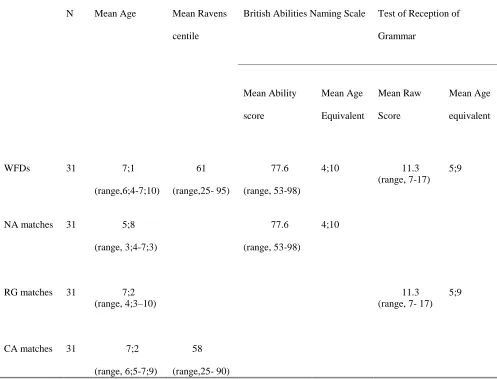
score of each child in this control group was exactly matched to those of the children with WFDs. The children’s mean reception of grammar age was 5;9. Table 1 presents the group scores on the relevant matched measures.
INSERT TABLE 1 ABOUT HERE
Description of Language skills of the children with WFDs
matching of the control groups on key language measures, helps to justify the decision to carry out analyses on the whole of the sample of children with WFDs.
Materials
The complete set of naming stimuli consisted of 40 coloured drawings of objects and 20 coloured drawings of actions, together with5 single digit numerals and 5 letters. The itemsthat were used are presented in Appendix 1. The drawings chosen were ones commonly used
successfully in a pre-school speech and language unit and were therefore deemed appropriate for the population. The pictures were scanned into a specially designed computer programme. In the comprehension tests four pictures were presented on the screen. The location of the correct picture on the computer screen varied randomly across trial items. Three foil pictures were chosen to allow different error patterns to be investigated: a semantic foil (an item from the same semantic domain), a phonological foil (an item starting with the same sound pattern), and finally an irrelevant foil. Frequency was controlled across foil items.
approximation, and items were only included if they also were contained in at least one of three primary grade sources books (Burroughs, 1957; Gates, 1935; Edwards & Gibbon, 1973). It was not possible to match for frequencies across categories. However, frequency ranges did not overlap, thus the lowest frequency count for a high frequency item was 46 and the highest frequency count for a low frequency item was 17. In addition low frequency items were excluded if they were contained in the top 1,000 words of Burroughs (1957), as were items of low picturability.
The age of acquisition could be identified for 32 of the 40 object names using a
combination of databases (Gilhooly & Logie, 1980; Morrison, Chappell & Ellis, 1997), but no data could be found about the age of acquisition for any of the verbs. Data were available for all high frequency objects with a mean age of acquisition of 25.4 months (range 15.3-47.6) and 12 low frequency items with a mean age of acquisition of 38.6 (range 17.7-74.1). From these figures it would appear that all high frequency items and most low frequency items had an age of acquisition of below four years (see Appendix 1).
Procedure
Each child was tested individually. Children's naming and comprehension of the test stimuli were assessed in a single session. All children completed the naming task before the comprehension task. Items were randomly presented to each childfor naming and there were five preset random orders for the comprehension items. Object naming occurred before action naming.
The stimuli for both naming and comprehension were presented on a portable computer that recorded accuracy and latency. In parallel, a tape recorder was used to capture oral
provided with five practice items for each condition. No feedback was provided on the test items. Children appeared to enjoy the task. Naming and comprehension tasks were always completed in a single session.
Error analysis
RESULTS
The results are presented in four sections. Section 1 examines the children’s performance with numerals and letters. These data are considered before the data concerning objects and actions, because interpretation of these findings is more straightforward. Section 2 compares the performance of the four groups across the remaining naming domains. The initial analysis includes data for both objects and actions and allows a comparison of the two word classes. Because differing patterns in performance were identified for objects and actions,
separategroup comparisons were performed for these items. The between group differences for object names are described in section 3, and similar analyses for actions are presented in section 4. In all cases the ANOVA analyses use group as a between subject factor and the relevant stimulus dimensions as within subject factor.
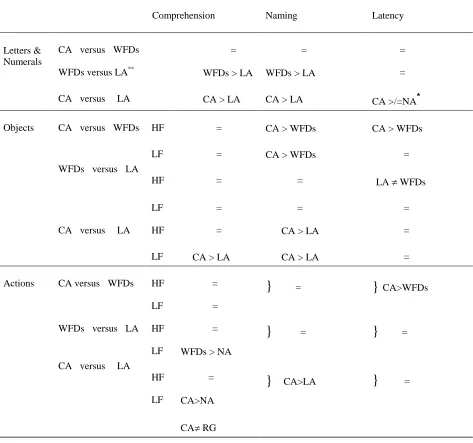
INSERT TABLE 2 ABOUT HERE
Section 1: Comprehension and Naming of letters and numerals
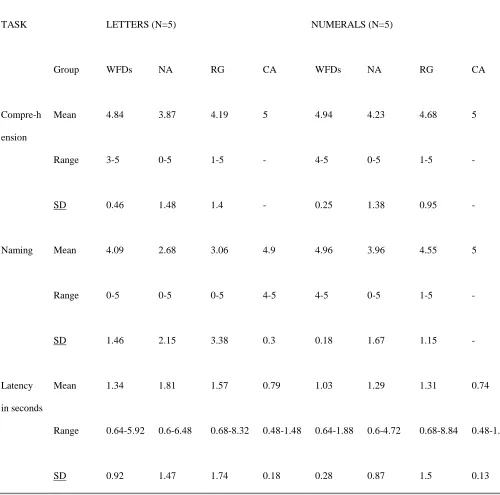
Table 3 presents the findings from the letters and numerals tasks. Separate ANOVAs (involving comprehension, naming accuracy and latency) were conducted on letters and numerals. These revealed that there were significant differences between the groups in terms of comprehension (Letters F(3,120) = 8.094, p < .001; Numerals F(3,120) = 5.337, p < .001), accuracy (Letters F(3,120) = 10.07, p < .001; Numerals F(3,120) = 6.98, p < .001) and latency (Letters F(3,120) = 3.91, p < .001; Numerals F(3,120) = 2.89, p < .05). Post hoc tests revealed no significant differences between the children with WFDs and their CA matched peers in comprehension, naming accuracy or latency. Children with WFDs in comparison to the NA matches were significantly more accurate in comprehension (for letters p < .01 and for numerals p < .05) and in naming (for letters p < .05 and for numerals p < .001). In terms of the mean latency for both letters and numerals, the groups were ordered as follows: CA, WFDs and then the NA and RG groups. The only significant difference occurred between the NA and CA groups for letters (p < .05). Thus, when comprehending and naming letters and numerals, children withWFDs were neither less accuratenor slower than typical children of the same age.
INSERT TABLE 3 ABOUT HERE
Section 2: Overall results, objects and actions
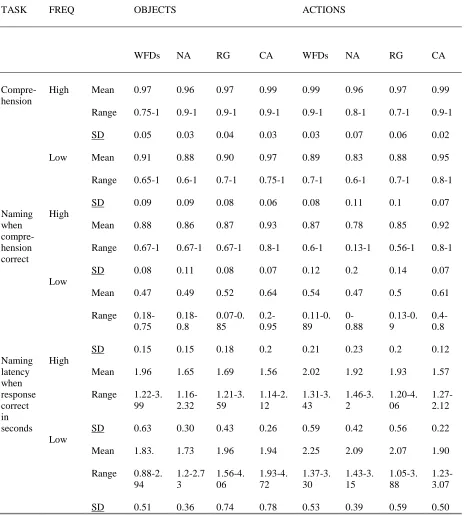
INSERT TABLE 4
As the table shows, all children were highly accurate in their comprehension. The comprehension data were analysed with word class (objects or actions) and word frequency (high or low) as within subject factors and group (CA, NA, RG, & WFDs) as the between subject factor. There was a significant effect of both word frequency (F (1,120) = 158.19, p < .001) and experimental group (F (3,120) = 14.86, p < .001) for comprehension, but no main effect of word class. There were significant interactions between group and word frequency (F (3, 120) = 6.78, p < .001 ) and word class and word frequency (F (1,120) = 8.14, p < .001). Thus despite the overall high levels of success, the groups were performing significantly differently and all children performing better with high frequency items.
3.06, p < .05). The differential effect of word class on latency suggests thatnaming objects and actions involve different processing demands. To explore these differences further post-hoc analyses to test for group and task effects were carried out separately for each word class. These are presented in the next sections, first for objects and then for actions. For each word class there is an examination of comprehension accuracy, naming accuracy, naming latency, and error responses.
Section 3: Objects
Accuracy ofobject comprehension:
Analysis of the full data set for comprehension revealed a significant effect of group (F(3,120) = 6.296, p < .01), word frequency (F(1,120) = 65.648, p < .001) and an interaction between group and word frequency (F(3,120) = 3.284, p < .05). Post hoc Scheffe’s tests between the 4groups of children revealed no differences in theaccuracy of comprehension for high frequency items. However, for low frequency items there were differences between groups. The CA control group was significantly better thanthe two language match groups (NA: p < .01; RG: p < .05). The children with WFDs had intermediate scores and were not significantly different from their NA, RG, or CA peers.
Accuracy of object naming
interaction between group and word frequency (F(3,120) = 3.20, p < .05). Post hoc
Scheffe’s tests between groups revealed that the CA group was performing significantly better than the other three groups for high frequency (WFDs: p < .05; NA: p < .01; RG: p < .01) and low frequency items (WFDs: p < .001; NA: p < .001; RG: p < .05). No other significant differences between the groupswere identified.
Latency of object naming
Mean latencies for correct responses to high and low frequency items are presented in Table 4. There was a significant effect of word frequency (F(1,120) = 9.04 p < .01) and an interaction between group and word frequency (F(3,120) = 5.05 p < .01). Post hoc Scheffe’s tests indicated that the children with WFDs were significantly slower than CA matches for high frequency items (p < .01) and there was a trend suggesting that they were also slower than their NA matches (p = .052). There were no significant differences between the NA or RG matches and the CA matched peers for high frequency items and no significant differences between any of the groupsfor low frequency items.
Error patterns in naming objects
errors. Proportions were calculated to allow comparisons between groups and word classes. Object naming errors are presented in Table 5.
As Table 5 shows the overall distribution of error types across the groups was similar, and that semantic errors were the most common of the four types. Comparisons between the groups using a Kruskal Wallis test revealed no significant differences in the proportion of semantic errors (X2 = 1.10, df = 3, ns), don’t know responses (X2 = 1.88, df = 3, ns) or other errors produced (X2 = .11 df = 3, ns). In contrast the proportion of phonological errors varied significantly across the groups (X2 = 8.79, p < .05).The WFDs children produced significantly more phonological errors than their CA peers (U = 293, p < .01) and their RG matches (U = 329, p < .05) but not their NA matches. The distribution of phonological errors within the WFDs group was examined to establish whether individual children were accounting for these responses. This was not the case, phonological errors were distributed across the sample of children with WFDs. Thus, these analyses indicate that children with WFDs made proportionally more phonological errors than their CA matched peers and RG matched peers, but not proportionally more than their NA matched peers did. Overall semantic errors dominate all children’s erroneous responses for the object pictures.
INSERT TABLE 5 ABOUT HERE
4: Actions
Accuracy of comprehension for actions
93.54, p < .001) and an interaction between group and word frequency (F(3,120) = 3.79, p < .05). Post hoc Scheffe’s tests between groups revealed no differences for high frequency actions. However for low frequency actions both the CA control (p < .001) and the children with WFDs (p < .05) were significantly better than the NA group and there was a trend identifiedsuggesting a difference betweenRG matches and CA matches (p = .058). Thus, there was no evidence for a difficulty with the comprehension of verbs for children with WFDs.
Accuracy of naming actions
There was a significant correlation between accurate naming and accurate comprehension (r = .353, N = 124, p < .001) of actions, but children were less accurate in producing than in comprehending these items (t = -20.57, df = 123, p < .001). Analysis of the full data set shows that there is a significant group effect (F(3,120) = 8.21, p < .001), word frequency effect (F(1,120) = 496.29, p < .001), but no significant interactions. All groups were more accurate on high frequency words. Since there were no significant interactions between group and frequency, high and low frequency results were collapsed and post hoc Scheffe’s tests were conducted between groups. There were no differences between the WFDs group and their chronological and language age matches. In contrast both the NA matches (p < .001) and the RG matches (p < .05) were performing significantly poorer than the CA matches.
Latency to name actions
Scheffe’s tests were conducted between groups. The WFDs group were significantly slower than their CA matches (p < .05). No other significant differences existed between the groups. Nonetheless as shown in Table 4 the children with WFDs were the slowest group to respond for both low frequency and high frequency actions.
Error patterns in naming actions
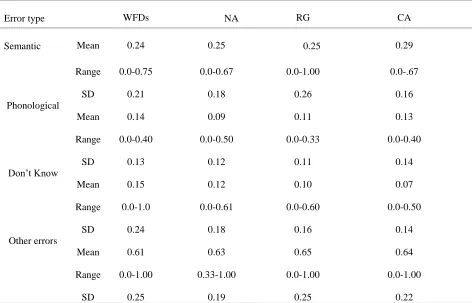
Action errors were initially subjected to the same analyses as object errors. Errors were classified as semantic, phonological, don’t know responses and other errors. These are presented in Table 6.
INSERT TABLE 6 ABOUT HERE
As Table 6 shows the overall distribution of error types across the groups was similar, and that other errors were the most common of the four types. As with the object errors there were few phonological errors overall. In contrast to the object errors, for actions children were producing more errors that were categorised as other errors. Since the error data did not meet the requirements of parametric tests the data were analysed with non-parametric tests. Comparisons between the groups using a Kruskal Wallis test revealed no significant differences in the proportion of semantic errors (X2 = 3.22, df = 3, ns), don’t know responses (X2 = 1.83, df = 3, ns), phonological errors (X2 = 2.38, df = 3, ns), or other errors produced (X2 = 1.18, df = 3, ns).
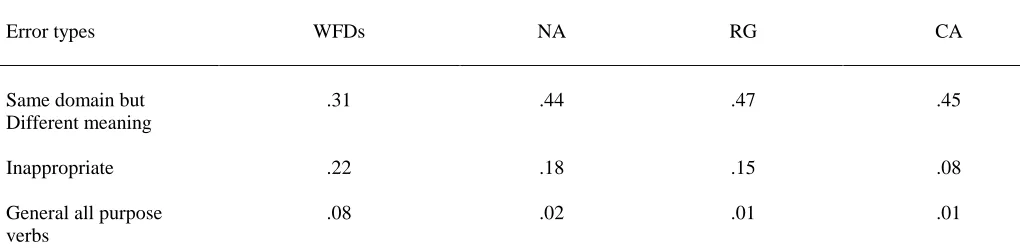
target verbs that were inappropriate e.g. ‘swimming’ for ‘fishing’. These non-target verbs accounted for over 50% of each group’s non-target responses. The proportions of non-target verbs categorised as other errors are presented in table 7
INSERT TABLE 7 ABOUT HERE
The children with WFDs produced fewer similar but incorrect verbs than their CA matched peers (U = 293.5, p < .05), NA matched peers (U = 327.5, p < .05) and RG matched peers (U = 296, p < .05). Instead the children with WFDs used more non-specific verbs (U = 372, p < .05) and more verbs that were inappropriate (U = 312, p < .05) than CA matched peers. These responses did not differ significantly from their language age matches. All these differences in error patterns suggest that, despite their equivalent naming accuracy with CA peers, the semantic domains for children with WFDs were less clearly delineated than their CA peers.
DISCUSSION
Although children with WFDs performed as well as CA controls on comprehension tasks, they did not perform as well as these children in terms of the accuracy of naming. For the naming of low and high frequency objects, the CA group was significantly better than all the other three groups. In other words, for accuracy of object naming the children with WFDs did not differ significantly from their language matched controls. In the case of actions, the pattern of differences was slightly more complicated. The CA group was significantly better than the language matched groups but the performance of children with WFDs was between the highest and lowest scoring groups and their performance was not significantly different from any of the other groups. Thus, the naming accuracy of children with WFDs was equivalent to language matched children for objects and intermediate between CA and LA controls for actions.
The examination of latency of naming reveals yet a third pattern of relations between the performance of children with WFDs and the control groups. Children with WFDs had the slowest responses of all 4 groups on latencies for high frequency objects and for low and high frequency action words. Furthermore, they were significantly slower than CA matches for high frequency objects and for all action words (see Table 2). The difference between children with WFDs and NA matches approached significance for high frequency objects suggesting that there may be a reliable difference between these groups. This trend deserves attention because it suggests that when children with WFDs are matched with typical children on the accuracy of naming (i.e. the BAS naming scale), then children with WFDs are slower than typical children in producing names. Consequently, the children appear to have a specific problem in accessing representations even when they accurately retrieve them.
groups. This suggests that the longer latencies identified for object words and actions were not simply a product of slower general processing, but this is an issue that needs to be considered in future investigations of the children’s difficulties. Further investigations of the differential latencies between accurate, wrong and don’t know response have the potential to increase our understanding of the children’s strategies for managing their difficulties.
Previous research on children with WFDs has identified high rates of semantic substitution errors (German, 1982; Lahey & Edwards, 1999; McGregor, 1997). Children with WFDs also appear to produce higher rates of don’t know responses than chronological age matched peers in naming tasks (Fried-Oken, 1984; German, 1982; McGregor & Waxman, 1998). However, our analyses for object errors did not identify any significant differences across groups in the frequency of semantic, don’t know or other responses. In contrast the children with WFDs were more likely to make phonological errors. However, this was not true for the action naming. In this case errors were suggestive of less differentiated semantic domains.
idea of a phonological deficit. Nonetheless only 18% of the errors were phonological and this proportion did not differ significantly from NA matches.
We argued in the introduction that it is of little practical or theoretical interest to apply the term WFDs to children who have general language delays and that it can be useful to compare the performance of these children with a carefully chosen set of matches. The findings from this studyprovide support for this argument. The analyses that have been
conducted suggest that children with WFDs have lexical comprehension skills that are similar to those of typical children of the same age. However, the accuracy of naming of children with WFDs was similar to that of typical children who have the same language level, suggesting that the children are delayed in their naming accuracy. Finally, there was an important trend indicating that speed of naming of children with WFDs for high frequency objects was below that of naming age matched typical children and similar non-significant patterns were evident for the naming of actions. It is important to note that neither of the language matched groups differed significantly from the CA group in latency to respond. Thus, in the naming of objects and actions there appears to be a marked decline in the relative performance for children with WFDs across these 3 different forms of assessment. Any one set of these comparisons could give a very limited and possibly distorted picture of the abilities of children with WFDs, and so these findings reinforce our view that a better understanding of this condition requires a more extensive and careful use of comparison groups.
items that are more semantically complex such as objects and actions. The crucial
comparisons involve determining whether, for a particular set of words, the performance of children with WFDs is similar to that of the comparison groups. In the case of numerals and letters, there were no significant differences between children with WFDs and typical CA matched children in terms of speed and accuracy of naming. Furthermore, children with WFDs were significantly more accurate than typical LA matched peers on numerals and letters. Thus, for the domains of numerals and letters, where it is argued complex semantic representations are not required, the children with WFDs were performing similarly to children of the same age. In contrast, for objects and actions, children with WFDs performed less well than their CA
matched controls. Given the low age of acquisition of many of the lexical items employed in this study, it is unlikely that time of exposure can explain the WFDs children’s high levels of
performance with numerals and letters. Therefore these differences between the set of words are unlikely to be simply due to the amount of time that the children have had to learn the items, and the pattern of differences is consistent with the idea of children with WFDs having impoverished semantic representations.
Comparisons of children's performance on object words and action words, as well as high frequency words and low frequency words, also has a relevance to evaluating the semantic elaboration hypothesis. These comparisons suggest that frequency rather than word type is more influential in determining accuracy. There was, for example, no main effect of word class for accurate naming but there was a main effect of word frequency. Children with WFDs performed significantly less well than chronological aged matched children in naming high frequency objects (see Table 2) and were slower to respond. However, there were no significant
findings suggest that children with WFDs may experience more problems with lexical items that are relatively well established, rather than items that are likely to be less familiar. Such a pattern of findings is consistent with the idea that the children with WFDs have more problems in building up a complex set of representations than in initially forming these representations, and that as a result they have more problems than matched peers in retrieving these words.
The comparisons also show that across groups, word frequency effects produced similar patterns of results, thereby providing support for the view that the complexity of children’s semantic representations influence word retrieval. These results stand in contrast to current research that has highlighted the difficulties with verbs for the language-impaired population (Conti-Ramsden & Jones, 1997; Fletcher & Peters, 1984; Tomasello 1992; Watkins, Rice & Moltz, 1993). However, an examination of the children’s errors and latency suggest that there are subtle problems in naming actions for this population. Firstly, there was the greater preponderance of non-verb responses, secondly when verbs were used they were often semantically inappropriate and finally general verbs were used more by the children with WFDs. The latter result is consistent with a reliance on general all purpose verbs that has been reported in the literature about children with language difficulties. Thus, the type of children’s errors provide further support the view that part of the difficulties are caused by impoverished semantic representations.
explained by generalised limitations in processing capacity (Kail, 1994; Kail & Salthouse, 1994; Windsor & Hwang, 1999). Our present analyses do not directly address this question.
Nonetheless, the data indicate that processing limitations per se are not a sufficient explanation of their naming patterns. This is because although children with WFDs had poorer accuracy of naming objects and actions than CA matches, they were not significantly different from CA matches in their latency to name numerals and letters.
Secondly, it is important to consider the comprehension data in more detail. Why was it that children with WFDs were no different from CA matches on comprehension tasks, but slower than CA matches when retrieving the very same words? It often has been argued that retrieval is a more demanding activity than comprehension and Ralli (1999) has provided evidence that children can succeed in comprehension tasks when they either fail to produce a word or provide additional evidence about the word’s meaning. Successful comprehension only requires there to be available a partial representation about the relation between the word and the picture. Although our foils were carefully chosen to allow for either phonological or semantic errors, the choices were highly constrained. As a result, we cannot be sure that the children’s knowledge about the word’s meaning was comparable to that of their CA peers. Even so, it is not unreasonable to suppose that comprehension might be possible with limited
representations and consequently, children with WFDs are able to perform almost as well as CA peers on this type of task. Future investigations of these children’s representations could be especially valuable (see McGregor, 1999 as an example).
REFERENCES
Anthony, A., Bogle, D. Ingram, T.T.S. & McIsaac, M. (1971). Edinburgh Articulation Test. Longman:UK.
Bishop, D.V.M. (1989). Test of Reception of Grammar, 2nd Edition. University of Manchester, The Author, Age & Cognitive Performance Research Centre.
Bishop, D.V.M. (1997). Uncommon Understanding: Development and Disorders of Language Comprehension in Children. Hove, East Sussex: Psychology Press.
Braisby, N. & Dockrell, J.E. (1999). Why is colour naming difficult? Journal of Child Language, 26, 23-47.
Burroughs, G.E.R (1957). A study of vocabulary of young children. Birmingham: Oliver Boyd. Catts, H.W & Kamhi, A. (1999). Language and Reading disabilities. Boston: Allyn and Bacon. Chiat, S. & Hunt, J. (1993). Connections between phonology and semantics: an exploration of
lexical processing in a language impaired child. Child Language Teaching and Therapy 9, 201-213.
Constable A, Stackhouse J, & Wells B. (1997). Developmental word-finding difficulties and phonological processing: The case of the missing handcuffs. Applied Psycholinguistics, 18, 507-536.
Conti-Ramsden, & Jones, M. (1997). Verb use in specific language impairment. Journal of Speech Language and Hearing Research, 40, 1298-1313.
Denckla, M.B. & Rudel, R. (1976). Naming of object drawings by dyslexic and other learning disabled children. Brain and Language, 3, 1-16.
Dockrell, J.E. Messer, D. George, R. & Wilson, G. (1998). Children with word-finding difficulties -prevalence, presentation and naming problems. International Journal of Language and Communication Disorders, 33, 445-454.
Dockrell , J.E., Messer, D. & George, R. (2000) Accuracy and errors in naming objects in children with word finding difficulties. In M.Beers, B.v.d.Bogaerde, G.Bol, J. de Jong & C.Rooijmans (Eds.) From sound to sentence - studies on first language acquisition . Centre for Language and Cognition, Groningen.
Donaldson, M.L. & Laing, K. (1993).Children’s comprehension of locative expressions. In D. Messer & G.Turner Critical Influences on Child Language Acquisition and Development. Macmillan: Basingstoke.
Edwards, R.P.A. & V. Gibbon (1973). Words your children use. London: Burke Press.
Elliott, C.D., Smith, P. & McCulloch, K. (1997) The British Ability Scales II. Windsor, NFER-Nelson.
Faust, M., Dimitrovsky, L. & Davidi, S. (1997). Naming difficulties in language disabled children: preliminary findings with the application of the Tip-of-the-Tongue paradigm. Journal of Speech, Language and Hearing Research, 40, 1026-1036.
Fletcher, P. & Peters, J. (1984). Characterizing language impairment in children: An exploratory study. Language Testing, 1, 33-49.
Fredrickson, N., Frith, U. & Reason, R. (1997). Phonological Assessment Battery. Windsor, NFER-Nelson.
Fried-Oken, M. (1984). The development of naming skills in normal and language deficient children. Doctoral dissertation, Boston University.
Gates A.I., (1935). A reading vocabulary for the primary grades. Bureau of publications, Teacher College, Columbia University. New York.
Gentner, D (1981). Some interesting differences between verbs and nouns. Cognition and Brain Theory, 4, 161-178.
German, D.J. (1979). Word finding skills in children with learning disabilities. Journal of Learning Disabilities, 12, 43-48.
German, D.J. (1982). Word-finding substitutions in children with learning disabilities. Language, speech and hearing services in schools, 13, 223-230.
German, D.J. (1984). Diagnosis of word-finding disorders in children with learning disabilities. Journal of Learning Disabilities, 17, 353-358.
German, D.J. (1985). The use of specific semantic word categories in the diagnosis of dysnomic learning-disabled children. British Journal of Disorders of Communication, 20, 143-154. German, D. J. (1989). Test of Word Finding TWF . Chicago Ill., Riverside Publishing
Company.
German, D.J., & Simon, E. (1991). Analysis of children's word-finding skills in discourse. Journal of Speech and Hearing Research, 34, 309-316.
Kail, R. (1994). A method of studying the generalized slowing hypothesis in children with specific language impairment. Journal of Speech and Hearing Research, 37, 418-421. Kail, R., Hale, C., Leonard, L., & Nippold, M. (1984). Lexical storage and retrieval in
language-impaired children. Applied Psycholinguistics, 5, 37-49.
Kail, R. & Leonard, L.B. (1986). Word-finding abilities in language-impaired children. ASHA Monographs, 25.
Kail, R. & Salthouse, T. (1994). Processing speed as mental capacity. Acta Psychologica, 86, 199-225.
Lahey, M. & Edwards, J. (1996). Why do children with specific language impairments name pictures more slowly than their peers. Journal of Speech and Hearing Research, 39, 1081-98.
Lahey, M. & Edwards, J. (1999). Naming errors of children with SLI. Journal of Speech, Language and Hearing Research, 42, 195-205.
Leonard, L.B. (1988). Lexical development and processing in specific language impairment. In R. Schiefelbusch & L.Lloyd (Eds.) Language Perspectives: Acquisition, retardation and intervention. (pp 69-87). Austin TX:Pro-Ed.
Leonard, L.B. (1998). Children with Specific Language Impairment. Cambridge MA: MIT Press.
Markman, E.M. (1989). Categorisation and Naming in Children. Cambridge, MA: MIT Press. McGregor, K.K. (1999). Semantic representation and developmental word finding deficits.
McGregor, K.K. (1997). The nature of word-finding errors in preschoolers with and without word-finding deficits. Journal of Speech, Language and Hearing Research, 40, 1232-44. McGregor, K.K. & Leonard, L. B. (1989). Facilitating the word-finding skills of
language-impaired children. Journal of Speech and Hearing Disorders, 54, 141-47. McGregor, K.K & Waxman, S. (1998). Object naming at multiple hierarchical levels: a
comparison of preschoolers with and without word-finding deficits. Journal of Child Language, 25, 419-430.
McGregor, K.K & Windsor, J. (1996). Effects of priming accuracy of preschoolers with word-finding deficits. Journal of Speech, Language and Hearing Research 39, 1048-57. Menyuk, P. (1975). The language-impaired child: Linguistic or Cognitive impairment?
Annals of the New York Academy of Sciences, 263, 59-69.
Morrison, C., Chappell, T. & Ellis, A. (1997). Age of Acquisition Norms for a large set of object names and their relation to adult estimates and other variables. Quarterly Journal of Experimental Psychology, 50, 528-559.
Nippold, M. (1992). The nature of normal and disordered word finding in children and adolescents. Topics in Language Disorders, 13, 1-14.
Ralli, A. (1999). Investigating lexical acquisition patterns: context and cognition. Doctoral dissertation. University of London.
Rapp, B. & Caramazza, A. (1993). On the distinction between deficits of access and deficits of storage: A question of theory. Cognitive Neuropsychology, 10, 113-141.
Raven, J.C. (1983). Raven’s Progressive Matrices. London: H.K. Lewis & Co. Ltd.
Rice, M. (1991). Children with specific language impairment: Toward a model of teachability. In N. Krasnegor, D. Rumbaugh, R. Schielfelbusch & M. Studdert-Kennedy (Eds.). Biological and behavioural determinants of language development. (pp 447-480). Hillsdale, NJ:Lawrence Erlbaum.
Rudel, R., Denckla, M., & Broman, M. (1981). The effect of varying stimulus context on
word-finding ability: Dyslexia further differentiated from other learning disabilities. Brain and Language, 13, 130-144.
Soja, N.N. (1994). Young children’s concept of colour and its relation to the acquisition of colour words. Child Development, 65, 918-937.
Snyder, L.S. & Godley, D. (1992). Assessment of word-finding disorders in children and adolescents. Topics in Language Disorders, 13, 15-32.
Swan, D. & Goswami, U. (1997). Phonological awareness deficits in developmental dyslexia and the phonological representations hypothesis. Journal of Experimental Child
Psychology, 66, 18-41.
Tomasello, M. (1992). First Verbs: A case study of early grammatical development. New York: Cambridge University Press.
Watkins, R., Rice, M. & Moltz, C. (1993). Verb use by language-impaired and normally developing children. First Language, 37, 133-143.
Wiig, E.H. & Semel, E.M. (1975). Productive language abilities in learning disabled adolescents. Journal of Learning Disabilities, 8, 578-586.
Windsor, J. & Hwang, M. (1999). Testing the generalized slowing hypothesis in specific
language impairment. Journal of Speech, Language and Hearing Research, 42, 1205-1218. Wolf, M. (1980). The word-retrieval process and reading in children and aphasics. Children’s
Language, 3, 437-490.
Table 1 Results of Standardised tests used for matching
N Mean Age Mean Ravens centile
British Abilities Naming Scale Test of Reception of Grammar Mean Ability score Mean Age Equivalent Mean Raw Score Mean Age equivalent
WFDs 31 7;1 (range,6;4-7;10)
61 (range,25- 95)
77.6 (range, 53-98)
4;10 11.3 (range, 7-17)
5;9
NA matches 31 5;8 (range, 3;4-7;3)
77.6 (range, 53-98)
4;10
RG matches 31 7;2 (range, 4;3–10)
11.3 (range, 7- 17)
5;9
CA matches 31 7;2 (range, 6;5-7;9)
Table 2 – Summary of significant differences between the groups
Comprehension Naming Latency
Letters & Numerals
CA versus WFDs = = = WFDs versus LA** WFDs > LA WFDs > LA = CA versus LA CA > LA CA > LA CA >/=NA* Objects CA versus WFDs HF = CA > WFDs CA > WFDs
LF = CA > WFDs = WFDs versus LA
HF = = LA WFDs LF = = = CA versus LA HF = CA > LA =
LF CA > LA CA > LA
= Actions CA versus WFDs HF =
}
=}
CA>WFDsLF =
WFDs versus LA HF =
}
=}
= LF WFDs > NA
CA versus LA
HF =
}
CA>LA}
= LF CA>NACA RG
** LA (language age) matches refer to the combined pattern for the NA and RG matches when no differences between the language matches occur
* CA>NA for letters, CA=LA for letters = No significant differences between groups
> Performance of first named group significantly better either in terms of accuracy or speed Trend for better performance by first named group
Table 3 Correct responses for comprehension and naming of letters and numerals by group
TASK LETTERS (N=5) NUMERALS (N=5)
Group WFDs NA RG CA WFDs NA RG CA
Compre-h ension
Mean 4.84 3.87 4.19 5 4.94 4.23 4.68 5
Range 3-5 0-5 1-5 - 4-5 0-5 1-5 -
SD 0.46 1.48 1.4 - 0.25 1.38 0.95 -
Naming Mean 4.09 2.68 3.06 4.9 4.96 3.96 4.55 5
Range 0-5 0-5 0-5 4-5 4-5 0-5 1-5 -
SD 1.46 2.15 3.38 0.3 0.18 1.67 1.15 -
Latency in seconds
Mean 1.34 1.81 1.57 0.79 1.03 1.29 1.31 0.74
Range 0.64-5.92 0.6-6.48 0.68-8.32 0.48-1.48 0.64-1.88 0.6-4.72 0.68-8.84 0.48-1.2
Table 4 Proportion of correct responses for comprehension, naming and latency for correct response by group and frequency
TASK FREQ OBJECTS ACTIONS
WFDs NA RG CA WFDs NA RG CA
Compre-hension
High Mean 0.97 0.96 0.97 0.99 0.99 0.96 0.97 0.99 Range 0.75-1 0.9-1 0.9-1 0.9-1 0.9-1 0.8-1 0.7-1 0.9-1 SD 0.05 0.03 0.04 0.03 0.03 0.07 0.06 0.02 Low Mean 0.91 0.88 0.90 0.97 0.89 0.83 0.88 0.95 Range 0.65-1 0.6-1 0.7-1 0.75-1 0.7-1 0.6-1 0.7-1 0.8-1 SD 0.09 0.09 0.08 0.06 0.08 0.11 0.1 0.07 Naming when compre-hension correct High
Mean 0.88 0.86 0.87 0.93 0.87 0.78 0.85 0.92 Range 0.67-1 0.67-1 0.67-1 0.8-1 0.6-1 0.13-1 0.56-1 0.8-1 SD 0.08 0.11 0.08 0.07 0.12 0.2 0.14 0.07 Low
Mean 0.47 0.49 0.52 0.64 0.54 0.47 0.5 0.61 Range 0.18-
0.75 0.18- 0.8 0.07-0. 85 0.2- 0.95 0.11-0. 89 0- 0.88 0.13-0. 9 0.4- 0.8
SD 0.15 0.15 0.18 0.2 0.21 0.23 0.2 0.12
Naming latency when response correct in seconds High
Mean 1.96 1.65 1.69 1.56 2.02 1.92 1.93 1.57 Range 1.22-3.
99 1.16- 2.32 1.21-3. 59 1.14-2. 12 1.31-3. 43 1.46-3. 2 1.20-4. 06 1.27-2.12 SD 0.63 0.30 0.43 0.26 0.59 0.42 0.56 0.22 Low
Mean 1.83. 1.73 1.96 1.94 2.25 2.09 2.07 1.90 Range 0.88-2.
Table 5 Proportion of error types for naming objects4
Error type WFDs NA RG CA
Semantic Mean 0.60 0.62 0.59 0.62 Range 0.25-0.91 0.29-0.90 0.13-0.83 0.00-1.0
SD 0.17 0.16 0.16 0.24
Phonological Mean 0.18 0.13 0.11 0.11 Range 0.0-0.71 0.0-0.36
0.0-0.40 0.0-0.50
SD 0.15 0.11 0.11 0.13
Don’t Know Mean 0.21 0.25 0.24 0.25
Range 0.0-0.67 0.0-0.71 0.0-0.63 0.0-1.00
SD 0.2 0.2 0.16 0.27
Other errors Mean 0.22 0.19 0.20 0.21
Range 0.0-0.75 0.0-0.64 0.0-0.63 0.0-0.75
SD 0.18 0.14 0.17 0.19
Table 6 Proportion of error types for naming actions5
Error type WFDs NA RG CA
Semantic Mean 0.24 0.25 0.25 0.29
Range 0.0-0.75 0.0-0.67 0.0-1.00 0.0-.67
SD 0.21 0.18 0.26 0.16
Phonological
Mean 0.14 0.09 0.11 0.13
Range 0.0-0.40 0.0-0.50 0.0-0.33 0.0-0.40
SD 0.13 0.12 0.11 0.14
Don’t Know
Mean 0.15 0.12 0.10 0.07
Range 0.0-1.0 0.0-0.61 0.0-0.60 0.0-0.50
SD 0.24 0.18 0.16 0.14
Other errors
Mean 0.61 0.63 0.65 0.64
Range 0.0-1.00 0.33-1.00 0.0-1.00 0.0-1.00
SD 0.25 0.19 0.25 0.22
Table 7 Proportion of non-target verbs categorised as other errors
Error types WFDs NA RG CA
Same domain but Different meaning
.31 .44 .47 .45
Inappropriate .22 .18 .15 .08
General all purpose verbs
Appendix 1 Stimuli for naming
A) OBJECTS
ANIMALS BODY PARTS HOUSEHOLD
ITEMS CLOTHES High Frequency Low Frequency High Frequency Low Frequency High Frequency Low Frequency High Frequency Low Frequency
Beara Camela Eyea Anklea Beda Bowla Coata Apron
Cowa Deera b Fingera Elbowa Cupa Cushion Dressa Cloak
Doga Mole Foota Kneea Knifea Stoola Hata Pyjamas
Horsea Tigera Handa Toea Tablea Vasea b Shoesa Vest
Sheepa Zebraa Lega Wrist Televisiona Wardrobe Skirta Waistcoata b
a Items where age of acquisition data was available b Items where age of acquisition was above 4 years
B) ACTIONS
TRANSITIVE INTRANSITIVE
High frequency Low frequency High Frequency Low frequency
Cut Sew Run Bark
Ride Wrap Dance Hop
Pick Stroke Fly Crawl
Pull Mow Swim Wobble