BlindBox: Deep Packet Inspection
over Encrypted Traffic
Justine Sherry
UC BerkeleyChang Lan
UC BerkeleyRaluca Ada Popa
ETH Zürich andUC Berkeley
Sylvia Ratnasamy
UC BerkeleyEXTENDED TECHNICAL REPORT
ABSTRACT
Many network middleboxes performdeep packet inspection
(DPI), a set of useful tasks which examine packet payloads. These tasks include intrusion detection (IDS), exfiltration detection, and parental filtering. However, a long-standing issue is that once packets are sent over HTTPS, middleboxes can no longer accomplish their tasks because the payloads are encrypted. Hence, one is faced with the choice ofonly oneof two desirable properties: the functionality of middle-boxes and the privacy of encryption.
We proposeBlindBox, the first system that simultaneously providesbothof these properties. The approach of Blind-Box is to perform the deep-packet inspectiondirectly on the encrypted traffic. BlindBox realizes this approach through a new protocol and new encryption schemes. We demon-strate that BlindBox enables applications such as IDS, ex-filtration detection and parental filtering, and supports real rulesets from both open-source and industrial DPI systems. We implemented BlindBox and showed that it is practical for settings with long-lived HTTPS connections. Moreover, its core encryption scheme is 3-6 orders of magnitude faster than existing relevant cryptographic schemes.
1.
INTRODUCTION
Many network middleboxes performdeep packet inspec-tion (DPI) to provide a wide range of services which can benefit both end users and network operators. For example, Network Intrusion Detection/Prevention (IDS/IPS) systems (e.g., Snort [9] or Bro [39]) detect if packets from a compro-mised sender contain an attack. Exfiltration prevention de-vices block accidental leakage of private data in enterprises by searching for document confidentiality watermarks in the data transferred out of an enterprise network [47]. Parental filtering devices prevent children from accessing adult mate-rial in schools, libraries, and homes [13]. These devices and many others [6,8,7] all share the common feature that they inspect packet payloads; the market for such DPI devices is expected to grow to over $2B by 2018 [46].
At the same time, HTTPS and other encryption protocols have seen dramatic growth in usage in recent years [38]; encryption protects users’ private data from eavesdroppers anywhere in the network, including at a middlebox. Unfor-tunately, HTTPS poses a long-standing challenge for DPI
devices. Since packet payloads are encrypted, network mid-dleboxes can no longer inspect payloads [38] and accom-plish their tasks. To enable middlebox processing, some currently deployed middlebox systems support HTTPS in an insecure way: they mount a man-in-the-middle attack on SSL and decrypt the traffic at the middlebox [30, 29]. This approach violates the end-to-end security guarantees of SSL and thus causes an unfortunate set of issues as surveyed in [30]. Moreover, users and clients have criticized this ap-proach [53,33,44,50], some expressing worry that the pri-vate data logged at the middlebox is given to marketers.
Therefore, one is faced with an unfortunate choice ofonly oneof two desirable properties: the functionality of the mid-dleboxes and the privacy given by encryption. At a first glance, it may appear that these two properties are funda-mentally at odds with each other: how can a network appli-ance make decisions based on connection contents when it cannot see these contents?
In this paper, we demonstrate that it is possible to build a system that satisfies both of these seemingly conflicting properties. We presentBlindBox, the first system that pro-vides both the benefits of encryption and functionality at a DPI middlebox. The name “BlindBox” denotes that the mid-dlebox cannot see the private content of traffic.
Our approach is to performthe inspection directly on the encrypted payload, without decrypting the payload at the middlebox. Building a practical such system is challenging: networks operate at very high rates requiring cryptographic operations on the critical path to run in micro or even nano seconds; further, some middleboxes require support for rich operations, such as matching regular expressions. A poten-tial candidate is expressive cryptographic schemes such as fully homomorphic or functional encryption [25, 24, 28], but these are prohibitively slow, decreasing network rates by many orders of magnitude.
To overcome these challenges, BlindBox explores and spe-cializes on the network setting. BlindBox enables two classes of DPI computation each having its own privacy guarantees:
encryp-tion [48,31]. Depending on the class of computation, Blind-Box allows the middlebox to learn a small amount of infor-mation about the traffic to detect rules efficiently.
The first class of computation consists of DPI applications that rely only on exact string matching, such as watermark-ing, parental filterwatermark-ing, and a limited IDS. Under the asso-ciated privacy model, exact match privacy, the middlebox learns at which positions in a flow attack keywords occur; for substrings of the flow that do not match an attack key-word, the middlebox learns virtually nothing.
The second class of computation can support all DPI ap-plications, including those which perform regular expres-sions or scripting. The privacy model here, probable cause privacy, is a new network privacy model: the middlebox gains the ability to see a (decrypted) individual packet or flowonly if the flow is suspicious; namely, the flow contains a string that matches a known attack keyword. If the stream is not suspicious, the middlebox cannot see the (decrypted) stream. Hence, privacy is affectedonly with a cause. Blind-Box allows users to select which privacy model they are most comfortable with.
To implement these two models, we developed the follow-ing techniques:
• DPIEncandBlindBox Detect are a new searchable en-cryption scheme [48] and an associated fast detection pro-tocol, which can be used to inspect encrypted traffic for certain keywords efficiently. As we explain in §3, existing searchable encryption schemes [48,31,15] are either de-terministic (which can enable fast protocols, but provide weak security) or randomized (which have stronger secu-rity, but are slow in our setting). DPIEnc with BlindBox Detect achieve both the speed of deterministic encryption and the security of randomized encryption; detection on encrypted traffic runs as fast as on unencrypted traffic.
• Obfuscated Rule Encryptionis a technique to allow the middlebox to obtain encrypted rules based on the rules from the middlebox and the private key of the endpoints, without the endpoints learning the rules or the middlebox learning the private key. This technique builds on Yao’s garbled circuits [52] and oblivious transfer [37,42,23].
• Probable Cause Decryptionis a mechanism to allow flow decryption when a suspicious keyword is observed in the flow; this is the mechanism that allows us to implement our probable cause privacy model.
We implemented BlindBox as well as a new secure trans-port protocol for HTTP, which we call BlindBox HTTPS. We evaluated BlindBox HTTPS using several real DPI ap-plications: data watermarking [47], parental filtering, and in-trusion detection. We used attack signatures from the open-source community (Snort [9]) and industrial IDSes (McAfee Stonesoft and Lastline).
We show that BlindBox’s performance is practical for many settings. For example, the rate at which the middlebox can inspect packets is as high as 186Mbps per core in our
ex-periments. Given that standard IDS implementations, such as Snort [9], peak at under 100Mbps, this performance is competitive with existing deployments. We achieve this per-formance due to DPIEnc and BlindBox Detect. When com-pared to two strawmen consisting of a popular searchable en-cryption scheme [48] and a functional enen-cryption scheme [32], DPIEnc with BlindBox Detect are 3-6 orders of magnitude faster. Nevertheless, a component of BlindBox is not yet as fast as desirable: the setup of an HTTPS connection. This setup performs obfuscated rule encryption and it takes time proportional to the number of attack rules. For rulesets with tens of keywords, this setup completes in under a second; however, for large IDS installations with thousands of rules, the setup can take up to 1.5 minutes to complete. Hence, BlindBox is most fit for settings using long or persistent con-nections through SPDY-like protocols or tunneling, and not yet practical for short, independent flows with many rules.
We see BlindBox as a first step towards a general proto-col that will allow middleboxes and end-to-end encryption to coexist, without sacrificing the benefits of either. Blind-Box shows that this coexistence is possible for the class of middleboxes performing deep packet inspection. A future, general protocol will devise mechanisms to address the full range of middleboxes including those that process packet headers, modify packet payloads (such as transcoders and WAN optimizers), or terminate sessions (such as Web or SIP proxies). Consequently, the subject of our current and future work focuses on achieving this end goal: a general protocol to allow all middleboxes to coexist with encryption.
2.
OVERVIEW
Fig. 1 presents the system architecture. There are four parties: sender (S), receiver (R), middlebox (MB), and rule generator (RG) – these reflect standard middlebox deploy-ments today. RG generates attack rules (also called signa-tures) to be used by MB in detecting attacks. Each rule at-tempts to describe an attack and it contains fields such as: one or more keywords to be matched in the traffic, offset in-formation for each keyword, and sometimes regular expres-sions. The RG role is performed today by organizations like Emerging Threats [3], McAfee [4], or Symantec [11]. S and R send traffic through MB. MB allows S and R to communi-cate unless MB observes an attack rule in their traffic.
tokenize
traffic
sender middlebox
detect rule preparation
rule generator
rules
encrypted rules
encrypted traffic
encrypted tokens
receiver
traffic
encrypt
SSL SSL
validate tokens
Figure 1: System architecture. Shaded boxes indicate algorithms added by BlindBox.
we discuss in §2.2.1.
In today’s deployments, MB can read any traffic sent be-tween S and R. With BlindBox, MB should be able to detect if attack rules generated by RG match the traffic between R and S, but should not learn the contents of the traffic that does not match RG’s attack rules.
2.1
Usage Scenarios
Before formalizing our threat model, we illustrate our us-age scenario with three examples. For each individual in these examples, we indicate the party in our model (R, S, MB, or RG) that they correspond to.
Example #1: University Network. Alice (R or S) is a stu-dent at the University of SIGCOMM and brings her own lap-top to her dorm room. However, university policy requires that all student traffic be monitored for botnet signatures and illegal activity by a middlebox (MB) running an IDS. Al-ice is worried about her computer being infected with botnet software, so she also desires this policy applied to her traffic. McAfee (RG) is the service that provides attack rules to the middlebox and Alice trusts it. However, she is uncomfort-able with the idea of someone she doesn’t know (who has access to the middlebox) potentially being able to read her private Facebook messages and emails. Alice installs Blind-Box HTTPS with McAfee’s public key, allowing the IDS to scan her traffic for McAfee’s signatures, but not read her private messages.
Example #2: ISP Service. Bob has two young children (S or R) at home, and registers for parental filtering with his ISP so that all traffic is filtered for adult content. How-ever, Bob has read stories in the news of ISPs selling user browsing data to marketers [50] and wants to prevent his ISP (MB) from using his data in this way. Bob trusts the Elec-tronic Filtering Foundation (RG), a non-profit which gener-ates rulesets for filtering and pledges not to sell user data. Bob installs BlindBox HTTPS on his home computer with the Electronic Filtering Foundation’s public key, allowing his traffic to be scanned for EFF rules, but no other data.
In the above examples, Alice and Bob want to have a mid-dlebox in their network checkfor the attack rules the corre-sponding trusted parties permit, but the middlebox should not learn anything else about the content of the traffic. A key requirement is that there exists an RG which Alice, Bob and the MB trust with rule generation; if this is not the case,
the parties cannot use BlindBox.
Anti-Example #1: Political Dissident. Charlie (R or S) is a political dissident who frequently browses sensitive web-sites, and is concerned about government monitoring. If the government coerces one of MB or RG, Charlie remains pro-tected. However, BlindBox should not be used in a setting in whichbothMB and RG can be controlled by an attacker: in this case, RG can produce signatures for sensitive terms and MB will use these to match the traffic. Hence, if the govern-ment can coerce both MB and RG together, Charlie should not use BlindBox. Similarly, if the government can coerce root certificate generators, Charlie should not use vanilla HTTPS either because it may allow man-in-the-middle at-tacks on his traffic.
2.2
Security and Threat Model
The goal of our work is to protect the privacy of user traf-fic from MB. Any solution must satisfy a set of systems re-quirements we discuss in §2.2.1. We then discuss the threat model in §2.2.2and the privacy guarantees BlindBox pro-vides in §2.2.3.
2.2.1
System Requirements
BlindBox retains key system goals of traditional IDS de-ployments today: (1) BlindBox must maintain MB’s ability to enforce its policies (i.e., detect rules and drop/alert ac-cordingly), and (2) endpoints must not gain access to the IDS rules. The rationale behind the second requirement is twofold. First, in order to make IDS evasion more difficult for an attacker at the user, the rules should be hidden from the endpoints [39]. Second, most vendors (e.g., Lastline and McAfee Stonesoft) rely on the secrecy of their rulesets in their business model, as their value added against competi-tors often includes more comprehensive, more efficient, or harder to evade rules.
BlindBox maintains these two requirements, and adds an additional one: (3) that the middlebox cannot read the user’s traffic, except the portions of the traffic which are considered
suspiciousbased on the attack rules.
2.2.2
Threat Model
There are two types of attackers in our setup.
do not change the threat model here. Our goal is to detect such an attacker over encrypted traffic. As in traditional IDS, one endpoint can behave maliciously, but at least one endpoint must be honest. This is a fundamental requirement of any IDS [39] because otherwise two malicious endpoints can agree on a secret key and encrypt their traffic under that key with a strong encryption scheme, making prevention im-possible by the security properties of the encryption scheme. Similarly, the assumption that one endpoint is honest is also the default for exfiltration detection and parental filtering to-day. Parental filters can assume one endpoint is innocent un-der the expectation that 8-year-olds are unlikely replace their network protocol stack or install tunneling software. Com-mercial exfiltration detection devices primarily target acci-dental exfiltration (e.g., where an otherwise innocent em-ployee attaches the wrong file to an email), recognizing that deliberate exfiltration requires control of the end host. The attacker at the middlebox. This is the new attacker in our setting. This attacker tries to subvert our scheme by attempting to extract private data from the encrypted traffic passing through the middlebox. We assume that the mid-dlebox MB performs the detection honestly, but that it tries to learn private data from the traffic and violate the privacy of the endpoints. In particular, we assume that an attacker at MB reads all the data accessible to the middlebox, in-cluding traffic logs and other state. Given this threat model, BlindBox’s goal is to hide the content of the traffic from MB, while allowing MB to do DPI. We do not seek to hide the at-tack rules from the MB itself; many times these rules are hardcoded in the MB.
2.2.3
Privacy Models
We now describe our privacy models.
Exact Match Privacygives the following guarantee: the middlebox will be able to discover only those substrings of the traffic that are exact matches for known attack keywords. For example, if there exists a rule for the word “ATTACK”, the middlebox will learn at which offset in the flow the word “ATTACK” appears (if it appears), but does not learn what the other parts of the traffic are. Traffic which does not match a suspicious keyword remains unreadable to the middlebox. Probable Cause Privacygives a different guarantee: that the middlebox will be able todecrypt a flowonly if a sub-string of the flow is an exact match for a known attack key-word. Probable cause privacy is useful for IDS tasks which require regular expressions or scripting to complete their anal-ysis. This model is inspired from two ideas. First, it is in-spired from the notion of probable cause from United States’ criminal law: one should give up privacy onlyif there is a reason for suspicion. Second, most rules in Snort that contain regular expressions first attempt to find a suspicious keyword in the packet – this keyword is selective so only a small fraction of the traffic matches this string and is passed through the regexp. Indeed, the Snort user manual [49] urges the presence of such selective keywords because otherwise,
detection would be too slow. Since rules are structured this way, it becomes easier to implement our probable cause pri-vacy model by decrypting the stream if there is a match to the suspicious keyword.
Exact match privacy provides security guarantees as in searchable encryption [48], which are well-studied. Prob-able cause privacy is a new privacy model, and we believe it may be useful in other network domains beyond middle-boxes (e.g. network forensics or search warrants), although we leave such investigation to future work. We formalize and prove the security guarantees of BlindBox using stan-dard indistinguishability-based definitions in the Appendix. Both models are stronger than the “man in the middle” ap-proach in deployment today, where all traffic is decrypted regardless of suspicion. A user who prefers exact match privacy over probable cause privacy can indicate so within BlindBox HTTPS.
2.3
System Architecture
We now return to Fig.1to explain each module and how BlindBox functions from a high level; we delve into the pro-tocol and implementation details in the following sections.
Prior to any connection, RG generates a set ofruleswhich contain a list of suspicious keywords known to formulate parts of attacks; RG signs these rules with its private key and shares them with MB, its customer. S and R, who trust RG, install a BlindBox HTTPS configuration which includes RG’s public key. Beyond this initial setup, RG is never di-rectly involved in the protocol. We now discuss the interac-tions between R, S, and MB when R and S open a connection in a network monitored by MB.
Connection setup. First, the sender and receiver run the regular SSL handshake which permits them to agree on a keyk0. The sender and receiver usek0to derive three keys
(e.g., using a pseudorandom generator):
• kSSL: the regular SSL key, used to encrypt the traffic as
in the SSL protocol,
• k: used in our detection protocol, and
• krand: used as a seed for randomness. Since both
end-points have the same seed, they will generate the same randomness.
At the same time, MB performs its own connection setup to be able to perform detection over S and R’s traffic. In an exchange with S and R, MB obtains each rule from RG deterministically encrypted with key k– this will later en-able MB to perform the detection. However, this exchange occurs in such a way that MBdoes not learn the value ofk
and in such a way that R and Sdo not learn what the rules are. We call this exchangeobfuscated rule encryptionand we describe how it is implemented in the following section.
proxies [17] or NAT hole-punching [21], they may do so). Even though this step removes the complete “transparency” of the DPI appliance, it is an incremental change that we consider an acceptable tradeoff for the benefits of BlindBox. Sending traffic. To transmit, the sender: (1) encrypts the traffic with SSL as in a non-BlindBox system; (2) tokenizes the traffic by splitting it in substrings taken from various off-sets (as discussed in §3); and (3) encrypts the resulting to-kens using our DPIEnc encryption scheme.
Detection. The middlebox receives the SSL-encrypted traf-fic and the encrypted tokens. The detect module will search for matchings between the encrypted rules and the encrypted tokens using BlindBox Detect (Sec.3.2). If there is a match, one can choose the same actions as in a regular (unencrypted IDS) such as drop the packet, stop the connection, or notify an administrator. After completing detection, MB forwards the SSL traffic and the encrypted tokens to the sender. Receiving traffic. Two actions happen at the receiver. First, the receiver decrypts and authenticates the traffic using reg-ular SSL. Second, the receiver checks that the encrypted to-kens were encrypted properly by the sender. Recall that, in our threat model, one endpoint may be malicious – this end-point could try to cheat by not encrypting the tokens cor-rectly or by encrypting only a subset of the tokens to eschew detection at the middlebox. Since we assume that at least one endpoint is honest, such verification will prevent this attack. Because BlindBox only supports attack rules at the HTTP application layer, this check is sufficient to prevent evasion. Almost all the rules in our datasets were in this category. Nonetheless, it is worth noting that, if an IDS were to sup-port rules that detected attacks on the client driver or NIC – before verification –, an attackercouldevade detection by not tokenizing.
2.4
Protocols
BlindBox provides three protocols. In Protocol I, a rule consists of one keyword. MB must be able to detect if the keyword appears at any offset in the traffic based on equal-ity match. This protocol suffices for document watermark-ing [47] and parental filterwatermark-ing [13] applications, but can sup-port only a few IDS rules. In Protocol II, a rule consists of multiple keywords as well as position information of these keywords. This protocol supports a wider class of IDS rules than Protocol I, as we elaborate in §8. Protocol I and II pro-vide Exact Match Privacy, as discussed in §2.2.3. Protocol III additionally supports regular expressions and scripts, thus enabling a full IDS. Protocol III provides Probable Cause Privacy, as discussed in §2.2.3.
3.
PROTOCOL I: BASIC DETECTION
Protocol I enables matching a suspicious keyword against the encrypted traffic. An attack rule in this protocol consists of one keyword. Even though this protocol is the simplest of our protocols, it introduces the majority of our techniques. The other protocols extend Protocol I.To detect a keyword match on encrypted text, one nat-urally considers searchable encryption [48,31]. However, existing searchable encryption schemes do not fit our setting for two reasons. First, the setup of searchable encryption re-quires the entity who has the secret key to encrypt the rules; this implies, in our setting, that the endpoints see the rules (which is not allowed as discussed in §2.2.2). Our obfus-cated rule encryption addresses this problem.
Second, none of the existing schemes meet both of our security and network performance requirements. There are at least two kinds of searchable encryption schemes: deter-ministic and randomized. Deterdeter-ministic schemes [15] leak whether two words in the traffic are equal to each other (even if they do not match a rule). This provides weak privacy be-cause it allows an attacker to perform frequency analysis. At the same time, these schemes are fast because they enable MB to build fast indexes that can process each token (e.g. word) in a packet in time logarithmic in the number of rules. On the other hand, randomized schemes [48, 31] provide stronger security guarantees because they prevent frequency analysis by salting ciphertexts. However, the usage of the salt in these schemes requires combining each token with each rule, resulting in a processing time linear in the number of rules for each token; as we show in §8, this is too slow for packet processing. In comparison, our encryption scheme DPIEnc and detection protocol BlindBox Detect achieve the best of both worlds: the detection speed of deterministic en-cryption and the security of randomized enen-cryption.
Let us now describe how each BlindBox module in Fig.1 works in turn. Recall that S and R are the sender and re-ceiver, MB the middlebox and RG the rule generator. Tokenization. The first step in the protocol is to tokenize the input traffic. We start with a basic tokenization scheme, which we refer to as “window-based” tokenization because it follows a simple sliding window algorithm. For every off-set in the bytestream, the sender creates a token of a fixed length: we used 8 bytes per token in our implementation. For example, if the packet stream is “alice apple”, the sender generates the tokens “alice ap”, “lice app”, “ice appl”, and so on. Using this tokenization scheme, MB will be able to detect rule keywords of length 8 bytes or greater. For a key-word longer than 8 bytes, MB splits it in substrings of 8 bytes, some of which may overlap. For example, if a key-word is “maliciously”, MB can search for “maliciou” and “iciously”. Since each encrypted token is 5 bytes long and the endpoint generates one encrypted token per byte of traf-fic, the bandwidth overhead of this approach is of 5×.
delim-iter. Delimiters are punctuation, spacing, and special sym-bols. For example, for the payload “login.php?user=alice”, possible keywords in rules are typically “login”, “login.php”, “?user=”, “user=alice”, but not “logi" or “logi.ph”. Hence, the sender needs to generate only those tokens that could match keywords that start and end on delimiter-based off-sets; this allows us to ignore redundant tokens in the window. We refer to this tokenization as “delimiter-based" tokeniza-tion. In §8, we compare the overheads and coverage of these two tokenization protocols.
3.1
The DPIEnc Encryption Scheme
In this subsection, we present our new DPIEnc encryption scheme, which is used by the Encrypt module in Fig.1. The sender encrypts each tokentobtained from the tokenization with our encryption scheme. The encryption of a tokentin DPIEnc is:
salt, AESAESk(t)(salt)mod RS, (1)
wheresaltis a randomly-chosen value andRSis explained below.
Let us explain the rationale behind DPIEnc. For this pur-pose, assume that MB is being handed, for each ruler, the pair (r,AESk(r)), but not the keyk. We explain in §3.3how
MB actually obtainsAESk(r).
Let’s start by considering a simple deterministic encryp-tion scheme instead of DPIEnc: the encrypencryp-tion oftisAESk(t).
Then, to check iftequals a keywordr, MB can simply check
ifAESk(t) ?
=AESk(r). Unfortunately, the resulting security
is weak because every occurrence oftwill have the same ci-phertext. To address this problem, we need to randomize the encryption.
Hence, we use a “random function"Htogether with a ran-dom salt, and the ciphertext becomes:salt, H(salt,AESk(t)).
Intuitively,H must be pseudorandom and not invertible. To perform a match, MB can then computeH(salt,AESk(r))
based onAESk(r)andsalt, and again perform an equality
check. The typical instantiation ofH is SHA-1, but SHA-1 is not as fast as AES (because AES is implemented in hard-ware on modern processors) and can reduce BlindBox’s net-work throughput. Instead, we implementH withAES, but this must be done carefully because these primitives have different security properties. To achieve the properties ofH, AES must be keyed with a value that MB does not know when there is no match to an attack rule – hence, this value isAESk(t). Our algorithm is now entirely implemented in
AES, which makes it fast.
Finally, RSsimply reduces the size of the ciphertext to reduce the bandwidth overhead, but it does not affect secu-rity. In our implementation,RSis240, yielding a ciphertext length of5 bytes. As a result, the ciphertext is no longer decryptable; this is not a problem because BlindBox always decrypts the traffic from the primary SSL stream.
Now, to detect a match between a keywordrand an en-cryption of a tokent, MB computesAESAESk(r)(salt)mod
RSusingsaltand its knowledge ofAESk(r), and then tests
for equality withAESAESk(t)(salt)mod RS.
Hence, naïvely, MB performs a match test for every token
t and ruler, which results in a performance per token lin-ear in the number of rules; this is too slow. To address this slowdown, our detection algorithm below makes this cost logarithmic in the number of rules, the same as for vanilla inspection of unencrypted traffic. This results in a signifi-cant performance improvement: for example, for a ruleset with10000keywords to match, a logarithmic lookup is four orders of magnitude faster than a linear scan.
3.2
BlindBox Detect Protocol
We now discuss how our detection algorithm achieves log-arithmic lookup times, resolving the tension between secu-rity and performance. For simplicity of notation, denote Enck(salt, t) =AESAESk(t)(salt).
The first idea is to precompute the valuesEnck(salt, r)for
every rulerand for every possiblesalt. Recall that MB can computeEnck(salt, r)based only onsaltand its knowledge
ofAESk(r), and MB does not need to knowk. Then, MB
can arrange these values in a search tree. Next, for each en-crypted token t in the traffic stream, MB simply looks up Enck(salt, t)in the tree and checks if an equal value exists.
However, the problem is that enumerating all possible salts for each keywordris infeasible. Hence, it would be desir-able to use only a few salts, but this strategy affects security: an attacker at MB can see which token in the traffic equals which other token in the traffic whenever the salt is reused for the same token. To maintain the desired security, every encryption of a tokentmust contain a different salt (although the salts can repeat across different tokens).
To use only a few salts and maintain security at the same time, the idea is for the sender togenerate salts based on the token valueandno longer send the salt in the clear along with every encrypted token. Concretely, the sender keeps a
counter tablemapping each token encrypted so far to how many times it appeared in the stream so far. Before sending encrypted tokens, the sender sends one initial salt,salt0, and
MB records it. Then, the sender no longer sends salts; con-cretely, for each tokent, the sender sendsEnck(salt, t)but
notsalt. When encrypting a tokent, the sender checks the number of times it was encrypted so far in the counter table, sayctt, which could be zero. It then encrypts this token with
the salt(salt0+ctt)by computingEnck(salt0+ctt, t). Note
that this provides the desired security because no two equal tokens will have the same salt.
For example, consider the sender needs to encrypt the to-kens A, B, A. The sender computes and transmits: salt0,
Enck(salt0, A),Enck(salt0,B), andEnck(salt0+ 1, A). Not
hence they are not equal.
To prevent the counter table from growing too large, the sender resets it everyP bytes sent. When the sender resets this table, the sender setssalt0←salt0+ maxtctt+ 1and
announces the newsalt0to MB.
For detection, MB creates a table mapping each keyword
rto a counterct∗r indicating the number of times this key-wordrappeared so far in the traffic stream. MB also creates a search tree containing the encryption of each rulerwith a salt computed fromct∗r: Enck(salt0+ct∗r, r). Whenever
there is a match tor, MB incrementsct∗r, computes and
in-serts the new encryptionEnck(salt0+ct∗r, r)into the tree,
and deletes the old value. We now summarize the detection algorithm.
BlindBox Detect:The state at MB consists of the coun-tersct∗r for each rule rand a fast search tree made of Enck(salt0+ct∗r, r)for each ruler.
1: For each encrypted tokenEnck(salt, t)in a packet:
1.1: IfEnck(salt, t)is in the search tree:
1.1.1: There is a match, so take the correspond-ing action for this match.
1.1.2: Delete the node in tree corresponding to
rand insertEnck(salt0+ct∗r+ 1, t)
1.1.3: Setct∗r←ct∗r+ 1
With this strategy, for every tokent, MB performs a sim-ple tree lookup, which is logarithmic in the number of rules. Other tree operations, such as deletion and insertion, hap-pen rarely: when a malicious keyword matches in the traffic. These operations are also logarithmic in the number of rules.
3.3
Rule Preparation
The detection protocol above assumes that MB obtains AESk(r)for every keywordr, every time a new connection
(having a new keyk) is setup. But how can MB obtain these values? The challenge here is that no party, MB or S/R, seems fit to computeAESk(r): MB knowsr, but it is not
allowed to learnk; S and R knowk, but are not allowed to learn the ruler(as discussed in §2.2.2).
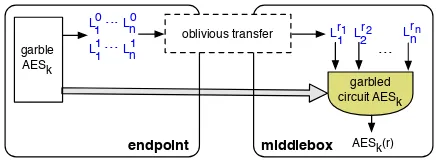
Intuition. We provide a technique, calledobfuscated rule encryption, to address this problem. The idea is that the sender provides to the middlebox an “obfuscation” of the functionAESwith the keykhardcoded in it. This obfusca-tion hides the keyk. The middlebox runs this obfuscation on the rulerand obtainsAESk(r), without learningk. We
denote this obfuscated function byObfAESk.
Since practical obfuscation does not exist, we implement it with Yao garbled circuits [52, 36], on which we elabo-rate below. With garbled circuits, MB cannot directly plug inr as input to ObfAESk(); instead, it must obtain from
the endpoints an encoding ofr that works withObfAESk.
For this task, the sender uses a protocol called oblivious
Lr11Lr22 Lrnn oblivious transfer
middlebox AESk(r) endpoint
garbled circuit AESk
... garble
AESk
L10...Ln0
L11...Ln1
Figure 2: Rule preparation. The endpoint has a key k
and the middlebox has a keywordr.
transfer [37,14], which does not revealrto the endpoints. Moreover, MB needs to obtain a fresh, re-encrypted garbled circuit ObfAESk()for every keyword r; the reason is that
the security of garbled circuits does not hold if MB receives more than one encoding for the same garbled circuit.
A problem is that MB might attempt to run the obfus-cated encryption function on rules of its choice, as opposed to rules from RG. To prevent this attack, rules from RG must be signed by RG and the obfuscated (garbled) function must check that there is a valid signature on the input rule before encrypting it. If the signature is not valid, it outputs null.
Let us now present the building blocks and our protocol in more detail.
Yao garbling scheme [52,36]. At a high level, a garbled circuit scheme, first introduced by Yao, consists of two algo-rithmsGarbleandEval. Garbletakes as input a functionF
withnbits of input and outputs a garbled functionObfFand
npairs of labels(L0
1, L11), . . . ,(L0n, L1n), one pair for every
input bit ofF. Consider any inputxofnbits withxibeing
itsi-th bit.ObfFhas the property thatObfF(Lx1
1 , . . . , Lxnn ) = F(x). Basically, ObfFproduces the same output as F if given the labels corresponding to each bit ofx. Regarding security,ObfFandLx1
1 , . . . , Lxnn do not leak anything about F andxbeyondF(x), as long as an adversary receives la-bels for only one inputx.
1-out-of-2 oblivious transfer (OT) [37,14].Consider that a party A has two values,L0andL1, and party B has a bitb. Consider thatB wants to obtain theb-th label fromA,Lb, but B does not want to tellbto A. Also, A does not wantB
to learn the other labelL1−b. Hence,B cannot sendbto A and A cannot send both labels to B. Oblivious transfer (OT) enables exactly this:Bcan obtainLbwithout learningL1−b
and A does not learnb.
Rule preparation.Fig.2illustrates the rule preparation pro-cess for one keywordr. One endpoint could be malicious and attempt to perform garbling incorrectly to eschew de-tection. To prevent such an attack, both endpoints have to prepare the garbled circuit and send it to MB to check that they produced the same result. If the garbled circuits and labels match, MB is assured that they are correct because at least one endpoint is honest (as discussed in Sec.2.2.2). To enable this check, the endpoints must use the same random-ness obtained from a pseudorandom generator seeded with
Rule preparation:
1: MB tells S and R the number of rulesN it has. 2: For each rule1, . . . , N, do:
2.1: S and R: Garble the following functionF.
F on input [x,sig(x)] checks if sig(x) is a valid signature onxusing RG’s public key. If yes, it encryptsxwithAESk and outputs
AESk(x); else, it outputs⊥.
In the garbling process, use randomness based onkrand. Send the resulting garbled
cir-cuit and labels to MB.
2.2: MB: Verify that the garbled circuits from S and R are the same, and letObfAESk be this
garbled circuit. Letrandsig(r)be the cur-rent rule and its signature. Run oblivious transfer with each of S and R to obtain the labels forrandsig(r). Verify that the labels from S and R are the same, and denote them
Lr1 1 , . . . , L
rn n .
2.3: MB: Evaluate ObfAESk on the labels Lr1
1 , . . . , L rn
n to obtainAESk(r).
Rule preparation is the main performance overhead of Blind-Box HTTPS. This overhead comes from the oblivious trans-fer and from the generation, transmission and evaluation of the garbled circuit, all of which are executed once for every rule. We evaluate this overhead in §8.
We additionally use a performance optimization that, in-stead of garbling the verification ofsig, it garbles a hash computation while achieving the same security level.
3.4
Validate Tokens
As shown in Fig.1, the validate tokens procedure runs at the receiver. This procedure takes the decrypted traffic from SSL and runs the same tokenize and encrypt modules as the sender executes on the traffic. The result is a set of encrypted tokens and it checks that these are the same as the encrypted tokens forwarded by MB. If not, there is a chance that the other endpoint is malicious and flags the misbehavior.
3.5
Security Guarantees
We proved our protocol secure with respect to our exact match privacy model; the proofs can be found in the Ap-pendix. We formalized the property that DPIEnc hides the traffic content from MB using an indistinguishability-based security definition. Informally, MB is given encryptions of a sequence of tokenst01, . . . , t0n and keywordsr1,. . .,rm.
Then, MB can choose two tokenst0 andt1 which do not match any of the keywords. Next, MB is given a ciphertextc
=Enck(salt, tb)for some bitbandsaltgenerated according
to the BlindBox Detect protocol. The security property says that no polynomial-time attacker at MB can guess the value
ofbwith chance better than half. In other words, MB cannot tell ift0ort1is encrypted inc. We can see why this
prop-erty holds intuitively: if MB does not have AESk(tb), this
value is indistinguishable from a random value by the pseu-dorandom permutation property of AES. Hence,Enck(·, tb)
maps each salt to a random value, and there are no repeti-tions among these random values due to the choice of salt in BlindBox Detect. Thus, the distributions of ciphertexts for each value ofbare essentially the same, and thus indistin-guishable.
As part of our privacy model, BlindBox reveals a small amount of information to make detection faster: BlindBox does not hide the number of tokens in a packet. Also, if a suspicious keyword matches at an offset in the traffic stream, MB learns this offset. Hence, BlindBox necessarily weakens the privacy guarantees of SSL to allow efficient detection. (Note that BlindBox preserves the authenticity property of SSL.)
4.
PROTOCOL II: LIMITED IDS
This protocol supports a limited form of an IDS. Namely, it allows a rule to contain: (1) multiple keywords to be matched in the traffic, and (2) absolute and relative offset informa-tion within the packet. In our industrial dataset, the average
rulecontained threekeywords; a rule is “matched” if all key-words are found within a flow.
This protocol supports most of the functionality in the rule language of Snort [49]. A few functional commands are not supported, the most notable beingpcre, which allows arbi-trary regular expressions to be run over the payload. This command is supported by Protocol III.
For example, consider rule number 2003296 from the Snort Emerging Threats ruleset:
alerttcp $EXTERNAL_NET $HTTP_PORTS
-> $HOME_NET 1025:5000 (
flow: established,from_server;
content: “Server|3a| nginx/0.”;
offset: 17;depth: 19;
content: “Content-Type|3a| text/html”;
content: “|3a|80|3b|255.255.255.255”; )
This rule is triggered if the flow is from the server, it contains the keyword “Server|3a| nginx/0.” at an offset be-tween 17 and 19, and it also contains the keyword “Content-Type|3a| text/html” and “|3a|80|3b|255.255.255.255”. The symbol “|” denotes binary data.
whether the offset of this encrypted token satisfies any range that might have been specified in the relevant rule. If all the fields of the relevant rule are satisfied, MB takes the action indicated by the rule.
Security Guarantee. The security guarantee is the same as in Protocol I: for each rule keyword, the middlebox learns if the keyword appears in the traffic and at what offset, but it learns nothing else about the parts of the traffic that do not match keywords. Note that the security guarantee is defined per keyword and not per rule: MB learns when a keyword matches even if the entire rule does not match.
5.
PROTOCOL III: FULL IDS WITH
PROBABLE CAUSE PRIVACY
This section enables full IDS functionality, including reg-exp and scripts, based on our probable cause privacy model. If a keyword from a rule (a suspicious keyword) matches a stream of traffic, MB should be able to decrypt the traf-fic. This enables the middlebox to then run regexp (e.g., the “pcre” field in Snort) or scripts from Bro [39] on the de-crypted data. However, if such a suspicious keyword does not match the packet stream, the middlebox cannot decrypt the traffic (due to cryptographic guarantees), and the security guarantee is the same as in Protocol II.
Protocol insight. The idea is to somehow embed the SSL key kSSL into the encrypted tokens, such that, if MB has
a rule keywordrthat matches a tokent in the traffic, MB should be able to computekSSL. To achieve this goal, we
re-place the encrypted tokenEnck(salt, t)withEnck(salt, t)⊕ kSSL, where⊕is bitwise XOR. Ifr =t, MB hasAESk(t)
and can constructEnck(salt, t), and then obtainkSSLthrough
a XOR operation. The problem is that this slows down de-tection to a linear scan of the rules because the need to com-pute the XOR no longer allows a simple tree lookup of an encrypted token into the rule tree (described in Sec.3.2). Protocol. To maintain the efficiency of the detection, we retain the same encrypted token as in DPIEnc and use it for detection, but additionally create an encrypted token that has the key embedded in as above. Now, the encryption of a to-kentbecomes a pair[c1=Enck(salt, t),c2=Enc∗k(salt, t)⊕ kSSL],whereEnc∗k(salt, t) = AESAESk(t)(salt+ 1)and the
saltis generated as in BlindBox Detect (§3.2). Note that it is crucial that the salt inEnc∗k differs from the salt in anyc1
encryption oftbecause otherwise an attacker can compute
c1⊕c2and obtainkSSL. To enforce this requirement across
different occurrences of the same token in BlindBox Detect, the sender nowincrements the salt by two: it uses an even salt forc1(and so does MB for the rules in the tree), while it uses an odd salt forc2. MB usesc1to perform the detection as before. If MB detects a match with rulerusing Blind-Box Detect, MB computesEnc∗k(salt, r)usingAESk(r), and
computesEnc∗k(salt,r)⊕c2, which yieldskSSL. We prove
the security of this protocol in the Appendix.
6.
DISCUSSION
In this section, we discuss adoption of BlindBox and pri-vacy implications of the choice of rules and tokenization strategy in BlindBox.
6.1
Adoption
ISP Adoption. In enterprises and private networks, Blind-Box provides a good trade-off between the desires of users (who want privacy, and may want processing) and the net-work administrator (who wants to deploy processing primar-ily, and is willing to respect privacy if able to do so). Hence, deploying BlindBox is aligned with both parties’ interests. However, in ISPs, sales of user data to marketing and ana-lytics firms are a source of revenue – hence, an ISP has an incentive not to deploy BlindBox. Consequently, deploy-ment in ISPs is likely to take place either under legislative requirement through privacy laws, or through a change in incentives. The growing trend of middlebox processing be-ing offered as a “service” – which users opt in to and pay for – may offer an incentive for an ISP to deploy BlindBox with the promise of a new revenue stream directly from the user. Client Adoption.BlindBox proposes a new end-to-end en-cryption protocol to replace HTTPS altogether. A truly ideal solution would require no changes at the endpoints – indeed, the success of middlebox deployments is partly due to the fact that middleboxes can be simply “dropped in” to the net-work. Unfortunately, existing HTTPS encryption algorithms use strong encryption schemes, which do not support any
functional operations and cannot be used for our task; hence one must change HTTPS. Nonetheless, we believe that, in the long run, a change to HTTPS to allow inspection of en-crypted traffic can be generic enough to support a wide ar-ray of middlebox applications, and not just the class of mid-dleboxes in BlindBox. We believe these benefits will merit widespread “default” adoption in end host software suites.
6.2
Privacy implications of choice of rules and
tokenization
The choice of rules affects privacy significantly. In the extreme, rules that match each letter ‘a’, ‘b’,. . ., ‘z’, result in no privacy at all.
With BlindBox, rule designers must consider privacy im-plications of the rules they choose: ideally, a keyword should not match benign traffic at all.
Note that we donotprovide guidelines on how to choose keywords or rules that are safe to use with our protocols; we contributeonlythe mechanism for implementing match-ing and probable cause decryption once the rules are chosen carefully. Choosing rules in a way that preserves matching and privacy requires careful thought.
In fact, we emphasize that some existing rules arenot safe
‘.exe’. This can cause frequent matching in Protocol II or frequent decryption in Protocol III.
An interesting future work question is to design a scheme that enables the middlebox to learn if a rule matches in an all-or-nothing way: that is, if a rule has more than one keyword, the middlebox should learn only if all strings match, and not if a subset of them match.
6.2.1
How to tokenize given rules
Consider a set of rules. Define “effective keyword” to be a keyword that must be matched by BlindBox on the traffic. For Protocol II, every keyword of each rule is an effective keyword. For Protocol III, there is one effective keyword per rule as defined in §6.2.2. Since effective keywords have different lengths, the tokenization can happen in lengths of 2,4,8,16,32,64, and128. If an effective keyword is of size
`, a rule keyword is tokenized using thelargesttoken size at most`. For example, if the string is size65, it is broken into two strings each of size64that overlap in63positions. One mustnotbreak the effective keywords in smaller tokens because this will leak more than necessary. Hence, for ex-ample, if there is only one effective keyword that is short, say of length4, tokens of size4in the traffic will match only this effective keyword and not other rules.
6.2.2
Tokenization for Protocol III
Given a rule for Protocol III, to decrease the frequency of decryption, the probable cause decryption must be trig-gered by a string in this rule that appears in the traffic as infrequently as possible (ideally, only when the traffic is sus-picious). This string can be a keyword or a substring of a regular expression that is matched by equality. Probable cause decryption should be triggered by only one such string per rule (because a rule matches only when all such strings match). For example, for a rule with content =‘abc’ and con-tent = ‘abcdefghij’, the trigger should be the second string. If the rule additionally contains pcre = ‘[1-9]abcdefghij123’, the trigger should be ‘abcdefghij123’.
Furthermore, our subsequent work on Embark [35] con-verts a class of regular expressions into exact matching. Thus, for some rules, one can use Protocol II instead of Protocol III and avoid probable cause decryption. For example, for Snort community, BlindBox would resort to Protocol III for 33% of rules, but Embark would only require this for 11.3%. With Snort Emerging Threats, BlindBox would use Protocol III for 58% of rules, but Embark would only do so for 20.2%.
7.
SYSTEM IMPLEMENTATION
We implemented two separate libraries for BlindBox: a client/server library for transmission called BlindBox HTTPS, and a Click-based [34] middlebox.
BlindBox library.The BlindBox HTTPS protocol is imple-mented in a C library. When a client opens a connection, our protocol actually opens three separate sockets: one over nor-mal SSL, one to transmit the “searchable” encrypted tokens,
and one to listen if a middlebox on path requests garbled circuits. The normal SSL channel runs on top of a modi-fied GnuTLS [12] library which allows us to extract the ses-sion key under Protocol III. On send, the endpoint first sends the encrypted tokens, and then sends the traffic over normal HTTPS. If there is a middlebox on the path, the endpoints generate garbled circuits using JustGarble [16] in combina-tion with the OT Extension library [5].
The middlebox. We implemented the middlebox in multi-threaded Click [34] over DPDK [2]; in our implementation, half of the threads perform detection over the data stream (“detection” threads), and half perform obfuscated rule en-cryption exchanges with clients (“garble” threads). When a new connection opens, a detection thread signals to a garble thread and the garble thread opens an obfuscated rule en-cryption channel with the endpoints. Once the garble thread has evaluated all circuits received from the clients and ob-tained the encrypted rules, it constructs the search tree. The detection thread then runs the detection based on the search tree, and allows data packets in the SSL channel to proceed if no attack has been detected.
When a detection thread matches a rule, under Protocols I and II, the middlebox blocks the connection. Under Pro-tocol III, it computes the decryption key (which is possible due to a match), and it forwards the encrypted traffic and the key to a decryption element. This element is implemented as a wrapper around the open-source ssldump [10] tool. The decrypted traffic can then be forwarded to any other system (Snort, Bro, etc.) for more complex processing. We mod-eled this after SSL termination devices [18], which today man-in-the-middle traffic before passing it on to some other monitoring or DPI device.
8.
EVALUATION
When evaluating BlindBox, we aimed to answer two ques-tions. First, can BlindBox support the functionality of our target applications – data exfiltration (document watermark-ing), parental filtering, and HTTP intrusion detection? Sec-ond, what are the performance overheads of BlindBox at both the endpoints and the middlebox?
8.1
Functionality Evaluation
To evaluate the functionality supported by BlindBox, we answer a set of sub-questions.
Can BlindBox implement the functionality required for each target system? Table1 shows what fraction of “rules” for different target applications rely solely on single-exact match (as in Protocol I), multiple exact-match strings (as in Proto-col II), or regular expressions or scripts (as in ProtoProto-col III). We evaluate this using public datasets for document water-marking [47], parental filtering [13], and IDS rules (from the Snort community [9] and Emerging Threats [3]). In ad-dition, we evaluate on two industrial datasets from Lastline and McAfee Stonesoft to which we had (partial) access.
com-pletely supported using Protocol I because each system re-lies only on the detection of a single keyword to trigger an alarm. However, Protocol I can support only between 1.6-5% of the policies required by the more general HTTP IDS applications (the two public Snort datasets, as well as the datasets from McAfee Stonesoft and Lastline). This limita-tion is due to the fact that most IDS policies require deteclimita-tion of multiple keywords or regular expressions.
Protocol II, by supporting multiple exact match keywords, extends support to 29-67% of policies for the HTTP IDS applications. Protocol III supports all applications includ-ing regular expressions and scriptinclud-ing, by enablinclud-ing decryp-tion when there is a probable cause to do so.
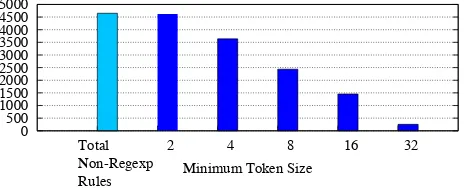
What fraction of existing rules can be used with Protocol II and a given minimum token length? Protocol II allows a middlebox to search for multiple exact-match strings to detect an attack. A rule generator may choose to restrict the minimum size of transmitted tokens to avoid many false pos-itive matches (trivially, the set of rules ‘a’, ‘b’... ‘z’ would allow a middlebox to decrypt all text), requiring tokens of 4, 8, or 16 bytes. Figure3shows the number of rules from the Emerging Threats Snort ruleset such that all search strings in the rule arencharacters long or more. This further reduces the number of rules that can be implemented with Blind-Box ‘as is.’ A rule generator may be able to rewrite these rules such that they do not require searches for such short tokens, removing the short terms and potentially adding in additional search terms to avoid increasing false positives. We leave an exploration of such a mechanism to future work.
Does BlindBox fail to detect any attacks/policy violations that these standard implementations would detect? The an-swer depends on which tokenization technique one uses out of the two techniques we described in §3: window-based and delimiter-based tokenization. The window-based tok-enization does not affect the detection accuracy of the rules because it creates a token at every offset. The delimiter-based tokenization relies on the assumption that, in IDSes, most rules occur on the boundary of non-alphanumeric char-acters, and thus does not transmit all possible tokens – only those required to detect rules which occur between such “de-limiters”. To test if this tokenization misses attacks, we ran BlindBox over the ICTF2010 [51] network trace, and used as rules the Snort Emerging Threats ruleset from which we removed the rules with regular expressions. The ICTF trace was generated during a college “capture the flag” contest during which students attempted to hack different servers to win the competition, so it contains a large number of attacks. We detected 97.1% of the attack keywords and 99% of the attack rules that would have been detected with Snort. (Re-call that an attack rule may consist of multiple keywords.)
8.2
Performance Evaluation
We now investigate BlindBox’s performance overheads at both the client and the network. For all experiments, the client software uses Protocol II, which has higher overhead
Dataset I. II. III.
Document watermarking [47] 100% 100% 100%
Parental filtering [13] 100% 100% 100%
Snort Community (HTTP) 3% 67% 100%
Snort Emerging Threats (HTTP) 1.6% 42% 100%
McAfee Stonesoft IDS 5% 40% 100%
Lastline 0% 29.1% 100%
Table 1: Fraction of attack rules in public and industrial rule sets addressable with Protocols I, II, and III.
0 500 1000 1500 2000 2500 3000 3500 4000 4500 5000
Total Non-Regexp Rules
2 4 8 16 32
Minimum Token Size
Figure 3: Number of rules in the Emerging Threats dataset which (a) do not require regular expressions, and (b) search for exact match strings of minimum lengths 2 - 32.
than Protocol I. We do not evaluate Protocol III directly; the differences we would expect from Protocol III relative to II would include a secondary middlebox to perform regular ex-pression processing, and an increase in bandwidth due to the key being embedded in each encrypted token.
Our prototype of the client software runs on two servers with 2.60 GHz processors connected by a 10GbE link. The machines are multicore, but we used only one thread per client. The CPU supports AES-NI instructions and thus the encryption times for both SSL and BlindBox reflect this hard-ware support. Since typical clients are not running in the same rack over a 10GbE links, in some experiments we re-duced throughput to 20Mbps (typical of a broadband home link) and increased latency to 10ms RTT. Our prototype mid-dlebox runs with four 2.6GHz Xeon E5-2650 cores and 128 GB RAM; the network hardware is a single 10GbE Intel 82599 compatible network card. All of our experiments were performed on this testbed. For microbenchmarks (as in Table2), we measured time to complete a loop of 10,000 iterations and took an average. For flow completion bench-marks we took an average of five runs.
rules; hence, BlindBox is not yet practical for systems with thousands of rules and short-lived connections that need to run setup frequently. We now elaborate on all these points.
8.2.1
Strawmen
BlindBox is the only system we know of to enable DPI over encrypted data. Nevertheless, to understand its perfor-mance, we compare it to standard SSL as well as two straw-men, which we now describe.
A searchable encryption scheme due to Song et al. [48]:
This scheme does not enable obfuscated rule encryption or probable cause decryption, but can implement encryption and detection as in Protocols I and II (but not Protocol III). We used the implementation of Song et al. from [40], but re-placed the use of SHA512 with the AES-NI instruction in a secure way, to speed up this scheme.
Generic functional encryption (FE) [24,28]:Such schemes, if enhanced with our obfuscated rule encryption technique, can in theory perform Protocols I, II, and III. However, such encryption schemes are prohibitively expensive to be run and evaluated. For example, one such scheme [28] nests fully homomorphic encryption twice, resulting in an overhead of at least10orders of magnitude. Instead, we chose and im-plemented a simple and specialized functional encryption scheme due to Katz et al. [32]. The performance of this scheme is a generous lower bound on the performance of the generic protocols (the Katz et al. scheme does not sup-port Protocol III because it can compute only inner product).
8.2.2
Client Performance
How long does it take to encrypt a token?Table2provides micro-benchmarks for encryption, detection, and setup using BlindBox, HTTPS, and our strawmen. With HTTPS (using GnuTLS), encryption of one 128-bit block took on average 13ns, and 3µs per 1400 byte packet. BlindBox increases these values to69ns and 90µs respectively. These figures include the time to perform HTTPS transmission in the pri-mary channel, as well as the overheads from BlindBox: the tokenization process itself (deciding which substrings to tok-enize) as well as the encryption process (encrypting and then hashing each token with AES). The searchable strawman performs encryption of a single token on average 2.7µs and 257µs for an entire packet; the primary overhead relative to BlindBox here is multiple calls to/dev/urandombecause the scheme requires random salts for every token. With fixed or pre-chosen salts, we would expect the searchable straw-man to have comparable encryption times to BlindBox. As we discuss, the detection times for this strawman are slower. The FE strawman takes six orders of magnitude longer than BlindBox and is even further impractical: a client using this scheme could transmit at most one packet every 15 seconds.
How long does the initial handshake take with the middle-box? The initial handshake to perform obfuscated rule en-cryption runs in time proportional to the number of rules. In the datasets we worked with, the average Protocol II rule had
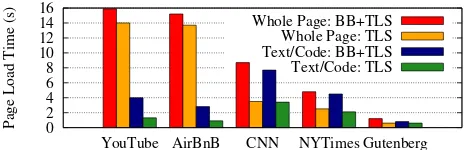
0 2 4 6 8 10 12 14 16
YouTube AirBnB CNN NYTimes Gutenberg
Page Load Time (s)
Whole Page: BB+TLS Whole Page: TLS Text/Code: BB+TLS Text/Code: TLS
Figure 4: Download time for TLS and BlindBox (BB) + TLS at 20Mbps×10ms.
0 1 2 3 4 5 6 7 8 9
CNN NYTimes YouTube AirBnB Gutenberg
Page Load Time (s)
Whole Page: BB+TLS Whole Page: TLS Text/Code: BB+TLS Text/Code: TLS
Figure 5: Download time for TLS and BlindBox (BB) + TLS at 1Gbps×10ms.
slightly more than 3 keywords; a typical 3000 rule IDS rule set contains between 9-10k keywords. The total client-side time required for 10k keywords was 97 seconds; for 1000 keywords, setup time was 9.5s. In a smaller ruleset of 10 or 100 keywords (which is typical in a watermark detection exfiltration device), setup ran in 650ms and 1.6 seconds, re-spectively. These values are dependent on the clock speed of the CPU (to generate the garbled circuits) and the network bandwidth and latency (to transmit the circuits from client to sender). Our servers have 2.6GHz cores; we assumed a mid-dlebox on a local area network near the client with a 100µs RTT between the two and a 1Gbps connection. Garbling a circuit took 1042µs per circuit; each garbled circuit trans-mission is 599KB.
Neither strawman has an appropriate setup phase that meets the requirement of not making the rules visible to the end-points. However, one can extend these strawmen with Blind-Box’s obfuscated rule encryption technique, and encrypt the rules using garbled circuits. In this case, for the scheme of Song et al., the setup cost would be similar to the one of BlindBox because their scheme also encrypts the rule key-words with AES. For the scheme of Katz et al., the setup would be much slower because one needs garbled circuits for modular exponentiation, which are huge. Based on the size of such circuits reported in the literature [16], we can compute a generous lower bound on the size of the garbled circuits and on the setup cost for this strawman: it is at least 1.8·103times larger/slower than the setup in BlindBox.
Guten-Vanilla HTTPS FE Strawman Searchable Strawman BlindBox HTTPS
Client
Encrypt(128 bits) 13ns 70ms 2.7µs 69ns
Encrypt(1500 bytes) 3µs 15s 257µs 90µs
Setup(1 Keyword) 73ms N/A N/A 588 ms
Setup(3K Rules) 73ms N/A N/A 97 s
MB
Detection:
1 Rule, 1 Token NP 170ms 1.9µs 20ns
1 Rule, 1 Packet NP 36s 52µs 5µs
3K Rules, 1 Token NP 8.3 minutes 5.6ms 137ns
3K Rules, 1 Packet NP 5.7 days 157ms 33µs
Table 2: Connection and detection micro-benchmarks comparing Vanilla HTTPS, the functional encryption (FE) strawman, the searchable strawman, and BlindBox HTTPS. NP stands for not possible. The average rule includes three keywords.
berg. The data shown represents the post-handshake (per-sistent connection) page download time, with tokenization on 8-byte boundaries. YouTube and AirBnB load video, and hence have a large amount of binary data which is not tok-enized. CNN and The New York Times have a mixture of data, and Project Gutenberg is almost entirely text. We show results for both the amount of time to download the page in-cluding all video and image content, as well as the amount of time to load only the Text/Code of the page. The overheads when downloading the whole page are at most 2×; for pages with large amount of binary data like YouTube and AirBnB, the overhead was only 10-13%. Load times for Text/Code only – which are required to actually begin rendering the page for the user – are impacted more strongly, with penal-ties as high as 3×and a worst case of about 2×.
What is the computational overhead of BlindBox encryption, and how does this overhead impact page load times?While the encryption costs are not noticeable in the page download times observed over the “typical client” network configura-tion, we immediately see the cost of encryption overhead when the available link capacity increases to 1Gbps in Fig-ure5– at this point, we see a performance overhead of as much as 16×relative to the baseline SSL download time. For both runs (Figs. 4 and5), we observed that the CPU was almost continuously fully utilized to transfer data dur-ing data transmission. At 20Mbps, the encryption cost is not noticeable as the CPU can continue producing data at around the link rate; at 1Gbps, transmission with BlindBox stalls relative to SSL, as the BlindBox sender cannot encrypt fast enough to keep up with the line rate. This result is unsur-prising given the results in Table2, showing that BlindBox takes 30×longer to encrypt a packet than standard HTTPS. This overhead can be mitigated with extra cores; while we ran with only one core per connection, tokenization can eas-ily be parallelized.
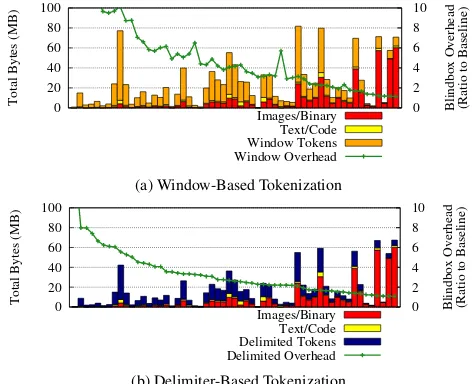
What is the bandwidth overhead of transmitting encrypted tokens for a typical web page?Minimizing bandwidth over-head is key to client performance: less data transmitted means less cost, faster transfer times, and faster detection times. The bandwidth overhead in BlindBox depends on the num-ber of tokens produced. The numnum-ber of encrypted tokens varies widely depending on three parameters of the page
0 20 40 60 80 100
0 2 4 6 8 10
Total Bytes (MB) Blindbox Overhead (Ratio to Baseline)
Images/Binary Text/Code Window Tokens Window Overhead
(a) Window-Based Tokenization
0 20 40 60 80 100
0 2 4 6 8 10
Total Bytes (MB) Blindbox Overhead (Ratio to Baseline)
Images/Binary Text/Code Delimited Tokens Delimited Overhead
(b) Delimiter-Based Tokenization
Figure 6: Bandwidth overhead over top-50 web dataset.
ing loaded: what fraction of bytes are text/code which must be tokenized, how “dense” the text/code is in number of de-limiters, and whether or not the web server and client support compression.
0 100000 200000 300000 400000 500000 600000 700000 800000
900000 1e+06
Gutenberg AirBnB NYT YouTube CNN
Total Transmitted Tokens
Size = 2 Size = 4 Size = 8 Size = 16 Size = 32
Figure 7: Tokens generated for each of six popular web-sites using delimiter-based tokenization and a minimum token size between 1-32 bytes.
0 0.2 0.4 0.6 0.8 1
0 5 10 15 20
CDF
Tokenization Overhead Ratio Delim Tokenization : Plaintext Window Tokenization : Plaintext Delim Tokenization : gzip Window Tokenization : gzip
Figure 8: Ratio: transmitted bytes with BlindBox to transmitted bytes with SSL.
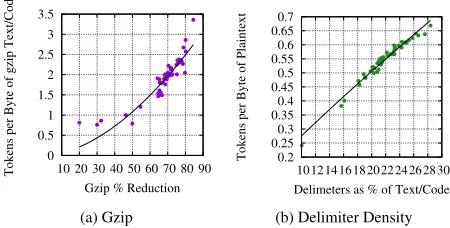
text, HTML, and Javascript because we do not tokenize video. A second factor, better observed in Figures 8 and9(a) is whether or not the web server hosting the page supports gzip compression. Many web servers will compress con-tent before sending it to clients, which then unzip the data before passing to rendering in the browser. Where win-dow based tokenization imposes a penalty of one token (five bytes) per plaintext byte (and delimiter-based tokenization imposes less than half of a token – 2.2 bytes – by eliminat-ing tokens which are redundant to the DPI engine), com-pressing the plaintext makes the perceived penalty higher: the baseline data can be compressed, but encrypted tokens cannot. In Figure8we show a CDF of the ratio of BlindBox bytes to SSL bytes when gzip is not enabled, and when gzip is enabled exactly as in the original trace (i.e. we compare against the bytes gzipped when we downloaded the dataset from the webservers; if any data was not compressed we left it as-is and did not try to compress it further). When com-pared against plaintext, both window and delimiter based to-kenization have “tight” tails – the worst page with window based tokenization has slightly more than 5×overhead, and the worst page with delimiter tokenization has around 4×
overhead. But, for pages which benefit strongly from com-pression, the penalty can begin to look dramatic at the tail, going as high as 24×for one page (Craigslist.com, which is mostly text/code and benefits strongly from compression). Figure9(a) shows for each page the number of tokens pro-duced on average per byte, plotted against the page reduction achieved by the web server by using gzip.
The final factor is simply the number of delimiters seen in a page – text-only pages like Project Gutenberg do well
0 0.5 1 1.5 2 2.5 3 3.5
10 20 30 40 50 60 70 80 90
Tokens per Byte of gzip Text/Code
Gzip % Reduction
0.2 0.25 0.3 0.35 0.4 0.45 0.5 0.55 0.6 0.65 0.7
10 12 14 16 18 20 22 24 26 28 30
Tokens per Byte of Plaintext
Delimeters as % of Text/Code
(a) Gzip (b) Delimiter Density
Figure 9: Impact of compression and delimiter density on tokenization overhead for delimiter-based tokeniza-tion only.
in this metric, since there are few code-like characters in the text. The worst performers in this area are pages which make large use of compressed javascript code, where a large frac-tion of characters result in tokenizafrac-tion. Figure9(b) illus-trates this effect for the same dataset as previously.
8.2.3
Middlebox Performance
We investigate performance at the middlebox using both micro-benchmarks and overall throughput.
What throughput can BlindBox sustain and how does this compare to standard IDS?When running our BlindBox im-plementation over synthetic traffic, we measured a through-put of 166Mbps; when running Snort over the same traf-fic, we measured a throughput of 85Mbps. Hence, Blind-Box performed detection twice as fast as Snort, which in-spectsunencryptedtraffic. The reason behind this situation is twofold. First, BlindBox reduces all detection to exact matching, pushing all regular expression parsing to a sec-ondary middlebox, invoked rarely. Second, our implementa-tion is built over DPDK-click, a faster packet-capture library than what Snort uses by default. Hence, it is unsurpris-ing that BlindBox performs detection more quickly. Nev-ertheless, the point of this experiment is not to show that BlindBox is faster than Snort, but instead to demonstrate that BlindBox provides competitive performance to today’s deployments.
How does BlindBox compare in detection time against other strawmen approaches? While we did not implement a ver-sion of BlindBox which relied on our strawmen, we can compare against it using a smaller benchmark. Once again, in Table2, the FE strawman is seen to be prohibitively im-practical: detection over a single packet against a 3000 rule-set takes more than a day.