Knowledge Based Inter-Firm Collaborations: A Theoretical
Review
Lydia Wanjiku Gachengo; B.Com, M.BA, PhD (Candidate)
P.O. Box 53 - 00200, Nairobi, Kenya
[email protected]
Josphat K. Kyalo; BSC, MSC [IS], PhD (Candidate)
P.O. Box 222 – 00519; Mlolongo, Kenya
[email protected]
Abstract
This paper seeks to study the theoretical and empirical theories of knowledge based strategic inter-firm collaboration between inter-firms. Strategic alliances are innovative and interesting forms of relationships between organizations and organizations create alliances in their quest to compete against fast and nimble competitors. This paper provided some evidence to suggest that companies relying on strategic alliances are more profitable than their vertically integrated counterparts. In effect, strategic alliances provide an effective means to improve both the economies of scale and scope offered by traditional modes of organization. Consequently, there has been a dramatic increase in the number of strategic alliances. In the last two decades, alliances have become a central part of most companies’ competitive and growth strategies. Alliances help firms strengthen their competitive position by enhancing market power, increasing efficiencies, accessing new or critical resources or capabilities and entering new markets. By the turn of this century many of the world’s largest companies had over 20% of their assets, and over 30% of their annual research expenditures, tied up in such relationships. The review of related literature brought out some theories and concepts which were related to my study.
Introduction
Global competition and complexity of the current economic context drive companies to meet market requirements and needs by devising quicker profitable solutions. As a consequence, firms should focus on exclusive resources, such as knowledge and capabilities. This exigency has caused some changes in the structure of companies to go beyond the traditional geographical, industrial and organizational boundaries. Moreover, periods of market uncertainty have suggested to take advantage from alliances and collaborations instead of facing limitations of self-sufficiency in order to access different sorts of intangible assets (Kraatz, 1998).
In the last two decades, alliances have become a central part of most companies’ competitive and growth strategies. Alliances help firms strengthen their competitive position by enhancing market power (Kogut, 1991), increasing efficiencies (Ahuja, 2000), accessing new or critical resources or capabilities (Rothaermel and Boeker, 2008), and entering new markets (Garcia-Canal et al., 2002). By the turn of this century many of the world’s largest companies had over 20% of their assets, and over 30% of their annual research expenditures, tied up in such relationships (Ernst, 2004).
A study by Partner Alliances reported that over 80% of CEOs believed that alliances would account for almost 26% of their companies’ revenues in 2007–08 (Kale, Singh, & Bell, 2009). Nevertheless, alliances also tend to exhibit high failure rates (Dyer, Kale, & Singh, 2001). Studies have shown that between 30% and 70% of alliances fail; in other words, they neither meet the goals of their parent companies nor deliver on the operational or strategic benefits they purport to provide (Bamford et al., 2004). Alliance termination rates are reportedly over 50% (Lunnan and Haugland, 2008), and in many cases forming such relationships has resulted in shareholder value destruction for the companies that engage in them (Kale et al., 2002).
Alliance management literature stream focuses on the on-going collaboration between alliance partners, and explores current practices for alliance making. While the dynamic perspective may be potentially extended to different aspects of a collaborative relationship (Ariño et al., 2008), the current literature comprises two stand-alone research streams in knowledge and risk management. This is the case since the monitoring of multiple risks, the integration of relevant knowledge, and the protection of proprietary knowledge represent primary requirements for the ultimate success of a strategic alliance. The management perspective is receiving increasing attention within the general alliance literature, but still needs to gain momentum within the start-up focused alliance literature.
Much attention has recently been devoted to issues surrounding strategic alliances as organizations are increasingly turning to alliances to help them successfully compete in the marketplace (Das, 1997). Despite the advantages of these alliances, strategic alliances do not always achieve desired results. Uncertainty about the behaviour of partners can be a cause for significant concern, thus leading to unstable and conflicting relationships (Hamel et al., 1989). Furthermore, many of the costs and risks of strategic alliances are indirect and long-term, and alliances initiated for short-term gains may generally lead to a loss of technological dynamism for the firm. Parkhe (1993) notes that a failure to understand the problems associated with strategic alliances can be attributed to a significant dearth of theoretical and empirical research on the topic.
Literature Review
With slow growth in the developed markets and lucrative opportunities in the under-developed economies, international companies have been seeking underdeveloped markets for new business expansion. Many scholars posits that markets of the future are not in the developed countries (where leading global firms are located) but in what are called transition economies (Arnold and Quelch 1998) which are characterized by scarcer resources, increased competition, higher customer expectation and a quicker pace of change but with institutional uncertainty socially within organizations are embedded to their environment with the level of embededness depending on the environmental uncertainty a company and its network partners face since the transition economies face unstable and fluctuating business environment strong interconnectedness and high complementarily among network partners capabilities is very critical for a firm’s success (Hitt et al 2004). The overall network structure of organizations can help managers to support organizational change.
senses, it will be deprived boundaries or the boundaries will be a sum of the boundaries of network elements. This, K Perechuda(1999) argues, threatens the organization and makes it susceptible to absorption by hostile ambient systems.
Worldwide there is a clear trend to blurr the boarders between economic organizations which are a
result of the progressive concentration of capital and emergence of transnational corporations. This is important to small businesses becoming satellite in relation to large international companies. This process makes it possible to attain capital more quickly, technology and know-how making an even greater case for interfirm networks.
Where organization boundaries are set F. Santos and K. Elsenhardit(1997) argue that they should be set at the point that maximizes the value of the firms resource portfolio. On the other hand, R Course(2000) states that these boundaries should be set at the point that minimizes the cost of governing activities. Thus its no longer a question of whether to have an interfirm network but a question of what and where boundaries should be put.
Interfirm networks can be studied from different disciplinary approaches using a number of social, economic and organization dimensions and showing different coordination properties.
As it is widely used the term “network” has lost precision (nohria and Ecclesu, 1992), the term itself being an abstract notion referring to a set of nodes and relationships which connect them (Fambrum 1982).
The way in which inter-organizational structures have been conceptualized and investigated varies among different scholars (Marrett 1971; Aldrich 1979; Hall 1991). In general, inter-organizational structures are described by the hierarchies, power relations, procedures, roles and routines among the network members (Barki and Pinsonneault 2005, 173)There are five dimensions of inter-organizational structures that reflect their characteristics. These five dimensions of a corporation’s inter-organizational structure are both network-wide and organization-specific (Hall and Tolbert 2005,201). They will be homogenous to the external environment but simultaneously heterogeneous within the network. All five dimensions are associated with the flexibility and ease of information exchange through their impact on the level of contact or the accessibility they provide to the business network members.
Commitment is an ‘enduring desire to maintain a valued’ relationship (Morgan & Hunt 1994) while trust is a confidence in a partner’s reliability and integrity and these two affect the relational depth. These two constructs together positively influence performance and relations behavior because organizations are more likely to act positively towards and in the best interest of committed and trusted allies. (Aderson and Weitc 1992, Hibbard et al 2001)
Dependence
This refers to the need to maintain a relationship to achieve goals. Researchers show that both interdependence and the mutual dependence of partners and the dependence asymmetry or the imbalance between the partners dependence are critical to understanding its impact in an interfirm relationship (Jap and Ganesan 2000). Kumar (1995) indicate that interdependence positively affects commitment and trust through a reduction in relationship problems and convergence of interests whereas dependence asymmetry undermines commitment and trust as partners interests diverge and the structural barriers to the coercive use of power fall. Relational norms have been investigated as both unique norms and composite construct. The commonly investigated norms are solidarity or partner believe in the importance of the relationship mutuality or the believe that success of one is a function of the partners success and that partner should share benefits and costs and flexibility – the willingness of the interfirm partners to adapt to new conditions (cannon, Achrol and Gundlach, 2000). Dependence has been widely studied as a critical determinant of interfirm relationship performance in terms of financial outcomes, cooperation and conflict. As firm invest time and effort to build relational governance structures, they become more dependent on their partner because duplicating relational bonds with a new partner would involve additional investments. Thus commitment and trust in a relational firm increases interdependence (E Ansary 1975). As partner firms commit RSI, they grow more dependent, and switching threats are less credible. Furthermore potential firms in an interfirm relationship may engage in opportunism and so eradicate trust in a partner. A firm must expend effort and search costs which increase dependence on safe partners.
Transaction Cost Economies Perspective
This focus on the twin focal constructs of specific investments and opportunism to predict governance and exchange performance. The normative claim is that firms should be vertically integrate when confronted with investments in idiosyncratic specific assets or suspicious of opportunistic behaviours of other firms. Because RSI represents sunk unredeployable assets in an exchange relationship, parties’ RSI reduce their motivation to behave opportunistically and the credibility of switching threats which in turn minimizes the partners needs ( and cost) to monitor performance or safeguard assets. With fewer opportunism concerns and lower monitoring and safeguarding costs, the relationship becomes more beneficial and efficient more prone to joint action and includes higher expectations of continuity all of which contribute to enhanced performance (Heide and John 1990). Researchers agree that opportunism has a negative impact on interfirm performance because it significantly increase the ex post costs associated with monitoring performance and safeguarding investments. Strong relationships cause partners to discount the possibilities that their partner firms will appropriate their investments and relational bonds and increase their willingness to make RSI. Its expected that interdependence will have a positive effect on a partner firms RSI because they are less concerned that partners will appropriate them (Heide and John, 1988). Interdependence would reduce partners tendency to behave opportunistically because they do not want to jeopardise a difficult to replace relationship. Transact cost analysis will work on the presumption of bounded rationality that effective communication between the interfirm organizations will reduce uncertainties in the relationship.
Relational Norms Perspective
Relational exchange theory rests on two key propositions for a contract to function, a set of common contracting norms must exist and that transactions are immersed in the relationship that surround them which may be described in terms of the relational norms of the partners. Relationalism plays a significant role in structuring economically efficient relationships and therefore should lead to improved financial performance (Heide and John 1992).
perceptions of dependence indicate significant stakes in the relationship and increase partners’ interest in maintaining the relationship. Conversely asymmetrical dependence promotes the coercive use of power and undermines relational norms. Communications effect on relational sentiments should be positive because ‘communication is the glue that holds together the relationship and helps create an atmosphere of mutual support and participative decision making (Mohr and Nevin 1990 pg 36).
The two basic philosophies which underlie the theories of firm behaviour are that companies either adapt to their environment or that companies attempt to influence their environment (Varadarajan, and Cunningham, 1995). In reality, companies develop and implement strategies constantly and rarely follow either of these two approaches alone. For explanatory purposes, the two philosophies can be seen as anchor points on a continuum on which various theories of firm behaviour can be examined. Several theories of firm behaviour can be used as a basis for explaining strategic collaboration formation: transaction cost theory, resource dependency theory, organizational theory, relationship marketing, and strategic behaviour theory. These theories of rational behaviour can be positioned with respect to the underlying philosophies.
According to transaction cost economics (TCE), in a world without transaction costs all activities would be carried out as exchanges between units, and it is due to the failure of markets to allow for many exchanges without prohibitively high transaction costs that firms come to exist (Williamson, 1985, 1991). In addition to concerns about the emergence of firms as a response to transaction costs, TCE also deals with the choice of organizational form and how this may vary according to the specific types of exchange activities encompassed. Alliances blend elements of the two extremes of market and hierarchy. Following this, it seems logical that firms would enter such collaborative arrangements when the transaction costs associated with an exchange are intermediate and not high enough to justify vertical integration (Williamson, 1985). Hence, the application of TCE to the formation and management of international strategic alliances seems obvious. Recently, however, researchers have been critical of TCE’s treatment of each transaction between firms as an independent event (Ring & Van de Ven, 1992). This assumption is particularly inappropriate in situations where firms repeatedly enter into relationships of transactions with each other, since as the length of the interaction between partners in-creases, the economic and informational transactions become increasingly embedded within the social relations of the partners, which helps establish trust and deter opportunism (Granovetter, 1985).
The desire and willingness to expend resources in the development of long-term relationships is closely linked to a firm’s prior experiences with that partner and the extent to which positive or negative expectancies have been fulfilled (Larson, 1992). Experience earned from prior engagement serves as evidence to justify subsequent risky steps beyond the accumulated evidence (Das and Teng, 1998). That is, faced with a situation in which one can be taken advantage of, a natural response is to restrict one’s transactions to those who have shown themselves to be trustworthy. Hence, a benefit of prior affiliation is that it allows the partner firms to know each other better thus facilitating a greater understanding of the respective capabilities and resources they are seeking to access and combine (Saxton, 1997). In addition, prior relationships indicate a history of repeated interaction, which may lead to relational advantages and stability. Thus, from a game-theoretic perspective, giving incumbents an advantage in the next round serves as a signal to the partner that the focal firm is playing a long-run “repeated game” (Fundenberg & Levine, 1998).
anew. Hence, prior experience with a partner may increase the likelihood of predicting accurately expected behavior of the partner and thus reduce the potential for conflict. Consequently, one would expect prior experience with a partner to be positively related to international alliance performance.
Another pre-alliance factor is reputation. Reputation refers, in this study, to the knowledge held by individuals about the potential partner in terms of this partner’s behavior in prior network relationships in addition to more traditional attributes of reputation, such as innovativeness, quality of management, employee talent, financial soundness, use of corporate assets, social responsibility, quality of product/services etc. Hence, the concept of reputation is closely related to Mayer et al.’s (1995) concept of integrity, since among the biggest concerns of firms entering into alliances is the predictability of their partner’s behavior. In lack of prior experience with a particular partner, the next logical step is to rely on the reputation of that firm, which is a direct consequence of prior relational behavior (Granovetter, 1985). Research suggests that most firms are embedded in a social network of prior alliances through which they are connected with one another either directly or indirectly (Kogut et al., 1993). The concept of structural embeddedness focuses on the informational role of the position an organization occupies in the overall structure of the network (Gulati, 1998; Uzzi, 1996).
A firm with a reputation of being honest, fair, and trustworthy gives one the first piece of evidence to take some initial risk (Barney and Hansen, 1994). Alternatively, once a firm has acquired a reputation for not being trustworthy in collaborative relation-ships or in general, future partners will perceive this firm as a greater liability in terms of inter-firm collaboration. Hence, following Burt and Knez’s (1996) argument, the historical trustworthiness of parties in previous interaction with others is important, and that it is the social context (e.g. networks) that makes reputational effects possible. Therefore, locating a partner with a good reputation seems to be an early indicator of successful collaboration.
As alliances increasingly become a fact of life in the business environment, exploiting the learning potential of alliances will become more important. By bringing together different firms with unique skills and capabilities, alliances can create powerful learning opportunities. However, without active management of the learning process and an under-standing of the nature of alliance knowledge, many of these opportunities will remain un-exploited. The acquisition of new organizational knowledge is increasingly becoming a managerial priority. As the global competitive environment continues to intensify, this priority takes on new significance. New knowledge provides the basis for organizational renewal and sustainable competitive advantage. In various studies, knowledge acquisition has been linked with operational performance as well as with the performance of specific organizational tasks (e.g. Epple et al., 1991; Doz, 1996). In bringing together firms with different skills and knowledge bases, alliances create unique learning opportunities for the partner firms. By definition, alliances involve a sharing of resources. In some cases, the shared resources are strictly financial, limiting partner learning opportunities, while in others access to knowledge is more profound. This access can be a powerful source of new knowledge that, in most cases, would not have been possible without the formal structure of an alliance. Partner firms that use this access to knowledge as the basis for learning have the opportunity to acquire knowledge that can be used to enhance partner strategy and performance. Despite the logical notion that alliances create learning opportunities, and although organizations often talk in glowing terms about their alliances' learning potential, research suggests that learning through alliances is a difficult, frustrating, and often misunderstood process (Inkpen, 1996; Inkpen & Crossan, 1995).
Moreover, if the initial motivational intent behind the alliance includes explicit attention to knowledge development and learning and this intent is later manifested in considerable resource commitment to knowledge development and internalization for commercial purposes through absorptive capacity (Cohen & Levinthal, 1990), one would expect a high potential for learning to have a positive impact on alliance performance.
Once the alliance has been formed, prior experience at cooperating becomes essential to the management of a diverse portfolio of collaborative ties as well as to accumulate the capability to benefit from the resulting interdependencies (Powell et al., 1996). The importance of collaborative know-how in relation to alliance performance is evidenced by Lei and Slocum (1992), who attribute alliance failure to lack of collaborative experience and understanding. Moreover, Simonin (1997) empirically found support for the emergence of a distinct form of collaborative know-how, which emerges from past experience, and which helps achieve greater benefits in subsequent alliances. As suggested by Simonin (1997) and others, this collaborative know-how affects the ability of firms, engaged in strategic alliances, to understand and adopt proper procedures and mechanisms for knowledge accumulation, transfer, interpretation, and diffusion. Key routines that help facilitate learning in the extended enterprise include the establishment of on-site consulting, supplier learning teams and problem-solving teams as well as employee rotation and elaborate systems for performance feedback and process monitoring (Dyer, 2000).
Trust has been included in numerous relationship studies conducted in both domestic (see Anderson & Weitz, 1989; Morgan & Hunt, 1994) and international (see Johnson et al., 1996; Larson, 1992) settings. Most studies concentrate, however, on two key components of trust; a cognitive component, derived from confidence in the reliability of a partner, and a behavioral component, derived from confidence in the intentions, motivations, honesty, or benevolence of a partner. Despite this attention to trust in alliance literature, the majority of research on trust is anecdotal, with little evidence of economic benefits. One reason for this lack of evidence is the intangible nature of trust, making it hard to define, not to mention quantify and measure. Hence, trust’s impact on ISA bottom-line results remains somewhat of a mystery. Consequently, we need to measure performance differently in order to capture the real benefits of trust in international joint ventures.
Trust is an important component of IJV performance because it provides for greater adaptability in an IJV, as well as improves knowledge exchange, a key component of organizational learning and IJV success (Dodgson, 1996; Das & Teng, 1997). Since the knowledge being exchanged may be not only tacit but also proprietorial (specific), and as such constitute important elements of a firm’s competence and competitiveness, high levels of trust are positively related to knowledge transfer (Simonin, 1999). Uzzi (1996) re-ported from his field study that trust acted as the governance mechanisms of embedded relationships and as such facilitated the exchange of especially tacit knowledge related capabilities and information. In other words, trust promotes voluntary, non-obligating exchanges of assets and services between actors. Hence, many researchers (see for in-stance Park & Ungson, 1997; Das & Teng, 1997) suggest that trust is important because it reduces the likelihood of opportunistic behavior, facilitates control through a shared- value system, and it tends to increase efficiency and improve performance.
If, as noted by Williamson (1985: 19), “transaction costs are the economic equivalent of friction in physical systems”, then we may conceptualize trust as the behavioral ‘lubricant’ that can improve a system’s (here an alliance’s) operating efficiency. Consequently, a significant outcome of trust is that it facilitates tighter social relationships and hence reduces uncertainty in transactions. In collaboration across organizational and national boundaries, where the level of complexity makes it virtually impossible to monitor in de-tail all aspects of exchange, trust is even more important. Hence, as the level of trust increases the (perceived) need to monitor diminishes. It follows, then, that trust is an important determinant of alliance performance because it increases a firm’s access to external knowledge and strengthens its ability to- in conjunction with its network partner- create new innovative and efficient ways of combining existing knowledge-related capabilities and resources in order to extract superior rents.
Another factor is protectiveness. Transaction cost economics assumes that agents are opportunistic, demonstrating self-interest (Williamson, 1985). Williamson (1985) asserts that opportunism does not pose the same difficulties for transactions within firms as it does for transactions between firms. He provides three reasons: 1) common ownership of assets limits incentives for individuals within firms to be opportunistic, 2) internal organization is able to use authority to direct behaviour, and 3) individuals within firms are likely to be better informed about conditions or be better able to monitor behaviour than those in different firms. Hence, the lesson of opportunism, Williamson maintains, is that contracts must recognize conditions, which promote opportunism and provide appropriate safeguards, such that contractual commitments become credible (Williamson, 1993).
Strategic collaboration has been advanced - from a traditional Williamson-like transaction cost standpoint – as an intermediate form between market and hierarchy, in order to explain the existence and economic justification of these networks. As mentioned earlier, knowledge exchanged in a collaborative arrangement may be proprietorial and thus provide important elements of a firm’s defining competence and competitiveness. Therefore, consistent with the re-source-based view of the firm, knowledge protectiveness is often seen as an appropriate safeguard against opportunistic behaviour in strategic alliances. Because of inter-partner asymmetry of knowledge demand and supply, it is expected that partner protectiveness and accessibility to its knowledge will be correspondingly asymmetrical. Hence, in general, international alliance partners are likely to be more protective of their knowledge resources when their competitive advantage relies on them. Consequently, in a situation of high competitive overlap between partners (for instance in a horizontal alliance), the firms will strive to restrict knowledge sharing because of the risk of knowledge spillover (Yan & Luo, 2001).
technology. In addition, gatekeepers can be assigned to filter information access and disclosure across organizational boundaries. However, the ability to learn through joint ventures does not simply rest on the firm’s internal absorptive capability and willingness to learn; it also depends on the willingness of external sources to cooperate (i.e. minimize protectiveness) (Pisano, 1988). Reciprocity suggests that accessibility to a partner’s knowledge depends, to a large degree, upon the extent to which the focal firm is open with its own knowledge to the partner. Protectiveness not only reduces the amount of information exchanged but also leads to uncertainty and distrust. Hence, Simonin (1999) found in his study of knowledge transfer in strategic alliances that protectiveness was positively related to ambiguity, and hence negatively related to knowledge transfer, suggesting that protectiveness acts as a barrier to effective knowledge exchange. This argument is supported by Madhok & Tallman (1998), who argue that safeguarding may hinder learning (performance) in strategic alliances. Lyles and Salk (1996) furthermore suggest that when disruptive to the operation of the alliance, protectiveness will contribute to the escalation of cross-cultural and other conflicts between partners. Protectiveness, then, hinders the effective exchange of knowledge and resources, suggesting that in order for successful collaboration to take place in international strategic alliances, the level of protectiveness should be at its lowest.
By their very nature, international strategic alliances are affected by differences in national cultures (Barkema & Vermeulen, 1997; Park & Ungson, 1997). The adverse affect of cultural differences between IJV partners on alliance performance has been suggested by several scholars (Mjoen and Tallman, 1997). This is consistent with the traditional internationalization perspective, which suggests a negative relationship between national cultural distance and performance. In fact, as argued by Meschi (1997), most problems encountered in international joint ventures can be traced back to cultural factors, be they national or organizational. Lyles and Salk (1996) report that not only conflicts but also cultural misunderstandings rooted in cultural differences can minimize flows of information and learning. Hence, the partner’s national or organizational culture has the potential to affect in depth all aspects of the collaboration, including performance.
Empirical findings are inconsistent due to the methodological and theoretical confusion related to the cultural distance construct (see Shenkar, 2001). For instance, Barkema and Vermeulen (1997) found that cultural distance (measured as uncertainty avoidance and long-term orientation) was positively related to IJV survival.This is supported by Barkema et al. (1997), who also found aggregate cultural distance to be significantly related to IJV survival. However, Chen and Boggs (1998) found that cultural distance de-creased the perceived prospects of IJV continuation in their sample of Chinese IJVs. In addition, Killing (1983) found that joint ventures, where one partner is from a developing country and the other from a developed country, are more likely to lead to decision impasses due to divergent attitudes. Moreover, Beamish (1985) showed that such joint ventures have a higher rate of failure than those formed between two firms both originating in developed countries. Similarly, Mowery et al. (1996) found that distance and cultural differences were key obstacles to inter-firm collaboration for U.S. firms engaged in inter-national alliances compared to firms engaged in domestic alliances. Moreover, cultural asymmetry (Hamel, 1991) can sometimes lead to an unbalanced situation between partners in their attempt to decode, transfer, and interpret knowledge.
Hongbin (UN) did a study based on 68 bio-tech firms in Xinjiang region and focused on the impact of cultural difference and communication on strategic alliance performance through Structural Equation Model (SEM). Empirical test proved although the cultural difference between strategic partners makes no difference on strategic alliance performance, their communication quality has a positive effect on trust between partners. The study found that trust between partners does not only impact on the evaluation of alliance performance, but shows a significant effect on the willingness of further cooperation. Meanwhile, the study revealed that alliance performance has a positive effect on partners’ future cooperation.
Gardner (1985) defined corporate culture as the shared value and thinking system which was intertwined though and by corporate employee, organizational structure and control mechanism. By which corporate behaviour was regulated. Lorsch (1986), according to high rank managers mental system, defined corporate culture as high rank managers’ shared value system, by which they knew how to manage their subordinates as well as run the company. Barney (1986) defined corporate culture as complex portfolio of value, belief, hypothesis and signal, which kept firms on the right track.
Morgan & Hunt (1994) and McAllister (1995) etc. believed when strategic partners have slight difference on corporate culture, by shared value, belief, partners could have high degree of trust. Smith & Barclay (1997) thought strategic partners’ cultural difference could influence inter-firm trust. When there exists big cultural difference, it would have a negative impact on mutual trust. Hofstede (1980) believed that in terms of strategic alliance, partners are the loading body. So their cultural difference would directly impact on alliance performance. Smilor & Gibson (1991) empirically proved that alliance partners’ similarity in corporate could enhance their performance based on marketing alliance Vyas, Shelburn & Rogers (1995) argued that cultural difference does not only exist in cross nation alliance, but in different firms of same nation. The mutual understanding of cultural difference is the key issue of alliance performance, while the flexibility and learning is the best solution to cultural difference.
Wolf (1994) in Hongbin (UN) found communication is essential to establish mutual trust between alliance partners based strategic alliance of US firms. Grounded on the alliance of manufacturer and distributors, Kumar (1997) proved that good and frequent communication would positively promote the mutual understanding between alliance partners, which is the critical factor to enhance partners’ trust. Simpson & Mayo (1997) thought the agreement and shared value derived from inter-firm communication is likely to increase alliance partners’ trust. Morris & Hegert (1987) argued that the number and quality of communication between alliance partners would have a positive impact on alliance success. Smilor & Gibson (1991) found communication plays a key role in technologic transfer between alliances. Wang Mingyu & Yuan Jianzhong (1994) empirically proved the smoothness communication would have a positive impact the effectiveness of alliance partners’ involvement based on strategic alliance in Taiwan Xinzhu Hi-tech development zone. Jao (1997) proved that the frequency and quality of communication between alliance partners is the vital factor for alliance performance.
Anderson & Narus (1990) found in the alliance of manufacturers and distributors, when manufacturers have high degree of trust to distributors, here comes high degree of satisfaction for partner relationship, meanwhile distributors also have same recognitions to manufacturers. Aulakh, Kotabe & Sahay (1996) found trust between alliance partners would positively impact their performance in cross nation marketing alliance. Parkhe (1993), Shamdasani & Sheth (1995) pointed if one firm believes his partner is trustworthy, the transaction cost could be greatly cut down, which further increase alliance performance.
cooperative relationship. Aulakh, Kotabe & Sahay (1996) argued the willingness of further cooperation is the signal of trust between partners. Based on vertical alliance, Anderson & Narus (1990) proved that the overall satisfaction to partners positively impact on the duration of alliance. So satisfaction could be employed as the indicator of future cooperation. Shamdasani & Sheth (1995) proved that the overall satisfaction derives from alliance practice and former experience, which reflects the willingness of further cooperation. When one firm gains more benefit from alliance, it brings stronger motivation to maintain cooperative relationship (Li Shengxiang, 1998).
According to several scholars (Colombo et al., 2006; Eisenhardt and Schonhooven, 1996; Mc Gee et al., 1995; Shan, 1990), technology start-ups facing adverse conditions are more inclined than their larger counterparts to establish collaborative relations. In highly competitive and emergent industries, new ventures consider strategic alliances either to pioneer innovative technologies, or to move away from a vulnerable position (Shan, 1990). The intellectual capital of a new venture represents an important determinant of alliance formation, since the possession of valuable resources is a necessary condition for the attraction of suitable partners (Ho Park et al., 2002). Moreover, the social connections of the founding team, along with endorsement by reputable organizations – such as venture capitalists – facilitate start-ups’ involvement in strategic alliances (Eisenhardt and Schonhooven, 1996). While access to external resources represents the strategic rationale for alliance making, the possession of valuable resources – in terms of intellectual, social, and reputational capital – are the primary enablers of alliance implementation. In a way, alliance making presents an inherent paradox for new ventures, since strategic alliances are set up to access external resources, yet internal resources are needed to set up strategic alliances. In this regard, Ho Park et al. (2002) showed that technology start-ups endowed with valuable resources are better able to bring about strategic alliances, and to get access to external resources needed to cope with market uncertainties. Therefore, the foremost determinants of alliance formation in new ventures are a combination of strategic necessities, internal resources, and social opportunities.
As suggested by diverse scholars (Colombo et al., 2006; Faems and Van Looy, 2003), the strategic alliances undertaken by new ventures can be classified in two broad categories based on the resources sought after in the collaborative engagement. On the one hand, start-ups may enter into exploitative commercial alliances with the purpose of accessing the resources necessary to introduce technological innovations to the final market. An exploitative propensity generally leads to the constitution of strategic alliances with downstream partners, such as large companies excelling at product commercialization. For example, several authors (Alvarez and Barney, 2001; Baum et al., 2000; Powell
et al., 1996) report on biotech start-ups undertaking alliances with pharmaceutical corporations in order to leverage well-known brands, trained sales force, and specialized distribution channels. On the other hand, explorative technological alliances enable new ventures to advance innovation, either by pooling together complementary resources or internalizing the partner’s knowledge. An explorative propensity usually leads to the formation of strategic alliances with horizontal partners in a similar positioning along the industry value-chain, or with upstream partners such as universities and government labs. In this regard, a research consortium where new ventures pool together resources in order to explore an untested field would clearly represent an example of explorative technological collaboration.
partner organizations. When the management function is small, top executives are also pressed with short-term operating matters, thus lacking the time to bring about collaborative relationships (Eisenhardt and Schoonhoven, 1996).
Nielsen (2002) considers the relationship between subjective measures of international alliance performance and a set of variables, which may act as predictors of success before the alliance is formed (pre-alliance formation factors), and a set of variables which emerge during the operation of the alliance (post-alliance formation factors). The empirical study, based on a web-survey, investigates a sample of Danish partner firms engaged in 48 equity joint ventures and 70 non-equity joint ventures with international partners. The results show a significant relationship between alliance performance and partner reputation preceding alliance formation as well as strong relationships between collaborative know-how, trust, and protectiveness and alliance performance during the operation of the alliance.
Theoretical Framework
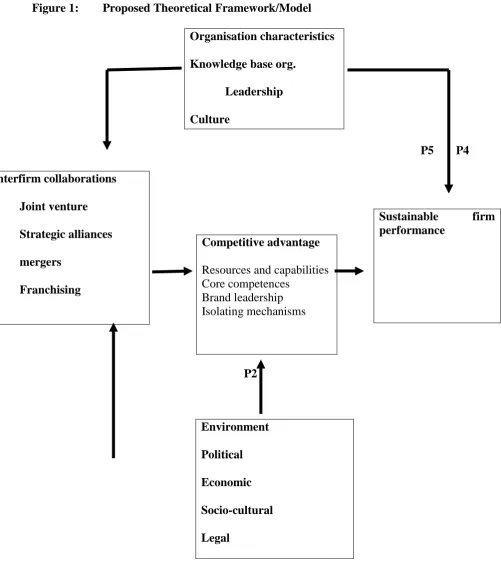
Several issues have been raised for researchers to study. This chapter proposes a theoretical
model that attempts to address the issues that relate to the discussed concepts as shown in the
figure below.
Figure 1:
Proposed Theoretical Framework/Model
Organisation characteristics
Knowledge base org.
Leadership
Culture
P5
P4
Interfirm collaborations
Joint venture
Strategic alliances
mergers
Franchising
P2
Sustainable
firm
performance
Competitive advantage
Resources and capabilities
Core competences
Brand leadership
Isolating mechanisms
Environment
Political
Economic
Socio-cultural
P3
Source: Author,(2014)
Explanation of the model
The outcome of the process described in the model is sustainable competitive advantage. This advantage arises from the organizational resources. Each organization has to perform certain things within its environment and choose relevant strategies to bring about sustainable competitive advantage as discussed below:
1.
Interfirm collaborations
Over time, strategies and organizations of cooperating firms might vary because of changes in environments and staff, but also because of the new resources born from cooperation. Simultaneously, the iteration of contacts between firms promotes the implementation of real organizational routines specific to the dyad, which also require adjustments in the governance of the relationship. Moreover, the capacity of each firm to adjust and to keep coherent operating mechanisms in place to manage the inter-firm relationship is seen as a cause of success or failure of the cooperation (Doz, 1996).
Proposition 1: The choice of interfirm networks impacts the competitive advantage to achieve sustainable firm performance.
2.
Internal and external environment
The environmental change has differential effects on companies because of their different resources and capabilities or strategic positioning (Grant, 2010). External change is as a result of resources heterogeneity among firms such that some firms are faster and more effective in exploiting change. Capabilities of firms changes over time and thus, their competitive implication of those changes (Barney, 2001).
External change occurs when firms have greater creative and innovative capacity. Globalization, rapid change, outsourcing and other major forces shaping today’s economic landscape have ushered in multi-business decision making that also focuses on the role and value added contributions (Pearce & Robinson, 2005).
Competitive processes are significantly influenced by five environmental factors: the societal resources, the societal institutions, actions of competitors, consumer behaviors and public policy dimensions (Hunt & Morgan, 1996). Therefore it is proposed that:
Proposition 2: Environmental changes influences the type of isolating mechanism and the choice of interfirm networks an organisation will execute to create competitive advantage which will directly influence sustainable firm performance.
3. The effect of the environment on choice of strategic collaboration
The environmental change has differential effects on companies because of their different resources and capabilities or strategic positioning (Grant, 2010). External change is as a result of resources heterogeneity among firms such that some firms are faster and more effective in exploiting change. Capabilities of firms changes over time and thus, their competitive implication of those changes (Barney, 2001).
External change occurs when firms have greater creative and innovative capacity. Globalization, rapid change, outsourcing and other major forces shaping today’s economic landscape have ushered in multi-business decision making that also focuses on the role and value added contributions (Pearce & Robinson, 2005).
Proposition 3: Environmental changes influence the choice of interfirm collaborations.
4.
Organizational characteristics
Successful knowledge management (KM) enables organizations to make increasingly manufacturer cost and customer value. Knowledge is a significant business asset that prevents organizations from spending time reinventing solutions, and maintains organizational focus on providing a high quality output. This is accomplished through the storing, sharing, and using of knowledge, with the intent of improving the knowledge throughout the management cycle (Brian, O., 2011).
Proposition 4: Organizational characteristics such as organization learning, type of leadership, organization culture, strategic orientation determine the managements choice on the type of interfirm network.
5.
Organizational characteristics and firm performance
Successful knowledge management (KM) enables organizations to make increasingly more intelligent decisions. Modern competition places the market battles in terms of manufacturer cost and customer value. Knowledge is a significant business asset that prevents organizations from spending time reinventing solutions, and maintains organizational focus on providing a high quality output. This is accomplished through the storing, sharing, and using of knowledge, with the intent of improving the knowledge throughout the management cycle (Brian, O., 2011).
Proposition 5: The influence of organizational characteristics on sustainable firm
performance
5.1.6 Effect of competitive advantage on creating sustainable firm performance
Kotelnikov (2004) proposes three strategies for sustainable competitive advantage: basic
competitive advantage - a product/service with internationally competitive cost, quality, and
after-sale service; revealed competitive advantage - reflected market share;
sustainable
competitive advantage - allows the maintenance and improvement of the enterprise's
competitive position in the market. The strategy should be unique, difficult to replicate,
superior to competition, sustainable and applicable to multiple situation.
Proposition 6: The impact of competitive advantage on sustainable firm performance.
Ahuja, G. (2000). Collaboration networks, structural holes and innovation: A longitudinal study. Administrative Science Quarterly, 45(3), 425–456.
Aldrich, H.E. (1999). Organizations evolving. London. Thousand Oaks, California: Sage.
Allaire, Y., & Firsirotu, M.E. (1989). Coping With Strategic Uncertainty. Sloan Management Review, 30(3), 7.
Archibald, G.C. (2008). Theory of the firm. The New Palgrave: A Dictionary of Economics, v. 2, p. 357.
Arndt, J. (1979). Towards a Concept of Domesticated Markets. Journal of Marketing, 43, 69-75. Bamford, J., Gomes-Casseres, B., & Robinson, M. (2004). Envisioning collaboration: Mastering
alliance strategies. San Francisco: Jossey-Bass.
Berry, L.L. (1995). Relationship marketing of services: growing interest, emerging perspectives. Journal of the Academy of Marketing Science, Vol. 23, No. 4, pp. 236.
Carlton, D. & Perloff, J. (1994). Modern Industrial Organization (2nd ed.), Harper Collins, New York.
Cha, H. S., Pingry, D. E., and Thatcher, M. E.. (2008). Managing the Knowledge Supply Chain: An Organizational Learning Model of Information Technology Offshore Outsourcing, MIS Quarterly (32:2), June, pp. 281-306.
Coase, Ronald H. (1937). The Nature of the Firm. Economica, 4 (16), 386–405
Coviello, N.E., Brodie, R.J., Munro, J. (1997). Understanding contemporary marketing: development of a classification scheme. Journal of Marketing Management, 1997, Vol. 9, No. 4, pp. 23. Das, T. K. & Teng, B.S. (1997). Sustaining strategic alliances: Options and guidelines. Journal of
General Management, 22(4), 49-64.
Dyer, J., Kale, P., & Singh, H. (2001). How to make strategic alliances work. Sloan Management Review, 42(4), 37–43.
Ernst, D. (2004). Envisioning collaboration. In J. Bamford, B. Gomes-Casseres, & M. Robinson (Eds.), Mastering alliance strategies. San Francisco: Jossey-Bass.
Garcia-Canal, E., Duarte, C., Criado, J., & Llaneza, A. (2002). Accelerating international expansion through global alliances. Journal of World Business, 37(2), 91–107.
George, D., & Mallery, P. (2003). SPSS for Windows step by step: A simple guide and
Glaister, K.W. (1996). UK-Western European Strategic Alliances: Motives and Selection Criteria. Journal of Euromarketing, 5 (4), 5-35.
Grewal, R., & Dharwadkar, R. (2002). The role of the institutional environment in marketing channels. Journal of Marketing, 66(3), 82.
Grınroos, C. (1990). Marketing redefined. Management Decision, Vol. 28, No. 8, pp. 5
Gulati, R. (1995). Does familiarity breed trust? The implications of repeated ties for contractual choice in alliances. Academy of Management Journal, 38(1), 85-112.
Hamel, G., Doz, YL., & Prahalad, C.K. (1989). Collaborate with your competitors and win. Harvard Business Review, 67(1), 133-139.
Janz, B. D. and Prasarnphanich, P. (2003). Understanding the Antecedents of Effective Knowledge Management: The Importance of a Knowledge-Centered Culture. Decision Sciences, (34:2), Spring, pp. 351-385.
Kale, P., Singh, H., & Bell, J. (2009). Relating well: Building capabilities for sustaining alliance networks. In P. Kleindorfer & Y. Wind (Eds.), The network challenge: Strategies for managing the new interlinked enterprise. London: Pearson Press.
Kanter, R.M. (1994). Collaborative advantage: The art of alliances. Harvard Business Review, 72(4), 96-108.
Kim, D.H. (1993). The link between individual and organizational learning. Sloan Management Review, Fall, pp. 37-50.
Kogut, B. (1988). Joint Ventures: Theoretical and Empirical Perspectives. Strategic Management Journal, 9, 319-332.
Levitas, E.,. Hitt, M.A., and Dacin, M.T. (1997). Competitive Intelligence and Tacit Knowledge Development in Strategic Alliances. Competitive Intelligence Review, 8 (2), 20-27.
Lunnan, R., & Haugland, S. (2008). Predicting and measuring alliance performance: A multidimensional analysis. Strategic Management Journal, 29(5), 545–556.
Martin, S. (1993). Advanced Industrial Economics, Blackwell, Cambridge, Mass.
Mudambi, R., Navarra, P. (2004). Is knowledge power? Knowledge flows, subsidiary power and rent-seeking within MNEs. Journal of International Business Studies, Vol. 35 No.5, pp.385-406. Hongbin, D. (UN). Impact of cultural difference and communication on strategic alliance
performance. Available online from
http://www.seiofbluemountain.com/upload/product/200911/2009scyxhy09a2.pdf
Parkhe, M.A. (1993) Research, methodological predispositions, and theory development in international joint ventures. Academy of Management Journal, 18(2), 227-268.
Pfeffer, J., & Salancik, G. R. (1978). The external control of organizations : a resource dependence perspective. New York: Harper & Row.
Pfeffer, J., and Moore, W.L. (1980). Power in university budgeting: a replication and extension. Administrative Science Quarterly, Vol. 25 No.4, pp.637-53.
Rao, S., Perry, C., (2002). Thinking about relationship marketing: where are we now? The Journal of Business and Industrial Marketing, 2002, Vol. 17, No. 7, pp. 599.
reference. 11.0 update (4th ed.). Boston: Allyn & Bacon.
Rothaermel, F., & Boeker, W. (2008). Old technology meets new technology: Complementarities, similarities and alliance formation. Strategic Management Journal, 29(1), 47–77.
Schein, E.H. (1996). Organizational learning: what is new? Invited address to the 3rd Biennial International Conference on Advances in Management, Framingham, MA, July, available at: learning.mit.edu/res/wp/10012.html.
Scott, W.R. (1998). Organizations: rational, natural, and open systems (4th ed.). Upper Saddle River, N.J.: Prentice Hall.
Smith, R.L., and Round, D.K. (1998). A Strategic Behaviour Approach to Evaluating Competitive Conduct. Agenda, 5(1), 25-36.
Tully, S. (1993). The modular corporation. Fortune, 130(3), 106-108, 112-114.
Ulrich, D., & Barney, J. B. (1984). Perspectives in Organizations: Resource Dependence, Efficiency, and Population. Academy of Management. The Academy of Management Review, 9(3), 471. Varadarajan, P.R., and Cunningham, M.H. (1995). Strategic Alliances: A synthesis of Conceptual
Foundations. Journal of the Academy of Marketing Science, 23 ( 4), 282-296.
Webster, F.E. Jr. (1992). The Changing Role of Marketing in the Corporation. Journal of Marketing. 56 (Oct), 1-17.