ISSN (Print) : 2347 - 6710
I
nternationalJ
ournal ofI
nnovativeR
esearch inS
cience,E
ngineering andT
echnologyVolume 3, Special Issue 3, March 2014
2014 International Conference on Innovations in Engineering and Technology (ICIET’14) On 21st & 22nd March Organized by
K.L.N. College of Engineering, Madurai, Tamil Nadu, India
Copyright to IJIRSET www.ijirset.com 508
M.R. Thansekhar and N. Balaji (Eds.): ICIET’14
ABSTRACT— Direct Torque Control is most widelyused in industrial standard for high power induction motor drives. The conventional DTC method uses the hysteresis-based voltage switching method which has some drawbacks of higher torque ripple and speed pulsation. The main aim of the paper is to obtain the enhanced torque control and smooth flux trajectory. The proposed approach uses the sensorless drive which is incorporated in Direct Torque Control to improve the performance. Sensorless drive eliminates the shaft mounted speed encoder which is undesirable in a drive because it increases the cost and reliability problems. Sensorless method is used to estimate the speed signal with the help of machine terminal voltages and currents. The proposed method is simulated with the help of MATLAB and result shows that performances are improved.
KEYWORDS— Direct Torque Control, MRAS, and Induction motor.
I. INTRODUCTION
In recent years the sensorless based direct torque control of induction motor drive has grown significantly due to its reduced hardware complexity, cost effective, elimination of sensor cable, increased reliability and less maintenance requirements [1], [2].
The principle of conventional Direct Torque Control is to controls the torque and flux directly or independently by selecting proper inverter switching states [3] that includes the hysteresis band controller which has some advantage
of ease of implementation and simple structure. Hysteresis controller has main drawbacks of higher torque ripple, flux ripple and speed pulsation [4]. To solve the above problems, a direct torque control with space vector modulation schemes is introduced. In this method, closed loop for estimation of torque and flux is implemented as in DTC but the inverter switching states is produced by SVM signal [5], [6].
To obtain better torque and smooth flux control of induction motor drives, various sensorless-based methods have been used for speed estimation and give a good performance in large speed range. The different methods are speed adaptive flux observer [7], [8], model reference adaptive system [9], [10] slip calculation method and extended kalman filter [11], [12]. Among various machine model-based methods, Model Reference Adaptive System (MRAS) appeared to be the best solutions for speed sensorless drives [13], [14].
This paper proposes the Model reference adaptive system which is used to estimate the rotor speed with the help of machine terminal voltages and currents. MRAS observer is widely preferred due to its ease of implementation with high speed of adaptation for wide range of applications, although this approach leads to small variations in low speed region. The Popov’s hyper stability criterion is used to estimate the stability of closed loop speed [5], [6]. The proposed control scheme for sensorless based DTC-SVM is elaborately discussed in this paper.
Section 1 describes the mathematical model of Induction Motor drive. Section 2 describes the proposed sensorless
Asiya Husna V, Kousalya D, Manoj Kumar N
Department of EEE, RMK Engineering College Chennai, India
RMK Engineering College Chennai, India
Department of EEE, RMK Engineering College Chennai, India
Performance Analysis of Sensor Less
Copyright to IJIRSET www.ijirset.com 509
M.R. Thansekhar and N. Balaji (Eds.): ICIET’14
drives and DTC-SVM. Section 4 shows the simulation results for DTC, Sensorless DTC and Sensorless based DTC-SVM. Section 5 gives conclusion and future works.
II.SENSORLESS BASED DTC-SVM
A.Machine Equations
The behavior of IM is analyzed with the use of space phase quantities in a stationary reference frame. The voltage balance equations for the d-q axes are as follows.
= (1)
= (2)
= (3)
= (4)
=
(5)
The mechanical equation is given as
(6)
(7)
Where,
P- Number of poles
(8) (9) (10)
Where, , are stator voltage in d and q axis
respectively. , are stator current in d and q axis
respectively.
are stator and rotor resistance respectively. are stator inductance, rotor
inductance and mutual inductance.
B. Proposed Model Reference Adaptive System
The proposed structure is a model-reference adaptive system MRAS, it consists of three steps: reference model, adaptive model and an adaptive method. The proposed sensorless drive is presented in Figure 1.
Fig.1 Block Diagram of sensorless drive.
Both models are referred to in the stationary reference frame. The output of a reference model is compared with the output of an adjustable or adaptive model until the errors between the two models vanish to zero.
1) Reference Model: This model receives the machine stator side voltage and current signals and calculates the rotor flux vector signals. The stator and rotor flux linkages in the stator reference frame are defined as
(11)
(12)
Where = 1- ; Leakage co-efficient.
(13)
(14)
2) Adaptive Model: The adjustable or adaptive model equation is simpler and is obtained from the current model of the machine equations in stationary reference frame using stator currents if the speed signal is known.
(15)
(16)
Where ; Rotor time constant.
With the correct speed signal, fluxes calculated from reference model matches with the adaptive model.
Copyright to IJIRSET www.ijirset.com 510
M.R. Thansekhar and N. Balaji (Eds.): ICIET’14
stable system, the speed estimation equation is
(17)
= X – Y = - (18)
Estimation accuracy is good if parameter variation is considered as constant.
C) Direct Torque Control with SVM
In Direct torque control, it is possible to control directly the stator flux and the torque by selecting the appropriate inverter state. To overcome the classical DTC drawbacks like increased torque ripple, SVM based DTC is used here. The block diagram of sensorless based DTC with SVM is shown in fig 2.
Block Diagram of Sensorless based DTC-SVM for Induction Motor.
The proposed topology of the DTC-SVM comprises two PI regulators for flux and torque. The controller receives inputs in the form of torque and stator flux errors and generates the inverter’s command signals. The SVM unit produces the inverter control signals. It receives the reference voltage in stator reference frame.SVPWM is a digital modulation technique which treats sinusoidal voltage as a constant vector rotating at constant frequency. This PWM technique approximates the reference voltage VREF by combination of the eight switching patterns (V0 to V7). Figure shows space vector representation.
Fig.3 Space Vector Representation.
Steps involved in implementing the space vector PWM is given as
Calculation of , VREF and angle(α) .
Calculation of T1, T2, T0.
Calculation of switching time for each switch.
III. SIMULATION RESULTS
To validate the effectiveness of the MRAS based DTC-SVM methods, a two-level sensor less based DTC-DTC-SVM motor drive was developed in MATLAB environment and simulation results are presented here in fig 6. The Model Reference Adaptive System based DTC drive is illustrated in Fig. 1.
Fig.6 MATLAB modelling of sensorless based DTC of Induction Motor.
Sensorless MRAS technique is employed for closed loop speed estimation. A simulation work has been carried out on an induction motor with the specifications given in appendix. The proposed MRAS scheme is simulated in MATLAB/SIMULINK which is shown in Fig.7. Fig. 8 and Fig. 9 shows stator current for DTC of induction motor and sensorless based DTC of induction motor.
Copyright to IJIRSET www.ijirset.com 511
M.R. Thansekhar and N. Balaji (Eds.): ICIET’14
When load torque of 500Nm is applied at time t = 0.3s in classical DTC and sensorless based DTC, same magnitude of stator current is flow in induction motor. But current pulsation in sensorless based DTC is comparatively reduced.
Fig.8 Stator Current for DTC of Induction Motor.
Fig.9 Stator Current for Sensorless based DTC of Induction Motor.
Stator flux of direct torque control and sensorless based direct torque control of induction motor is shown in Fig. 10 and Fig. 11.When compared with DTC, stator flux is more uniform in sensorless based DTC.
Fig.10 Stator flux trajectory for DTC of induction motor
Fig.11 Stator flux trajectory for sensorless based DTC of Induction motor.
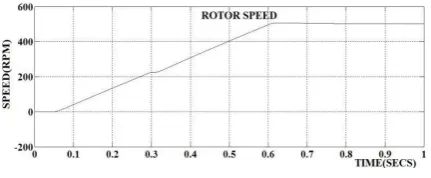
Electromagnetic torque response for DTC and sensorless based DTC for induction motor is shown in fig.12 and fig. 14.The Fig. 12 shows the electromagnetic torque for DTC of induction motor. Initially the motor run with a electromagnetic torque of 300 Nm. At t = 0.3 s, the load torque of 500 Nm is applied to the motor shaft while the
motor speed is still ramping to its final value. This forces the electromagnetic torque to increase to the maximum value and then to stabilize around 500 Nm once the speed ramping is completed. Speed ramping is completed at t = 0.6s.
Fig.12 Electromagnetic Torque for DTC of Induction Motor.
Fig.13 Rotor Speed for DTC of Induction Motor.
Fig.14 Electromagnetic torque for sensorless based DTC of induction motor.
Fig.15 Rotor Speed for sensorless based DTC of Induction Motor.
In sensorless based direct torque control when motor is starts with zero load torque at t=0s, it will oscillates and settles to its steady state with 300Nm initially. When load torque of 500 Nm is applied at 0.3 seconds applied, motor oscillates and then settles at steady state. In steady state the load torque oscillates between maximum and minimum value of 520 Nm to 460 Nm.
Copyright to IJIRSET www.ijirset.com 512
M.R. Thansekhar and N. Balaji (Eds.): ICIET’14
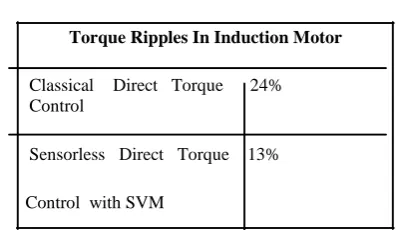
TORQUE RIPPLE COMPARISON
Torque Ripples In Induction Motor
Classical Direct Torque 24%
Control
Sensorless Direct Torque 13%
Control with SVM
Comparison of torque ripple in DTC and DTC with sensorless is shown in table. Therefore from results in table it is inferred that proposed scheme has less torque ripple, smooth flux response and less current pulsation.
IV CONCLUSION AND FUTURE WORK
In this paper, sensorless based direct torque control technology for induction machine has been proposed. Speed estimation is achieved using model reference adaptive system which eliminates the need speed sensor. Sensorless based DTC improve induction motor performance in terms of flux, torque and current response. Application of Neuro-Fuzzy in error minimization in MRAS will gives more accurate speed estimation which will be future scope. The simulation results verify that the proposed scheme improves the performance of induction motor.
APPENDIX
Motor parameter used in the simulation: Induction Motor Detail
460V, 149.2KW, 4 Poles, 1785 rpm
Stator resistance 14.85e-3 ohm
Stator inductance 0.3027 mH Moment of inertia 3.1 kg.m2 Friction coefficient
0.08 N.m.s/rad
REFERENCES
[1] Domenico Casadei, Giovanni Serra, Angelo Tani, Luca Zarri, and
Francesco Profumo,” Performance Analysis of a Speed-Sensorless
Induction Motor Drive Based on a Constant-Switching-Frequency DTC Scheme‖ IEEE Transactions On Industry Applications, VOL. 39, NO. 2,pp. 476-484, March/April 2003.
[2] Haithem Abu-Rub, Jaroslaw Guzinski, Zbigniew Krzeminski, and
Hamid A. Toliyat, “Speed Observer System for Advanced
Sensorless Control of Induction Motor‖ IEEE
Transactions On Energy Conversion, VOL. 18, NO. 2,pp.219-224 june 2003.
[3] I. Takahashi and T. Noguchi, ―A newquick-response and
high-efficiency control strategy of an induction motor,‖ IEEE Trans. Ind. Applicat., vol.IA-22, pp. 820–827, Sept./Oct.1986.
[4] D. Casadei, G. Grandi, G. Serra, and A. Tani, ―Effects of flux and
torque hysteresis band amplitude in direct torque control of
induction machines,‖ in Proc. IECON’94, Bologna, Italy, Sept. 5–
9, 1994, pp.299–304.
[5] D. Casadei, G. Sera, and A. Tani, ―Stator flux vector control for high performance induction motor drives using space vector
modulation,‖ in Proc. OPTIM’96, 1996, pp. 1413– 1422.
[6] P. Thoegersen and J. K. Pedersen, ―Stator flux oriented
asynchronous vector modulation for AC-drives,‖ in Proc. IEEE
PESC’90, 1990, pp. 641–648.
[7] A. Paladugu, B. H. Chowdhury, ―Sensorless control of inverter-fed induction motor drives‖, Electric Power Systems Research 77 (2007) 619-629.
[8] M.Juili, K.Jarray, Y.Koubaa, M.Boussak, ―Lenberger state observer for speed sensorless ISFOC induction motor drives‖, Electric Power Systems Research 89 (2012) 139-147.
[9] T. Ravi kumar, Ch. Shankar Rao, Ravi Shankar ―Model Reference Adaptive Technique For Sensorless Speed Control Of Induction Motor‖ International Journal Of Engineering And Computer Science ISSN:2319-7242 Volume 2 Issue 5 May, 2013 Page No. 1578-1583. [10] M.K. Metwally ―Sensorless speed control of 4-switch three phase inverter fed induction motor drives at very low and zero speed‖ Alexandria Engineering Journal (2013).
[11] Salomón Chávez Velázquez, Rubén Alejos alomares, Alfredo Nava Segura ―Speed Estimation for an Induction Motor Using the Extended Kalman Filter‖, Proceedings of the 14th International
Conference on Electronics,Communications and Computers
(CONIELECOMP’04) 0-7695-2074-X/04 $ 20.00 © 2004 IEEE. [12] Americo Vicente Leite, Rui Esteves Araujo, , and Diamantino Freitas ―A New Approach for Speed Estimation in Induction Motor Drives Based on a Reduced-Order Extended Kalman Filter‖ 0-7803-8304-4/04/$20.00 C02004.
[13] D. P. Marcetic, S. N. Vukasavic, ― Speed-Sensorless AC Drive With the Rotor Time Constant Parameter Update‖,IEEE Trans on industrial electronics, VOL. 54,NO. 5,October 2007.
[14] P. Jansen, R. Lorenz, and D. Novotny, ―Observer-based direct field orientation: analysis and comparison of alternative methods,‖ Industry Applications, IEEETransactions on, vol. 30, no. 4, pp. 945–953, 1994. [15] Y.D.Landau, Adaptive control- The Model Referencing Apprach,