Copyright to IJIRSET www.ijirset.com 196
Study on the efficiency improvement of Diode
Side Pumped Solid State Lasers
Ashitha P R1, Dileep P2 S.K.S.Nair3
Senior Research Fellow, Toc H Institute of Science and Technology, Arakkunnam, Ernakulam, Kerala, India1
Assistant Professor, Toc H Institute of Science and Technology, Arakkunnam, Ernakulam, Kerala, India2
Professor, Dept of Electronics & Communication, Toc H Institute of Science and Technology, Arakkunnam, Ernakulam, India3
Abstract: Improving the efficiency of Diode Pumped Solid State Laser (DPSSLs) is a challenging job ever since the
discovery of DPSSLs. End pumped DPSSL has an inherent advantage of higher coupling efficiency compared to side pumped DPSSLs due to higher absorption length for the input diode power. However this technique is not applicable to high power DPSSL especially above 100 W CW lasers as the laser crystal cannot withstand the very high pump power density and the get fractured under thermal stress. Therefore, obviously side pumping is the only option for high power DPSSLs typically above 100 W average power. The limitation of side pumping is the lower absorption length and multiple reflection of diode power is required for efficient use of pump power. This is partially solved by increasing the doping concentration but the lower beam quality is the price to be paid for it. Further doping concentration cannot be increased beyond certain level as the crystal breaks under strain developed by the dopant. This introduces stringent design constraints for high power DPSSL and also limitations to the power coupling. Furthermore bare diodes have typical divergence of 40 to 50 deg and very close coupling becomes essential for efficient utilization of diode power. Use of micro-lens array is the usual solution, but this reduces the available diode power to be coupled to the laser crystal due to Fresnel reflections leading to reduction in overall efficiency of the system. Thus the laser head design becomes a real challenge for any designer working with high average power DPSSLs. In this paper we describe various techniques employed to improve the overall efficiency of diode side pumped DPSSL.
Keywords: Diode pumped solid state laser, efficiency improvement of lasers, resonators, power concentrators
I. INTRODUCTION
Design and optimization of a DPSSL depends on three important issues, namely, the thermal analysis of the gain medium, coupling of diode power into the laser crystal and the resonator design incorporating the variable thermal lens. The requirement of thermal analysis and management stems from the fact that the excitation process of a laser crystal produces heat inside the material due to radiative transitions. This heat generated during diode pumping is non-negligible and sufficient to modify the temperature and refractive index distribution inside the gain medium. The resonator design includes selection of optical components and their placements for desired output power and other beam parameters. However, in addition to these theoretical problems the designer has to make enormous effort to couple diode power in to the laser crystal and to determine space for optimum positioning of various components such Q Switches, intra cavity frequency doublers etc. The former is critical for improving the efficiency of DPSSL whereas the later for beam quality. We have used parameters of Nd YAG laser rod for our theoretical and experimental studies reported in this paper.
For thermal analysis we have developed the necessary simulation framework that takes into account temperature
Copyright to IJIRSET www.ijirset.com 197
coefficient (=dn/dT), and obtained the distribution of temperature and refractive index together with the thermal lens
focal length, for both radial (fr) and transverse (f) of the Nd:YAG laser rod [1,4,7,8,10].
Following thermal analysis of the Nd:YAG rod, we begin simulations for resonator design. The thermal lens focal length (f) obtained from the thermal analysis of Nd:YAG rod provides an input for resonator design. We develop here simulation methodology in the framework of ABCD matrix and study the effect of the resonator parameters such as
distance of 100% mirror (d1), output coupler (d2), and the suitable radii of curvatures (r1 and r2)on the beam parameters
under the influence of thermal effects[3,11]. We have shown that the curves of the output beam size generated for the variation of the resonator parameters show a stable region that is insensitive to the thermal/mechanical fluctuations, and this region is of interest for the operation of a DPSSL to produce maximum output power and lowest sensitivity to any misalignment [9, 10]. The choice of resonator parameters arrived from our study is also required to take into account the physical limitations in incorporating other optical elements such as acousto-optic Q-switch, second harmonic crystal etc[2,5]. These theoretical observations are proved during the assembly and testing of our laser systems.
II. DESIGN AND EXPERIMENTATION
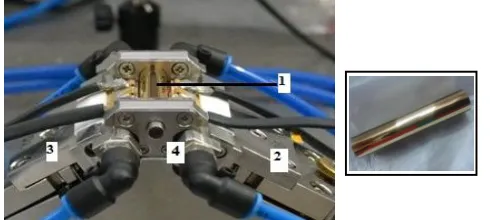
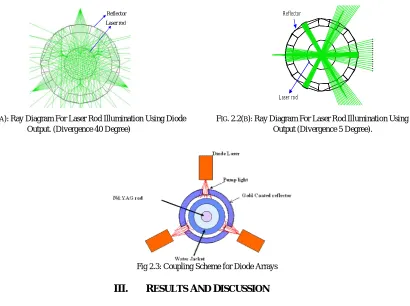
Based on the theoretical studies we designed a practical laser system. During the design, we face additional challenges such as physical constraints of placing various components, coupling of diode power into laser crystal and the optimization of various components and parameters. Efficient coupling of highly divergent diode laser output to the Nd:YAG laser rod is the most difficult task that we have encountered in the mechanical design and assembly of the DPSSL developed in our laboratory. Various coupling schemes to transport diode power into the laser rod can be found in the literature [1]. We designed, fabricated and tested an optimized laser system through a close coupled scheme with no additional intervening optics except the water flow tube between laser rod and diode output. The flow tube is a gold coated glass tube which acts also as the reflector to concentrate diode power into the laser rod. The flow tube is shown in Fig 2.1. Precisely fabricated slits on the gold coated glass tube allow the diode power to enter into the reflector cum flow tube and after successive reflections the diode power almost completely get absorbed by the laser rod. Ray tracing techniques are employed to provide design guidelines of various devices for coupling diode laser output in to the laser rod with minimum loss for diode power. The ray diagram for laser rod illumination using diode array is shown in Fig 2.2.At the end of experimentation with various options we have adopted a cavity structure, which is one of the simplest in terms of design with minimum number of mechanical and optical components and thereby reducing the complexity and cost of fabrication, assembly and testing. At the same time while using this scheme we have not observed any degradation in the performance of the laser system. In this direct coupling scheme light from linear array of diode bars without micro lens is being used. The coupling scheme employed in our design is shown in Fig 2.3.We have adjusted the size of the diode beam on the laser rod just sufficient to illuminate it. This is made possible by changing the distance of diode bars from the laser rod by means of translation stages attached to the base plate mounting the diodes and also a tilt mechanism provided in the assembly. Finally, the output power is optimized by temperature tuning of diode arrays.
Copyright to IJIRSET www.ijirset.com 198
FIG.2.2(A):Ray Diagram For Laser Rod Illumination Using Diode Output. (Divergence 40 Degree)
FIG.2.2(B):Ray Diagram For Laser Rod Illumination Using Diode Output (Divergence 5 Degree).
Fig 2.3: Coupling Scheme for Diode Arrays
III. RESULTS AND DISCUSSION
The heat load that limits the performance of DPSSL in terms of output power and beam quality is addressed by the unique design methodology. Using finite element method and advanced mathematical computational techniques, we have modelled temperature and refractive index variations inside the laser rod both at non-lasing and lasing conditions incorporating the changes of all known material parameters like thermal conductivity, refractive index, coefficient of thermal expansion etc. [7, 8]
The design and developmental studies conducted to produce maximum output power at fundamental wavelength is explained. Efficient coupling of highly divergent diode laser output to the Nd:YAG laser rod is a challenging job and we have achieved the same via a close coupled scheme with no additional intervening optics but at the same time providing a uniform excitation of the laser medium. Ray tracing techniques are employed to provide design guidelines for coupling diode laser output in to the laser rod. Since the complexity of the design and assembly increases with increasing number of components we have adopted a cavity structure which is one of the simplest in terms of design, containing minimum number of mechanical and optical components. Such a cavity can be fabricated at the lowest possible cost and has minimum complexity without sacrificing the performance of the laser system. In the coupling
scheme we have adopted light from linear array of diode laser bars having divergence up to 500 can be used.
We have indigenously developed laser head and fabricated by M/s Holmarc Optomechatronics Pvt. Ltd. Laser Diodes used were supplied by Northrop Grumman, USA Model No. ARR121C160. The laser rod of diameter 4mm and length 70 mm with 0.6% of doping concentration is used. The alignment of laser diode is done using CCD camera, from Thorlabs Model No. DCU223M, connected to a computer. And the power optimization is done using the translational
Reflector Laser rod
Copyright to IJIRSET www.ijirset.com 199
stages fitted on the laser head. The distribution of diode power inside the laser rod during the alignment of the three laser diodes are shown in Fig 3.1.
Q switching was done using Acouto-Optic Q switch from Gooch and House go Model No.I-QS027-5S4G-B5. We have operated in the frequency range from 2 kHz to 10 kHz. The pulse width was measured using a photodiode connected to Mixed Signal Oscilloscope from Agilent Technologies, Model No. MSO-X 2002A. The smallest pulse width measured is 80ns at 2 kHz, p r f.
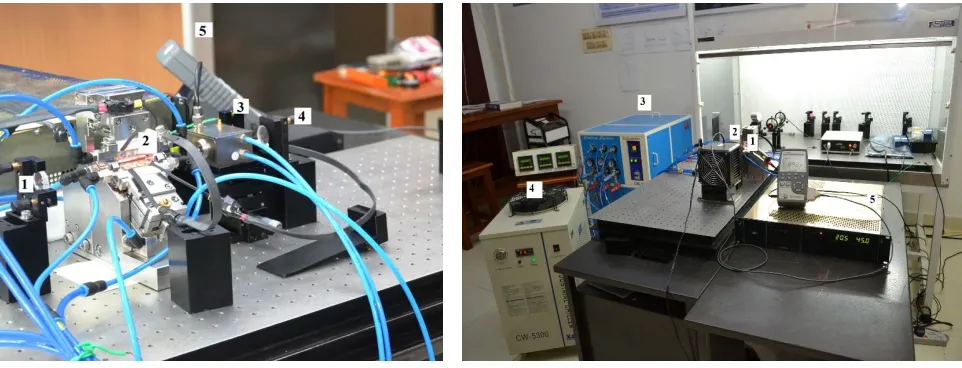
The laser resonator with different configurations is tested for the fundamental wavelength i.e. 1064nm. The maximum power of 100W is obtained for input mirror(HR at 1064nm) of 500mm ROC and 1000mm ROC output coupler(85% reflection at 1064nm)with d1 = 52mm and d2 = 52mm. (d1 and d2 are the distances of input mirror and output mirror from the end of laser rod). The laser system developed in our laboratory is shown in Fig 3.2.
(a) (b) (c) (d)
Fig. 3.1: Distribution of diode power inside the laser rod – CCD images of rod illumination. (a) (b) & (c) Diodes aligned individually and (d) Three diodes (symmetrically placed around the laser rod)
Fig 3.2(a) Laser Assembly: 1 - 100% Mirror, 2 Laser Head, 3-Acousto Optic Q-Switch, 4- Output Mirror, 5 - Power Meter
Copyright to IJIRSET www.ijirset.com 200
IV. CONCLUSION
We have developed a 100 W CW Nd YAG laser with wall plug efficiency more than 10%, optical to optical efficiency 25% and slope efficiency 40%. This power and efficiency is comparable to that reported in the literature. Efficiency of the system can be further improved by using better diode laser power concentrators which is under development.
ACKNOWLEDGEMENT
The project is sponsored by Department of Science and Technology (DST), Govt. of India Sanction No. DST/TSG/ME/2011/38-G( Technology Systems Development (TSD) Programme)
R
EFERENCES[1]. W. Koechner, “Solid State Laser Engineering”, Springer, Berlin, (2006). [2]. W. Koechner, “Solid State Laser Engineering”, Springer, Berlin, (1999).
[3]. T. Y. Fan and R. L. Byer, “Diode pumped solid state lasers”, IEEE J QE. 24, 895 (1988)
[4]. R. Ifflander “Solid state lasers for materials processing Fundamental Relations and Technical Realizations”, Springer, Berlin, (2001).
[5]. D. Golla, S. Knoke, W. Schone, G. Ernst, M. Bode, A. Tunnermann, and H. Welling, “300W cw diode laser side pumped Nd:YAG rod laser”,
Opt. Lett. 20, 1148 (1995).
[6]. S. K. Sreenivasan Nair,“Design and development of High Efficiency Laser Reflectors”, National Seminar on Horizons in Thin Film Technology, Toc H Institute of Science & technology, Ernakulam, 20-21 January, 2011.
[7]. S. K. Sreenivasan Nair, “Studies on the Design, Development and Optimization of High Average Power Diode Pumped Solid State Lasers”, ,
Proceedings of National Symposium on Atomic, Molecular and Optical Physics, February –2011, Karnatak University, Dharwad.
[8]. Sreenivasan Nair S K, “Influence of temperature on the performance of Diode Pumped Solid State Lasers", TIST International Journal of Science, Technology and research, Vol. 1, 13-18, 2012.
[9]. Inon Moshe, Steven Jackel, Avi Meir, Yaakov Lumer, and Eyal Leibush, “2 kW, M2 <10 radially polarized beams from aberration compensated rod based Nd:YAG Lasers”, Opt. Lett. 32, 47 (2007).
[10]. David C Brown, Member, IEEE, "Nonlinear Thermal Distortion in YAG Rod Amplifiers", IEEE Journal of Quantum Electronics, Vol. 34, No.12 December 1998