ISSN(Online): 2320-9801
ISSN (Print) : 2320-9798
I
nternational
J
ournal of
I
nnovative
R
esearch in
C
omputer
and
C
ommunication
E
ngineering
(An ISO 3297: 2007 Certified Organization)
Vol. 3, Issue 9, September 2015
Industrial Automation using Robot
Programming by Demonstration Technique
with Neuroph Framework
Dr. S. K. Dixit1, Tushar K. Patil2
HOD, Dept. of Electronics & Tele-communication Engineering, Walchand Institute of Technology, Solapur,
Maharashtra, India1
PG Student, Dept. of Electronics Engineering, Walchand Institute of Technology, Solapur, Maharashtra, India2
ABSTRACT: The programming of a robot is not that much easy now a days. Also it takes lots of time to do the programming. Even if it is programmed, then one can’t be assure about the accuracies and inconsistency that is involved. So, the new concept like Programming by Demonstration (PbD) is coming into picture and is a topic of research. So, the paper aims to develop a robot arm on which the servo motors and the different type of sensors are located. Because of the PbD system, accurate and desired output can be taken with much more ease and without bothering about the programming concepts. PbD is therefore one way of programming the robots. The paper also takes help of the Artificial Neural network (ANN) to detect the sequence of actions demonstrated which is explained later.
KEYWORDS: Programming by Demonstration (PbD), learning from Demonstration (LfD), Industrial Automation, Robot task demonstration and learning.
I. INTRODUCTION
Robots are getting automated and intelligent with the recent advances in the CPU architectures, computation and accessibility technologies and sensors. The PbD intuitive method is now mostly used in the Automation industries like Automobile Manufacturing Companies. The user has implicit knowledge about the task to be done but doesn’t have the skill of programming and the hardware knowledge. Therefore, the PbD allows explicit programming of the task demonstrated by the user even if he / she doesn’t have skills of programming and electronic components. The concept of PbD includes the teach-in, guiding or playback methods that involve the Demonstration of the task and replaying the demonstrated action sequence [1]. The use of robots in industry is increasing in manufacturing process related departments. The robot can be made adaptive to the new environments that demand more different & flexible algorithms to be used.
Robots are becoming more commonplace due to the fact that the Non-technical persons are also able to do the policy development. This happens because of the property of the PbD system to not to have problem domain specific knowledge. PbD is a way of communication medium to have interaction between the users or rather humans with the robotic systems.
This paper aims to build the robot arm with sensors and actuators located on it. Sensors to sense the information related to the action and motors to perform same sequence of actions. Block diagram is given in later section.
II. RELATED WORK
PbD approach is a big area of research and the researchers are still working on it. The Proposed work consists of the ANN used to detect the sequences demonstrated to the robot arm. The Neural network controller can be generated to implement the imitation learning. But, that’s quite difficult to deal with it. The Ping Jiang [8] has introduced the iterative learning method for imitation learning. For, Demonstration method given in paper doesn’t require such type of methods.
ISSN(Online): 2320-9801
ISSN (Print) : 2320-9798
I
nternational
J
ournal of
I
nnovative
R
esearch in
C
omputer
and
C
ommunication
E
ngineering
(An ISO 3297: 2007 Certified Organization)
Vol. 3, Issue 9, September 2015
the cameras too. This improves the accuracy level while play-backing the action demonstrated. The Christian [9] demonstrated a wheelchair with a robot arm mounted on it. He is demonstrating the arm through the speechinputs driven commands. The Sylvain Calinon [10] has demonstrated the work in which the ANN algorithms are implemented to map the regular space system to the destination robots joint spaces. This allows demonstrating the action on some robot system and performing the same actions on other kind of robotic systems.
III.DEFINITION AND TERMINOLOGY
PbD is a one way where the demonstrator is demonstrating the task to the arm with his / her own hands & gives directions to the arm. So, the same task is then learned by the system which is then replicated by the system itself. Learning by showing, PbD (Programming by Demonstration), shadowing are the other type of techniques. All of them are one and the same thing. But their use differs slightly in the many articles.
As stated previously, PbD gets rid of the direct programming technique. Here, a demonstrator teaches an action of sequences which are then recorded by the controller. With the Supervised machine learning technique, the Sequences are detected and the same action is then performed by the robot hand.There are 2 ways to program a Robot arm [2],
1) By demonstration of a task, and
2) By Imitation Learning etc.
The paper mainly talks about the first one only. It is a way in which the task’s state-actions are recorded and is then learned with the supervised learning techniques. And the same task is repeated again. But, if we talk about the second one, then it requires the robot hand to use sensors like a camera to imitate the demonstration. So, it’s somewhat difficult to implement the second type.
There are 2 ways in PbD as follows,
1. Either the Demonstration is given to the robot arm only once and generalizing the demonstrated sequence with
the history sequences stored in the databases, or
2. The multiple demonstrations are given to the arm so that the generalization concept is applied over the
multiple demonstrated sequences of the same task. Off course, we can take the help of history also.
IV.BASIC FLOW OF THE SYSTEM
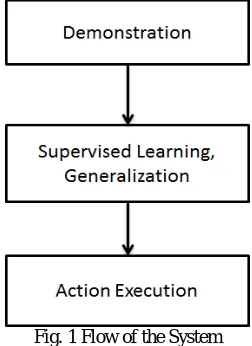
As shown in diagram 1, the system flow mainly includes 3 blocks [5]. 1st is Demonstration. Here, in this step, the
demonstrator with his/her own hands actually demonstrates an action to the arm. As the robot arm body has the sensors on it; during the phase of demonstration, whatever action’s positional parameters are generated will be recorded as it is by the controller.
Fig. 1 Flow of the System
ISSN(Online): 2320-9801
ISSN (Print) : 2320-9798
I
nternational
J
ournal of
I
nnovative
R
esearch in
C
omputer
and
C
ommunication
E
ngineering
(An ISO 3297: 2007 Certified Organization)
Vol. 3, Issue 9, September 2015
Multilayer perceptron give much better results for this type of application. As the system uses Neural network just for only the classification of the actions, Multilayer Perceptron is best suited for this kind. The output of this step is the learned macros or labels describing the demonstrated action.
Well, talking about the generalization of the task demonstrated, Generalization is required just to verify that the demonstrated action sequences are valid and are well learned by the system [3]. But, if this technique is used for the complex tasks, then the system should go for the generalization. Generalization phase is only taking the identified labels and compares it with the history or the multiple demonstrations of the same task giving a valid execution sequence that is well describing the demonstrated action sequences [4].Once second step is also completed, the same action is the executed with the final generated sequence which is the output of the second step.
V. BLOCK DIAGRAM
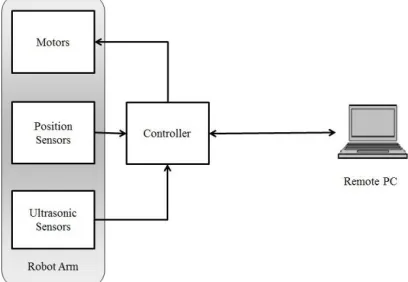
The System block diagram is shown in figure 2. The Robot arm used itself is consisting of the sensors and the actuators or motors. The Sensors used here are Ultrasonic sensors and Gyro-sensors with accelerometer sensor. All these sensors are continuously communicating with the controller. The system Proposed includes a Arduino UNO controller board which is collecting all the required positional and the other information. The servo motors of 3 and 6 kg torque are used. The ADXL335acclerometer and the HMC5883 are used for horizontal and vertical movements [12]. Then the collected data is supplied to the Remote PC through communication media. The proposed system uses the Serial COM Port communication for the transmission of the data. There the data is analysed and the appropriate sequences are detected with the help of ANN’s MLP algorithm. Neural network application at the Remote PC is developed in the Java language [9]. The detected sequences are sent back to the controller for the execution of the same task. Now, this time the motors are rotated in the appropriate directions to follow the demonstrated task.
Fig. 2 Block Diagram of the PbD system
VI.POWER SUPPLY
ISSN(Online): 2320-9801
ISSN (Print) : 2320-9798
I
nternational
J
ournal of
I
nnovative
R
esearch in
C
omputer
and
C
ommunication
E
ngineering
(An ISO 3297: 2007 Certified Organization)
Vol. 3, Issue 9, September 2015
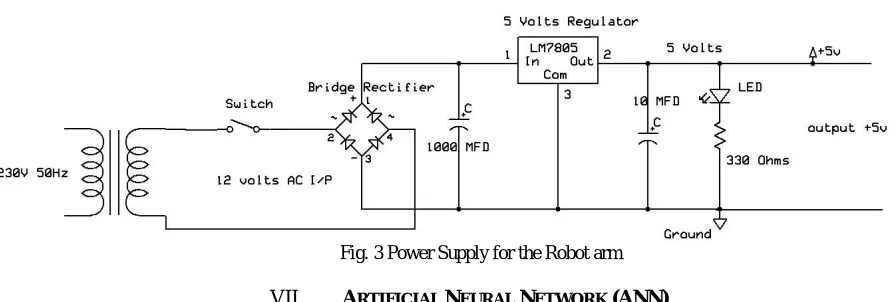
Fig. 3 Power Supply for the Robot arm
VII. ARTIFICIAL NEURAL NETWORK (ANN)
The neuron receives the value at input. This input is multiplied by weights (Strength ofsignal). The resultant value is then the mathematical function of neuron (also called as an activation function) computes the output for a neuron. Therefore, the neurons are processing computational blocks. The higher a weight of an artificial neuron is, the stronger the input which is multiplied by it will be. The network formed of multiple neurons is called ANN.
Fig.4 Artificial Neruron
Learning:
The ability of learning is basic requirement of Intelligence. Learning is nothing but updating the network architecture and the weights of an ANN so that efficient output is derived quickly. The process of performing the update of the architecture and weights is called Learning.
Supervised learning:
The supervised learning process is nothing but the providing the certain set of inputs and their respective outputs at the time of learning process of ANN. There are some types of learning rules from which the Error correction rule suites best for the PbD system. In this type of rule, the multi-layer perceptron (MLP) is used to perform learning process successful. The MLP consists of a set of sensory units that constitute the input layer and one or more hidden layer of computation nodes.
The MLP gives the best results for the PbD type system. The proposed system uses 10 neurons in the input, 3 neurons at single hidden layer and only 1 neuron at output layer. The proposed work followed the formula [6],
Number of neurons in hidden layer = √( m * n)
Where, m is the total number of neurons in input layer and n as the number of neurons in output layer. The Same concept of MLP can be implemented with backpropagation algorithm. But, the MLP is somewhat sufficient for giving the expected Output. Later in this article, the snapshot of the ANN program which is implemented in Java is shown.
ISSN(Online): 2320-9801
ISSN (Print) : 2320-9798
I
nternational
J
ournal of
I
nnovative
R
esearch in
C
omputer
and
C
ommunication
E
ngineering
(An ISO 3297: 2007 Certified Organization)
Vol. 3, Issue 9, September 2015
VIII. RESULTS
1. Remote PC ANN in java:
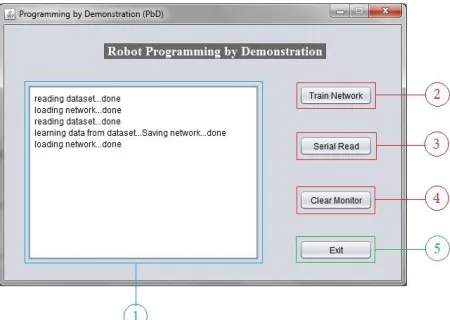
Figure 5 shows the GUI form of the Java Program from the project. It includes the various types of buttons and the status report monitor etc. As per as the above diagram shows, the numbers represent the specific type of functionality as given below,
1 – Status / Report monitor : to display the status of the program which are running in the background of the GUI,
2 – Train Network button : used to train the supervised learning algorithm of the neural network. 3 – Serial read button : this is used to connect and lock the Java program to the Serial COM port. 4 – Clear Monitor button : used to clear the Status monitor.
5 – Exit button : used to exit from the Java Program.
Fig. 5 Remote PC Program’s GUI implementation using Java
Dataset sample is shown in figure 6. It contains only a set of patterns. Particular type of pattern is used for each motor. As it clears that the paper only deals with the supervised learning algorithms, The Neural network must be then generated from the dataset which is specific to the Robot arms similar to the my robot arms.
Fig. 6 Dataset Sample
ISSN(Online): 2320-9801
ISSN (Print) : 2320-9798
I
nternational
J
ournal of
I
nnovative
R
esearch in
C
omputer
and
C
ommunication
E
ngineering
(An ISO 3297: 2007 Certified Organization)
Vol. 3, Issue 9, September 2015
suitable for the supervised learning process. The figure 7 shows the learning of network. Hardly it takes 27 to 30 seconds to learn and train the neural network. The overall progress and status is also given in the status/report monitor. Once this is done, the neural network is ready to use. The same saved network can be reused for testing the upcoming multiple demonstrations.
The figure 7 includes learning of the ANN with the MLP algorithm. The MLP with backpropagation can also be used, but takes lots of time to learn. i.e. it takes at least 6 to 7 hours which is not acceptable & also in this work only detection of a pattern is important not the accuracy. So, MLP is best suitable for such type of applications. Once the network is created, the program of Java is now ready to receive the data i.e. for the test data. When it gets the test data, it is just giving out the appropriate output sequence.
Fig. 7 Learning of ANN
The Status monitor is displaying the status of the Java program. As soon as data is received, it displays that the data is received into the monitor and also displays the information about the Training and learning of the neural
network. It too displays the error reports as well. The 3rd button from above GUI will clear the status monitor. And the
last button is disposing the object of the Program which then results to the ending of the Java Program.
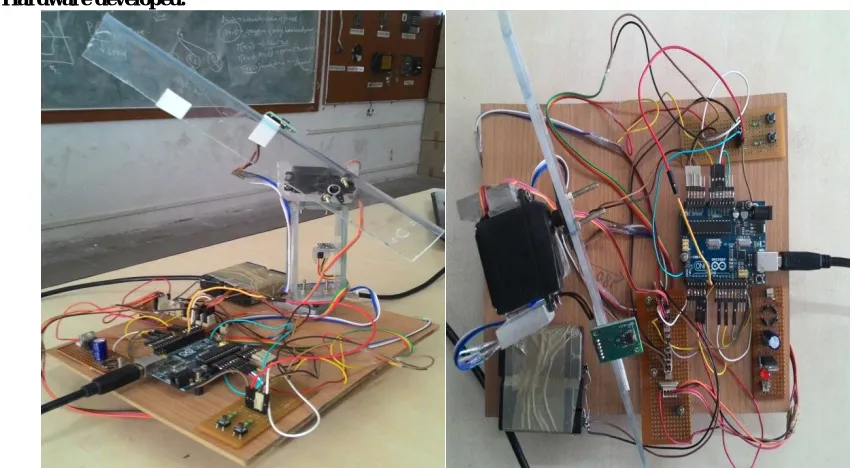
2. Hardware developed:
ISSN(Online): 2320-9801
ISSN (Print) : 2320-9798
I
nternational
J
ournal of
I
nnovative
R
esearch in
C
omputer
and
C
ommunication
E
ngineering
(An ISO 3297: 2007 Certified Organization)
Vol. 3, Issue 9, September 2015
Figure 8 shows a side view and top view of the robot arm developed. It includes the hardware devices like Push-to-on switches, Arduino UNO, HMC5883 magnetometer, ADXL553 accelerometer and batteries etc. Here, only 2 motors have been used. Number of motors can be increased according to the requirement. Arduino UNO is not much faster but, that is sufficient to give the results. Therefore, to make it faster, one may use the raspberry pi or other different boards for the advancement & accuracy point of view.
IX.CONCLUSION AND FUTURE WORK
With the PbD system, Industrial robot arms can be automized and make it more interactive with the user. Any person(technical or non-technical) who knows the procedure of PbD system can teach new actions to robot arm and can get it done from robot arm. The ANN implemented in Java Neuroph framework is used to increase the computational and decision time for the PbD system. Different functionalities can be taught to the robot arm so that there will be reduction in terms of the time and cost for the current industries.
The PbD system makes use serial of COM port as a communication media. The other medias like Bluetooth, wi-fi or zigbee network might be used. Also, the PbD robot arm spaces can be mapped to the other robot arms space by using the advanced ANN controllers in future. The work further can be extended to make the systemto have plug-and-play technology to be free from the re-configurability.
REFERENCES
1. Brenna D. Argall, Sonia Chernova, “A survey of Robot learning from Demonstration”, Robotics and Autonomous Systems, Elesevier, Robotics and Autonomous Systems 57 (2009) 469-483.
2. Staffan Ekvall and Danica Kragic, “Robot Learning from Demonstration: A Task-level Planning Approach”. ARS International, Vol. 5, No. 3 (2008).
3. Aude Billard and Sylvain Calinon,“Handbook of Robotics”, Chapter 59, Robot Programming by Demonstration, LASA Laboratory, School of Engineering,EPFL, 9-1015, Lausanne, Switzerland, 3 Jan. 2008.
4. Monica N. Nicolescu, “Natural Methods for Robot Task Learning: Instructive Demonstrations, Generalization and Practice”, University of southern California, 2002.
5. S. MÜNCH, J. KREUZIGER, “Robot Programming by Demonstration (RPD) - Using Machine Learning and User Interaction Methods for the Development of Easy and Comfortable Robot Programming Systems”, Proceedings of the 24th International Symposium on Industrial Robots (ISIR '94).
6. Sylvain Calinon and Aude Billard, “A Probabilistic Programming by Demonstration Framework Handling Constraints in Joint Space and Task Space”, Learning Algorithms and Systems Laboratory (LASA), Switzerland, 2005.
7. Yusuke MAEDA, Nanako ISHIDO, “Teaching of Grasp/Graspless Manipulation for Industrial Robots by Human Demonstration”, IEEE/RSJ, Switzerland, October 2002.
8. Ping Jiang, “Indirect Iterative Learning Control for a DiscreteVisual Servo Without a Camera-Robot Model”, IEEE Transactions On Systems, Man, And Cybernetics—Part B: Cybernetics, Vol. 37, No. 4, August 2007.
9. Christian Martens, “A FRIEND for AssistingHandicapped People”, Nils Ruchel,IEEE Robotics & Automation Magazine, March 2001. 10. Sylvain Calinon and Aude Billard, “A Probabilistic Programming by Demonstration Framework HandlingConstraints in Joint Space and Task
Space”, European Commission, Learning Algorithmsand Systems Laboratory (LASA), Ecole Polytechnique Federale de Lausanne (EPFL), 2006.
11. http://www.oracle.com/index.html/ 12. https://learn.adafruit.com/
13. http://neuroph.sourceforge.net/
14. http://www.arduino.cc/.
BIOGRAPHY
First Author – Dr. Shantanu K.Dixit, B.E. Electrical, M.E. and Ph.D in Electronics Engineering, Electronics and Telecommunication Engineering, Walchand Institute of Technology, Solapur. Areas of interest are Robotics and Embedded systems. He has an Teaching experience of 32 years.