Improving Energy efficiency in Clustered
Wireless Sensor Networks
Kiran Kumar V1, Vinayaka K S2, Swaroop M3,Sumana N4 ,Shalini R5
Assistant professor, Dept.of Information Science Engineering, SJBIT, Bangalore,Karnataka, India1
U.G Student, Dept.of Information Science Engineering, SJBIT, Bangalore, Karnataka, India2,3,4,5
ABSTRACT: One of the most critical issues in designing wireless sensor network is to minimize the energy consumption and increase longevity. In Wireless Sensor Network, data fusion can reduce data redundancy among sensed data and optimal sensor routing algorithm can provide strategy for data gathering with as minimum energy as possible. We combined data fusion and clustering method together to reduce the energy.
In this paper we propose K-means algorithm for clustering. We design a novel routing algorithm called an Adaptive algorithm(AA) for energy efficient data gathering in sensor network that optimizes data transmission cost and the data fusion cost. Simulation result is given for the proposed protocol with K-means Algorithm. Simulation result shows that AA achieves better performance than MFST.
KEYWORDS: K-means Algorithm, Data fusion, Data Aggregation, MFST and AA
I. INTRODUCTION
Sensor node is a tiny device includes four components like sensing unit, processing unit for compression and aggregation, storage and communication unit for transmission and reception. At last, a power supply unit. In wireless sensor network, nodes collaborate with themselves and complete its assigned task. Wireless sensor network is used various application areas such as the military, environment monitoring, medical services and business. The main problem with sensor node is tedious to recharge when battery power get discharged. If there is no battery power the node is assumed to be a dead node. This becomes a key issue in WSN to construct an optimal technique. In “Zhang Jian[13]”, proposed LEACH routing protocol to optimizes the energy conservation techniques. “Rawazan Cristescu”
[14], discussed about Stepian Wolf model where optimal coding is used to reduce the transmission cost.
Data aggregation fusion and optimal routing are the further methods to conserve energy of the sensor nodes so, we consider data aggregation and fusion technique as the key method to save energy with this an idea we assume following properties
In this paper assume a Sensor node model with following properties.
1 All sensor nodes are immobile and homogeneous with a limited stored energy.
2 The nodes are equipped with power control capabilities to vary their transmitted power.
3 None of the nodes know their location in the network.
4 Each node senses the environment at a fixed rate and always has data to send to the base station.
With various scopes, Cluster head is to collect information periodically from a remote terrain, where each Sensor node continually sense the environment and sends back data to the base station (BS).
Energy efficiency is the most important issue in wireless sensor network, for data fusion and data aggregation, a randomized algorithm is needed to optimize both fusion cost and transmission cost to minimize overall energy consumption. Therefore, Adaptive algorithm has been accounted for this problem.
II. RELATED WORK
prolong the network lifetime. In mobile nodes, the traffic flow can be altered if mobile devices are responsible for data collection directly from static nodes. It takes limited multi-hop traversals to sink nodes so energy is reduced at all levels in a network as in [15, 16].
The work in [15], introduce the expellant self organizing [ESO] protocol that is dynamic. Each node in a network, broadcasts its maximum radio power level to all nodes with its location details to calculate its neighbors costs. The maximum energy node is elected as cluster head instead of random selection in LEACH.
K-Means Clustering on Data Streams
The study is related to data stream clustering. The values of points evolve over time. Thus, the values of one point over time can be modelled as a data stream.
A few studies have been conducted to investigate the problem of data stream clustering, such as [3], [4], and [5]. Different from our study where the number of points is fixed and the interest is on maintaining k-means of the current snapshot, most of the existing work on stream clustering assumes that new data points keep arriving.
Clustering in Sensor Networks
Since we use data sensor networks as a motivating example of the problem studied here, our study is also related to clustering in sensor networks.
Most of the previous studies on sensor network clustering focus on how to cluster sensors so that sensors having similar readings or behavior are grouped together first step is completed and an early groupage is done. At this point we need to re-calculate k new centroids as barycenters of the clusters resulting from the previous step. After we have these k new centroids, a new binding has to be done between the same data set points and the nearest new centroid. A loop has been generated. As a result of this loop we may notice that the k centroids change their location step by step until no more changes are done. In other words centroids do not move any more
III. PROPOSED ALGORITHM
A. Description of the Proposed Algorithm:
Given the source node set S and target node t, our objective is to design a routing algorithm that minimizes the energy consumption when delivering data from all source nodes in S to t. We need to design routing paths back traverse sensed information driven by information aggregation and we have to optimize over the decisions as to whether aggregation shall occur or not on a particular node.
Mathematically, a feasible routing scheme is a connected subgraph G′ = (V′, E′) where G′ G contains all
sources (S V′ ) and the sink (t є V′ ). Depending on whether fusion is performed or not, the edge set E′ can be divided
into two disjoint subsets E′ f and E′ n , where E′ f = {e|e Є E′, xe = 1} and E′ n= {e|e є E′, xe =0}. Our goal is to find a
feasible subgraph G* such that
G* = argminG′ ) +
Adaptive algorithm(AA):
IV. PSEUDO CODE
1. Initialize the loop index i = 0. Define S0 = S Ư{t}, and E* = ø. Let lv0 for any v є S equal to its original weight, and
let lt0 = 0.
2. For every pair of nodes (u, v) є Si, find the minimum cost path (u, v) in G according to the metric M(e) = qui,vi+1 (lui
+ lvi) + α (lui ,lvi )c(e) and define Ki(u, v) to be the distance under metric M(e) of this path.
3. Find minimum-cost perfect matching between nodes in Si. If there is only one non-sink node left after matching,
match it to itself without any cost, and consider it as the last “single-node pair” in Si.
4. For each matched pair (u, v), calculate the fusion benefit for node u and v respectively according to this new definition:
∆ui,vi+1 = (lui + lvi )SP(vi, t)–((lui + lvi )
(1−σek )SP(vi, t) +qui,vi+1 (lui + lvi))
where, SP(vi, t) denotes the summation of unit transmission cost from vi to the sink t using shortest path. We call (u, v) a non-fusion pair if there is no fusion benefit regardless which node is selected as the center. It means that the two following equations are satisfied
∆ui, vi+1 < 0 and ∆vi, ui+1 < 0.
Otherwise, we call them a fusion pair.
5. For each non-fusion pair (u, v), add those edges that are on the shortest paths of (u, t) and (v, t) to set E*n , remove
both nodes u and v from Si.
6. For each fusion pair (u, v),
Add those edges that are on the path defining Ki(u, v) to set E*f .
Choose u to be the center with probability l2ui / (l2ui+l2vi). Otherwise v will be the center. For pair (u, t),
choose t to be the center.
Transport weight of non-center node to its corresponding center node. According to Equation (3), the weight
of the center satisfies li+1(center) = (lui+lvi )(1−σui,vi ).
Remove all non-center nodes from Si, and then the remaining center nodes induce Si+1.
V. SIMULATION RESULTS
In Simulation Environment setup, 100 sensor nodes are uniformly distributed in a region of a 50m*50m square. It is divided into 20 regions with size 65cm* 70cm and also divided into 6 Groups based on correlation ratio with respect to distance. 4
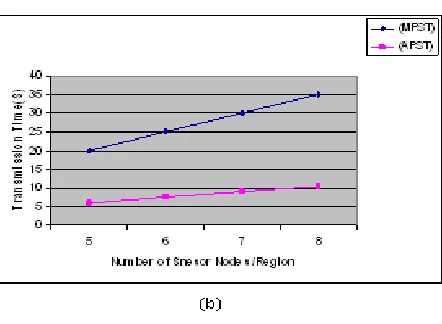
Fig 2 Sensor Node Vs Transmission Time
Fig 1 denotes the simulation result of sensor node vs data path here as the number of nodes increases using MPCT it requires more data paths whereas when we use the algorithm that AA(APCT) the data paths required for transmission is less which is good sign.
Fig 2 denotes Sensor node vs Transmission time where as the number of nodes increases per region using MPCT the transmission time required to transmit the data along data path is more but when we use AA algorithm as the number of data paths decreases the transmission time required to transfer the data decreases.
So from the Simulation result we can say that the developed algorithm is faster and efficient compared to MPCT.
VI. CONCLUSION AND FUTURE WORK
In this paper, we proposed AA routing with K-means algorithm for minimizing energy consumption in Wireless Sensor Network. K-means algorithm, a greedy algorithm for partitioning n samples into k clusters to minimize the sum of distances to the cluster head. AA, a routing algorithm optimizes over both transmission and fusion cost, also adaptively adjusts fusion decision for sensor node as to whether aggregation shall be performed.
Our propose model indicate that AA provides a clustering scheme with near optimal routing performance. The simulation result shows that AA has better performance over MFST. AA can increase 70% of the total lifetime compared to MFST. This approach can be used for both uniform and non-uniform energy distributed sensor nodes in a network. The performance of AA depends on the Grouping, Shortest Path Routing and data rate.
Our proposed model designed for uniformly distributed sensor nodes with uniform energy levels. The system can be extended for non uniform distribution of sensor nodes with different energy levels.
REFERENCES.
[1]. W. Ye, J. Heidemann, “Medium Access Control in Wireless Sensor Networks”, Chapter 4 in Wireless Sensor Networks
[2]. C. Tang, C. S. Raghavendra, “Compression techniques for wireless sensor networks”, Chapter 10 in book Wireless Sensor Networks, Pp. 207 – 231
[3]. I. Solis, K. Obraczka, “The impact of timing in Data Aggregation for Sensor Networks”, Proc. ICC 2004, June 2004
[4]. P. Venkitasubramaniam, S. Adireddy and L. Tong, “WSN with Mobile Access: Optimal Random Access and Coding", IEEE Journal: Volume: 22, Issue: 6, August 2004.
[5] M.S. Anbarasi and K.M. Mehata, ”Enhanced K-means Clustering on distributed data base”, journal of advanced Research in computer Engineering, Vol 3,No.2 , July-December 2009,pp 213-218”.
Trans. Mobile Computing, vol.3, no.4, pp. 367-379,
[10] H. Luo, J. Luo, Y. Liu, & S.K. Das “Adaptive data fusion fusion for energy efficient routing in wireless sensor networks”, IEEE transactions on computers, vol. 55, no. 10, october 2006
[11] H. Luo, J. Luo, Y. Liu, and S.K. das, "Routing correlated data with adaptive fusion in wireless sensor networks," proc. Third ACM/SIGMOBILE INT'L workshop foundations of mobile computing.
BIOGRAPHY
Kiran kumar V is working as an assistant professor in Information Science at SJBIT,Bangalore(Karnataka). His research interests are Cross Layer Design in Wireless Sensor Networks and energy efficient routing protocols.
Vinayaka K S is a U.G student in Information Science at SJBIT,Bangalore(Karnataka).His interests are wireless sensor networks.
Swaroop M is a U.G student in Information Science at SJBIT,Bangalore(Karnataka).His interests are wireless sensor networks.
Sumana N is a U.G student in Information Science at SJBIT,Bangalore(Karnataka).Her interests are wireless sensor networks.