ISS N(Online): 2320-9801
ISS N (Print): 2320-9798
International Journal of Innovative Research in Computer
and Communication Engineering
(An ISO 3297: 2007 Certified Organization)
Vol. 3, Issue 4, April 2015
High Utility Itemset Mining from Transaction
Database Using UP-Growth and UP-Growth+
Algorithm
Komal Surawase
1, Madhav Ingle
2PG Scholar, Dept. o f Co mputer Engg., JSCOE, Hadapsar, Pune, Ind ia
Assistant Professor, Dept. of Co mputer Engg., JSCOE, Hadapsar, Pune, India.
ABSTRACT: Effic ient discovery of ite msets with high utility like profits deals with the mining h igh utility ite msets fro m a transaction database Although a number of relevant approaches have been proposed in recent years, these algorith m incur the proble m of producing a la rge nu mber of candidate ite msets for high utility ite msets and probably degrades the min ing performance in terms of e xecution time and me mo ry space. In this paper, we propose two algorith ms, viz., utility pattern growth (UP-Growth) and Improved UP-Gro wth i.e. Imp roved Utility Pattern Gro wth, for mining h igh utility ite msets with a set of effective strategies for pruning candidate ite msets. The information of high utility ite msets is ma intained in a co mpact tree-based data structure utility pattern tree (UP -Tree), it scan the original database twice to manage data structured way. Proposed algorithms, espe cially Improved UP Growth, not only reduce the number of candidates effective ly but also outperform other algorithms substantially in terms of runtime and
me mo ry consumption, especially when databases contain lots of long transactions.
KEYWORDS: High Utility Ite mset; UP-Gro wth; Transaction Weighted Utility; Frequent Itemset Mining; Ut ility Mining; Down ward Closure Property.
I. IN TRO DUC TION
Mining frequent itemsets from a transaction database refers to the discovery of the itemsets which frequently appear together in the transactions. The main objective of Utility Mining is to identify the itemsets with highest utilit ies above a user-specified threshold, by considering profit, quantity, cost or other user preferences. If the support of an itemset e xceeds a user-specified minimu m support threshold, the itemset is considered as frequent. Most frequent itemset mining a lgorith ms e mploy the downward closure property of ite msets[1] ,[2],[13]. However, the unit profits and purchased quantities of items are not considered in the frame work of frequent itemset mining. The basic meaning of utility is the interestedness/ importance/profitability of ite ms to the users.
The utility of ite ms in a transaction database consists of two aspects: (1) the importance of ite ms of diffe rent transaction is called e xterna l utility, and (2) the importance of the items in the transaction, which is called internal utility. The utility of an itemset is defined as the external utility mult iplied by the internal utility. An itemset is called a high utility ite mset if its utility is greater than a user specified threshold; otherwise, the itemset is called a low utility ite mset[8][17][20].
ISS N(Online): 2320-9801
ISS N (Print): 2320-9798
International Journal of Innovative Research in Computer
and Communication Engineering
(An ISO 3297: 2007 Certified Organization)
Vol. 3, Issue 4, April 2015
II. RELA TED WORK
A number of traditional ARM algorith ms and optimizat ions have been proposed. One of the well-known algorith ms is Apriori a lgorith m[10], which is the pioneer for efficiently mining association rules from la rge databases. It’s widely recognized that FP-Growth[6] achieves a better performance than Apriori Algorith m since it finds frequent itemsets without generating any candidate itemset and it scans database just twice. There are also many studies that have developed different we ighting functions [14] for weighted pattern mining.
Mengchi Liu [13] proposed an algorithm, called HUI -Miner (High Utility Ite mset Miner), for high utility itemset mining.HUI-M iner uses a structure, called utility-list, to store the utility information of an ite mset and the heuristic informat ion for pruning the search space of HUI -Miner. By avoiding the costly generation and utility computation of numerous candidate itemsets, HUI-M iner can effic iently mine high utility ite msets fro m the utility lists constructed fro m a mined database.
Although two-phase algorithm reduces search space by using TWDC property, it still generates too many candidates to obtain HTWUIs and requires multip le database scans. To overcome this problem, Li et al. [11] proposed an isolated ite ms discarding strategy (IIDS) to reduce the numbe r of candidates. By pruning isolated ite ms during level-wise search, the number of candidate itemsets for HTWUIs in phase I can be reduced. However, this algorithm still scans database for several times and uses a candidate generation -and-test scheme to find high utility ite msets. To efficiently generate HTWUIs in phase I and avoid scanning database too many times, Ahmed et al. [3] proposed a tree -based algorith m, na med IHUP. A t ree -based structure called IHUP -Tree is used to ma intain the information about ite msets and their utilit ies. Each node of an IHUP -Tree consists of an ite m na me, a TWU value and a support count. IHUP algorith m has three steps: 1) construction of IHUP-Tree, 2) generation of HTWUIs, and 3) identification of high utility ite msets[21]. In step 1, ite ms in transactions are rearranged in a fixed order such as lexicographic order, support descending order or TWU descending order. Then the rearranged transactions are inserted into an IHUP-Tree. In step 2, HTWUIs are generated fro m the IHUP-Tree by applying FP-Growth [14]. Thus, HTWUIs in phase I can be found without generating any candidate for HTWUIs. In step 3, high utility ite msets and their utilities are ident ified fro m the set of HTWUIs by scanning the original database once.
Although IHUP achieves a better performance than IIDS and Two -Phase, it still produces too many HTWUIs in phase I. Note that IHUP and Two-Phase produce the same number of HTWUIs in phase I since they both use TWU fra me work to overestimate ite msets utilit ies. However, this fra mework may p roduce too many HTWUIs in phase I since the overestimated utility calcu lated by TWU is too large. Moreover, the number of HTWUIs in phase I a lso affects the performance of phase II since the more HTWUIs the algorithm generates in phase I, the more e xecution time for identifying high utility ite msets it requires in phase II.
III. PROBLEM STATEMEN T
In the literature we have studied the different methods proposed for high utility ite mset mining fro m la rge datasets. But all this methods frequently generate a huge set of PHUIs and their mining performance is degraded consequently. Further in case of long transactions in dataset or low thresholds are set, then this condition may become worst. The huge number of PHUIs forms a challenging proble m to the mining perfo rmance since the more PHUIs the algorithm generates, the higher processing time it consumes. Thus to overcome this challenges the efficient algorithms presented recently in [1], [3], [12]. These methods in [1] outperform the state-of-the-art algorithms a lmost in all cases on both real and synthetic data set. However this approach in [1] is still needs to be imp roved in case of less me mory based systems.
IV.EXISTING SYSTEM
ISS N(Online): 2320-9801
ISS N (Print): 2320-9798
International Journal of Innovative Research in Computer
and Communication Engineering
(An ISO 3297: 2007 Certified Organization)
Vol. 3, Issue 4, April 2015
methods are not based on traditional TWU model. By our effect ive strategies, the set of PHUIs will beco me much smaller than the set of HTWUIs. After constructing a global UP-Tree, a basic method for generating PHUIs is to mine UP-Tree by FP-Gro wth. Thus, we propose an algorith m UP -Growth by pushing two more strategies into the fra me work of FP-Growth. By the strategies, overestimated utilit ies of item sets can be decreased and thus the number of PHUIs can be further reduced. UP-Growth achieves better performance than FP-Gro wth by using DLU and DLN to decreas e overestimated utilities of ite m sets. However, the overestimated utilit ies can be closer to their actual utilit ies by eliminating the estimated utilities that are closer to actual utilit ies of unpromising ite ms and descendant nodes. In UP -Growth, minimu m ite m utility table is used to reduce the overestimated utilities. In UP-Gro wth+, min ima l node utilities in each path are used to make the estimated pruning values closer to real utility values of the pruned items in database. The mining processes of UP-Gro wth and UP-Gro wth+ by maintain ing only essential informat ion in UP-Tree. By these strategies, overestimated utilities of candidates can be well reduced by discarding utilities of the ite ms that cannot be high utility or are not involved in the search space.
V. PRO POSED METHO D
The goal of utility mining is to generate all the high utility ite msets whose utility values are beyond a user specified threshold in a transaction.
A. Up Growth:
The UP-Gro wth [11] is one of the effic ient algorith ms to generate high utility ite msets depending on construction of a global UP-Tree. In phase I, the frame work of UP-Tree follows three steps: (i). Construction of UP-Tree [2]. (ii). Generate PHUIs fro m UP-Tree . (iii). Identify h igh utility ite msets using PHUI.
The construction of global UP-Tree [2] is fo llo ws,
(i). Discarding global unpromising ite ms (i.e., DGU strategy) is to eliminate the lo w utility ite ms and their utilities fro m the transaction utilities.
(ii). Discarding global node utilities (i.e ., DGN strategy) during global UP-Tree construction. By DGN strategy, node utilit ies which are neare r to UP-Tree root node are effectively reduced. The PHUI is similar to TWU, wh ich compute all ite msets utility with the help of estimated utility. Finally, identify high utility ite msets (not less than min_sup) from PHUIs values. The global UP-Tree contains many sub paths. Each path is considered fro m bottom node of header table. This path is named as conditional pattern base (CPB).
Disadvantages
It requires mu ltiple database scans.
It Generate mu ltiple candidate Ite mset.
Other Algorithm like Aprio ri treats all ite m with same importance or profit.
It consumes more me mory space and performs badly with long patte rn data set.
These methods are further needs to be imp roved over their limitations presented below:
(1) Performance of this methods needs to be investigated in low me mory based systems for mining high utility itemsets fro m large transactional datasets and hence needs to address further as well.
(2)These proposed methods cannot overcome the screenings as well as overhead of null transactions; hence, performance degrades drastically.
B. Up-Growth+:
ISS N(Online): 2320-9801
ISS N (Print): 2320-9798
International Journal of Innovative Research in Computer
and Communication Engineering
(An ISO 3297: 2007 Certified Organization)
Vol. 3, Issue 4, April 2015
Advantages
It scan the database just twice.
It is easy to imple ment.
It reduces unnecessary calculation when database is updated, and when user specified minimu m threshold is
changed.
It requires less me mory space and less execution time.
C. Up-Growth+ Algorithm:
Input: Transaction database D, user specified threshold.
Output: h igh utility ite msets.
Begin
1. Load dataset contains number transactions Td ∈ D
2. Determine transaction utility of Td in D and TWU of ite mset (X) 3. Co mpute min_sup (MTWU * user specified threshold)
4. If (TWU(X) ≤ min_sup) then Remove Items fro m transaction database 5. Else insert into header table H and to keep the ite ms in the descending order. 6. Repeat step 4 & 5 until end of the D.
7. Insert Td into global UP-Tree .
8. Apply DGU and DGN strategies on global UP - tree. 9. Re -construct the UP-Tree
10. For each ite m ai in H do
11. Generate a PHUI Y= X U ai
12. Estimate utility of Y is set as ai’s utility value in H
13. Put local p ro mising ite ms in Y-CPB into H
14. Apply strategy DLU to reduce path utilit ies of the paths 15. Apply strategy DLN and insert paths into Td
16. If Td ≠ null then call fo r loop
End for End
D. Application:
Rare ite msets provide useful informat ion in different decision -ma king domains such as business transactions, medical, security, fraudulent transactions and retail co mmunit ies. For e xa mp le, in a supermarket, customers purchase mic rowave ovens or frying pans rarely as compared to bread, washing powder, soap. But the former transactions yield more profit for the superma rket. Similarly, the high-profit rare ite msets are found to be very useful in many application areas. For e xa mple , in medica l application, the rare co mb ination of symptoms can provide useful insights for doctors [7][18]. A retail business may be interested in identify ing its most valuable customers i.e . who contribute a ma jor fract ion of overall co mpany profit[4][19].
VI. IMPLEMENTATIONDETAILS
A. System Architecture and Design
ISS N(Online): 2320-9801
ISS N (Print): 2320-9798
International Journal of Innovative Research in Computer
and Communication Engineering
(An ISO 3297: 2007 Certified Organization)
Vol. 3, Issue 4, April 2015
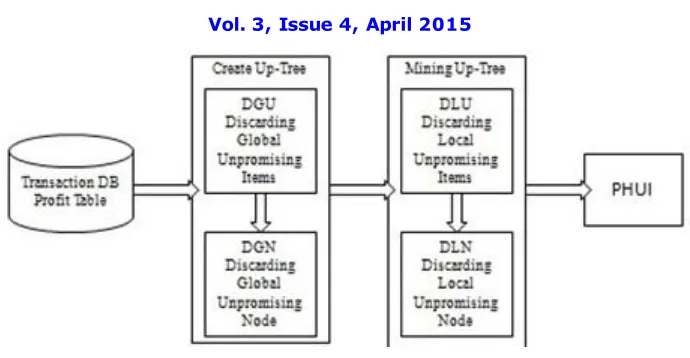
Fig. 1 System Architecture
Fig. 1 contains the follo wing bloc ks:
Transaction DB and Profit table are input to the system to discover potential high ly utilized Ite m sets.
Create UP-tree : UP-tree is created using discarding unfavourable global ite ms and reducing global node utility.
UP-t ree has fields as Node.name wh ich contain name of the ite m, Node. Count, Node.nu, Node. parent, Node. hlink.
Discarding global unpromising ite ms: After calculating transaction utility and transaction weighted utility, the item
sets having less utility than predefined min imu m threshold utility are d isposed.
Discarding global node utility: After disposing the unfavourable items the global node utilities are reduced. And
nodes are inserted into UP tree using create UP-tree algorith m.
Mining Up-t ree: In wh ich loca l unpro mising Ite m and node utility.
Discarding local unpro mising ite ms: Construct conditional pattern base of bottom ite m entry in header table
Retrieve the entire path related to that item CPB. Conditional UP tree created by two scans over CPB. Local unfavourable items re moved using path utility of each ite m in CPB paths are organized in descending order.
Discarding local node utility: Reorganized path is inserted into conditional utility pattern tree using reduce local node utility strategy.
Potential High Utility Ite m sets: Identify potential high utility ite m sets and their utilities form UP tree mining using Dispose of local unfavourable ite ms and Reduce local node utility.
B. Mathematical Model
Let S be the system that describes dataset i.e. set of transaction with profit of ite m as input to system with calculat ion of transaction utility, transaction weighted utility, recognized transaction utility, up tree construction, UP growth algorith m, Improved UP gro wth algorith m and this all g ives output as high potential utility ite m sets.
Vari able use d in Mathe matical Model
S= (Tp, TU, TWU, RTU, Up tree, UP growth, UP growth+, PHUI) S= System
Tp= Set of transaction with profit of each ite m TU=Transaction Utility
TWU=Transaction Weighted Utility RTU=Recognized Transaction Utility UUI=Utility of Unpro mising Ite m UP t ree= Utility Pattern Tree UP gro wth= Utility Pattern Gro wth
ISS N(Online): 2320-9801
ISS N (Print): 2320-9798
International Journal of Innovative Research in Computer
and Communication Engineering
(An ISO 3297: 2007 Certified Organization)
Vol. 3, Issue 4, April 2015
Inputs:
Tp= {D,P}
Fig. 2 Mathe matica l Model
Process:
1) TU=Σ ip Є Td [pr(ip)*qp(ip,Td)]
2) TWU(ip) = Σ TU Є ip
3) RTU (Td):= TU (Td) - UUI
4) c reate UP tree and Mine it.with Node.name , Node. count, Node.nu, Node. parent, Node.hlink.
Output:
All Potential High Utility Ite msets in Tx
VII. EXP ERIMEN TAL RESULTS
The experiments were done on a 2.20 GHz Intel(R) Pentiu m(R) Processor with 3 GB RAM, and performing on Windows 7(32 b it). The proposed algorith ms are imple mented in .Net language.
In our project Up-Growth and Up-Gro wth+ outperform the state-of-the-art algorithms in all cases on both real and synthetic data sets.
ISS N(Online): 2320-9801
ISS N (Print): 2320-9798
International Journal of Innovative Research in Computer
and Communication Engineering
(An ISO 3297: 2007 Certified Organization)
Vol. 3, Issue 4, April 2015
Fig.4 Formatted Dataset with Utility
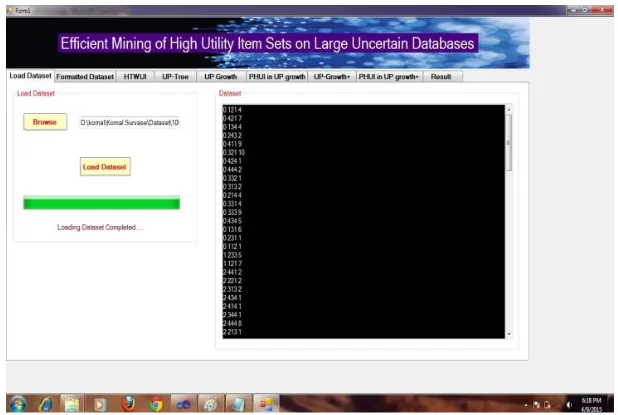
In fig. 3 dataset are loaded as system works with respect to different transaction size and different min imu m utility as shown below fig. 3.
After calculat ion of Transaction Utility and Transaction Weighted Utility new Transaction Utility is generated by pruning unpromising ite ms called as Recognized transaction utility (RTU). Also we maintain a min imu m ite m utility to keep minimu m ite m utilit ies for all global pro mising items in the database.Up-tree is constructed by applying DGU, DGN, DLU and DLN strategy potential high utility itemset identified. And Final output is generated. Time comparison between UP-Gro wth and Up-Growth+ is shown in fig. 5.
Fig.5 Generated Result
ISS N(Online): 2320-9801
ISS N (Print): 2320-9798
International Journal of Innovative Research in Computer
and Communication Engineering
(An ISO 3297: 2007 Certified Organization)
Vol. 3, Issue 4, April 2015
Fig. 6 Execution time for phase I on Chess Fig. 7 Execution time for phase II on Chess
VIII. CO NCLUSION AND FUTURE SCOPE
Proposed system UP-Gro wth and UP-Growth+ Min ing for discovering High utility ite m sets from databases. Data Structure UP-Tree for recording the information of highly utilized item sets and four effective strategies, DGU, DGN, DLU and DLN, to minimize search space and the number of candidates for utility mining. Potential h igh utility ite m sets can be generated from Utility Pattern Tree with only two scans of the database. UP-Growth specially Up-Gro wth+ Algorith m is faster than previous algorith ms when database have lots of long transactions.
The current study proposed two definitions to capture the effects of the noise in the data. This pointed out possible scenarios where the mining of these patterns is central as well as the challenges in developing effic ient mining algorith ms. Future works include the extension of the temporal utility pattern tree to mine noisy patterns[5][16], and developing more e fficient techniques to handle genomic data.
REFER ENC ES
1. Vincent S T seng, Bai-En Shie, Cheng-Wei Wu, and Philip S. Yu, Fellow, “Efficient Algorithms for Mining High Utility Itemsets from Transactional Databases”, IEEE Transactions On Knowledge And Data Engineering, volume 25, Issue No. 8, pp 1772-1786, AUGUST 2013. 2. Vincent S. T seng, Cheng-Wei Wu, Bai-En Shie, and Philip S. Yu, “ UP-Growth: An Efficient Algorithm for High Utility Itemset Mining”, Proc.
15th ACM SIGKDD Conf. on Knowledge Discovery and Data Mining (KDD'09), Paris, France, volume 8, Issue No. 10, pp 1222-1228, 2010. 3. Liang Wang, David Wai-Lok Cheung, Reynold Cheng, Member, IEEE, Sau Dan Lee, and Xuan S. Yang, “ Efficient Mining of Frequent Item
Sets on Large Uncertain Databases”, IEEE Transactions On Knowledge And Data Engineering, volume 24, Issue No. 12, pp 2170-2183, DECEMBER 2012.
4. Thomas Bernecker, Hans-Peter Kriegel, Matthias Renz, Florian Verhein, Andreas Zuefle, “Probabilistic Frequent Itemset Mining in Uncertain Databases”, Proc. 15th ACM SIGKDD Conf. on Knowledge Discovery and Dat a Mining (KDD'09), volume 24, Issue No. 12, pp 1270-1283 , 2009.
5. Jency Varghese, K.Soundararajan, “ Frequent Itemsets Mining on Large Uncertain Databases: Using Rule Mining Algorithm ”, International Journal of Computer Applications, Volume 65– Issue No. 20,pp 0975-8887, March 2013.
6. Supriya P. Bhosale, “Mining High BeneficialItemsets from T ransactional Database”, International Journal of Computer Science and Information Technologies, ISSN: 0975-9646, Vol. 5, Issue No. 6 , 2014.
7. Maya Joshi, Mansi Patel, “A Survey on High Utility Itemset Mining Using T ransaction Databases”, (IJCSIT ) International Journal of Computer Science and Information Technologies, ISSN: 0975-9646, Vol. 5 Issue No. 6 , pp 2407-2412, 2014.
8. A. Erwin, R.P. Gopalan, and N.R. Achuthan, “Efficient Mining of High Utility Itemsets from Large Data Sets,” Proc. 12th Pacif ic-Asia Conf. Advances in Knowledge Discovery and Data Mining (PAKDD), Volume 5, Issue No. 7 , pp. 554-561, 2008.
9. Rakesh Agrawal, Ramakrishnan Srikant, “Fast algorithms for mining association rules”, In Proc. of the 20th Int'l Conf. on Very Large Data Bases,Volume No. 4, Issue No. 5, pp. 487-499, 1994.
10. Y.-C. Li, J.-S. Yeh, and C.-C. Chang, “Isolated Items Discarding Strategy for Discovering High Utility Itemsets,” Data and Knowledge Engg., volume 64, no. 1, pp. 198-217, Jan. 2008.
11. Adinarayanareddy B, O Srinivasa Rao, MHM Krishna Prasad, “ An Improved UP -Growth High Utility Itemset Mining”, International Journal of Computer Applications Volume 58, Issue No.2, pp 2275 – 2287, November 2012.
12. Mengchi Liu, Junfeng Qu, “ Mining High Utility Itemsets without Candidate Generation”, Data and Knowledge Engg, Volume 58, Issue No.2, pp 1106 – 1111, Nov 2012.
0 10 20 30 40
0 50 100
pha se I (s e c) Min_Sup UPG IUPG 0 10 20 30 40 50 60
0 50 100
ISS N(Online): 2320-9801
ISS N (Print): 2320-9798
International Journal of Innovative Research in Computer
and Communication Engineering
(An ISO 3297: 2007 Certified Organization)
Vol. 3, Issue 4, April 2015
13. Junfu Yin, Zhigang Zheng, Longbing Cao, “USpan: An Efficient Algorithm for Mining High Utility Sequential Patterns”, Knowledge-Based Systems, vol. 24, Issue No. 9, pp 660-668, 2008.
14. More Rani N., Anbhule Reshma V., Waghmare Archana B., “Mining High Utility Item sets From Transaction Database”, International Journal of Latest Trends in Engineering and T echnology (IJLTET), ISSN: 2278-621X, Vol. 3 Issue No. 3, pp 180-182, January 2014.
15. S. Gomathi, M. Suganya, “ An Enhanced Upgrowth Algorithm For Temporal High Utility Item Mining”, International Journal Of Engineering Sciences & Research Technology, Volume 6, Issue No. 8, pp 2277-2282, January 2015.
16. A. A. Bhosale, S. V. Patil, P. M. T are, P. S. Kadam, “ Review Paper - High Utility Itemsets Mining on Incremental T ransactions using UP-Growth and UP-UP-Growth+ Algorithm”, International Journal on Recent and Innovation Trends in Computing and Communication, Volume 2, Issue No. 11, pp 3366 - 3368.
17. Jyothi Pillai, O.P.Vyas, “ Overview of Itemset Utility Mining and its Applications”, International Journal of Computer Applications Volume 5, Issue No.11, pp 9-13, August 2010.
18. Supriya P. Bhosale, “Novel Approach to Discover High Utility Itemsets from Transactional Database”, International Journal of Advanced Research in Computer Engineering & Technology (IJARCET) Volume 3, Issue No.1, pp 139-142, January 2014.
19. Arshia Sultana, E.Krishnaveni Reddy, “Up Approach: Mining High Utility Itemsets”, International Journal of Computer & Organization Trends, Volume 10, Issue No 1, pp 1-10, July 2014.
20. Switi Chandrakant Chaudhari, Vijay Kumar Verma, “Mining High Utility Item Set From Large Database: - A Recent Survey”, International Journal of Emerging Technology and Advanced Engineering, ISSN 2250-2459, ISO 9001:2008 Certified Journal, Volume 3, Issue No. 5, pp 685-688, May 2013.
21. Rajmohan C, Priya G, Niveditha C, Pragathi R, Generation of Potential High Utility Itemsets from Transactional Databases, International Journal of Innovative Research in Advanced Enginneing, Volume 1, Issue No. 1, pp 61-67, Mar 2014.
BIOGRAPHY
Ms. Komal S Surawase is Co mpleted his BE in RSCOE, Chip lun. Later she is studying ME (Co mputer Engineering) in JSCOE, Hadapsar, Pune, having 3 years teaching experience. He r interested areas are data mining MANET and My SQL Database with .net technologies.