Enhancement in Channel Equalization
Using Artificial Neural Network
D.C.Diana1, M.Muthu mari2
Department of Electronics Engineering, Madras Institute of Technology, Anna University, Chennai, India1,2
ABSTRACT: Digital communication is developed for high speed and efficient data transmission over the
communication channel. However the rate of data transmission over the communication system is limited due to the distortion in channel. Inter-symbol interference (ISI) in the presence of additive white Gaussian noise in channel which creates distortion. To mitigate these effects in communication channel the equalization techniques are applied at the receiver side. In digital communication adaptive equalizers are used to remove all these distortion. Adaptive channel equalizers have played an important role in digital communication systems. Generally equalizer works like an inverse filter which is placed at the front end of the receiver. Its transfer function is inverse of the transfer function of the associated channel, which is able to reduce the error between the desired and estimated signal. Artificial neural network is an adaptive system that changes its structure based on external and internal information that flows through the network to compensate the distortion occurs in channel. So it performs better in all noise condition than other conventional method. This adaptive equalizer is trained by different optimisation techniques. Particle Swam Optimization (PSO) algorithm is used to train an artificial neural network.
KEYWORDS: Inter symbol interference, Particle Swarm Optimization, Artificial Neural network.
I.INTRODUCTION
The advent of high speed global communication ranks as one of the important developments of human civilization from the second half of twentieth century to till date. This was only feasible with the introduction of digital communication systems. Today there is a need for high speed and efficient data transmission over the communication channels. It is a challenging task for the engineers and scientists to provide a reliable communication service by utilizing the available resources effectively in-spite many factors that distort the signal. The goal of the digital communication system is to transmit symbols with minimum errors. The high speed digital communication requires more bandwidth, which is not possible due to availability of resources is low.
Digital communication systems are designed to transmit high speed data over communication channels. During this process the transmitted data is distorted, due to the effects of inter-symbol interference (ISI) in the presence of additive noise along with nature of the medium. To Compensate all these channel distortion is known as channel equalization technique at the receiver side which aids reconstruct the transmitted symbols correctly. In digital communication systems adaptive channel equalizers plays an important role. Generally equalizer works like an inverse filter which is placed at the front end of the receiver. Due to the transfer function of equalizer is inverse to the transfer function of the associated channel, it can be able to reduce the error causes between the desired and estimated signal. This is done throughout a process oftraining. During this time the transmitter transmits a fixed data sequence and then the receiver has a copy of the same data sequence.
The main aim is to develop and investigate novel artificial neural network equalizer, which can be trained with best optimization algorithms, so as to minimize the error caused in the desired signal.and also develop a Functional link artificial neural network equalizer.
Performance comparison of this network was carried out by extensive simulations with two other neural networks: an MLP and a functional link ANN together with a linear LMS-based equalizer. Zhao H Zeng et al [17], (2012) analysed a novel complex-valued non-linear equaliser-based pipelined decision feedback recurrent neural network (CPDFRNN) for non-linear channel equalization in wireless communication systems.
Potter C et al [12], (2010) proposed a new hybrid PSO-EA-DEPSO algorithm based on particle swarm optimization (PSO). To train a recurrent neural network (RNN) for multiple-input multiple-output (MIMO) channel prediction the evolutionary algorithm (EA), and differential evolution (DE) is presented. In [16], (2011) discussed a novel joint-processing adaptive nonlinear equalizer based on a pipelined recurrent neural network (JPRNN) with modified real-time recurrent learning (RTRL) algorithm to eliminate nonlinear channel distortion in chaotic communication systems.
Gyanesh Das et al [1], (2014) at Artificial Neural Network (ANN) trained with Particle Swarm Optimization (PSO) for the problem of channel equalization. The PSO algorithm optimizes all the variables, and also network weights and network parameters. From the analysis, it shows that ANN equalizer performs better in all noise conditions as compared to other ANN based equalizers as well as Neuro-fuzzy equalizers.
The rest of the paper is organized as follows, Section 2 describes the channel equalization. The performance analysis is done in Section 3. Finally, Section 4 gives the conclusion of this paper
II.CHANNEL EQUALIZATION
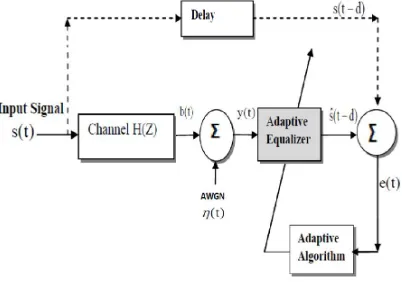
Digital communication systems transmi the high speed and efficient data over the communication channels. During this process the transmitting data it is distorted, due to the effect of distortions. Distortion includes inter-symbol interference (ISI) in the presence of additive white Gaussian noise (AWGN). Compensating all these channel distortion calls for channel equalization techniques at the receiver side, to reconstruct the transmitted symbols correctly. For which generally an adaptive equalization technique is used.It is very difficult to estimate both the channel order and the distribution of energy among the multiple taps. So it necessary that the equalization process must be adaptive means the equaliser needs to be adapted very frequently with the changing environment. This includes two phases. Firstly the equaliser needs to be trained with some known samples in the presence of some desired response of signal known as Supervised Learning. The equaliser structure is frozen to function as a detector after training the weights and various parameters associated with it. These two processes are frequently implemented to keep the equaliser adaptive.
Figure 1. Block Diagram of the channel equalization
These steps constitute the training process of the equalisation. After the completion of training, the equaliser output is compared with some threshold and decision is made regarding the symbol received
.
A. INTER SYMBOL INTERFERENCE
Inter-symbol interference (ISI) arises when the data transmitted through out the channel is dispersive, in which each received pulse is affected by adjacent pulses due to which interference occurs in the transmitted signals.
Figure 2:Spectrum of ISI in Channel
In digital communication, generally the transmitted signals are represented by multilevel rectangular pulses. The absolute bandwidth of multilevel rectangular pulses is become infinity. If these pulses pass through a band limited channel, then they will spread over time and the pulse for each symbol may become aoverlapped symbolwith adjacent time slot and interferes with the adjacent symbol. This is referred as inter symbol interference (ISI).
B. TAPPED DELAY LINE MODEL
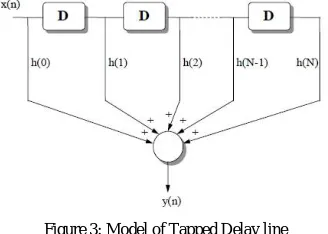
Figure 3: Model of Tapped Delay line
This model represents the channel by a delay line with N taps. For example, the channel shown in Figure 2 can be represented by a 4-tap model as shown in Figure 3.This is mathematically expressed as with AWGN noise,
( ) = { ( )∗ ℎ(0) + ( −1)∗ ℎ(1) +⋯+ (0)∗ ℎ( )} +Ƞ( ) (1)
Then this channel output y(n) is given to equalizer (ANN) to compensate the noise(ISI) introduced in the channel i.e. to get the original input sequence at the receiver. From the equalizer output calculate the mean square error for optimization. Initialize the equalizer coefficients and update that using Particle Swarm Optimization (PSO) algorithm.ANN equalizer is adaptively trained for best possible weight using particle swarm optimization.
C. ARTIFICIAL NEURAL NETWORK
A neural network is an artificial representation of human brain that tries to simulate its learning process. An artificial neural network is often called as “Neural network”, that process and transmits the information. Artificial neural network is an adaptive system so it can be able to change its structure based on external and internal information that flows through the network.
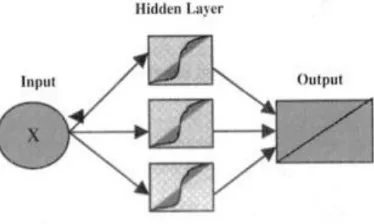
ANN is a feed forward network. ANNs are organized into three typer of layers. They are input layer, output layer and hidden layers. The hidden layers are acts as a root of the ANN that performs the actual computations of the network.
Figure 5:Structure of Artificial Neural Network
The output of the network ( )can be calculated from following,
( ) = (ℎ( )∗ ) + (2)
Where the ℎ( ) - hidden node, it is defined as
ℎ( ) = (( ( )∗ ) + ) (3)
( )– input of the network.
- weight between hidden node to output. - weight between input to hidden node. B – Biases weight.
( )– Transfer function.
D. FUNCTIONAL LINK ARTIFICIAL NEURAL NETWORK
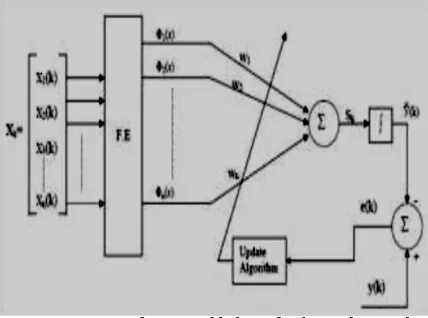
Figure 6:Structure of Functional link Artificial Neural Network
Further, the FLANN structure offers less computational complexity and higher convergence speed than those of an MLP because of its single layer structure. The expanded function make use of a functional mode comprising of a subset of orthogonal sin and cos basis functions and the original pattern along with its outer products.,the enhanced pattern is obtained by using the trigonometric function as the functional expansion [ cos( ) sin( )]which is then used by the network for the equalization purpose. The PSO algorithm, which is used to train the network, becomes very simple because of absense of any hidden layer.
E. TRANSFER FUNCTION
Each of the neurons associated with a transfer function that operates on the layer. A good transfer function is the sigmoid function. The sigmoid function maps the input to the range [0, 1].
Sigmoid(x) = ∝.
(4)
Artificial neural network is used as an adaptive equalizer. Initialize the equalizer coefficients and update that using Particle Swarm Optimization (PSO) algorithm. ANN equalizer is adaptively trained for best possible weight using particle swarm optimization.
F. PARTICLE SWARM OPTIMIZATION
PSO simulates the behaviour same as the bird flocking. Suppose the following scenario: a group of birds are randomly searching food in an area. The effective one is to follow the bird, which is nearest to the food. PSO learned the algorithm for optimization from the above scenario and used it to solve the optimization problems. In PSO, each single solution is a "bird" in the search space. It is known as "particle". Each particle has a fitness value, which are evaluated by the fitness function to be optimized, and have velocities, which direct the flying of the particles.
PSO is initialized with a random particles (solutions) they are formed a groupand then searches for optima byupdating generations. In every iteration each particle is updated by following two "best" values. The first best solution is the fitness, it has achieved so far and also stored. This value is called pbest. Another "best" value tracked by the particle swarm optimizer it is the best value, it can be obtained by any particle in the population. This best value is a global best and called g-best. When a particle takes part of the population as its topological neighbours, the best value is a local best and is called p-best.
= + (5)
Where, is the velocity vector of particle that drives the optimization process and reflects both the own experience knowledge and the social experience knowledge from the all particles
= + , − + − (6)
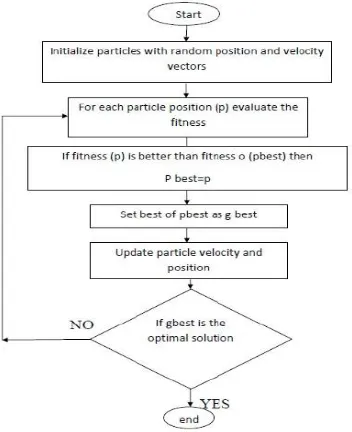
Figure 7: Process of PSO Algorithm
Where is the velocity vector of particle and is the position vector of particle i in dimension j at time t . ,is the personal best position and is the global best position of particle i in dimension j found from
initialization through time t. and are positive acceleration constants which are used to level the contribution of the cognitive and social components respectively. and are random numbers from uniform distribution U(0,1) at time t.
In the PSO method, all particles are initiated randomly and evaluated to compute fitness and also with finding the personal best (best value of each particle) and global best (best value of particle in the entire swarm). After that a loop starts to find an optimum solution. In the loop, first the particle’s velocity is updated by the personal and global bests, and then each particle’s position is updated by the current velocity. The loop is ended with a stopping criterion predetermined in advance. Basically PSO algorithms, namely the Global Best (gbest) have been developed which differ in the size of their neighbourhoods.
III.RESULTSANDDISCUSSION
variance of 0.001 and zero mean. The simulations are performed in MATLAB R2010a version. The simulations are observed for average of 200 iterations.
In FLANN, the original input pattern undergoes a pattern enhancement by using some nonlinear functions. Then the enhanced patterns are applied to a single-layer perceptron. The functional expansion in these networks was carried out using orthogonal trigonometric functions.
Figure 8 :Convergence Characteristics of Functional link Artificial Neural Network
Performance of ANN, RNN equalizers have been analysed for equalization in different channel conditions. ANN is a feed forward network. In this network, the connections are made always in the direction of forward from input to output. There is no feedback connection from higher layers to lower layers. Often, but not always, each layer connects only to the one above. RNN is a feedback network that the network contains at least one feed-back connection, so the activations can flow round in a loop.
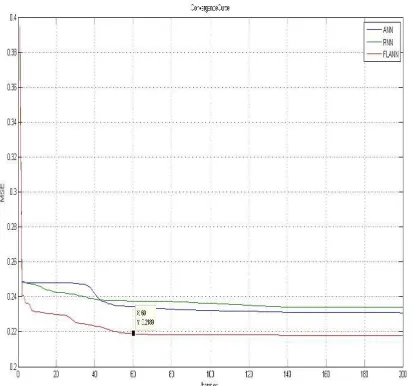
Figure 9: Comparison of FLANN with ANN and RNN equalizers
Due to the absence of hidden layers, the computational complexity of FLANN is drastically reduced. Compared to ANN and RNN, the FLANN gives better convergence as shown in figure 9.
random number, the acceleration is not necessarily directed straight toward the best. Were the same random number used on all dimension, each pull will be straight towarditsbest.
Either way, particles are accelerated in two different directions at once so that they do not actually accelerate straight toward either best. From the comparison we observed that, by varying these two constants convergence characteristics of equalizer as shown in figure 10
Figure 10: Convergence curve of ANN with different cognitive and social constants
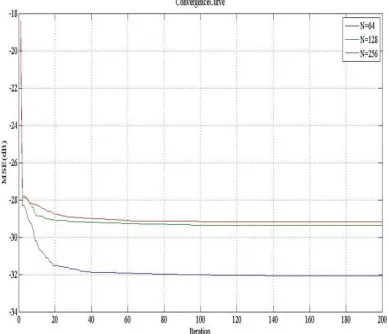
Swarm size or population size is the number of particles n in the swarm. That most of the PSO implementations use an interval of for the swarm size. From the comparison we observed that, by varying number of particles and number of training samples also gives a better convergence shown in figure 11 and figure 12 respectively.
Figure 12: Convergence curve of ANN with varying number of training samples
V. CONCLUSION AND FUTURE WORK
The aim is to develop a novel artificial neural network equalizer trained with optimization algorithms to mitigate the distortion like ISI occurs in the communication channel and can provide minimum mean square error. In this proposed method Artificial Neural Network (ANN) trained with Particle Swarm Optimization (PSO) for the problem of channel equalization.An analysis and performance evaluation of the different types of ANN based equalizers are trained with PSO. The proposed neural network equalizer provided a better performances than other conventional equalizer. Existing applications of Artificial Neural Networks (ANN) trained with PSO have only been used to find optimal weights of the network. The PSO algorithm optimizes all the variables, and hence network weights and network parameters. Hence, this technology makes use of PSO to optimize the number of layers, input and hidden neurons, the type of transfer functions etc. The weights, transfer function, and topology of an ANN constructed for channel equalization are optimized by this technology. Extensive simulations presented in this project shows that, an Functional link ANN based equalizer trained with PSO as compared with other neural network based equalizers. As compared to other ANN based equalizers the proposed equalizer performs better in all noise conditions. In future current optimization (Particle Swarm Optimization) and equalization (ANN) technique will be compared with different optimization and equalization techniques.
REFERENCES
[1]. Gyanesh Das,Prasant Kumar Pattnaik,Sasmita Kumari Padhy (2014) ‘Artificial Neural Network trained by Particle Swarm Optimization for non-linear channel equalization’. Expert Systems with Applications 41 3491–3496.
[2]. Chau, K. W. (2006). ‘Particle swarm optimization training algorithm for ANNs in stage prediction of Shing Mun River’. Journal of Hydrology, 329, 363–367.
[3]. Del Valle, Y., Venayagamoorthy, G. K., Mohagheghi, S., Hernandez, J.-C., & Harley, R.G. (2008). ‘Particle swarm optimization: basic concepts, variants and applications in power systems’. IEEE Transactions on Evolutionary Computation,12, 171–195.
[4]. Hong, W.-C. (2008). ‘Rainfall forecasting by technological machine learning models’. Applied Mathematics and Computation, 200(1), 41–57.
[5]. Kennedy, J., & Eberhart, R. (1995). ‘Particle swarm optimization’. In Proc. IEEE int. conf. neural networks (pp. 39–43). [6]. Lee, C.-H., & Lee, Y.-C. (2012). ‘Nonlinear systems design by a novel fuzzy neural system via hybridization of
electromagnetism-like mechanism and particle swarm optimization algorithms’. Information Sciences, 186(1), 59–72 [7]. Liang, J., & Zhi, D. (2004). ‘FIR channel estimation through generalized cumulant slice weighting’. IEEE Transactions
[8]. Lin, C.-J., & Chen, C.-H. (2011). ‘Nonlinear system control using self-evolving neural fuzzy inference networks with reinforcement evolutionary learning’. Applied Soft Computing, 11(8), 5463–5476
[9]. Lin, C.-J., & Liu, Y.-C. (2009). ‘Image backlight compensation using neuro-fuzzy networks with immune particle swarm optimization’. Expert Systems with Applications, 36(3, Part 1), 5212–5220.
[10].Mingo López, L. F., Blas, N. G., & Arteta, A. (2012). ‘The optimal combination: Grammatical swarm, particle swarm optimization and neural networks. Journal of Computational Science’, 3(1-2), 46–55.
[11].Patra, J. C, Poh, W. B., Chaudhari, N. S., & Das, A (2005). ‘Nonlinear channel equalization with QAM signal using Chebyshev artificial neural network’. In Proc. of international joint conference on neural networks (pp. 3214–3219). [12].Potter, C., Venayagamoorthy , G. K., & Kosbar, K. ‘RNN based MIMO channel prediction’. Signal Processing, 90(2),
440–450 (2010).5
[13].Ribeiro, P. F., & Schlansker, W. K (2004). ‘A hybrid particle swarm and neural network approach for reactive power control’. IEEE.6.
[14].Touri, R., Voulgaris, P. G., & Hadjicostis, C. N. (2006). ‘Time varying power limited preprocessing for perfect reconstruction of binary signals’. In Proc. of the 2006 American control conference (pp. 5722–5727). Minneapdis, USA [15].Yogi, S., Subhashini, K. R., & Satapathy, J. K. (2010). ‘A PSO based functional link artificial neural network training
algorithm for equalization of digital communication channels’. In Int. conf. on industrial and information systems (pp.107–112).7
[16].Zhao, H., Zeng, X., Zhang, J., Li, Y., Wang, X., & Li, T (2011a). ‘A novel joint-processing adaptive nonlinear equalizer using a modular recurrent neural network for chaotic communication systems’. Neural Networks, 24, 12–18.
[17].Zhao, H., Zeng , X. P., He, Z. Y., Jin, W. D., & Li, T. R (2012). ‘Complex-valued pipelined decision feedback recurrent neural network for nonlinear channel equalization’. IET Communications, 6(9), 1082–1096.
[18].Zhao,H., & Zhang, J. (2009). ‘Adaptively combined FIR and functional link neural network equalizer for nonlinear communication channel’. IEEE Transactions on Neural Networks, 20(4), 665–674.
[19].Zhao, H.,Zhang, X., Zhang, J., & Li, T. (2010b). ‘Nonlinear adaptive equalizer using a pipelined decision feedback recurrent neural network in communication systems’. IEEE Transactions on Communications, 58 (8), 2193–2198 [20].J.C. Patra and R.N. Pal, “Functional link artificial neural network model for channel equalization”, Proc. 5th Internat.
Con& on SignalProcessing Applications and Technology, ICSPAT’94, Dallas, USA, 18-21 October 1994,pp.1251-1256. [21].Sandhya Yogi, Prof. K.R. Subhashini, Prof. J.K.Satapathy, “A PSO based Functional Link Artificial Neural Network
training algorithm for Equalization of Digital Communication Channels”. 2010 5th International Conference on Industrial and Information Systems.(2010)
[22].Satchidananda Dehuria, Rahul Royb, Sung-Bae Choc, Ashish Ghosh “An improved swarm optimized functional link artificial neural network (ISO-FLANN) for classification” .The Journal of Systems and Software 85 (2012).