HIGHLIGHTED ARTICLE
| INVESTIGATION
The Evolution of Polymorphic Hybrid Incompatibilities
in House Mice
Erica L. Larson,*,†Dan Vanderpool,* Brice A. J. Sarver,* Colin Callahan,*,1Sara Keeble,*,‡ Lorraine L. Provencio,‡Michael D. Kessler,‡Vanessa Stewart,* Erin Nordquist,* Matthew D. Dean,‡ and Jeffrey M. Good*,2
*Division of Biological Sciences, University of Montana, Missoula, Montana 59812,†Department of Biological Sciences, University of Denver, Denver, CO 80210 and‡Molecular and Computational Biology Section, Department of Biological Sciences, University of Southern California, Los Angeles, California 90089 ORCID IDs: 0000-0003-3006-645X (E.L.L.); 0000-0002-7318-3122 (S.K.); 0000-0003-0707-5374 (J.M.G.)
ABSTRACTResolving the mechanistic and genetic bases of reproductive barriers between species is essential to understanding the evolutionary forces that shape speciation. Intrinsic hybrid incompatibilities are often treated asfixed between species, yet there can be considerable variation in the strength of reproductive isolation between populations. The extent and causes of this variation remain poorly understood in most systems. We investigated the genetic basis of variable hybrid male sterility (HMS) between two recently diverged subspecies of house mice,Mus musculus domesticusandMus musculus musculus. We found that polymorphic HMS has a surprisingly complex genetic basis, with contributions from at leastfive autosomal loci segregating between two closely related wild-derived strains ofM. m. musculus. One of the HMS-linked regions on chromosome 4 also showed extensive introgression among inbred laboratory strains and transmission ratio distortion (TRD) in hybrid crosses. Using additional crosses and whole genome sequencing of sperm pools, we showed that TRD was limited to hybrid crosses and was not due to differences in sperm motility betweenM. m. musculus strains. Based on these results, we argue that TRD likely reflects additional incompatibilities that reduce hybrid embryonic viability. In some common inbred strains of mice, selection against deleterious interactions appears to have un-expectedly driven introgression at loci involved in epistatic hybrid incompatibilities. The highly variable genetic basis to F1 hybrid incompatibilities between closely related mouse lineages argues that a thorough dissection of reproductive isolation will require much more extensive sampling of natural variation than has been commonly utilized in mice and other model systems.
KEYWORDSpolymorphism; hybrid male sterility; transmission ratio distortion; QTL mapping; introgression
T
HE evolution of intrinsic hybrid incompatibilities,whereby divergent genomic regions interact negatively in hybrid genomes, is one of the most commonly studied
models of speciation [i.e., Bateson–Dobzhansky–Muller
in-compatibilities or BDMIs, Bateson 1909; Dobzhansky 1937; Muller 1942; reviewed in Maheshwari and Barbash 2011].
Although often viewed asfixed epistatic barriers to geneflow
between species, many incompatible alleles are polymor-phic within populations, leading to variation in the overall strength of reproductive isolation between populations (Gordon 1927; Patterson and Stone 1952; Forejt and Ivanyi
1974; Reed and Markow 2004; Goodet al.2008b; Scopece
et al.2010; Cutter 2012). Relatively few studies have exam-ined the genetic basis of variation in BDMIs (Christie and
Macnair 1987; Vyskočilováet al. 2005; Wrightet al.2013;
Sweigart and Flagel 2015; Caseet al.2016) and the
evolu-tionary forces underlying variable incompatibilities remain unexplored in most species.
Hybrid incompatible alleles can arise through any
evolution-ary process that contributes to genetic divergence (e.g., genetic
drift, natural or sexual selection). However, reproductive iso-lation is expected to evolve more quickly when divergence is driven by selection. Consistent with this, several incompatibility Copyright © 2018 by the Genetics Society of America
doi:https://doi.org/10.1534/genetics.118.300840
Manuscript received February 20, 2018; accepted for publication April 23, 2018; published Early Online April 24, 2018.
Supplemental material available at Figshare: https://doi.org/10.25386/genetics.
6149399.
1Present address: Center for Epigenetics, Johns Hopkins University School of
Medicine, Baltimore, MD 21205.
2Corresponding author: Division of Biological Sciences, University of Montana,
genes show signatures of positive selection or have diverged through antagonistic coevolutionary dynamics (Johnson 2010; Presgraves 2010; Maheshwari and Barbash 2011).
Poly-morphism is an inevitable phase in thefixation of an allele, but
directional selection shouldfix alleles relatively quickly. Thus, it
should be rare that incompatibilities are sampled while poly-morphic if positive directional selection drives the evolution of BDMIs. Alternatively, BDMIs could involve a combination of unsorted ancestral variation or modifying loci that segregate neutrally within species (Rieseberg and Blackman 2010;
Scopeceet al.2010; Cutter 2012; Matuteet al.2014) or are
subject to balancing selection (Cutter 2012). Finally, polymor-phic incompatibilities may reflect the breakdown of
reproduc-tive barriers due to gene flow between partially isolated
populations. Hybrid incompatible alleles are generally assumed to be resistant to introgression (Barton and Hewitt 1985; Harrison 1990; Payseur 2010), but epistatic barriers may
quickly erode in the face of gene flow (Bank et al. 2012;
Lindtke and Buerkle 2015). Differentiating between these alter-natives is crucial to understanding the evolution of reproductive isolation and the nature of species boundaries.
House mice provide a powerful system to understand the causes of polymorphic barriers during the early stages of
spe-ciation. There are three major lineages withinMus musculus—
M. m. musculus,M. m. domesticus, andM. m. castaneus—that
diverged 0.35–0.50 MYA (Geraldes et al. 2011) and
show partial reproductive isolation primarily due to hy-brid male sterility (HMS). However, there appears to be con-siderable standing genetic variation for the strength of HMS
(Britton-Davidianet al.2005; Vyskočilováet al.2005; Good
et al. 2008b; Turneret al.2012). For example, crosses
be-tweenM. m. musculusfemales andM. m. domesticusmales
typically yield sterile F1 hybrid males due, in part, to negative
interactions betweenM. m. musculusChr X and the
autoso-mal genePrdm9, a DNA binding protein that directs the
lo-cation of double-strand breaks during recombination (Mihola et al.2009). PRDM9 binding sites evolve rapidly (Bakeret al. 2015), leading to asymmetric binding and autosomal asyn-apsis that disrupts sex chromosome expression during
sper-matogenesis (Bhattacharyya et al. 2013; Campbell et al.
2013; Turner et al. 2014; Davieset al.2016; Larson et al.
2017).Prdm9appears to be polymorphic for sterile and
fer-tile alleles within bothM. m. domesticusandM. m. musculus
(Forejt and Ivanyi 1974; Vyskocilováet al.2009; Flachset al.
2012), and the strength ofPrdm9-associated sterility is
vari-able withinM. m. musculus(Bhattacharyyaet al.2014; Flachs
et al.2014; Turneret al.2014).
There is also variation in the severity of HMS in house mice
that is independent of the M. m. musculus X (Good et al.
2008b). For example, crosses betweenM. m. domesticus
fe-males and M. m. musculus males produce sterile or fertile
hybrid males dependent on the genotype of theM. m.
mus-culus sire (Vyskočilová et al. 2005; Good et al. 2008b;
Bhattacharyyaet al.2014; Flachset al.2014). The autosomal
variants contributing to HMS in these crosses are unresolved
and, aside from the rapid evolution ofPrdm9(Davieset al.
2016), the causes of standing variation for HMS are not clear. One possible factor is that the small effective population sizes of house mice results in strong genetic drift and local
inbreed-ing (Geraldeset al.2011). Further,M. m. domesticusandM.
m. musculus form a narrow hybrid zone in central Europe
(Janouˇseket al.2012), which may weaken reproductive
bar-riers through introgression (Turner and Harr 2014). In this study, we used the genetic variation segregating
between two wild-derived inbred strains ofM. m. musculusto
begin to characterize the genetic architecture of polymorphic
barriers betweenM. m. domesticusfemales andM. m.
muscu-lusmales. We found that polymorphic HMS encompasses at
least five autosomal regions of the genome. We then used
additional genetic crosses, whole genome sequencing of sperm pools, and population genomic analyses to explore the mechanistic and evolutionary drivers contributing to var-iation at one of these regions on the distal portion of Chr 4. These diverse genetic and genomic experiments further re-veal the complex genetic basis of reproductive isolation in this system and demonstrate how these reproductive barriers have shaped introgression among mouse subspecies and the genomic composition of common laboratory strains of mice.
Materials and Methods
Mouse strains and experimental crosses
We focused on two wild-derived inbred strains ofM. m.
mus-culus(PWK/PhJ and CZECHII/EiJ, hereaftermusculusPWKand
musculusCZII) that differ in the degree of HMS when crossed to
M. m. domesticus(Goodet al.2008b). ThemusculusPWKstrain
was originally isolated near the hybrid zone in Prague, Czechia
(50.0216°N, 14.4350°E) and yields weak HMS when crossed
to femaleM. m. domesticus. ThemusculusCZIIwas isolated
fur-ther from the hybrid zone in Bratislava, Slovakia (48.1492°N,
17.1070°E) and produces mostly sterile males when crossed
to female M. m. domesticus. We used two wild-derived
strains of M. m. domesticus (WSB/PhJ and LEWES/PhJ,
hereafter domesticusWSB and domesticusLEW) derived from
natural populations in North America (MD, 39.3358°N,
77.3282°W and DE, 39.1453°N, 75.4188°N). Mice were
originally purchased from Jackson Laboratory (Bar Harbor, ME). All animal use was approved by the University of Mon-tana (protocol 002–13) and the University of Southern Cal-ifornia (protocol 11,394) Institutes for Animal Care and Use Committees.
Hybrid incompatibilities underlying F1 hybrid phenotypes usually cannot be mapped because of a lack of genetic vari-ation. However, the existence of polymorphic sterility factors
within musculus provides an elegant way to resolve these
incompatibilities directly in F1 hybrid males. Wefirst
quan-tified HMS in F1 crosses between femaledomesticusWSBand
eithermusculusPWKormusculusCZIImales. To control for the
effects of inbreeding depression in inbred strains, we
com-pared the fertility of these F1 hybrids to M. m. domesticus
evaluating each cross at different time points [60–65, 70–80, and 85–95 days postpartum (dpp)]. We then used an F1
hybrid test cross betweendomesticusWSBfemales and
inter-strain F1 males from reciprocal crosses ofmusculusPWKand
musculusCZII(Figure 1). This design maintains the F1 hybrid
genotype, while segregating variation between two different M. m. musculusgenomes. Finally, we backcrossedM. m. mus-culusinterstrain F1 males tomusculusPWKfemales to
deter-mine if loci on Chr 4 showing strong transmission ratio distortion (TRD) in our hybrid crosses also showed TRD
withinM. m. musculus.
Male reproductive phenotypes
We quantified reproductive phenotypes of virgin males weaned in same-sex sibling groups at 21 dpp and housed singly at 45 dpp to mitigate dominance interactions (Snyder 1967). Males were killed using carbon dioxide followed by cervical dislocation at 58–70 dpp (F1 hybrid test cross) or up
to 90 dpp (aged F1 males). Following Goodet al.(2008b), we
measured paired testes (an overall measure of fertility) and seminal vesicles (correlated with serological testosterone lev-els) relative to body weight. We isolated sperm from caudal
epididymides diced in 1 ml of Dulbecco’s PBS (Sigma, St.
Louis, MO) and incubated at 37°for 10 m. The proportion
of motile sperm and total sperm numbers were estimated
from 5 ml suspensions (regular and heat-shocked,
respec-tively) viewed in a Makler counting chamber on a light
mi-croscope over afixed area and observation time. To evaluate
sperm morphology, 25ml sperm suspensions werefixed and
stained, and$100 intact sperm were visually classified by a
single individual (E.L.L.) while blind to genotype. Sperm head morphology were (1) normal with a long apical hook, (2)
slightly abnormal (i.e., shortened hook), (3) abnormal (i.e.,
short hook and rounded shape), or (4) severely abnormal
(i.e., amorphous shape). We summarized these categories
with a weighted index that ranged from high (3) to low (0)
quality sperm (Okaet al.2004; Goodet al.2008a). Sperm tail
morphology were (1) normal, (2) bent at the base of the sperm head, (3) bent in the center of the tail forming a loop,
or (4) twisted distally (Whiteet al.2011).
Genotyping and genome sequencing
We genotyped 468 individuals from our two genetic mapping
experiments (i.e., 156 F1 hybrid test cross males and 312
M. m. musculusbackcross) and eight reference samples (two
of each parent strain anddomesticusWSB3musculusCZIIF1
hy-brids) using double-digest restriction site–associated DNA
se-quencing (ddRADseq; Peterson et al. 2012), with minor
modifications. DNA was extracted from liver tissue using the NucleoSpin Tissue kit (Machery-Nagel, Düren, Germany)
and incubated in 5ml RNAase A (Fisher Scientific, Waltham,
MA) at 37°for 15 m. We digested 1mg of DNA withMspI and
SbfI-High-Fidelity enzymes (New England Biolabs, Beverly,
MA), ligated unique adaptors, and selected 200–500 bp frag-ments using a two-step size selection with AMPure XP beads (Agencourt Bioscience, Beverly, MA). Individual libraries
were amplified 16 cycles in three 20 ml reactions using
Phusion High-Fidelity DNA Polymerase (New England BioLabs), cleaned using AMPureXP, and quantified with a NanoPhotometer (IMPLEN, München, Germany). F1 hybrid libraries were paired-end sequenced on an Illumina HiSeq 2000 at the California Institute for Quantitative Biosciences, University of California, Berkley and on a MiSeq at the IBEST Genomic Resources Core, University of Idaho. The M. m. musculus backcross libraries were single-end se-quenced on an Illumina HiSeq 4000 at the University of Oregon Genomics and Cell Characterization Core Facility.
Libraries were checked for intact barcodes, restriction
enzyme cut-sites, and demultiplexed using preprocess_
radtag_lane.py(Petersonet al.2012). We used Trimmomatic
v0.32 (Lohseet al.2012) to remove adaptor sequences and
low-quality bases and mapped reads to the Genome Refer-ence Consortium mouse build 38 (GRCm38) using BWA-MEM v0.7.10 (Li 2013). We applied the Genome Analysis
Tool Kit (GATK) v3.4 (McKenna et al. 2010) to call SNPs
(HaplotypeCaller) that we thenfiltered (minDP 10, maxDP
150, minGQ 20) using VCFtools v0.1.14 (Danecek et al.
2011). We retained biallelic SNPs that were homozygous in the parent references, heterozygous in the F1 hybrid
refer-ence, genotyped in$95% of individuals, and.1000 bp from
other SNPs. We retained individuals that were genotyped
in$85% of markers and showed normal crossover rates.
We also performed two targeted genotyping assays. Males from the F1 hybrid test cross were genotyped for microsatellite
length variants that encompass differentPrdm9alleles. We
used modified versions of D17Mit78 (forward: CACAGTG AGTCTGGGCTAGTC, reverse: GCATCTTATGGATTGAAATAC GG) and D17Mit261 (forward: CCCTTGCTCTCCTTCATTCA,
re-verse: AATGCCAAATGGTCAGCC; Copelandet al.1993) in 10ml
PCR reactions using MangoTaq (Bioline, Luckenwalde,
Ger-many), run at 35 cycles of 94°for 30 sec, 58–48°for 30 sec
(decreased by 1°per cycle for thefirst 10 cycles), and 72°for
1 m. We also expanded the genotyping of ourM. m. musculus
backcross using diagnostic microsatellites from the middle (D4Mit64: 140.08–141.03 bp) and distal end (D4Mit127:
148.60–151.60 bp) of Chr 4 (Copelandet al. 1993). These
markers spanned SNPs genotyped using ddRADseq, and we genotyped 88 mice using both methods to allow cross validation. All fragments were analyzed on an ABI 3130xl at the University of Montana Genomics Core.
Reference genomes have been published formusculusPWK
anddomesticusWSB(Keaneet al.2011). We generated whole
genome shotgun sequences of a female musculusCZII and a
femaledomesticusLEWfrom NEXTflex DNA sequencing
geno-mic libraries (Bio Scientific, Austin, TX) that were paired-end sequenced on an Illumina HiSeq 2000 at the California In-stitute for Quantitative Biosciences University of California, Berkley. We generated additional whole genome sequence
data from the samemusculusCZIIfemale at GENEWIZ (South
QTL mapping
We performed QTL mapping in R/qtl v1.40-8 (Bromanet al.
2003) with an assumed genotyping error rate of 0.001 and the Carter–Falconer mapping function (Carter and Falconer 1951). For all QTL analyses we used a grid size of 1 cM and 5% genome-wide significance thresholds estimated from 1000 per-mutations. We used standard interval QTL interval mapping (scanone) with a Haley–Knott regression for normally distrib-uted traits, and nonparametric interval mapping for the pro-portion of motile sperm, and sperm head and tail morphologies.
We used two-dimensional QTL mapping (scantwo) and
multi-ple QTL model selection (stepwiseqtl) to identify additional QTL
that may be involved in epistatic interactions. Multiple QTL models were compared using penalized LOD score with
thresh-olds calculated fromscantwopermutations. We tested for TRD
in our cross using ax2test of Mendelian proportions.
Genomic analyses
To investigate the evolutionary history of genomic regions
associated with polymorphic sterility, we first analyzed the
newly sequenced musculusCZIIand domesticusLEW genomes
and published genomic data from GRCm38 (domesticusC57),
domesticusWSB,musculusPWK, andMus spretus SPRET/EiJ
(Keaneet al.2011). For each genome, we called SNPs using
the GATK (HaplotypeCaller) andfiltered SNPs with VCFtools
(minDP 10, maxDP 150, minGQ 30). We generated a BEDfile
with all SNP positions and used the GATK to re-call genotypes in each genome for our target SNPs (HaplotypeCaller) and
filter our VCFfiles (SelectVariants, minGQ 30, biallelic). We
then tested for introgression using the four-taxonD-statistic
(Greenet al.2010; Durandet al. 2011) as implemented in
dfoil (Pease and Hahn 2015). Here, the D-statistic is the
normalized difference in site pattern counts that support a
closer relationship between musculusCZIIand a focal M. m.
domesticus(ABBA, negativeD-statistic) ormusculusPWKand a
focalM. m. domesticus(BABA, positiveD-statistic) with
var-iants polarized usingM. spretus. We calculated theD-statistic
per chromosome and for nonoverlapping 100 kb and 1 Mb windows. We repeated these analyses using three different
strains of M. m. domesticus (domesticusC57, domesticusWSB,
anddomesticusLEW).
Second, we used published genotype data for classic
lab-oratory strains, wild-derived strains (Yanget al.2011), and
wild populations of house mice (Harret al.2016) to evaluate
genetic structure with principal components analysis using
the R packageSNPRelate(Zhenget al.2012). We then used
genotype data from 76 classic laboratory strains (Yanget al.
2011) to test for gametic disequilibrium (r2) between
candi-date sterility regions and SNPs on other chromosomes using
PLINK v2.0 (Changet al.2015). We restricted these analyses
to SNPs betweenmusculusPWKandmusculusCZII$1 Mb apart
with no missing data, minor allele frequencies$0.1, and that
were alsofixed between strains ofM. m. musculus(CZECHII,
STUS, and STUP) andM. m. domesticus(LEWES, ZALENDE,
and PERA) with very low levels of introgression (Yanget al.
2011; Didion and Pardo-Manuel de Villena 2012).
Third, we evaluated phylogenetic discordance using whole
exome data from 10 species ofMus(Sarveret al.2017) and
whole genomes fromdomesticusC57anddomesticusWSB(Keane
et al.2011). We cleaned and mapped reads to species-specific
exome-pseudoreferences generated by Sarveret al.(2017). We
used RAxML v8.2.3 (Stamatakis 2014) to estimate maximum
likelihood phylogenies (rapid bootstrapping and a GTR + G
model of sequence evolution) for nonoverlapping 100 kb win-dows, and used these windows to produce a concatenated Figure 1 Crossing design to map polymorphic HMS loci inmusculus. The fertility of F1 hybrids from crosses betweenM. m. domesticusfemales and
M. m. musculusmales depends on the strain of
M. m. musculus; hybrids with musculusCZIIsires
species tree for each chromosome. We then used ASTRAL v4.10.11 (Mirarab and Warnow 2015) to estimate the species tree while accounting for phylogenetic discordance among in-dividually estimated gene trees. Trees were visualized with FigTree v1.4.3.
Genome-wide assessment of TRD
To test for TRD associated with sperm function, we used low-coverage whole genome sequencing of motile and immotile
sperm populations collected from four F1 maleM. m.
muscu-lus (musculusPWK 3musculusCZII). Epididymal sperm were
collected from euthanized adult males (106 dpp) in 2 ml
Dulbecco’s PBS (equilibrated at 37°and 5% carbon dioxide
overnight). We applied 1 ml aliquots of sperm to a Percoll
gradient (1 ml layers of 90 and 45% Percoll at 37°; GE
Healthcare Life Sciences) and centrifuged (300 g for 13 min) to separate cellular debris (top), immotile sperm
(middle), and motile sperm (bottom) (Ng et al. 1992;
Phelps et al.1999). Immotile and motile sperm fractions
(400ml each) were rinsed (1 ml 1.5 M NaCl, centrifuged at
10,000 g for 10 min) and stored at280°. We purified DNA
using the MasterPure Complete DNA purification kit (Epi-centre Biotechnologies). Sperm fractions were rinsed in
600 ml of 70% EtOH (centrifuged at 14,000 g for 5 min)
and incubated overnight at 55°in 600ml lysis buffer, 25ml
of 1 M dithiothreitol, and 10ml of 20 mg/ml proteinase K. We
treated samples with RNase A (3ml, for 30 min at 37°),
pre-cipitated the sperm in 200ml of protein precipitation buffer
(centrifuged at 14,000 g for 30 min), and incubated in 600ml
of isopropanol at280°for 2–3 hr (centrifuged at 14,000 g for
20 min). The pellet was rinsed with 500 ml 75% ethanol
(centrifuged at 14,000 g for 10 min) and dried overnight. We then constructed sequencing libraries using the NEBNext Ultra DNA Library Prep Kit for Illumina with Bio Scientific NEXTflex DNA Barcodes and generated 76 bp paired-end sequences on a HiSeq 2000 at the Epigenome Center, Univer-sity of Southern California.
We conducted all analyses using reads mapped to
strain-specific pseudoreferences for musculusCZII or musculusPWK
(Sarver et al. 2017). Briefly, for each whole genome
(de-scribed above), we called SNPs relative to GRCm38 (GATK HaplotypeCaller), hard-filtered our SNPs (maskExtension 5,
QD,2.0, FS.60.0, MQ,40.0, MQRankSum, 212.5,
ReadPosRankSum, 28.0, QUAL,30.0, minDP 10, maxDP
150), recalled SNPs that passed filtering at a base-pair
resolution in each genome, and used this high-confidence SNP set to inject variants into GRCm38 using the GATK FastaAlternativeReferenceMaker. We trimmed and
quality-filtered sperm fraction reads using expHTS (Streettet al.2015),
mapped reads to each pseudoreference using BWA-MEM, and called SNPs using the GATK (HaplotypeCaller). We assigned
reads (MQ$56) that overlapped at least one diagnostic SNP
as eithermusculusPWKormusculusCZIIorigin, and summarized
read counts in 1 Mb sliding windows (step size 0.5 Mb). We
tested for TRD in windows with $100 reads in all samples
using a x2 test (false discovery rate–corrected P , 0.01;
Benjamini and Hochberg 1995) to test the proportions of mus-culusPWKvs. musculusCZII reads in motilevs. immotile sperm
fractions. We considered a window skewed if the proportion ofmusculusCZII-derived reads significantly differed by at least
0.15 between sperm fractions.
To validate our Percoll method, we repeated our pipeline with experimentally combined normal and heat-shocked
(immotile) sperm samples from two predominantly M. m.
domesticus inbred strains (C57BL/6J and DBA/2J). We pooled normalized sperm extractions from each strain and then mixed sperm in equal proportions from the two strains, and repeated our experiment to vary which strain was heat shocked. We isolated DNA as described above, and
PCR-amplified and Sanger-sequenced through a marker con-taining a diagnostic SNP.
Data availability
All data are available through NCBI under projects SRP093943 (F1 hybrid test cross RADseq), SRP094878 (M. m. musculus CZECHII/EiJ whole genome sequencing),
SRP094877 (M. m. domesticus LEWES/EiJ whole genome
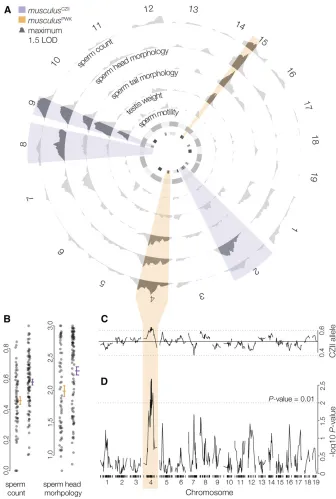
sequencing), SRP082237 (sperm pools whole genome se-quencing), and SPR102485 (backcross RADseq). Supple-mental Material, File S1 contains phenotype data for F1 hybrids and F1 hybrid test cross. File S2 contains microsatel-lite genotypes for markers inside and outside the Chr 4 TRD Figure 2QTL for polymorphic HMS in muscu-lus. (A) LOD curves (standard interval mapping) for HMS phenotypes. Highlighted intervals are the maximum LOD intervals (across all traits) on each chromosome for QTL associated with lower fertility inmusculusCZII(purple) and
mus-culusPWK(orange). The inner circle is QTL LOD
support intervals for previously reported hybrid sterility loci mapped inM. m. domesticusand
M. m. musculusF2 crosses (Whiteet al.2011;
dark gray), wild mice from the hybrid zone (Turneret al.2014; medium gray), and an F1 hybrid test cross (Bhattacharyya et al. 2014; light gray). (B) Normalized sperm count and sperm head morphology index plotted against the genotype of the marker with the largest Chr 4 LOD score. Lines indicate mean trait values (6SE). (C) Frequency of themusculusCZII
allele at each marker (Mendelian expectations 0.5:0.5, genome wide average: 0.496:0.504). (D) TRD plotted as the2log10P value fromx2
region. Supplemental material available at Figshare:https:// doi.org/10.25386/genetics.6149399.
Results
HMS is polymorphic and polygenic in M. m. musculus
We found that F1M. m. domesticus3M. m. musculushybrids
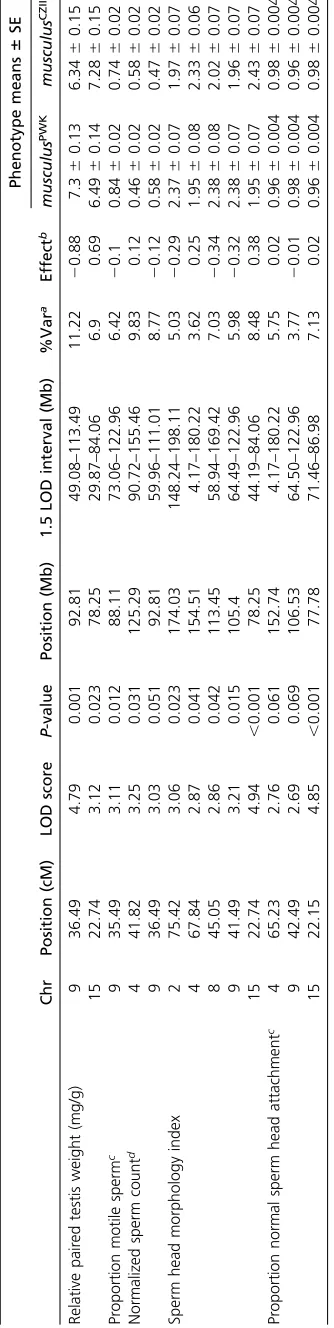
had variable fertility that was dependent on the strain of M. m. musculussires (Table 1), extending previous results (Good et al.2008b). Compared to fertileM. m. domesticusF1 males (domesticusWSB3domesticusLEW), hybrid males with
muscu-lusPWK sires had smaller testes and more abnormal sperm
morphologies. Hybrid males with musculusCZII sires were
even more severely sterile. These males had smaller testes, lower sperm counts, and a high proportion of abnormal sperm head and tail morphologies compared to hybrid males with musculusPWK sires (Table 1). The fertility of
domesti-cusWSB 3 musculusPWK hybrids was lower than previously
reported fromdomesticusLEW 3musculusPWKcrosses (Good
et al.2008b; Campbellet al.2013; Larsonet al.2017),
sug-gesting thatdomesticusWSBhas sterility factors not present in
other strains ofM. m. domesticus(Odetet al.2015).
Differ-ences among F1 crosses remained qualitatively consistent as males aged and sperm head morphology actually worsened with age (Figure S1). Therefore, HMS was not due to delayed reproductive maturity, as has been observed in other crosses
(Campbell and Nachman 2014; Flachset al.2014). Overall,
we found thatM. m. domesticus3M. m. musculusHMS was
dependent on the paternal strain, indicating autosomal and/ or Y-linked sterility loci contribute to polymorphic sterility in M. m. musculus.
Next, we used an F1 hybrid test cross to generate 156 males (62 litters) that ranged from reproductively normal to mostly sterile. On average these males had smaller testes, lower sperm counts, and more abnormal sperm head and tail
mor-phologies (Table 1). Afterfiltering for coverage, we retained
ddRADseq data for 150 males that had between 118,000 and 921,000 uniquely mapped paired reads (median 297,634, total mapped reads of 48.5 million paired reads). We con-structed a genetic map using 582 high-quality SNPs between musculusCZIIandmusculusPWK. Using standard interval
map-ping we detected two regions of theM. m. musculusgenome
on Chr 9 and Chr 15 that contributed to multiple sterility phenotypes (Figure 2A), suggesting a shared genetic and/ or developmental basis. Chr 9 QTL reduced the fertility of
hybrids carrying a musculusCZIIallele and Chr 15 QTL
re-duced the fertility of hybrids carrying a musculusPWKallele
(Table 2). We identified two additional QTL on Chr 2 and Chr 8 that contributed to abnormal sperm head morphologies
associated with themusculusCZIIallele, and QTL on Chr 4 that
contributed to lower sperm counts and abnormal sperm head
and tail morphologies associated with themusculusPWKallele
(Figure 2B). Using two-dimensional QTL mapping, we iden-tified pairs of QTL that additively contributed to sperm count
(Chr 4 and Chr 9) and abnormal sperm head morphologies Table
(Chrs 1, 2, 4, 7, 8, 9, and 15). We found no evidence of epistatic interactions (Table S1), although sample sizes were likely too small to detect such effects. Multiple QTL models supported several loci contributing to sperm count and ab-normal sperm head morphology, consistent with our single QTL results (Table 3). Neither Chr Y origin nor genotyped Prdm9 alleles were associated with hybrid sterility pheno-types (Table S2).
Hybrid sterility QTL colocalized with TRD on Chr 4
Sterility phenotypes associated with themusculusPWKallele
on Chr 4 colocalized with a large region (46.91:153.39 Mb)
that had a deficit ofmusculusPWK alleles at 50 consecutive
markers (expected allelic ratio: 50:50, median observed
39.5:60.5,x2test,P#0.05; Figure 2, C and D). The most
extreme TRD was observed at 116.01:151.14 Mb (median
observed 38.7:61.3, x2 test,P # 0.001) and was also
ob-served when crosses were parsed by sire (musculusPWK3CZII
sire, N = 75, 33.3:66.7; musculusCZII 3 PWK sire N = 75,
44.3:55.7). Sex ratios were normal in these crosses (females:
males 51:49,x2test,P= 0.701). The Chr 4 region showing
TRD overlapped with QTL for lower sperm count (61.5 LOD
interval 90.72–155.46) and more abnormal sperm head and
tail morphology (61.5 LOD interval 4.17–180.22) in males
with themusculusPWKallele. This could be due to chance given
that the61.5 LOD intervals for all sterility QTL encompassed
19.1% (275.59 cM) of the total genome, although sterility QTL
associated withmusculusPWKalleles encompassed only 5.5% of
the genome (79.16 cM total).
Chr 4 sterility and TRD loci showed unusual patterns of introgression
The distal region of Chr 4 showing TRD contained an
un-usually high density of SNPs betweenmusculusCZIIand
mus-culusPWK(hypergeometric test, P ,0.001). Previous work
has shown appreciable subspecific introgression into
muscu-lusPWK, including a large tract ofM. m. domesticus
introgres-sion on the distal portion of Chr 4 (Yang et al. 2011).
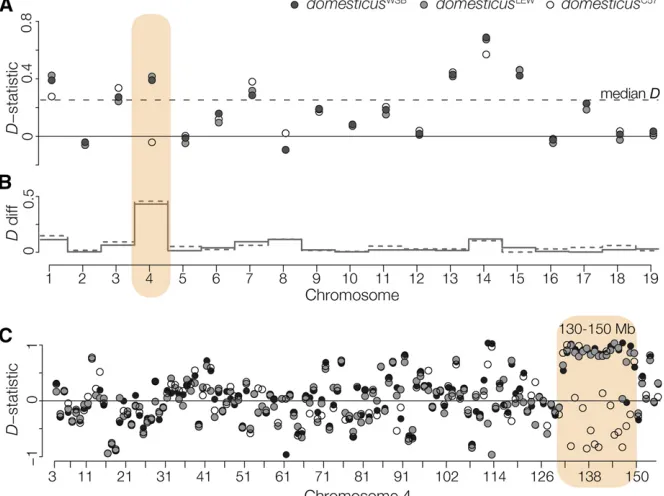
Consistent with this, we found considerable genome-wide
introgression between musculusPWK and M. m. domesticus
(medianD-statistic of 0.253, Figure 3A). Across most
chro-mosomes, D-statistic estimates were similar regardless of
whichM. m. domesticusstrain was used. On Chr 4 we detected
introgression between M. m. domesticus (domesticusWSB,
domesticusLEW) andmusculusPWK, but not betweendomesticusC57
andmusculusPWK. Discordance in theD-statistic amongM. m.
domesticus strains was localized to a 20 Mb region on the distal end of Chr 4 (130–150 Mb), coincident with the musculusPWKsterility QTL and the region with the strongest
TRD (Figure 3B). For simplicity, we will refer to this narrower region as the Chr 4 TRD locus.
We then contrasted patterns of divergence outside and
inside of the Chr 4 TRD locus using otherM. m. musculus
inbred strains and wild house mice (Yang et al.2011; Harr
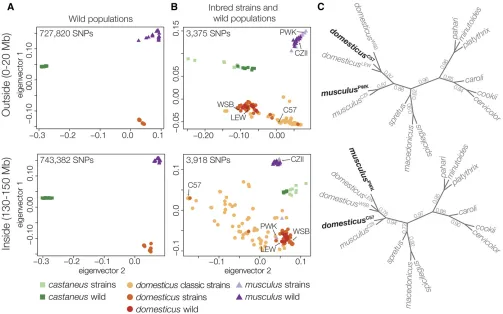
et al.2016). Wild mice strongly clustered by subspecies both outside and inside of the TRD locus (Figure 4A). In contrast, someM. m. musculuswild-derived strains (PWK and PWD)
clustered with M. m. domesticus at the TRD region while
classic laboratory strains (primarilyM. m. domesticusin
ori-gin) showed a mosaic of subspecific origins within the Chr 4 TRD locus (Figure 4B). We then estimated gametic disequi-librium between Chr 4 (130–150 Mb) and 1313 autosomal and Y-linked SNPs to test for other genomic regions that may be associated with the Chr 4 TRD locus. Overall, gametic
disequilibrium was low (r2: median 0.014, maximum
0.645), and similar to prior estimates (Payseur and Hoekstra
2005). Seven SNPs showed elevatedr2(Table S3), but we
did notfind any SNPs that had highr2values across the Chr
4 TRD haplotype. There was no association between Chr
4 and Chr Y, which has either a M. m. musculusorM. m.
domesticusorigin in the classic strains (Bishopet al.1985). To evaluate the deeper evolutionary origin of the Chr 4 TRD
locus, we estimated the phylogenies across 10 species ofMus
for Chr 3 (a similar sized chromosome with limited introgres-sion relative to other chromosomes and no TRD) and Chr 4 regions outside and inside the TRD locus. Concatenated trees for Chr 3 and non-TRD Chr 4 (Figure S2) were
consis-tent with previous species tree estimates (Sarveret al.2017).
Table 3 Polymorphic F1 hybrid sterility QTL detected using multiple QTL mapping
Chr Position (cM) LOD score P-value Position (Mb) 1.5 LOD interval (Mb)
%Var
Effect6SEc
QTLa Fullb
Relative paired testis weight (mg/g) 9 34.65 4.71 ,0.001 85.99 59.96–113.49 13.46 NA 20.9660.20
Normalized sperm countd 4 41.82 3.7 ,0.001 125.29 90.72–155.46 9.83 18.30 0.1260.03
9 34.65 3.32 ,0.001 85.99 59.96–104.82 8.77 20.1260.03
Sperm head morphology index 4 67.84 6.82 ,0.001 154.51 149.56–155.46 12.93 45.35 0.3560.08
8 45.05 5.08 ,0.001 113.45 95.68–129.09 9.36 20.460.08
9 34.65 9.33 ,0.001 85.99 85.99–85.99 18.41 20.560.08
15 22.74 5.72 ,0.001 78.25 76.5–78.25 10.65 0.4260.08
4:9 NA 3.95 ,0.001 NA NA 7.14 NA 0.7060.16
QTL identified using nonparametric interval mapping were not assessed using multiple QTL mapping.
aThe percent of the phenotypic variance explained by each QTL.
bThe percent of the phenotypic variance explained by all terms (e.g., all QTL) in the model.
cThe difference between the phenotype averages of themusculusPWKandmusculusCZIIalleles. A negative effect indicates themusculusCZIIallele lowers the reproductive
phenotype value.
In contrast, trees from the Chr 4 TRD locus showed reciprocal
swapping of M. m. musculusandM. m. domesticus strains,
withmusculusPWKclosest todomesticusWSBandmusculusCZII
closest todomesticusC57. These conflicting patterns were most
apparent using a gene-tree approach to characterize patterns
of fine-scale topological discordance across Chr 4 (Figure
4C). We found no otherMuslineages with variant topologies
for the Chr 4 TRD region.
TRD was restricted to hybrid crosses and was not associated with sperm motility
Male meiotic drivers often operate through various
mecha-nisms of sperm impairment (Lindholm et al. 2016). In the
classic house mouse tcomplex drive system, heterozygous
males show a higher frequency in motile sperm of the sperm
killing Chr 17thaplotype (Lyon 2003). We used whole
ge-nome sequencing of sperm pools to test if the higher
fre-quency of the musculusCZII Chr 4 TRD haplotype in the
offspring of the F1 hybrid test cross reflected motility
differ-ences in the sperm of theM. m. musculus (musculusPWK3
musculusCZII) sires. We generated between 40 and 64 million
uniquely mapped reads (MQ$56) from the motile and
im-motile sperm fractions of four F1M. m. musculusmales. An
average of 7 million reads per sample spanned at least one diagnostic SNP. We parsed reads into 5463 overlapping 1 Mb windows and analyzed an average of 4777 windows
with$100 mapped reads and$1 diagnostic SNP (QUAL$
24). No window showed significant skew between motile and immotile sperm pools in any male. In an additional experi-ment, we confirmed that the Percoll method was effective in separating motile from immotile sperm (Figure S3).
Our sequencing experiment demonstrated that Chr 4 TRD is likely not related to sperm motility and therefore must
reflect genotypic differences in sperm competitive interactions (including female choice), fertilization ability, or postzygotic development. To localize the timing of distortion, we crossed
the sameM. m. musculussire genotype (musculusPWK3
mus-culusCZII) tomusculusPWKfemales to generate 602 backcross
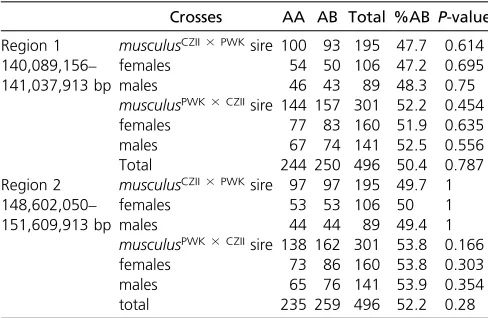
offspring (319 female and 283 male) from 133 litters. We generated ddRADseq libraries for 312 backcross mice. After removing individuals with low coverage, we retained 303 mice that had between 156,791 and 3,315,067 uniquely mapped reads (median of 664,627 per mouse, total of 232,515,877 single reads) and we constructed a genetic map using 358 high-quality SNPs. We found no evidence of TRD on Chr 4 (expected allelic ratio, 50:50; median ob-served, 50:50) and this pattern held when parsed by sire, sex, or sire and sex. To confirm these results, we genotyped an additional 193 backcross mice using microsatellite markers spanning Chr 4 and still found no evidence of TRD
(N= 496 mice; Table 4). Thus, Chr 4 TRD between
muscu-lusCZIIandmusculusPWKalleles was only observed in crosses
involvingdomesticusWSBfemales (Figure 5A).
Discussion
Polymorphic HMS has a polygenic basis in house mice
Individuals often vary in the degree that they are reproduc-tively isolated from other lineages, but the genetic basis and evolutionary origin of such variation remains poorly under-stood. In house mice, there is considerable variability in the strength of F1 HMS in crosses using different inbred strains or
wild isolates ofM. m. musculusandM. m. domesticus
(Britton-Davidian et al. 2005; Vyskočilová et al.2005; Good et al.
2008b; Bhattacharyyaet al.2014). One simple interpretation
Figure 3 Introgression betweenM. m. musculus
andM. m. domesticus. (A)D-statistics, calculated
for each chromosome, testing for introgression betweenmusculusCZIIormusculusPWKandM. m.
domesticus. The median D-statistic across all
M. m. domesticuscomparisons is represented by
the dashed line. Patterns on Chr 4 vary depending on the strain ofM. m. domesticus. (B) The absolute difference in theD-statistic usingdomesticusWSB
(solid gray line) ordomesticusLEW(dashed gray
line) compared todomesticusC57. (C)D-statistic
of these results is that there are one or a few common
in-compatibilities that are polymorphic withinM. m. musculus
and/orM. m. domesticuspopulations. Consistent with this,
the only HMS gene yet identified in mammals, Prdm9,
ap-pears to be polymorphic for sterile and fertile alleles within bothM. m. musculusandM. m. domesticus(Forejt and Ivanyi
1974; Vyskocilováet al.2009; Flachset al.2012). While the
evolutionary origin and extent ofPrdm9-linked HMS
varia-tion remains unclear in natural populavaria-tions, our results re-veal that there is likely to be considerable polymorphism at other HMS loci.
We identified five autosomal regions that contributed to
variation in HMS in crosses betweenM. m. domesticusfemales
andM. m. musculusmales, despite sampling just two
wild-derived inbred strains ofM. m. musculus(Figure 2). F1 hybrid
males from crosses between femaleM. m. domesticusand
mus-culusPWKyield only weak sterility phenotypes, while crosses
in-volvingmusculusCZIIare more severely sterile in both directions
of the cross (Table 1; Goodet al.2008b). Surprisingly,
consider-able variation exists beneath this seemly simple F1 architecture. Sterility loci were associated with both strains; sterility alleles
on Chrs 2, 8, and 9 derived from musculusCZII, while
muscu-lusPWKsterility variants were mapped to Chr 4 and Chr 15.
F1 HMS variability has been observed in otherM. m.
mus-culusstrains (Piáleket al.2008; Bhattacharyyaet al.2014)
and in wild M. m. musculus isolated from eastern Czechia
(Good et al. 2008b). Thus, the polymorphic HMS that we
document here may be relatively widespread within M. m.
musculus (Vyskočilová et al. 2005; Good et al. 2008b;
Bhattacharyyaet al.2014). Consistent with this, there was
some overlap between the HMS loci we identified and HMS
QTL from other studies (Figure 2A). Bhattacharyya et al.
(2014) used a similar experimental design between
domes-ticusC57females andM. m. musculusinterstrain males (PWD
and STUS) to map polymorphic hybrid sterility to Chr 9 (sperm count). Sterility loci were identified on Chr 4 (epi-didymis weight) in recombinant inbred lines derived from all
threeM. m. musculussubspecies (Shorteret al.2017), Chr
4 (testis weight) and Chr 15 (abnormal sperm morphology)
were identified in F2 crosses between domesticusWSB and
of an increasingly complex genetic basis to HMS that depends strongly on genotype. Indeed, multiple polymorphic hybrid sterility factors would account for the variable fertility of multigeneration hybrids from the center of the hybrid zone
(Turneret al.2012). Inbred line crosses remain one of the
most powerful tools for the genetic dissection of hybrid in-compatibilities. However, the common assumption that most
incompatibilities reflectfixed differences between lineages
ap-pears increasingly tenuous, especially during the early stages of speciation. This realization has the potential to broadly impact important issues in speciation genetics. In addition to the need to incorporate population-level sampling into the design of mapping studies on the genetics of speciation, many theoretical predications on the accumulation of reproductive isolation are based on epistatic models that treat interacting hybrid
incom-patibilities asfixed within species (e.g., Orr and Turelli 2001;
Wanget al.2013; Lindtke and Buerkle 2015).
The causes of polymorphic reproductive isolation
Several incompatibilities are polymorphic in house mice, but the origins of these variants are unclear. One possible source is
introgression at previously fixed incompatibilities. Alleles
contributing to hybrid incompatibilities should have restricted introgression relative to the rest of the genome. Indeed, the
identification of loci showing restricted gene flow across
hybrid zones is a powerful approach to identifying alleles that contribute to reproductive barriers (Barton and Hewitt 1985;
Harrison 1990; Payseur 2010). However, geneflow and
re-combination within a hybrid zone can quickly break down epistatic interactions among BDMIs (Virdee and Hewitt 1994;
Shuker et al. 2005; Bank et al. 2012; Lindtke and Buerkle
2015), which could in turn result in polymorphic incompat-ibilities. The house mouse hybrid zone is wide relative to the
dispersal distances of mice. As a result, pureM. m. domesticus
andM. m. musculusrarely come into contact and few F1 mice are found in the hybrid zone. The zone is primarily composed
of complex, multigeneration hybrids that show extensive
var-iation in the severity of HMS (Janouˇseket al. 2012; Turner
et al.2012; Turner and Harr 2014), which likely reflects the partial breakdown of epistatic reproductive barriers.
Several of the common wild-derived strains show
appre-ciable introgression between subspecies of M. m. musculus,
includingmusculusPWK(Yanget al.2011; Sarveret al.2017).
Four of our polymorphic HMS regions did not colocalize with strong signatures of introgression (results not shown),
al-though geneflow cannot be ruled out at our current mapping
resolution. At least one HMS region (Chr 4) did coincide with
introgression intomusculusPWK(Figure 3), but not
necessar-ily in the direction predicted if HMS polymorphism reflects the partial erosion of reproductive barriers. Hybrid sterility QTL on Chr 4 contributed to low sperm counts and abnormal
sperm morphology in males carrying themusculusPWKallele
(Figure 2A). Coincident with the Chr 4 HMS QTL, an20 Mb
M. m. domesticus haplotype (represented here by domesti-cusWSB and domesticusLEW) was introgressed into
muscu-lusPWK, while a M. m. musculushaplotype (represented by
musculusCZII) appears introgressed intodomesticusC57(Figure
3) and some other classic strains (Figure 4, Yanget al.2011).
At least twoM. m. musculusstrains (PWK and PWD) derived
from different localities carry introgressedM. m. domesticus
haplotypes. In other words, aM. m. domesticus-derived
hy-brid sterility locus has introgressed into at least two
inde-pendentM. m. musculusstrains. Transmission of the same
introgressed musculusPWKallele was also underrepresented
in our hybrid test cross (Figure 2C). Thus, the distal end of Chr 4 shows a propensity to reciprocally introgress between M. m. musculusandM. m. domesticusgenomes despite asym-metric TRD and detrimental effects on hybrid fertility.
How can recurrent reciprocal introgression be reconciled with the evolution of HMS and TRD in the same genomic region? Non-Mendelian segregation is common in divergent crosses and can reflect differences in gamete production,
fertilization, and zygote survival (Lindholm et al. 2016).
For example, sexual selection can lead to TRD when gametes carrying different alleles have contrasting fertilization abil-ities due to male gamete competition or cryptic female choice
(e.g., Fishmanet al.2008). We did not observe TRD in our
independentM. m. musculusbackcross or distal Chr 4
intro-gression in wild mice, arguing against simple competitive
advantage of the musculusCZII haplotype. In divergent
crosses, TRD is often caused by biased transmission of selfish
genetic elements (i.e., meiotic drive or segregation distortion;
McDermott and Noor 2010; Lindholmet al.2016) as found,
for example, at theR2d2 locus in house mice (Didionet al.
2015, 2016). Drive elements generate intragenomic conflict, which should drive strong counter selection for unlinked drive suppressors. Drive systems coevolve independently in isolated populations, which can lead to sterility when drivers and suppressers are uncoupled in hybrid genomes (Frank 1991; Hurst and Pomiankowski 1991). Male meiotic drivers often act by impairing the development or fertilization
capac-ity of nondriving sperm (Lindholmet al.2016). We tested this
Table 4 Summary of genotype frequencies in M. m. musculus backcross
Crosses AA AB Total %AB P-value
Region 1 musculusCZII3PWKsire 100 93 195 47.7 0.614
140,089,156– females 54 50 106 47.2 0.695
141,037,913 bp males 46 43 89 48.3 0.75
musculusPWK3CZIIsire 144 157 301 52.2 0.454
females 77 83 160 51.9 0.635
males 67 74 141 52.5 0.556
Total 244 250 496 50.4 0.787
Region 2 musculusCZII3PWKsire 97 97 195 49.7 1
148,602,050– females 53 53 106 50 1
151,609,913 bp males 44 44 89 49.4 1
musculusPWK3CZIIsire 138 162 301 53.8 0.166
females 73 86 160 53.8 0.303
males 65 76 141 53.9 0.354
total 235 259 496 52.2 0.28
To test for TRD withinM. m. musculus, femalemusculusPWKwere crossed to
re-ciprocal interstrain F1s between musculusCZIIandmusculusPWK. Offspring were
scenario directly and found no TRD between motile and
im-motile sperm ofmusculusPWK3CZIImales. More broadly, TRD
on the distal region of Chr 4 has also been reported in two other divergent crosses: TRD favoring the distal Chr 4 M. spretusallele in crosses betweendomesticusC573M. spretus
F1 females anddomesticusC57males (Ceciet al.1989), and
TRD again favoring the musculusCZII distal Chr 4 allele in
crosses between domesticusC57BL/KsJ males and
domesti-cusC57BL/KsJ 3 musculusCZII F1 females (Fiedorek and Kay
1994). Importantly, both crosses reveal reduced transmission
of the distal portion of Chr 4 derived fromM. m. domesticus
through female gametogenesis (Figure 5B). If these patterns reflect a common mechanism, then Chr 4 TRD must act in-dependent of male-specific mechanisms.
Collectively, these results suggest that Chr 4 TRD and introgression are both a consequence of incompatibilities that reduce hybrid embryo viability (postzygotic inviability). In principle, TRD could occur because of a negative interaction between egg (or female reproductive tract) and sperm result-ing in reduced fertilization (postmatresult-ing prezygotic barriers) (Nadeau 2017), although incompatible egg–sperm
interac-tions are often asymmetric (i.e., depend on the parent of
origin of gametes; Larsonet al.2012). Chr 4 TRD occurs in
crosses involving both male and female M. m. domesticus,
with consistent bias against the Chr 4M. m. domesticusallele
when backcrossed toM. m. domesticus(Figure 5). The
sim-plest explanation for this pattern is a two locus BDMI
involv-ing a recessive Chr 4 incompatibility derived in the M. m.
domesticus lineage. It remains unclear why TRD driven by
hybrid inviability in crosses involvingM. m. domesticus
coloc-alizes with HMS QTL that manifests in the F1 offspring. It is possible that early-acting hybrid inviability leads to the pleio-tropic impairment of other reproductive traits. Alternatively, this region may harbor multiple incompatibilities, which ap-pears to be the case for TRD of polymorphic hybrid incom-patibilities in monkeyflowers (Kerwin and Sweigart 2017).
Under an inviability model, introgression at the Chr 4 TRD
locus in various classic and wild-derived inbred strains (i.e.,
musculusPWK, PWD) would reflect different outcomes of selection
against particular incompatible allelic pairings. Such epistatic selection should generate linkage disequilibrium between distal Chr 4 and other genomic regions within hybrid genomes. Al-though our initial scan of genotypes from 76 classic laboratory strains failed to detect these associations (Table S3), multiple genome-wide studies have revealed that selection against other deleterious allelic combinations has shaped the mosaic compo-sition of introgressed laboratory strains (Payseur and Hoekstra
2005; Petkovet al.2005) and theM. m. domesticus–M. m.
mus-culushybrid zone (Turneret al.2012; Turner and Harr 2014). There has been considerable effort to resolve the extent to which various classic and common wild-derived laboratory strains are introgressed, with an emphasis on overall strain
ge-netic purity (Yang et al. 2011; Didion and Pardo-Manuel de
Villena 2012). While overall admixture proportions are of some relevance, our results suggest that specific genome-wide pat-terns of introgression may be strongly shaped by selection with the unexpected result that selection against epistatic BDMIs may facilitate introgression at underlying loci. These results un-derscore the intricacies of nascent species boundaries during the early stages of speciation when reproductive isolation remains incomplete and genetically variable.
Acknowledgments
We thank Kathleen Tsung, Joseph Dysthe, Brent Young, Nick Schultz, Selene Tyndale, and Charlie Nicolet for assistance with data collection and analysis. We also thank members of the Good laboratory; Ryan Bracewell, Lila Fishman, David Aylor, Bret Payseur, Michael Nachman, Peter Ellis, and two anonymous reviewers for helpful feed-back; the Vincent J. Coates Genomics Sequencing Laboratory at the University of California Berkeley, supported by the National Institutes of Health S10 instrumentation grants S10RR029668 and S10RR027303; and the University of Montana Genomics Core, supported by a grant from the M.J. Murdock Charitable Trust. This research was sup-ported by the Eunice Kennedy Shriver National Institute of Child Health and Human Development of the National Figure 5Summary of Chr 4 TRD. (A) The muscu-lusPWKhaplotype on the distal portion of Chr 4,
which is derived from M. m. domesticus, was undertransmitted in the offspring of crosses
involv-ingM. m. domesticusfemales andM. m. musculus
males, but not inM. m.musculusbackcrosses or the sperm ofM. m. musculusmales. (B) Two other crosses have reported reduced transmission of the distal portion of Chr 4 derived from M. m.
domesticus, but through females. Thefirst was an
interspecific cross between F1 females (M. m.
domesticusC57BL/6J3 M. spretus) andM. m.
domesticusC57BL/6J males (TRD73 Mb to end of
Chr 4; Ceciet al.1989), and the second was an interspecific cross between interstrain F1 females (M. m. domesticusC57BL/KsJ3musculusCZII) and
M. m. domesticus C57BL/KsJ males (TRD 107–
Institutes of Health (R01-HD073439 and R01-HD094787 to J.M.G.), the National Institute of General Medical Sciences (R01-GM098536 to M.D.D.), and the National Science Foundation (1146525 to M.D.D.).
Author contributions: J.M.G. conceived the study. J.M.G., E.L.L., and M.D.D. designed the experiments. E.L.L., D.V., C.C., V.S., E.N., and L.P.P. performed experiments and collected data. E.L.L., D.V., B.A.J.S., S.K., L.P.P., M.D.K., and M.D.D. analyzed data. E.L.L. and J.M.G. wrote the manuscript with feedback from the authors.
Literature Cited
Baker, C. L., S. Kajita, M. Walker, R. L. Saxl, N. Raghupathyet al.,
2015 PRDM9 drives evolutionary erosion of hotspots in Mus
musculusthrough haplotype-specific initiation of meiotic
recom-bination. PLoS Genet. 11: e1004916.https://doi.org/10.1371/
journal.pgen.1004916
Bank, C., R. Bürger, and J. Hermisson, 2012 The limits to
para-patric speciation: dobzhansky–Muller incompatibilities in a
con-tinent–island model. Genetics 191: 845–863. https://doi.org/
10.1534/genetics.111.137513
Barton, N. H., and G. M. Hewitt, 1985 Analysis of hybrid zones.
Annu. Rev. Ecol. Syst. 16: 113–148. https://doi.org/10.1146/
annurev.es.16.110185.000553
Bateson, W., 1909 Heredity and variation in modern lights, pp.
85–101 inDarwin and Modern Science, edited by A. C. Seward.
Cambridge University Press, Cambridge, UK.
Benjamini, Y., and Y. Hochberg, 1995 Controlling the false
dis-covery rate: a practical and powerful approach to multiple
test-ing. J. R. Stat. Soc. 57: 289–300.
Bhattacharyya, T., S. Gregorova, O. Mihola, M. Anger, J. Sebestova et al., 2013 Mechanistic basis of infertility of mouse
intersub-specific hybrids. Proc. Natl. Acad. Sci. USA 110: E468–E477.
https://doi.org/10.1073/pnas.1219126110
Bhattacharyya, T., R. Reifova, S. Gregorova, P. Simecek, V. Gerge-litset al., 2014 X chromosome control of meiotic chromosome
synapsis in mouse inter-subspecific hybrids. PLoS Genet. 10:
e1004088.https://doi.org/10.1371/journal.pgen.1004088
Bishop, C. E., P. Boursot, B. Baron, F. Bonhomme, and D. Hatat,
1985 Most classicalMus musculus domesticuslaboratory mouse
strains carry a Mus musculus musculus Y chromosome. Nature
315: 70–72.https://doi.org/10.1038/315070a0
Britton-Davidian, J., F. Fel-Clair, J. Lopez, P. Alibert, and P. Boursot,
2005 Postzygotic isolation between the two European
subspe-cies of the house mouse: estimates from fertility patterns in wild
and laboratory‐bred hybrids. Biol. J. Linn. Soc. Lond. 84: 379–
393.https://doi.org/10.1111/j.1095-8312.2005.00441.x
Broman, K. W., H. Wu, S. Sen, and G. A. Churchill, 2003 R/qtl:
QTL mapping in experimental crosses. Bioinformatics 19: 889–
890.https://doi.org/10.1093/bioinformatics/btg112
Campbell, P., and M. W. Nachman, 2014 X-Y interactions underlie
sperm head abnormality in hybrid male house mice. Genetics 196:
1231–1240.https://doi.org/10.1534/genetics.114.161703
Campbell, P., J. M. Good, and M. W. Nachman, 2013 Meiotic sex
chromosome inactivation is disrupted in sterile hybrid male
house mice. Genetics 193: 819–828. https://doi.org/10.1534/
genetics.112.148635
Carter, T. C., and D. S. Falconer, 1951 Stocks for detecting linkage
in the mouse, and the theory of their design. J. Genet. 50: 307–
323.https://doi.org/10.1007/BF02996226
Case, A. L., F. R. Finseth, C. M. Barr, and L. Fishman, 2016 Selfish
evolution of cytonuclear hybrid incompatibility in Mimulus.
Proc. Biol. Sci. 283: 20161493–20161499. https://doi.org/
10.1098/rspb.2016.1493
Ceci, J. D., L. D. Siracusa, N. A. Jenkins, and N. G. Copeland,
1989 A molecular genetic linkage map of mouse chromosome
4 including the localization of several proto-oncogenes. Genomics
5: 699–709.https://doi.org/10.1016/0888-7543(89)90111-0
Chang, C. C., C. C. Chow, L. C. Tellier, S. Vattikuti, S. M. Purcell et al., 2015 Second-generation PLINK: rising to the challenge
of larger and richer datasets. GigaSci 4: 7–16.https://doi.org/
10.1186/s13742-015-0047-8
Christie, P., and M. R. Macnair, 1987 The distribution of
postmat-ing reproductive isolatpostmat-ing genes in populations of the yellow
monkey flower, Mimulus guttatus. Evolution 41: 571–578.
https://doi.org/10.1111/j.1558-5646.1987.tb05827.x
Copeland, N. G., N. A. Jenkins, D. J. Gilbert, J. T. Eppig, L. J.
Maltaiset al., 1993 A genetic linkage map of the mouse:
cur-rent applications and future prospects. Science 262: 57–66.
https://doi.org/10.1126/science.8211130
Cutter, A. D., 2012 The polymorphic prelude to
Bateson-Dobzhan-sky-Muller incompatibilities. Trends Ecol. Evol. 27: 209–218.
https://doi.org/10.1016/j.tree.2011.11.004
Danecek, P., A. Auton, G. Abecasis, C. A. Albers, E. Banks et al.,
2011 The variant call format and VCFtools. Bioinformatics 27:
2156–2158.https://doi.org/10.1093/bioinformatics/btr330
Davies, B., E. Hatton, N. Altemose, J. G. Hussin, F. Prattoet al.,
2016 Re-engineering the zinc fingers of PRDM9 reverses
hy-brid sterility in mice. Nature 530: 171–176. https://doi.org/
10.1038/nature16931
Didion, J. P., and F. Pardo-Manuel de Villena, 2012 Deconstructing
Mus gemischus: advances in understanding ancestry, structure, and variation in the genome of the laboratory mouse. Mamm. Genome
24: 1–20.https://doi.org/10.1007/s00335-012-9441-z
Didion, J. P., A. P. Morgan, A. M. F. Clayshulte, R. C. Mcmullan, L.
Yadgary et al., 2015 A multi-megabase copy number gain
causes maternal transmission ratio distortion on mouse
chromo-some 2. PLoS Genet. 11: e1004850. https://doi.org/10.1371/
journal.pgen.1004850
Didion, J. P., A. P. Morgan, L. Yadgary, T. A. Bell, R. C. Mcmullan et al., 2016 R2d2 drives selfish sweeps in the house mouse.
Mol. Biol. Evol. 33: 1381–1395. https://doi.org/10.1093/
molbev/msw036
Dobzhansky, T., 1937 Genetics and the Origin of Species. Columbia
University Press, New York.
Durand, E. Y., N. Patterson, D. Reich, and M. Slatkin, 2011 Testing for
ancient admixture between closely related populations. Mol. Biol.
Evol. 28: 2239–2252.https://doi.org/10.1093/molbev/msr048
Fiedorek, F. T., and E. S. Kay, 1994 Mapping of PCR-based
markers for mouse chromosome 4 on a backcross penetrant
for the misty (m) mutation. Mamm. Genome 5: 479–485.
https://doi.org/10.1007/BF00369316
Fishman, L., J. Aagaard, and J. C. Tuthill, 2008 Toward the
evo-lutionary genomics of gametophytic divergence: patterns of
transmission ratio distortion in monkeyflower (Mimulus)
hy-brids reveal a complex genetic basis for conspecific pollen
pre-cedence. Evolution 62: 2958–2970. https://doi.org/10.1111/
j.1558-5646.2008.00475.x
Flachs, P., O. Mihola, P. Simecek, S. Gregorova, J. C. Schimenti et al., 2012 Interallelic and intergenic incompatibilities of the Prdm9 (Hst1) gene in mouse hybrid sterility. PLoS Genet. 8:
e1003044.https://doi.org/10.1371/journal.pgen.1003044
Flachs, P., T. Bhattacharyya, O. Mihola, J. Piálek, J. Forejt et al.,
2014 Prdm9incompatibility controls oligospermia and delayed
fer-tility but no selfish transmission in mouse intersubspecific hybrids.
PLoS One 9: e95806.https://doi.org/10.1371/journal.pone.0095806
Forejt, J., and P. Ivanyi, 1974 Genetic studies on male sterility of
hybrids between laboratory and wild mice (Mus musculusL.). Genet.
Frank, S. A., 1991 Divergence of meiotic drive-suppression systems as an explanation for sex-biased hybrid sterility and inviability.
Evolution 45: 262–267.https://doi.org/10.1111/j.1558-5646
Geraldes, A., P. Basset, K. L. Smith, and M. W. Nachman, 2011 Higher
differentiation among subspecies of the house mouse (Mus musculus)
in genomic regions with low recombination. Mol. Ecol. 20: 4722–
4736.https://doi.org/10.1111/j.1365-294X.2011.05285.x
Good, J. M., M. D. Dean, and M. W. Nachman, 2008a A complex
genetic basis to X-linked hybrid male sterility between two
spe-cies of house mice. Genetics 179: 2213–2228.https://doi.org/
10.1534/genetics.107.085340
Good, J. M., M. A. Handel, and M. W. Nachman, 2008b Asymmetry
and polymorphism of hybrid male sterility during the early
stages of speciation in house mice. Evolution 62: 50–65.
Gordon, M., 1927 The genetics of a viviparous top-minnow
Pla-typoecilus; the inheritance of two kinds of melanophores.
Genet-ics 12: 253–283.
Green, R. E., J. Krause, A. W. Briggs, T. Maricic, U. Stenzelet al.,
2010 A draft sequence of the Neandertal genome. Science
328: 710–722.https://doi.org/10.1126/science.1188021
Harr, B., E. Karakoc, R. Neme, M. Teschke, C. Pfeifle et al.,
2016 Genomic resources for wild populations of the house
mouse,Mus musculusand its close relativeMus spretus. Sci. Data
3: 160075.https://doi.org/10.1038/sdata.2016.75
Harrison, R. G., 1990 Hybrid zones: windows on evolutionary
process. Oxf. Surv. Evol. Biol. 7: 69–128.
Hurst, L. D., and A. Pomiankowski, 1991 Causes of sex ratio bias
may account for unisexual sterility in hybrids: a new
explana-tion of Haldane’s rule and related phenomena. Genetics 128:
841–858.
Janouˇsek, V., L. Wang, K. Luzynski, P. Dufková, M. M. Vyskočilová
et al., 2012 Genome-wide architecture of reproductive
isola-tion in a naturally occurring hybrid zone betweenMus musculus
musculus and M. m. domesticus. Mol. Ecol. 21: 3032–3047.
https://doi.org/10.1111/j.1365-294X.2012.05583.x
Johnson, N. A., 2010 Hybrid incompatibility genes: remnants of a
genomic battlefield? Trends Genet. 26: 317–325. https://doi.
org/10.1016/j.tig.2010.04.005
Keane, T. M., L. Goodstadt, P. Danecek, M. A. White, K. Wonget al.,
2011 Mouse genomic variation and its effect on phenotypes
and gene regulation. Nature 477: 289–294. https://doi.org/
10.1038/nature10413
Kerwin, R. E., and A. L. Sweigart, 2017 Mechanisms of
transmis-sion ratio distortion at hybrid sterility loci within and between Mimulusspecies. G3 7: 3719–3730.
Larson, E. L., G. L. Hume, J. A. Andrés, and R. G. Harrison,
2012 Post-mating prezygotic barriers to gene exchange
be-tween hybridizing field crickets. J. Evol. Biol. 25: 174–186.
https://doi.org/10.1111/j.1420-9101.2011.02415.x
Larson, E. L., S. Keeble, D. Vanderpool, M. D. Dean, and J. M. Good,
2017 The composite regulatory basis of the large X-effect in
mouse speciation. Mol. Biol. Evol. 34: 282–295.
Li, H., 2013 Aligning sequence reads, clone sequences and
assem-bly contigs with BWA-MEM. arXiv:1303.3997v2.
Lindholm, A. K., K. A. Dyer, R. C. Firman, L. Fishman, W. Forstmeier et al., 2016 The ecology and evolutionary dynamics of meiotic
drive. Trends Ecol. Evol. 31: 315–326.https://doi.org/10.1016/
j.tree.2016.02.001
Lindtke, D., and C. A. Buerkle, 2015 The genetic architecture of
hybrid incompatibilities and their effect on barriers to
introgres-sion in secondary contact. Evolution 69: 1987–2004. https://
doi.org/10.1111/evo.12725
Lohse, M., A. M. Bolger, A. Nagel, A. R. Fernie, J. E. Lunn et al.,
2012 RobiNA: a user-friendly, integrated software solution for
RNA-Seq-based transcriptomics. Nucleic Acids Res. 40: W622–
W627.https://doi.org/10.1093/nar/gks540
Lyon, M. F., 2003 Transmission ratio distortion in mice. Annu.
Rev. Genet. 37: 393–408. https://doi.org/10.1146/annurev.
genet.37.110801.143030
Maheshwari, S., and D. A. Barbash, 2011 The genetics of hybrid
incompatibilities. Annu. Rev. Genet. 45: 331–355. https://doi.
org/10.1146/annurev-genet-110410-132514
Matute, D. R., J. Gavin-Smyth, and G. Liu, 2014 Variable post-zygotic
isolation in Drosophila melanogaster/D. simulanshybrids. J. Evol.
Biol. 27: 1691–1705.https://doi.org/10.1111/jeb.12422
McDermott, S. R., and M. A. F. Noor, 2010 The role of meiotic
drive in hybrid male sterility. Philos. Trans. R. Soc. Lond. B Biol.
Sci. 365: 1265–1272.https://doi.org/10.1098/rstb.2009.0264
McKenna, A., M. Hanna, E. Banks, A. Sivachenko, K. Cibulskiset al.,
2010 The genome analysis toolkit: a mapReduce framework
for analyzing next-generation DNA sequencing data. Genome
Res. 20: 1297–1303.https://doi.org/10.1101/gr.107524.110
Mihola, O., Z. Trachtulec, C. Vlcek, J. C. Schimenti, and J. Forejt,
2009 A mouse speciation gene encodes a meiotic histone H3
methyltransferase. Science 323: 373–375. https://doi.org/
10.1126/science.1163601
Mirarab, S., and T. Warnow, 2015 ASTRAL-II: coalescent-based
species tree estimation with many hundreds of taxa and
thou-sands of genes. Bioinformatics 31: i44–i52. https://doi.org/
10.1093/bioinformatics/btv234
Muller, H. J., 1942 Isolating mechanisms, evolution and
temper-ature. Biol. Symp. 6: 71–125.
Nadeau, J. H., 2017 Do gametes woo? Evidence for their
nonran-dom union at fertilization. Genetics 207: 369–387.
Ng, F. L., D. Y. Liu, and H. G. Baker, 1992 Comparison of
Percoll, mini-Percoll and swim-up methods for sperm
prepara-tion from abnormal semen samples. Hum. Reprod. 7: 261–266.
https://doi.org/10.1093/oxfordjournals.humrep.a137628
Odet, F., W. Pan, T. A. Bell, S. G. Goodson, A. M. Stevans et al.,
2015 The founder strains of the collaborative cross express a
complex combination of advantageous and deleterious traits for
male reproduction. G3 (Bethesda) 5: 2671–2683. https://doi.
org/10.1534/g3.115.020172
Oka, A., A. Mita, N. Sakurai-Yamatani, H. Yamamoto, N. Takagi et al., 2004 Hybrid breakdown caused by substitution of the X chromosome between two mouse subspecies. Genetics 166: 913–924.https://doi.org/10.1534/genetics.166.2.913
Orr, A. H., and M. Turelli, 2001 The evolution of postzygotic
iso-lation: accumulating Dobzhansky-Muller incompatibilities.
Evolu-tion 55: 1085–1094.https://doi.org/10.1111/j.0014-3820.2001.
tb00628.x
Patterson, J. T., and W. S. Stone, 1952 Evolution in the Genus
Drosophila. The Macmillan Company, New York.
Payseur, B. A., 2010 Using differential introgression in hybrid
zones to identify genomic regions involved in speciation. Mol.
Ecol. Resour. 10: 806–820.
https://doi.org/10.1111/j.1755-0998.2010.02883.x
Payseur, B. A., and H. E. Hoekstra, 2005 Signatures of
reproduc-tive isolation in patterns of single nucleotide diversity across
inbred strains of mice. Genetics 171: 1905–1916. https://doi.
org/10.1534/genetics.105.046193
Pease, J. B., and M. W. Hahn, 2015 Detection and polarization of
introgression in afive-taxon phylogeny. Syst. Biol. 64: 651–662.
https://doi.org/10.1093/sysbio/syv023
Peterson, B. K., J. N. Weber, E. H. Kay, H. S. Fisher, and H. E.
Hoekstra, 2012 Double digest RADseq: an inexpensive method
for de novo SNP discovery and genotyping in model and
non-model species. PLoS One 7: e37135.https://doi.org/10.1371/
journal.pone.0037135
Petkov, P. M., J. H. Graber, G. A. Churchill, K. DiPetrillo, B. L. King et al., 2005 Evidence of a large-scale functional organization
of mammalian chromosomes. PLoS Genet. 1: e33. https://doi.