The Impact of Buildability Factors on
Formwork in Residential Building
Construction
Sona M1, Janakaraj M2
P.G. Student, Department of Civil Engineering, N.M.A.M. Institute of Technology, Nitte, Udupi India1
Assistant Professor, Department of Civil Engineering, N.M.A.M. Institute of Technology, Nitte, Udupi, India2
ABSTRACT: Improving productivity, increasing output for the same inputs, has been a longstanding concern of the Construction Industry. Objective of this paper is to identify the buildability factors affecting labour productivity in slab formwork by collecting the data at both macro and micro level.
Questionnaire survey was carried in Mysore district to obtain data regarding the labours such as carpenter and helpers and type material used for formwork and data was scrutinized and analysed using Multilinear Regression Analysis. The key results of Multilinear Regression analysis such as coefficient of determination, Correlation value, Significance level and major influencing factor are identified and the major deterrent to improve buildability of labours in slab formwork and by which buildability problems are being overcome are identified and solution for same is given.
KEYWORDS: formwork, labour productivity, buildability factors.
I. INTRODUCTION
I.1 GENERAL
Construction industry is one of the vast industry as well has a risk involving high hazard industry, which comprises of different set of activities, which involves construction, alteration and repair, road paving, large scale painting jobs etc... This industry is generally categorised into three categories namely
•
Structure regarding dense and civil engineering: the production of massive tasks which includes bridge, road, and many others comes under this class.•
General construction: The works that involves constructing of actual estate ones which include housing or industrial real property belongings, etc.•
Construction initiatives concerning uniqueness trades: Works that involve constructing of specific objects such as, electric powered associated works, works on woods, work on mass formwork and so forth.Among other trades sectors construction is the largest sector, which accounts formore than 11.5% of GDP and it is predictable to raise to 13% by 2020 [11] but there are many underlying challenges in this industry which needs to be addressed, such as, productivity, profitability, performance, labour and sustainability, these challenges could derail the construction industry.
Productivity is traditionally measured in terms the ratio of output to inputs used in a production process. Productivity as a tool in construction trade is used to quantify the performance of manufacturing. Efficient control of production sources can lead to higher productiveness which can assist to obtain cost and time saving. Decreasing productiveness of challenge has usually been primary issue for construction Industry.
performance and its productivity improvement is the area to be focused in construction industry for any nation. In any multimillion-dollar production project, even a small growth in productivity can yield tens of millions of bucks in additional profit, safer and more efficient work environment.
I.2 Over view of Formwork
Formwork is transient or everlasting moulds to which concrete or comparable substances are poured. With the reference to concrete construction, the falsework supports the shuttering moulds. Formwork involves different types namely, formwork for foundation, shuttering/formwork for ceiling, wall formwork, beam shuttering and column formwork. Slab formwork which is a form of wall formwork where in timbers are arranged vertically to which metal sheets are pinned on the concrete side. Generally, 2`x2` or 2`x4` size sheets are used for slab shuttering. Steel sheets are widely used as due to their wide advantages.
Labour productivity, also called team of worker’s productivity, is defined as real economic output in step with exertions hour. Growth in exertions productiveness is measured by the exchange in monetary output in keeping with hard work hour over a described duration. There are many factors which effect labour productivity in formwork but buildabilty is one of the important factor
1.3 Buildability
Buildability is seen since from mankind started erecting simple shelters making use of available materials and simple hand-made tools. However, the term buildability, is seen in language in the late 1970’s. CIRIA(Construction Industry Research and Information Association) in 1983 defined buildability as “the extent to which the design of a building can facilitate ease of construction, subject to the overall requirements for the completed building” [16].
Some of the factors of buildability are: Labour’s skill, supervision, level of complexity, working duration, type of material used, gang size, site layout, availability of power tools, proportion of work done by subcontractor etc…
II. REVIEWS ON IMPACT OF BUILDABILITY FACTORS ON FORMWORK IN RESIDENTIAL BUILDING CONSTRUCTION
In general productivity is measured as ratio of out to input wherein human resource and their part in productivity is also important to be considered. Kulkarniand et al., (2017)made an attempt to asses and understand the role of ergonomics in various tasks in construction industry and also to find the level of Musculoskeletal Disorders (MSDs) and Cumulative Trauna Disorder (CTD) and suggest corrective measures for every task having a high risk factor. Two methods such as Rapid Upper Limb Assessment (RULA) and Rapid Entire Body Assessment (REBA) methods were used, to quantify the amount of fatigue experienced by the workers. The study was carried on excavation, centering, tiles work and marble polishing work. The outcomes of these assessment indicates a extreme risk of developing disorders such as CTD and also MSDs and has to be investigated further [1].
Adrieli Cristina Vieira de Carvalho et al., (2017) This research paper highlights the capacities of lean elements in the course of a constructing’s lifecycle.
Systematic Review process was done according to: planning, conducting the review and results reporting and dissemination. Soon after reporting results, six synergies have been maximum often mentioned they are: waste-reduction, reduced value and lead time, improved cost advent, optimized useful resource use, reduced electricity consumption and advanced health and safety [2].
considered were, variability of beam size, usable floor area, slab panel floor index, beam floor index, number of beam intersections, floor configuration criteria, floor perimeter geometry [3].
Dongmin Lee et al., (2017) This paper aims to provide new planning approach with integrated software. Comparative study between Harmony Search Algorithm (HSA) and Genetic Algorithm (GA) was carried using data such as spacing around vertical members, layout regions. Autocad was used to generate layout regions and generate grid on each region and optimized coordinates on the floor plan.
Comparative analysis between GA and HSA derived than an applying compatible algorithm provides better solution in both quantitative and qualitative [4]
Shuquan Li et al., (2016) The goals the research work is: 1) to examine the volume of implementation of the lean creation in China, 2) to explore the factors of lean construction influencing in China's creation firms.
Data are arrived from the interviews, questionnaires, and conferences. Examination of this lean construction implementation involves, The Transformation Flow Value (TFV) version can explain the primary notion of lean production. The concept of T(transformation) involves the input and output strategies. Its attention is to attain cost-added sports. F(Flow) approach details and cloth float, and it stresses to lessen non-cost-delivered activities. V(Value/cost) way which involves the route of reaching the customers’ necessities, and it stresses is to growth the task's price. The results of this research paper consist of: 1) exclusive firms that have distinctive implementation degrees of lean creation, and 2) the key findings of lean production implementation in China are the know-how of lean the creation, organizational shape and culture, and market factors [5].
Sheila Belayuthan et al., (2016) This research observes for seamlessly develop the manufacturing with reference to time, cost and environmental (sediment pollutants) variables via uses the idea of lean production system efforts in achieving an earthworks activity with much clean. Case study on the project located at Rauls, a place in Malaysia is considered where, a lean methodology proposed by “Womack and Jones” that mixes special statistics series techniques (interview, statement, web site report) are used. Findings of the observe recommend lean allows smooth. Improvements with reduction of time component of 42% and price component of 24% were seen. Rainfall Erosivity an environmental factor was reduced to 41.8%, thereby soil erosion and also sediment production is decreased. [6].
Chien-Ho KO et al., (2015) The objective here is to use manufacturing strategies of lean to formwork in order to lessen waste. Case study is carried, in which the waste elements are identified using a lean tool (value streaming) and a lean construction model is adopted in which, Andon culture is used to establish an on-web page pleasant manipulate lifestyle, making workers of shuttering to achieve help immediately each time when trouble takes place. Adding to this, operations of formwork are drawn through the Kanban method in order to decrease mold stock and attain uninterrupted production waft. Improving formwork exceptional relies upon on adopting a tradition of continuous getting to know and improvement. With the Andon way of life and Kanban gadget waste can be eliminated. [7].
G.Boopathi et al., (2014) this paper aims to examine the effect of usage of equipment on labour productivity during the period of 1997 to 2014 for 40 different types of construction activities under various categories .Data on labour and equipment co-efficient for this research were collected from the Central Public Works Department (CPWD) Analysis of Rates for Delhi (DAR). Data from DAR 1997 and DAR 2014, latest version made by CPWD were considered for the study.
It was observed that mean percentage increase in labour productivity from 1997 to 2014 is 23.88% which inferred as increasing equipment input can improve labour productivity in Indian construction industries [8].
Define: clarifying the project issues, and recognize customer anticipations to established project goals Measure: gathering necessaryinformation of measureable constraints of methodology
Analyse: analyse data and find the root cause and the find the solution
Innovation: It refers to action plan of action describing the operation for taken solution control the process Check: To make sure the problem is solved.
By using this statistical maintenance method of 5 phase good results in case of profits and also quality can be gained [9].
Mohammed Taher Ahmed et al., (2014) This research objective is to identify the basic benchmarks for sustainable formwork system. Sustainable construction goals to imply the sustainable improvement precept to construction enterprise using imparting methods of the buildings that use much low virgin fabric and low power, cause low pollutants and much less waste but nevertheless give the blessings that construction activities have introduced us during records.
This study identifies the benchmark of sustainable formwork that be divided into 3 primary classes; environmental including (Waste era, using renewable material, Formwork reusable, and Material efficiency), economic along with (Installation price, cost in-use, Life-cycle price, and Formwork serviceability), and social which include (Safety evaluation & protection layout of formwork system, Direct employment, and fire resistance) [10].
Abdulaziz M Jarkas (2014) Here the project paper aims to determine the surface area of wall and also perimeter geometry effect labour efficiency in formwork.
Data was collected from 36 constructions sites which includes residential, offices structures, profitable centers and not but the least manufacturing amenities. Voluminous data was collected and statistical analysis was done through regression method. Results of this research establishes a noteworthy impact of factors of buildability on formwork workthat enhances their efficiency. This results were made to produce an nominal planning and also foreffective usage of labours by managers of construction filed [11].
Rosli Mohammad Zin et al., (2013) This paper discusses and determines the elements that lead to formwork system in responsive manner. The necessary data collection is done through questionnaire survey carried in different construction parts of Malaysia and questionnaire had been divided into 3 parts they are Demographic respondents, Identify factors for the system of formwork, Response for sustainability.
The sustainable elements identified in this paper through questionnaire survey are classified in terms of environmental elements, social elements and economical elements. Social elements being: Highly resistance to change of climate, environmental liable for system of working, absorption of sound, decline consumption of energy, manufacture non-toxic waste, conserve natural resource, reprocess formwork, minimal waste, solid waste etc. The social elements being: fire resistance, better thermal insulation, branded and patented, anti-insects and vermin, etc. Economical elements are: high durability, low cost energy use, speed of construction time, low maintenance, lightweight system, reduce labour cost etc… [12].
Mohammed Sarhan Al-Zwainy et al., (2013) This paper aims to develop productivity in constructionby assessing a marble finishing model of floors. A set of hundred figures of information was placid at a place of Iraq which included data from residential, commercial and educational projects and procedure of Multivariable Linear Regression was used in oder to create the model.
Results in this paper says that the explanatory variable considered proved to be best predictors in finishing marble floor work. Co-efficient of determination R2 is 0.8213 which directs it as a good relation between independent and dependent variables [13].
were given 240 respondents with experienced background. The feedback form consists of sections. The first section became covering the respondent background and experience at the same time as the second phase was inquiring about the prominence of the form work gadget in accomplishing sustainable structure.
As per this questionnaire survey 50% of plaintiffs said that they decide that kind of formwork system is disturbing at the sustainability of the project, and 39.5 % percentage have been sound approximately that, thus the formwork system recollect by way of a crucial element which has its impact at sustainable production [14].
Alexandra Rueff Vieira et al., (2011) This paper aims at contributing to the assessment of the relationship and complementarities between Sustainability and LC concepts and standards. This paper portrays a case look at in which lean construction tool and strategies in which carried out on a construction site, so as to observe and verify the connection and complementarity between those and the Sustainability Construction Index (SCI) advanced by using a chief Portuguese Construction Company at Soares da Costa Construcoes (SDC). The site was at once observed in the course of a duration of 1 month, wherein a statistics collection become carried out through direct observation, document analysis (made available with the aid of the organization), meetings on website online with the heads of the undertaking, methodology used is based on the 5steps that compose the VSM in this work it become possible to establish that there's a relationship among Lean and Sustainability. Through the utility of Lean tool in the construction procedures of a case examine, it was viable to establish a parallelism among SCI metrics and Lean [15].
Abudulaziz M Jarkas (2011) This research paper approach to establish the buildability elements that as an impact on productivity of labours at micro level in formwork for beam structures in floors.
Information for analysis was collected through site surveying done at 39 different construction site The approach for site data collection was done through two folds
1. Exploring the effects of buildability factors 2. Quantifying the factors influencing at micro level
Details were analyse by categorical regression method. As a results the main influencing buildability elements were identified as a beam repetition size, interactions and span geometry. It shows labour productivity increase by 0.08 m2/mh for an increase in formwork area straight by 1.00 m2. Few numbers of larger beam size increase as the efficiency of forming operation [16].
A M Jarkas (2010) This research paper is to compute the effect and virtual influence of the factorsof buildabilityof the following:
1. Depth ofedge formed slab 2. Geometry factor for slab 3. Material used type for formwork
Information regarding to productivity in labous were collected from 68 different sites where RCC type is used. The information was analysed using multiple categorical regression method of analysis.
The results of this research shows a significant effect of influencing buildability elements such as edge formwork influencing labour productivity which have helped the construction managers for planning the activity efficiently and using the labours effectively [17].
Adulaziz M Jarkas (2010) Paper intents to measure the intense of influence and effects of grid patterns, variations of foundations sizes, surface area of isolated foundation on labour production
Large set of data was obtained through micro and macro levels in site investigation representing labour productivity which was analyzed through regression model and results were discussed:
Grid pattern =
M Jarkas (2010) This project aims to quantify the effects and relative influence of the various buildability factors such as beam size, repetition of floor layout, beam floor area ratio and of curved beam sizes. The requires labour productivity data was placid from different construction sites. Data was statistically analyzed by Multiple categorical regression modelto determine the connection for productivity of formwork labours in structural floors.Outcomes reflected a greater influence of buildability factors where beam floor area as the highest influence on labour productivity [19].
Rong-yan Huang et al., (2004) The objective of this paper is to organize better plan for gang forming construction and to facilitate modular formwork system. Simulation techniques through computer process are used in this paper. CYCLONE system is applied to create computer oriented models. Five forms of schemes for reuse are identified they are, SR, MR/CS/FS, MR/CNS/FS, MR/CS/FNS, MR/CNS/FNS these forms help to have effective planning and to analysis gang formwork operation which also measures productivity [20].
III. RESEARCHMETHODOLOGYANDANALYSIS
In order to minimize the negative influence and disruption on labour productivity responsible for slab formwork was taken into consideration hence labour inputs for slab formwork was collected from 37 different residential construction sites residing in Mysore district, this information collected were analysed and it possible to attain reliable and statistical results.
After reviewing certain buildability factors of formwork such as Numbers of usage cycles of formwork material, number of working hours of labours per day, count of skilled labours, count of semiskilled labours, duration taken for erection, duration taken for stripping, total gang size and area completed per day were listed and data inputs were collected. Labour productivity was quantified by . All these factors are subjected to Multiple Regression analysis; In statistical modelling, regression analysis is a fixed of statistical methods for estimating the relationships among variables. It consists of many techniques for modelling and reading numerous variables, when the point of interest is on the relationship between an established variable and one or more impartial variables (or 'predictors'). Regression is a way used to model to examine the relationships between variables and often times how they make a contribution and are related to producing a selected final results together. Here regression analysis is made use to determine which are the prime factors affecting the variation of labour productivity in slab formwork.
Table 1. Statistics of regression model for labour productivity of labour for slab formwork
Multiple R 0.925686065
R Square 0.856894692
Adjusted R Square 0.813582088 Standard Error 0.494114975 Observations 37
Table 2. Individual values of factors affecting labour productivity
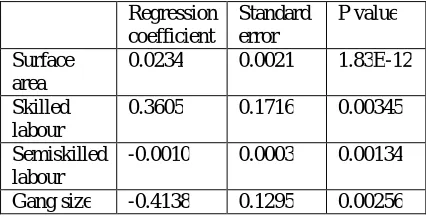
Regression coefficient
Standard error
P value
Surface area
0.0234 0.0021 1.83E-12
Skilled labour
0.3605 0.1716 0.00345
Semiskilled labour
-0.0010 0.0003 0.00134
Graph 1. Normal probability plot for labour productivity in slab formwork
IV. DISCUSSION OF RESULTS OF REGRESSION ANALYSIS
The effect and virtual influence of the various factors of buildability were examined by means of regression relationship by carrying a statistically significant test at significance level of 5%. Table 1. Presents the correlation value i.e. Multiple R as 92% which is too high value means there is high correlation between dependent and independent value and Table 1. also give coefficient of determination value i.e. R square value as 85% which tells 85% of variation of reliant variable could be explained by non-reliant variables. After examining eight buildability factors four among them have proved to have significant impact on productivity of labour of slab formwork among them area of formwork surface completed stands 1st followed by count of skilled labours, count of semiskilled labours and gang size. The quantity to which the statistics disagree with the null hypothesis, i.e. The regression coefficient of the corresponding buildability issue inside the regression model is insignificantly specific from zero, consequently its effect on labour productivity is statistically insignificant, become decided by the p-value received for each thing investigated. If p-value of the corresponding factors are smaller than 0.05, null hypothesis is rejected and it is said to have more significant value, smaller the value greater its significance. Table 2. Gives the p-value of each factor examined were each factor has its p-value less than 0.05. Table 2. Presents the regression coefficient of various factors were in the negative value of factor is statistically insignificant but also affects labour productivity i.e. an increase of semiskilled by one reduces the of productivity by 0.001%. Graph 1 discloses that the various values fit to nearly normally distributed population, thence they prove that statistical results are sensibly agreeing and have a reliability inferences.
V.CASESTUDY
Buildability factors identified in regression analysis namely Area of formwork completed per day, count of semiskilled labours, count of skilled labours and total gang size were considered in a particular site i.e. Agrahara in Mysore district to identify the negative influence and disruption affecting the above mentioned buildability factors and also the reduction of labour productivity is observed due to negative influence and solution is being addressed for the same. This study area is about construction of residential house where the build-up area is 1081sq ft. As a part of construction, forming process for the framed structures is also one of the important task Hence forming process for slab is scheduled in MSP. As per schedule the activity was to start from 8.01.2019 and complete on 10.01.2019 but, due many disruption and delay complete date was extended to 12.01.2019.
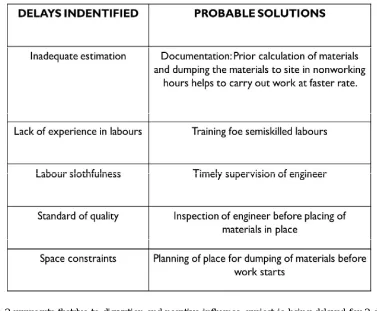
Following are the negative influence and disruption on labour productivity and reasons for delay of project is listed below,
Inadequate estimation (materials)
Lack of experience in labours
Labour slothfulness
Standard of quality
Graph 2. Impact of negative influence on Labour Productivity Graph 3. Overall project view (case study)
VI. DISCUSSON OF RESULTS OF CASE STUDY
Table 3. Addressing of delay
Graph 2 represents thatdue to disruption and negative influence, project is being delayed for 2 days where each day labour productivity is reduced to 37.5% of its productivity.
VII.CONCLUSION
Major buildability factors influencing the labour productivity are identified and addressed namely Area of formwork, skilled labour, semiskilled labour and total gang size were identified.
The outcomes of this research provides a correlation value has 85% between the independent variables and dependent variables
This project says there is 65% of significance for the independent variables as a predictors of dependent variables.
Among four buildability factors identified in this research, Area of formwork completed stands first in influencing the labour productivity in slab formwork followed by skilled labour, semiskilled and gang size. The buildability factors identified so far was examined in a particular site in Mysore district where, Inadequate
estimation, Lack of experience in labours, Labour slothfulness, Standard of quality of material used and Space constraints are the elements causing to know the negative influence and disruption affecting buildability factors were identified
Due to these negative influence 37.5% of labour productivity was reduced Total cost variance observed of forming process is ₹31/m2.
REFERENCES
[1]. Vikram S. Kulkarni and R.V. Devalkar, “Ergonomics Analysis of Building Construction Workers Using RULA and REBA Techniques”Elesvier, (2017), volume-11
[2]. Adrieli Cristina Vieira de Carvalho, Ariovaldo Denis Granja and Vanessa0 Gomes da Silva, “A Systematic Literature Review on Integrative Lean and Sustainability Synergies over a Building’s Lifecycle”Elesvier July 2017, volume-103.
[3]. Soumya R S, A NisharaParveen, “Labour0 productivity Model for Structural Elements by Varying Buildability Factors using Multiple Regression”International Journal of Science and Engineering Research, June 2017, Volume-5.
[4]. Dongmin Lee, Hyunsu Lim, Taehoon Kim, Hunhee Cho, Kyung-In Kang, “Advanced planning model of formwork layout for productivity improvement in high-rise building construction”International 0Research Journal of Engineering and Technology, September 2017.
[5]. Shuquan Lia, XiuyuWua, Yuan Zhouc, Xin Liub, “A study on the evaluation of implementation level of lean construction in two Chinese firms” Elsevier, December 2016, Volume-71.
[6]. Sheila Belayutham0 Vicente A. Gonzalez, Tak Wing Yiu, “Lean-based clean earthworks operation” Elsevier, Nov 2016, Volume-142. [7]. Chien-Ho KO, JiunDe KUO “Making0 Formwork Construction Lean”Journal of Civil Engineering and Management, March 2015,
volume-21.
[8]. G. Boopathi and Satyanarayana N Kalidindi “Impact of equipment Usage On Labour Productivity in The Indian Construction Industry at the Activity 0Level” April 2014.
[9]. AyadiYoussouf, Chanib0Rachid, Verzealon “Contribution to The Optimization of Strategy of Maintenance by Lean Six Sigma” August 2014, Volume-55.
[10]. MOHAMMED Taher0 Ahmed, ROZANA Zakaria, Rosli Mohamad, MOHD AFFENDI Ismail, “Benchmarks for Sustainable Formwork System” International Conference on Sustainable Infrastructure and Built Environment in Developing Countries, June 2014, volume-63. [11]. Abulaziz M Jarkas, “Buildability factors Influencing Formwork Labour Productivity of Walls” International Journal of Construction
Management, Feb 2014, volume-10
[12]. Rosli Mohamad0 Zin, MohdAffendi Ismail, Mohammed AherAlashwal, SurianiHassin, “Sustainability Elements of IBS Formworks System in Malaysia” May 2013, volume-174.
[13]. Faiq0Mohammed Sarhan Al-Zwainy, Mohammed HashimAbdulmajeed, HadiSalihMijwelAljumaily, “Using Multivariable Linear Regression Technique for Modeling Productivity Construction in Iraq”, July 2013
[14]. MOHAMMED Taher Ahmed, ROZANA Zakaria, Rosli Mohamad, MOHD AFFENDI Ismail, “Importance of Sustainable Concrete Formwork System” Advanced Materials Research, Nov 2012, Volume-598
[15]. Alexandra 0Rueff Vieira, Nuno0Cachadinha, “Lean Construction and Sustainability-Complementary Paradigms (A Case Study)”, July 2011.
[16]. Abdulaziz M Jarkas, “Buildability Factors that Influences Micro Level 0Formwork Labour Productivity of Beams in Building Factors”Journal of Construction in Developing Countries, June 2011 Volume-16.
[18]. Abdulaziz M Jarkas, “Buildability Factors0 Influencing Formwork Labour Productivity of Isolated Foundations”Journal of Engineering, Design and Technology, March 2010 volume -8.
[19]. Abdulaziz M. Jarkas,0 “Buildability factors affecting formwork labour productivity of building floors”Australasian Journal of Construction Economics and Building, June 2010 volume-37