University of Windsor University of Windsor
Scholarship at UWindsor
Scholarship at UWindsor
Electronic Theses and Dissertations Theses, Dissertations, and Major Papers
2009
Optical Properties of Nanostructures and Applications to
Optical Properties of Nanostructures and Applications to
Surface-Enhanced Spectroscopy
Enhanced Spectroscopy
Daniel Ross
University of Windsor
Follow this and additional works at: https://scholar.uwindsor.ca/etd
Recommended Citation Recommended Citation
Ross, Daniel, "Optical Properties of Nanostructures and Applications to Surface-Enhanced Spectroscopy" (2009). Electronic Theses and Dissertations. 473.
https://scholar.uwindsor.ca/etd/473
This online database contains the full-text of PhD dissertations and Masters’ theses of University of Windsor students from 1954 forward. These documents are made available for personal study and research purposes only, in accordance with the Canadian Copyright Act and the Creative Commons license—CC BY-NC-ND (Attribution, Non-Commercial, No Derivative Works). Under this license, works must always be attributed to the copyright holder (original author), cannot be used for any commercial purposes, and may not be altered. Any other use would require the permission of the copyright holder. Students may inquire about withdrawing their dissertation and/or thesis from this database. For additional inquiries, please contact the repository administrator via email
OPTICAL PROPERTIES OF NANOSTRUCTURES AND APPLICATIONS TO
SURFACE-ENHANCED SPECTROSCOPY
BY
DANIEL JOSEPH ROSS
A Dissertation
Submitted to the Faculty of Graduate Studies through the
Department of Physics in Partial Fulfillment of the
Requirements for the Degree of Doctor of Philosophy at
The University of Windsor
Windsor, Ontario, Canada
2009
Optical Properties of Nanostructures and Applications to Surface Enhanced
Spectroscopy.
By
Daniel Joseph Ross
APPROVED BY
_________________________________________ Dr. Cecilia Noguez, External Examiner
Instituto de Fısica, UniVersidad Nacional Autonoma de Mexico,
_________________________________________ Dr. S. Holger Eichorn
Department of Chemistry and Biochemistry
_________________________________________ Dr. Chitra Rangan
Department of Physics
_________________________________________ Dr. Roman Maev
Department of Physics
_________________________________________ Dr. Ricardo Aroca, Advisor
Department of Chemistry and Biochemistry
_________________________________________ Dr. Jichang Wang
DECLARATION OF CO-AUTHORSHIP
I hereby declare that this dissertation incorporates material that is result of joint research, as follows:
This dissertation incorporates the outcome of joint research undertaken with Mathew Halls, under the supervision of Ricardo Aroca and Gholam Abbas Nazri of GM Research laboratories. The results of this collaboration are detailed in Chapter 8, section B of this dissertation. In this case the primary contributions, data analysis, and interpretation were all performed by the author. Contribution of Mathew Halls was primarily through advice on use of high level computational tools in cluster based research, while Gholam Abbas Nazri provided the
materials, as well as details and expertise on synthesis.
This dissertation also includes the outcome of joint research undertaken with Dr. R. E. Clavijo of the University of Chile. The results of this collaboration are detailed in chapter 8, section C. In this case, the experimental Raman, SERS, and infrared spectra were obtained by Dr. Clavijo, who granted permission for their use.
I am aware of the University of Windsor Senate Policy on Authorship and I certify that I have properly acknowledged the contribution of other researchers to my thesis, and have obtained written permission from each of the co-author(s) to include the above material(s) in my thesis.
I certify that, with the above qualification, this thesis, and the research to which it refers, is the product of my own work.
DECLARATION OF PREVIOUS PUBLICATION
This thesis includes 2 original papers that have been previously
published/submitted for publication in peer reviewed journals, as follows:
Thesis Chapter
Publication title/full citation Publication
status Chapter 8,
section C
Surface Enhanced Raman Scattering of trans-p-Coumaric and Syringic Acids
Accepted
Chapter 8, Section B
Raman scattering of complex sodium aluminum hydride for hydrogen storage/Daniel J Ross, Mathew D Halls, Abbas G Nazri and Ricardo F Aroca,
Chemical Physics Letters, 388, 430, 2004
Published
Chapter 7 Surface enhanced infrared spectroscopy /R.F. Aroca,
D. Ross, and C. Domingo, Applied Spectroscopy, 58, 324-338A., 2004.
I certify that I have obtained a written permission from the copyright
owner(s) to include the above published material(s) in my thesis. I certify that the above material describes work completed during my registration as graduate student at the University of Windsor.
I declare that, to the best of my knowledge, my thesis does not infringe upon anyone’s copyright nor violate any proprietary rights and that any ideas, techniques, quotations, or any other material from the work of other people included in my thesis, published or otherwise, are fully acknowledged in
accordance with the standard referencing practices. Furthermore, to the extent that I have included copyrighted material that surpasses the bounds of fair dealing within the meaning of the Canada Copyright Act, I certify that I have obtained a written permission from the copyright owner(s) to include such material(s) in my thesis.
ABSTRACT
Metallic nanoparticles, in particular silver and gold nanostructures, are at
the centre of the development of plasmon enhanced optical signals. There is a
flurry of activities in the fabrication and testing of these nanostructures, especially
in surface enhanced Raman scattering (SERS) and surface enhanced-infrared
absorption (SEIRA), the two branches of surface-enhanced vibrational
spectroscopy. The need to develop an understanding of this general subject
matter for practicing spectroscopists cannot be questioned. This work is a unique
undertaking intended to examine some of the elements that give rise to
surface-enhanced spectroscopy.
The optical properties of nanoparticles are discussed in detail, beginning
with a discussion of the electromagnetic theory describing the interaction of light
and matter. Exact solutions to the electromagnetic equations are used to model
and calculate plasmonics of nanoparticles. These methods include Mie theory,
and extensions to Mie such as for concentric spheres and interacting spheres.
Approximate methods are also discussed, such as the dipolar model for
ellipsoids of rotation, and the coupled dipole equations for irregular or interacting
particles. These models are used to obtain optical properties as well as
enhanced electromagnetic fields, applied to surface enhanced vibrational
spectroscopy. The origin of vibrational spectroscopy is briefly described, and
quantum mechanical calculations are performed to describe a variety of the
molecular possibilities arising through surface enhanced spectroscopy, such as
DEDICATION
ACKNOWLEDGEMENTS
An enormous number of people have been a part of my work during my
PhD, and it is a monumental, albeit extremely enjoyable, task to enumerate and
thank each one.
First, my family, especially my parents, Fred and Catherine, have never
questioned my ability to do this. My siblings and their spouses, Neil, Tara,
Gerard, Jenny, and Caroline, have always been extremely supportive. My other
family, including Laurel, James, John, and Dorothy-Anne have also been a
source of encouragement and strength. Catherine and Laurel, especially, are
thanked for their prowess at editing. All remaining errors are mine alone. It goes
without saying that Hank has probably been my most loyal fan throughout the
process.
The Department of Physics has been gracious to provide me with support,
both financial and in terms of available resources, and most of all, a knowledge
base on which to stand. The staff in the Department of Chemistry have also
been part of my support network many times.
Working on a dynamic and vibrant research team like the Materials and
Surface Science group has been an experience that will stay with me forever. I
would like to thank all present and past members for their contributions to my
learning. Special acknowledgements go to Nik Pieczonka, Paul Goulet,
Teodosio del Caño, Ramon Alvarez-Puebla, Carlos José Constantino, and
Abbas Nazri for invaluable discussions and generosity with their expertise. Extra
special thanks to Mathew Halls, who shared many hours of his time to give me
an insight into quantum chemistry enjoyed by very few. Ricardo Aroca has been
a supervisor about which I have boasted on many occasions, providing
knowledge, support, resources, a lifetime of experience, and friendship.
Although “I couldn’t do it without you” is a cliché, it has rarely been more true.
Lastly, the acknowledgement my wife Reagan Gale Ross deserves would
require a dissertation longer than this one. Her patience, encouragement, and
TABLE OF CONTENTS
DECLARATION OF CO-AUTHORSHIP/PREVIOUS PUBLICATION iii
ABSTRACT v
DEDICATION vi
ACKNOWLEDGEMENTS vii
LIST OF TABLES x
LIST OF FIGURES xi
LIST OF APPENDICIES xvii
LIST OF SYMBOLS, ABBREVIATIONS, AND NOMENCLATURE xviii
CHAPTER
I. INTRODUCTION 1
A. Plasmonics and Optical Properties of Nanoparticles 1
B. Definition of The Optical Constants 5
C. Surface Enhanced Spectroscopy 13
D. Bibliography 17
II. MIE THEORY 19
A. Solution for Maxwell’s Equations for a Sphere 19
B. Expansion of Incident Field 28
C. Scattered and Internal Fields 33
D. Extinction and Scattering Cross Sections 36
E. Calculation of the Near Field 50
F. Bibliography 58
III. NANOSHELLS 59
A. Theoretical Background 59
B. Results 64
C. Bibliography 72
IV. DIPOLE APPROXIMATIONS AND THE COUPLED DIPOLE EQUATIONS
74
A. Non-Spherical Shapes Through the Dipolar Approximation
74
B. Non-Spherical Shapes Through the Coupled Dipole Equations
81
D. Bibliography 97
V. EXTENDED MIE THEORY 98
A. Theory of Cooperative Scattering 98
B. Addition Coefficients for Vector Spherical Harmonics 106
C. Calculation of the Near Field 108
D. Normal Incidence 115
E. Particles along a Common Z-axis 119
F. Field at a Point on the Z-axis 121
G. Asymptotic Expansion for Large Separation 125
H. Rayleigh Regime for Identical Particles 132
I. Extinction Cross Sections and Field Calculations 145
J. Bibliography 151
VI. QUANTUM OPTICAL MODEL OF SURFACE ENHANCED SPECTROSCOPY
152
A. Unified Surface Enhanced Spectroscopy Through Quantum Optics
152
B. Quantum Optical Results from Couple Particles 161
C. Bibliography 163
VII. SURFACE ENHANCED INFRARED ABSORPTION (SEIRA) 164
A. Introduction to Surface Enhanced Infrared Absorption 164
B. Effective Medium Theories 170
C. A Model SEIRA Case 175
D. Bibliograpy 181
VIII. QUANTUM CHEMISTRY FOR MOLECULAR SYSTEMS 184
A. Nanostructures and the Observed Spectra in SER(R)S 184
B. Materials for Hydrogen Storage 192
C. SERS Study Case 203
D. PTCDA 215
E. Bibliography 218
IX. CONCLUSION 220
A. Biblography 223
APPENDICIES
A. Couple Dipole Equation Program for C++ 224
B. Mie Scattering, Extinction, and Near Field Calculations 230
C. Copyright Releases 233
VITA AUCTORIS 238
LIST OF TABLES
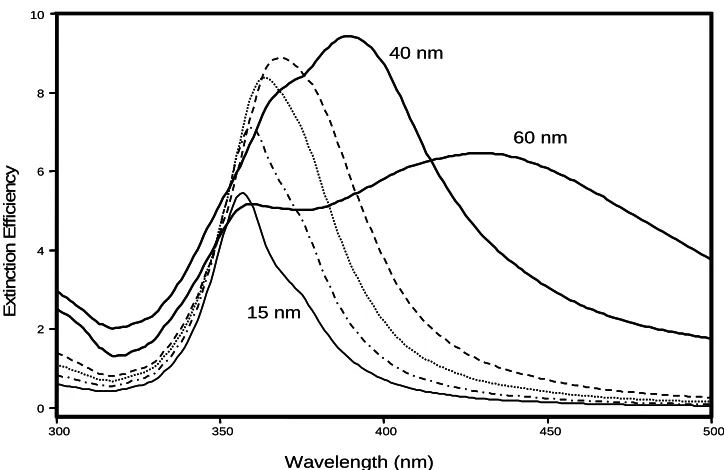
Table 2.1. Computed extinction results for silver spheres. 40
Table 2.2. Computed scattering results for silver spheres. 42
Table 2.3. Comparison of extinction, scattering, and absorption cross sections and efficiencies for silver spheres
44
Table 2.4. Scattered field peak wavelength, relative intensity, FWHM, and scattering efficiency for silver spheres varying radii.
52
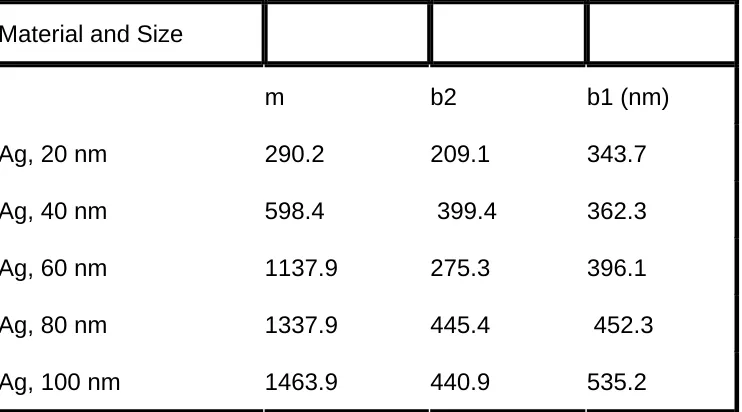
Table 3.1. Calculated parameters for use in equation 3.7, from Mie calculations
67
Table 6.1: Differential cross section results. Intensities are in units of 10
-18
cm2/(meV sr).
162
Table 8.1. Geometric parameters and relative energies for monomers of
NaAlH4, in bidentate, tridentate, and monodentate configurations. (Lower
numbered hydrogen are those bonded to Na in all three cases)
197
Table 8.2:. Wavenumbers and vibrational assignments of observed
Raman bands of NaAlH4.
200
Table 8.3: Character table of syringic and p-coumaric acid. Acronyms include ip: in-plane, and oop: out of plane.
206
Table 8.4: Observed and calculated Raman wavenumbers (cm-1) of
syringic acid and its Ag-complex and SERS on Ag colloids
211
Table 8.5: Observed and calculated infrared spectra of syringic acid. 212
Table 8.6: Calculated Infrared frequencies and intensities for PTCDA at B3LYP/6-31g(d) level of theory. oop and ip are acronyms designating “out of plane” and “in plane”, respectively.
LIST OF FIGURES
Figure 1.1 Illustration of surface charge and electric field in a surface plasmon.
2
Figure 1.2. Schematic of Raman scattering (RS), resonant Raman scattering (RRS), Infrared Absorption (IR), and Fluorescence.
15
Figure 2.1. Extinction, absorption, and scattering cross sections for a 30nm silver sphere.
38
Figure 2.2. Extinction efficiency of silver spheres of varying radii. 39
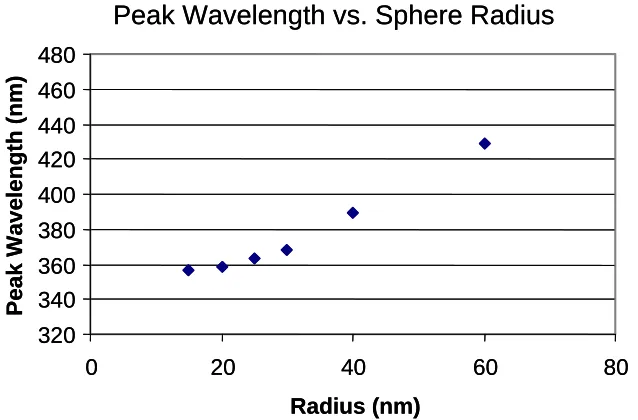
Figure 2.3. Peak wavelength of main peak vs. radius for silver spheres. 41
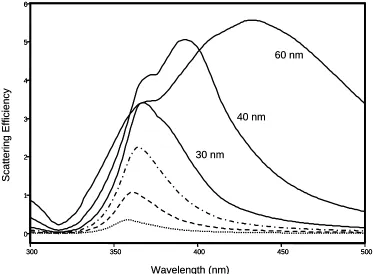
Figure 2.4. Scattering efficiency of silver spheres of varying radii. 42
Figure 2.5. Scattering cross sections of 30 nm silver particles in a variety of media.
45
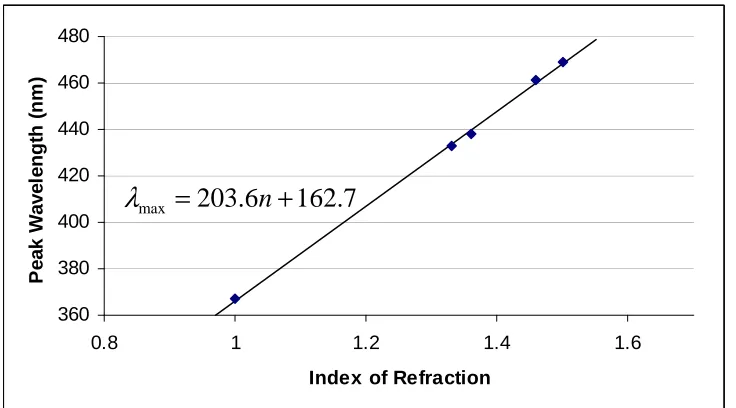
Figure 2.6. Plot of peak wavelength vs. Index of Refraction. 45
Figure 2.7 Real part of dielectric functions of Silver (solid), Gold (dotted) and Copper (dashed)
46
Figure 2.8. Real part of dielectric functions of Silver (solid), Gold (dotted) and Copper (dashed)
46
Figure 2.9: Extinction cross sections of Copper, Gold, and Silver. 47
Figure 2.10: Scattering cross sections of Gold, Copper (dashed) and Silver.
48
Figure 2.11: Scattered field by silver spheres of varying radii. 51
Figure 2.12 Plot of relative scattered field intensities (triangles) and extinction efficiencies divided by the cube of the radius (squares), as a function of radius.
52
Figure 2.13. Plot of relative scattered field intensity against volume normalized scattering efficiency.
53
Figure 2.14. Relative scattered field intensity of silver, gold (dotted), and copper as a function of wavelength
Figure 2.15. Scattered Field Intensities for 20 and 30 nm Silver Particles. 55
Figure 2.16 Relative scattered field intensity as a function of distance from surface for 20nm (solid), 25 nm (dotted), and 30 nm (dashed) silver spheres.
56
Figure 2.17 Natural logarithm of relative scattered field intensity as a function of distance from surface for 20nm (solid), 25 nm (dotted), and 30 nm (dashed) silver spheres.
57
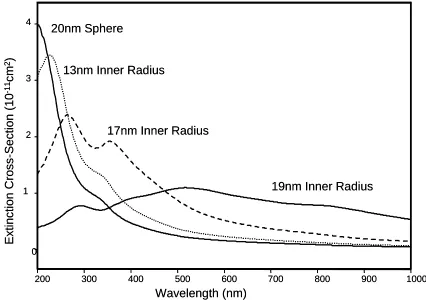
Figure 3.1. 20 nm outer radius of Ag: a) Solid line, sphere. b) Long dash, 11 nm inner radius. c) Short dash, 17 nm inner radius. d) dotted line, 19 nm inner radius.
65
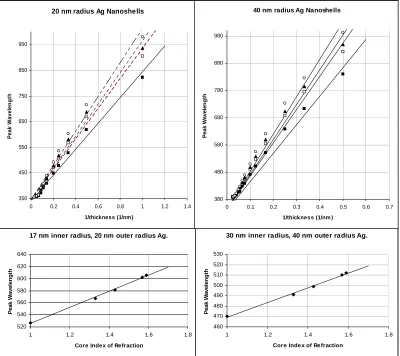
Figure 3.2: Peak wavelength vs. inverse shell thickness for Ag nanoshells of 60 nm outer radius, and peak wavelength vs. core index of refraction for 0.587 core/shell volume ratio for Ag nanoshells of 60nm outer radius.
65
Figure 3.3: Peak wavelength vs. inverse shell thickness for Ag nanoshells of 20 and 40 nm outer radius, and peak wavelength vs. core index of refraction for 0.587 core/shell volume ratio for Ag nanoshells of 20 and 40nm outer radius.
66
Figure 3.4. Extinction Cross Section of Ir nanoshells, outer radius 20nm, vacuum core
68
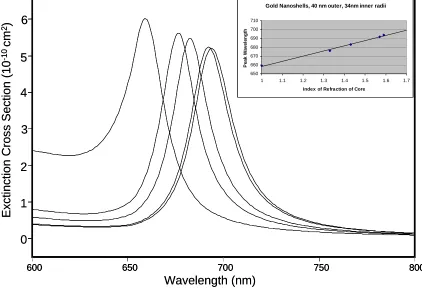
Figure 3.5. Plasmon response of Au nanoshells, 40 nm outer radius, 34 nm inner radius, for vacuum, aqueous, silica, dendrimer, and polystyrene cores.
69
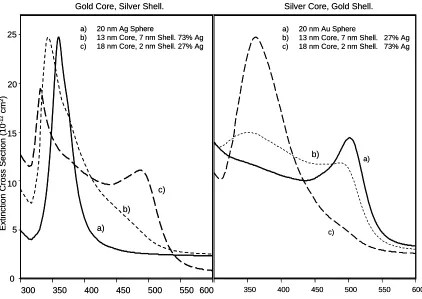
Figure 3.6. Plasmon response of silver/gold and gold/silver core/shell systems.
70
Figure 3.7. Plasmon response of silver/gold and gold/silver core/shell systems, contrasted with mixtures from effective medium theory, for 27% Ag by volume.
71
Figure 4.1: Extinction cross section of a gold nanorod of aspect ratio 4 considering only the minor axis.
77
Figure 4.2 Extinction cross section of a gold nanorod of aspect ratio 4 considering only the major axis.
77
Figure 4.4. Extinction cross section of a gold nanorod of aspect ratio 4 in different media: Vacuum(εm=1), Water(εm=1) (dotted), Benzene(εm=1.5)
(dashed), and εm=1.75 (dot-dash).
79
Figure 4.5: Extinction cross sections for gold spheres and nanorods, with major axis 25 nm, corresponding to sphere, aspect ratio of 2 (dotted), aspect ratio of 3 (dashed), aspect ratio of 4 and aspect ratio of 6.
80
Figure 4.6: Spheres made up of 136 dipoles (left) and 304 dipoles (right). 83
Figure 4.7: Extinction cross sections of 10 nm sphere using Mie (solid), CDE using 136 dipoles (dashed), CDE using 304 dipoles (dotted).
83
Figure 4.8 Extinction cross sections of 50 nm sphere using Mie (solid), CDE using 136 dipoles (dotted), CDE using 304 dipoles (dashed), CDE using 1024 dipoles (dot-dashed)
84
Figure 4.9: Discretization of a 380 dipole cylinder of aspect ratio 4. 85
Figure 4.10: Extinction of a gold cylinder of major axis 25 nm, and minor axes 6.25 nm.
85
Figure 4.11 Schematic of particle arrangement for calculation of
enhancement. The particles of radius R are separated by a distance d.
88
Figure 4.12: Field enhancement as a function of wavelength for 2 particle system.
89
Figure 4.13 : Arrangements of particles. 1 and 2 represent the positions of a single particle and dimer respectively, while 3a and 3b refer to the two different configurations of a 3 particle system.
90
Figure 4.14: Extinction cross section vs. Incident Wavelength for 1 (solid), 2 (dashed), and 3 particles, in configuration 3a (dot-dash) and 3b (dotted).
91
Figure 4.15. Electric field enhancement vs. Wavelength for 1 particle sampled at S1 (solid), 2 particles sampled at S1 (dashed), and 3 particles
(dotted line), in configuration 3a sampled at S1, and 3b sampled at S2 and
S4. The inset shows detail of the single particle and configuration 3a
from 300 to 450nm.
92
Figure 4.16: Electric field enhancement for 1 particle at 356 nm (left) and 2 particles at 428 nm (right).
Figure 4.17: Electric field enhancement for 3 particles in configuration 3a at 426 nm (left) and 342 nm (right).
94
Figure 4.18: Electric field enhancement for 3 particles in configuration 3b
at 530 nm. 94
Figure 4.19: Self-avoiding random walks of 100 particles. 95
Figure 4.20: Extinction cross section of 20 nm silver particles for the configurations seen in Figure 4.19.
96
Figure 5.1: Ray diagram of the scattering events considered in order of scattering method.
111
Figure 5.2. Schematic of two particles along z axis. 132
Figure 5.3: Extinction cross section of two interacting 30 nm silver spheres, with surface separation of infinity (solid), 2 nm (dotted), 1 nm (dashed), and in contact (dot-dash)
145
Figure 5.4: Extinction cross section of two 20nm particles at a distance of infinity (dotted), 8 nm, 4 nm (dashed), 2 nm (dot-dash), and in contact.
146
Figure 5.5: Field enhancements for 20nm particles with surface separations of 4 nm, 2 nm, and in contact.
147
Figure 5.6: Enhancement for two 20 nm silver particles. In contact, field enhancement (solid) and damping enhancement (dotted), at 2 nm
surface separation, field enhancement (dashed) and damping enhancement (dot-dash)
148
Figure 5.7: Electric field enhancement for 2 20nm silver particles. 148
Figure 5.8: Electric field enhancement for 3 20nm silver particles in a triangular formation.
149
Figure 5.9: Electric field enhancement for 3 20nm silver particles in a straight line.
149
Figure 6.1. Scattering and Fluorescence cross sections for d=0, 1, 2, and
4 nm. The parameters used are: ħωL=2.45 eV, : ħωge=2.35 eV,
ħωvib=0.16 eV, γph=1x10¹⁴ Hz, α=0.5, and E0=1x10⁴ N/C.
161
Figure 7.1: Enhancement factor of the electromagnetic field for spheroids in vacuum, with lengths of 90 and 30 nm for major and minor axes
respectively
Figure 7.2: Real and Imaginary parts of the dielectric function for Silver and Tin.
168
Figure 7.3: Enhancement factor for SiC averaged over the surface of a particle with the same computational parameters as those in Figure 7.1
169
Figure 7. 4: Maxwell-Garnet computation for a collection of prolate ellipsoids, with a major axis of 90 nm and a minor axis of 30 nm, coated with a 1 nm thick layer of PTCDA.
174
Figure 7.5: Planar, D2h PTCDA molecule. 175
Figure 7.6: DFT B3LYP/6-31g(d) computation results, and the transmission FTIR spectrum of PTCDA in a KBr pellet.
177
Figure 7.7: RAIRS spectrum of a 50 nm PTCDA film deposited onto smooth reflecting silver mirror and calculated vibrational intensities for the b3u species.
177
Figure 7.8. Transmission spectra. PTCDA pellet, SEIRA spectrum, and 50 nm film on KBr crystal.
178
Figure 7.9. SEIRA spectrum of the 10 nm PTCDA film on 15 nm silver island film. RAIRS spectrum of the 10 nm PTCDA film on smooth silver mirror, and transmission FTIR spectrum of the 10 nm PTCDA film on KBr crystal.
179
Figure 8.1. Eight monomer cluster of NaAlH4 optimzed at the
B3-LYP/6-31+G(d,p) level of theory.
195
Figure 8.2. Raman scattering of NaAlH4 using the 633 nm excitation line. 196
Figure 8.3. Simulated and experimental Raman spectra for the high
frequency region of NaAlH4 using the largest cluster model and the
633nm laser line, top and bottom trace respectively. Inset: Calculated high-frequency Raman for the one, two, four, six, and eight monomer models.
198
Figure 8.4. Simulated and experimental Raman spectra for the middle
frequency region of NaAlH4 using the largest cluster model and the
633nm laser line, top and bottom trace respectively. Inset: Calculated mid-frequency Raman for the one, two, four, six, and eight monomer models.
Figure 8.5. Simulated and experimental Raman spectra for the low
frequency region of NaAlH4 using the largest cluster model and the
633nm laser line, top and bottom trace respectively. Inset: Calculated low-frequency Raman for the one, two, four, six, and eight monomer models.
199
Figure 8.6: Syringic acid (left) and p-coumaric acid (right). 203
Figure 8.7: Calculated Raman spectra of: P-coumaric acid (top) and syringic acid (bottom).
204
Figure 8.8: Structure of syringic acid (left) and p-coumaric (right). 207
Figure 8.9: Raman spectra of syringic acid (bottom) and syringic silver salt (top). The spectrum of the syringic salt is offset for clarity.
208
Figure 8.10: Raman spectra of p-coumaric acid (bottom) and p-coumaric silver salt (top). The spectrum of the syringic salt is offset for clarity.
209
Figure 8.11: Difference spectra of p-coumaric (top) and syringic (bottom).
210
Figure 8.12. Raman and SERS spectra of syringic acid. 213
Figure 8.13: Raman intensity of yy elements of polarizability tensor of p-syringic acid.
214
Figure 8.14: Raman and SERS spectra of coumaric acid. 214
Figure 8.15. Computed infrared spectrum of PTCDA at B3LYP/6-31g(d), with classification of bands according to character.
LIST OF APPENDICIES
224 230 A. Couple Dipole Equation Program for C++
B. Mie Scattering, Extinction, and Near Field Calculations
LIST OF SYMBOLS, ABBREVIATIONS, AND NOMENCLATURE
AFM: Atomic Force Microscopy
LSPR: Localized Surface Plasmon Resonance
RRS: Resonance Raman Scattering
RS: Raman Scattering
SAW: Self Avoiding Walk
SEF: Surface Enhanced Fluoresence
SEIRA: Surface Enhanced Infrared Absorption
SERRS: Surface Enhanced Resonance Raman Scattering
SERS: Surface Enhanced Raman Scattering
CHAPTER ONE INTRODUCTION
A. Plasmonics and Optical Properties of Nanoparticles
The following dissertation may best be understood to be part of the field of
plasmonics. Plasmonics is the study of the electronic oscillation, or plasmon,
which is created by the interaction of light with a nanostructured material.1 It is the optical response of noble metals, dominated by the behavior of their
conduction electrons, which can produce collective oscillations of the electrons,
or, plasmon. The interaction between electromagnetic radiation (from infrared to
the ultraviolet) and a metal surface may lead to surface plasmon excitation, as
this interaction creates electronic plasma oscillations on the surface of the metal.
When speaking of a plasmon, it is necessary to differentiate whether the
collective excitation of electrons of the metal is contained within the metal or is a
surface excitation.
Should the excitation be found within the metal (e.g., bulk plasmons), the
oscillations due to fluctuations in the electronic density of the metal are
longitudinal2-4. In this case, the condition for plasmon formation is that the real part of the dielectric function is zero, which is only true at a specific frequency of
light. This frequency is termed the plasma frequency, and, in practice, is very
distinctive among different materials. For metallic surfaces, however, there
exists a surface plasmon with an amplitude that dies off quickly away from the
surface. This surface excitation is a coupling of the incident photons with the
oscillation of the conduction electrons and it polarizes the surface. The surface
plasmon is often thus referred to as the surface plasmon-polariton, clearly
indicating that this excitation is a coupling of the light and a material. This
concept is shown in Figure 1.1, which is an idealized image of the charge, and
Figure 1.1 Illustration of surface charge and electric field in a surface plasmon.
The electromagnetic field of a surface plasmon at the metal/dielectric
interface is the evanescent solution of Maxwell’s equations, applying the correct
continuity conditions at the surface. This work deals with the surface plasmons
in a specific size regime: that of metal nanoparticles. These excitations depend
strongly on both the size and shape of the particle or particles involved, and thus
are very different from the surface plasmon created in a flat surface. These are
often termed localized surface plasmons, or localized surface plasmon
resonances (LSPR), as they are confined to nanometric particles, leading to
resonances that depend on the size, shape, and dielectric function of the material
that the particle is made up of. Discussing the solution of Maxwell’s equations for
this problemwill be one of the main subjects of this work.
Although plasmonics is a relatively new field, (the term was first appeared
in the literature in 2001)5 , the study of plasmons has had a much longer history.
For example, the use of colloidal gold and silver particles in the Lycurgus cup
give it unique optical properties6. These gold and silver particles, as will be shown in detail later (See chapter 2, p.18) absorb and scatter light primarily in the
shorter wavelengths of the visible region. When viewed using reflected light, the
cup is a green colour. When lit from inside, however, the gold and silver particles
historic application for the scattering of light by metal particles is seen in the
windows of temples, churches, and other buildings, as well as in other forms of
stained glass artwork. The bright colours of the stained glass are due to metallic
nanoparticles, the specific colour depending on the size and material of the
particle.
The first systematic understanding of the phenomenon that would later
develop into the field of plasmonics was through Mie’s solution to Maxwell’s
equations for a dielectric sphere8. The exact solution of the interaction of light with a spherical body was now understood, given that the optical properties of
the specific material were known. In addition to colloidal metal particles, Mie’s
solution applies to a wide variety of problems 9: atomospheric dust, interstellar
particles, solar coronas, scattering by raindrops10, and others. The theory of
electromagnetic absorption and scattering by small particles, as well as
applications and computational techniques has been summarized by Kerker11
and Bohren and Huffman10.
Given the wide variety of techniques to fabricate nanoparticles, there are a
plethora of possible shapes and sizes, even for the two most common materials,
silver and gold. Although spheres are probably the most common (due to the
relative ease of synthesis through colloidal suspensions of gold and silver) some
of the geometrically simple, yet interesting shapes include nanoshells12-15,
ellipsoids of revolution16, triangles17, cubes18, and hexagons19. These latter shapes make up a fairly small sample that reveals possibility of modifying the
nanoparticle shape. Fortunately, this modification of shape allows for control
over the resonance wavelength, amplitude, and bandwidth. Another important
development is that of interacting particles, such as dimers of spheres and
shells20, and of triangles17, forming nano ‘bow-ties’. The problem of two interacting particles is one of the few that can be treated exactly, or at least
approximated well, while still having some of the essential features of a system of
particles.
The confinement of electromagnetic field to the particle gives the surface
used for studying adsorption on the surface, as well as surface roughness and
related phenomena. Devices based on the surface plasmon are used in chemical
and biological sensors21. The enhancement of the electromagnetic field at the
interface is responsible for phenomena such as optical amplification surface: the
intensification of the surfaces by Raman scattering (SERS), where it is possible
to detect a single molecule; second harmonic generation; fluorescence, and so
on. In addition, the two-dimensional nature of the surface plasmon makes it
particularly interesting in building plasmon circuits, where the information is
transmitted through a surface plasmon, with potential applications in optical
computing. The fabrication, manipulation, and characterization of nanometric
surfaces has recently become relatively easier, thanks to developments in
techniques such as high resolution electron microscopy, AFM, and STM, allowing
for novel opportunities in optoelectronics and photonic devices, with length
scales much smaller than traditional electronic or optical methods, down to the
scale of nanometers. As a result of these developments, as well as increasing
knowledge of other characteristics of surface plasmon, there is now more interest
in new technologies, as well as in the study of new physical phenomena in which
plasmons play a leading role. Taken together, this interest has lead the the field
B. Definition of The Optical Constants
The optical constants arise from Maxwell’s equation with a time harmonic
field. Starting from the derivative form22:
ρ = ⋅
∇ D (1.1)
0 = ⋅
∇ B (1.2)
0
= ∂ ∂ − − × ∇
t
D J H
(1.3)
0
= ∂ ∂ + × ∇
t
B E
(1.4)
In general, the macroscopic manifestation of the fields, D and H, called the
electric displacement and magnetic field, respectively, depend on the electric or
magnetic polarization of the medium, P and M. Assuming that the contribution of
the quadrupole and higher moments to the polarization are small compared to
the dipole, and can be neglected, these are:
P E
D=ε0 + (1.5)
M B H= −
0
µ (1.6)
For a proof of the above, please refer to Jackson, Classical Electrodynamics,
chapter 6, section 6.22
In any media besides vacuum, constitutive relations are used to describe
the fields. Assuming linear, isotropic, and homogeneous media, the derived
fields D and H can take simple forms. The linearity implies that an electric or
magnetic field induces a polarization proportional to the field. For the sake of
consistency, the permittivity will be symbolized by εˆ, rather than ε, which will be reserved for the relative permittivity, or the dielectric function.
E
D=ε) (1.7)
H
B=µ (1.8)
E
J=σ (1.9)
Although the above restrictions to the medium seem stringent, they are
applicable to a large class10; however, they are not appropriate for ferroelectric or ferromagnetic materials, or when the applied fields are very high.
Optical properties and spectroscopic studies necessarily use oscillating
fields. A harmonic oscillating field can be used without loss of generality, as
different oscillating fields can be produced by superposition. It is also
advantageous at this time to introduce complex notation. The complex
time-harmonic field, F is expressed as
t i Ce
t =F −ω
F )( (1.10)
where
Im
Re F
F
FC = +i (1.11)
The partial derivative of the complex time-harmonic field is then:
(
)
( )) (
Im Re
Im
Ree i e i e e i t
t t
t i t i t i t i t
F F
F F
F F
ω ω
ω ω ω
ω
ω + =− + =−
∂ ∂ = ∂
∂ − − − −
(1.12)
Thus, evaluating the partial derivatives with respect to time, and inserting the
constitutive relations 1.7-1.9, equations 1.1-1.4 can be re-written as:
ερ) = ⋅
∇ E
(1.13)
0 = ⋅
∇ H (1.14)
0 = +
− ×
∇ H σE iωε)E (1.15)
0
= −
×
∇ E iµωH (1.16)
The permittivity can now be seen to be a complex number. Although the
permeability will also in general be complex, the majority of this work focuses on
the electric part, and the magnetic properties will not be treated. Factoring the
electric field in equation 1.15, which is possible as the medium is assumed to be
(
)
+ −
= − = ×
∇ ε
ω σ ω ε
ω
σ i ) i E i )
E H
(1.17)
The complex permittivity is then:
ωσ ε εC = +i
) )
(1.18)
Although the assumption of time-harmonic fields has been made, there is not yet
any indication of how the electromagnetic fields extend in space. Only certain
fields will satisfy Maxell’s equations, 1.13-1.16. To form a solution, the curl of
equations 1.17 and 1.16 is taken:
(
∇×)
+ ∇× =0 ×∇ H iεCω E
)
(1.19)
(
∇×)
−(
∇×)
=0 ×∇ E iµω H (1.20)
Using the triple product
(
∇×a) (
=∇∇⋅a)
−∇2a×
∇ (1.21)
and inserting equations 1.13 and 1.14:
0
2 + ∇× =
∇
− H iωε)C E
(1.22)
(
)
0ˆ
2 − ∇× =
∇ −
∇ E µω H
ε ρ
i
(1.23)
Equation 1.23 requires some comment at this point. Many texts assume
that no free charges are present, giving divergence free equations. This is not
completely necessary for this analysis, as the form of the permittivity used here
comes with the assumptions of the medium being both homogeneous and
isotropic. Therefore, both the free charge density and the permittivity of the
system are divergence free, causing the first term in equation 1.23 to be zero. It
is not required that no free charges exist: rather, only that they are
divergence-free.
Substituting 1.16 and 1.17 back into 1.22 and 1.23, and simplifying gives
0
2
2 + =
∇ H µω ε)CH
(1.24)
0
2
2 + =
∇ E µω ε)CE (1.25)
A possible solution is a plane wave traveling in the x direction. Similar to
time-harmonic fields, however, many complicated fields, including those such as
pulsed fields, can be represented by a superposition of plane waves:
(i i t) Ce
t =F k⋅x−ω F )(
(1.26)
where k is the wavevector, and x is the direction of travel, and F represents either
the electric or magnetic field. Inserting the general plane wave solution into
equation 1.25 (the magnetic field equations will yield a symmetric result) gives:
0 ) , ( )
,
( 2
2 + =
−k E x t µω ε)CE x t (1.27)
Solving for k:
ω ε µ C
k= )
(1.28)
It is clear that with a complex permittivity, the wavevector is also complex. The
phase velocity of the wave is defined for non-magnetic materials as:22
0
ˆ ˆ 1
ε ε
ε µ ω
c c
n
n c k
v
=
= =
=
(1.29)
where c is the speed of light, and n the index of refraction of material, which is
also in generally complex. As well, it is common to see the dielectric function,
often labelled the dielectric constant for regions where it is insensitive to
frequency, defined as:
0
2 ˆ
ε ε
ε c
n =
= (1.30)
The complex index of refraction and the dielectric function are referred to as the
optical properties of the materials. Their definition comes from Maxwell’s
equations, and are thus considered macroscopic parameters to describe the
objects in question. When using classical electrodynamics to solve a problem,
however, these macroscopic values are quite appropriate.
So there are two sets of optical constants which are generally used side
by side, although it is important to note that they are not independent. The
'' ' '
ε ε
ε i
ik n n
+ =
+ =
(1.31)
where the complex dielectric function ε is related to the complex index of
refraction n by
( )
2 22
' 2
' ink k n
n = + −
=
ε (1.32)
and n can be recovered by taking the real and imaginary parts of the dielectric
function, although care should be taken near the region of the branch cut of
square root function, which lies along the line ε’’=0 while ε’<0.
Understanding the dielectric function is best achieved through the use of a
model, in this case a classical model of the dielectric function that is appropriate
for both metals and molecules, the Lorentz model. This follows the damped and
driven harmonic oscillator quite closely, although the model phrases the problem
in terms of electrodynamics rather than classical mechanics. An oscillator of
mass m, and charge q has three forces acting on it: a restoring spring force kx,
where k is the spring constant, and x the displacement from equilibrium, a
damping force γv, where γ is the damping constant, and v the velocity, and a
driving force produced by the local electric field E. The equation of motion is
then
E x x
x k q
m&&+γ&+ = , (1.33)
There are two parts to the solution of equation 1.33, the first being a transient
part which dies away quickly due to the damping. The oscillatory solution, which
oscillates at the same frequency as E is similar to those derived in classical
mechanics23
m m k
i m
q
γ ω
ω ω
ω
= Γ
=
Γ − − =
2 0
2 2 0
E x
(1.34)
Although the usual method is to derive the amplitude and phase angles in this
constants10. The dipole moment that is induced by this oscillator is p=qx. If there are N oscillators per unit volume, the electric polarization P, the number of
dipoles per unit volume, appearing in equation 1.5 is
0 2 2
0 2
2 0
2
ε ω
ε ω ω
ω ω
m Nq
i Nq
N
p
p
=
Γ − − = =
= p x E
P
(1.35)
This specific example of the polarization can be put into equation 1.5 to obtain
E E
E
D 2 2 0
0 2
0 2
2 0
2
0 1 ε
ω ω
ω ω ε
ω ω
ω ω
ε
Γ − − + = Γ
− − + =
i i
p p
(1.36)
When this is compared to equation 1.7, the permittivity is apparent, and thus the
relative permittivity, or the dielectric function can be written as
ω ω
ω ω ε
Γ − − + =
i
p
2 2 0
2
1 (1.37)
While the Lorentz model is an idealized model, it has utility from the
generality. The charge carriers may be electrons or nuclei, or entire atoms,
depending on what the physical system is.
The Drude model is a further approximation to the Lorentz model, by
assuming that electrons in metals are near the Fermi level can be excited by very
small amounts of energy, making them essentially free. The electrons are now
the oscillators, and as they are free, the restoring force in the Lorentz oscillator is
zero, causing the resonance frequency ω0 also to be zero. In the Drude model
the dielectric function is then
ω ω
ω ε
Γ + − =
i
p
2 2
1 (1.38)
The Drude model demonstrates when bulk plasmon formation is possible, when
the dielectric function goes to zero, which occurs when
2 4 0
2 2 2 2
p p
i i
ω ω
ω ω ω
+ Γ − ± Γ − =
= − Γ +
Assuming that the damping is much smaller than the plasma frequency, the
plasmon condition is
2
Γ − +
=ωp i
ω , where the sign uncertainty is dropped as the
negative branch of the plasma frequency, will give a negative frequency. The
bulk plasmon is thus a well defined entity, an oscillation of electrons with a
lifetime defined by Г. Localized surface plasmons are not quite so neatly
captured, but an understanding of the Drude model is a valuable tool to
understanding plasmonics.
Although it is possible to look up plasma frequencies ωp and damping constants
for most materials, and thus generate optical properties of metals from the Drude
model, the model ignores many aspects, such as anisotropy, interband
transitions, and differences between free and bound electrons. Tabulated values
are available for many materials, and these give more realistic results than the
Drude and Lorentz models.
With the complex definition of the optical constants, we have seen the
generation of a new field in the study of optical properties of materials. As the
permittivity is frequency dependent, it is important to remember that the square
root of a complex number contains a branch cut along the negative part of the
real axis, meaning that the principle square root will be discontinuous along the
negative real axis. This is not usually a problem, as real materials will have a
small positive imaginary value, representing attenuation in the medium. A new
class of materials, however, referred to as metamaterials 24, or left-handed
materials, have complex permittivity and permeability, where for both quantities
the real part is negative, and the imaginary part positive. Explicitly defining these
complex quantities
Im Re ε ε ε)C = ) +i)
(1.40)
Im Re µ µ
µC = + (1.41)
the product will be:
(
Re Im Im Re)
Im Im Re
Reµ ε µ ε µ ε µ
ε µ
As the imaginary parts are small, the real part of the product is dominated by the
product of the real parts, giving a positive real part. The imaginary part, however,
will be negative: however, as both terms are products of the negative real parts,
and the positive imaginary parts. A positive imaginary part will be required after
the square root, however, to represent that these materials are lossy. So the
principle square root is multiplied through by a negative, giving a negative real
part, and a positive imaginary part. The term left-handed material arises from the
fact that, in this special case, the wave vector has a real part pointing in the
opposite direction of propagation. This is of interest as many metals at optical
frequencies posses a negative real permittivity in the bulk. It is through
C. Surface Enhanced Vibrational Spectroscopy
Surface enhanced spectroscopy is a complex field as it includes many
different concepts of the surface, the enhancement, and the spectroscopy. For
the purposes of this dissertation, the two main groups to be considered are 1)
Surface Enhanced Vibrational Spectroscopy25, including surface enhanced
Raman scattering (SERS), surface enhanced resonance Raman scattering
(SERRS), surface enhanced infrared absorption (SEIRA), and 2) Surface
Enhanced Fluorescence (SEF). By far, SER(R)S has the most publications of
the field, as the enhancement effect is quite dramatic.
Surface enhancement is defined here as enhancement of the intensity of
the optical signal when is coupled to the localized surface plasmon excitation of
metal nanostructures. Other aspects include the chemical effect, or chemical
enhancement 26,27, which can arise from spectroscopic changes due to
interactions with the surface (chemical adsorption), leading to changes in the
electronic structure of the molecule, the breaking or creation of chemical bonds,
or from charge transfer to and from the surface to the molecule. While all these
factors certainly effect the observed spectroscopic result, it is the plasmon
enhancement which provides the main contribution to the SERS effect27.
Localized surface plasmons can be supported by nanorods, nanowires, and a
plethora of nanoparticles of other different shapes (cubes, stars, cones, etc.),
and, in particular, by metallic tips. The latter give rise to Tip Enhanced Raman
Spectroscopy (TERS)28,29.
A schematic of the energy levels involved in absorption, emission and
scattering spectroscopies to be discussed is shown in Figure 1.2, for a simplified
version of molecular energy levels: The two-state system, being the ground and
the excited electronic states |g> and |e>. Each of these states has many
vibrational states within it, labeled ν, starting with ν = 0, the fundamental vibrational state. Raman scattering in this context is excitation by a
monochromatic source to a virtual state, and returning to a different vibrational
state than the original. Since the virtual state is not a stationary state of the
state are not important. The key point is the difference in energy between the
incident photon and the Raman scattered photon. If there is no difference in
energy, or the photon is elastically scattered, the effect is Rayleigh scattering.
Infrared absorption is a transition within an electronic state, defined here as being
a simple increase in vibrational state. As opposed to Raman, infrared
spectroscopy uses a broad source and a photodetector, with the frequencies
modulated by an interferometer, resulting in an interferogram leading to a Fourier
transform infrared, or FT-IR spectrum. Infrared absorption and Raman
scattering, although probing the same vibrational states, have intensity that
depends on different quantities. In the case of the infrared, the absorption
intensity is proportional to the derivative of the dipole moment with respect to the
normal coordinate of the vibrational mode, whereas for Raman, the intensity is
proportional to the derivative of the polarizability with respect to the normal
coordinate. The use of the techniques together is a full complementary
spectroscopic method, as vibrations which are weak in one technique may be
very strong in the other.
Resonant Raman scattering is similar to Raman scattering, except that the
energy of the incident light is matched to the energy difference between the
ground and excited electronic states. This causes the molecule to be excited,
and it has a possibility for a finite lifetime and movement on the excited state. As
the photon returns to the ground state to a different vibrational state, it may have
the character of the excited state, causing differences in relative intensities
Figure 1.2. Schematic of Raman scattering (RS), resonant Raman scattering (RRS), Infrared Absorption (IR), and Fluorescence.
Fluorescence is a two part process, the first being absorption (annihilation)
of a photon and formation of an excited state. The molecule may exist in the
excited state for a period of time (lifetime), and may plummet down vibrational
levels, or even back to the ground state by non-radiative processes, without
emission of a photon. If the decay is radiative (photon creation), it may involve a
variety of vibrational and rotational levels, causing a relatively large bandwidth
that is generally not resolvable in room temperature experiments of liquids and
solids.
Unlike the case for isolated molecules, surface enhanced spectroscopies
rely on the total local field at the nanostructure location of the molecule, rather
than the incident field of the light to provide the excitation. The local field
enhancement, M can be defined as
0 0
E
E
E
M
=
l+
(1.34)where El is the local field due to the presence of the nanostructure, and E0 the
incident field. The concept of surface enhanced spectroscopy is that the metal
nanoparticles create a local field considerably stronger than the incident field,
The different surface enhanced spectroscopies follow different physical
pathways, and thus, are enhanced in different ways. There is considerable
evidence that both SERS30 and SEF31 are both enhanced to the fourth power of
the field enhancement, meaning that a change in the order of magnitude of the
electric field causes massive signal increases. In SEF, however, there is
non-radiative decay near the metal surface31,32 as well as enhancement of the field,
and these competing mechanisms will determine the observed enhancement
factor SEF.
Surface enhanced spectroscopy is coupling of light, the localized surface
plasmon excitation of metal nanostructures, and a molecule. Classical
electrodynamics is used to model the interaction of light with the nanoparticle
through the use of macroscopic optical constants to calculate the local
electromagnetic field. Although many different techniques have arisen from
solutions to the different problems that the variety of possible nanoparticle
shapes, they are most often treated through the framework of electrodynamics,
D. Bibliography
(1) Ozbay, E. Science 2006, 311, 189-193.
(2) Kittel, C. Introduction to Solid State Physics; 6th ed.; Wiley: New York,
1996.
(3) Bohm, D.; Pines, D. Physical Review 1951, 82, 625.
(4) Bohm, D.; Pines, D. Physical Review 1952, 85, 338.
(5) Maier, S. A.; Brongersma, M. L.; Kik, P. G.; Meltzer, S.; Requicha, A. A.
G.; Atwater, H. A. Advanced Materials 2001, 13, 1501.
(6) Freestone, I.; Meeks, N.; Sax, M.; Higgitt, C. Gold Bulletin 2007, 40, 270.
(7) Atwater, H. Scientific American 2007, 296, 56-63.
(8) Mie, G. Annalen der Physik 1908, 25, 377-445.
(9) Papavassiliou, G. C. Progress in Solid State Chemistry 1979, 12, 185-271.
(10) Bohren, C. F.; Huffman, D. R. Absorption and Scattering of Light by Small
Particles.; Wiley: New York, 1983.
(11) Kerker, M. The scattering of light and other electromagnetic radiation;
Academic Press, 1969.
(12) Hao, E.; Li, S.; Bailey, R. C.; Zou, S.; Schatz, G. C.; Hupp, J. T. Journal of
Physical Chemistry B 2004, 108, 1224-1229.
(13) Sun, Y.; Xia, Y. Analyst 2003, 128, 686-691.
(14) Sun, Y.; Xia, Y. Analytical Chemistry 2002, 74, 5297-5305.
(15) Averitt, R. D.; Sarkar, D.; Halas, N. J. Physical Review Letters 1997, 78,
4217.
(16) Grand, J.; Adam, P.-M.; Grimault, A.-S.; Vial, A.; Lamy de la Chapelle, M.;
Bijeon, J.-L.; Kostcheev, S.; Royer, P. Plasmonics 2006, 1, 135.
(17) Hao, E.; Schatz, G. C. Journal of Chemical Physics 2004, 120.
(18) Sun, Y.; Xia, Y. Science 2002, 298, 2176.
(19) Maillard, M.; Giorgio, S.; Pileni, M.-P. Journal of Physical Chemistry 2003,
107, 2466.
(20) Nordlander, P.; Oubre, C.; Prodan, E.; Li, K.; Stockman, M. I. Nano Letters
2004, 4, 899-903.
(21) Boisde, G.; Harmer, A. Chemical and biochemical sensing with optical
fibers and waveguides; Arthech House: Boston, 1996.
(22) Jackson, J. D. Classical Electrodynamics; 3rd ed.; John Wiley and Sons:
New York, 1999.
(23) Chow, T. L. Classical Mechanics; John Wiley and Sons: New York, 1995.
(24) Pendry, J. B. Contemporary Physics 2004, 45, 191-202.
(25) Aroca, R. Surface-Enhanced Vibrational Spectroscopy; John Wiley and
Sons: Chichester, West Sussex, 2006.
(26) Palonpon, A.; Ichimura, T.; Verma, P.; Inouye, Y.; Kawata, S. Applied
Physics Express 2008, 1, 092401.
(27) Otto, A. Journal of Raman Spectroscopy 2005, 36, 497-509.
(28) Pettinger, B. In Topics in Applied Physics, 2006; Vol. 103.
(29) Williams, C.; Roy, D. Journal of Vacuum Science and Technology B 2008,
(30) Le Ru, E. C.; Etchegoin, P. G. Chemical Physics Letters 2006, 423, 63-66.
(31) Johansson, P.; Xu, H.; Käll, M. Physical Review B 2005, 72, 035427.
(32) Gersten, J.; Nitzan, A. Journal of Chemical Physics 1981, 75, 1139-52.
(33) Handbook of Mathematical Functions with Formulas, Graphs, and
Mathematical Tables.; 9 ed.; Abramowitz, M.; Stegun, I. A., Eds.; Dover Publications: New York, 1972.
(34) Handbook of Optical Constants of Solids; Palik, E. D., Ed.; Academic
Press, 1985.
(35) Noguez, C. Optical Materials 2005, 27, 1204-1211.
(36) Noguez, C. Journal of Physical Chemistry C 2007, 111, 3806-3819.
(37) Griffiths, D. J. Introduction to Electrodynamics; 2nd ed.; Prentice Hall:
CHAPTER TWO MIE THEORY A. Solution to Maxwell’s Equations for a Sphere
The exact solution of the scattering and absorption by a sphere, known as
Mie theory8, who explained the variation in colour of gold colloids suspended in
water. Since that time, this method has been used numerous times in a wide
variety of applications. Although the mathematics may be cumbersome, and
certainly not trivial, they are quite amenable to computation. While obtaining
extinction and scattering cross sections for arbitrary radius and optical properties
is not too difficult, understanding and visualizing the results tends to be a more
complex task. This is especially important for the case of field enhancement for
the various surface enhanced spectroscopies, as it is the fields themselves,
rather than the integrated results, which are of interest.
Although Mie theory, due to the exact nature, is correct for arbitrary size
and index of refraction, two important details must be kept in mind when
comparing it to experimental results. First, and most obvious, is that the
treatment is for a sphere. Secondly, the particles are isolated. While these
requirements are quite stringent, it is often the case that Mie results can provide
a good first approximation for many systems, such as ellipsoids, or thin island
films.
This derivation is similar in kind to that of Bohren and Huffman10, although
some of the notation and formalism is taken from Jackson.22 While Bohren and
Huffman present a well structured solution to the problem, the older notation, in
terms of the associated Legendre polynomials, is less elegant that the spherical
harmonic approach.
It has been shown previously that the time-harmonic fields in a linear,
isotropic, homogeneous medium obey the following vector wave equations:
0
2
2 + =
∇ H µω ε)CH
(2.1)
0
2
2 + =
These fields are divergence free, and are not independent from one another.
This can be summarized through Maxwell’s equations.
0 = ⋅
∇ E (2.3)
0 = ⋅
∇ H (2.4)
0 = +
×
∇ H iωε)E (2.5)
0
= −
×
∇ E iµωH (2.6)
To solve the wave equations, suppose there is a vector function M, built from a
scalar function ψ and some constant vector c, such that
( )
( )
(
∇×)
=0⋅ ∇ = ⋅ ∇
× ∇ =
ψ ψ
c M
c M
(2.7)
M is used to try and solve the vector wave equations. Clearly it satisfies the
divergence equations. The vector Laplacian of M is:
(
M)
(
M)
M=∇∇⋅ −∇× ∇×
∇2
(2.8)
The first term is clearly zero, from above. The curl of M is
( )
(
cψ)
(
( )
cψ)
( )
cψM=∇× ∇× =∇∇⋅ −∇2
×
∇ (2.9)
where the vector identity for the triple vector product was used. The curl of this
result is required, or:
(
∇×M)
=∇×[
∇(
∇⋅( )
cψ)
]
−∇×[
∇2( )
cψ]
×
∇ (2.10)
The first term here, however, can be recognized as the curl of a gradient, which
is zero. Thus, the Laplacian of M is
(
M)
(
( )
cψ)
M 2
2 =−∇× ∇× =∇× ∇
∇ (2.11)
The vector Laplacian can be simplified
( )
(
( )
)
(
( )
)
(
)
[
]
(
c)
(
c)
c c
c c
c c
c
× ∇ × ∇ − ∇ ⋅ ∇ =
× ∇ + × ∇ × ∇ − ⋅ ∇ + ∇ ⋅ ∇ =
× ∇ × ∇ − ⋅
∇ ∇ = ∇
ψ ψ
ψ ψ
ψ ψ
ψ ψ
ψ 2
(2.12)
To clean up the notation slightly, the gradient of the scalar function is called d.
Thus
( ) ( )
c =∇c⋅d −∇×(
d×c)
∇2 ψ(2.13)
( ) ( ) (
)
(
)
(
)
(
d c) ( ) (
d c c d) ( ) (
c d d)
cc d
d c
c d d c d c
∇ ⋅ − ∇ ⋅ + ⋅ ∇ − ⋅ ∇ = × × ∇
× ∇ × + × ∇ × + ∇ ⋅ + ∇ ⋅ = ⋅ ∇
(2.14)
yields
( )
c =c×(
∇×d)
+d×(
∇×c) ( ) (
−d∇⋅c +c∇⋅d)
∇2 ψ(2.15)
The curls of d and c are zero, as d is a gradient. Also, the divergence of c is
zero. Finally, the result is recognized as the scalar Laplacian.
( ) (
ψ ψ)
( )
2ψ2 = ∇⋅∇ = ∇
∇ c c c (2.16)
So the Laplacian of the vector function is:
(
2ψ)
2 =∇× ∇
∇ M c (2.17)
With the Laplacian derived, it is a trivial matter to use the vector function in
the wave equation.
(
2ψ)
2( )
ψ[
(
2ψ 2ψ)
]
22
k k
k =∇× ∇ + ∇× =∇× ∇ + +
∇ M M c c c (2.18)
Therefore, M is a solution to the vector equation if ψ is a solution to the scalar wave equation. Another vector function can be constructed from M, N. If N is
M N= ∇×
k
1
(2.19)
then following the same development as M:
(
)
(
)
{
}
(
)
(
2( )
ψ)
(
2ψ)
2
1 1
1∇× ∇× ∇× = ∇× ∇×∇ = ∇× ∇× ∇ −
=
× ∇ × −∇ = × ∇ × −∇ = ∇
c c
M
N N
N
k k
k (2.20)
Thus, N will also be a solution to the vector wave equation if is a solution to the
scalar wave equation. The problem is now reduced to a fairly simple one, solving
the scalar wave equation.
The derivation so far is general. The specific problem to be solved is that
of a sphere, and thus the generating function ψ must satisfy the wave equation in
spherical coordinates. Using the usual spherical coordinates choice of r,θ,φ, being the radius, zenith angle (from +z axis), and azimuthal angle (from +x), and
the Laplacian definition from Jackson22, the scalar wave equation is
0 sin
1 sin
sin 1
1 2
2 2
2 2 2
2
2 ∂ + =
∂ +
∂ ∂ ∂
∂ +
∂ ∂ ∂
∂ ψ
φψ θ θ
ψ θ θ θ ψ
k r
r r r r
Separating out radial and angular parts,
( ) ( )
θ φψ =R(r)Θ Φ (2.22)
Using the ‘prime’ notation to signify derivatives with respect to the argument (ie.
R’(r)= ∂R(r)/∂r, then this is substituted in:
(
)
( ) ( ) ( ) ( )
(
( )
) ( ) ( ) ( )
''( ) ( ) ( )
0 sin ' sin sin ) ( ' 1 2 2 2 2 22 Φ + Θ Φ =
Θ + Θ ∂ ∂ Φ + Φ Θ ∂ ∂ φ θ φ θ θ θ θ θ θφ φ
θ k R r
r r R r r R r R r r r (2.23)
If the equation is multiplied by r2sin2θ/(RΘΦ) then:
( )
(
'( )
)
sin( )
(
sin '( )
)
1( ) ( )
'' sin 0sin 2 2 2 2
2 = + Φ Φ + Θ ∂ ∂ Θ + ∂ ∂ φ θ φ θ θ θ θθ θ r k r R r r r
R (2.24)
The third term depends on only φ, and no other term depends on φ. It is
therefore isolated, and must yield a constant of separation, called m2.
( )
( )
0; '' + 2Φ =Φ φ m φ (2.25)
This has solutions
( )
φ imφe± =
Φ (2.26)
which is single valued for integer m. Dividing by sin2θ gives
( )
(
( )
)
( )
(
( )
)
0sin ' sin sin 1 '
1 2 2
2 2
2 Θ − + =
∂ ∂ Θ + ∂ ∂ r k m r R r r r
R θ θ θ θ θ θ (2.27)
Separating out the zenith angle terms, and setting x=cos θ gives
( )
( )
( )
x x ∂ Θ ∂ − → ∂ Θ ∂ = Θ θ θθ θ sin ' (2.28)Evaluating the equation to a constant C yields
(
)
(
)
( ) 01 ) ( 2 ) ( 1 0 ) ( 1 ) ( 1 2 2 2 2 2 2 2 2 = Θ − − + Θ − Θ − = Θ − − + − Θ ∂ ∂ x x m C dx x d x dx x d x x x m C dx x d x x (2.29)
This is Legendre’s associated differential equation33, and thus C is recognized as
n(n+1). The solutions are then the associated Legendre polynomials, labeled