ISSN(Online): 2319-8753
ISSN (Print): 2347-6710
I
nternational
J
ournal of
I
nnovative
R
esearch in
S
cience,
E
ngineering and
T
echnology
(An ISO 3297: 2007 Certified Organization)
Vol. 6, Special Issue 11, May 2017
Data Transmission Using Li-Fi System
Achal B. Kolhe1, Prof. R. N. Mandavgane2
M. Tech (VLSI), BDCE, Sewagram, India
Associate Professor, Department EXTC, BDCE, Sewagram, India
ABSTRACT: This paper introduced the concept of Li-Fi which is used for data transfer. Li-Fi is an LED based alternative that uses visible light instead of radio frequency spectrum. Simply, Li-Fi is nothing but Wi-Fi using light. In Li-Fi system we analyses its performance with respect to existing technology. With the help of light data can transmit. This is latest technology in which LED can transmit data faster as compare to Wi-Fi technology. Here we developed hardware of Li-Fi technology using microcontroller ATMEGA16 in which data can be transmitted through light and received by using photodiode or photo detector.
KEYWORDS: Li-Fi, Wi-Fi, LED, ATMEGA16
I. INTRODUCTION
At the time of using internet whether it is own or stealing from other, one has probably gotten frustrated because slow speed of the internet when more devices are connected to a same router.Due to increasing of internet users exponentially, Radio Spectrum is congested but the demand for wireless data double each year. Dr. Harald Haas has come up with a solution for those he calls “Data through illumination”, SimplyLi-Fi. Li-Fi is nothing but Wi-Fi using light. Li-Fi is now part of the VLC as is implemented using white LED light bulbs. Data transmission takes place from this LED bulb by varying the current at extremely high speeds which undetectable by the human eye. Li-Fi is a data transfer technique that uses light for data transfer. Light is analogous not only to illumination but also speed. Thus Li-Fi provides very high data rates. Also Li-Fi is very secure as light cannot penetrate through the walls. Li-Fi uses visible light spectrum, thus it is known as visible light communication (VLC). Visible light is unregulated unlike radio frequency spectrum. Hence it is cost effective. Here we developed application module of Li-Fi technology which transmits data through LED bulbs and receive by using photodiode.
II. PROBLEMFORMULATION
Data can be transmitted through air and water. Lot of technologies used for this purpose.These technologies are Wi-Fi, Bluetooth, etc. These technologies use electromagnetic wave for data transfer.Wi-Fi technology usedhigher frequency and bandwidth for under water communication. Electromagnetic wave causes high absorption of the transmitted signals. This type of communication needs big antenna, thus it affects design complexity and cost. To overcome this limitation we used Li-Fi technology for wireless and underwater communication because light can travel easily in water. Li-Fi technology solves the problem of radio frequency congestion. Visible light has very large spectrum and is safe for human. Thus it has very high data transfer rate.
III. LITERATUREREVIEW
ISSN(Online): 2319-8753
ISSN (Print): 2347-6710
I
nternational
J
ournal of
I
nnovative
R
esearch in
S
cience,
E
ngineering and
T
echnology
(An ISO 3297: 2007 Certified Organization)
Vol. 6, Special Issue 11, May 2017
the rise of the hotspot -public access Wireless Local Area Networks (WLANs) that allow anyone with a Wi-Fi capable notebook or PDA to connect to the Internet. Wi-Fi gives us speed up to 150mbps as per IEEE 802.11n, it is still insufficient to accommodate number of users. To overcome these limitations of Wi-Fi, we are introducing the concept of Li-Fi. In Wi-Fi technology, users depend upon source like router, but Li-Fi is not. The Li-Fi uses light as source for data transfer while Wi-Fi uses radio frequency signal which is unable to use underwater for data transmission because ofits low absorption characteristic for underwater communication. Byusing electromagnetic wave, the communication can be established at higherfrequency and bandwidth. The limitation is due to high absorption or attenuation that has significant effect on thetransmitted signals. Big antenna also needed for this type of communication which affects design complexity andcost. Due to absorption characteristics of water Wi-Fi is not used for underwater communication.[9] We have already know that light can easily pass through the water, hence Li-Fi is helpful for under water data transmission. In Wi-Fi technology data can be hacked easily because radio waves can penetrates through the walls but in case of Li-Fi data is more secures as light cannot penetrates through the walls.[4]
TABLE1:COMPARISON OF BLUETOOTH, WI-FI And LI-FI [1][4]
Parameter Bluetooth Wi-Fi Li-Fi
IEEE Standard IEEE 802.15.1 IEEE 802.11 IEEE 802.15.7 Development Year
1994 1990 2011
Range Typically
less than 10m to up to
100m
About 300m Based on
LED Light Intensity Operating Band Radio Frequeny Band Radio Frequency Band Visible Light band
Frequency 2.4Ghz
(GSM)
2.4-5Ghz 400-800
THz (Visible light) Network Topology Piconet: Startopology Point-to- Multipoint Point-to-Point Data Transfer Rate
slow Downlink
speed:10.9Mbps Uplink Speed: 2.8Mbps >1Gbps Routing device
- Access Point LEDs
Environmental Impact
Low Medium Low
ISSN(Online): 2319-8753
ISSN (Print): 2347-6710
I
nternational
J
ournal of
I
nnovative
R
esearch in
S
cience,
E
ngineering and
T
echnology
(An ISO 3297: 2007 Certified Organization)
Vol. 6, Special Issue 11, May 2017
used
Carrier - Information
carried over electric field
Information carried over optical
intensities
Cost Low High Low
Security - Less Secured Highly
Secured
IV. WORKING PRINCIPLE OF LI-FI
The working principle of Li-Fi was first proposed by Harald Haas from University of Edinburgh, UK, in his TED global talk on VLC.Li-Fi is typically implemented using white LED light bulbs. High brightness LED’s is the heart of this technology. The working principle of Li-Fi is very simple, it is based on the transmission of digital data 0’s and 1’s. The logic is, if the LED is OFF, digital 0 is transmitted and if theLED is ON, digital 1 is transmitted, The LED can switched on and off very quickly to transmit the data with the help of light that can’t be detected by human eyes.Hence all that is required is some LEDs and a controller that code data into those LEDs. This binary data is received by the receiver equipped with decoder that decrypts the data and covert it back into original data. This method of using rapid pulses of light to transmit data is called Visible Light Communication. The basic principle of VLC shown in fig.
Fig. 1: Basic Principle of VLC[7]
ISSN(Online): 2319-8753
ISSN (Print): 2347-6710
I
nternational
J
ournal of
I
nnovative
R
esearch in
S
cience,
E
ngineering and
T
echnology
(An ISO 3297: 2007 Certified Organization)
Vol. 6, Special Issue 11, May 2017
V. PROPOSEDSYSTEM Block diagram
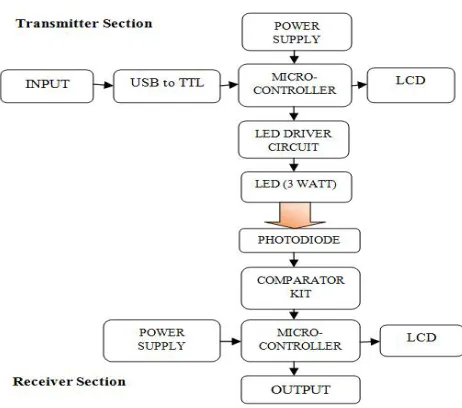
Fig 2: Block diagram of proposed system
The block diagram of proposed system is shown in fig. This system is divided into to two parts-
Transmitter section
Transmitter section consists of microcontroller ATMEGA16 in which programming using AVR studio5 is done. The keyboard is used for transmitting the message. The measure data are store in ATMEGA16. LCD display is used to display the message which we are going to transmit. This data is been transfer using LED panel by light waves. When LED is ON microchip convert digital data in form of light. The operational procedure is simple. If the LED is on, we transmit a digital 1 and if it is off transmit a 0. The LED can be switched on and off very quickly, which gives nice opportunities for transmitting data.
Receiver section
Receiver section consists of photo detector, which detects the light. Then this light fed to the LED driver circuit. Using this driver circuit we drive the received data to the ATMEGA16, which stores this data and display on LCD Display in receiver section.
The proposed system mainly consists of
1. Microcontroller ATMEGA16
2. Comparator Kit
3. LED Driver circuit
4. LCD display
ISSN(Online): 2319-8753
ISSN (Print): 2347-6710
I
nternational
J
ournal of
I
nnovative
R
esearch in
S
cience,
E
ngineering and
T
echnology
(An ISO 3297: 2007 Certified Organization)
Vol. 6, Special Issue 11, May 2017
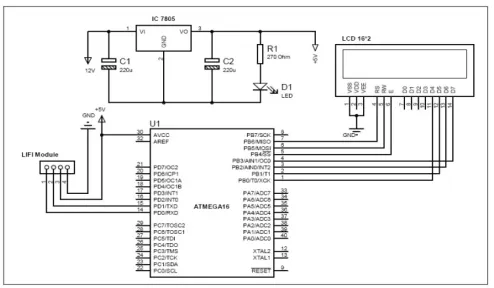
Fig. 3: Circuit diagram of transmitter
Fig. 4: Circuit diagram of Receiver
1. Microcontroller ATMEGA16
Microcontroller ATMEGA16 isan 8-bit microcontroller of Atmel’s Mega AVRfamily with low power
consumption. ATMEGA16 is based on RISC architecture with 131 powerful instructions. Most of the instructions
execute in one machine cycle. ATMEGA16 can work on a maximum frequency of 16MHz.ATMEGA16has 16 KB
programmable flash memory, static RAM of 1 KB and EEPROM of 512 Bytes. The endurance cycle of flash memory is 10000 and EEPROM is 100,000. ATmega16 is a 40 pin microcontroller. There are 32 I/O lines which are divided
into four 8-bit ports named as PORTA, PORTB, PORTC and PORTD.ATMEGA16 has various in-built peripherals
like USART, ADC, AnalogComparator, SPI, JTAG etc. Each I/O pin works on alternative task related to in-built
ISSN(Online): 2319-8753
ISSN (Print): 2347-6710
I
nternational
J
ournal of
I
nnovative
R
esearch in
S
cience,
E
ngineering and
T
echnology
(An ISO 3297: 2007 Certified Organization)
Vol. 6, Special Issue 11, May 2017
Fig 5: Pin diagram of ATMEGA16
2. Photodetector
Photdiodes or photodetectors are sensors of light .A photo detector has a p–n junction that converts light photons into current. The junction is covered by an illumination window, usually having an anti-reflective coating. The absorbed photons make electron-hole pairs in the depletion region. Photodiodes and photo transistors are a some examples of photo detectors. Solar cells convert some of the light energy absorbed into electrical energy.
ISSN(Online): 2319-8753
ISSN (Print): 2347-6710
I
nternational
J
ournal of
I
nnovative
R
esearch in
S
cience,
E
ngineering and
T
echnology
(An ISO 3297: 2007 Certified Organization)
Vol. 6, Special Issue 11, May 2017
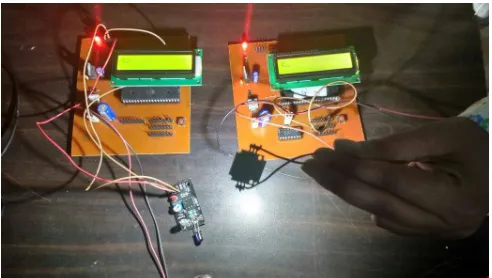
Fig. 7: Li-Fi Circuitry Module
VI. CONCLUSION
Though number of wireless communication system, these are time consuming, slow data rate and cost effective. Some of them have used router for communicating purpose.
Since we are using Li-Fi system for communicating purpose, since data transmitted through light. The size of this system will be reduced as compared to previous systems. Also this system is cost effective. The data transmission rate is greater than previous communication system.With the increase in the cellular networks, this newest technology has proven to be a milestone incommunication systems. It uses the visiblespectrum of light which is better than theRF. With theuse of LEDs the information can betransmitted at very high rates with just thesimple turning on and off of the LEDs. Thistechnology is free to use as well as provides a safe and secure access of data.
ACKNOWLEDGMENT
Firstly I would like to thank to my respectedProf. R. N. Mandavgane for giving me such a wonderful opportunity to expand my knowledge,for her huge support and encouragement. Secondly I would like to thank to my parents, family and friends for their moral and financial support.
REFERENCES
[1] Achal B. Kolhe, Prof. R. N. Mandavgane,”A Review: Wireless Communication Using Li-Fi”IJRITCC | January 2017 (Special Issue), Available @ http://www.ijritcc.org
[2] Rajeev Shore, Brent A. Miller, ”The Bluetooth Technology: Merits and Limitations” 0-7803-5893-7/00/$10.00 0 2000 IEEE.
[3] Daniel Camps-Mur,”Device-to-Device Communications with Wi-Fi direct: overview and experimentation” IEEE wireless communications • june 201396 1536-1284/13/$25.00 © 2013 IEEE.
[4] Prof. Amit K. Mishra, Mr. Lalit A. Pawar, Mr. Sandeep U. Gaikwad, Mr. Gaurav A. Sonawane,” Li-Fi: Wireless Communication Media”,INTERNATIONAL JOURNAL OF INNOVATIVE RESEARCH IN ELECTRICAL, ELECTRONICS, INSTRUMENTATION AND CONTROL ENGINEERINGVol. 4, Issue 2, February 2016
[5] Shuang Song and Biju Issac ,”Analysis of Wi-Fi and WiMAX and Wireless Network coexistence” International Journal of Computer Networks & Communications (IJCNC) Vol.6, No.6, November 2014.
[6] Harald Haas, Liang Yin,Yunlu Wang, Cheng Chen,”What is LiFi?” Journal of Lightwave Technology, Vol. 34, No. 6, March 15, 2016. [7] R.Karthika, S.Balakrishnan, “Wireless Communication using Li-Fi Technology” SSRG International Journal of Electronics and
Communication Engineering (SSRG-IJECE) volume 2 Issue 3 March 2015.
[8] Moussa Ayyash, Hany Elgala, Abdallah Khreishah, Volker Jungnickel, Thomas Little, Sihua Shao, Michael Rahaim, Dominic Schulz, Jonas Hilt, Ronald Freund,” Coexistence of Wi-Fi and Li-Fi Toward 5G: Concepts, Opportunities, and Challenges” IEEE Communications Magazine • February 2016, 0163-6804/16/$25.00 © 2016 IEEE.
ISSN(Online): 2319-8753
ISSN (Print): 2347-6710
I
nternational
J
ournal of
I
nnovative
R
esearch in
S
cience,
E
ngineering and
T
echnology
(An ISO 3297: 2007 Certified Organization)
Vol. 6, Special Issue 11, May 2017
[10] E. B. Adoptante, K. D. Cadag, and V. R. Lualhati,” Audio Multicast by Visible Light Communication for Location Information for the Visually Impaired”, 8th IEEE International Conference Humanoid, Nanotechnology, Information Technology Communication and Control, Environment and Management (HNICEM) The 978-1-5090-0360-0/15/$31.00 ©2015 IEEE.