Effect of Back Pressure Due to Biodiesel on
Engine Life Improvement
Kiran R. Patil 1, Dr.R.R.Arakerimath2
P.G. Student, Dept. of Mechanical Engineering, G.H.R.C.E.M. Wagholi, Pune, Maharashtra, India 1
Associate Professor, Dept. of Mechanical Engineering, G.H.R.C.E.M. Wagholi, Pune, Maharashtra, India2
ABSTRACT: Petroleum products resources are limited and their consumption rate is increasing very fast with technological development since the last two decades. The emissions from the usage of these petroleum products pollute the environment consider ably. Jatropha oil & Karanja Oil are one of the renewable energy resources which are easily available in India. This study investigates the percentage substitution of jatropha methyl ester & Karanja blends to diesel as fuel for automobiles and other industrial purposes. The study details the analysis of the performance and emission characteristics of the jatropha methyl esters, Karanja and its comparison with petroleum diesel. . The exhaust back pressure is the gauge pressure in the exhaust system al the outlet of the exhaust manifold The term back pressure can be also spelled as one word (backpressure) or using a (back- pressure). It should be noted that the term "back pressure" is counterintuitive and may interfere, with a proper understanding of the exhaust gas flow mechanics. The word back seems to suggest a pressure that is exerted on a fluid against its direction of flow indeed; back pressure definitions of that sort are common in sources of relaxed scientific standards. The tests were carried out on a 3.7 KW single cylinder, direct injection and a water-cooled diesel engine. The fuel ls used were neat Karanja ,jatropha methyl ester, diesel and different blends of the biodiesel with diesel. The experimental result shows that 10% upto 20% of the blend shows better performance with reduced pollution. The analysis shows that Karanja & jatropha methyl ester blended biodiesel is a good substitute for pure diesel.
KEYWORDS: Karanja, Jatropha biodiesel , water-cooled diesel engine, performance, Back Pressure ,emission characteristics.
I. INTRODUCTION
In recent years several researches have been made to use vegetable oil, animal fats as a source of Renewable energy known as bio diesel that can be used as fuel in CI engines. Vegetable oils are Alternative fuels for CI engines as they are renewable, biodegradable, non toxic, lower emission compared to diesel fuel. Even though “diesel” is part of its name there is no petroleum in bio-diesel. It is 100% vegetable oil based, that can be blended at any level with petroleum diesel to create a bio diesel.
Rapeseed oil is the main raw materials for the biodiesel production in the EU. The quality of biodiesel in the EU member states is regulated by the EN 14214:2008+A1:2009 standard, which defines the main indicator to be ester content, which depends on biofuel production technology. Fatty acid composition is the indicator, which shows the nature of biodiesel. The purity of this alternative fuel is defined by the free glycerol content, which depends on the manufacturing method as well as product treatment and purification methods.
The advantage of using biodiesel to diesel engines is the higher content of oxygen in its fatty acid composition compared with diesel fuels (Torres-Jimenez et al. 2011). Being an oxygenated fuel, it is environmentally cleaner than petrol diesel with respect to hydrocarbon and particulate matter emissions.
Engine exhaust back pressure is defined as the exhaust gas pressure that,is produced by the engine lo overcome the hydraulic resistance of the exhaust system in order to discharge the gases into the atmosphere. The exhaust back pressure is the gauge pressure in the exhaust system al the outlet of the exhaust manifold The term back pressure can be also spelled as one word (backpressure) or using a hyphcn (back- pressure). It should be noted that the term "back pressure" is counter. intuitive and may interfere ,with a proper understanding of the exhaust gas flow mechanics. The word back seems to suggest a pressure that is exerted on a fluid against its direction of flow indeed; back pressure defininition of that sort are common in sources of relaxed scientific standards.
II. RELATED WORK
The engine was started with the neat diesel fuel with constant speed of 1500 rpm and allowed to run for 20 minutes to obtain the steady state condition. The variable load tests were conducted. At each load, air flow rate, fuel flow rate, exhaust gas temperature, oxides of nitrogen, unburned hydrocarbon, carbon monoxide and smoke density were measured. Then the same procedure was repeated with AME20.
Study of Engine Performance has been an important process since the evolution of the engines. In the very early stages, only the external performance was studied with help of loading with a Dynamometer and measuring the parameters like Torque, Output power, Specific Fuel Consumption .For this, in the earlier research, Mechanical Spring and piston type recorders were used. Computerized IC engine Test Rigs with an intent not only to give the students how the testing is done and data is acquired, but to give them a more clear idea about the real time combustion by developing the combustion analysis system .Along with that, one can get all other data like Heat Balance Sheet, Thermal efficiencies, BSFC, Mechanical Efficiency, Air-fuel ratio etc.
A. Main components of system
Dynamometer :Eddy Current type with computerized torque measuring Burette: For measuring the fuel consumption per unit time.
Manometer: For measuring the air consumption.
Temperature Indicator: For measuring the temperature at various locations. Potentiometer: For loading the dynamometer.
Engine fitted with a Piezo sensor for Pressure measurement Computerized Fuel Flow measurement system
Computerized Water Flow measurement system
Sr. No
Parameters Range value
1) LOAD ( value ) --- X1 40 % , 60 % , 100 %
2)
Compression Ratio (CR) ---X2 14 , 16 ,18
3 ) Injection pressure ---X3 P1 P2 P3
4) Speed ---X4 1500
Table. Parameter & Range Value
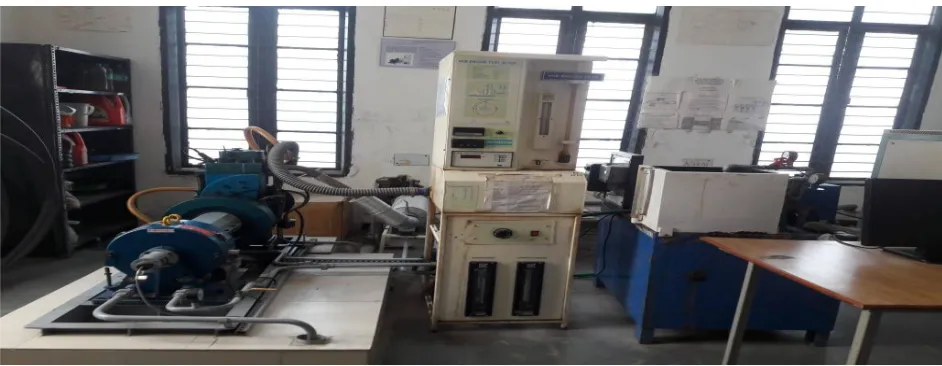
Fig. 1 Experimental setup
Particular Specification
Type Single cylinder engine
No. of strokes & cylinder 4 stroke & single cylinder
Fuel H.S diesel
Rated power 3.5 kW
Speed 1500 RPM
Cylinder diameter 87.5 mm
Stroke Length 110 mm
Connecting Rod length 234 mm
Compression Ratio 12 o 18.1:1
III. BIODIESEL BLENDS
Biodiesel is a domestically produced, renewable fuel that can be manufactured from new and used vegetable oils, animal fats, and recycled restaurant grease. Biodiesel’s physical properties are similar to those of petroleum diesel, but the fuel significantly reduces greenhouse gas emissions and toxic air pollutants. It is a biodegradable and cleaner burning alternative to petroleum diesel Biodiesel can be blended and used in many different concentrations. They include B100 (pure biodiesel), B5 (5% biodiesel, 95% petroleum diesel), B10 (10% biodiesel, 90% petroleum diesel), and B20 (20% biodiesel, 80% petroleum diesel).The most common biodiesel blend is B20, which qualifies for fleet compliance under the Energy Policy Act (Epact) of 1992
Blends Jatropha % Karanja% Diesel%
B5 2.5 2.5 95
B10 5 5 90
IV.EXPERIMENTALRESULTS
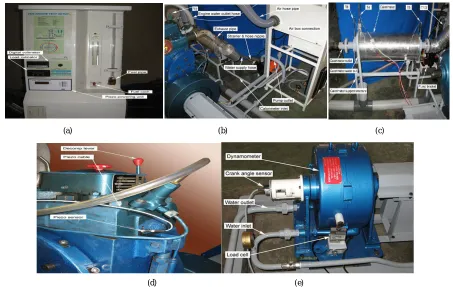
The Images Below are Some Parts of Experimental Setup Which are used to Measure the performance of engine a) VCR engine Test Setup
b) Engine & Calorimeter inlet & outlet detailing for Measuring Temperature c) Calorimeter Details for checking the Temperature of Inlet and outlet
d) Engine Decomposed Lever e) Dynamometer & Water Inlet & Outlet for managing the speed and proper flow of water
V.
Fig.2. (a) VCR engine test setup (b)engine inlet/outlet detailing (c) Calorimeter Details (d) Engine decomposed lever (e) Image Dynamometer
(a) (b) (c)
Solid Model :
Solid model of exhaust pipe with gate valve created in CATIA modeling software with the following design dimensions such as :
Pipe diameter 40mm
Pipe length 600 mm
Valve position At center of the pipe
Valve closing conditions 80 %
Fig. 3 . (a) & (b) Image Of Solid Exhaust Pipe
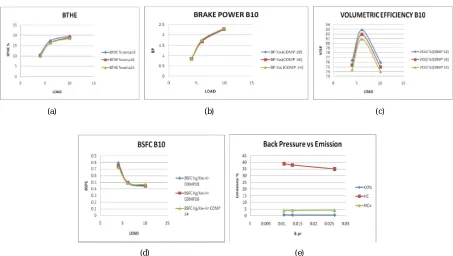
For B10 blend, graphs show that Brake power of Karanja and Jatropha increases when load increases but brake power of diesel slightly increases with load. With increase inload.value of B.S.F.C. of Karanja and Jatropha Decreases gradually but B.S.F.C of diesel deceases slightly. When the load increases, thermal efficiency of Karanja and Jatropha increases rapidly but thermal efficiency of diesel slightly increases. Volumetric efficiency of Karanja,Jatropha and Diesel Increases with Increase in Load
Fig. 4 (a) Graph BTHE for B10(b) Graph Brake Power for B10 (c) Graph Volumetric Efficiency for B10 (d) Graph Brake Specific fuel consumption for B10 (e) Graph Back Pressure vs Emission (B5 , B10 , B20 )
VI. CONCLUSION
Performance of C.I. Engine using Jatropha and karanja Biodiesel shows that Biodiesel is more efficient than diesel. The thermal efficiency of Jatropha and karanja increases with increases in load rapidly but increases slightly for diesel. The volumetric efficiency of karanja, Jatropha and diesel increases when load increases
(a) (b) (c)
In the present investigation experimental work has been carried out to estimate the performance, combustion and emission characteristics of a single cylinder, four stroke variable compression ratio fuel engine fuelled with jatropha blended with standard diesel.
The Brake power of Jatropha and karanja increases with increase in load but when load increase, Brake power of diesel decreases. B. S. F. C. of karanja and Jatropha drastically decrease but for diesel decreases gradually. From the Research it is Concluded that, Above 10% up to 20% Blend of Karanja & Jatropha gives the good
Result with Decrease in Emission .
REFERENCES
1. Banapurmath N.R., Tewari P.G., Hosmath R.S., 2008. Experimental investigation of four stroke direct injection diesel engine operated on dual fuel mode with producer gas as a inducted fuel and honge oil and Honge oil methyl ester as injected fuels, Renewable Energy, Vol. 33, No. 9. pp. 2007 – 2018.
2. Dipak Patil,Dr.Rachayya. Arakerimath, Performance characteristics and analysis of Jatropha oil in multicylinder turbocharge Compression Ignition Engine, International Journal of Engineering Research and Development ISSN: 2278-067X, Volume 1, Issue 10 (June 2012), PP.50-55
3. P. Suresh Kumar, Ramesh Kumar Donga, P. K. Sahoo “Experimental comparative study between Performance and emissions of jatropha biodiesel And diesel under varying injection pressures”.
4. B. B. Ghosh , Sandip Kumar Haldarb and Ahindra Nag “Synthesis of biodiesel from oils of jatropha, karanja and Putranjiva to utilize in Ricardo engine and its performance & emission measurement”
5. Sushma. S et al “Production of Biodiesel From Hybrid Oil (Dairy Waste Scum and Karanja) and Characterization and Study of Its Performance on Diesel Engine” International Journal of Engineering Research and Technology (IJERT) 2014.
6. K. Ramachandran et al “Recent Developments for Biodiesel Production by Ultrasonic Assist Transesterification Using Different Heterogeneous Catalyst: A Review” Renewable and sustainable Energy reviews Elsevier Journal 2013.
7. N. Stalin and H. J. Prabhu1 “Performance Test Of IC Engine Using Karanja Biodiesel Blending With Diesel” ARPN Journal of Engineering and Applied Sciences October 2007 ARPN Journal of Engineering and Applied Sciences
8. H.M. Dharmadhikari, P. Ravikumar, S. Srinivasa Rao,“Performance and Emissions of CI Engine Using Blends of Biodiesel and Diesel At Different Injection Pressures”, International Journal of Applied Research in Mechanical Engineering, VOl. 2, Iss 2, 2012.
9. T. Ganpathy, R.P. Gakkhar, K. Murugesan, “An Analytical and Experimental study of Performance on Jatropha Biodiesel Engine”, Thermal Science, Vol. 13,No.3, pp69-82, 2009.