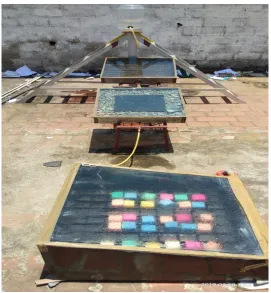
Enhancing the Performance of Solar Still
With Internal Modification Flat Plate
Collector
S.Joe Patric Gnanagaraj1 Paulpandi2, Sajey Raja2, Sivarama Krishnan2, Sathesh Kumar2,
Associate Professor, Department of Mechanical Engineering, Francis Xavier Engineering College, Vanarpettai,
Tirunelveli, Tamil Nadu, India1
U.G. Student, Department of Mechanical Engineering, Francis Xavier Engineering College, Vanarpettai, Tirunelveli,
Tamil Nadu, India2
ABSTRACT: A Single basin solar still with basin Area (0.9mx0.7m) was design & fabricated with integration of flat plate collector (0.9mx0.9mx0.3m) to increase the heat transfer rate. Experiments were done with different modifications of solar still and the readings were taken .First reading is taken from still without modification of flat plate collector .The second setup consists of still with flat plate collector modified by heat absorbing materials (pebbles, chips, red stone) . The final experimental setup consist of still integrated with flat plate collector and glass wool. The results indicated that the productivity of the still without modification of flat plate collector, still with flat plate collector modified by heat absorbing materials, still integrated with flat plate collector and glass wool was 36.92 %, 42.68 % and 46.60 %. Also it was found that the productivity of the still was highest with the minimum depth of water.
KEYWORDS: Flat Plate Collector, Heat Absorbing Materials, Solar Still,
I.INTRODUCTION
General
More than two-thirds of the earth’s surface is covered with water. Most of the available water is either present as seawater or icebergs in the Polar Regions. More than 97% of the earth’s water is salty; the remaining 2.6% is fresh water. Less than1% fresh water is within human reach. This small amount is adequate to support life and vegetation on earth. Nature itself provides most of the required fresh water, through the horological cycle. A very large-scale process of solar distillation naturally produces fresh water.The essential features of this process are thus summarized as the production of vapors above the surface of the liquids, the transport of vapors by winds, the cooling of air–vapor mixture, condensation and precipitation. This natural process is copied on solar desalination. As the available fresh water is fixed on earth and its demand is increasing day by day due to increasing population and rapidly increasing of industry, hence there is an essential need to get fresh water from the saline brackish water present on or inside the earth. This process of getting fresh water from saline brackish water can be done easily and economically by desalination.
II. PROBLEM DEFINITION
In many countries that suffer a chronic shortage of water, such as those of the Middle East and North Africa, over 80% of all fresh water consumed is used by agriculture. As fresh water resources are finite, there is a pressure to reduce agricultural use of water to meet the growing demand for domestic and industrial use. The number of
quota of water resources in India is expected to reach 645 (m3/person) in 2025.So there is a need for desalination to meet the requirements of industry, tourism, petroleum, electricity, health, and reconstruction. The desalination plants spread on the Red Sea coast, South Sinai, and the northern coast.
III. AIM OF THE EXPERIMENT
The objectives of the present work are preparation and development of single Solar still with two flate plate collector
IV. EXPERIMENTAL SETUP
Fig -1 Schematic diagram of Experimental setup
1) Single Basin Still + Without Modification 2) Single Basin Still + Flat Plate collector 3) Single Basin Still + Baked Plate Collector 4) Single Basin Still + Parallel Collector 5) Single Basin Still + Series Collector
The slope of glass is maintained at 300 . the double slope allows more radiation into the still. The collection channel is fabricated at both end of still using PVC pipe for the collection of condensate. further modifications of the still is done by insulating the basin with materials like glasswool,sponge,thermocol in the space between hotbox and basin.the amount of incedent solar rays can be increased with addition of a reflecting mirror at the side. the reflecting mirror is adjusted at various angles for experimentation. The output productivity of still is observed during high radiation condition and low radiation condition with and without modifications to still.
MATERIAL USED
Fig mild steel with two flate plate collector
The mild still angle are L-shaped structural steel represented by dimension of sides & thickness . For e.g.50cmx50cmx6cm means , both the sides of angles are 50mm & thickness is of 6mm.The is welded by filler rod into dimensions of (0.9mx0.9mx0.3m) it re angular shape it connected by stand like material the stainless still are used cover material which can with stand heavy load such as pebbles , red stone with any error welding process is used join the material into respective shape .carbon steel is steel in which the main interstitial alloying constituent is carbon in the range of 0.12-2.0% The American iron and steel institute (AISI).
The purpose of heat treating carbon steel is to change the mechanical properties of steel usually ductility ,hardness, yield strength or impact resistance .weldability is a term used to describe the relative ease or diffcullty with which a metal or alloy can be welded .the better the weldability, The easier it is to weld . However, weldablilty is a compatibility of the metal or alloy with a specific welding process.its ability to be welded with mechanical soundness .
VI.RESULTANALYSIS
THERMOCOUPLE
2 READINGS AND GRAPH
Table5.2.1Internal Modification of single basin Solar still with high radiation
Sl.no. Description
During High Radiation (600–720W/m2)
Date Input water 5 liters
Output 8 H/ D
Daily efficiency
%
1 Single Modification Basin Still + Without 02.03.19 5 1.8 36
2 Single Basin Still + Flat Plate collector 03.03.19 5 2.2 44
3 Single Basin Still + Baked Plate Collector 05.03.19 5 2.8 56
4 Single Basin Still + Parallel Collector 07.03.19 5 3.2 64
5 Single Basin Still + Series Collector 15.03.19 5 3.8 70
38 42 54 66 40 48 60 68 40.4 44.8 49.2 51.2 38 42.4 46.8 51.2 30 35 40 45 50 55 60 65 70
Still alone Still and Fins Still, Fins and Glass
Wool
VII.CONCLUSION
Four DBSS solar stills have been fabricated and their performances were compared to various length of external reflecting mirror
Providing bricks, red stone, glass wool,chips and pebbles were used to in the basin for the improvement of the productivity
The productivity of the still with reflectors and flat plate collector 29.92 %, 38.68 % and 41.60 % respectively more than the conventional still.
Maximum productivity occur in internal and external modification were, glass wool, chips, redstone, pebbles
Daily cleaning of the Basin , glass cover, and the reflecting mirror is required. .
REFERENCES
[1] U.S. Energy information Administration, world supply and consumption of petroleum products, Wikipedia,
http://en.wikipedia.org./wiki/Petroleum
[2] Y. Uemichi, Development of a catalytic cracking process for converting waste plastics to petrochemicals, J. Mat. Cycles Waste Manage.,5(2),
89-93, 2003.
[3] A. Marcilla, A. Gómez-Siurana and F. Valdés, Catalytic cracking of low-density polyethylene over H-Beta and HZSM-5 zeolites: Influence
of the external surface. Kinetic model, Polym. Degrad. and Stability, 92(2), 197-204, 2007.
[4] G. Manos, “Catalytic Degradation of Plastic Waste to Fuel Over Microporous Materials” Chapter 7 in Recycling of Waste Plastics: Pyrolysis
and Related Feedstock Recycling Techniques, (Eds: J. Scheirs, W. Kaminsky), J. Wiley, 193-208, 2006.
[5] Convert Agricultural Waste into Sustainable Profitable Green Energy, Available online at www.pmcbiotec.com/downloads/agriocultural.pdf.
[6] Marcilla A, Beltran MI, Navarro R (2008). Evolution with the Temperature of the Compounds Obtained in the Catalytic Pyrolysis of