ISSN(Online): 2320-9801
ISSN (Print): 2320-9798
International Journal of Innovative Research in Computer
and Communication Engineering
(An ISO 3297: 2007 Certified Organization)
Vol. 3, Issue 1, January 2015
A Survey on Feature Based Image Retrieval
Using Classification and Relevance Feedback
Techniques
Keyuri M. Zinzuvadia
1, Prof. Bhavesh A. Tanawala
2, Prof. Keyur N.Brahmbhatt
3PG Student, Department of Computer Engineering, B.V.M. Engineering College, V. V. Nagar, India 1
Assistant Professor, Department of Computer Engineering, B.V.M. Engineering College, V. V. Nagar, India 2
Assistant Professor, Department of Information Technology, B.V.M. Engineering College, V. V. Nagar, India 3
ABSTRACT: Now a day, digital world increase with bandwidth, handheld devices, storage technologies and social networking sites and huge volume of images are stored on web. With significantly huge image database it is difficult to mine that data and retrieve relevant images. Feature Based Image Retrieval is a very important research area in the field of image processing. It is comprises of low level feature extraction such as color, texture and shape and similarity measures for the comparison of images. Recently, the research focus in FBIR has been in reducing the semantic gap, between the low level visual features and the high level image semantics. Here in this paper we have provided comparative study of various methods which are available for each step of FBIR system.
In Proposed system architecture HSV space histogram will be used for colour information extraction. Gabor filter will be use for texture feature extraction and shape feature will be extract using moment invariant method. In this study multiple feature extraction will be use by combining above three methods. Based on the extracted feature Support vector machine classification technique is applied. Here classification reduce the search space and reduce retrieval time. After that for given relevant images relevance feedback algorithm is applied which provide user intension for resultant images to the system .This increase classification accuracy by taking feedback from user which decrease semantic gap.
KEYWORDS: FBIR, Feature Extraction, color, texture, shape, Classification technique
I. INTRODUCTION
In our digital world, multimedia data plays a vital role in every field such as e-commerce, entertainment, education, medicine, aerospace and so on. With the increasing use of internet and handheld devises there is an enormous volume of digital images are generated every day .This all useful information extract properly if it is efficiently stored, indexed accurately , easily search and retrieved .Image mining deals with image retrieval ,indexing and storing. This is combination image processing and data mining techniques. The increased bandwidth availability to access the internet in the will allow the users to search for and browse through video and image databases located at remote sites [6]. Therefore, fast and accurate retrieval of images from large databases is an important problem that needs to be addressed.
ISSN(Online): 2320-9801
ISSN (Print): 2320-9798
International Journal of Innovative Research in Computer
and Communication Engineering
(An ISO 3297: 2007 Certified Organization)
Vol. 3, Issue 1, January 2015
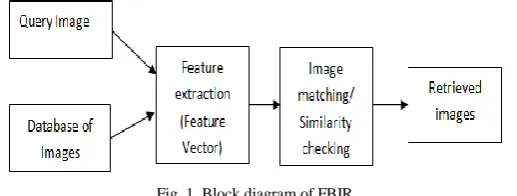
Most FBIR systems work in this way: Load query image, a feature vector is extracted from the query image. A feature vector is extracted from each image in the database and the set of all feature vectors is organized .It is matched against the feature vectors of the query image and give relevant images from the database. The block diagram of basic FBIR system is shown in Fig. 1.
Fig. 1 Block diagram of FBIR
II. FEATUREEXTRACTION
Feature extraction is most important step in the procedure of the fbir. Features are classified into three types that is low, middle and high level. Low level features are color, texture and Middle level feature is shape and High level feature is semantic gap of objects [13]. Color is by far the most common visual feature used in FBIR, primarily because of the simplicity of extracting color information from images. Texture and shape are also key component of human visual perception. Like color, this makes it an essential feature to consider when querying image databases. Here features are described in detail below.
A. Colour Feature
In image retrieval, the color is widely used feature. Many methods are use to extract color feature from images. Here some of the method is described. To extract the color features from the content of an image, we need to select a color space and use its properties in the extraction.
In common, colors are defined in three-dimensional color space. In digital image purposes, RGB color space is the most prevalent choice. The main drawback of the RGB color space is that it is perceptually non-uniform and device dependent system [2]. The HSV color space is an intuitive system, which describes a specific color by its hue, saturation, and brightness values. HSV Histogram shows the frequency of occurrence of each color in the image according to its intensity, it shows the Global description of the color in image. Simply by matching it with the stored histogram in database the relevant images can be retrieved.
The first-order (mean), the second (standard deviation) and the third-order (skewness) color moments have been proved to be efficient and effective in representing color distributions of images .As it has lower dimension of vector but for all type of images it might not give accurate result [2]. There are MPEG-7 standard is also there to provide a rich set of standardized descriptors and description scheme to describe multimedia content like image and audio. Mpeg-7 Stands for Multimedia Content Description Interface. MPEG-Mpeg-7 has five color descriptor named as Dominant Color, Scalable Color, Color Structure, Color Layout and Group of Frames Color. It has allowed quick and efficient content identification and addressing a large range of applications [5].
For region based image retrieval dominant color technique is used or color feature extraction. Due to the inaccuracy of the segmentation, the average color of a segmented region may be different from that of the original region. To obtain the dominant color of the image, first the histogram is obtained and then the bin with the maximum size is taken as the dominant color of the region [3].
B. Texture Feature
ISSN(Online): 2320-9801
ISSN (Print): 2320-9798
International Journal of Innovative Research in Computer
and Communication Engineering
(An ISO 3297: 2007 Certified Organization)
Vol. 3, Issue 1, January 2015
The common known texture descriptors are Wavelet Transform, Gabor-filter ,co-occurrence matrices and Tamura features .In MPEG-7 two descriptors related to texture known as Homogenous Texture Descriptor and Non-Homogenous Texture Descriptor (Edge Histogram)[5].Edge histogram descriptor is used for texture.
And also
CCH (Contrast Context Histogram) is used find out the feature of the query image and other images stored in the database.CCH is in spatial domain and it provides global distribution [5].Gray Level Co-occurrence Matrix (GLCM) method, which is based on the conditional probability density function. Co-occurrence matrix is a function of distance and direction. GLCMs have been used very successfully for texture calculations. From GLCM all the features are calculated and stored into the database [10].Gabor is widely adopted to extract texture from the images for retrieval and has been shown to be very efficient because it has similar characteristics with human perception. Basically Gabor filter have tunable orientation and radial frequency bandwidths, tunable center frequencies, and optimally achieve joint resolution in space and spatial frequency [17]. Tamura feature contain six characteristics like Coarseness, contrast, directionality, line-likeness, regularity and roughness. Coarseness, contrast and directionality correlate strongly with the human perception, and hence they are very important.
C. Shape Feature
Shape of the objects in the images is one of the most significant properties used in image reorganization and retrieval task of fbir [18].There is no general feature and technique which works best for every kind of image [3]. A good shape representation feature for an object should be invariant to translation, rotation and scaling .The most frequently used methods for shape description can be boundary based or region based. There are several techniques available for shape representation that is summarized such as Fourier descriptors, Wavelet descriptors, grid-based. In MPEG-7 Visual Shape Descriptors consists of 3-D Shape Descriptor, Region-Based Descriptor, Contour-Based Shape Descriptor and 2-D/3-D Shape Descriptor [5].
M Mary Helta Daisy, Dr.S. TamilSelvi and Js. GinuMol have proposed method where Shape feature is extracted by using Fourier Descriptor and the centroid distance .And Gabor filter is used to extract texture features from images [8]. By using combined Fourier descriptor feature and Gabor filter feature along with morphological closing operation result is improved compare to using only one feature at a time.The histogram of edge direction method captures general shape information of image. This information is obtained using canny, sobel algorithm and edge directions are quantized to store in bins. This technique provide scale and rotation invariance [3]. Among region-based descriptors, moments are very popular. These include invariant moments, Zernike moments and Legendre moments. Invariant moments or geometric moments are the simplest moment functions and they are invariant to translation, scale change, mirroring and rotation [18]. Zernike moments are derived from the orthogonal Zernike polynomials. Hence, it is an orthogonal moment. Also they are robust to noise and minor variations in shape. But the computational complexity of Zernike moments is high. Legendre moments use Legendre polynomials as the kernel function. Wavelet based shape representation is also give better result than canny and sobel algorithm. In this they have used shape representation by Daubechies and Coiflets wavelets which give performance increment to identify shape [9].
III.CLASSIFICATIONMETHODS
Classification and clustering are important part of image mining. This machine learning technique is used to reduce semantic gap between low level image feature and high level semantic. Data classification is a twostep process, consisting of a learning step and a classification step [21]. Classification algorithm is applied to image database in which image is best described to classify it in classes. Classification is challenging task in various application domains, including biomedical imaging, biometry, video surveillance, vehicle navigation, industrial visual inspection, robot navigation, and remote sensing, handwritten letter reorganization [12].Image Classification have mainly three steps [1]:
a. Feature extraction – In this step features are extracted from sample images that are already labelled and establish feature description for each image.
ISSN(Online): 2320-9801
ISSN (Print): 2320-9798
International Journal of Innovative Research in Computer
and Communication Engineering
(An ISO 3297: 2007 Certified Organization)
Vol. 3, Issue 1, January 2015
There is various ways to combined classification technique with feature extraction techniques. Sultan Aljahdali, Aasif Ansari has proposed method for feature based image retrieval process and it is applied with Gabor filter texture feature extraction technique [15]. They have experimented this method with Support Vector Machine Supervised Classification technique and without using it. Their result shows that great improvement in result by using SVM classification technique. But they have considered only texture feature which will not give best result for all type of images [15]. There are some comparison is also there with SVM classifier. D. Jeyabharathi and Dr.A. Suruliandi have compared various feature extraction technique with different classification technique [16]. They have explored PCA, LDA and ICA for feature extraction techniques. On the basis of that features SVM and nearest neighbour classifier are compared. Their experiment result is evaluated based on reorganization rate and F score. Based on result they have concluded that PCA with SVM gives accurate result than nearest neighbour technique [16].Literature survey on various techniques to classify labelled and unlabelled images is available in [14].Like Svm, D-Em, RF, Active Learning, Transductive Learning techniques are explain. And they have given some recommendation for choosing fuzzy set theory or Rough set theory according to our application [14].
Apostolos Marakakis, Nikolaos Galatsanos, Aristidis Likas have proposed relevance feedback approach with SVM classification .They have used two feature selections method to train the database according to feedback given by user and for reducing the database dimensionality[20]. This method improves performance compare to existing feature selection methods.
IV.RELEVANCEFEEDBACK
Relevance feedback is a powerful technique in FBIR systems, in order to improve...e the performance. It allows reducing semantic gap between low level feature and high level semantics. The idea behind relevance feedback is to take the results that are initially returned from a given query and to use information about whether or not those results are relevant to perform a new query [21]. Here user give this feedback to the system based on the given feedback it learn the concept .Learning in relevance feedback is divided in two parts short term learning and long term learning. In long term learning past query and feedback are stored and based on past result it gives result where in short term learning it does not remember past query session. In short term learning each session has mutual result independent of previous result [18].
There are also query refinement method is there which is similar like shot term learning .It is done by query point movement, update weight vector and probabilistic approach. Hossein Nezamabadi-pour, Ehsanollah Kabir have proposed relevance feedback scheme by feature weight update algorithm. In that method semantic network of image is created by fuzzy knn method and relevance feedback method is applied by taking image feedback like relevant or irrelevant. Based on that feature weight is adjusted and user gets more satisfactory result.
V. SIMILARITY MEASURE
In FBIR system similarity measure is important step. Similarity measure is applied between feature of query image and feature vector of database images. Similarity between two images can be found by calculating difference between them .It gives list of images which are similar to the query image or it has least distance from query image. Different similarity measures will affect the retrieval performance of image significantly.
ISSN(Online): 2320-9801
ISSN (Print): 2320-9798
International Journal of Innovative Research in Computer
and Communication Engineering
(An ISO 3297: 2007 Certified Organization)
Vol. 3, Issue 1, January 2015
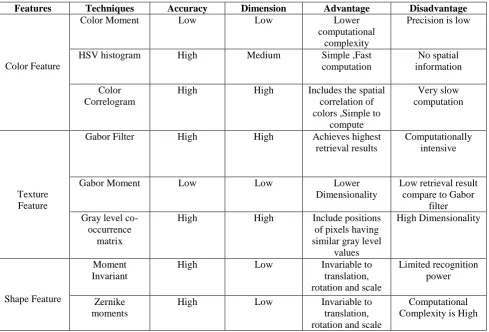
VI.COMPARISON OF THE VARIOUS TECHNIQUES
This section summarizes the above mentioned techniques of the FBIR used in various recent papers.
Features Techniques Accuracy Dimension Advantage Disadvantage
Color Feature
Color Moment Low Low Lower
computational complexity
Precision is low
HSV histogram High Medium Simple ,Fast
computation
No spatial information
Color Correlogram
High High Includes the spatial correlation of colors ,Simple to
compute
Very slow computation
Texture Feature
Gabor Filter High High Achieves highest
retrieval results
Computationally intensive
Gabor Moment Low Low Lower
Dimensionality
Low retrieval result compare to Gabor
filter Gray level
co-occurrence matrix
High High Include positions
of pixels having similar gray level
values
High Dimensionality
Shape Feature
Moment Invariant
High Low Invariable to
translation, rotation and scale
Limited recognition power
Zernike moments
High Low Invariable to
translation, rotation and scale
Computational Complexity is High
Fig. 2 Comparison of the various techniques
VII. CONCLUSION
Feature based image retrieval is very versatile subject. And its result varies according to approach used. From above study we can say that color feature extraction using HSV space histogram based technique is more efficient and it requires less memory so resultant database will be small. Gabor filter will be use for texture feature extraction which is near to human visual performance. For shape feature moment invariant method will be used which is invariable for translation, rotation and scale. Here multiple features will use rather than individual feature extraction method which will give good result.
By using machine learning algorithm and relevance feedback we will try to reduce semantic gap. From above study we can say that SVM (Support Vector Machine) has a higher predication capability compare to other supervised algorithms likes Navies Bayes, Nearest Neighbour and Trees. Using Query refinement method of relevance feedback system will get user intension for relevant images. By which system can give result until user in not satisfy with result.
ACKNOWLEDGMENT
ISSN(Online): 2320-9801
ISSN (Print): 2320-9798
International Journal of Innovative Research in Computer
and Communication Engineering
(An ISO 3297: 2007 Certified Organization)
Vol. 3, Issue 1, January 2015
REFERENCES
1. D.N.D.Harini, Dr.D.Lalitha Bhaskari “Image Mining Issues and Methods Related to Image Retrieval System”, 2. International Journal of Advanced Research in Computer Science, 2 (4), July-August, 224-229,2011
3. Ahmed J. Afifi, Wesam M. Ashour “Content-Based Image RetrievaUsing Invariant Color and Texture Features”, IEEE , 978-1-4673-2181-5/12,2012.
4. Felci Rajam and S. Valli “A Survey on Content Based Image Retrieval”,Life Science Journal,10(2) , 2013
5. S. Singaravelan, D. Murugan, K. Rajalakshmi, G. Santhiya “ Refining CBIR Using Rule Based KNN”, Journal of Remote Sensing Technology,Vol. 1 Iss. 1, PP. 13-19,May 2013
6. Swapnalini Pattanaik ,D.G. Bhalke “Efficient Content based Image Retrieval System using Mpeg-7 Features” , International Journal of Computer Applications(0975 – 8887) Volume 53– No.5, September 2012
7. D S Guru , Y. H. Sharath , S. Manjunath “Texture Features and KNN in Classification of FlowerImages”,IJCA Special Issue on “Recent
Trends in Image Processing and Pattern Recognition”RTIPPR, 2010
8. Manimala Singha and K.Hemachandran “Content Based Image Retrieval using Color and Texture”, Signal & Image Processing : An International Journal (SIPIJ) , Vol.3, No.1, February 2012
9. M Mary Helta Daisy, Dr.S. TamilSelvi,Js. GinuMol, “Combined texture and Shape Features for Contentbased Image Retrieval”,
978-1-ICCPCT ,4673-4922-2/13, 2013
10. Padmashree Desai, Jagadeesh Pujari and Goudar R.H. “Image Retrieval using wavelet based shape features”, Journal of Information Systems and Communication, 2012
11. Guoyong Duana, Jing Yanga, Yilong Yanga “Content-Based Image Retrieval Research”,ICPST, Physics Procedia 22 (2011) 471 – 477, 2011 12. Reshma Chaudhari, A. M. Patil “Content Based Image Retrieval Using Color and Shape Features”,Vol. 1, Issue 5,IJAREEIE,2012
13. Pooja Kamavisdar, Sonam Saluja, Sonu Agrawal, “A Survey on Image Classification Approaches and Techniques”,International Journal of Advanced Research in Computer and Communication Engineering, Vol. 2, Issue 1, January 2013.
14. T. Dharani, I. Laurence Aroquiaraj IEEE Member “Content Based Image Retrieval System using Feature Classification with Modified KNN Algorithm”, arXiv preprint:130.4717,2013
15. T. Dharani ,I. Laurence Aroquiaraj “A Survey on Content Based Image Retrieval”,IEEE,978-1-4673-5845-3/13,2013
16. Sultan Aljahdali ,Aasif Ansari ,Nisar Hundewale “Classification of Image Database using SVM with Gabor Magnitude”,IEEE, 978-1-4673-1520-3/12/ ,2012.
17. D.Jeyabharathi , Dr.A. Suruliandi “Performance Analysis of Feature Extraction and Classification Techniques in CBIR”,ICCPCT, 978-1-4673-4922-2/13/ ,2013
18. Mit Patel, Keyur Bhrahmbhatt, Kanu Patel “Feature based Image retrieval based on clustering, classification techniques using low level image features”, IJAERD,Volume 1,Issue 5,May 2014, e-ISSN: 2348 – 4470,2014
19. Pushpa B. PATIL, Manesh B. KOKARE”Relevance Feedback in Content Based Image Retrieval: A Review”, Journal of Applied Computer Science & Mathematics ,no. 10 (5) /2011, 2 011.
20. Hossein Nezamabadi-pour, Ehsanollah Kabir , “ Concept learning by fuzzy k-NN classification and relevance feedback for efficient image retrieval”,Elsevier-5948–5954,2009
21. Apostolos Marakakis, Nikolaos Galatsanos2, Aristidis Likas3 “Relevance Feedback for Content-Based Image Retrieval Using Support Vector Machines and Feature Selection”,Springer-Verlag Berlin Heidelberg ,ICANN s, Part I, LNCS 5768, pp. 942–951, 2009
22. www.wikipedia.org
23. R.C. Gonzalez, R.C. Woods, Digital Image Processing, Addison-Wesley
24. Jiawei Han, Micheline kamber, Jain pei, “Datamininng concept and techniques” The morgan Kaufmann series in Data management system.
BIOGRAPHY