Intelligent Trolley for Automatic Billing
Sabari Banu1, Sumalatha2, Govindamma3 , Subba reddy4 ,Nagaraju5
Associate Professor, M.Tech., (Ph.D), Department of Electronics and Communication Engineering, KEC,JNTU
Ananatapur, Andhra Pradesh, India1
B.Tech, Department of Electronics and Communication Engineering, KEC, JNTU Anantapur, Andhra Pradesh,
India2,3,4,5
ABSTRACT: Now a day’s purchasing and shopping at big malls becoming a daily activity in metro cities. We can see huge rush at malls on holidays and weekends. The rush is even more when there are special offers and discount. People purchase different items and put them in trolley. After shopping one needs to go to billing counter for billing. Usually more time is consumed in preparing the bill than shopping. At the billing counter the cashier prepares the bill using barcode reader which is a time consuming process which results in long queues. Our aim is to develop a system that can be used in shopping malls to solve the above mentioned challenge. The system will be placed in all the trolleys which consist of a RFID reader. All the products in malls will be equipped with RFID tags. When a person puts any product in the trolley, its code will be detected and the price of those products will be stored in memory. As we put the products, the costs will get added to total bill. If the product is removed from the trolley its bill will be automatically deducted. Thus the billing will be done in trolley itself. Number of items and total cost will be displayed on LCD. Further we will send the bill and other details of the product to the local server where all the information will be saved and that information will be useful for inventory management using Wi-Fi by an app.
KEYWORDS: RFID Reader, RFID tag , Wi-Fi ,etc
I.INTRODUCTION
In metro cities purchasing and shopping at super shops and big malls is a daily activity. We have seen big lines for payment of the bill at malls on weekends, festive seasons and holidays. When there are special offers and discounts the rush is also even more. Customers will purchase many items and put it into the trolley. After customers done the purchasing they need to go to billing counter for the payment of the bill. At the billing counter the person prepares the bill using bar code reader which is an existing system of time consuming and manually operated process which leads to creation of long queues at billing counters. Hence, we are proposing to develop an intelligent shopping trolley system which will keep the track of purchased products and the total bill.
Current development in chip manufacturing technology increases practical approach for new applications. Fast growth in RFID technology is making impact on many industries. The hard ware used in the system is RFID reader, RFID tag and Wi-Fi module. Every trolley have RFID Reader and WI-FI attached to it and every product in the mall have RFID tag. When a customer put any product in the trolley, its unique code will be detected from the tag attached to it and the price of those products will be gets stored in memory by pressing the total switch the total bill will be displayed on the LCD.
II. LITERATURE SURVEY
Mr.P. Chandrasekar and Ms.T. Sangeetha, Smart Shopping Cart with Automatic Billing System through RFID and ZigBee.
reader, EEPROM, and ZigBee module. Purchasing product information will be read through a RFID reader on shopping cart, mean while product information will be stored into EEPROM attached to it and EEPROM data will be send to Central Billing System through ZigBee module. The central billing system gets the cart information and EEPROM data, it access the product database and calculates the total amount of purchasing for that particular cart.
Muhib A. Lambay[1] , Abhishek Shinde[2] , Anupam Tiwari[ 3] , Vicky Sharma[4] ,Automated Billing Cart
When we go for shopping we usually select the required products and add them into the shopping cart. But when it comes to the final bill payment there are no adequate counters in the mall that can handle all the customers. Also scanning each and every product of all the customer becomes a huge task and leads to large queue formation. we have modified a cart which will contain a barcode scanner by which the customer can scan the product and automatically the product id, product name
Scanner will keep the track of products added to the cart. Each cart has some unique ID, an android application will use this ID so that the database can be accessed by the user through Wi-Fi module. The mall's computer will display all the list of product added to the cart and the final bill will be generated.
Ashmeet Kaur#1, Avni Garg#2, Abhishek Verma#3, Akshay Bansal#4, Arvinder Singh#5-Arduino based smart cart
There has been an emerging demand for quick and easy payment of bills in supermarkets. In this paper, smart cart is proposed that will be capable of generating a bill from the cart itself. The customer will make the payment in no time through a rechargeable credit card which will help to maintain database and introduce schemes and offers in stores accordingly. The designed cart eliminates the effort of self packaging, makes the best use of cart storage space and involves security mechanism for theft control. The smart cart uses RFID technology for shopping and payment, AVR microcontroller for peripheral interfacing and inventory management. This innovative system will help the stores to see a rise in their sales along with delighting customers.
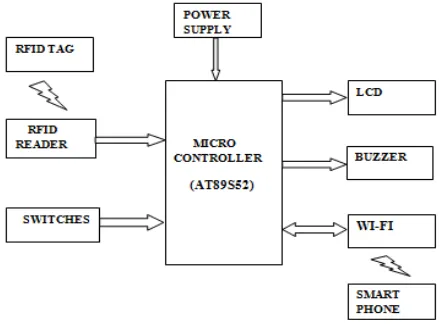
III. PROPOSED SYSTEM
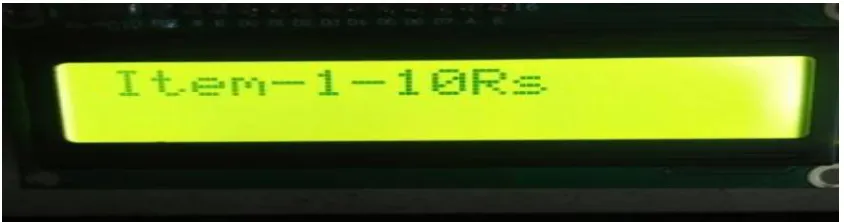
displayed on LCD and switches are provided for addition and removal of number of products. After confirming about the product we need to press the total switch which will display the individual cost of the product. After done with the purchasing we need to press grand total switch to display the total bill of all products. This total bill is transferred to the customer’s smart phone through Wi-Fi. The customer can see the amount by TCP TELNET terminal app.
The time consumed to make the bill at billing section has been reduced, the manpower is reduced and the customer can have a track on his/her budget and the individual cost of the item.
IV. HARDWARE IMPLEMENTATION
1. Microcontroller (AT89S52):
The AT89S52 is a low-power, high performance CMOS 8-bit microcontroller with 8K bytes of in-system programmable Flash memory. The on-chip flash allows the program memory to be reprogrammed in-system or by a conventional nonvolatile memory programmer. The AT89S52 provides the standard features like 8K bytes of flash, 256 bytes of RAM, 32 I/O lines, watchdog timer, two data pointers, three 16 bit timer/counters, on-chip oscillator, a full duplex serial port etc.
2. RFID reader (EM-18):
It scans the RF tags and reads the information from the cards and sends it to microcontroller. It plays main role in our project to increase the efficiency. The RFID can read up to the distance of 300 feet and it does not require any line-off sight for scanning of moving objects.
3. RFID tags:
The tag is attached to the product and scans by the RFID reader. The tags is of active and passive, we choose passive tags which does not require power supply separately it took from the reader by radio waves.
4. Wi-Fi module:
The ESP8266 module has a powerful enough on board processing and storage capability. This module receive the information from the microcontroller and send it to mobile phone through the TCP telnet app and displays the individual items total bill and grand total bill on customers smart phone .
5. LCD Display:
Its role is to display the information which is send by the microcontroller for user purpose. The 16*2 LCD display is used by pin 4 it is interfaced with the controller.
6. Power supply:
The power supply is used to provide power to all the components we used in the project. The power supplied to the project id of 9v. by the relay the power is divided to all the components as their operating voltages.
7. Switches:
V. RESULTS
After initializing the device led indicates the signal availability and LCD displays “Shopping Trolley” as in the
below figure.
Figure 2: After initializing the system
Figure 3: Waiting for connection of Wi-Fi
Figure 4:addition of product
By pressing the “add” switch number of items will increase or by pressing “remove” button we can able to remove the items and by pressing the “total” button the total bill will be displayed on LCD as well as in the telnet app in our mobile simultaneously as shown in the above figure. And repeat the above steps for second product also.
figure 5: total individual bill and grand total bill of two products.
figure 6: Top view of the system
VI. CONCLUSION
By this device the time consumption for billing at billing section has been reduced and results in fast billing and reduction of manpower due to usage of RFID which increases the speed of billing which does not require any line of sight for scanning of products. This device has a facility to keep track on the customer budget and cost of each product by his/her own. This can be installed easily in all shopping malls as the cost is less.
FUTURE SCOPE
By adding QR code generator to this device the payment of bills can be done easily.The moving of trolley can be made as automatic moving and can guide the people about the product availability and the location using maps.
REFERENCES
1. B. N. Arathi and M. Shona, “An Elegant Shopping using Smart Trolley”, Indian Journal of Science and Technology, Vol 10(3), January 2017. 2. Megha R. Mane1, Nilam G. Amane2,Sunita D. Patil3, Archana L.Lakesar4, “Electronic Shopping Using Barcode Scanner”, International Research Journal of Engineering and Technology (IRJET), Volume: 03 Issue: 04 | Apr-2016.
3. Aniket Wani1, Krutika Thakur2, Nikhil Vaze3, Meeta Vadhel4 , Prof. Rupali Advirkar5, “RFID Based Intelligent Trolley System using Zigbee”, Volume 4 Issue 3 March 2015.
4. Prasiddhi K. Dhanashri H. Gawali,”Innovative Shopping Cart For Smart Cities” May 19-20, 2017
BIOGRAPHY
R. SABARI BANU Associate Professor, KEC M.Tech., (Ph.D), Department of ECE
Jawaharlal Nehru Institute of Technology, Anantapuramu
Sumalatha
B.Tech in Electronics and Communication Engineering,KEC, JNTU Anantapuramu
Govindamma B.Tech in
Electronics and Communication Engineering,KEC, JNTU Anantapuramu
Subba reddy
B.Tech in Electronics and Communication Engineering, KEC JNTU Anantapuramu
Nagaraju