ISSN(Online): 2319-8753 ISSN (Print): 2347-6710
International Journal of Innovative Research in Science,
Engineering and Technology
(A High Impact Factor, Monthly, Peer Reviewed Journal) Visit: www.ijirset.com
Vol. 7, Special Issue 3, March 2018
Security to Data Transmission over Wireless
Sensor Network
Vicky G. Saokar
1, Y B Jadhao
2P.G. Student, Department of Computer Engineering, Dr.VBKCOE, Malkapur, MH, India1 Assistant Professor, Department of CSE, Dr.VBKCOE, Malkapur, MH, India2
ABSTRACT:The management of ADHOC network is great challenge due to dynamic infrastructure and mobility of
node. Due to mobility of node routing path of network and security of communication suffered. In the process of node mobility and path discovery of routing protocol take huge amount of power and decrease the life of network. For the improvement of power and secured communication various protocol are designed but all are limitation in terms of group communication in ADHOC network. In this dissertation we modified the secured stateless protocol for secured routing and minimized the utilization of power during path discovering and establishment. For the authentication of group node used group signature technique and sleep mode threshold concept for power minimization.
Our proposed modified scheme “secured backup routing protocol with minimization of power consumption” simulate in NS-2 simulator. In simulation process we used 25 normal nodes and 2 abnormal nodes. The evaluation of perform ace is measured by packet delivery ratio, normalized load, packet throughputs and also evaluate the life time of network or sleep mode energy of node. Our modified scheme is compared with existing SBPAODV and good results in compare with old method. These process previously used in MOAODV protocol, but in this dissertations we used AODV protocol for routing protocol.
KEYWORDS:ADHOC Network, WSN.
I. INTRODUCTION
(a)
(b)
Figure 1: (a) Architecture of WSN (b) Working of general AdHoc NetworkII. PROBLEM DEFINITION
In the WSN most important part is security. A wireless sensor network is composed of tiny sensor nodes each capable of sensing some phenomenon, doing some limited data processing and communicating with each other [7]. These tiny sensor nodes are deployed in the target field in large numbers and they collaborate to form an adhoc network capable of reporting the phenomenon to a data collection point called sink or base station. These networked sensors have man potential civil and military applications i.e., intrusion detection, habitat and other environmental monitoring related applications etc.
Coverage Holes
Although the coverage problem has been interpreted in a variety of ways in the existing literature, we follow [9] for defining the coverage hole problem as follows. Given a set of sensors and a target area, no coverage hole exists in the target area, if every point in that target area is covered by at least k sensors, where k is the required degree of coverage for a particular application.
Routing Holes
A routing hole consists of a region in the sensor network where either node are not available or the available nodes cannot participate in the actual routing of the data due to various possible reasons. These holes can be formed either due to voids in sensor deployment or because of failure of sensor nodes due to various reasons such as malfunctioning, battery depletion or an external event such as _re or structure collapse physically destroying the nodes.
Jamming Holes
ISSN(Online): 2319-8753 ISSN (Print): 2347-6710
International Journal of Innovative Research in Science,
Engineering and Technology
(A High Impact Factor, Monthly, Peer Reviewed Journal) Visit: www.ijirset.com
Vol. 7, Special Issue 3, March 2018
III.PROPOSED DESCRIPTION SOFTWARE
Network Simulator (Version 2), widely known as NS2, is simply an event driven simulation tool that has proved useful in studying the dynamic nature of communication networks. Simulation of wired as well as wireless network functions and protocols (e.g., routing algorithms, TCP, UDP) can be done usingNS2. In general, NS2 provides users with a way of specifying such network protocols and simulating their corresponding behaviors .Due to its flexibility and modular nature, NS2 has gained constant popularity in the networking research community since its birth in 1989. Ever since, several revolutions and revisions have marked the growing maturity of the tool, thanks to substantial contributions from the players in the field .Among these are the University of California and Cornell University who developed the REAL network simulator,[1 2] the foundation which NS is based on. Since 1995 the Defence Advanced Research Projects Agency (DARPA) supported development of NS through the Virtual Inter Network Test bed (VINT) project [9].2 currently the National Science Foundation (NSF) has joined the ride in development. Last but not the least, the group of researchers and developers in the community are constantly working to keep NS2 strong and versatile. Main NS2 Simulation Steps The followings show the three key step guideline in defining a simulation scenario in a NS2
Step 1: Simulation Design The first step in simulating a network is to design the simulation. In this step, the users should determine the simulation purposes, network configuration and assumptions, the performance measures, and the type of expected results.
Step 2: Configuring and Running Simulation This step implements the design in the first step. It consists of two phases: Network configuration phase: In this phase network components (e.g. node, TCP and UDP) are created and configured according to the simulation design. Also, the events such as data transfer are scheduled to start at a certain time. 2.6 A Simulation Example 27 Simulation Phase: This phase starts the simulation which was configured in the Network Configuration Phase. It maintains the simulation clock and executes events chronologically. This phase usually runs until the simulation clock reached a threshold value specified in the Network Configuration Phase In most cases, it is convenient to define a simulation scenario in a Tclscripting file (e.g., <file>) and feed the file as an input argument of an NS2 Invocation (e.g., executing “ns <file>”).
Step 3: Post Simulation Processing the main tasks in this step include verifying the integrity of the program and evaluating the performance of the simulated network. While the first task is referred to as debugging, the second one is achieved by properly collecting and compiling simulation results.
IV.EXPERIMENTAL RESULTS
TABLE-I SIMULATION PARAMETER
We simulate our method in NS-2 with help of OTCL & TCL simulation script file, now evaluation of performance of these modified scheme we used standard parameter of adhoc network.
Throughput: It gives the fraction of the channel capacity used for useful transmission (Data packets correctly delivered to the destination) and is defined as the total number of packets received by the destination. It is in fact a measure of the effectiveness of a routing protocol.
Average end-to-end delay: This includes all possible delays caused by buffering during route discovery latency, queuing at the interface queue, retransmission delays at the MAC, and propagation and transfer times.
Packet delivery fraction: The ratio of the data packets delivered to the destinations to those generated by the traffic sources.
Parameter value Simulation
duration
100 sec
Simulation area 1000*1000 Number of
mobile node
25
Traffic type Cbr(udp) Packet rate 4 packet/sec Abnormal node 2
(a) (b)
(c) (d)
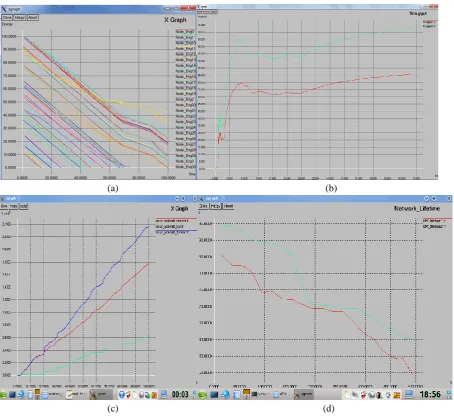
Fig. 2 (a) shows the power consumption of mobile node in given scenario of mobile node. (b) Shows that throughput of packet send and received during attacking mode. (c) Shows that packet transmits and received packet ratio during attacking mode during communication of group node. (d)
Shows that network life time of simulated node in given scenario.
V. CONCLUSION
ISSN(Online): 2319-8753 ISSN (Print): 2347-6710
International Journal of Innovative Research in Science,
Engineering and Technology
(A High Impact Factor, Monthly, Peer Reviewed Journal) Visit: www.ijirset.com
Vol. 7, Special Issue 3, March 2018
improved the key authentication mechanism in group communication. Our proposed mechanism has overcome some of the limitations like it has the miss some group node request during group communication. It also introduces little bit computational overhead during route advertisement and path establishment.
REFERENCES
[1] Mustafa Bani Khalaf, Ahmed Y.Al-Dubai and William Buchanan “A New Adaptive Broadcasting Approach for Mobile Ad hoc Networks”,978-1-4244-7071-6/10/$26.00 ©2010 IEEE
[2] Mr. Sandeep Gupta Prof.Abhishek Mathur “Enhanced Flooding Scheme for AODV Routing Protocol in Mobile Ad hoc Networks” ,2014 International Conference on Electronic Systems, Signal Processing and Computing Technologies
[3] Mozmin Ahmed, Md. Anwar Hussain, “Performance of an IDS in an Adhoc Network under Black Hole and Gray Hole attacks”
[4] Zhimu Huang, Ryo Yamamoto, Yoshiaki Tanaka, “A Multipath Energy-Efficient Probability Routing Protocol in Ad Hoc Networks” Feb 16-19 ICATE2014
[5] Akshay Aggarwal, Savita Gandhi, Nirbhay Chaubey, Keyurbhai A Jani “Trust Based Secure on Demand Routing Protocol (TSDRP) for MANETs”, 2014 Fourth International Conference on Advanced Computing & Communication Technologies
[6] Jih-ching Chiu1, Chun-Yao Zheng, Yao-Chin Huang and Kai-Ming Yang, “Design and Implementation of Sequential Repair and Backup Routing Protocol for Wireless Mesh Network”
[7] D. Sandhiya K. Sangeetha R.S. Latha, “Adaptive Acknowledgement Technique with Key Exchange Mechanism for MANET”
[8] Neha Shirke, Kishor Patil, Shriram Kulkarni, Shriram Markande, “Energy Efficient Cluster based Routing Protocol for Distributed Cognitive radio network” 978-1-4799-3486-7/14/$31.00_c 2014 IEEE.
[9] Aarfa Khan Prof. Shweta Shrivastava, Prof. Vineet Richariya, “Normalized Worm-hole Local Intrusion Detection Algorithm (NWLIDA)” 2014 International Conference on Computer Communication and Informatics (ICCCI -2014), Jan. 03 – 05, 2014, Coimbatore, INDIA. [10] Jyoti Joshi, Vidhate Amarsinh, “Enhanced 2ACK Scheme to Prevent Routing "Misbehavior Using OLSR Protocol.” 2014 International
Conference on Computer Communication and Informatics (ICCCI -2014), Jan. 03 – 05, 2014, Coimbatore, INDIA.
[11] Mallapur Veerayya, Vishal Sharma and Abhay Karandikar “Sq-Aodv: A Novel Energy-Aware Stability-Based Routing Protocol for Enhanced Qos In Wireless Ad-Hoc Networks” IEEE 2012.
[12] Seema Verma Pinki Nayak and Rekha Agarwal” Energy Efficient Routing in Mobile Adhoc Networks based on AODV Protocol “ in IJCSI International Journal of Computer Science Issues, Vol. 9, Issue 6, No 2, November 2012
[13] S. Narayanaswamy, V. Kawadia, R. Sreenivas, and P. Kumar. Power control in adhoc networks: Theory, architecture, algorithm and implementation of the compow protocol, 2002.