Re-Organizable Wireless Mesh Network
Using ARS
Mahesh.S1, Mohamed Riswan.M2, Pravin.N3, Prem Kumar.B4 and Dr.Menakadevi.T5
UG Scholar, Department of ECE, Adhiyamaan College of Engineering , Hosur ,TN, India1,2,3, 4 Professor, Department of ECE, Adhiyamaan College of Engineering , Hosur, TN, India5
ABSTRACT: In recent year wireless communication is most widely used, but there is also traffic in surrounding environment, while transferring the data from source to destination. This can be possible due to channel interference, various obstacles, which result in link failure causes poor performance, require expensive network management for their recovery. To maintain the network performance Autonomous network reconfiguration system (ARS) is used which autonomously reconfigure and recover from local link failure. ARS has been implemented and evaluated. ARS improves the channel efficiency better than other recovery methods for example reroute and greedy channel.
KEYWORDS: Failure detection, route recovery, reconfiguration, enhancement of the channel efficiency, IEEE 802.11.
I. INTRODUCTION
The wireless mesh network(WMN) is widely used in various application such as security, internet services, environment monitoring system[I]-[3].WMN has some important characteristics which includes without sacrificing channel capacity multi-hop wireless network extend the coverage range, without line of sight improves the connectivity among user, support ADHOC networking, capability of self-forming, self
organizing, self-healing. Mesh client can be mobile or stationary node; mesh routers usually have minimal mobility. It has multiple type of network access. Power consumption constraint depends on mesh node. The WMN improve the ability of user to connect directly with each other and enable distributed network in frastructure that provi de multiple paths to the network for communication and centrally located towers are not required. By using different signal path they can bypass different obstacle such as building, trees, hills, have no any failure and can easily pullout. With existing tools, the mesh network constructed with set of hardware from high end carrier class equipment consists of shelf in home router, laptop, computer, mobile devices. This result in device of infrastructure network support end to end communication and avoiding dependency of path and vendor lock in. The WMN has challenging problem to meet required performance of system [4]. Due to channel interference some link of the WMN get affected or damaged. Some part of wireless networks does not meet the bandwidth requirement from other user. In certain area links are unable to use frequency channel because of frequency regulation [5]. Reconfiguration methods such as rerouting method and greedy channel method are used to recover from the local link failure, but these methods have limitation, the rerouting methods adopted to use network level route diversitfor minimizing the faulty links, they depend onredundant transmission having more networks resources. Greedy channel method unable to consider the full improvement achieved by considering the configuration of adjacent mesh router along with faulty link.
2.4,3.6,5 and 60 GHz. IEEE LAN/MAN standard committee creates and maintains IEEE 802.11. In 1997 the base version of the standard was released. It provides the base for wireless network product using Wi-Fi brand [6]. In WMN transmission of signal is done by using TCP and UDP. From one computer to another computer, TCP provide ordered delivery of stream of octet. By the different internet application such as file transfer, remote administration, World Wide Web, email TCP protocol is used. The end to end connectivity is provided by TCP/IP describing how data should be transmitted, formatted, addressed, routed and received at the destination. Autonomous reconfiguration system improves local network throughput and channel efficiency over the other rerouting method and greedy channel meth
II. RELATED WORK
On the various problems in wireless mesh network, up till now lots of work has been done. By the use of planning algorithm which helps to the local changes as possible instead of changing the entire network arrangement. The algorithm often requires global changes in network, the QoS on each link must have to satisfy as possible. The approximately maximum network configuration can be provided by scheduling algorithm, bandwidth constraint and channel assignment. To maximize the chance of getting QoS demand configuration algorithm requires only local changes. Among multiple network layer network setting can be consider by network configuration. The local rerouting allow for flow reconfiguration to get QoS constraint by exploiting path diversity, more network resources consume by them than link reconfiguration because of redundant transmission.
III. ARS ARCHITECTURE
ARS support re-configurability because of following specific features:
QoS aware planning: 1) ARS recognizes the QoSsatisfiablity of organized reconfiguration plans. 2) In channel utilization generating their expected profits.
Link quality monitoring: In the distributed manner autonomous reconfiguration system examines quality of each node. Depending on link's QoS constraint and calculation, autonomously reconfiguration system identifies local link failure and initiates the network reconfiguration autonomously.
Link layer interaction: For the purpose of planning autonomously reconfigurable system interact within the network and link layer; it causes to include rerouting in addition to link layer configuration.
Contained Reconfiguration: By generating recon figuration plan ARS permits for changes of reconfiguration of
network where link failure occured maintaining configuration in space away from failure location.
ARS FLOW CHART
The above flow chart describe the operation of autonomously reconfigurable system, first it at every time i.e. at 10 s observe the quality of wireless link and via management message, send result to gateway, after detecting the link failure trigger the formation of group, one of the group member selected as leader. The planning request is sent by leader node to gateway, then
gateway generate reconfiguration plan for request, if there are multiple request. Reconfiguration plan send to the group member and leader node by gateway. All nodes in group execute the changes. Routing protocols send all the messages during formation and reconfiguration.
NETWORK RECONFIGURATION PLANNING
ARS generate reconfiguration plan for every failure of link, different network configuration can be caused due to changes in link requirements, ARS applies connectivity constraint to create group of feasible reconfiguration plan to enumerate link, channel, route changes around the faulty region, given link failure constraint and connectivity. To identify plan of reconfiguration, this satisfies QoS demand and improves network utilization.
Plan Generation: To avoid local link failure and maintain existing network connectivity ARS identifies some changes, but doing thisARS has to address the following challenges.
Removing faulty channel: ARS identifies three main linkchanges for fix faulty link. ARS can use both the end radios of link XY can simultaneously change their tuned channel i.e. channel switch S. 2) A radio switch R where one radio in node X can switch its channel and associate with another radio in node y. 3) A route switch L, instead of using faulty link all traffic over faulty link use detour path.
it may explore broad range of link changes. On the basis of existing reconfiguration for the faulty and value of total reconfiguration is defined.
IV. IMPLIMENTATION OF SYSTEM ANDEXPERIMENTATION
ARS IMPLEMENTATION DETAIL
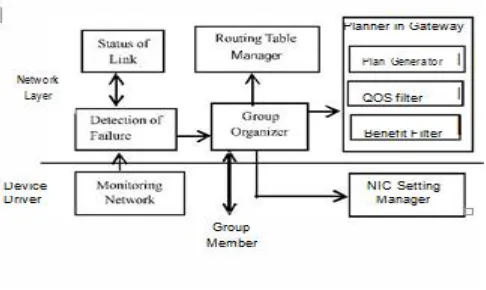
Fig.2 ARS software architecture
Fig. 2 shows ARS software architecture. In the network layer using netfilter, inside the Linux kernel netfilter is set of hook which permits the kernel modules to register the function of callback with the stack network. For every packet that traverses the respective hook within the network stack a registered callback function is then called back. For the definition of rule sets IP table is generic table structure. Within an IP table each rule consists of one connected action (IP table's target), connection tracking, number of classifiers, ip_tables. The major part of framework is built by the NAT subsystem together [9].
ARS is implemented which provides ARS with hook to detent and send formation of group messages. This module include in network layer
Link Status:which identify the status of link, whether link fai led to send data or working properly.
Failure detector: It detect the failure if occurs whilesending data.
Group Organizer: This generates group betweendifferent mesh routers.
Routing table manager: Routing information is provided by routing table manager to all interested client such as management programs, routing programs, routing protocols. It passes best information to the entire interested client. Through routing table manager ARS can be obtained.For making accurate network monitoring in MAC layer the device driver allows for accessing management registers and various control. The device driver includes
Monitoring Network:Network monitor constantly the network for slow and failing components. In case of outages that notifies network administration. Monitorthe network which includes different links and nodes.
SETUP OF EXPERIMENT
rate and transmission. For wireless interfaces and implementation of ARS, all nodes run Linux OS, MADWiFi device driver [8]. For routing protocols weighted cumulative expected transmission time (WCETT) and ETX [10] routing matrices are implemented. The WCETT include assigning weight to every link given time in transmission linked out. WCETT has a routing metrics that take two things into account 1) Channel assignment diversity 2) Difference in the bandwidth of link. It has advantage to configure the best path for the variety of channel offered and bandwidth of link IGWs.
V. RESULT OF EXPERIMENT
ARS causes the improvement in quality of system satisfiability, efficiency of channel, and throughput, ripple effect reduction.
QoS gain satisfaction: QoS indicate differentiation of traffic and using multiple point to point communication service between two networks with significances and configuration adjusted to guarantee sufficient service quality of each user. Based on QoS classes identifiers network controlled simplified QoS profiler and network initiated bearer establishment are vital features of the evolved QoS concept. ARS generally is responsible for getting varying QoS demand. To show the gain considers the example as follows.
Where the node X, Z and P are the gateway, a mesh router in the shop and mesh router in a control room respectively. During meeting through router Z mobile clients in the shop request video stream and after meeting return to the control room and connect to the router P. It can measure the total number of admitted stream after network reconfiguration, whiIe number of video stream increases. ARS improves chance for wireless mesh network to meet varying QoS demand.
increases more as compare to other methods. According to planning algorithm to another channel ARS switches the fault related channel linlc Local rerouting can causes interference of channel heavily for the detour path, slows down the neighborinflow's activity
Channel efficiency and Throughput gain: In this paper one UDP flows at maximum rate for selected link on the test board increasing the level of interference, as shown in graph static assignment causes the severe degradation of throughput, but ARS detect failure using completes network reconfiguration and link quality monitoring information. The delay is mainly to link quality information update and with gateway a communication delay and the delay can be adjusted. Actual channel switch is less than 3 ms. causes negligible flow disruption. The local rerouting improves the throughput using detour path, still suffers from throughput degradation because of along detour path an increased loss rate.
source node to destination node, it select shortest path, but if in case link or node failure occurs then radio switch and channel switch done by ARS, another alternative shortest path is selected. As shown in NAM window node 4 is failed, so thatdata reach to the destination by choosing another path which comes in broadcasting range node in network. Meanwhile ARS detect failure in the network, reconfigure it and recover it. After reconfiguration again the first shortest path is selected. By doing this it helps to reduce loss of packets transfer, enhance channel efficiency and throughput.
VI. CONCLUSION
CONCLUDING REMARKS
ARS autonomously reconfigure failure in the network by generating effective reconfiguration plan which satisfy application's constraints and admitting up to two times more flow than static assignment. Based on existing MAC, routing, and transport protocols, network performance is not scalable with either the number of nodes or the number of hops in the network.
FUTURE WORK
In this paper I have implemented the static ADHOC network, i.e. the nodes are immobile but in future I am going to implement mobile node. The nodes are free to move anywhere and communicate with other nodes which are in broadcasting range. Mobile nodes in ADHOC network increases the complexity as it is difficult to be in the broadcasting range of other nodes.
REFERENCES
[I] Akyildiz, X. Wang, and W. Wang, "Wireless mesh networks: A surveY,"Comput. Netw. vol.47, no.4, pp.445-447, Mar.2005. [2] "MIT Roofnet," [Online].
Available: http://www.pdos.lcs.mit.edulroofnet
[3] Motorola, Inc., "Motorola, Inc., mesh broadband" Schaumburg, IL [Online]. Available: http://www.motorola.com/mesh.
[5] MJ. Marcus, "Real time spectrum markets and interruptible spectrum: New concept of spectrum use enabled by cognitive radio," in proc. IEEE DySPAN, Baltimore, MD, Nov.2005, pp.512-517.
[6] A. Raniwala and T. Chiueh, "Architecture and algorithms for an IEEE 802.1I-based multi-channel wireless mesh network," in Proc. IEEE INFOCOM, Miami, FL, Mar 2005, voI.3,pp. 2223-2234.
[7] A.S. Tanenbaum and M. V. Steen, Distributed system. Upper Saddle River, NJ: Person Education, 2002. [8] "MADWiFi,"Linux-Consulting, Reno, NV[Online]. Available: http://www.madwifi.org"MIT Roofnet," [Online].
Available: http://www.pdos.lcs.mit.edulroofnet
[9] Motorola, Inc., "Motorola, Inc., mesh broadband" Schaumburg, IL [Online]. Available: http://www.motorola.com/mesh.
[10] P. Kyasanur and N. Vaidya,"capacity of multichannel wireless networks: Impact of number of channel and interferences," in Proc. ACM Mobicom, Cologne, Germany, Aug. 2005, pp.43-57.
[11] MJ. Marcus, "Real time spectrum markets and interruptible spectrum: New concept of spectrum use enabled by cognitive radio," in proc. IEEE DySPAN, Baltimore, MD, Nov.2005, pp.512-517.
[12] A. Raniwala and T. Chiueh, "Architecture and algorithms for an IEEE 802.1I-based multi-channel wireless mesh network," in Proc. IEEE INFOCOM, Miami, FL, Mar 2005, voI.3,pp. 2223-2234.