IMPORTANCE OF SHEAR DEFORMATION THEORY IN NUCLEAR
CONTAINMENT DESIGN
Mukti L. Das1, Jaya B. Bose2, Shainur Ahsan3, Gang Lu4
1 Principal Civil Engineer, Bechtel Corporation, Frederick, MD, USA ([email protected]) 2 Civil Engineer, Bechtel Corporation, Frederick, MD, USA
3 Civil Engineer, Bechtel Corporation, Frederick, MD, USA 4 Senior Civil Engineer, Bechtel Corporation, Frederick, MD,USA
ABSTRACT
Recently, several studies in limited scope have been conducted to establish the importance of the shell theory considering shear deformation in the design of nuclear containments subjected to static loads [1]. However, very few studies with dynamic loads have been undertaken. The purpose of this research is to conduct a systematic study to understand the importance of shell theory in the design of containments subjected to both static and dynamic loads.
Initially, to accomplish this objective, a cylinder, with a shape similar to that of a nuclear containment, is studied for its modeling simplicity. With the information learned from this experiment, a containment that is typical to the nuclear industry is selected as the benchmark model. This model is subjected to two types of loadings, a) static load corresponding to an internal pressure generated due to the loss of coolant accident event and, b) dynamic load corresponding to an earthquake that a nuclear containment may encounter during its life cycle. At the conclusion of these experiments, based on the results obtained, the authors will make prudent recommendations.
INTRODUCTION
The scope of the shell theory research is relatively extensive. This study attempts to provide a clear direction that may be followed in the design of a nuclear containment. In following mathematical formulations of different shell theories, it is difficult to predict which theory will provide an acceptable approximation of equations of three dimensional quantum mechanics. This is particularly true for shell elements, where one dimension is small compared to the other two dimensions. To circumvent this problem, a numerical approach is undertaken that utilizes the finite element analysis capabilities of several commercially available software. The results obtained from the analyses are presented in a systematic way so the readers can follow the logic of the authors’ conclusion. Two shell (or plate) theories form the basis for the numerical experiments conducted in this study. These theories are conceptualized below:
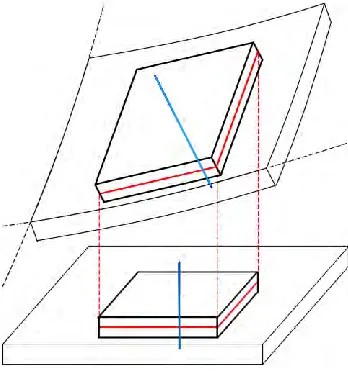
- Kirchhoff-Love Theory: This thin shell theory neglects shear deformation. Simply stated, the theory (hereafter referred to as Kirchhoff) assumes that a straight line, initially normal to the middle surface of a shell, remains straight and normal to the middle surface after deformation [3]. This concept is represented in Fig. 1.
However, the first order term of the power series depicts a straight line, which forms the basis of the first-order shear deformation theory.
Despite these differences, both theories assume the thickness of the shell remains unchanged during the deformation process. This assumption is realistic, provided the shell is moderately thick.
Figure 1. Kirchhoff Theory
FINITE ELEMENT ANALYSIS COMPUTER PROGRAMS
The computer programs used for the finite element analyses related to this study are indicated below. These programs are some of the commercially available finite element analysis software typically used for structural engineering work. The respective finite element types (and the corresponding shell theory) adopted in modeling the physical structure are also included.
ANSYS Version 13.0 [4]:
o SHELL63 Based on Kirchhoff Theory (Thin); 3 or 4 nodes o SHELL181 Based on Mindlin Theory (Thick); 3 or 4 nodes
GTSTRUDL Version 32 [5]:
o SBHQ6 Based on Kirchhoff Theory (Thin); 4 nodes o SBHT6 Based on Kirchhoff Theory (Thin); 3 nodes o SBMITC Based on Mindlin Theory (Thick); 4 nodes
STAAD.Pro V8i [6]:
o SHELL Based on Mindlin Theory (Thick); 3 or 4 nodes
After Deformation
EXPERIMENT WITH CYLINDER MODEL
A simple model representing the shape of a nuclear containment was studied in [2] and is examined here. The model is a cylinder with fixed ends shown in Fig. 2. The material properties are summarized below.
- Young's Elastic Modulus: 2.06 x 10⁷ kN/m2
- Poisson's Ratio: 0.20
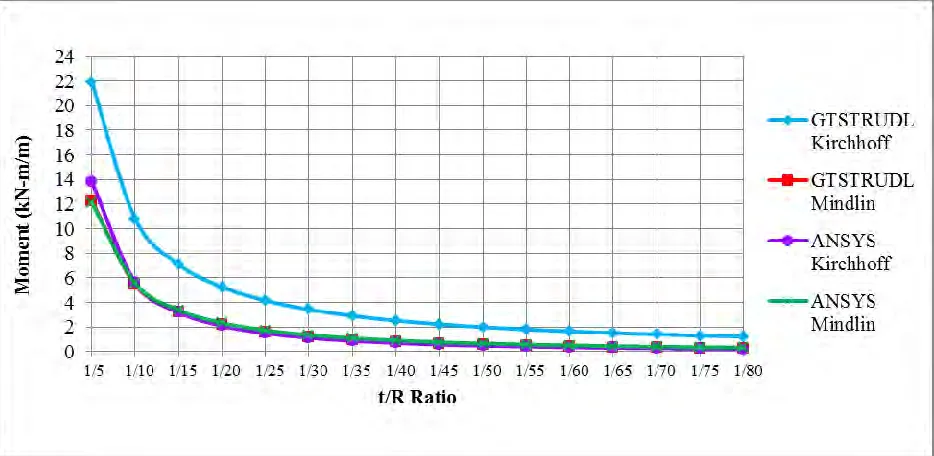
The cylinder is loaded with a constant internal pressure of 98.07 kN/m². In this experiment, the wall thickness (t) was varied with radius (R) held constant, to study the influence of shear deformation on this model. The fixed end moment obtained from the finite element analysis (using the software
mentioned in the previous section) is presented in Fig. 3.
Figure 2. Cylinder Model with Associated Coordinate System
In regards to the fixed end moment results, it may be noted when t/R is approximately 1/10, ANSYS Mindlin, ANSYS Kirchhoff and GTSTRUDL Mindlin coincide to a single curve. However, GTSTRUDL Kirchhoff does not follow this convergent behavior even when the cylinder thickness is made very thin.
EXPERIMENT WITH CONTAINMENT MODEL
A typical containment that is used in the nuclear industry is selected as the benchmark model. The following are various parameters of this model:
Dimension
Cylinder Diameter (2R) = 45.25 m (148’-6”) Cylinder Thickness = 1.2 m (3’-11”) Cylinder Height = 39.4 m (129’-3”) Dome Thickness = 1.0 m (3’-3”) Base Mat Thickness (t) = 4m (13’-1”) Total Inside Height = 58.5 m (192’-0”)
Soil Type
Loose Sand
Vertical Subgrade Modulus = 7500 kN/m3
Loading
Accidental Internal Pressure = 1000kN/m2 (145 psi)
Seismic Base Acceleration = El Centro Time History & Response Spectrum
CONTAINMENT SUBJECTED TO STATIC LOAD
Experiments with various static loads have been performed in Ref. [1]. However, in this study only an accidental internal pressure of 1000 kN/m2 is applied as the static load. The moment resultants
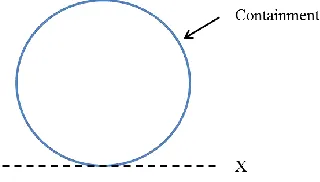
about the circumferential axis (shown as X in Fig. 4) and the vertical membrane stress of the experiment models were investigated. In both cases, nodal values of an element were considered.
Figure 4. Circumferential Axis
Fixed Base Containment with Variable Base Thickness
Figure 5. Moment Resultant about X at Various Containment Elevations
Figure 6. Middle Surface Vertical Stress at Various Containment Elevations
Containment on Soil Springs with Variable Base Mat Thickness
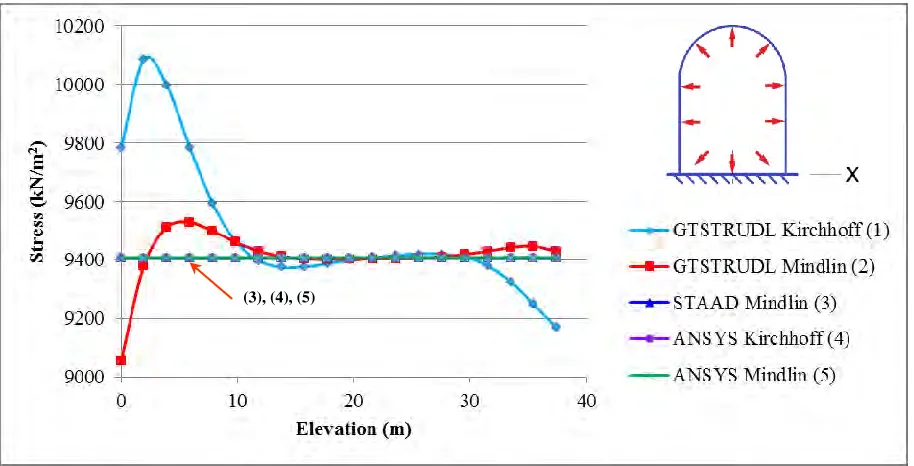
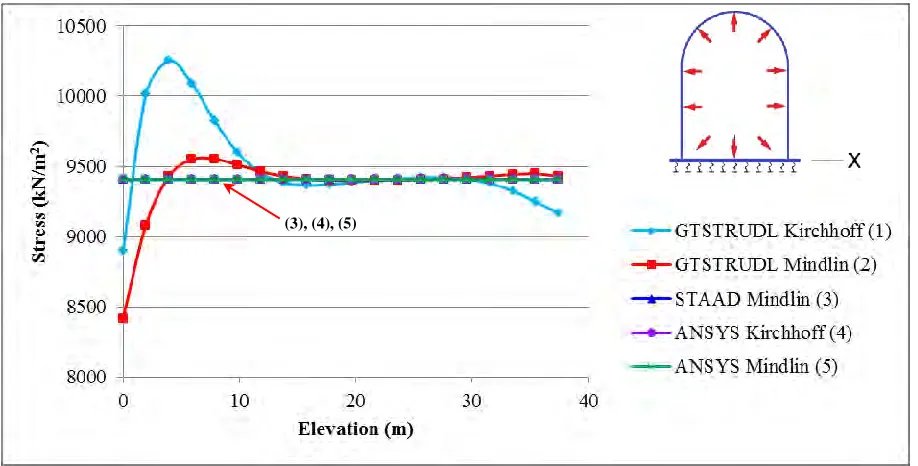
The containment is again subjected to the static load. The following values were considered for the thickness of the base mat - 1m, 4m and 8m. Changes in results were observed, but the general behavior of the response was similar. Therefore, for concision, only the results associated with the 4m thick base mat are presented in Fig. 7 and Fig. 8.
(2), (3), (4), (5)
Figure 7. Moment About X Axis at Various Containment Elevations
Figure 8. Middle Surface Vertical Stress at Various Containment Elevations
(2), (3), (4), (5)
Fixed Base Containment with Variable Wall Thickness
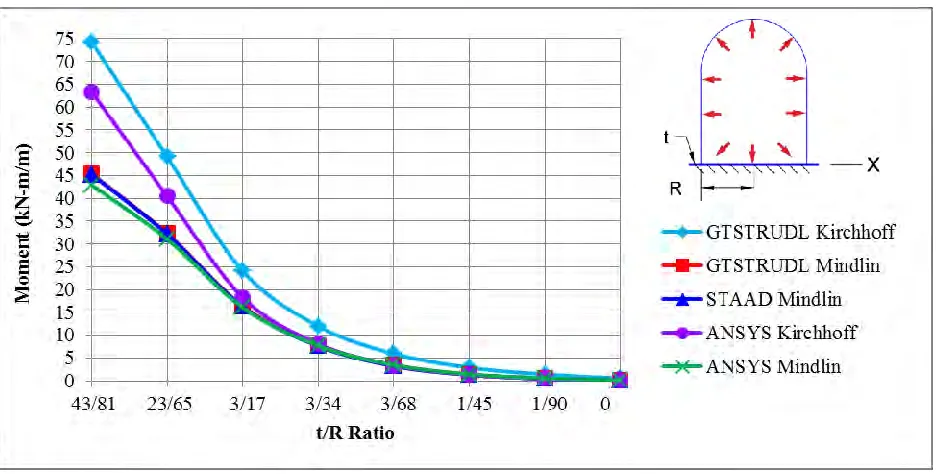
The prediction of structural response, based on different shell theories due to changing wall thickness, is studied under static loading. The result of this study is presented in Fig. 9.
Figure 9. Fixed End Moment About X Axis for Various Containment Wall Thicknesses
It may be noted that when the t/R ratio is approximately 1/10, all results except GTSTRUDL Kirchhoff coincide to a single curve. The same phenomenon was observed in Fig. 3.
CONTAINMENT SUBJECTED TO SEISMIC LOAD
Before the containment is subjected to the seismic load, a comparative study of the eigenvalues obtained by the various shell theories is performed.
Eigenvalue Analysis
First, an eigenvalue analysis was performed on a containment considering its self weight with a base mat thickness of 4m. Subsequently, the base mat thickness was varied over the following values - 1m, 2m and 8m. As expected, the eigenvalues were exactly the same as those for 4m thick base mat. The results of this study are presented in Table 1. A similar study was undertaken with the containment supported on soil springs and yielded similar results. However, for concision, those results are not presented here.
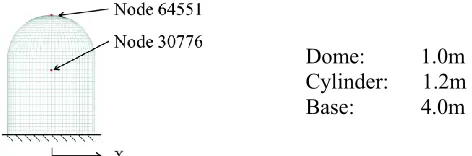
Figure 10. Location of Nodes 30776 & 64551 on Containment
Table 1: Natural Frequencies for Various Modes for Fixed Based Containment
Mode ANSYS
Kirchhoff (Hz)
ANSYS Mindlin (Hz)
GTSTRUDL Kirchhoff (Hz)
GTSTRUDL Mindlin (Hz)
STAAD Mindlin (Hz)
1 4.51 4.51 4.51 4.52 4.51 3 5.92 5.94 5.92 5.93 5.92 5 6.60 6.64 6.62 6.62 6.60 110 29.56 29.91 29.58 29.78 29.63
Time History Analysis of Containment
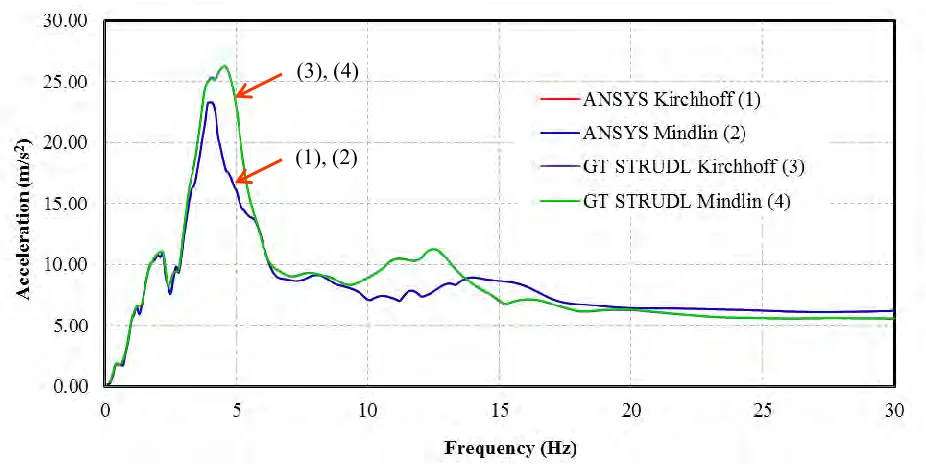
For this experiment, the El Centro time history was selected. This acceleration time history was applied at the base in the global X direction. An in-structure X-response spectrum was generated at node 30776, located approximately 33.5 m vertically above the base mat. The maximum X displacement at node 64551 and the time of occurrence were also generated. The response spectrum is presented in Fig. 11 and the displacements are in Table 2.
Table 2: Maximum X-Displacement at Node 64551
Displacement/Time Kirchhoff ANSYS MindlinANSYS GTSTRUDL Kirchhoff GTSTRUDL Mindlin
Maximum X
Displacement (m) 0.0118243 0.013451 0.013107 0.013193
Time of Max
Displacement (sec) 2.52 2.52 2.51 2.51
Figure 11. In-Structure X-Response Spectrum of El-Centro at Node 30776
Response Spectra Analysis of Containment
To conclude the study of seismic behavior, a response spectrum analysis of the containment is performed. For this purpose, the El Centro response spectrum is applied at the base of the containment in the direction of Global X. The Complete Quadratic Combination (CQC) X-displacement at node 64551, the CQC X-base shear and the Square Root Sum of Squares (SRSS) X-base shear are presented in Table 3.
Table 3: Maximum X-Displacement at Node 64551 and Base Shear
X-Displacement/ X-Base Shear
ANSYS Kirchhoff
ANSYS Mindlin
GTSTRUDL Kirchhoff
GTSTRUDL Mindlin
CQC Displacement (m) 0.013119 0.013107 0.013107 0.0130674 CQC Base Shear (kN) 125,008 125,010 124,842 124,497 SRSS Base Shear (kN) 124,037 121,387 118,978 109,780
CONCLUSION
The Mindlin-Reissner theory provides reasonably accurate analysis results for all moderately thick shells and thin shells subject to static structural loads. However, in this study, it is observed that for the static load which generally creates membrane stress, some implementations of the Kirchhoff-Love theory do not predict the results that are close to those obtained from most implementations of the Mindlin-Reissner theory even at lower thicknesses of the shell element. Generally, the Kirchhoff-Love theory predicts conservative results for most static loads.
It is also observed that for eigenvalue, time history and response spectra analyses, the implementations of both the theories within the purview of this study predict almost same results.
(3), (4)
REFERENCES
[1] Das, M. L., “Validity of Shell Theories for Designing Nuclear Structures”, 21st International
Conference onStructural Mechanics in Reactor Technology, New Delhi, India, SMiRT
Transaction, Div-III, 2011
[2] Das, M. L., “Consideration of Shear Deformation in the Analysis of Unsymmetrical Bending of Moderately Thick Shells of Revolution”, ThirdInternational Conference on Structural
Mechanics in Reactor Technology, London, UK, SMiRT Transaction, Vol. 5, 1975
[3] Timoshenko, S. P., Theory of Plates and Shells, McGraw-Hill Book Company, USA, 1959
[4] ANSYS, User Manual, Version 13.0, 2007, ANSYS, Inc., USA
[5] GTSTRUDL User Guide, Version 32, CASE Center, George Institute of Technology, Atlanta, GA, USA
[6] STAAD.Pro V8i, Online User Manual, Bentley Systems, Inc., USA
[7] Ramaswamy, G. S., Design and Construction of Concrete Shell Roofs, McGraw-Hill Book Company,