ISSN(Online): 2320-9801
ISSN (Print): 2320-9798
International Journal of Innovative Research in Computer
and Communication Engineering
(An ISO 3297: 2007 Certified Organization)
Vol. 3, Issue 7, July 2015
Reconfigurable Low Area Complexity Filter Bank
Architecture Based on Frequency Response
Masking For Software Defined Radio
Anuradha S. Deshmukh
1, Prof. M. N. Thakare
2, Prof.G.D.Korde
3M.Tech (VLSI) IV th Sem Student, Department of Electronics & Telecommunication Engineering, BDCOE,
Sewagram, India 1
Associate Professor, Department of Electronics & Telecommunication Engineering, BDCOE, Sewagram, India 2
Assistant Professor, Department of Electronics & Telecommunication Engineering, BDCOE, Sewagram, India 3
ABSTRACT
:
The high and constantly increasing demand to develop radio transceivers with enhanced functionalities, inter-standard portability, higher throughputs, compact physical size, low cost, and longer battery lifetime impose challenges on the radio designer. A Software Defined Radio is capable of meeting these challenges provided (i) enhanced signal processing algorithms with reduced complexities, (ii) high performance HW/SW platforms, and (iii) the optimized architectural design that finally maps the algorithms to the processing platform.KEYWORDS; Reconfigurability, Low complexity, Digital filter banks, Software Defined Radio (SDR), Channelizer, reconfigurable architecture, Lookup Table (LUT)
I. INTRODUCTION
Software radios can significantly reduce the cost and complexity of today‘s cellular radio base stations. Software radios architectures centre on the use of wide band (WB) A/D converters and D/A converters as close to the antenna as
possible, with as much radio functionality as possible implemented in the digital domain.The reconfigurable FIR filters
are widely used in multiband mobile communication system. The filters using in mobile communication system must
be operating in low frequency and realize to consumes less power and high speed. The advance technologies in mobile
communication systems are demanding the low power and low complexity techniques. The Software Defined Radio (SDR) and the FIR filter researches are focused on reconfigurable realizations [2]. The SDR technology used to replace the analog signal processing with digital signal processing in order to provide flexible reconfiguration. A SDR design must meet today's reconfigurability requirements and adapt to emerging standards, as well as accommodate cost, power and performance demands. Reconfigurability of the receiver to work with different wireless communication standards is another key requirement in an SDR. Generally the complexity of FIR filter depends upon the number of adders performs in the multiplier unit. Chanalizer is known as the most important block of the SDR which operates in high sampling rate but the SDR must be realizing of low power consumption and high speed. Using a bank of FIR filters in the channel filters introduces the multiple numbers of narrowband channels from a wideband signal.
II. LITERATURE REVIEW
ISSN(Online): 2320-9801
ISSN (Print): 2320-9798
International Journal of Innovative Research in Computer
and Communication Engineering
(An ISO 3297: 2007 Certified Organization)
Vol. 3, Issue 7, July 2015
standards. If the channel bandwidth is very small compared with wideband input signal (extremely narrowband channels), the prototype filter must behighly selective resulting in a very high-order filter.As the order of the filter increases, the complexity
increases linearly. Also the DFT size needs to be increased. Pucker, L. in paper [2] entitled ―Channelization techniques for software defined radio‖ proposed DFT Filter Banks. DFT filter bank is a uniformly modulated filter bank, which has been developed as an efficient substitute for PC approach when the number of channels need to be extracted is more, and the channels are of uniform bandwidth (for example many single standard communication channels need to be extracted). The main advantage of DFT filter bank is that, it can efficiently utilize the polyphase decomposition of filters. The limitations of DFTFBs is that the channel filters have fixed equal bandwidths corresponding to the specification of a given standard.R. MAHESH et.al. in paper [3] entitled ―Reconfigurable Low Area Complexity Filter Bank Architecture Based on Frequency Response Masking for Non uniform Channelization in Software Radio Receivers‖ proposed a new reconfigurable FB based on the FRM approach for extracting multiple channels of non uniform bandwidths. The FRM approach is modified to achieve following advantages: 1) incorporate reconfigurability at the filter level and architectural level, 2) improve the speed of filtering operation, and 3) reduce the complexity.
III.FRM-BASED FILTER BANK ARCHITECTURE
Filter reconfigurability means changing the coefficients of each filter in Fig. 1 according to the specifications of the new standard. It is well known that one of the efficient ways to reduce the complexity of multiplication operation is to realize it using shift and add operations [3]. In contrast to conventional shift and add units used in previously proposed reconfigurable filter architectures, a binary common sub expressions (BCSs) based shift and add unit has been employed in the filter architectures. The existing architecture of the filter for an 8-bit coefficient is shown in Fig. 3. M1 and M2 are 8 : 1 multiplexers; M3 is a 4 : 1 multiplexer and M4 and M5 are 2 : 1 multiplexers.
Fig.1 FRM based filter bank architecture
ISSN(Online): 2320-9801
ISSN (Print): 2320-9798
International Journal of Innovative Research in Computer
and Communication Engineering
(An ISO 3297: 2007 Certified Organization)
Vol. 3, Issue 7, July 2015
most significant non-zero bit in the coefficient, and X represents the bit values after the coefficients are shifted left so that the most significant bit (MSB) to the right of the decimal point (position value corresponding is always ―1.‖ Each row in the LUT corresponds to one coefficient. The MSB of the modified coefficient S stored in the LUT is given as the select signal to the multiplexer (MUX), M5.The MUX M5 determines whether to complement the output or not depending on the sign bit of the coefficient. The values DDDD form the select signal to the programmable shifter (PS) which will perform the shifting . The least significant 2 bits form the select signal to M4. The values r1,r2,r3 and r4 correspond to the outputs of multiplexers M1,M2,M3, and M4 respectively. The reconfigurability can be achieved by changing the coefficients in the LUT[3].
IV.PROPOSED SYSTEM OVERVIEW
It is well known that one of the efficient ways to reduce the complexity of multiplication operation is to realize it using shift and add operations. In contrast to conventional shift and add units are used in previously proposed reconfigurable
filter architectures. A programmable shifter is more complex. Often the speed of multiplication limits the performance
of the digital processor. So, we can use barrel shifter (a circuit that shifts multiple bits at a time) in proposed architecture instead of programmable shifter. The time required/delay will considerably improve by doing this and the proposed architecture is modified for reducing its complexity.
Fig.2 Proposed reconfigurable filter architecture
ISSN(Online): 2320-9801
ISSN (Print): 2320-9798
International Journal of Innovative Research in Computer
and Communication Engineering
(An ISO 3297: 2007 Certified Organization)
Vol. 3, Issue 7, July 2015
coefficient is shown in figure.4. M1 and M2 are 8:1 multiplexers; M3 is a 4 : 1 multiplexer and M4 and M5 are 2 : 1
multiplexers. The input is given to the shift and add unit whose output is shared among the multiplexers.
V. RESULTS &CONCLUSION
In this section, the synthesis results of the FRM FB, and modified FB architectures are presented and parameters like area and delay are compared. The comparison table states the architecture which has high speed and minimum delay. The Xilinx 9.1i ISE Virtex-II used for synthesizing purposes.
Table 1: The delay Comparison between the Existing and Proposed Method
Parameter
Existing Method From ref.3
Proposed Method
Delay(ns) 38.67 13.65
Graph 1: Delay comparison
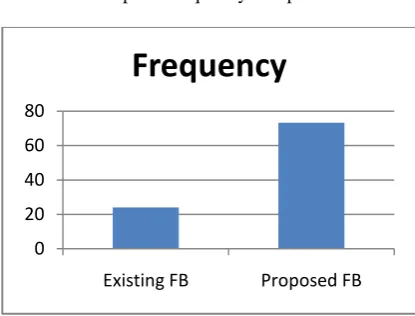
Table 2: The frequency Comparison between the Existing and Proposed Method
0 10 20 30 40 50
Existing FB Proposed FB
Delay
Parameter
Existing Method From ref.3
Proposed Method
Frequency ofoperation(speed
ISSN(Online): 2320-9801
ISSN (Print): 2320-9798
International Journal of Innovative Research in Computer
and Communication Engineering
(An ISO 3297: 2007 Certified Organization)
Vol. 3, Issue 7, July 2015
Graph 2: frequency comparison
The comparison table states the architecture which has less area. The Xilinx 9.1i ISE spartan-III used for synthesizing
purposes.
Table 3: The area Comparison between the Existing and Proposed Method
Parameter
From reference.4
Proposed Method
Area(slices) 20 14
Graph 3: Area comparison
VI.CONCLUSION
The proposed reconfigurable filters architecture results in low area and low delay. The FRM reconfigurable technique is modified to improve the speed and reduce the complexity. Synthesis results show that the proposed FB offers area reduction.
REFERENCES
[1] Hentschel, T. Channelization for software defined base-stations. Annales des, Telecommunications (May—June (2002)
[2] Pucker,L.―Channelization techniques for software defined radio‖. Spectrum Signal. Processing Inc, Burnaby B.C,Canada,Nov.2003.
0 20 40 60 80
Existing FB Proposed FB
Frequency
0 5 10 15 20 25
Existing FB Proposed FB
ISSN(Online): 2320-9801
ISSN (Print): 2320-9798
International Journal of Innovative Research in Computer
and Communication Engineering
(An ISO 3297: 2007 Certified Organization)
Vol. 3, Issue 7, July 2015
[3] Mahesh, R., Vinod, A. P., ―Reconfigurable Low Area Complexity Filter Bank Architecture Based on Frequency Response Masking for Non uniform Channelization in Software Radio Receivers‖ IEEE TRANSACTIONS ON AEROSPACE AND ELECTRONIC SYSTEMS APRIL 2011.
[4] G.O.Jijina and V.Ranganathan ―Low Power Architecture For Reconfigurable Fir Filter For SDR‖ World Applied Sciences Journal164-168,2014. [5] Hartley,R.I. ― Subexpression sharing in filters using canonic signed digit multipliers‘‘.IEEE Transactions on Circuits and Systems-II,43(Oct.
1996)
[6] Peiro, M. M., Boemo, E. I., and Wanhammar, L. ― Design of high-speed multiplierless filters using a non recursive signed common subexpression algorithm‘‘ IEEE Transactions on Computer Aided Design of Integrated Circuits and Systems,49, 3 (Mar. 2002)
[7] Mahesh, R. and Vinod, A. P. ― Reconfigurable low complexity FIR filters for software radio receivers.‘‘ In Proceedings of 17th IEEE International Symposium on Personal, Indoor and Mobile Radio Communications, Helsinki, Finland, Sept. 2006.
[8] Mahesh, R. and Vinod, A. P. ― Reconfigurable frequency response masking filters for software radio channelization. ‗‘IEEE Transactions on Circuits and Systems-II,44,3(Mar.2008),
[9] xu, F., Chang, C. H., and Jong, C. C. ― Contention resolution algorithm for common subexpression elimination in digital filter design.‘‘ IEEE Transactions on Circuits and Systems-II,52(Oct.2005)
[10] Mahesh, R. and Vinod, A. P. ― A new common subexpression elimination algorithm for realizing low complexity higher order digital filters‘‘ IEEE Transactions on Computer Aided Design of Integrated Circuits and Systems, (Feb. 2008),
[11] R. Mahesh & A. P. Vinod & Edmund M-K. Lai & Amos Omondi, ―Filter Bank Channelizers for Multi-Standard Software Defined Radio Receivers‖, J Sign Process System (2011).
[12] S.Alex J.Selvakumar‘‘ FPGA Implementation of Novel Reconfigurable Pipelined Architectures for Low Complexity FIR Filters‘‘ iJARS/ Vol. II/Issue3 /Mar, 2013/386