University of Windsor University of Windsor
Scholarship at UWindsor
Scholarship at UWindsor
Electronic Theses and Dissertations Theses, Dissertations, and Major Papers
2009
Study of challenges in technology development and market
Study of challenges in technology development and market
penetration of hybrid electric vehicles in Canada
penetration of hybrid electric vehicles in Canada
Mariam Khan
University of Windsor
Follow this and additional works at: https://scholar.uwindsor.ca/etd
Recommended Citation Recommended Citation
Khan, Mariam, "Study of challenges in technology development and market penetration of hybrid electric vehicles in Canada" (2009). Electronic Theses and Dissertations. 8211.
https://scholar.uwindsor.ca/etd/8211
This online database contains the full-text of PhD dissertations and Masters’ theses of University of Windsor students from 1954 forward. These documents are made available for personal study and research purposes only, in accordance with the Canadian Copyright Act and the Creative Commons license—CC BY-NC-ND (Attribution, Non-Commercial, No Derivative Works). Under this license, works must always be attributed to the copyright holder (original author), cannot be used for any commercial purposes, and may not be altered. Any other use would require the permission of the copyright holder. Students may inquire about withdrawing their dissertation and/or thesis from this database. For additional inquiries, please contact the repository administrator via email
STUDY OF CHALLENGES IN TECHNOLOGY
DEVELOPMENT AND MARKET PENETRATION
OF HYBRID ELECTRIC VEHICLES IN CANADA
By
Mariam Khan
A Thesis
Submitted to the Faculty of Graduate Studies
through the Department of Electrical and Computer Engineering
in Partial Fulfillment of the Requirements for
the Degree of Master of Applied Science at the
University of Windsor
Windsor, Ontario, Canada
2009
1*1
Library and Archives CanadaPublished Heritage Branch
395 Wellington Street OttawaONK1A0N4 Canada
Bibliotheque et Archives Canada Direction du
Patrimoine de Pedition 395, rue Wellington Ottawa ON K1A 0N4 Canada
Your file Votre r6f6rence ISBN: 978-0-494-82088-9 Our file Notre reference ISBN: 978-0-494-82088-9
NOTICE:
The author has granted a
non-exclusive license allowing Library and Archives Canada to reproduce, publish, archive, preserve, conserve, communicate to the public by
telecommunication or on the Internet, loan, distribute and sell theses worldwide, for commercial or non-commercial purposes, in microform, paper, electronic and/or any other formats.
AVIS:
L'auteur a accorde une licence non exclusive permettant a la Bibliotheque et Archives Canada de reproduire, publier, archiver, sauvegarder, conserver, transmettre au public par telecommunication ou par I'lnternet, preter, distribuer et vendre des theses partout dans le monde, a des fins commerciales ou autres, sur support microforme, papier, electronique et/ou autres formats.
The author retains copyright ownership and moral rights in this thesis. Neither the thesis nor substantial extracts from it may be printed or otherwise reproduced without the author's permission.
L'auteur conserve la propriete du droit d'auteur et des droits moraux qui protege cette these. Ni la these ni des extraits substantiels de celle-ci ne doivent etre imprimes ou autrement reproduits sans son autorisation.
In compliance with the Canadian Privacy Act some supporting forms may have been removed from this thesis.
Conformement a la loi canadienne sur la protection de la vie privee, quelques formulaires secondaires ont ete enleves de cette these.
While these forms may be included in the document page count, their removal does not represent any loss of content from the thesis.
Bien que ces formulaires aient inclus dans la pagination, il n'y aura aucun contenu manquant.
AUTHOR'S DECLARATION OF ORIGINALITY
I hereby certify that I am the sole author of this thesis and that parts of this thesis
have been published or submitted for publication. I also certify that I have the right to use
all or part of the published work in other work.
I certify that, to the best of my knowledge, my thesis does not infringe upon
anyone's copyright nor violate any proprietary rights and that any ideas, techniques,
quotations, or any other material from the work of other people included in my thesis,
published or otherwise, are fully acknowledged in accordance with the standard
referencing practices.
I declare that this is a true copy of my thesis, including any final revisions, as
approved by my thesis committee and the Graduate Studies office, and that this thesis has
ABSTRACT
Growing concerns of the economic and environmental impact of petroleum
combustion by on-road transportation have accelerated the development of alternative
fuel vehicles; of these, the hybrid electric vehicle (HEV) is currently the most
commercially successful technology. It integrates an electric drivetrain to the internal
combustion engine for optimized engine operation giving significantly higher fuel
efficiency and lower emissions. However, despite their well recognized benefits,
Canadian consumers have shown reluctance in adapting HEVs so far.
This thesis discusses the immediate need for Canada to adopt more efficient and
eco-friendly transportation systems and analyzes the cost effectiveness and tailpipe
emissions of HEVs that offer a suitable alternative. The factors inhibiting market
acceptance of hybrids are have been reviewed and a set of comprehensive policy
guidelines and measures have been proposed to provide financial incentives, enforce
emission regulations and support technology development of hybrid vehicles. As part of
the highlighted target, challenges in key areas of HEV technology have been discussed
and one such challenge is addressed by proposing a more robust electric motor drive for
vehicle traction.
DEDICATION
ACKNOWLEDGEMENT
I am thankful to God Almighty for giving me the opportunity to pursue Masters
program and the strength and patience to see it through. I am grateful to my wonderful
parents whose love, encouragement and sacrifice has made me what I am today.
I wish to express my sincere gratitude to my advisor Dr. Narayan Kar for his
assistance at every step of the way. His guidance has had an immense influence on my
professional growth and without his technical expertise, reviews, and criticism it would
not have been possible to shape this thesis. I would also like to thank my committee
members Dr. Minaker and Dr. Wu for their valuable suggestions and guidance in the
completion of this work.
I would like to show my appreciation for my thoughtful brother, adorable sister
and my dear friends who made strenuous times seem easy and turned stressful days into
fun. Their love and support will always be invaluable.
In the end, I want to thank my fellow graduate students in the Electric Machines
and Drives Research Lab for their support and encouragement. Working in their friendly
company was a memorable experience.
TABLE OF CONTENTS
AUTHOR'S DECLARATION OF ORIGINALITY HI
ABSTRACT IV DEDICATION V ACKNOWLEDGEMENT VI
LIST OF TABLES XI LIST OF FIGURES XII NOMENCLATURE XIV 1 INTRODUCTION 1
1 1 BACKGROUND 1 1 2 ALTERNATIVE FUEL VEHICLES 2
/ 2 / Battery Electric Vehicles (BEVs) 2
/ 2 2 Fuel Cell Vehicles (FCVs) 4
123 Hybrid Electric Vehicles (HEVs) 5
1 3 RESEARCH OBJECTIVES 7 1 4 THESIS OUTLINE 8 1 5 REFERENCES 9 2 HEVS FOR SUSTAINABLE AND ECO-FRIENDLY TRANSPORTATION 10
2 1 IMPACT OF GROWTH IN PETROLEUM DEMAND BY O N - R O A D TRANSPORTATION IN CANADA 11
211 Economic Impact of Fossil Fuel-Based Transportation 13 2 12 Degradation of Air Quality Due to Vehicular Emissions 15 2 13 Health Risks Associated with Vehicular Emissions 17 2 2 HYBRID ELECTRIC VEHICLES AS A FUEL-EFFICIENT ALTERNATIVE I 8
2 2 1 Toyota Prius \ 8
2 2 2 Toyota Camry Hybrid 19 2 2 3 Ford Escape Hybrid ] 9
2 2 4 Honda Civic Hybrid 19 2 2 5 Chevy Mahbu Hybrid 20 2 3 EMISSION AND COST SAVING ANALYSIS OF HYBRID CARS 21
2 3 2 Lifetime Emission Savings by Hybrid Vehicles 29
2 4 REFERENCES 32 DEVELOPMENT OF POLICIES AND STRATEGIES TO PROMOTE HEV SALES IN THE
MAINSTEAM MARKET 33 3 1 FACTORS AFFECTING CONSUMER ACCEPTANCE OF HYBRID VEHICLES 33
3 11 Financial Limitations 33 3 12 Consumer Lack of Information 34
3 13 Technology Challenges 34 3 2 N E E D FOR STRATEGIES TO PROMOTE H E V S IN CANADA 35
3 3 EXISTING FEDERAL PROGRAMS AND PUBLIC POLICIES 37
33 1 ecoAUTO Rebate Program 37 3 32 ecoTECHNOLOGYfor Vehicles Program 38
3 3 3 Excise Tax 39 3 34 ecoENERGYforPersonal Vehicles 39
3 3 5 Motor Vehicle Fuel Efficiency Initiative 39 3 3 6 Moving on Sustainable Transportation 40
3 3 7 Fuel Consumption Program 40 3 3 8 Urban Transportation Showcase Program 41
3 4 EXISTING PROVINCIAL INITIATIVES TO ENCOURAGE H E V S 42
3 4 1 Ontario 42 3 4 2 British Columbia 42
3 4 3 Prince Edward Island 42 3 4 4 Saskatchewan 42 3 4 5 Alberta, Manitoba and Quebec 43
3 5 PROPOSED GUIDELINES TO ACCELERATE MARKET DIFFUSION OF HYBRID ELECTRIC VEHICLES 43
3 51 Economic Policies and Financial Incentives 43
3 5 2 Regulation ofC02 Emission 44
3 5 3 Support for Technology Development 45
3 6 REFERENCES 47 DEVELOPMENT OF HYBRID DRIVETRAIN TECHNOLOGY 48
4 1 HEV DESIGN CONCEPT 48 4 11 Optimized Operation of Internal Combustion Engine 49
412 Regenerative Braking 51
4 2 HYBRID DRIVETRAIN CONFIGURATIONS 54
4 2 1 Series Architecture 54 4 2 2 Parallel Architecture 56 4 2 3 Series-Parallel Architecture 57
42 4 Mini Hybrids 59 42 5 Mild Hybrids 59 42 6 Full Hybrids 60 4 3 ENERGY MANAGEMENT SYSTEMS 60
4 4 BATTERY TECHNOLOGY 62 4 4 1 Nickel-Metal Hydride Batteries 64
4 4 2 Lithium-ion Technology 67 4 5 ELECTRIC TRACTION MOTOR 69
4 5 1 Induction Motors 70 4 5 2 Permanent Magnet Synchronous Motors 11
4 5 3 Switched Reluctance Motors 72 454 HEV Specific Motor Designs 72
4 6 REFERENCES 74 INDIRECT FIELD ORIENTED CONTROL OF AN INDUCTION MOTOR 77
5 1 INTRODUCTION TO INDUCTION MOTOR 77
5 11 Construction 11 5 12 Operating Principle 78 5 13 Equivalent Circuit 79 5 14 Operational Characteristics of Induction Motors in HEV Application 80
5 15 Scalar vs Vector Speed Control Methods of Induction Motors 82
5 2 D-Q AXIS MODELING OF INDUCTION MOTORS 83 5 3 VECTOR CONTROL OF INDUCTION MOTORS 86
5 3 1 Principle of Vector Control 86 5 3 2 Indirect Field Oriented Controller 87 5 4 FUZZY LOGIC-BASED INDIRECT FIELD ORIENTED CONTROLLER 92
5 5 SIMULATION RESULTS AND ANALYSIS 98
5 5 1 Speed Tracking Performance under Constant Load Condition 98
5 52 Motor Acceleration Performance 100
5 5 3 Effect of Load Change on Motor Performance 102
5 5 4 Effect of Variation in Rotor Resistance on Machine Performance 103
5 6 REFERENCES 105
6 CONCLUSIONS AND FUTURE WORK 106
61 CONCLUSIONS 106
6 2 FUTURE WORK 107
LIST OF PUBLICATIONS 108
APPENDIX 109 VITAAUCTORIS 110
LIST OF TABLES
TABLE 2.1 STATUS OF GLOBAL OIL RESERVES AS OF 2007 14
TABLE 2.2 MSRP AND ANNUAL FUEL COST OF VEHICLES 23
TABLE 2.3 EMISSION SAVINGS BY HYBRID VEHICLES 30
TABLE 4.1 SUMMARY OF BATTERY SYSTEMS FOR AUTOMOTIVE APPLICATION 66
LIST OF FIGURES
Fig. 2.1. Worldwide C02 emission from petroleum consumption 11
Fig. 2.2. Light-duty vehicle registrations in Canada 12 Fig. 2.3. Annual vehicle kilometres and motor gasoline sales in Canada 13
Fig. 2.4. Regular unleaded gasoline retail price by cities in Canada 14
Fig. 2.5. Projected annual C02 emissions by province 16
Fig. 2.6. C02 emission by transport sector (2005) 16
Fig. 2.7. Annual GHG emissions in Canada 17 Fig. 2.8. Hybrid vehicles on the Canadian market, (a) Toyota Prius. (b) Toyota Camry Hybrid. (c) Ford
Escape Hybrid, (d) Honda Civic Hybrid, (e) Chevy Malibu Hybrid 20 Fig. 2.9. Cumulative annual savings for Toyota's Prius over Yaris. (a) Gas price Cdn $1.35/1. (b) Gas price
Cdn $0.8/1 24 Fig. 2.10. Cumulative annual savings for Ford's Escape Hybrid over Escape, a) Gas price Cdn $1.35/1.
(b) Gas price Cdn $0.8/1 25 Fig. 2.11. Cumulative annual savings for Honda's Civic Hybrid over Civic, a) Gas price Cdn $1.35/1.
(b) Gas price Cdn $0.8/1 26 Fig. 2.12. Cumulative annual savings for Toyota's Camry Hybrid over Camry. a) Gas price Cdn $1.35/1.
(b) Gas price Cdn $0.8/1 27 Fig. 2.13. Cumulative annual savings for Nissan's Altima Hybrid over Altima. a) Gas price Cdn $1.35/1.
(b) Gas price Cdn $0.8/1 28 Fig. 3.1. Collaboration amongst major stake-holders to promote HEVs for sustainable transportation 36
Fig. 4.1. Fuel economy characteristics of a typical vehicle at constant speed 50
Fig. 4.2. Fuel economy characteristics of atypical gasoline engine 51
Fig. 4.3. Ideal and actual braking force distribution 52
Fig. 4.4. Series drivetrain configuration 55 Fig. 4.5. Parallel drivetrain configuration 57 Fig. 4.6. Series-parallel drivetrain configuration 58 Fig. 4.7. Energy control unit of hybrid drivetrain 61 Fig. 4.8. Electrochemical reaction in a cell during discharge 62
Fig. 4.9. NiMH battery construction, (a) Cylindrical, (b) Prismatic 65 Fig. 4.10. Performance characteristics of Panasonic NiMH module, (a) Specific power for varying
operating temperature, (b) Change in internal resistance over the cycle life 67
Fig. 4.11. Change of lithium-ion battery impedance after 300,000 cycles 68
Fig. 4.12. Desired characteristics of electric traction in HEV 69 Fig. 4.13. Special motor designs for HEVs. (a) PMSM in Honda Civic Hybrid, (b) Hub style induction
motor, (c) Nissan's 3D PM motor 73
Fig. 5.1. Per-phase equivalent circuit of induction motor 79 Fig. 5.2. Flux weakening for extended speed range of IMs 81 Fig. 5.3. Torque-speed characteristics of IM at fixed voltage and frequency 82
Fig. 5.4. Equivalent circuit of induction motor, a) d-axis. b) q-axis 84
Fig. 5.5. Phasor diagram of vector control 86 Fig. 5.6. IFOC control scheme for induction motor drives in HEV application 90
Fig. 5.7. PI controller 91 Fig. 5.8. Fuzzy membership functions, (a) Triangular, (b) Trapezoidal, (c) Bell shaped 93
Fig. 5.9. Fuzzy logic-based controller for IFOC 95 Fig. 5.10. Fuzzy membership functions, (a) Input error, (b) Input error derivative, (c) Output current
change 95 Fig. 5.11. 3D representation of fuzzy rule base 97
NOMENCLATURE
Generally symbols have been defined locally. The list of principle symbols is
given below.
:d- and q-axis rotor flux respectively
:d- and q-axis stator flux respectively
:d- and q-axis stator current respectively
:d- and q-axis rotor current respectively
:d- and q-axis rotor voltage respectively
:d- and q-axis stator voltage respectively
: Mutual inductance
: Stator and rotor inductance respectively
: Stator and rotor leakage inductance respectively
: Stator and rotor resistance
: Synchronous speed and rotor speed respectively
: Mechanical load torque
:Electromagnetic torque
:Torque producing current
: Field producing current
1 INTRODUCTION
1.1 Background
In the last several decades, excessive combustion of fossil fuel across the globe
and its impact on the global economy and environment is beginning to raise serious
concerns. Transportation is one of the highest consumers of fossil fuels and the largest
contributor of greenhouse gas (GHG) emissions. With a worldwide trend of increase in
population, economic growth and rapid urbanization and industrial development,
particularly in the developing nations, the demand for transportation is on the rise. Due to
the dependency of the transport sector on fossil fuels, the consequent consumption of
petroleum is also increasing exponentially. In 1971, the global consumption of petroleum
was close to 49 million barrels per day, 33 percent of which was consumed by transport
sector. This share increased to 48 percent of the 77 million barrels per day consumed in
2002. According to an estimate by the International Energy Annual, the global oil
demand will spike up to 121 million barrels per day by 2030, 54 percent of which will be
consumed by transportation alone [1]. It is noteworthy that amongst all modes of
transportation, light-duty vehicles consume the largest quantity of fuel. In 2002,
petroleum demand by light-duty vehicles was close to 18 million barrels a day which is
estimated to increase significantly to about 32 million barrels per day by 2030.
Fossil fuel dependency of the rapidly growing transport sector, particularly
on-road transportation, and massive increase in its petroleum demand is a source of concern
as fuel reserves continue to deplete at an alarming rate. The rate of depletion of these
reserves is likely to further increase sharply with the industrialization of developing
countries. This calls for the search for alternative fuel vehicle technology to gradually
displace gasoline driven vehicles by those powered by more sustainable and
environment-friendly fuel options. Moreover, erratic fluctuations in gas prices are also
creating a burden on the global economy as end users suffer from high cost of travel,
transport and the price of all other commodities and services.
A yet more grave consequence of the combustion of petroleum, particularly in
on-road transportation is the emission of toxic pollutants including carbon monoxide, nitrous
quality with a long lasting damaging effect on the environment but also pose risk to
public health. Nitrous oxides can exacerbate asthma, damage lungs and increase
susceptibility to respiratory diseases. They can react with atmospheric water to produce
acid rain that kills vegetation and fauna. Carbon monoxide acts as a poison to humans
and animals that inhibits the ability of blood to carry oxygen and can cause damage to
nervous system. Unburned hydrocarbon particles, similarly, are responsible for smog,
damage lung tissue and cause lung cancer. There are several other impurities and
chemical additives in petroleum that produce emissions with sulfur and lead content, both
hazardous to human, plant and animal life. Vehicular emissions are also a source of
carbon dioxide, the principle greenhouse gas, responsible for global warming that is
continuing to cause ecological changes and natural disasters.
Realization of the severe effects of extensive fuel combustion has motivated
researchers to improve the efficiency of today's on-road transportation. Conventional
vehicles powered by internal combustion engines (ICEs) have been in extensive use for
over 100 years and although efforts continue to improve their fuel efficiency, the long
term solution to vehicular emissions and dependence on petroleum products will rely on
the development of renewable energy sources and alternative fuel vehicle technologies.
Alternative fuel vehicles refer to the class of vehicles that are partially or solely powered
by sources of energy other than fossil fuels such as biofuels, electricity or hydrogen. The
target of all such vehicles is to minimize vehicle emission, increase sustainability and
reduce strain on the environment.
1.2 Alternative Fuel Vehicles
1.2.1 Battery Electric Vehicles (BEVs)
The concept of battery powered electric vehicle was first proposed as early as
1834 [2]. In electric vehicles, traction is provided by an electric motor, typically powered
by a battery that is the only source of energy on-board. The batteries are recharged by
plugging into a power source though an on-board or external charger. The electric motor
is controlled by an electronic motor controller that signals to a power electronic drive to
run the motor [3]. The motor can also act as a generator during braking to regain part of
the kinetic energy and store it in the battery as electrical energy. This operation is called
regenerative braking. BEVs do not require gasoline and, thus, in the absence of fuel
combustion, they have no tailpipe emissions. They offer high efficiency and smooth and
quiet operation.
Initial prototypes of battery electric vehicles were developed shortly after the
invention of the first DC motor in 1831, and up until the early 1900s, BEVs outnumbered
gasoline vehicles. However, with the improvement in the production of ICE driven
vehicles and the reduction of their cost from $850 in 1909 to $260 in 1925, BEVs became
a more expensive choice and began to disappear from the market [4]. They started to
resurface, however, in the 1960s as environmental concerns began to arise. General
Motors (GM) introduced its electric vehicles Electrovair with a 115 hp three-phase
induction motor powered by a 512 V silver-zinc battery. Around the same time period
"The Great Electric Car Race" cross-country competition between an EV from Caltech
and an EV from MIT stirred an excitement for electric vehicle technology in USA.
However, the BEV technology, especially in terms of energy storage was not mature
enough to support commercial production. The energy crisis in the 70s, followed by the
dramatic increase in oil prices made BEVs once again the focus of automotive research.
In the coming two decades, development of high frequency semiconductor switching
devices and microcontroller technology led to the improvement in power converter
devices for efficient control of electric motors in electric vehicles. During the last decade
of the 19th century, a number of companies produced battery powered electric vehicles in
USA, Britain, and France.
BEVs however have a crucial limitation of short driving range due to the limited
capacity of batteries and the absence of any on-board charging source. They have a high
initial cost, long charging time and smaller capacity. This is why today BEVs are mainly
used for small vehicles and short distance applications. Nickel-metal hydride batteries,
most commonly used in automotive applications at present, do not have sufficient storage
capacity and energy density to allow wide-scale mass production of BEVs. However,
lithium-ion batteries are under research that is expected to provide specific energy and
storage capacity higher than any other commercially available battery to provide a much
1.2.2 Fuel Cell Vehicles (FCVs)
Since the specific energy and energy density of batteries are much lower than that
of gasoline, the development of fuel cells to generate power for electric vehicles has
accelerated in recent years. FCVs are similar to BEVs in their electric propulsion except,
in addition to a chemical battery for energy storage, they use fuel cells to generate
electricity by an electrochemical reaction between electrodes in the presence of an
electrolyte. Unlike batteries, fuel cells consume their reactants and do not store energy
but only generate it as long as the fuel supply is maintained [5]. This fuel can be
hydrocarbons or alcohol, but hydrogen that can either be stored in pure form on-board or
produced from on-board hydrogen carriers that feed directly to the fuel cells is most
typically used. A fuel cell system in an FCV serves as the primary energy source to
generate electricity that is then either used to propel the vehicle or stored in a battery that
does not need any external charging. The battery serves as a storage device for energy
generated by fuel cells and also improves the low power density of fuel cell systems that,
when used alone, would require a more bulky construction [6]. Furthermore, fuel cells
have a slow response that increases the startup time of the vehicle. Fuel cell vehicles offer
a much longer driving range than BEVs and almost zero emissions.
The concept of the fuel cell was discovered by Sir William Grove in 1839, and
was first engineered in 1889. A limited amount of research was carried out to develop
carbon or coal based fuel cells in the early 1900s; however, it lost focus with the
popularity of gasoline driven vehicles. The first successful fuel cell was produced in
1932. It consisted of a hydrogen-oxygen cell using alkaline electrolytes and nickel
electrodes. Although fuel cell technology faced several challenges, it was used in space
programs including Apollo and Gemini in the late 1950s. In 1959 a practical 5 kW fuel
cell system was produced, followed by the first ever 20 hp fuel cell-powered tractor.
More recently, several leading auto makers have initiated research on fuel cells for use in
automotive applications with the aim to displace conventional power sources. Honda
developed the FCX, which became the first fuel cell vehicle to be approved by US
Environmental Protection Agency (EPA) and California Air Resources Board (CARB)
for commercial use and has been certified as a zero emission vehicle by EPA and CARB.
The 2008 Honda FCX offers a fuel economy of 124 km/kg and 108 km/kg for city and
highway driving respectively.
Although the fuel cell is an emerging technology with immense potential to
significantly reduce petroleum combustion and harmful emissions, high cost and fixed
lifecycle of the fuel cell, and storage, production and transportation of hydrogen are huge
challenges that need to be addressed before FCVs can become feasible for commercial
production [7].
1.2.3 Hybrid Electric Vehicles (HEVs)
Hybrid electric vehicles were designed to overcome the disadvantages of gasoline
powered and battery electric vehicles. HEVs combine the conventional ICE driven
mechanical drivetrain with a motor propelled electric drivetrain. Electric power to the
motor in a hybrid vehicle is usually provided by a chemical battery. The presence of an
on-board electric motor allows optimized operation of the engine in its maximum
efficiency region, thus giving higher fuel efficiency than ICE vehicles (ICEVs) while the
use of the ICE to charge the battery allows a much more extended driving range than
BEVs. The electric motor also enables regenerative braking and shutting down the engine
during idling, further increasing the efficiency of the vehicle [8].
The two drivetrains in an HEV can be integrated in various configurations that
give varied operational and performance characteristics. In a series HEV, the ICE propels
an electric generator to produce electrical energy either to charge the battery or to propel
the vehicle by an electric motor [9]. In parallel HEVs both the ICE and the motor are
coupled to the drive shaft of the wheels, allowing power to be delivered in dual, ICE
alone or motor alone mode [10]. Series-parallel is a more complex design in hybrids that
combines the advantages of both series and parallel configurations. Due to the optimized
operation of the ICE and regenerative braking, maintenance requirements for oil changes,
exhaust repairs, and brake replacement are significantly reduced.
The first hybrid car design is reported as early as 1899 by Pieper establishment of
Liege, Belgium. It was a parallel hybrid with lead acid batteries that were charged by the
engine during coasting or idling. The electric motor, in addition to regenerative braking,
assisted the engine in high power demands. The same year, Vendovelli and Priestly
with electric motors on the two rear wheels and a fractional horsepower gasoline engine
that did not propel the vehicle but instead was coupled to a 1.1 kW electric generator. Dr.
Ferdinand Porsche's second car was also a hybrid that used an ICE to power a generator
which in turn powered electric motors located in the wheel hubs.
The aim of these early HEVs was to assist the rather weak gasoline engines. But
as Henry Ford overcame many of the challenges in ICEs including noise and vibration,
and mass production of self starting gasoline engines gained pace in 1920s, like all other
alternative fuel vehicles, HEVs saw a sharp decline. The control of electric machines in
the absence of advanced power switching devices was also a hurdle that discouraged the
use of electric motors in cars. This is why HEVs did not attract attention until the 1970s
as the converter technology began to evolve and Arab oil embargo and consequent
energy crisis triggered the development of alternate fuel vehicles including HEVs.
The status of hybrid vehicles took a drastic turn with the commercial launch of
Toyota Prius in 1997 which has since sold over a million units. Two years later, the
Honda Insight was introduced in North America and was soon followed by the Honda
Civic Hybrid. There are now several hybrid vehicles offered by some of the prominent
automakers around the world that have together raised annual sales of hybrid units in
North America from around 62,000 in 2002 to almost 400,000 in 2006. These sales have
proven that hybrid cars not only offer a much better fuel efficiency than ICEVs but are
commercially the most viable technology at present, despite their comparatively higher
purchase cost. Most of these mass produced hybrid models are available in Canada, but
despite their well recognized environmental benefits and fuel savings, and government
incentives to promote their sales, consumer acceptance of HEVs remains low throughout
the country. With growing awareness of deteriorating air quality and the economic
burden of fluctuating gas prices, it has become essential to determine the inhibitors that
are retarding market diffusion of hybrid electric vehicles in order to devise systematic
strategies to produce hybrid vehicles that satisfy consumer demands and help encourage
buyers to consider HEVs in their choice of vehicles.
1.3 Research Objectives
Hybrid electric vehicles are currently recognized as the most viable technology
amongst alternative fuel vehicles that offer significant reduction in fuel consumption and
vehicular emissions while maintaining vehicle performance, design requirements and
affordability within reasonable range. Many auto manufacturers from around the world
are producing commercial hybrid vehicles that are available throughout Canada.
However, despite their availability and increasing awareness of the harmful impact of
fuel combustion in ICEVs, Canadian buyers are reluctant to choose hybrids due to several
reasons, high initial cost being the primary cause. The coming chapter will show that
despite their savings on fuel cost, some hybrids take seven to ten years to reach the
breakeven point. Consumers are also looking for improvement in driving and operational
performance of hybrids where they can aggressively compete with the conventional
vehicles.
The aim of this research is to devise strategies and propose a set of comprehensive
policies, based on the present scenario in Canada, that are urgently needed to promote
hybrid vehicles. The proposed policies consist of guidelines formulated to target the
following three areas that can provide a thrust to sales of hybrid cars:
• Smart allocation of financial incentives,
• Stringent emission regulations and
• Support for research and development of HEV technology
As a part of the target themes, this thesis discusses in detail the challenges in technology
development of some key areas in HEV designs and addresses one such challenge by
1.4 Thesis Outline
This thesis is organized as follows:
Chapter 2: This chapter demonstrates the increase in petroleum consumption by on-road
transportation in Canada and discusses the effect of fossil fuel dependency on
the economy, environment and public health. Some of the currently available
hybrid cars have been briefly reviewed to demonstrate their improvement in
fuel economy with respect to ICEVs, making them a logical alternative for
eco-friendly transportation. The results of comparative cost analysis of
hybrids and their non-hybrid versions have been presented to determine the
financial implications of owning a hybrid vehicle.
Chapter 3: This chapter discusses some of the main reasons why Canadian consumers
hesitate to adopt hybrid vehicles and government efforts for the development
and promotion of high performance, fuel-efficient hybrid drivetrains systems.
The chapter proposes long-term and short-term policies that the government
further needs to adapt, to educate consumers, help boost market penetration
of HEVs and support their technology development.
Chapter 4: In this chapter key areas of interest in HEV technology development, from an
electrical design perspective, are identified as drivetrain configuration,
energy management systems, battery technology, and electric motor drive.
Challenges in the development of each of these areas that need to be resolved
to achieve the common goal of maximizing the utilization of the electric
motor for reduction in gasoline consumption while improving the driving
performance of the vehicle are discussed. A brief review of electric machines
considered suitable for vehicle traction is also presented.
Chapter 5: Induction machines are discussed in detail as a highly suitable candidate for
HEV propulsion. The chapter discusses their construction, operating
principle and mathematical modeling in detail and demonstrates the
parameter sensitivity of the conventional field oriented speed control of an
induction machine. The chapter will introduces a proposed fuzzy logic-based
vector control strategy for induction machines that exhibits lower sensitivity
to parameter changes expected in traction environment.
1.5 References
[1] A. Raskin and S. Shah, "The emergence of hybrid vehicles," Alliance Bernstein,
June 2006.
[2] C. C. Chan, "The state of the art of electric, hybrid, and fuel cell vehicles,"
Proceedings of the IEEE, vol. 95, pp. 704-718, April 2007.
[3] M. Zeraoulia, M. E. H. Benbouzid, and D. Diallo, "Electric motor drive selection
issues for HEV propulsion systems: A comparative study," IEEE Transaction on
Vehicular Technology, vol. 55, pp. 1756-1764, Nov 2006.
[4] I. Husain, Electric and Hybrid Vehicles - Design Fundamentals, Boca Raton: CRC
Press, 2003.
[5] M. Ehsani, Y Gao, S. E. Gay, and A. Emadi, Modern Electric, Hybrid Electric, and
Fuel Cell Vehicles: Fundamentals, Theory, and Design, Boca Raton: CRC Press,
2005.
[6] R. Copparapu, D. S. Zinger, and A. Bose, "Energy storage analysis of a fuel cell
hybrid vehicle with constant force acceleration profile," in Proc. 2006 North
American Power Symposium, pp. 43-47.
[7] S. Rogerson, "Road to realism [fuel cell vehicles]," Power Engineer, vol. 19, pp.
24-25, June-July 2005.
[8] C. M. Jefferson and R. H. Barnard, Hybrid Vehicle Propulsion, Southampton: WIT
Press, 2002.
[9] S. Barsali, C. Miulli, and A. Possenti, "A control strategy to minimize fuel consumption of
series hybrid electric vehicles," IEEE Trans, on Energy Conversion, vol. 19, pp. 187-195,
March 2004.
[10] S. Delprat, J. Lauber, T. M. Guerra, and J. Rimaux, "Control of a parallel hybrid
powertrain: Optimal control," IEEE Trans, on Vehicular Technology, vol. 53, pp. 872-881,
2 HEVS FOR SUSTAINABLE AND ECO-FRIENDLY
TRANSPORTATION
Growth in on-road transportation is closely associated with the development of
the global economy. Due to the present worldwide trends of population increase,
expansion in international trade and economic development, the demand for heavy and
light-duty vehicles is on the rise. With close to 600 million vehicles on the road today,
over the next forty years 800 million more people are expected to own cars around the
world. In 2002, light-duty vehicles alone accounted for 23% of the total 77 million
barrels per day of oil consumption in the world, and is expected to go as high as 32
million barrels per day by 2030 [1], making them one of the major users of energy. This
absolute dependence of on-road transportation on the unsustainable resource of fossil
fuels is beginning to raise serious concerns. With the current growth in industrial
development and transport demands, especially in the developing countries, the finite fuel
reserves are depleting at an alarming rate and will eventually run out. Another cause of
concern is the soaring gas prices that have increased exponentially over the last few years
due to rapid industrialization of growing economies, depletion of fuel reserves, political
factors and speculations. This high fuel cost not only influences the direct expense on
transport but also has a cascading effect on prices of all other commodities and services,
creating stress on the economy. Another hazard of fossil fuel combustion in vehicles is
the expulsion of harmful emissions including carbon dioxide (CO2), nitrogen oxides
(NOx), carbon monoxide (CO) and unburned hydrocarbons. Emission levels of CO2, the
principle greenhouse gas associated with global warming, have steadily escalated
corresponding to the increasing fuel consumption particularly in the transport sector.
Figure 2.1 shows the trend of worldwide CO2 emissions in the past three decades [2].
These pollutants from fuel combustion are not only held responsible for climate
change, but they also degrade the air quality that has a far reaching impact on human
health. Air pollution is linked to cardiovascular and respiratory diseases and is a major
environment-related health threat especially to children. An assessment by World Health
Organization associates more than 2 million premature deaths due to air pollution [3].
„ 7
S 6
!5 4
r 12
^ - H . . * . * " * " H»»a
> * . * . * • * • * • • * • * ' '
• * • * 5?ww *e* 10 I
• 2
O
<-> 0
ilinn in
^ftO <$&• $&• *$#> ^g%» . ^ 9 ° X<&1 tfj* tffr tffr 7J0QO ^00*2- -jjjO*
- 4 LU
o 0 5
I Japan I Italy i United States
I China I France l Canada
mmmm United Kingdom ^^^m Brazil
— K — World Total
Fig. 2.1. Worldwide CO2 emission from petroleum consumption.
Canada is facing a similar trend of increase in fuel consumption due to a rapidly growing
transport sector and the consequent damaging impact on its economy, environment and
public health. The coming sections will discuss the effect of growing fuel consumption
by on-road transportation in Canada and the economic and environmental feasibility of
hybrid vehicles as an alternative.
2.1 Impact of Growth in Petroleum Demand by On-Road
Transportation in Canada
Canada spreads over 9,984,670 km2, making it the world's second largest country
by total area. Canada's road network spans more than 1.4 million km over its ten
provinces and three territories. It is home to the seventh largest auto industry in the
world, which employs well over half a million people associated with automotive
assembly, component manufacturing, distribution and aftermarket sales and services. The
industry produces about 2.7 million vehicles every year and is a major contributor to the
Canadian economy with a share of nearly 13% of its current manufacturing GDP of 176
development and population growth, the country is now facing a sharp rise in the demand
for on-road transportation, particularly light-duty vehicles. In 2007, 1.6 million light-duty
vehicles were sold in Canada, increasing the total number of light-duty vehicle
registrations to more than 19 million from 16.8 million in 2000 as demonstrated in Fig.
2.2 [4]. Although this drastic growth in the transport sector is an indicator of a thriving
economy, it has also grown to become the largest consumer of petroleum. The number of
vehicles on the road today, though higher than ever before, cannot be blamed entirely for
high fuel consumption by the country's transport sector. Canada's vast road network
compels people to travel longer distances between its widespread cities. According to
Canada Vehicle Survey, light-duty vehicles travelled close to 300 billion kilometres in
2007. As a result, motor gasoline sales have reached 42 billion litres [5] which constitutes
41% of the country's total domestic petroleum sales as shown in Fig. 2.3. Weather
conditions in Canada also influence the amount of fuel consumption in automobiles.
While the coastal regions enjoy milder temperatures, most parts of the country,
particularly the interior and Prairie provinces, experience harsh winters forcing vehicle
engines to burn more gas.
•$°fr 100° 7.00^ 200"1 x$& 2^ z$fr 7OO6 ^00',
Fig. 2.2. Light-duty vehicle registrations in Canada.
300 298 _ 296 | 294 .5 - 292 O) IS 290 £ ° 288 •D 286 284 282 280 Vehicle Kilometres •Gasoline Sales
- i 1 1
r-43.0
42.5
42.0
4 1 5
41.0 40.5 40 0 39 5 39.0 38.5 38.0 19
•y999 lOO° -j.00^ 7.OOI i$fl 7.00* i<tffi 7.0O6 a 0Q l
Fig. 2.3. Annual vehicle kilometres and motor gasoline sales in Canada.
Thus, due to the growth in Canadian transport sector and the vast and diverse
geography with long distances and harsh weather, transportation draws the largest share
of oil, making per capita fuel consumption in Canada higher than most industrialized
nations.
2.1.1 Economic Impact of Fossil Fuel-Based Transportation
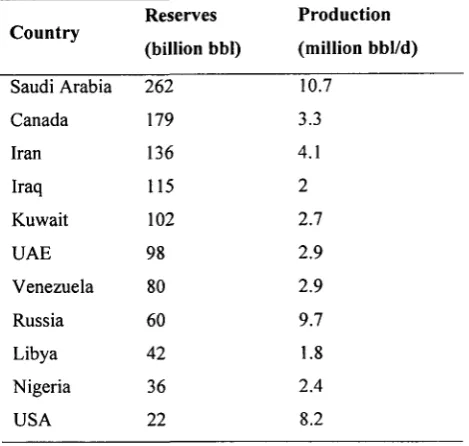
With the world's second largest oil reserves of 179 billion bbl [6] and a
production rate of 3.3 million bbl per day [7] as shown in Table I, Canada may not have
to worry about depletion of fuel reserves for decades, but dependence of its transport
sector on fossil fuel is beginning to raise serious concerns as Canadians face the impact
of worldwide escalation in oil prices. Rapid industrial development and urbanization of
growing economies, depletion of global fuel reserves, political factors and speculations
are amongst the many reasons why oil prices in Canada have almost tripled in the last 10
years. In the current scenario of global economy, the price of gasoline, shown in Fig. 2.4,
saw a sudden decline as far low as 2004 level. This exponential increase or sudden
fluctuation in fuel cost not only influences the expenditure on transportation, producing
financial strain on vehicle owners, but also has a cascading effect on the prices of all
TABLE 2.1
STATUS OF GLOBAL OIL RESERVES AS OF 2007 Reserves Production Country
(billion bbl) (million bbl/d) Saudi Arabia
Canada Iran Iraq Kuwait UAE Venezuela Russia Libya Nigeria USA
262 179 136 115 102 98 80 60 42 36 22
10.7 3.3 4.1 2 2.7 2.9 2.9 9.7 1.8 2.4 8.2
Fig. 2.4. Regular unleaded gasoline retail price by cities in Canada.
2.1.2 Degradation of Air Quality Due to Vehicular Emissions
An equally alarming consequence of petroleum combustion in transportation is
the emission of C02, and toxic pollutants including CO, NOx, hydrocarbons and
particulate matter that are known to produce adverse health effects. Canada is amongst
the ten highest CO2 producing nations in the world with a per capita annual emission
close to 22 tonnes.
In an effort to reduce these emissions, Canada is systematically replacing coal
based electricity generation by hydro and nuclear power plants. However, rapidly
increasing passenger transportation and consumer trend shifting towards minivans, sport
utility vehicles and small trucks have led to an increase in fuel consumption. These
heavier vehicles with lower fuel efficiency emit on average 40% more greenhouse gases
per kilometre than passenger cars [8], playing a pivotal role in continued deterioration of
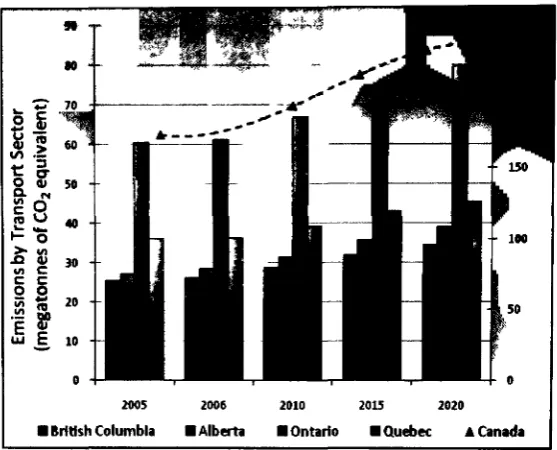
air quality. Figures 2.5 and 2.6 show that transport sector is the single largest source of
greenhouse gas in Canada, accounting for about 25% of total emissions within which
light-duty vehicles are the highest contributor to air pollution, emitting more than 11% of
the total CO2 in Canada [9]. Despite preventive efforts, emissions from transport sector
alone rose by about 44 megatonnes, or 32%, in the last fifteen years with a huge 24
megatonne increase in the emissions from light-duty gasoline trucks [10]. In December
1997, Canada and other developed countries negotiated the Kyoto Protocol at the United
Nations Framework Convention on Climate Change. The protocol commits Canada to
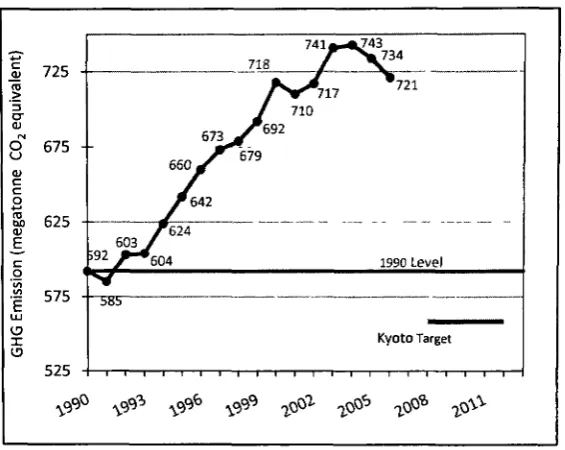
reduce its greenhouse gas emissions to 6% below 1990 level, indicated in Fig. 2.7, during
the five-year period from 2008 to 2012. However, if the current emission trend by
transportation continues, greenhouse gas emissions in Canada are expected to exceed
v- ^ ——3 60 1
-2 *
o ST= 8
50
-£
w 40 •
O
<Sj 30
-S *> + 1
100
SO
10
2005 I British Columbia
2006 2010 2015 2020
• Alberta • Ontario • Quebec A Canada
Fig. 2.5. Projected annual CO2 emissions by province.
y Electricity & Heat Generation • Industry
M Commercial & Residential
• Agriculture, Waste & Land Use • Fugitives
H Transport
Pipeline 5%
Off-Road 14%
Heavy Duty Gasoline Vehicles
21X ,
Others
> <T 01 O u ai c c o re aa <v E_ c 0 E UJ 13 X IS
V^° ^ ^ ^ tffr tffr T0O% ^
Fig. 2.7. Annual GHG emissions in Canada.
2.1.3 Health Risks Associated with Vehicular Emissions
Toxic emissions from fossil fuel combustion particularly in vehicles are not only
linked to climate change but also have a significant impact on air quality and health,
resulting in increased hospital admissions, respiratory illnesses and premature deaths,
especially in urban areas. Carbon monoxide is known to inhibit the ability of blood to
carry oxygen and may cause damage to central nervous system, nitrous oxides exacerbate
asthma, affect the lungs and increase susceptibility to respiratory infections, and
emissions of un-burnt particulate matter cause shortage of breath, worsen cardiovascular
diseases and cause lung cancer. The Canadian Medical Association (CMA) has recently
released data that predicts the annual death toll caused by air pollution to reach 21,000 in
2008. The CMA warns that 710,000 more people will lose their lives by 2031 due to
long-term exposure to air pollution and the count for acute short-term effects will reach
90,000 deaths. Children are particularly vulnerable since they breathe faster than adults
and inhale more air per pound of body weight. Air pollution is known to exacerbate the
condition of people with respiratory and cardiovascular diseases that are among the
leading causes of hospitalization and almost 80,000 deaths every year [11]. Canadians are
725 675 --625 673 660 jf /M2
^ 6 2 4 603 /
5 9 2 > - * 6 0 4
718 f
fSrin
J 710 ^ ^ 6 9 2
679
» 7 4 3 ^ V 7 3 4
* 7 2 1
1990 Level
575
E T C 585
also suffering the economic impact of air pollution as higher health care expenditures,
non-attendance of ill workers and several other factors have cost the country more than
$10 billion this year and according to the CMA, the cumulative total between 2008 and
2031 is expected to reach $300 billion. People are now recognizing the economic
constraints of fossil fuel-based vehicles and the grave impact of fuel combustion on the
Canadian environment and public health.
Attention is, therefore, focused towards the development and promotion of
advanced vehicular technology and alternative fuels that can reduce dependency on fossil
fuels in order to de-link transportation demand from fuel consumption and emissions.
Amongst several possible alternatives, hybrid vehicle technology has proven to be the
most commercially viable solution to conventional transportation.
2.2 Hybrid Electric Vehicles as a Fuel-Efficient Alternative
Hybrid electric vehicles offer an environment-friendly and fuel-efficient
alternative to gasoline fueled vehicles by combining an electric motor based drivetrain to
the conventional internal combustion engine (ICE) driven propulsion. This gives HEVs
significantly higher fuel economy and lower emission compared to ICEVs with an
extended range and better performance than electric vehicles. These benefits have
prompted the leading car manufacturers around the world to develop hybrid vehicles,
most of which are available in Canada today. As the leading names in auto industry
compete to market high performance hybrid vehicles, Canadian consumers now have a
wide selection of hybrid models from to choose. The availability of the Toyota Prius and
hybrid versions of the Toyota Camry, Chevy Malibu, Nissan Altima and Honda Civic,
sports utility vehicles (SUVs) such as the Ford Escape, Toyota Highlander and GM's
Saturn Vue, and even luxury cars such as the Lexus GS 450h is an indication that hybrid
technology is now ready to serve all types of consumer expectation.
2.2.1 Toyota Prius
It is the first mass-produced HEV with global sales of over 1 million units since
its launch in 1997, nearly 60% of which have been in North America. The Prius, shown
in Fig. 2.8(a), has sold over 13,000 units since the launch of its generation I in Canada in
2001. Its series-parallel powertrain integrated a 1.5-litre engine with a 33 kW motor that
was later upgraded to 50 kW in the generation II introduced in 2004. The 2004 model
featured a hatchback design, a lighter 201.6 V NiMH battery, higher system voltage of up
to 500 V and improved fuel economy of 4.9/5.2 L/100 km for city/highway driving. It is
now a part of the taxi fleet in Victoria and Vancouver in British Columbia (BC). The
third generation Prius is expected to have faster acceleration, improved fuel economy, a
1.8 L engine and net drivetrain power of 119 kW
2.2.2 Toyota Camry Hybrid
Acknowledged as the 2007 Canadian Car of the Year by Automobile Journalists
Association of Canada, the Toyota Camry Hybrid sold 5,802 units in 2007, accounting
for 20% of all Camry sales in the country. It is the most fuel-efficient sedan available
today, giving a fuel economy of 7.12 L/100 km for city and 6.92 L/100 km highway
driving. With a 108 kW motor and a 244 V NiMH battery on board, this full hybrid,
shown in Fig. 2.8(b), can accelerate from 0 to 100 km/h in 8.4 s with 80-120 km/h
passing move at 6.8 s. It is this combination of rapid acceleration, good fuel economy and
spacious interior that make Camry Hybrids widely popular.
2.2.3 Ford Escape Hybrid
The escape hybrid, shown in Fig. 2.8(c), was launched in 2004 and is considered
to be the most fuel-efficient SUV in Canada. A powerful 99 kW engine in this full hybrid
is coupled with a 75 kW motor to enable high acceleration resulting in a quality driving
experience similar to the standard Escape, yet maintaining a fuel economy that even beats
many subcompact gas-powered vehicles. Improved drivetrain management software in
the recent Escape Hybrid ensures a smooth drive and the vehicle boasts of a smarter,
more comfortable interior than earlier models. However, the driver's side window in the
cargo area is smaller to accommodate a ventilation slot for the high voltage battery.
2.2.4 Honda Civic Hybrid
This mild hybrid, shown in Fig. 2.8(d), was introduced in Canada in 2006. It
couples a 1.3-litre gasoline engine with a 15 kW motor. The motor provides assistance to
the engine in high vehicle power demand under acceleration and drives the vehicle on its
own at low speeds after which the engine takes over. Although slightly sluggish with an
acceleration time of 14.9 s from 0 to 100 km/h, they are highly fuel-efficient and are now
part of the courier fleets in Vancouver.
2.2.5 Chevy Malibu Hybrid
The Chevy Malibu's mini hybrid in Fig. 2.8(e) employs a relatively small 2.5 kW
motor during idling where the engine is shut off and for regenerative braking. As a result,
the vehicle size and performance resembles its non-hybrid version and there is little
improvement in fuel economy and a high emission rating for a hybrid.
(a) (b)
(c) (d)
(e)
Fig. 2.8. Hybrid vehicles on the Canadian market, (a) Toyota Prius. (b) Toyota Camry Hybrid, (c) Ford Escape Hybrid, (d) Honda Civic Hybrid, (e) Chevy Malibu Hybrid.
2.3 Emission and Cost Saving Analysis of Hybrid Cars
To examine the cost effectiveness and emission levels of HEVs, a comparative
assessment of hybrid cars with their corresponding standard counterparts was conducted.
The aim of this study is to determine the amount of emissions that vehicle owners can
save by driving a hybrid car. The study also evaluates the effective cost of owning and
driving a hybrid car to determine the number of years it takes for HEV models recoup
their high initial cost. The analysis was conducted for a vehicle life of seven years,
assuming it travels 24,000 kilometres every year, 55 percent of which was covered in city
driving and 45 percent on the highway.
2.3.1 Cost Savings by Hybrid Vehicles
The lifetime cost analysis evaluates the expenditure on purchasing, operating and
maintaining a 2008 hybrid model and its non-hybrid counterpart to determine the hybrid
car's breakeven point. The estimate encompasses the purchase price of the vehicles in
Canada, taking resale value into account, expected maintenance charges and total fuel
expense at the end of vehicle life. The base price of the hybrid models were taken from
the manufacturer's suggested retail price (MSRP) in Canada. The price of vehicles,
including hybrid versions are higher in Canada in comparison to United States. The
Alternative Fuels and Advanced Vehicles Data Centre (AFDC) under the US Office of
Energy has developed estimation models to determine the resale value of vehicles in
successive years. Since hybrid vehicles are new in the market and their technology is
rapidly evolving, it is difficult to make an accurate prediction of what their resale values
will be several years in the future. However, it is possible to determine a good estimate
based on the initial price, years in use and annual mileage. This estimation model was
used to calculate the resale values of hybrid cars in Canada for seven successive years.
Maintenance cost on commercial hybrids was obtained from a maintenance history of test
results from fleet data issued by US Department of Energy. Since the gasoline prices
have fluctuated drastically in the last few months, the annual fuel cost spent on vehicles
has been calculated for gasoline price of Cdn $1.35/litre and Cdn $0.80/litre, which were
the official retail price of gas in Canadian cities in September and December 2008
and annual fuel cost. From these values of retail vehicle price, resale value for every
consecutive year and annual maintenance and fuel expenditure, the total cost of owning
and driving conventional vehicles and their hybrid versions was determined. Figures 2.9
through 2.13 show the progressive difference in the cumulative spending for successive
years on HEVs and conventional cars from some of the leading automakers. Since
calculations are made by subtracting annual cost on a conventional car from that of its
hybrid version, a positive number indicates the amount of savings made by an HEV
compared to its counterpart. The Prius and Camry Hybrids, due to their exceptionally
good fuel economy and smaller difference in cost from their non-hybrid versions, reach
breakeven within three to four years. The Ford Escape Hybrid, on the other hand, due to a
much larger price difference from its non-hybrid version does not start paying back even
after seven years.
TABLE 2.2
MSRP AND ANNUAL FUEL COST OF VEHICLES
MSRP Manufacturer 2008 Model
(CdnS)
Yaris 14,945 Toyota
Prius 27,600 Escape 25,000 Ford
Escape Hybrid 35,000
Civic 20,700 Honda
Civic Hybrid 27,000 Camry 25,900 Toyota
Camry Hybrid 32,000 Altima 25,000 Nissan
Altima Hybrid 34,000
Fuel Economy Annual Fuel Cost
city/hwy at $0.80/1 at $1.35/1
(1/100 km) (Cdn$) (Cdn$)
8.1/6.7 1,442 2,439 4.9/5.2 972 1,645
$4,681
(a)
(b)
Fig. 2.9. Cumulative annual savings for Toyota's Prius over Yaris. (a) Gas price Cdn $1.35/1. (b) Gas price Cdn $0.8/1.
(a)
(b)
(a)
(b)
Fig. 2.11. Cumulative annual savings for Honda's Civic Hybrid over Civic, a) Gas price Cdn $1.35/1. (b) Gas price Cdn $0.8/1.
(a)
(b)
(a)
(b)
Fig. 2.13. Cumulative annual savings for Nissan's Altima Hybrid over Altima. a) Gas price Cdn $1.35/1. (b) Gas price Cdn $0.8/1.
It can be seen from Figs. 2.9 to 2.13 that if fuel economy is the motivation,
consumers have several hybrid options to chose from that can give considerable savings
on fuel cost to overcome the initial high cost of hybrid between five to seven years. On
the other hand, larger high performance hybrids may give the driving experience that
drivers demand, but such hybrids tend to deliver lower fuel economy by hybrid standards
and have much higher cost than their standard counterparts.
Determining the payback for the incremental cost of hybrid vehicles involves a
number of parameters, some of which are variable. The fuel cost is one such parameter.
With unpredictable fluctuation in gas prices, the number of years before the vehicle hits
breakeven may vary. Base price of hybrid cars also varies depending on technology
advancement and market demand; and the fuel economy of the car is affected by the
driving habits of vehicle owners. Financial incentives at the federal and provincial level
in the form of tax cuts and rebates also influence the payback period of hybrid cars by
bringing down their purchase price. It is notable that several factors influence the
accuracy of this analysis. One such factor is identifying the direct hybrid comparison.
Some hybrid cars such as the Toyota Prius do not have a direct basis for comparison. The
Toyota Yaris is the closest non-hybrid car manufactured by Toyota that is comparable to
the Prius, and is therefore used in the comparative assessment. Even hybrids with
standard versions, such as the Camry and its hybrid, are not identical in features and
accessories, which affects the cost of these vehicles. These variables have to be kept in
consideration while drawing any conclusion from the analysis discussed above.
2.3.2 Lifetime Emission Savings by Hybrid Vehicles
Irrespective of their cost, the most important feature that hybrid vehicles offer is
the drastic reduction in vehicular emissions. In order to determine the emission savings
that can be achieved in a lifetime of seven years with annual mileage of 24,000 km by
replacing conventional vehicles with hybrids, emissions from hybrids and gas powered
vehicles were calculated for 55 percent city and 45 percent highway driving based on
their respective fuel economies. Since combustion of one litre of gasoline emits 2.4
kilograms of carbon dioxide (CO2) [12], the consequent emissions from vehicles in their
TABLE 2.3
LIFETIME EMISSION SAVINGS BY HYBRID VEHICLES
Manufacturer 2008 Model Fuel Economy
city/hwy
(1/100 km)
Yaris 8.1/6.7 Toyota
Prius 4.9/5.2 Escape 10.1/7.2 Ford
Escape Hybrid 5.8/6.4
Civic 9.4/6.5 Honda
Civic Hybrid 5.8/5.2 Camry 11.2/7.6 Toyota
Camry Hybrid 7.1/6.9 Altima 10.2/7.6 Nissan
Altima Hybrid 5.6/5.9
Annual Lifetime Emission
Emissions Emissions Savings
(kilograms) (tonnes) (tonnes)
4,206 29.44 9.59 2,837 19.86 5,079 35.55
11.24 3,473 24.31 4,560 31.91
9.95 3,139 21.97 5,380 37.66
9.95 3,952 27.66 5,080 35.56
The emission calculations show that high fuel efficiency of hybrids not only
means less spending on gas but also translates into reduced CO2 emission. The analysis
indicates that at the end of seven years, all hybrids exhibit much lower emissions. The
Honda Civic Hybrid, for instance, emits 1,421 kg, or 31%, less C02 than the standard
Civic. This means that displacement of gas driven cars by hybrid vehicles can have a
significant impact on the air quality in Canada. In 2006, close to 870,000 passenger cars
were sold country wide. Amongst these, Honda Civic alone sold 70,028 units. If these
Civic units were to be replaced by their hybrid version, Canada could save 100 kilotonnes
of CO2 every year. Hence, while hybrid vehicles might not return the financial
investment soon enough, they have a huge impact in controlling vehicle emissions
countrywide to improve the air quality that can ensure a safer environment to safeguard
public health.
Despite this significant benefit of HEV technology, sales of hybrid units in
Canada continue to remain low. Close to 900,000 passenger cars were sold countrywide
in 2007 out of which HEVs could penetrate the market with a share of merely 1.6%.
There are several reasons associated with the slow market diffusion of hybrid technology
High initial cost, presumably poor acceleration, limited cargo and passenger space,
availability of spare parts and technicians and long waiting periods for vehicle delivery
are some of the causes of consumer hesitation in adapting HEVs. Overcoming these
barriers is a challenging task that calls for a well devised approach that not only requires
the formulation, regulation and implementation of policies, incentive strategies and
promotional campaigns to support and encourage hybrid vehicles but also requires
strenuous efforts towards the technological development of hybrid drivetrain systems so
that the drive performance and operational features of hybrid cars can compete with the
2.4 References
[I] World Energy Outlook 2004, International Energy Agency (IEA).
[2] International Energy Annual 2005, Energy Information Administration. [Online].
Available: http://www.eia.doe.gov/iea/
[3] World Health Report 2002, Reducing Risks, Promoting Healthy Life, World Health
Organization (WHO).
[4] Statistics Canada Report: 2006 Annual Canadian Vehicle Survey, Catalogue no.
53-223-XIE, Aug. 2007
[5] Statistics Canada Report: Energy Statistics Handbook - Fourth Quarter 2007,
Catalogue no. 57-601-X, April 2008.
[6] United States Energy Information Report: World Proved Reserves of Oil and
Natural Gas, Jan. 2007.
[7] US Energy Information Administration Report: International Energy Outlook
2008, Report no. DOE/EIA-0383, June 2008.
[8] Environment Canada Report: Canadian Environmental Sustainability Indicator
2006, Catalogue no. 16-251-XIE, Nov. 2006.
[9] Government of Canada Report: Canada's Energy and GHG Emissions Projections
Reference Case: 2006-2020, March 2008, http://www.ee.gc.ca/default.asp?lang=En
&xml=75038EBC-lBC5-4960-9016-3BEE0D9DA6El, accessed on July 14, 2008.
[10] Environment Canada Report: Canada's 2006 Greenhouse Gas Inventory,
http://www.ec.gc.ca/pdb/ghg/inventory_report/2006/som-sum_eng.cfm, accessed
on July 14,2008.
[II] Statistics Canada Report: Mortality, Summary List of Causes 2004, Catalogue no.
84F0209XIE, April 2007.
[12] Unites States Environmental Protection Agency Report: Emission Facts,
EPA420-F-05-001, Feb. 2005.
3 DEVELOPMENT OF POLICIES AND STRATEGIES TO
PROMOTE HEV SALES IN THE MAINSTEAM MARKET
Transportation has always been critical to the development and growth of the
Canadian economy and now, more than ever before, efficiency and sustainability are
becoming the top objectives, particularly in on-road transportation. Hybrid technology
has been recognized as a commercially viable, fuel-efficient alternative to conventional
transportation that can help cut down fossil fuel dependency and reduce toxic and
greenhouse gas emissions. Although there are several varieties of HEVs manufactured by
some of the leading automakers around the world, most of which are available in Canada
today, market diffusion of hybrid cars continues to remain slow.
3.1 Factors Affecting Consumer Acceptance of Hybrid Vehicles
There are several factors influencing hybrid vehicle sales in Canada. These factors
that can broadly be categorized into three areas discussed in this section.
3.1.1 Financial Limitations
The high initial cost of hybrids is main cause of low sales. Most hybrids cost
seven to ten thousand dollars more than their non-hybrid versions or vehicles of the same
class. This increase in cost is attributed to low demand and higher cost on additional
electric components, particularly the battery. The Ford Escape Hybrid, for example costs
approximately $35,000 compared to the standard Escape that costs approximately
$25,000. In some cases this sharp difference in initial price makes it difficult for hybrids
to payback this cost differential through fuel savings even after ten years. Car prices in
are higher in Canada compared to United States and the additional cost increase in
hybrids discourages consumers to choose HEVs. Moreover, consumers are concerned
about the expected maintenance expenditure. They are under the impression that battery
replacement can cost them up to $3,000.
These financial limitations compel buyers to shy away from the purchase of
hybrid cars since many people are reluctant to pay the price just for better emission