Normative data from Australian university students on Schommer's (1990) Epistemological Questionnaire
Keis Ohtsuka, Joe Mallamace, Marini Milonas, & Anthony Scicluna Victoria University, Australia
Paper presented at the 1996 Educational Research Association (Singapore)/Australian Association for Research in Education Joint Annual Conference, Singapore, 25-29 November 1996.
Abstract
The aim of this study was to produce normative data for an Australian
sample on Schommer's (1990) Epistemological Questionnaire [Schommer, M. (1990). Effects of beliefs about the nature of knowledge on
comprehension. Journal of Educational Psychology, 82, 498-504]. The original questionnaire was administered to a small number of
participants and feedback was sought. A revised version of the
Epistemological Questionnaire was then developed and a draft was sent to Schommer for comments. A sample of 150 Australian university students was collected using the revised version of the Epistemological Questionnaire. The results suggest that there are four similar
underlying factors comprising beliefs in (1) inability to learn to learn, and success is not related to hard work, (2) learning is innate, quick, and one-step process, (3) seeking simple answer and avoid
ambiguity and integration of knowledge, and (4) certainty of knowledge, dependence on the authority and reluctance to criticise it. The
implication of these findings from an Australian sample may suggest that epistemological beliefs among Australian university students are similar to those of the American students. With a slight modification, Schommer's (1990) Epistemological Questionnaire serves as an effective tool to assess students' beliefs regarding learning and the nature of knowledge.
Normative data from Australian university students on Schommer's (1990) Epistemological Questionnaire
The idea that students' beliefs about the nature of knowledge and learning may directly influence how they approach learning is not entirely new (e.g., Perry, 1968; Schommer, 1994b). Any teachers with substantial teaching experience could intuitively agree that this
In the past several years, especially in the United States educational research community, an emerging interest and conceptualization of epistemological beliefs and their role in learning has been recorded (see review by Schommer, 1994a) . The emerging interest on epistemological beliefs and their role in learning also reflects a natural progression of a schema theory which emphasised the role of general knowledge structure (background knowledge) in comprehension processes. The role of schemas or background knowledge in the
comprehension has been a dominant theme in comprehension research and set the tone for empirical research since the mid-70's.
theory has shown earlier on other types of background knowledge, the degree of sophistication and complexity of such schemas directly influence the outcome of learning.
Perry (1968) proposed a nine-stage intellectual progression model that students go through in the process of becoming sophisticated learners. At the beginning stages, students perceive knowledge as either correct or incorrect and believe that experts know the answer. This dualism evolves into recognition of conflicting views among experts. At this stage however, knowledge acquisition is nothing but a process of finding the right answer among conflicting views. Dualism eventually evolves into realisation of multiplicity of knowledge; that is,
students' preferred view is as equally good as other points of view. In the next stages, students discover a notion of relativism.
`Correctness' of knowledge depends on various contexts and is relative. In the final stage, Perry claims that students learn to make a strong yet tentative commitment to some ideas, while at the same time, acknowledging the multiplicity of knowledge.
Earlier attempts in finding empirical support for Perry's (1968) stage model was not entirely successful (e.g., Glenberg & Epstein, 1987; Ryan, 1984) but there is evidence suggesting that students'
epistemological beliefs influence mathematics problem solving (Schoenfeld, 1983; 1985) or predict students' persistence in a difficult learning task (Dweck & Leggett, 1988).
Schommer (1990) initiated the ground breaking research on
epistemological beliefs and their role in text comprehension in which she reported that readers whose epistemological beliefs are dualistic (knowledge is right or wrong) and rely on authoritative account for evaluating knowledge (experts know the answer) tend to mistakenly conclude that there is a conclusion after reading a paragraph which presents only opposing view points without definite conclusions. Schommer (1990) reports that the higher the beliefs in innate learning, simple knowledge, quick learning, and certainty of knowledge, the higher the students' tendency to subscribe to a `simpler' view of the world. This research has clearly shown that epistemological beliefs or a schema regarding the nature of knowledge directly influence the outcome of comprehension and learning. Her research generated a considerable level of interest on epistemological beliefs and
metacognition in learning processes and produced a series of research on related issues such as epistemological beliefs in mathematical text
comprehension (Schommer, Crouse, & Rhodes, 1992), academic performance among secondary students (Schommer, 1993b), postsecondary students (Schommer, 1993a), comparison of beliefs between gifted and non-gifted high school students (Schommer & Dunnell, 1994), and domain
independentness of epistemological beliefs (Schommer & Kiersten, 1995). To measure epistemological beliefs, Schommer (1990) developed the Epistemological Questionnaire (second version) first for American university students and demonstrated the existence of an
educational researchers' attention in North America, the
Epistemological Questionnaire has not yet been fully validated nor are normative data on epistemological beliefs collected outside the United States.
The aims of the current study were to develop an Australian version of M. Schommer's (1990) Epistemological Questionnaire, to obtain normative data from Australian university students, and to examine the results of a confirmatory factor analysis to verify the existence of similar epistemological beliefs structure among Australian students. The current project is has not yet concluded and the results reported here are preliminary.
Method Participants
The participants were obtained from universities around Melbourne, Australia. There were a total of 150 participants (60 Male and 90
Female). The age range of respondents were between 18 to 39 (M = 20.2, SD = 3.17). All participants were currently enrolled in the
undergraduate university level. The participants were recruited using a convenience sampling method. Demographic information and cultural background of participants were recorded. In this paper, however, these factors were not analysed since the majority of respondents were Australian-born with some links with another countries.
Materials
Schommer's (1990) Epistemological Questionnaire (Second Version) was used after a minor editorial change was made in order to make it clear to Australian respondents. The questionnaire, consisting of 63
statements, was designed to measure individual's epistemological beliefs. A five-point scale was used to indicate a respondent's degree of agreement with each statement. Statements in the questionnaire can be grouped into 12 subsets regarding epistemological beliefs: Seek single answers, Avoid integration, Avoid ambiguity, Knowledge is certain, Depend on authority, Don't criticise authority, learning ability is innate, Can't learn how to learn, Success is unrelated to hard work, Can learn the first time, Learning is quick, and Concentrated effort is waste of time.
Procedure
Phase 1 of this project was to develop an `Australian' version of
Schommer's Epistemological Questionnaire. The original Epistemological Questionnaire was presented to six volunteer participants. The
volunteers were interviewed individually and instructed to report any ambiguity or questions that they may have. Interpretation of
statements and answers were also recorded. Questions and responses obtained at interviews were directly sent back to the author of the Epistemological Questionnaire for clarifications and comments via electronic mail. Then, mutually agreed changes, mostly minor changes in phrase and expressions unfamiliar to Australian students, were implemented before the start of the data collection.
In Phase 2, the Revised Epistemological Questionnaire was administered to 150 university students.
Results
First, statements with negative valence were recoded so that the higher number on a scale always represents the more naive or the simpler epistemological beliefs. A confirmatory factor analysis was used to identify factor structure in the data. The procedure for calculating epistemological factor scores was identical to Schommer (1990). Twelve subset scores were calculated by averaging scores for all statements within a subset. These scores were then analysed through a principal varimax factor analysis on Statistical Package for Social
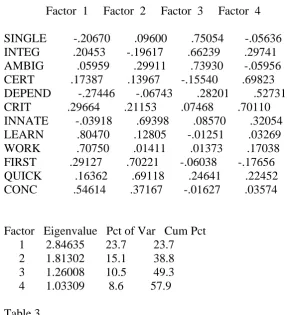
subsets for the entire sample. Retaining factors with Eigenvalues larger than one (minieigen rule), four factors were extracted that account for 57.9% of variance. Table 2 presents the rotated factor solution. Factor 1 relates to attitudes regarding knowledge and learning correlates highly with `Can't learn how to learn,' `Success is unrelated to hard work,' and, to a lesser extent, `Concentrated effort is useless' which accounts for 23% of variance. In essence, Factor 1 represents `lazy' or a fatalistic view of learning. Factor 2
correlates highly with `learning ability is innate,' `Can learn the first time,' `Learning is quick' and accounts for 15.1% of variance (eigenvalue 1.81). In other words, Factor 2 represents emphasis on innate ability in learning and a simplistic model of learning
`Avoid integration,' and `Avoid ambiguity' representing a preference towards a dualistic view of knowledge being either right or wrong. Factor 3 accounts for 10.5% of variance (Eigenvalue 1.26). Finally, Factor 4 correlates highly with a belief that `knowledge is certain,' `depend on authority,' and `avoid criticising authority.' Factor 4, therefore, represents a view that knowledge is either black or white with no grey area in between, and authority knows whether it is true or false. Factor 4 accounts for an eigenvalue of 1.03 which is about 8.6% of total variance.
Next, by multiplying standardized values of 12 subset variables which have been factor analysed with respective factor-score coefficients (see Table 3 for the factor score coefficient matrix), four factor scores (composite scales) for each respondent were calculated. The four factor scores for each respondent were then analysed as dependent variables to see if there are differences due to year level or gender. The effect of year level on composite scale scores were not
statistically significant in all four scales. However, there was a trend indicating that innate view of learning appears to decrease as the year level goes up. Regarding the gender difference, male students maintain a `lazy' or a fatalistic view of learning (Can't learn how to learn, Success is unrelated to hard work, Concentrated effort is useless) significantly stronger than female students, F(1, 147) = 4.98, p = .027.
Discussion
The results suggest the existence of four similar underlying factors. They are beliefs in (1) inability to learn to learn, and success is not related to hard work, (2) learning is innate, quick, and one-step process, (3) seeking simple answer and avoid ambiguity and integration of knowledge, and (4) certainty of knowledge, dependence on the authority and reluctance to criticise it. The overall trends of
extracted factor structure appear to be similar to Schommer's (1990) findings. On closer inspection, factor loading structure is not
entirely identical. A notable difference is that in our sample, a lazy fatalistic view of learning was independent of innate learning.
Furthermore, an innate view of learning appears to be correlated with a quick one-step model of learning. Our Factor 3 - `Knowledge is discrete and ambiguous,' is basically identical to Schommer's (1990) Factor 2. Our Factor 4 `Knowledge is certain and determined by authority' is identical to Schommer's (1990) Factor 4.
Male students, significantly more than female students, appear to maintain a view that success is unrelated to hard work and that one cannot learn to learn (inability to learn). Schommer and Dunnell (1994) report, in their study of gifted and non-gifted high school students, that boys are more likely than girls to have a belief in fixed ability to learn and quick learning. In addition, at the beginning of high school, there is no difference in participants'
genuine gender difference in epistemological beliefs between male and female students or a difference due to students' relative maturity. In light of Schommer and Kiersten's (1995) claim that epistemological beliefs are domain independent, an argument that the gender differences is a reflection of the different attitudes towards learning due to the field of specialisation (e.g., the majority of psychology students are female students) finds little support from previous research.
Table 1
Descriptive Statistics for 12 subsets
M SDN
SINGLE3.076.375150 INTEG2.885.423150 AMBIG3.161.623150 CERT2.641.502150 DEPEND2.912.592150 CRIT2.204.505150 INNATE2.758.628150 LEARN2.323.513150 WORK2.277.593150 FIRST2.298.660150 QUICK2.397.601150 CONC2.660.758150
Table 2
Rotated Factor Matrix Solution
Factor 1 Factor 2 Factor 3 Factor 4
SINGLE -.20670 .09600 .75054 -.05636 INTEG .20453 -.19617 .66239 .29741 AMBIG .05959 .29911 .73930 -.05956 CERT .17387 .13967 -.15540 .69823 DEPEND -.27446 -.06743 .28201 .52731 CRIT .29664 .21153 .07468 .70110 INNATE -.03918 .69398 .08570 .32054 LEARN .80470 .12805 -.01251 .03269 WORK .70750 .01411 .01373 .17038 FIRST .29127 .70221 -.06038 -.17656 QUICK .16362 .69118 .24641 .22452 CONC .54614 .37167 -.01627 .03574
Factor Eigenvalue Pct of Var Cum Pct 1 2.84635 23.7 23.7 2 1.81302 15.1 38.8 3 1.26008 10.5 49.3 4 1.03309 8.6 57.9
Table 3
Factor Score Coefficient Matrix:
Figure 1
Rotated factor space of Factor 1, `Inability to learn how,' Factor 2, `Learning is innate,' and Factor 3, `Seek single answer,' and `avoid ambiguity.'
References
Dweck, C. S., & Leggett, E. L. (1988). A socio-cognitive approach to motivation and personality. Psychological Review, 95, 256-273. Ryan, M. P. (1984). Monitoring text comprehension: Individual differences in epistemological standards. Journal of Educational Psychology, 76, 248-258.
Schoenfeld, A. H. (1983). Beyond the purely cognitive: Belief systems, social cognitions, and metacognitions as driving forces in intellectual performance. Cognitive Science, 7, 329-363.
Perry, W. G., Jr. (1968). Patterns of development in thought and values of students in a liberal art college: A validation of a scheme.
Cambridge, MA: Bureau of Study Counsel, Harvard University. (ERIC Document Reproduction Service No. ED 024315).
Schommer, M. (1990). Effects of beliefs about the nature of knowledge in comprehension. Journal of Educational Psychology, 82, 498-504. Schommer, M. (1993a). Comparisons of beliefs about the nature of knowledge and learning among postsecondary students. Research in Higher Education, 34, 355-370.
Schommer, M. (1993b). Epistemological development and academic performance among secondary students. Journal of Educational Psychology, 85, 406-411.
Schommer, M. (1994a). An emerging conceptualization of
epistemological beliefs and their role in learning. In R. Garner & P. A. Alexander (Eds.), Beliefs about text and instruction with text (pp. 25-50). Hillsdale, NJ: Erlbaum.
Schommer, M. (1994b). Synthesizing epistemological belief research: Tentative understandings and provocative confusions. Educational Psychological Review, 6, 293-319.
Schommer, M., Crouse, A., & Rhodes, N. (1992). Epistemological beliefs and mathematical text comprehension: Believing it is simple does not make it so. Journal of Educational Psychology, 84, 435-443. Schommer, M., & Dunnell, P. A. (1994). A comparison of epistemological beliefs between gifted and non-gifted high school students. Roeper
Review, 16 (3), 207-210.
Schommer, M., & Kiersten, W. (1995). Are epistemological beliefs similar across domains? Journal of Educational Psychology, 87, 424-432.
2. Program Description
This study reports a normative data obtained from the Australian
university sample on Schommer's (1990) epistemological questionnaire, which has been shown to assess university and high school students' beliefs about learning and knowledge. The results suggest that Australian university students have a similar belief structure regarding learning and knowledge as the American students do.
3. Biodata
education. Correspondence can be addressed to Keis Ohtsuka, Department of Psychology, St Albans Campus, PO Box 14428, MCMC, Melbourne, Vic 8001, Australia. Electronic mail can be addressed via his home page
http://cougar.vut.edu.au/~ohtke or sent to [email protected].
Joe Mallamace, Marini Milonas, and Anthony Scicluna received a Bachelor of Science degree in psychology at Victoria University in 1966. Joe