Demonetization Impact on Underpricing: An Empirical Study Based On NSE
Dr. Vinod Kumar
PGT Commerce, HES-II, DSE, Haryana
ABSTRACT
This empirical study is an attempt to gauge the level of underpricing or overpricing of Initial Public Offers in India after demonetization. The initial public offers offered (after demonization) during the period of 9 December 2016 to 30 June 2017 have been studied. The study observes the price behavior of twelve Initial Public Offers which have been offered after demonetization. The return on IPO has been computed by taking closing price of IPO on listing date and offer price of the IPO.
The price behavior of Initial Public Offers has been examined with the help of price indicators: Average Market Adjusted Abnormal Return (Avg. MAAR).
Key Words: Market Adjusted Abnormal Return, Initial Public Offers.
Introduction
On November 8, 2016 the Government of India announced to discontinue currency notes on Rs 500 &Rs 1000 to eliminate fake currency circulated in market and to curb the black money as per the Election Agenda of NDA. It was also an effort to turn India into cash less economy.
Due to demonetization GDP growth rate slowed down to 6.1 per cent in Q4 of financial year 2016-17 as come to 7.1 per cent in Q3 of the same year( Hindustan Times dated 1 June 2017).
Industrial production contracted in December 2016 due to a sharp decline in production of consumer goods confirming a demonetization led contraction in demand. The Index of Industrial Production (IIP) was 0.4 per cent lower in December 2016 from the same period ago.
The present study is attempt to check the impact of demonetization on pricing of Initial Public Offerings in India.
Review of Literature
issues were more underpriced than premium issues. Jankiramanan, S (2007) conducted a study on 116 IPOs issued by the companies in the Indian market during the period from 2000 to 2001. The study found that under- pricing exists in Indian Market. Kumar, SSS (2007) found underpricing of 26.35 per cent for a sample of 156 book-built IPOs offered during 1999-2006. Return on opening price was considered as the major determinant of underpricing. Shelly, Singh (2008) reported that the market adjusted initial return (MAIR), reputation of lead manager and age of the company have significant impact on level of subscription. Study also proved that underpricing is in existence in Indian IPO market. Oversubscription has the positive significant impact on underpricing. Age and Issue Size have significant negative impact. Reputation of the lead managers & dummy industry, both have no significant impact on underpricing. Sahoo, Seshadev&Rajib, Prabina (2010) covered 92 Indian IPOs issued during the period 2002- 2006. It is reported that on an average IPOs were underpriced by 46.55 per cent on the listing day. Kumar Vinod &DhandaNeelam (2013) examined 488 IPOs offered through BSE during 1993-2008, for both long term and short term price performance; the study proves existence of underpricing in Indian IPO market. Average market adjusted return & wealth relative are used as price performance indicators. The average market adjusted abnormal return has been reported 82.67 per cent on the listing of IPOs. All the twenty three sectors have shown existence of underpricing with more than one value of wealth relative. Kumar Vinod &DhandaNeelam (2013) in another study ofComparative Pricing Behavior between At Par & Premium Initial Public Offers In India, sample of the study constituted by adding 170 at par and 318 at premium IPOs during the period past 15 years (1993-94 to 2007-08). They also witnessed existence of underpricing in Indian capital markets. Kumar Vinod &DhandaNeelam (2013) in their study “Determinants of Under pricing: Indian Evidence” studied a total of 488 companies taking 166 Companies from 1993-94 to 1996-97 and 322 companies from 1997-98 to 2007-08 and studied the different factors affecting level of underpricing and reported that IPOs in Indian capital market are underpriced. NarangSahil& Kumar Vinod (2017) in study of underpricing of initial public offerings: An Indian Evidence considered a sample of 49 IPOs offered during 2014-16 proved that there is underpricing in Indian IPO Market. The Avg. MAAR was 14.63 per cent.
Research Methodology Objectives of the study:
The research has been conducted to attain the following objectives:
1. To ascertain the raw return of Initial Public Offers, as well as Market Adjusted Abnormal Rate of Return of Initial Public Offers;
2. To analyze the Market Price Performance of Initial Public Offers issued through Book Building; 3. To check the level of Underpricing in Indian capital markets after Demonetization.
Plan of the study:
Data Collection:
To achieve the objectives of the study, secondary data is used. The data has been collected from the sources such as: www.nseindia.com, various annual reports of SEBI, CMIE-Prowess database, Prime database, and several issues of The Economic Times& Hindustan Times.
Analysis Pattern of the Study:
With a view to know Average Raw Return on IPO (ARR), Return on Market Index (Rm) and Market Adjusted Abnormal Return (MAAR) of IPOs the following pattern is used:
Price Behaviour on Listing Day of Indian IPOs
To examine the price performance on listing day of Indian IPOs the market adjusted abnormal return of IPOs have been calculated as under:
Average Raw Return/Return on a Stock Ri = (Pi/Po)-1*100
Where, Ri (%)is the shareholders’ Average Raw Return, Pi is the closing price on the first day of trading and Po is the issue price.
Return on Market Index
The return on the market index Rm (%) during the same period is calculated as follows: Rm = (Pm1/Pm0)-1*100
Pm1 denotes the closing value of the benchmark index on the first trading day of the stock and Pm0 is the closing value on the benchmark index on the offer’s closing day. The BSE Sensex is used as the benchmark index.
Market Adjusted Abnormal Return MAAR= Ri-Rm
Market-adjusted abnormal return (%) is calculated as the return on the stock minus the return on a market benchmark (BSE-Sensex) over the same period.
Average MAAR= 1n ni=1MAAR
Hypothesis of the Study: H0: Average market adjusted abnormal return is not significant or there is no underpricing in Indian IPOs market.
Analysis and Statistics
different from zero. Therefore it is concluded that Indian IPO market remained underpriced during the study period. Demonetization could not change the nature of underpricing of the Indian IPO market.
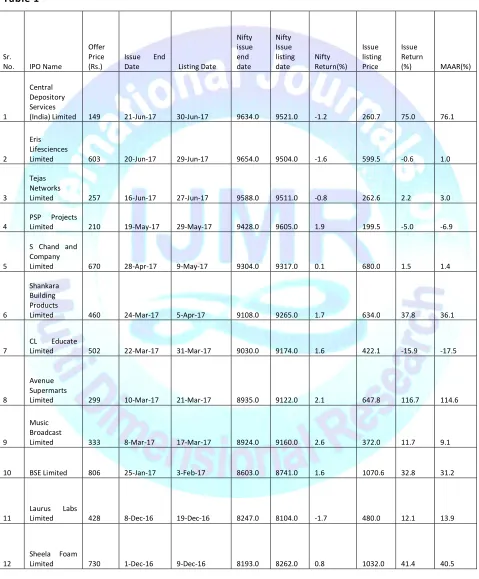
Table 1
Sr.
No. IPO Name
Offer Price (Rs.)
Issue End
Date Listing Date
Nifty issue end date Nifty Issue listing date Nifty Return(%) Issue listing Price Issue Return
(%) MAAR(%)
1
Central Depository Services
(India) Limited 149 21-Jun-17 30-Jun-17 9634.0 9521.0 -1.2 260.7 75.0 76.1
2
Eris Lifesciences
Limited 603 20-Jun-17 29-Jun-17 9654.0 9504.0 -1.6 599.5 -0.6 1.0
3
Tejas Networks
Limited 257 16-Jun-17 27-Jun-17 9588.0 9511.0 -0.8 262.6 2.2 3.0
4
PSP Projects
Limited 210 19-May-17 29-May-17 9428.0 9605.0 1.9 199.5 -5.0 -6.9
5
S Chand and Company
Limited 670 28-Apr-17 9-May-17 9304.0 9317.0 0.1 680.0 1.5 1.4
6
Shankara Building Products
Limited 460 24-Mar-17 5-Apr-17 9108.0 9265.0 1.7 634.0 37.8 36.1
7
CL Educate
Limited 502 22-Mar-17 31-Mar-17 9030.0 9174.0 1.6 422.1 -15.9 -17.5
8
Avenue Supermarts
Limited 299 10-Mar-17 21-Mar-17 8935.0 9122.0 2.1 647.8 116.7 114.6
9
Music Broadcast
Limited 333 8-Mar-17 17-Mar-17 8924.0 9160.0 2.6 372.0 11.7 9.1
10 BSE Limited 806 25-Jan-17 3-Feb-17 8603.0 8741.0 1.6 1070.6 32.8 31.2
11
Laurus Labs
Limited 428 8-Dec-16 19-Dec-16 8247.0 8104.0 -1.7 480.0 12.1 13.9
12
Sheela Foam
The Indian IPO market is underpriced because the average raw return as well as average market adjusted abnormal return is significantly different than zero at 5 percent level of significance. The null hypothesis, that the average market adjusted abnormal return is not significantly different than zero, is rejected.
Table 2
Summarised Position of Pricing Behaviour on Listing Day
Pricing Behaviour Sample Size
Underpricing 10
Overpricing 2
Total 12
Source: Data compiled by researcher
It has been across the world found that investors who purchased IPO shares on offering day have experienced positive returns on the first trading day after listing. It is indicating that these IPOs may have been priced at value less than their intrinsic or fair value. The results support the existence of significant underpricing in India. The results also confirm the findings of other Indian studies (Kumar, 1995), (Narasimhan, 1995), (Shah, 1995), (Madhusoodanan& Raju, 1997), (Singh& Mittal, 2003), (Kumar Vinod &DhandaNeelam, 2013) etc. But the level of underpricing is significantly lower as compared to other studies. Kumar vinod&DhandaNeelam reported 82% Average MAAR of 488 IPOs offered during 1993 to 2007.
Table 3
Descriptive Statistics
N Minimum Maximum Mean Std. Deviation
Offer Price (Rs.) 12 149 806 453.92 213.624
Nifty Return(%) 12 -1.7 2.6 .605 1.5600
Issue Return (%) 12 -15.9 116.7 25.806 38.1705
MAAR (%) 12 -17.5 114.6 25.202 37.9728
Valid N (listwise) 12
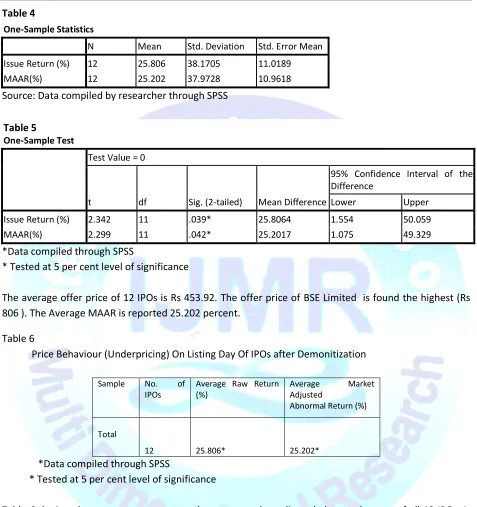
Table 4
One-Sample Statistics
N Mean Std. Deviation Std. Error Mean
Issue Return (%) 12 25.806 38.1705 11.0189 MAAR(%) 12 25.202 37.9728 10.9618
Source: Data compiled by researcher through SPSS
Table 5
One-Sample Test
Test Value = 0
t df Sig. (2-tailed) Mean Difference
95% Confidence Interval of the Difference
Lower Upper
Issue Return (%) 2.342 11 .039* 25.8064 1.554 50.059 MAAR(%) 2.299 11 .042* 25.2017 1.075 49.329
*Data compiled through SPSS
* Tested at 5 per cent level of significance
The average offer price of 12 IPOs is Rs 453.92. The offer price of BSE Limited is found the highest (Rs 806 ). The Average MAAR is reported 25.202 percent.
Table 6
Price Behaviour (Underpricing) On Listing Day Of IPOs after Demonitization
Sample No. of IPOs
Average Raw Return (%)
Average Market
Adjusted
Abnormal Return (%)
Total
12 25.806* 25.202*
*Data compiled through SPSS
* Tested at 5 per cent level of significance
Table 6 depicts the average raw return and average market adjusted abnormal return of all 12 IPOs. It depicts that the average raw return on the securities is 25.806 % and average market adjusted abnormal return is 25.202% which is significantly different than zero at 5 percent level of significance. It concludes that IPOs outperformed on the listing day after demonetization also. Therefore the investors invested in the IPOs earned a positive return on the listing day.
Conclusion
IPOs in India. The results of the study are in line with the other studies conducted in India. It is concluded that the average raw return of the IPO is 25.806 % and average market adjusted abnormal return is 25.202%
References
NarangSahil& Kumar Vinod (2017), “Underpricing of Initial Public Offerings: An Indian Evidence”, International Journal of Research in Finance and Marketing, Vol. 7, Issue 4, April 2017, pp 44-49.
Kumar Vinod and DhandaNeelam (2013), “Comparative Pricing Behaviour Between At Par & Premium Initial Public Offers in India”, International Journal of Management research, Vol. 1, No.2, pp. 12-23.
Kumar Vinod and DhandaNeelam (2013), “Determinants of Subscription: an empirical study of selected Indian IPOs”, International Journal of Research of IT & Management, Vol. 3, issue 12, pp. 34-43.
Kumar Vinod and DhandaNeelam (2013), “Determinants of Under Pricing: Indian Evidence”, International Journal of Management research, Vol. 1, No.2, pp. 120 -129.
Kumar Vinod and DhandaNeelam (2013), “Determinants of Under Pricing: Indian Evidence”, International Journal of Management research, Vol. 1, No.2, pp. 120 -129.
Kumar Vinod, DhandaNeelam, “An Evaluation of Initial Public Offers in India with Respect to Pricing Behaviour” Doctoral Thesis, Kurukshetra University, Kurukshetra, 2013
Loughran T& Ritter, J R (2003), “Why has IPO Under Pricing Changed Over Time?”, Working paper, University of Notre Dame and University of Florida.
Madhusoodan T P and Thiripalraju M (1997), “Underpricing in Initial Public Offerings: The Indian Experience”, Vikalpa, Vol. 22, No. 4, pp. 17-30.
Manigart S and Rogiers B (1992), “Empirical Examination of the Underpricing of Initial Public Offerings on the Brussels Stock Exchange”, Working Paper, Vlerick School for Management, University of Ghent.
Marchand J &Roufagalas J (1996), “Search and Uncertainty -Determinants of the Degree of Underpricing of Initial Public Offerings”, Journal of Economics and Finance, Vol. 20, No. 1, spring, pp. 47-64.
Mittal Anil, Gupta S. L.(2003), “Performance Evaluation of Equities in India” Doctoral Thesis, Kurukshetra University, Kurukshetra, 2003;
Rajan R and Servaes H (1997), “Analyst Following of Initial Public Offerings”, The Journal of Finance, Vol. 52, pp. 507-529.
Rock K (1986), “Why New Issues are Underpriced”, Journal of Financial Economics, Vol. 15, pp. 187-212.
Rydqvist K (1993), “Initial Public Offerings in Swede n”, Working Paper, Stockholm School of Economics.
SahooSeshadev&RajibPrabina( 2010), “After Market pricing Performance of Initial Public Offerings(IPOs): Indian IPO market 2002-2006”, Vikalpa, Vol. 35, No. 4, pp. 27-43.
Sehgal Shikha& Singh Balwinder(2007), “ The Initial and Aftermarket Performance of Indian IPOs”, The ICFAI Journal of Applied Finance, Vol. 13, No. 11, pp. 16 -36.
Singh Balwinder, Mittal R K(2002), “Performance Evaluation of IPOs in India” Doctoral Thesis, Kurukshetra University, Kurukshetra, 2002.