Volume
An investigation into the reiationship between
performance on tests neuropsychoiogical function
and performance on three everyday probiem-solving
tasks.
Michael Preisinger
Doctorate in Clinical Psychology University College London
ProQuest Number: U642411
All rights reserved
INFORMATION TO ALL USERS
The quality of this reproduction is dependent upon the quality of the copy submitted.
In the unlikely event that the author did not send a complete manuscript and there are missing pages, these will be noted. Also, if material had to be removed,
a note will indicate the deletion.
uest.
ProQuest U642411
Published by ProQuest LLC(2015). Copyright of the Dissertation is held by the Author.
All rights reserved.
This work is protected against unauthorized copying under Title 17, United States Code. Microform Edition © ProQuest LLC.
ProQuest LLC
789 East Eisenhower Parkway P.O. Box 1346
Table of contents
Table of contents... 1
Acknowledgements... 6
1. Introduction... 7
1.1. Background...7
1.2. Cognitive difficulties in everyday life after brain damage...8
1.3. Theories regarding the production of every day behaviour... 9
1.4. Executive Function... 12
1.4.1. Background... 12
1.4.2. Anatomical considerations...14
1.4.3. Processes underlying executive functions...14
1.4.4. Executive Function Tests... 18
1.5. Ecological Validity of neuropsychological tests...23
1.6. Relationship between performance on tests of executive function and performance in real life... 27
1.7. Rationale for this study and Hypotheses... 29
2. M ethod...33
2.1. Design... 33
2.2. Participants... 33
2.2.1. Inclusion criteria...33
2.2.2. Exclusion criteria...33
2.3. Procedure... 34
2.3.1. Ethical approval... 34
2.3.2. Recruitment of participants...34
2.4. Materials...36
2.4.1. Measures... 36
2.4.1.1. The Spot the Word Test...36
2.4.1.2. The Wechsler Abbreviated Scale of Intelligence... 37
2.4.1.3. Modified Card Sort Test...38
2.4.1.4. Brixton Spatial Anticipation Test... 39
2.4.1.5. Trail Making Test... 40
2.4.1.6. Modified Six Elements Test...41
2.4.1.7. Hayling Sentence Completion Test... 42
2.4.1.8. Shape Detection Screening Test... 44
2.4.1.9. Cube Analysis te s t... 44
2.4.1.10. Recognition Memory Test for Faces...45
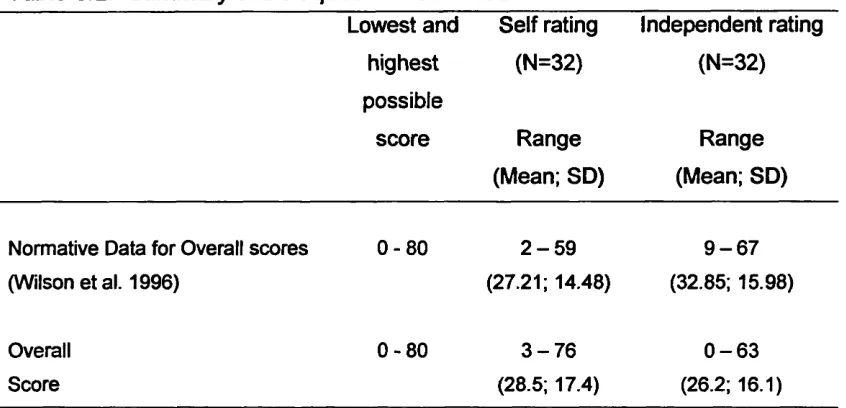
2.4.1.11. Dex questionnaire (Self rating, and Independent rating) 46
2.4.2. Activities of Daily Living Tasks... 47
2.4.21. Task 1 - Drink Making Task...48
2.4.2 2. Task 2 - Journey Planning Task... 50
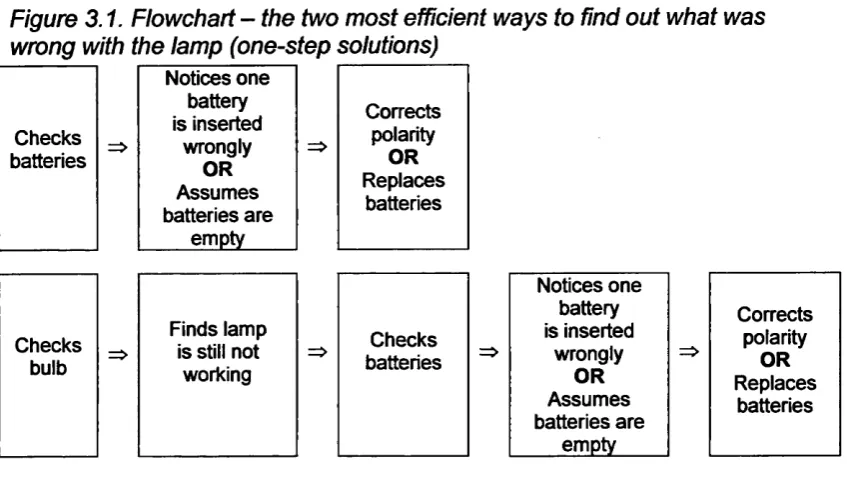
2.4 2.3. Task 3 - Lamp Fixing Task...53
3. Results... 55
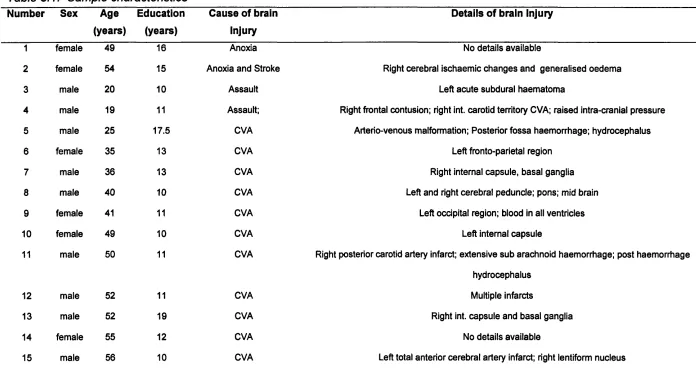
3.1. Sample characteristics... 55
3.2. Dysexecutive Questionnaire...58
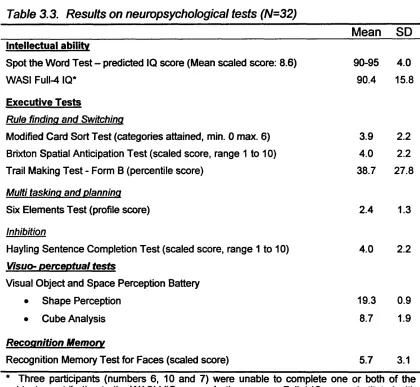
3.3. Neuropsychological measures of cognitive function...59
3.3.1. Results on neuropsychological tests... 59
3.4. Everyday problem solving tasks... 60
3.4.1. Drink Making Task...60
3.4.2. Lamp Fixing Task...63
3.4.3. Journey Planning Task... 67
3.6. Multiple regressions... 76
3.6.1. Drink Making Task... 76
3.6.2. Lamp Fixing Task... 77
4. Discussion... 79
4.1. Summary of aims of this study and its main findings... 79
4.1.1. Hypothesis 1 ...79
4.1.2. Hypothesis 2 ...86
4.2. Overall implications... 88
4.3. Coincidental finding...89
4.4. Methodological shortcomings of project...91
4.4.1. Correlational research...91
4.4.2. Sample size...92
4.4. Summary and Conclusion...93
References...95
Appendices... 100
Appendix 2.1.1. Ethics Committee Approval - Hillingdon Hospital...101
Appendix 2.1.2. Participant information sheet - Hillingdon Hospital... 103
Appendix 2.1.3. Informed Consent Form - Hillingdon Hospital...106
Appendix 2.1.4. Independent rater information sheet - Hillingdon Hospital...107
Appendix 2.2.1. Ethics Committee Approval - Northwick Park Hospital... 108
Appendix 2.2.2. Participant information sheet - Northwick Park Hospital... 109
Appendix 2.2.3. Informed Consent Form - Northwick Park Hospital ...112
Appendix 2.4.1 a. DEX questionnaire - Self rating...113
Appendix 2.4.1.b. DEX questionnaire - Independent rater... 114
Appendix 2.4.2.1. Drink Making Task - Photograph of set-up...115
Appendix 2.4.2 2. Lamp Fixing Task - Photograph of set-up... 116
Appendix 2.4.2 3.. Lamp Fixing Task - Detail photograph of set-up... 117
Abstract
This study set out to examine the relationship between performance on neuropsychological tests and performance on everyday-problem solving tasks.
Three everyday problem-solving tasks covering three domains of daily life were developed, and a battery of neuropsychological tests known to have an executive function component was selected. A within participants design was used and tasks and tests were administered to a group of thirty-two individuals (hospital inpatients and outpatients) with non-progressive brain- injuries.
Correlations between individual tests and everyday problem-solving tasks were examined and three multiple regressions (one for each of the everyday problem-solving tasks) carried out.
performance on everyday problem-solving tasks and on neuropsychological tests of executive function was observed.
The multiple regression analyses, carried out to explore the explanatory value of performance on the battery of neuropsychological tests for performance on the everyday problem-solving tasks, showed that, depending on the task, between one quarter and one third of overall performance were explained by the group of neuropsychological tests administered.
The study is best regarded as a pilot project on which to base further exploration of the association between performance on pure tests of neuro psychological functioning and performance on tasks of everyday problem solving.
Acknowledgements
This study would not have been possible without the generous cooperation, patience and support offered by a great number of individuals to whom I am very grateful.
Firstly there were the patients at Hillingdon and Northwick Park Hospitals who kindly agreed to participate in this study. They gave a substantial amount of their time to this project without being likely to benefit from it personally.
I also thank Dr. Shelley Channon for sharing her expertise and creativity in helping me to develop this project. I appreciated her being able to maintaining her belief in this project when I started to doubt it, her supervision, patience and gentle prodding when it became necessary!
Dr. Frances Clegg and Dr. Martin-Skelton Robinson were extremely supportive of the project and of me right from the start and remained so throughout.
I also thank my children Matt and Ilka for being so tolerant and understanding of my absent mindedness and unavailability.
1. Introduction
1.1. Background
Cerebro-vascular accidents and traumatic brain injuries as a consequence of accidents are major causes of severe disability in England and Wales.
Cerebro vascular accidents are the largest cause of severe disability in England and Wales, where annually approximately one hundred thousand people suffer their first stroke. Three hundred-fifty thousand people are affected by stroke at any one time (Kneebone and Dunmore, 2000).
Head injuries are the reason for approximately one million individuals presenting to Accident and Emergency departments in the United Kingdom every year. Of these, around ten percent are classified as moderate and severe, and less than five percent are referred to a neurosurgical unit. (Kay and Teasdale, 2001).
Improvements in medical care mean that more people who have suffered brain damage and who would have died as a consequence in the past, do now survive (Labi et al., 2003; Ponsford, 1995). Improved survival rates also mean that the number of people who experience impairments as a consequence of these events has increased, and that the level of impairment seen in survivors, be it sensory-motor, behavioural and/or cognitive, is often more severe than in the past.
1.2. Cognitive difficuities in everyday iife after brain damage
Depending on the localisation of brain damage, resulting deficits may be more focal, i.e. affecting more or less clearly circumscribed, specific cognitive functions, or more global, i.e. affecting a range of cognitive functions. Areas affected may include deficits in attention and speed of information processing, memory and learning, and higher order or executive functions to name, but a few (Ponsford, Sloan and Snow, 1995).
1,3. Theories regarding the production of every day behaviour
Following brain damage, people may find it difficult to carry out routine actions, often involving multiple steps, which posed little difficulty prior to the injury.
Shiffrin and Schneider (1977) made a distinction between routine and non routine behaviour, suggesting that well rehearsed and familiar actions rely on the activation of learned sequences of events. These sequences, stored in long-term memory, require few processing resources during their automatic execution. By comparison, non-routine or novel behaviour make more demands on processing resources since they require the conscious selection of appropriate component behaviours to achieve an overall goal.
This distinction is echoed in Shallice’s (1982, 1988) and Shallice and Norman's (1986) work. They propose everyday behaviour to be assembled from a number of schemas or scripts, i.e. hierarchically organised mental representations of action sequences. The model posits two systems coordinating the production of everyday behaviour: unfamiliar or novel tasks depend on a higher order Supervisory Attentional System, whereas performance of routine tasks is more reliant on a lower level Contention Programmer (Please see also section 1.4.3. “Processes underlying executive functions”).
Schwartz et al. (1993) conceptualise difficulties in everyday actions in terms of a disorder of executive function. In these authors' opinion, there is a
continuum of executive impairment, whereby, at the more severe end of the spectrum, planning and organisation even of routine activities of everyday life are affected. They refer to Luria’s (1966, cited in Schwartz et al. 1993) observation that, in a syndrome Luria (ibid.) referred to as ‘frontal lobe apraxia’, even well rehearsed routine actions may disintegrate into individual component actions that are no longer executed in their proper sequence. Schwartz et al. (1993) suggest that the deficit underlying such problems could negatively affect the online planning of action, i.e. there is a deficit in the processes responsible for activation and assembly of individual component behaviours, or schemas, into a coherent and purposive overall behaviour.
If the required action consists of partly routine and partly novel tasks, then familiar and task relevant information (schemas) can be accessed, whilst for the novel aspect of the task problem solving strategies, such as reasoning by logic or by analogy (comparing the present situation with a similar experience) have to be employed. Moreover, these authors suggest that the activation of higher-level representations (What am I doing?) may be important for successful completion of lower level procedures (How am I going to do it in this specific situation?).
i.4 . Executive Function
1.4.1. Background
The previous section showed that current models propose routine or everyday behaviour to be assembled from individual component behaviours. In order to select and assemble relevant component behaviours, higher-order processes, referred to as executive functions, are activated.
Fortin, Godbout and Braun (2003) note how wide-ranging and often eclectically used the term executive functions is. As outlined above, the term refers to a wide range of hypothetical constructs of higher-level cognitive processes, which are assumed to underlie an individual’s ability to produce “effective and contextually appropriate” (Spreen and Strauss, 1998; P. 171) and “independent, purposive, self-serving” (Lezak, 1995; P. 42) behaviour.
Cognitive functions subsumed under this term include initiation, cognitive flexibility, feedback utilisation, inhibition (Spreen and Strauss, 1998; Delis et al., 1992), concept formation, abstract thinking, organisation and regulation of behaviour (Delis et al., 1992), planning, hypothesis generation, decision making, judgement and self-perception (Spreen and Strauss, 1998).
functions. Planning is widely regarded as a key executive function, entailing the ability to think into the future, and to produce alternative responses to presenting situations. Decision-making describes one's ability to choose, from a range of options, one particular course of action. This, in the authors' view, involves a number of sub-tasks, such as accurate self-assessment, the ability to imagine a range of possible options, and to select and implement the most appropriate course of action. One aspect of decision-making is the ability to quickly compare and judge the relative merit of two or more possible courses of action. Finally, self-perception is about the ability to monitor and modulate one's behaviour.
Whilst the authors regard the notion of personality as too all encompassing to serve as a useful executive function, they do recognise that the dysexecutive syndrome associated with frontal lobe injuries is also frequently associated with personality changes. A number of hallmark case studies, such as those of Phineas Gage (Harlow, 1848) and EVR (Esiinger and Damasio, 1985), illustrate the striking effect brain injuries can have on an individual's personality. Such personality changes in the context of the dysexecutive syndrome are presumably best understood as an expression, or symptom, of the combination of impaired executive processes and functions outlined earlier.
Tranel et al. also mention creativity and artistic expression as deserving to be mentioned under the heading of ‘Executive Function', but there appears to be little agreement as to how to measure these. In addition, they find broad
agreement on the view that executive functions develop early on in life, from approximately three years of age onwards with an acceleration in maturation between the ages of six and twelve, and decline with age, especially in those aged sixty and over.
1.4.2. Anatomical considerations
As outlined above, there is a range of cognitive functions referred to as executive functions and there is a close connection between these functions and the frontal and prefrontal areas of the human brain, which has led to the development of the term ‘frontal lobe syndrome’. However, various authors (e.g. Rabbitt, 1997) have alluded to the observation that impaired executive functioning is often, but by no means always associated with frontal lobe damage. In an attempt to emphasize the functional aspects of the syndrome, rather than the possible localisation of the underlying damage, Baddeley and Wilson (1988) have proposed the term ‘frontal lobe syndrome’ be replaced by the term dysexecutive syndrome’.
1.4.3. Processes underlying executive functions
The literature refers to a number of cognitive processes underlying executive function: Humphreys, Forde and Riddoch (2001) refer to the role of working memory, and Fortin, Godbout and Braun (2003) suggest that, amongst recent approaches, investigating the roles of prospective memory, script generation and the role of the ‘Central Executive System’ (Baddeley and Hitch, 1974) show most promise.
Humphreys, Forde and Riddoch (2001) suggest that a working memory module modulates task performance. In routine behaviour, basic level components are well represented within overall action schemas. Therefore their execution places fewer demands on working memory. In unfamiliar behaviour basic level components are less well represented. In order to be able to choose the most appropriate component behaviour a range of possibilities has to be temporarily represented, which makes additional demands on working memory. Consequently, if working memory is already impaired, then the ability to select an appropriate action schema is also impaired.
Prospective memory, i.e. the ability to remember to do something at a specific point in the future, relates to several executive functions (Me. Daniel et al., 1999; cited Fortin et al., 2003). It is considered to be an important contributor to overall performance on everyday tasks (Marsh et al, 1998; Van den Broek et al., 2000; both cited Fortin et al., 2003) and frequently impaired in head injured patients (Shum et al., 1999; cited Fortin et al., 2003).
From an information-processing viewpoint, Shallice and Norman (1996) regard cognitive functions as programs, selected and co-ordinated by higher level supervisory programs. They distinguish between a decentralised system, referred to as ‘Contention Scheduling System', which deals with the quasi automatic selection of routine operations (schemas) in simple problem solving situations, such as ‘slicing bread’ and the selection and co-ordination of higher level schemata or ‘scripts'. Baddeley (1986) identifies the ‘Central Executive’ (Baddeley, 1990) with the Supervisory Attentional System’ (Shallice and Norman, 1986). Neither concept is particularly well defined (Baddeley, 1990). The Supervisory Attentional System’ is described as a centralised system that controls and co-ordinates executive functions (Norman & Shallice, 1986) or as a system that “modulates rather than dictates” (Shallice, 1988; P.332) how the remaining system will run. Baddeley (1990) describes its role as being to co-ordinate other cognitive sub-systems by “systematically biasing existing probabilities so as to make one line of action more likely and another line less ” (P. 127).
Design’ sub-test and the solution of written arithmetic problems involving several stages. The performance of these patients here indicated that they were able to analyse the individual sub-tasks correctly, but were unable to join up individual components in order to arrive at a correct overall solution. On tasks, which needed less programming, such as Digit Span, Picture Completion and the ‘Similarities’ sub-test of the WAIS, the individuals appeared unimpaired. Shallice (1988) therefore suggested that these individuals were impaired in the “programming, regulation and verification of activity” (P.332). In his view these patients displayed behaviour resulting from routine programs, or schemas, being executed without proper selection, monitoring and control. On the basis of such evidence, he argued that there must be a higher order system co-ordinating these programs.
Shallice (1988) argues that the Supervisory Attentional System’ is modular in construction, i.e. it should therefore fractionate. He bases this claim on computational theories and on empirical evidence pointing towards dissociations between different supervisory functions. He claims that by formulating a ‘Modular Supervisory Attentional System’ he avoids the difficult problem of defining the sub-processes involved in a ‘Supervisory Attentional System’, and proposes that any such attempt will involve great difficulty and be realisable only in highly abstract terms.
Shallice’s (1988) suggestion that the Supervisory Attentional System’ may be modular, has recently received some empirical support. Burgess et al. (1998) found that a factor analysis of data derived from the Independent rater
version of the Dex questionnaire yielded a five-factor structure, leading the authors to suggest that the dysexecutive syndrome may fractionate on the behavioural level and that there may be limits to this fractionation. They propose five factors as underlying the dysexecutive syndrome: inhibition, initiation, executive memory, positive affect and negative affect
Burgess et al. (1998) draw three main conclusions from the above work: Firstly, patients’ performance on neuropsychological tests of executive function correlates with symptoms observed in everyday life as expressed by factor scores derived from the Independent rater version of the Dex questionnaire. Secondly, although dysexecutive symptoms tend to co-occur on the behavioural level, at least in mixed aetiology with widespread damage, the dysexecutive syndrome can be fractionated into five factors. Of these, they suggest, the factors inhibition, initiation, and executive memory are well measured by neuropsychological tests, whereas there is a weaker relationship between test performance and the factors positive affect and negative affect, which pertain to aspects of individuals’ motivation and personality. Thirdly, different executive function tests measure different aspects of the dysexecutive syndrome.
1.4.4. Executive Function Tests
cognitive processes. Burgess et al. (1998) argued that if this is the case, then it is important to establish whether some neuropsychological tests tap fewer underlying resources, i.e. are more specific than others that may simply measure overall performance without giving specific information regarding the functioning of any underlying modules or processes.
As pointed out earlier, executive functions are constructs that have been inferred on the basis of empirical work. A literature review shows that there is broad consensus about the existence and function of these executive functions and the term has communicative value. However, Tranel et al. (1994) noted also how difficult they are to describe, measure and quantify. Since the term ‘Executive Function’ covers such a wide range of cognitive processes it is clear that there should also be a large range of tests purporting to assess or measure executive functions.
Tranel et al. (1994), furthermore, drew attention to the problem that few, if any, assessment techniques commonly used in the measurement of frontal lobe functions, do reliably assess executive function. They pointed out how “some of the most well founded and widely studied procedures”, such as for example the Wisconsin Card Sort Test, have serious shortcomings regarding their sensitivity and specificity to frontal lobe or executive functioning (P. 144).
A similar point was made by Delis et al. (1992) who noted that poor performance on the perseveration’ and the correct sort’ score of the Wisconsin Card Sort Test could be due to impairments in a number of
different abilities, such as that of identifying new sort rules and utilising feedback, which are not measured specifically by this test. This has led to some arguing (e.g. Stuss and Benson, 1986, cited in Delis et al., 1992) that there is a danger for researchers to infer higher-level functions without clearly defining or measuring these. There also is, at times, considerable disagreement as to which ‘higher level’ function should be considered impaired in view of a particular set of test results.
The assessment of executive functions is further complicated by our limited understanding of precisely what the underlying processes are and how these are implemented. Rabbitt (1997), for example, suggested that it is possible that separate working memory systems, each highly domain specific, i.e. dedicated to a single and situation specific function, may underlie overall executive function. He argued that this might explain why there is so little association between performance deficit and lesions. Another possible reason for such a lack of association is that lesions can occur anywhere along a neural pathway that contributes to the performance of a cognitive (sub-) system. Again, we may currently understand too little about the systems involved and their function to ‘discover* relevant dissociations.
Related to this is the issue of ‘task purity’ noted by Weiskrantz (1992, cited in Rabbitt, 1997) who pointed out that in any task multiple cognitive functions will be tapped - hence it can be difficult to conclude what precisely a test result is able to tell us.
Rabbitt (1997) pointed out that highly practised executive skills do not only become remarkably robust to injuries that severely disable other functions of the cognitive system, but also extremely domain specific (e.g. Schneider and Shiffrin, 1977; Shiffrin and Schneider, 1977), resulting in individual patients with marked frontal lobe damage being able to carry out any number of executive function tests successfully whilst failing on others.
1.5. Ecological Validity of neuropsychoiogical tests
As we have seen above, there are a number of difficulties associated with neuropsychological tests of executive function that can make it difficult to arrive at conclusions as to what individual test results’ implications are in terms of underlying cognitive and executive function.
Another very important aspect of test administration concerns the issue of ecological validity. The concept of ecological validity is related to that of external validity, which refers to the degree to which it is possible to generalise findings from one research situation to others (Barker, Elliott and Pistrang, 2002). In psychometric tests, ecological validity is concerned with the relationship between individuals’ performance on psychometric tests, i.e. relatively abstract or artificial tasks, and their performance on real-life tasks.
The question as to how ecologically valid neuropsychological test are, has gained greater importance over recent years, as neuropsychologists have become increasingly involved in contributing to brain damaged individuals’ rehabilitation programmes (Wilson, 1996). Whilst originally neuropsychology was predominantly concerned with diagnostic questions, i.e. answering questions, such as “does the patient’s performance pattern on neuropsychological tests suggest that there is brain damage?” and, if so, “what information can we glean from that performance pattern regarding the localisation of damage?” (Wilson, 1996). This has led to the development of tests that aim to facilitate such understanding. Comparatively little attention
had to be paid to questions surrounding the implications of such findings for patients’ functioning in their everyday lives.
Over the years, this has contributed to an improved theoretical understanding of cognitive processes. Coupled with the better understanding has been an increased expectation for this to facilitate the prediction of patients’ difficulties in everyday life, so that these could be anticipated and addressed in rehabilitation programmes (Hart and Hayden, 1986; Wilson, 1996). As neuropsychologists increasingly contribute to work carried out in rehabilitation settings and since rehabilitation is by definition about functioning in the ‘real’ world, the question of what test performance can tell us about ‘real world’ behaviour has become ever more important (Wilson, 1996).
ambiguous and such that familiar and unfamiliar interact to provide unique experiences.
Similarly, Wilson et al. (1997) observed that, in patients with frontal lobe damage, performance on traditional neuropsychological tests of executive function gave comparatively little information regarding the types of problems these individuals would experience during rehabilitation. Furthermore, they pointed out that performance on executive tasks does not tell us much about performance on everyday tasks, nor does it tell us which difficulties are likely to cause patients most distress or permit us to predict whether or not patients will be able to return to their previous life-style. They suggest that the difficulty has to do with a fundamental difference between neuropsychological tests of executive function and tasks of activities of daily living: whilst the former tend to be highly domain specific, the latter demand that the individual is competent across a broad range of everyday skills. Cole (1999) suggests that if one wanted to predict real life behaviour based on a particular method, then it would be prudent to make sure that the tests (or experimental) situation corresponds as closely as possible to the real-life behaviour one is trying to predict. In terms of development of psychometric tests, this would mean modelling them closely on real-life scenarios.
These concerns have led to the development of a range of tests of executive function, which are considered to have greater ecological validity, i.e. tests that do mimic real life situations. At the same time, such tests aim to meet requirements placed on psychometric measures, such as provision of and
adherence to standardised instructions, provision of normative performance data, and meeting established validity and reliability requirements. One of the earliest examples of such tests is the Multiple Errands Test (MET; Burgess and Shallice, 1991). More recent examples of such tests available to professionals are the Behavioural Assessment of the Dysexecutive Syndrome battery (BADS; Wilson et al. 1997), the Test of Everyday Attention (TEA; Robertson et al., 1994) and, most recently, a hospital-based version of the Multiple Errands Tests (MET-HV; Knight, Alderman and Burgess, 2002).
1.6. Relationship between performance on tests of executive function
and performance in real life.
Patients' performance on neuropsychological tests has not often been compared directly with their performance in real life. Some researchers and clinicians have made the observation that some individuals do not perform in everyday situations as expected and this raises the question as to exactly how test performance is related to everyday life performance.
Methodological issues have also complicated gaining a better understanding of this relationship. For example, different studies have used different measures of executive function, which has made comparison of their findings difficult (Fortin, God bout and Braun, 2003). Studies of this relationship also often rely on questionnaire report measures regarding patients' behaviour, such as the Independent rater version of the Dysexecutive questionnaire, rather than a direct observation of behaviour.
The literature points to a number of individual cases and groups, illustrating how individuals may be able to perform well on neuropsychological measures, but badly on everyday tasks, and vice versa (e.g. Crawford and Channon, 1999; Esiinger and Damasio, 1985). In other patients basic cognitive abilities may be intact as indicated by their normal performance on tests of neuropsychological function, yet their ability to monitor, plan etc., often described as elements of executive functions, is impaired (e.g. Burgess, 1998; Wilson, 1993; Shallice and Burgess, 1991; Esiinger and Damasio, 1985).
1.7. Rationale for this study and Hypotheses
Another approach to the issue of ecological validity of neuropsychological testing of executive function would be to investigate whether or not there is a correlation between performance on psychometric tests and performance on everyday tasks. Whilst correlations may be spurious, particular when employing tests with low specificity, if we did find that performance on certain neuropsychological tests of executive function correlates well with performance on everyday tasks, then one might legitimately infer that performance on one can tell us something about performance on the other. The advantages of this approach would be that we could refer to a range of existing test materials with associated research and norms, as well as having access to professionals already trained in their application.
Two hypotheses were formulated to explore this further:
Performance on neuropsychological tests with high ecological validity will correlate better with performance on three everyday problem-solving tasks that on individual ‘pure’ neuropsychological tests.
Performance on a battery of neuropsychological tests will correlate positively with performance on three tasks of everyday problem solving.
As indicated earlier, a number of authors have commented how difficult it is to draw specific conclusions from patients’ performance on neuropsychological tests of executive function about their ability to deal with
novelty in everyday life. An important reason behind this difficulty may be a tension between the requirements of tests administered for abstract and theoretical purposes, i.e. to help us gain a better understanding of the processes contributing to cognitive functioning, and tests administered for practical and predictive purposes, i.e. to help us understand and predict how an individual will fare when encountering novel situations.
An improved theoretical understanding depends upon successful attempts to break down overall behaviour into its component structures, i.e. we would like to have access to a range of tasks that are pure' in respect of the underlying processes they tap. Everyday life is, however, rarely pure. Instead, familiar and unfamiliar task demands interact with individual, situation specific and motivational factors to create complex everyday behaviour. To overcome this tension it will be necessary to develop and administer tests with high ecological validity. Alternatively, it may be possible to compose batteries of pure neuropsychological tests that are highly specific if administered on their own, but ecologically valid when administered and interpreted as a battery.
component and that patients’ perfonnance on these tests correlated with their functioning in real life, as measured by the Independent rater version of the Dysexecutive questionnaire.
In addition, we administered the Hayling sentence completion test, a test of verbal response inhibition, and the Brixton Spatial anticipation test, a test of visual rule detection and switching. These are two relatively new neuropsychological measures of executive function and we were interested in getting a better understanding of their predictive value in terms of participants’ performance on the everyday problem solving tasks administered.
Three everyday problem-solving tasks were designed with the aim of representing situations commonly encountered in daily life, whilst also containing ‘executive aspects’. The tasks were a ‘Drink Making Task’, a ’Lamp Fixing Task’ and a ‘Joumey Planning Task’. (Please see sections 2.4.2.1 to 2.4 2.3. Methods, for further details)
All tasks could be considered as tapping into a multitude of potential executive functions such as planning and sequencing of actions, ‘intentionality’ in that in all three tasks a goal state had to be reached (mixing of two drinks, fixing a lamp, planning a journey). They could also be conceptualised as tapping into executive or working memory, in that all three tasks required participants to hold in working memory their intention (the goal state), monitoring their performance and comparing it with the respective goal
State. The Journey Planning Task also involved a social interaction component.
In addition, the Journey Task consisted of two parts. Part One required participants to be able to infer what information a third person might need in order to successfully provide them with relevant details about a planned journey. For Part Two participants had to be able to infer what kind of information a friend might need in order successfully complete a journey, i.e. participants had to collect, retain and pass on relevant information.
Problem solving in the context of these tasks was then not only about dealing with the minutiae of the individual tasks but also required participants to be aware of their impairments and to employ suitable strategies, such as asking for help, taking notes etc. to successfully complete the tasks.
2.
Method
2.1. Design
A within participants design was used to compare performance on a range of neuropsychological measures of cognitive functioning with performance on three everyday problem- solving tasks.
2.2. Participants
2.2.1. Inclusion criteria
Patients with non-progressive neurological disorders (traumatic brain injury, cerebro-vascular accident, anoxia, viral encephalitis) were selected. Where available, the results of imaging procedures were also taken into account. Participants had to be fluent English speakers without receptive or expressive dysphasia, and to be able to give informed consent.
2.2.2. Exclusion criteria
Patients with a current diagnosis of major psychiatric illness and/or alcohol or drug dependence were excluded from the study. Also excluded were patients unable to complete the set of experimental tasks selected (see below) due to severe visuo-perceptual problems, aphasia, and limited English, and those unable to perform any of the motor actions. Patients with milder physical impairments, who were able to carry out all the tests with exception of the everyday problem solving tasks, were included in the study. In these cases, participants were able to instruct the experimenter to carry out the physical actions on their behalf. Care was taken to ensure that participants gave detailed, step-by-step instructions.
2.3. Procedure
2.3.1. Ethical approval
Ethical approval for the project was obtained from both relevant Ethic Committees (see Appendix 2.1. and 2.2.).
2.3.2. Recruitm ent o f participants
Clinicians working in the respective units identified potential participants, who met the inclusion criteria as outlined above. They would briefly discuss the study with them and seek their permission for me to approach them. During my initial visit I outlined the purpose of the study, answered any questions prospective participants had at that point, and gave them a copy of the patient information sheet (see Appendix 2.1.2 and 2.2.2) and consent form (see Appendix 2.1.3 and 2.2.3.). During a subsequent visit I read the information sheet to those participants, who wished me to do so and answered any questions arising.
Written consent to participate in the study was then obtained from participants. Consent included permission to peruse medical records, and to ask a member of the treatment team or another person, who knew the participant well, to complete the Independent Rater Version of the Dex. In addition, participants were asked if they wished me to pass on the test results to the Clinical Psychologist involved in their care.
arranged with participants and their treatment teams in order not to interfere with any rehabilitation programme.
The tests were administered over two sessions of approximately two hours duration each. Administration time varied, depending on participant’s level of ability. If particular tests had already been administered as part of the patients’ assessment and rehabilitation programme, then the results were, with participants’ permission, used in this study. Participants were able to take breaks as and when necessary. On the rare occasion that a participant became upset by her/his performance, or when she/he felt no longer able to continue, testing sessions would be discontinued early, and extra session(s) scheduled as necessary.
2
.
4
.
Materials
2.4.1. Measures
Standardised Instruments - Tests of cognitive function
The tests were selected to provide a means of estimating participants’ premorbid and current levels of cognitive function. In addition, a number of neuropsychological tests, all of which were known to have an executive component, were selected to reflect the range of clinical neuropsychological tests that previous research (e.g. Burgess et al., 1998) had shown to correlate well with Dex questionnaire data.
In addition, three everyday problem solving tasks, covering three domains of everyday life (mixing two drinks, technical problem solving, planning a journey) were developed.
All tests were administered following standardised test instructions.
2.4.1.1. The Spot the Word Test (Baddeley, Emslie and
Nlmmo-Smith, 1992)
lexical decision task, i.e. they have to decide, which of the two letter strings in each pair is a real word.
Performance on the Spot the Word Test is reportedly highly correlated (.79, n = 552, p<.001) with performance on the National Adult Reading Test (MART; Nelson and Willison, 1981), another commonly used measure in premorbid IQ estimation. Spot the Word Test and National Adult Reading Test give the same mean (96.7 versus 96.8) and have similar standard deviations (16.0 versus 15.6). In a large sample (n > 500), Spot the Word Test performance was also found to be highly correlated (all ps<.001) with WAIS-R full scale IQ (.68), Verbal IQ (.69) and Performance IQ (.55), and with performance on the WAIS-R Vocabulary subtest (.73) (Powell, cited Thames Valley Test Corporation).
The main reasons for using the Spot the Word Test were that it can be administered to people, who have some form of language impairment as a result of their brain injury, and performance is less strongly correlated to head injury severity than in the National Adult Reading Test.
2.4.1.2. The ]/^ech$ler Abbreviated Scale o f intelligence (Wechsler,
1999)
Current intellectual functioning was estimated based on individual's performance on the Wechsler Abbreviated Scale of Intelligence (WASI).
The WASI consists of four subtests. Two of these subtests, Vocabulary and Similarities, contribute to an estimate of the Verbal IQ score (WAIS-VIQ). The remaining two subtests, Block Design and Matrix Reasoning, form the basis for an estimate of the Performance 10 (WAIS-PIQ) score. The WASI Full-4 IQ score is calculated on the basis of participants' performance on all of the above subtests.
Overall, WASI performance is highly correlated with WAIS-III performance (r = .92), so are the individual sub-scales of these two tests (Vocabulary .88; Similarities .76; Block Design .83; Matrix Reasoning .66) (Psychological Corporation, 1999).
Administration of one or both of the verbal subscales (Vocabulary and Similarities) was omitted for three participants, who had word finding difficulties and found completion of the test(s) distressing. In these cases participants’ Performance IQ performance was taken as the basis for an estimate of the WASI Full-4 IQ.
2.4. 3. Modified Card Sort Test (Neison, 1976)
i.e. there are no ambiguous stimuli (Parker and Crawford, 1992) sharing more than one of the attributes with a key card.
The key cards are displayed in front of the participant, who is then asked to sort the stack of forty-eight cards according to certain rules, which s/he is asked to work out based on right/wrong feedback given by the test administrator. Once participants have sorted six consecutive cards correctly to a category, they are told that: “The rule has now changed, I want you to use a different rule”. This process is repeated until participants have either attained six categories, used up all cards, or are able to tell you what the underlying principle of the test is. The number of categories attained was used in the present study.
The test is considered to be sensitive to frontal lobe or executive dysfunction, and is traditionally considered to be a measure of perseverative tendencies (Milner, 1963; Nelson, 1976). It has, however, more recently been reported to be sensitive to any kind of neurological pathology (e.g. Anderson et al.,
1991; Corcoran and Upton, 1993).
2.4.1 A. Brixton Spatial Anticipation Test (Burgess and Shaiiice,
1997)
The Brixton test is a visuo-spatial rule attainment task, consisting of a 56- page stimulus booklet. Each page shows two rows of five circles. The ten circles are numbered from one to ten. One of the circles on each page is coloured blue, but its position within the array of ten circles changes from
page to page. The test is un-timed. Participants are shown the stimulus book, a page at a time, and told that the position of the circle changes from page to page, according to a rule that they are to work out. They are also told that the pattern will change from time to time and without warning. When the pattern changes, the participants are, again, expected to work out the new underlying rule. Overall, there are eight rule changes and six different rules, and participants' success or failure is measured by way of summing up the number of wrong predictions made during administration. The error score is then converted into a scaled score (range 1 - 10), where ‘six’ represents an Average score. This score was used in the present study.
2.4.1.5. Trail Making Test
The Trail Making Test (TMT) was originally known under the names “Partington’s Pathways” or “ Divided Attention Test” (Partington and Leiter, 1949 cited in Spreen and Strauss, 1998). It is considered to be a test of attention, sequencing, mental flexibility, visual search, and motor function (Spreen and Strauss, 1998).
Prior to administration of each Form, participants are read the instructions and given the opportunity to practice the task on a sample form. If a mistake is made on the sample forms, participants are given the opportunity to practise the task again. Once Sample A has been completed correctly, Form A is administered, followed by Sample B and Form B. If participants make a mistake on Forms A or B this is pointed out with the request to correct the error. The times taken to complete each of the Forms, including the time taken for corrections, is taken as performance measure.
The norms provided by Tombaugh, Rees and McIntyre (1996, cited in Spreen and Strauss, 1998, Table 12-13, Page 540) were used in scoring the test. For Part A norms from 10*^ to 90*^ percentile and for Part B from 20^ to 80*^ percentile are provided. Participants whose performance fell above or below these norms were classified as falling into the nearest category. Only the measure for Form B was taken forward for further analysis.
2.4.1.6. Modified Six Elements Test (Burgess, Alderman, Evans,
Wilson, Emslie and Shallice)
The Modified Six Elements Test (SET) is a subtest of the Behavioural Assessment of the Dysexecutive Syndrome (BADS; Wilson, Alderman, Burgess, Emslie and Evans, 1996).
Participants are given instructions to complete three tasks (dictation, naming pictures, arithmetic). Each of the three tasks is divided into Part A and Part
B. Participants are expected to attempt at least some of each of the resulting six subtasks during a period of ten minutes. In addition, participants are instructed not to attempt to do both parts of a task consecutively, i.e. they must not do Part A of a task immediately followed by Part B of the same task. Instead, any part of another task has to be attempted next. The test yields a Total Profile Score ranging from zero (lowest) to four (highest), which was used in the present study.
The test aims to provide a measure of how well an individual is able to organise him/herself (planning, organising and sequencing, multi tasking, monitoring). Whether or not individual items, such as arithmetic problems, are answered correctly is not evaluated. It also tests a person's prospective memory, i.e. her/his ability to remember to do things at some point in the future (Burgess and Shallice, 1997b). Failure on the SET may, however, not only be indicative of problems in the underlying processes listed above, but may also occur in individuals unable to understand the instructions due to impaired auditory-verbal comprehension (Wilson et al., 1996). Individuals, who were known to have such difficulties, were therefore excluded from the study.
2.4.1.7. Hayling Sentence Completion Test (Burgess and Shallice,
1997)
are read aloud to participants who, for Section 1 have been instructed to complete the sentences with a sensible word in as short a time as possible. In contrast, the instructions for Section 2 require participants to give a word that does not fit at the end of the sentence (“is unconnected in every way”).
Performance is timed: in both sections the time taken by participants to start responding to each stimulus is measured. Individual latencies are then summed up and yield an overall response time for each of the sections. These are then converted into scaled scores where ‘six’ represents an Average score (range: 1 to 7 for Section 1 ; 1 to 8 for Section 2).
In addition, errors made on Section 2 are classified into Category A errors, i.e. words completing the sentence in a sensible way, and Category B errors, i.e. words completing the sentence with a semantically connected word, but not in an entirely sensible fashion. The error scores are converted into scaled scores where six’ represents an Average score (range: 1 to 8).
Finally, the three scaled scores (Section 1 - Response latency; Section 2 - Response latency and Section 2 - Error score) are added up. This sum is again converted into a scaled score where ‘six’ represents an Average score (range: 1 to 10). This score was used in the present study.
2.4.1.8. Shape Detection Screening Test from the Visual Object and
Space Perception Battery (VOSP; Warrington and James,
1991)
In the Shape Detection Screening Test participants are shown twenty stimulus cards showing a black and white random pattern. Half of the these patterns have a degraded letter ‘X’ superimposed on them, and participants are asked to decide whether or not there is an X' shown on each individual card.
This test was included in the VOSP in order to screen out individuals with inadequate visual sensory processing, i.e. scores of 15 or fewer correctly identified items.
2.4.1.9. Cube Analysis subtest from the Visual Object and Space
Perception Battery (VOSP; Warrington and James, 1991)
This test consists of twelve stimulus cards (two practice items and ten test items), showing three-dimensional representations of structures constructed from a number of cubes. Participants are asked to decide how many cubes are represented on each stimulus card. The test items are graded by difficulty, showing between four and ten cubes, some of which may be obscured from participants' view. The number of items answered correctly was used in the present study.
(Intentionality; r = .26; p = .03) scores derived from the Dex - Independent rater questionnaire. Burgess et al. (1998) suggested that it is plausible that this test should have an executive component; it requires individuals to be able to predict and reason about a complex spatial relationship. This requires both, ‘foresight’ and ‘insight’. Higher scores on the Dex Independent rater questionnaire are commonly associated with a lack of insight by the rated individual regarding the severity of his or her problems, which is also often associated with a lack of foresight into the consequences of their actions.
2.4.1.10. Recognition Memory Test for Faces (Warrington, 1984)
The Recognition Memory Test for Faces consists of fifty target items (photographs of male faces), which participants are shown and asked to memorise. In order to encourage processing of individual items, participants are also instructed to decide whether the item is pleasant or not so pleasant. Immediately after presentation of the target items participants are asked to perform a forced choice recognition task. During this task they are shown one target and one distracter item and have to decide, which of the two items presented was included in the original series. The number of correctly identified items is recorded and categorised (scaled scores or percentile scores, both by age bands) according to norms provided by the manual. The scaled score was used in the present study.
2.4.1.11. Dex questionnaire (Self rating, and Independent rating)
Participants were asked to complete the Self Rating version of the DEX questionnaire, and a relative or a member of ward staff, most familiar with individual participants' behaviour, was asked to complete a copy of the Independent Rater version of the DEX questionnaire. (Please see Appendices 2.4.1.a. and 2.4.1.b. for sample questionnaires)
The Dex questionnaires are part of the Behavioural Assessment of the Dysexecutive Syndrome battery (BADS; Wilson, Alderman, Burgess, Emslie and Evans, 1996). Both versions of the questionnaire consist of 20 statements concerning a range of difficulties people with dysexecutive syndrome commonly experienced in everyday life. Patient and independent rater are asked to rate the patient’s behaviour on a Likert scale (range from 'O' for 'never' to '4' for very often ). The questionnaire can thus yield an overall score ranging from 'zero' to 'eighty'.
2.4.2.Activities of Daily Living Tasks
Three everyday problem-solving tasks were designed for this study. Rationale for their development was that each tasks should be ecologically valid, i.e. reflect problems that are commonly encountered in daily life. They also should cover a range of situations and domains to reflect the fact that executive functions are considered to be involved in virtually all novel daily activities. Therefore, whilst aiming to design tasks that are commonly carried out in daily life, we also wanted them to involve a degree of unfamiliarity in order to make demands on executive processes.
The tasks developed were a Drink Making Task, a Journey Planning Task and a Lamp Fixing Task. Further details regarding scoring are provided in the relevant parts of the Results section.
All materials used were mass-market products, bought in High Street shops. Alterations were made to products in the Lamp Fixing Task - these alterations are highlighted in the relevant task description.
2.4.2.1. Task 1 - Drink Making Task
This task involved participants preparing two beverages: one from a concentrate to be diluted with water, and one made with instant powder mixed with soya milk and one teaspoon of sugar added.
The set-up included the target items (underlined) and related distracter items, i.e. a choice of three fruit juice concentrates or cordials (Ginger, Elderflower, Summer Berrv). four instant powders (strawberrv milk shake, chocolate milk shake, coffee, lemon tea), two sweeteners (sugar and artificial sweetener), salt, three different types of milk (full fat and semi-skimmed ordinary, soya milk). Also provided were measuring utensils (three tea spoons, one table spoon, and a set of measuring spoons), a jug of water and four beakers.
The items were set up in the same order, on three sheets of standard kitchen roll to ensure a standardised arrangement for each participant (see picture in Appendix 2.3.1.). The verbal instructions given to participants are displayed in Figure 2.1 on the following page.
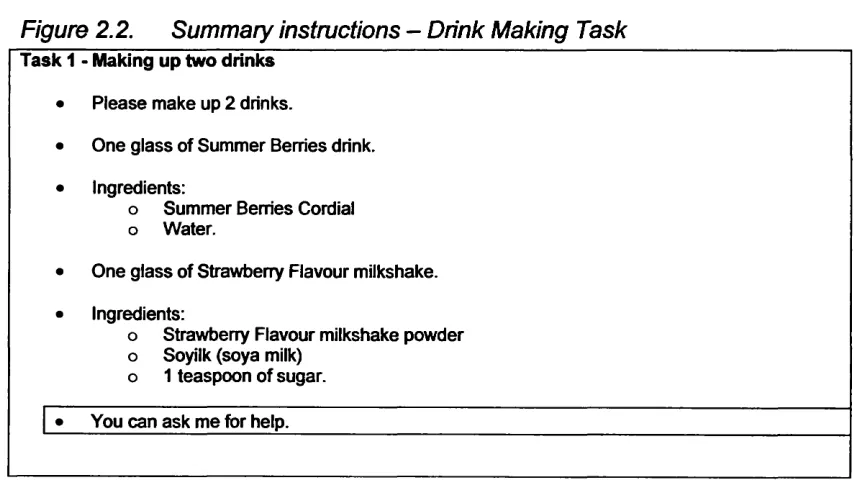
A summary of these verbal instructions was displayed in full view of participants throughout the procedure, in order to reduce memory load (please see Figure 2.2.).
Figure 2.1. Drink Making Task - Verbal instructions
Instructions:
In this task, I want you to make up two different drinks. One from a concentrate and one from an Instant powder.
Here you have:
• A choice of drink concentrates and instant drink powders. [Point to each one and read out name].
• There are also other things that you might find in a kitchen, like sugar, sweetener and salt. [Point
to each one and read out name].
• Here you have some beakers, teaspoons, measuring spoons and measuring jugs. [Point to each
one and say name].
• Here is a jug of water, a carton of skimmed ordinary milk, a carton of full-fat ordinary milk and a
carton of soya milk called "Soyilk". [Point out].
Do you have any questions?
Now, I want you to make up two drinks. One of the drinks is a glass of Summer Berry juice, the other drink is a glass of Strawberry Flavour milkshake.
Please prepare the Strawberry Flavour milkshake with Soyilk and add one tea spoon of sugar.
If you can’t manage part of a task you can ask me for help. For example, if you cannot read something or if you need help opening something.
Figure 2.2. Summary instructions - Drink Making Task
Task 1 - Making up two drinks
• Please make up 2 drinks.
• One glass of Summer Berries drink.
• Ingredients:
o Summer Berries Cordial
o Water.
• One glass of Strawberry Flavour milkshake.
• Ingredients:
o Strawberry Flavour milkshake powder
o Soyilk (soya milk)
o 1 teaspoon of sugar.
You can ask me for help.
2.4.2 2. Task 2 - Journey Planning Task
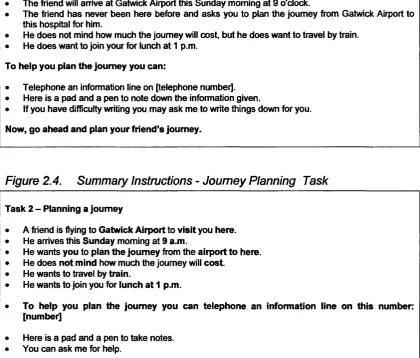
This task was concerned with social and planning aspects of the dysexecutive syndrome. Participants were asked to plan a journey for a friend, using a mobile telephone to obtain the necessary information. The telephone call involved interacting with a confederate ( telephone help line operator’). Figures 2.3. and 2.4. (below) respectively show the instructions read to prior to, and displayed in front of participants throughout the task.
Figure 2.3. Journey Planning Task - Verbal Instructions
Task 2 - Social Interaction, gathering infomiation, planning a journey.
In this task, I want you to plan a journey for a friend.
• The friend is coming from overseas and wants to visit you here in hospital.
• The friend will arrive at Gatwick Airport this Sunday morning at 9 o’clock.
• The friend has never been here before and asks you to plan the journey from Gatwick Airport to
this hospital for him.
• He does not mind how much the journey will cost, but he does want to travel by train.
• He does want to join your for lunch at 1 p.m.
To help you plan the journey you can:
• Telephone an information line on [telephone number].
• Here is a pad and a pen to note down the infomiation given.
• If you have difficulty writing you may ask me to write things down for you.
Now, go ahead and plan your friend’s journey.
Figure 2.4. Summary Instructions - Joumey Planning Task
Task 2 - Planning a joumey
• A friend is flying to Gatwick Airport to visit you here.
• He arrives this Sunday morning at 9 a.m.
• He wants you to plan the joumey from the airport to here.
• He does not mind how much the joumey will cost.
• He wants to travel by train.
• He wants to join you for lunch at 1 p.m.
• To help you plan the joumey you can telephone an information line on this number:
[number]
• Here is a pad and a pen to take notes.
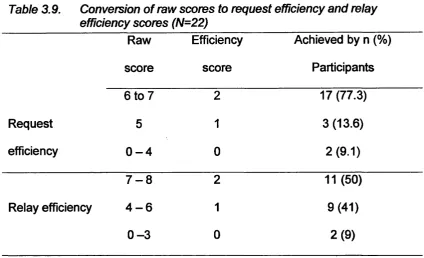
Participants’ performance on two aspects of this task was scored: the first score concerned the efficiency with which they provided details regarding their request to the ‘operator’ (part 1 - request efficiency), the second score concerned the efficiency with which they passed on the details gathered to the experimenter (part 2 - relay efficiency).
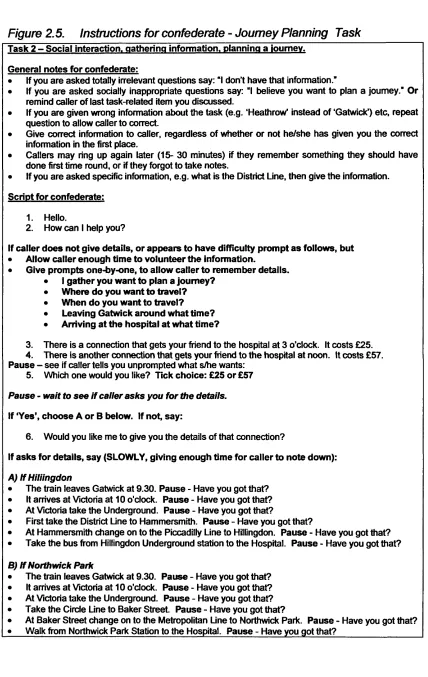
To ensure all participants would have the same opportunity to gather the relevant information, the ‘operator* followed a script. This ensured that all participants were asked (prompted) for any of the pieces of information that contributed to the overall score on the request efficiency’ part of the task that they had not volunteered. The reasoning behind the prompt was that, in a real life setting, help-line operators would try to elicit such relevant information from their clients. In addition, and as pointed out earlier, we did not want this to be a test of ‘memory’ per se.
For part two of the task, the operator was instructed to give correct travel information to participants, regardless of whether or not they had given the relevant information during part one of the task. Whilst this may not have been particularly realistic, it did allow us to compare participants’ performance on part two of the task without it being dependent on, or confounded by, performance on part one.
For scoring purposes the experimenter and confederate both took notes regarding of the details of the conversations taking place.
Figure 2.5. Instructions for confederate - Joumey Planning Task
Task 2 - Social interaction, gathering information, planning a ioumev.
General notes for confederate:
If you are asked totally irrelevant questions say: "I don't have that information.”
If you are asked socially inappropriate questions say: “I believe you want to plan a joumey.” Or remind caller of last task-related item you discussed.
If you are given wrong information about the task (e.g. Heathrow" instead of ‘Gatwick’) etc, repeat question to allow caller to correct.
Give correct information to caller, regardless of whether or not he/she has given you the correct information in the first place.
Callers may ring up again later (15- 30 minutes) if they remember something they should have done first time round, or if they forgot to take notes.
If you are asked specific information, e.g. what is the District Line, then give the information.
Script for confederate:
1. Hello.
2. How can I help you?
If caller does not give details, or appears to have difficulty prompt as follows, but
• Allow caller enough time to volunteer the information.
• Give prompts one-by-one, to allow caller to remember details.
• I gather you want to plan a joumey?
• Where do you want to travel?
• When do you want to travel?
• Leaving Gatwick around what time?
• Arriving at the hospital at what time?
3. There is a connection that gets your friend to the hospital at 3 o'clock. It costs £25. 4. There is another connection that gets your friend to the hospital at noon. It costs £57. Pause - see if caller tells you unprompted what s/he wants:
5. Which one would you like? Tick choice: £25 or £57
Pause - wait to see if caiier asks you for the details.
If Yes', choose A or B below. If not, say:
6. Would you like me to give you the details of that connection?
If asks for details, say (SLOWLY, giving enough time for caller to note down):
A) If Hiliingdon
• The train leaves Gatwick at 9.30. Pause - Have you got that?
• It arrives at Victoria at 10 o'clock. Pause - Have you got that?
• At Victoria take the Underground. Pause - Have you got that?
• First take the District Line to Hammersmith. Pause - Have you got that?
• At Hammersmith change on to the Piccadilly Line to Hillingdon. Pause - Have you got that?
• Take the bus from Hillingdon Underground station to the Hospital. Pause - Have you got that?
B) If NorOiwick Park
• The train leaves Gatwick at 9.30. Pause - Have you got that?
• It arrives at Victoria at 10 o'clock. Pause - Have you got that?
• At Victoria take the Underground. Pause - Have you got that?
• Take the Circle Line to Baker Street. Pause - Have you got that?
• At Baker Street change on to the Metropolitan Line to Northwick Park. Pause - Have you got that?