-53-
Aryabhatta Journal of Mathematics & Informatics Vol. 6, No. 1, Jan-July, 2014 ISSN : 0975-7139 Journal Impact Factor (2013) : 0.489
ANALYSIS OF VENDOR MANAGED INVENTORY SYSTEM IN
BANKING INDUSTRY: A CASE STUDY
Rishi Kumar
Department of Mechanical Engineering, Deenbandhu Chhotu Ram University of Science & Technology, Murthal131039,Haryana,India
ABSTRACT:
The basic principle of VMI is that the vendor, or supplier, becomes responsible for managing the inventory at the customer’s site. A suitable framework for implementation can be helpful. Before elucidation of such a framework, it is useful to identify problems that may be encountered during implementation. The conducted case study identifies some problems. Survey of these common problems will help to simplify the work in banking industries in India. The main purpose of VMI is to reduce the inventory. This research is aimed at creating a viable model of a single manufacturer single supplier collaborative supply chain system using a Vendor Managed Inventory (VMI) system.
Key words:VMI, Bullwhip Effect, Demand, Forecast
INTRODUCTION
The basic principle of VMI is that the vendor, or supplier, becomes responsible for managing the inventory at the customer‟s site. In contrast to buyers who often manage a broad portfolio of purchased items, suppliers are usually
responsible for a more limited range of products of which they have more specific knowledge, and therefore should
be better in forecasting and managing the flow of their products through to the end consumer. Making the supplier
responsible for replenishment should result in inventory and logistics costs being reduced throughout the total
supply chain. This research is aimed at creating a viable model of a single manufacturer single supplier
collaborative supply chain system using a Vendor Managed Inventory (VMI) system.
The research paper further uses known inventory performance parameters to performance benchmark the VMI
system with traditional push-pull systems, develop a collaborative forecasting spreadsheet solution and a best
alternative ordering policy amongst EOQ, Monthly, JIT and VMI policies under known lead time and a variety of
demand distribution functions. To reduce the risk level due to demand uncertainty, from raw materials to final
customers, companies should undergo innovative and revolutionary changes. For continuous growth and to remain
competitive, the Banking industries are adopting new approaches; one of them is Vendor Managed Inventory
(VMI). This study work identified various elements of VMI and critically examines them to find out which are
most important and suitable elements in context to banking industries. Banking industries can become competitive
by successful implementation of VMI.
A suitable framework for implementation can be helpful. Before elucidation of such a framework, it is useful to
identify problems that may be encountered during implementation. The conducted case study identifies some
problems. Survey of these common problems will help to simplify the work in banking industries in India. The
Rishi Kumar
-54-
1. LITERATURE REVIEW
Lee et al. [1997] identified four major causes of the bullwhip effect – Demand forecast updating, the rationing
gaming, order batching and price variations. Jan Holmstrom [1998] suggests that standard business system
solutions, e.g. from SAP R/3, might be adopted rather than introducing new problem specific systems solutions for
new business requirements. DALE D. ACHABAL [2000] describes the market forecasting and inventory
management components of a Vendor Managed Inventory (VMI) decision support system and how this system was
implemented by a major apparel manufacturer and over 30 of its retail partners. N. C. Simpson [2001] model the
order picking function and to explore the role of inventory stock levels in achieving economies of scale across this
function in a deterministic demand environment. S.M. Disney [2002] designed a VMI for various different ratios of
production adaptation cost and inventory holding cost. A decision support system using causal loop diagrams and
difference equations is proposed to determine the optimum design parameters in the vendor managed inventory,
automatic pipeline, inventory and order based production control system (VMI-APIOBPCS) by relating it to the
gain on demand when setting safety stocks at the distributor.S.M. Disney [2003] modelled three different scenarios – a traditional supply chain, an internal consolidation scenario (with batching in the order rule) and the VMI supply chain to investigates the impact of a vendor managed inventory (VMI) strategy upon transportation operations in a
supply chain. D.R. Towill [2003] compares the expected performance of a vendor managed inventory (VMI) supply chain with a traditional „„serially linked‟‟ supply chain. He compared the bullwhip performance of a number
of VMI supply chains with two-level supply chains and in all cases there is substantial reduction in bullwhip effect.
George Kuk [2004] survey the hypotheses related to the effects of organizational size, employee involvement, and
logistics integration and find how some of the acclaimed benefits of VMI were subjected to some of the key
barriers common in any IT implementation and reengineering initiatives.
Albrto Felice De Toni [2005] shows that vendor-managed inventory is also used fine in household electrical
appliances sector. Tinglong Zhang [2007] discussed an integrated vendor-managed inventory model based on the assumption that the buyer‟s cycle times may be different and the vendor‟s production cycle is an integer multiple of each buyer‟s replenishment cycle. Peter B. Southard [2008] compared the costs of inventory systems used in
practice by rural farm cooperatives to possible technology- enabled systems. Performance was measured in
inventory costs, delivery costs and stock outs. He found that VMI alternatives outperformed traditional delivery
methods and that the use of such technology could be economically justified in many logistics problems dealing
with variable demand patterns through the cost savings created.W.K. Wong [2009] proposed a model in the context
of a two-echelon supply chain with a single supplier serving multiple retailers in vendor-managed inventory (VMI)
partnership. The proposed model demonstrates that the supplier gains more profit with competing retailers than
without as competition among the retailers lowers the prices and thus stimulates demand.L. Yang [2010] evaluates
the effects of the distribution centre (DC) in a vendor-managed inventory (VMI) system comprising one
manufacturer, one DC and n retailers. He proposed a model to evaluate the system performance by considering the
scale of the distribution network, influential cost factors, demand distribution, planning horizon, and facility
locations. And found that the DC has effects on demand variance and system profit. G.P. Kiesm¨uller [2010]
Analysis Of Vendor Managed Inventory System In Banking Industry: A Case Study
transportation costs resulting in reduced total supply chain costs. He compared VMI strategies with a retailer
managed inventory strategy for two different demand models suitable for slow moving products and found that if
inventory holding costs are low, compared to handling and transportation costs, efficiencies at the warehouse are
improved and total supply chain costs are reduced.
Jun-Yeon Lee [2011] presented and analyzed a simple periodic-review stochastic inventory model to examine the
benefits of VMI from economies of scale in production/delivery in a global environment characterized by exchange
rate uncertainty and large fixed costs of delivery. He suggested that, despite of all the inventory costs transferred from the retailer, the supplier can be better off when his fixed cost of production/delivery is larger than the retailer‟s
fixed ordering cost. He also suggested that the benefits of VMI may be larger under exchange rate uncertainty.M.A.
Hoque [2011] stated that researchers have synchronized both the single-vendor single-buyer and the single-vendor
multi-buyer integrated inventory supply chains by transferring the lot either only with equal-sized or only with
unequal-sized sub-lot (batches). He developed two generalized single-vendor multi-buyer integrated inventory
supply chain models and provide the minimal cost solutions both for the single-vendor single-buyer and the single-
vendor multi-buyer integrated inventory supply chain problems, by a better synchronization of the production
flow.Yohanes Kristianto [2012] proposes an adaptive fuzzy control application to support a vendor managed
inventory (VMI).The methodology applies fuzzy control to generate an adaptive smoothing constant in the forecast
method, production and delivery plan to eliminate, the rationing and gaming or the Houlihan effect and the order
batching effect or the Burbidge effects and finally the Bullwhip effect. The simulation results show that adaptive
fuzzy VMI control model reduces the Bullwhip effect by eliminating the Houlihan effect and the Burbidge
effect.Leopoldo Eduardo Cárdenas-Barrón [2012] presents an alternative heuristic algorithm to solve the vendor
management inventory system with multi-product and multi-constraint based on EOQ with backorders considering
two classical backorders costs: linear and fixed. It demonstrates that the proposed heuristic algorithm is better based
on three aspects: the total cost, the number of evaluations of the total cost function and computational time.
Recently Jarial & Garg [2013] made thorough review of vendor selections supporting methods specifically
accommodate for buying situations.
2. VENDOR MANAGED INVENTORY (VMI)
Vendor Managed Inventory (VMI) originated in the early 1980s with mass retailers demanding vendors to take up
the responsibility for inventory replenishment based on sales figures made available by the retailer. Today, the
concept of VMI has spread to industries outside retailing like banking as well. VMI promises a win-win situation
for both the customer and the bank.
VMI also known as continuous replenishment or supplier managed inventory is one of the most widely discussed
partnering initiatives for encouraging collaboration and information sharing among trading partners. Popularized in
the late 1980s by Wal-Mart and Procter & Gamble, it was subsequently implemented by many other leading
companies from different industries, such as GlaxoSmithKline, Electrolux Italia, Nestle and Tesco, Boeing and
Alcoa etc. It is a supply chain initiative where the vendor decides on the appropriate inventory levels of each of the
products and the appropriate inventory policies to maintain those levels. In a true VMI setting, the supplier is given
Rishi Kumar
-56-
service levels are met. This enables suppliers to stabilize their production and to optimize the transportation costs.
For the buyer, administration and inventory costs can be decreased.
Enhanced collaboration between both supply chain partners should reduce lead times and minimize the risk of
demand amplification in the supply chain. Regardless of how promising the theory of VMI may appear, actual
results of VMI implementations can be disappointing. Dong, Muckstadt, Sabath and Fontanella, interviewed seven executives in the field of Supply Chain Management and quotes one of these managers saying:“Out of 10 VMI
implementations, three or four achieve great benefits. Three or four have some benefits, but not as much as anticipated, and two or three do not get any benefits”.
While many benefits have been identified, there are also a number of challenges that may exist in practice and that
can potentially reduce the benefits obtained from VMI or lead to failures in VMI programs. For instance, Spartan Stores, a grocery chain, shut down its VMI effort about one year after due in part to VMI vendors‟ inability to deal
with product promotions. Similarly, Kmart cut a substantial amount of VMI contracts because they were not
satisfied with the forecasting ability of VMI vendors.
2.1 STEPS FOR VMI IMPLEMENTATION
Each Step in this process is extremely important. Skipping or not completing any steps will have a major impact on
the success of your VMI program. Plan to invest the necessary amount of time on each step. Before you begin the
setup process, both the manufacturer and the distributor must be comfortable with using EDI or some form of
routine data sharing.
Step 1 – Senior Sponsorship:
Since the business paradigm is changing, senior management must make a firm commitment to this new process.
VMI must have senior management sponsorship. It should be identified as a strategic objective and then
communicated throughout the organization. Senior management must commit to the costs involved, and the
manpower needed for setup/maintenance. For the distributor, they must also become comfortable with the concept
of having someone else manage their inventory.
Step 2 – Employee Acceptance:
Get all employees to buy into the concept, especially the person currently responsible for maintaining the inventory
levels. Without their acceptance, your program will never work. They must understand that VMI will not push them
out of a job. It will free up some of their time to allow them to be more productive in other areas. Employees should be given a complete overview of what VMI will mean to the company and the reasons why it‟s being done.
Step 3 – Synchronize Files:
Synchronize the Distributors Product Files with the Manufacturers. This step alone is one of the greatest benefits you will receive from VMI. Synchronizing means that you must match the manufacturer‟s product data with the distributor‟s product data. Are there old, obsolete items on the file? Are the correct product numbers being used?
Have new product numbers been properly communicated to the distributor? Any time there is a change to the
product catalogue, the manufacturer must share the data with their VMI partners. Your initial data synchronization
is extremely important as well as the ongoing synchronization that will be needed.
Analysis Of Vendor Managed Inventory System In Banking Industry: A Case Study
Extensive testing of all EDI sets to be used. The manufacturer and distributor must work very closely together to
validate that the data is being properly sent/received. For example: Does the Quantity on Hand that is being received by the manufacturer match the Quantity on Hand in the Distributor‟s stock? Is Quantity Sold being
properly sent? You should check a variety of items in different categories (A, B, C). EDI testing many take many
tries and adjustments before it is finally correct.
Step 5 – Acceptance and Measurements:
The Distributor must understand and agree with the stocking plan the Manufacturer is creating. Even though the
exact method may be a proprietary method, the distributor should still have an understanding of how the plan is
calculated. This will help avoid the future question: "Why did they send us this product if we don't need it?"
Additionally, predetermined Inventory Turns, Fill Rates and Service Levels should be targeted. The Distributor
should monitor their current performance for comparison to later results. Both parties must agree upon the
frequency of replenishment (daily? once/twice per week?). Ideally, the Distributor should have at least one year‟s
worth of measurements prior to VMI for comparison to later results.
Step 6 – Point of Sale (POS) History:
The Distributor sends the Manufacturer his POS (Point of Sale) History file, usually 1-2 years (Disk or Email). This
will allow the manufacturer to base the inventory plan on direct sale data rather than data from the distributors past
ordering history. The format of the file must be compatible to the needs of the manufacturer. Then the Distributor
sends an EDI #852 All Item Refresh. This tells the status and stock level of every item they have. Make sure to
verify both sets of data. This will be the last and most important point.
Note: The standard #852 only sends those products that had a change in position since the last transmission (if no
activity took place for that item, then the item isn't sent). A #852 All Item Refresh sends every item.
Step 7: The Distributor makes a sale and enters that transaction into their computer.
Step 8: On a daily/weekly basis the Distributor sends a #852 Product Activity. This reports a change in position on
any item since the last #852.
Step 9: The Manufacturer receives the #852 and updates the Distributors Stock Plan. Once an Item or Items have
hit their Reorder Point (ROP), the Manufacturer creates an Order.
Step 10: The Manufacturer sends out an #855 Purchase Order Acknowledgment to the Distributor. This lets the
distributor update their system with the newly created PO. During the beginning stages of your VMI partnership, it
is important to have the Distributor review the #855 and point out any problems.
Step 11: The Manufacturer picks and ships the order and transmits a #857 Advance Ship Notice. This tells the
distributor exactly what is being sent and when it‟s shipping.
Step 12: When the shipment is received, the Distributor transmits a #861 Receipt Advice. This tells the
manufacturer exactly what was received. The manufacturer can then match this to his Purchase Order to determine
Rishi Kumar
-58-
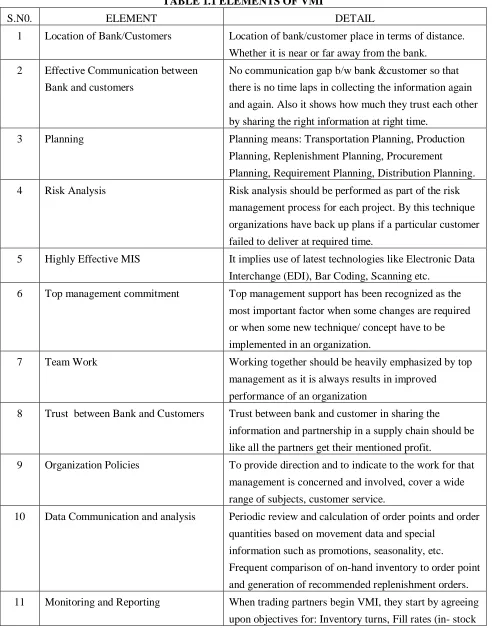
2.2 ELEMENTS OF VMI
TABLE 1.1 ELEMENTS OF VMI
S.N0. ELEMENT DETAIL
1 Location of Bank/Customers Location of bank/customer place in terms of distance.
Whether it is near or far away from the bank.
2 Effective Communication between
Bank and customers
No communication gap b/w bank &customer so that
there is no time laps in collecting the information again
and again. Also it shows how much they trust each other
by sharing the right information at right time.
3 Planning Planning means: Transportation Planning, Production
Planning, Replenishment Planning, Procurement
Planning, Requirement Planning, Distribution Planning.
4 Risk Analysis Risk analysis should be performed as part of the risk
management process for each project. By this technique
organizations have back up plans if a particular customer
failed to deliver at required time.
5 Highly Effective MIS It implies use of latest technologies like Electronic Data
Interchange (EDI), Bar Coding, Scanning etc.
6 Top management commitment Top management support has been recognized as the
most important factor when some changes are required
or when some new technique/ concept have to be
implemented in an organization.
7 Team Work Working together should be heavily emphasized by top
management as it is always results in improved
performance of an organization
8 Trust between Bank and Customers Trust between bank and customer in sharing the
information and partnership in a supply chain should be
like all the partners get their mentioned profit.
9 Organization Policies To provide direction and to indicate to the work for that
management is concerned and involved, cover a wide
range of subjects, customer service.
10 Data Communication and analysis Periodic review and calculation of order points and order
quantities based on movement data and special
information such as promotions, seasonality, etc.
Frequent comparison of on-hand inventory to order point
and generation of recommended replenishment orders.
11 Monitoring and Reporting When trading partners begin VMI, they start by agreeing
Analysis Of Vendor Managed Inventory System In Banking Industry: A Case Study
percentages), Transaction cost.
The system monitors actual activity with measurements
against those objectives. The system must report the
same information to both the bank and the customer so
that the process is highly transparent. Information should
always be available to both parties on-demand.
12 Employee Training Employee Training is must in banking services. In this
process all the employee well trained to satisfy the
customers.
13 Employee feedback and suggestion Employee feedback and suggestions should be
encouraged and rewarded while keeping both formal and
informal lines of communication open.
14 Evaluation of Employee capabilities
and technical skills
How much quantity of amount can be calculate per day
and whether the workforce are technically sound or not.
15 Infrastructure/ Layout Good organizational building with attractive facilities
attracts the customers.
16 Customer feedback & suggestion Customer feedback & suggestions should be encouraged
and find the organization what can do best for the
customer satisfaction.
17 Commitment An agreement to perform a particular activity at a certain
time in the future under certain circumstances.
18 Brainstorming Session Brainstorming is a group creativity technique designed
to generate a large number of ideas for the solution of
a problem.
19 Information flow analysis and
corrective and preventive action for
scattering
Corrective action and preventive action (CAPA) are
improvements to an organization's processes taken to
eliminate causes of non-conformities or other
undesirable situations. It focuses on the systematic
investigation of the root causes of non-conformities in
an attempt to prevent their recurrence (for corrective
action) or to prevent occurrence (for preventive action).
20 Standardization Standardization is the development of a set of defined
reference conditions and procedures (standards) to
consistently apply to a process to obtain consistent
results. Establish a committee to include a Physician
Advisor, Nursing, Pharmacy, Material Management,
Finance, Purchasing, and Prime Vendor personnel,
Rishi Kumar
-60-
throughout the bank.
3. METHODOLOGY
Every essential element of VMI may not be easily implemented and some elements are difficult to implement.
These problems may be related to in appropriate understanding of VMI methodology or may be related to
technical, operational and human problems.
There are some questions related to VMI system:
1. Which are the essential elements of VMI?
2. Which elements are important and difficult to implement?
3. Which elements can be easily implemented?
4. Which elements are highly beneficial in banks?
This section details the procedures for the study in the following subsections:
Research design,
Instrument,
Survey participants
Data collection, and
Data analysis.
3.1 Research Design
This study employed non-experimental quantitative research. Specifically, the design involves mail survey method,
which is the most frequently used descriptive research design. This research design requires responses from the
banks personnel and further requires quantitative data analyses. To increase the internal and external validity, the
sampling procedure in this study applied the stratified random sampling technique.
3.2 Instrument
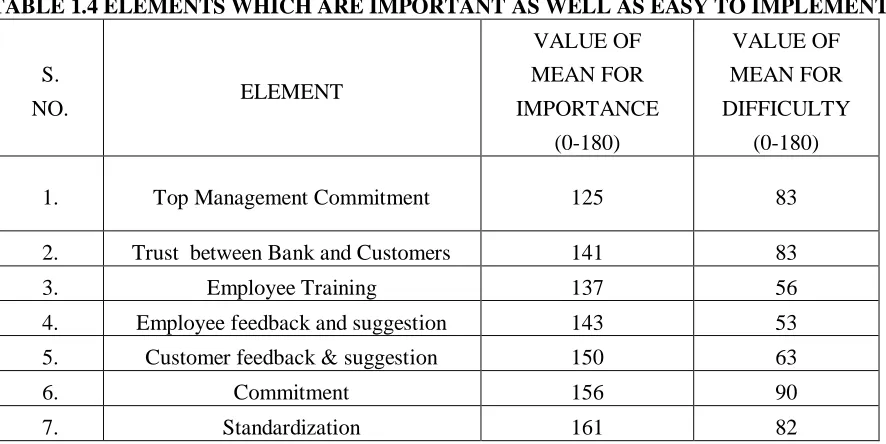
A survey was designed to find out the most important elements of VMI which are easy to implement in banks. The
survey consists of comparison based on following common parameters. The parameters are Top Management
Commitment, Trust between Bank and Customers, Employee Training, Employee feedback and suggestion,
Customer feedback & suggestion, Commitment, Standardization.
3.3 Survey Participants
A questionnaire regarding the importance and difficulties of VMI elements was designed and distributed/mailed in
various banks. This study uses a mail survey to distribute and gather the data. A mail survey provides the most
appropriate method to obtain relevant, up-to-date information from a large number of banks.
3.4 Data Collection
Data were collected following the self-administered mail survey method. Self-administered mail survey has the
advantages of relatively low cost and easy access to widely dispersed samples. These people were also assumed
aware of the general characteristics of the banks.
In mailing, the survey sends with:
i) The cover letter that informed an overview of the aim of the survey, identification of the researchers,
Analysis Of Vendor Managed Inventory System In Banking Industry: A Case Study
After sending the questionnaire, a follow- up postcard was sent to the participants one week later thanking for their
cooperation.
3.5 Data Analysis
The data was analyzed with the help of ANOVA (Analysis of Variance) Technique. The ANOVA technique is
important in the context of all those situations where we want to compare more than two populations such as in
comparing the yield of crop from several varieties of seeds. In such circumstances one generally does not want to
consider all possible combination of two populations at a time for what would require a great number of tests
before we would be able to arrive at a decision.
4. RESULTS
The questionnaire was distributed in 45 banks taking 1 employee from each bank. The questionnaire was collected
from all the banks successfully with a very good response. Then all the responses were analyzed. The mean score
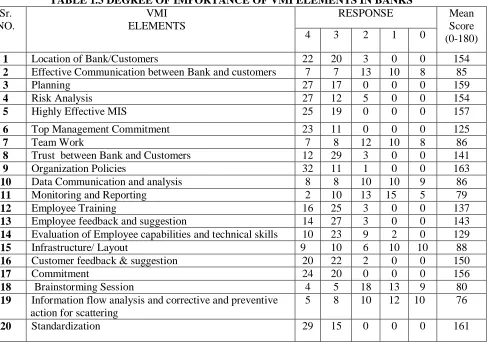
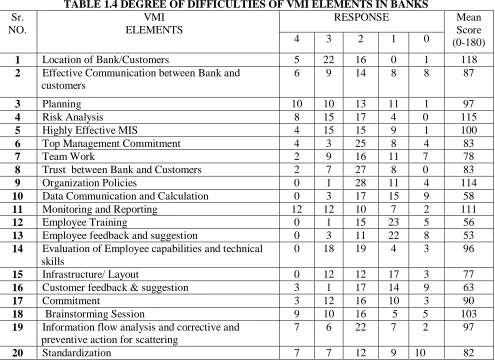
for each element was calculated. There are two tables giving the mean score of VMI elements for importance and
difficulties in context Indian banks. Table 1.3 and 1.4 reveals the degree of importance and degree of difficulties
respectively.
4.1. DEGREE OF IMPORTANCE OF VMI ELEMENTS IN INDIAN BANKS
The following table gives the mean score of Degree of Importance of VMI elements in various banks.
TABLE 1.3 DEGREE OF IMPORTANCE OF VMI ELEMENTS IN BANKS
Sr. NO.
VMI ELEMENTS
RESPONSE Mean
Score (0-180)
4 3 2 1 0
1 Location of Bank/Customers 22 20 3 0 0 154
2 Effective Communication between Bank and customers 7 7 13 10 8 85
3 Planning 27 17 0 0 0 159
4 Risk Analysis 27 12 5 0 0 154
5 Highly Effective MIS 25 19 0 0 0 157
6 Top Management Commitment 23 11 0 0 0 125
7 Team Work 7 8 12 10 8 86
8 Trust between Bank and Customers 12 29 3 0 0 141
9 Organization Policies 32 11 1 0 0 163
10 Data Communication and analysis 8 8 10 10 9 86
11 Monitoring and Reporting 2 10 13 15 5 79
12 Employee Training 16 25 3 0 0 137
13 Employee feedback and suggestion 14 27 3 0 0 143
14 Evaluation of Employee capabilities and technical skills 10 23 9 2 0 129
15 Infrastructure/ Layout 9 10 6 10 10 88
16 Customer feedback & suggestion 20 22 2 0 0 150
17 Commitment 24 20 0 0 0 156
18 Brainstorming Session 4 5 18 13 9 80
19 Information flow analysis and corrective and preventive action for scattering
5 8 10 12 10 76
Rishi Kumar
-62-
Table 1.3 indicates that Organization Policies has got the maximum value (i.e. 163), hence is the most important
element of VMI for Industries and Standardization got 161, as mean score, which is second most important element
of VMI whereas, Information flow analysis and corrective and preventive action for scattering got 76 as mean,
which is the least one, hence it can be termed as least important in bank in Indian context.
From Table 1.3, other most important elements are Top Management Commitment, Trust between Bank and
Customers, Employee Training, Employee feedback and suggestion, Customer feedback & suggestion,
Commitment. Table 1.3 also reveals the least important elements and these elements are Monitoring and Reporting,
Brainstorming Session.
4.2. DEGREE OF DIFFICULTIES OF VMI ELEMENTS IN BANKS
Table 1.4 gives the mean score of Degree of Difficulties of VMI elements in various banks.
TABLE 1.4 DEGREE OF DIFFICULTIES OF VMI ELEMENTS IN BANKS
Sr. NO.
VMI ELEMENTS
RESPONSE Mean
Score (0-180)
4 3 2 1 0
1 Location of Bank/Customers 5 22 16 0 1 118
2 Effective Communication between Bank and customers
6 9 14 8 8 87
3 Planning 10 10 13 11 1 97
4 Risk Analysis 8 15 17 4 0 115
5 Highly Effective MIS 4 15 15 9 1 100
6 Top Management Commitment 4 3 25 8 4 83
7 Team Work 2 9 16 11 7 78
8 Trust between Bank and Customers 2 7 27 8 0 83
9 Organization Policies 0 1 28 11 4 114
10 Data Communication and Calculation 0 3 17 15 9 58
11 Monitoring and Reporting 12 12 10 7 2 111
12 Employee Training 0 1 15 23 5 56
13 Employee feedback and suggestion 0 3 11 22 8 53
14 Evaluation of Employee capabilities and technical skills
0 18 19 4 3 96
15 Infrastructure/ Layout 0 12 12 17 3 77
16 Customer feedback & suggestion 3 1 17 14 9 63
17 Commitment 3 12 16 10 3 90
18 Brainstorming Session 9 10 16 5 5 103
19 Information flow analysis and corrective and preventive action for scattering
7 6 22 7 2 97
20 Standardization 7 7 12 9 10 82
From the above table the most difficult elements are Location of Bank/Customers, Planning, Risk Analysis, Highly
Analysis Of Vendor Managed Inventory System In Banking Industry: A Case Study
The least difficult elements from Table 1.4 are Effective Communication between Bank and customers, Team
Work, Data Communication and analysis, Infrastructure/ Layout etc.
TABLE 1.4 ELEMENTS WHICH ARE IMPORTANT AS WELL AS EASY TO IMPLEMENT
S.
NO. ELEMENT
VALUE OF
MEAN FOR
IMPORTANCE
(0-180)
VALUE OF
MEAN FOR
DIFFICULTY
(0-180)
1. Top Management Commitment 125 83
2. Trust between Bank and Customers 141 83
3. Employee Training 137 56
4. Employee feedback and suggestion 143 53
5. Customer feedback & suggestion 150 63
6. Commitment 156 90
7. Standardization 161 82
REFERENCES
1. Alberto Felice De Toni, Elena Zamolo, “From a traditional replenishment system to vendor-managed inventory: A case study from the household electrical appliances sector”, International Journal of Production Economics, Volume 96, Issue 1, 18 April 2005, Pages 63-79.
2. D.R. Towill, S.M. Disney, “The effect of vendor managed inventory (VMI) dynamics on the Bullwhip Effect in supply chains “, International Journal of Production Economics, Volume 85, Issue 2, 11 August 2003, Pages 199-215.
3. Dale D. Achabal, Shelby H. McIntyre, Stephen A. Smith, Kirthi Kalyanam, “A decision support system for vendor managed inventory”, Journal of Retailing, Volume 76, Issue 4, 4th Quarter 2000, Pages 430-454. 4. G.P. Kiesmüller, R.A.C.M. Broekmeulen, “The benefit of VMI strategies in a stochastic multi-product serial
two echelon system”, Computers & Operations Research, Volume 37, Issue 2, February 2010, Pages 406-416.
5. George Kuk, “Effectiveness of vendor-managed inventory in the electronics industry: determinants and outcomes”, Information & Management, Volume 41, Issue 5, May 2004, Pages 645-654.
6. Jan Holmstrom,” Business process innovation in the supply chain – a case study of implementing vendor managed inventory”, European Journal of Purchasing & Supply Management, Volume 4, Issues 2–3, June 1998,Pages 127-131.
Rishi Kumar
-64-
8. L. Yang, C.T. Ng, T.C.E. Cheng, “Evaluating the effects of distribution centres on the performance of
vendor-managed inventory systems”, European Journal of Operational Research, Volume 201, Issue 1, 16
February 2010, Pages 112-122.
9. Lee, Hau L., Padmanabhan, V and Whang, Seungjin. The Bullwhip Effect in Supply Chains. Sloan
Management Review (MIT: Maassachusetts Institute of Technology), Vol. 38, No. 3, 1997.
10. Leopoldo Eduardo Cárdenas-Barrón, Gerardo Treviño-Garza, Hui Ming Wee, “A simple and better
algorithm to solve the vendor managed inventory control system of multi-product multi-constraint economic order quantity model”, Expert Systems with Applications, Volume 39, Issue 3, 15 February 2012, Pages 3888-3895.
11. M.A. Hoque, “Generalized single-vendor multi-buyer integrated inventory supply chain models with a better synchronization”, International Journal of Production Economics, Volume 131, Issue 2, June 2011, Pages 463-472.
12. N. C. Simpson, S. Selcuk Erenguc, “Modeling the Order Picking Function in Supply Chain Systems:
Formulation, Experimentation, and Insights”, IIE Transactions, 33(2), pp.119-130, 2001.
13. Peter B. Southard, Scott R. Swenseth, “Evaluating vendor-managed inventory (VMI) in non-traditional environments using simulation”, International Journal of Production Economics, Volume 116, Issue 2, December 2008, Pages 275-287.
14. S.M. Disney, A.T. Potter, B.M. Gardner, Transportation Research Part E: Logistics and Transportation
Review, Volume 39, Issue 5,September 2003, Pages 363-380.
15. S.M. Disney, D.R. Towill, “A procedure for the optimization of the dynamic response of a Vendor Managed Inventory system”,Computers & Industrial Engineering, Volume 43, Issues 1–2, 1 July 2002, Pages 27-58. 16. Tinglong Zhang, Liang Liang, Yugang Yu, Yan Yu, “An integrated vendor-managed inventory model for a
two-echelon system with order cost reduction”, International Journal of Production Economics, Volume 109,
Issues 1–2, September 2007,Pages 241-253.
17. W.K. Wong, J. Qi, S.Y.S. Leung, “Coordinating supply chains with sales rebate contracts and vendor-managed inventory”, International Journal of Production Economics, Volume 120, Issue 1, July 2009, Pages 151-161.
18. Yohanes Kristianto, Petri Helo, Jianxin (Roger) Jiao, Maqsood Sandhu, “Adaptive fuzzy vendor managed
inventory control for mitigating the Bullwhip effect in supply chains”, European Journal of Operational
Research, Volume 216, Issue 2, 16 January 2012, Pages 346-355.
19. Jarial S.K. & Garg R.K. [2013] “A Review of Vendor Selection Supporting Criteria and Methods”