THE IMPACT OF AFT ON EXPORT PERFORMANCE OF SELECTED ASIAN DEVELOPING COUNTRIES
Mohammad Mowlaei1 1Department of Economics, Faculty of Economics and Social sciences Bu-Ali
Sina University, Hamedan, Iran
ABSTRACT
Article History Received: 1 August 2017 Revised: 4 September 2017 Accepted: 15 September 2017 Published: 28 September 2017
Keywords Aid-for-trade Asian countries Bilateral AFT Developing countries Exports
SYS-GMM.
JEL Classification
C23, F35, O19.
By liberalizing trade and capitalizing on areas of comparatives advantages, the developing countries can benefit economically. There are a lot of obstacles which constraints the ability of countries to engage in international trade. Aid-for-Trade (AFT) is a part of overall Official Development Assistance (ODA)-which helps developing countries to build their trade in global markets. This paper employs System-GMM technique to examine whether AFT helps Asian aid-receiving countries to improve their export performance over the period 2000-2015. The results show a positive and significant effect of AFT in multiple measures of export performance. However, the aids should be targeted and avoid any misusing.
Contribution/ Originality: This study is one of very few studies which have investigated the impacts of total AFT and bilateral and multilateral AFT on selected Asian countries by using SYS-GMM which is new to AFT literature.
1. INTRODUCTION
The developing countries face a range of supply-side and trade-related infrastructure obstacles which constrains their ability to engage in international trade. Aid-for-Trade (AFT) is about helping developing countries, in particular the least developed, to build the trade capacity and infrastructure they need to benefit from tradeopening (www.wto.org.). It is part of overall Official Development Assistance (ODA) — grants and concessional loans — targeted at trade-related programs and projects (www.oecd.org).
Aid-For-Trade emerged WTO in Hong Kong, based on the recognition that further trade liberalization would have limited effect if developing countries have supply and capacity constraints which were preventing them from trading more. The idea was simple: focus the foreign aid, a developing country receives on improving its ability to trade more. Poor infrastructure not only made it difficult to export or import, but it also imposed higher costs on Asian Development Policy Review
ISSN(e): 2313-8343 ISSN(p): 2518-2544
DOI: 10.18488/journal.107.2017.54.253.261 Vol. 5, No. 4, 253-261
firms, making it unprofitable for many. Reducing those costs not only made trade easier, it also made it profitable whereas it had not been previously. Developing countries would then trade more.
In 2005, Aid for trade Task Force identified the following categories:
1- Technical assistance for trade policy and regulations (e.g. helping countries to develop trade strategies, negotiate trade agreements and implement their outcomes)
2- Trade-related infrastructure (e.g. building roads, ports, and telecommunications networks to connect domestic markets to the global economy)
3- Productive capacity building, including trade development (e.g. supporting the private sector to exploit their comparative advantages and diversify their exports)
4- Trade-related adjustment (e.g. helping developing countries with the costs associated with trade liberalization such as tariff reduction, preference erosion, or declining terms of trade)
5- Other trade-related needs, if identified as trade-related development priorities in partner countries’ national development strategies (WTO, 2005).
The OECD defines bilateral transactions as those undertaken by a donor country directly with a developing country. They also include transactions with NGOS active in development and other, internal development related transactions like debt relief, administrative costs and spending on development awareness. A multilateral contribution, in contrast, can be delivered only by an international institution conducting all or part of its activities in favor of development. In some cases, a donor can contract with a multilateral agency to deliver a program or project on its behalf in a recipient country. Such cases are typically counted as bilateral flows and are often referred to as bilateral-multilateral (Bi/Multi) aid (Gulrajani, 2016).
Economists believe, by reducing the cost of trade through infrastructure improvements, the aid-receiving country would see a boost in their exports. Yet, at the same time, reduced trade costs work in both directions and make it easier for the aid-donor to export more to the aid-recipient countries. So, both donors and recipients can benefit from AFT by more trade (Huhne et al., 2014).
The possible influence of AFT on exports of developing countries is based on three main conceptual arguments. First, developing countries lack access to international markets. To address this problem, donor countries can potentially provide some of the recipient countries preferential access to the donors’ markets. Second, developing countries face supply-side infrastructure constraints and AFT is clearly designed to help the developing countries improve their export capacity and reduce these supply-side constraints by targeting aid to transportation, communication, energy, etc. This is supported by the fact that up to 60% of total AFT is spent on improving infrastructure and a significant amount of AFT (up to 44%) is spent on business promotion and banking services geared towards helping domestic production. Third, aid can also help improving trade policy of the recipient countries. These strategies are expected to have a positive impact on recipient exports and our analysis in-fact shows strong evidence in favor of AFT for improving export performance (Ghimire et al., 2013).
0 2000 4000 6000 8000 10000 12000 14000
1995 1996 1997 1998 1999 2000 2001 2002 2003 2004 2005 2006 2007 2008 2009 2010 2011 2012 2013 2014 2015
M
il
li
o
n
$
AFT
Fig-1. AFT in Asian Countries (Constant 2015 )
Source: OECD (2016).
The main objective of this paper is to answer the following questions: Has AFT improved Asian countries’ trade? Has AFT had a positive and significant effect on important Asian recipient countries’ exports? What is the effect of bilateral and multilateral aid on Asian countries’ exports?
The remainder of the paper is organized as follows: Section 2 presents a brief literature review on aid-exports relation, while, section 3 discusses data and methodology of research. Section 4 explains the empirical findings and section 5 concludes.
2. LITERATURE REVIEW
The Aid-For-Trade initiative has gained much popularity since its launch at the WTO’s Ministerial Conference in 2005, and there are ongoing discussions between the pros and cons to its effectiveness and potential to improve the integration of developing countries into the world economy. Some economists such as LIoyd et al. (2000);
Wagner (2003); Morrissey (2006); Winters (2010); Hallaert (2013) and Gamberoni and Newfarmer (2014)
concentrated on examining the relationship between aggregate foreign-aid (Official Development Assistance or ODA) and
trade. The studies present mixed results; for example, Wagner (2003) shows that donors’ exports increase more than recipients’ exports due to disbursement of foreign aid (ODA) to developing countries, while LIoyd et al. (2000)
found the opposite. Wood (2008); Hoekman (2010) and Wickstead (2015) point out that the AFT is the first initiative where trade and development community work together. At a more regional level, Cali and Te Velde
(2011) find that AFT does in-fact benefit small Caribbean Island countries. Pettersson and Johansson (2011) study
an aggregate bilateral trade relationship between the donors and recipients with respect to different aspects of foreign aid. While they find that general foreign aid impacts both donor exports and recipient exports positively, AFT benefits donor exports more significantly than it does for recipient exports. Helble et al. (2012) and Winters
and Martinez (2015) believes that AFT can have the potential to promote trade liberalization and facilitation trade,
and to master the consequences of trade liberalization. Using data on sectionall exports and sector specific AFT,
Ghimire et al. (2013) find significantly positive impact of
While most previous studies have examined the impact of bilateral AFT on bilateral exports (such as
Pettersson and Johansson (2011)) this study focuses on the effect of total (bilateral and multilateral) AFT on the
exports of Asian developing countries by using various measures of AFT. Since exports is considered to be an ―engine of economic growth‖ (Awokuse, 2006; Hausmann and Rodrick, 2006) it is more crucial for the Asian developing countries to be able to export, than which country exports are oriented to.
bilateral aid, it is hard to find proper instrumental variables (addressing endogeneity) for the total or the multilateral aid. However, studies such as Dalgaard et al. (2004); Ghimire et al. (2013) and Tortora and Steensen
(2014) have shown that the lag of aid serves as the best instruments, and helps researchers choose the lag-length
(for panel data) in a scientific way, producing efficient estimators.
While most previous studies have examined the impact of bilateral AFT on exports (such as Pettersson and
Johansson (2011)) this study focuses on the effect of total Aft and bilateral and multilateral AFT on the exports of
some important Asian countries’ recipients, by using various measures of AFT. The effects of bilateral versus multilateral AFT are distinguished in the context too. One of the Key contributions of our paper is the use of system-GMM (SYS-GMM) approach which is new to AFT export literature.
3.DATA ANDMETHODOLOGY OF RESEARCH
This study analyzed an annual level longitudinal dataset of 20 important AFT–recipient Asian countries over a period of 16 years [2000-2015]. Although discussion on AFT began with a design to help the least developed countries, there are a number of middle income countries benefitting as well. The AFT data are obtained from OECD’s Creditor Reporting System (CRS); detailed discussion on AFT measurement is presented below. The export data obtained from United Nation’s Conference on Trade and Development (UNCTAD). Trade openness as measured by trade freedom is obtained from Heritage Foundation. Other control variables included in the analysis are obtained from the World Bank (2015) and the institutional variables- control of corruption and regulatory quality- from the World Bank (2015) which are produced by Kaufmann et al. (2010).
It should be noted that AFT is not a separate category of foreign aid. Following the guidelines from the OECD1, the AFT measure is constructed by summing the amount of aid flowing into sectors that directly enhance economic infrastructures and other services expected to promote exports. These data are obtained from the CRS database maintained by OECD under different headings. From these broader headings, total AFT reflected the sum of aid that is categorically spent for: (i) trade policy and regulation, (ii) trade related infrastructure, and (iii) productive capacity building. A summary statistics of the data is presented in Table (1), where exports, aid, income, exchange rate, and domestic Credits are measured in real (2014) $US and are reported in their natural log form. Trade openness is an index that ranges between 0 and 100 with higher value representing more open economics. Similarly, control of corruption and regulatory quality between -2.5 and+2.5, with higher values indicating higher quality of institutions and vice versa.
Table-1. Summary descriptive statistics of regression variables: 2000-2015
Variable Mean SD Min Max
Exports 19.05431 2.3022146 14.86536 32.896531
AFT1 17.87603 2.1305782 2.87531 24.24680
AFT2 18.50245 2.1457940 8.456870 26.86421
AFT 19.48530 1.9741223 10.57884 29.32108
Bi-AFT 16.34402 3.13406 9.345703 26.98257
Multi-AFT 15.40627 2.954042 2.687895 29.35913
Income 6.023457 1.357045 4.877378 16.24589
Openness 74.12357 17.345041 0 94
Exchange Rate 3.905442 3.3219765 0.583801 11.35879
Domestic Credits 42.13497 3.6712412 27.87518 47.97123
Corruption Control -0.47742 0.4687214 -3.98612 1.853690
Regulatory Quality -0.52065 0.6123598 -2.98751 1.258634
Number of Aid Recipients: 20
Note 1: There are raw date before the log transformation.
Source: Author’s Calculation.
In this paper, the impact of AFT on selected Asian countries exports is analyzed with respect to the broader measure, total AFT, as well as some narrower measures. Based on the end use of AFT, the narrower measure (AFT1) reflects the amount of aid that is spent solely on trade policy and regulations. A slightly broader measure, AFT2, consists of AFT1 plus the aid that is provided for trade-related infrastructure- such as transport and storage, communications, and energy. Finally, the broadest measure, total AFT, consists of AFT2 plus the aid provided for productive capacity buildings such as Banking and Financial Services, Building and Other Services, agriculture, Forestry, Fishing, Industry, Mineral Resources and Mining and Tourism (OECD, 2006). This paper also distinguishes the impact of bilateral versus multilateral AFT on export too.
The paper primarily examines the impact of AFT on the export levels. Export levels are measured by the US dollar value (adjusted for inflation) of total exports: goods and services added together.
3.1. Model Specification and Estimation Technique
Since current exports are likely to depend heavily on past exports, the paper uses a dynamic panel specification while analyzing the impact of AFT on the level of most trade regressions. The empirical model takes the following form:
X it
Ln
= LnX t
i
,
1
+
1
Ln
AFT it
+
2
Ln
Y it
+
3
Ln
TOit
+
4
Ln
FDit
+
5
Ln
XRit
+CCit
Ln
6
+
7LnRQ
it+
i+
it
Where, Xit represents export level from an aid recipient country ―i‖ to the rest of the world at time period
―t‖. AFTit denotes Aid-For-Trade, the main variable of interest impacting exports. Our control variables are chosen from the existing literature (see Ghimire et al. (2013)). Yit is real GDP per capita of the exporting country. TOit represents the trade openness measured by trade freedom of that country. This is an index measuring import and export openness. FDit represents a measure of financial development (domestic credits2 to private sector as a proxy), which plays a crucial role in financing export promoting business (Munemo, 2013). XRit represents the real exchange rate of domestic currency vis-a vis US$, which is an important determinant of exports (Hsing and Guisan,
2011). Finally, CCit and RQit represents control of corruption and regulatory quality, respectively. These
institutional measures are relevant in this type of study as their quality determines the effectiveness of foreign aid
Burnside and Dollar (2000) and Sebastian (2015). All of these variables are expected to impact exports positively. In
the model presented above, δi represents the unobserved heterogeneity across individual countries and εit represents the idiosyncratic error.
As argued earlier, aid is endogenous to the Outcome variable (exports in our case). Also the presence of the lagged dependent variable along with country- specific heterogeneity adds to endogeneity problem, as is well known (see, Arellano, 2003 for details). To address these issues, system Generalized Method of Moments (SYS-GMM) is used for estimation (see Bun and Sarafidis (2013)). This technique uses instrumental variables from the system that consist of the exogenous and predetermined (lagged) variables, hence upholding the application of SYS-GMM for our data. This method provides efficient estimators and has been a popular method of analysis in studies where the problem of endogeneity is pervasive (See for example: (Osakwe, 2007; Elhiraika and Mbate, 2014)).
In this research, the model of research was estimated by Stata11.0 software.
2 . Domestic credit provided to the private sector by financial corporations, such as through loans, purchases of non-equity securities, and trade credits and other
4. EMPIRICAL RESULTS
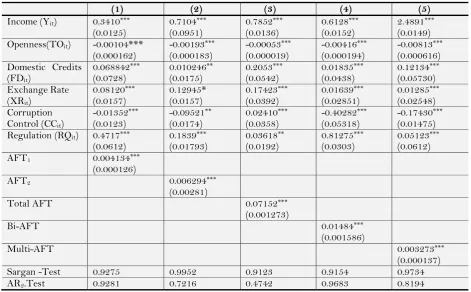
Table (2) presents an analysis of impact of AFT on export levels. We find that all three specifications based on the end use (AFT1, AFT2, and total AFT) have positive and highly significant coefficients on the level of total exports. Similarly, classifications of AFT based on their origin (bilateral AFT and multilateral AFT) also have a similar impact on the recipient’s total exports-a positive and statistically significant impact. Of course, the impact of bilateral AFT is more than multilateral AFT on export performance. One striking observation is the favorable impact of AFT with large and strong statistical significance.
Table-2. Results of estimation of model of research by SYS-GMM
(1) (2) (3) (4) (5) Income (Yit) 0.3410***
(0.0125) 0.7104
***
(0.0951) 0.7852
***
(0.0136) 0.6128
***
(0.0152) 2.4891
*** (0.0149) Openness(TOit) -0.00104***
(0.000162) -0.00193
***
(0.000183) -0.00053
***
(0.000019) -0.00416 ***
(0.000194) -0.00813 *** (0.000616) Domestic Credits
(FDit)
0.068842***
(0.0728) 0.010246
**
(0.0175) 0.2053
***
(0.0542) 0.01835
***
(0.0438) 0.12134
*** (0.05730) Exchange Rate
(XRit)
0.08120***
(0.0157) 0.12945* (0.0157) 0.17423 ***
(0.0392) 0.01639
***
(0.02851) 0.01285
*** (0.02548) Corruption
Control (CCit)
-0.01352***
(0.0123) -0.09521
**
(0.0174) 0.02410
***
(0.0358) -0.40282
***
(0.05318) -0.17430 *** (0.01475) Regulation (RQit) 0.4717***
(0.0612) 0.1839
***
(0.01793) 0.03618
**
(0.0192) 0.81275
***
(0.0303) 0.05123
*** (0.0612)
AFT1 0.004134***
(0.000126)
AFT2 0.006294***
(0.00281)
Total AFT 0.07152***
(0.001273)
Bi-AFT 0.01484***
(0.001586)
Multi-AFT 0.003273***
(0.000137)
Sargan -Test 0.9275 0.9952 0.9123 0.9154 0.9734
AR2-Test 0.9281 0.7216 0.4742 0.9683 0.8194
Note: The dependent variable is log exports. Standard errors in parenthesis. ***,** and * denote significance at the 1%, 5% and 10% levels, respectively.
5. CONCLUSION
The developing countries encounter a lot of various obstacles for liberalization trade in international markets. Aid- for-Trade (as a part of ODA) helps them to build their trade capacity and infrastructure. This study has investigated the impacts of AFT on Asian developing countries’ export performance, using several different measures of AFT as well as export performance. The SYS-GMM technique is employed to scrutinize the effectiveness of AFT on various export performance measures of aid recipient countries. The results show that AFT has a positive and significant effect on multiple measures of export performance of Asian studied countries. The classifications of AFT based on their origin also have a similar impact on total exports of Asian countries. The result of this study also show the impact of bilateral AFT on export is more than multilateral aid. In other words, the donors prefer to give different aids directly to official sources (governments). According to a research, DAC3 donors disbursed over 60% of ODA bilaterally and roughly 25% multilaterally, as measured in two-year averages over the 2008-2013 period. At least 17 out of 28 DAC countries provide over 50% of their ODA through bilateral channels. The use of multilateral channels as a percentage of total gross ODA also ranges widely from 14% to 30%
(Gulrajani, 2016). This finding is consistence with findings of Collier and Benedikt (2009); Pettersson and
Johansson (2011); Cadot and Newfarmer (2011); Cali and Te Velde (2011) and Ghimire et al. (2013) and Sabra and
Eltala (2016). The final research demonstrate that Asian developing countries are benefitting from AFT and are
able to increase their level of exports in the international market. For improving the ability to trade more, the Asian developing countries should reinforced the quality of production of various industries and reduce the costs of production by using modern technology. They also should use AFT for improving the trade structures (such as transport, communications, banking and financial services, policies and regulations) and avoid misusing AFT. They can receive various aids through bilateral or multilateral channels from different donors.
Funding: This study received no specific financial support.
Competing Interests: The author declares that there are no conflicts of interests regarding the publication of this paper.
REFERENCES
Awokuse, T., 2006. Causality between exports, imports and economic growth: Evidence from transition economics. Economic Letters, 94(3): 389-395.
Bun, M.J.G. and V. Sarafidis, 2013. Dynamic panel data models. The Netherlands: Amsterdam School of Economics. Burnside, C. and D. Dollar, 2000. Aid, policies and growth. American Economic Review, 90(44): 847-868.View at Google Scholar
Cadot, O. and R. Newfarmer, 2011. Does it work? Aid-for-trade through the evaluation prism. Trade Negotiations Insights, 10(7): 76-94.View at Google Scholar
Cali, M. and D.W. Te Velde, 2011. Does aid- for trade really improve trade performance? World Development, 39(5): 725-740.
View at Google Scholar | View at Publisher
Collier, P. and G. Benedikt, 2009. Does aid mitigate external shocks? Review of Development Economics, 13(3): 429-459.View at
Google Scholar | View at Publisher
Dalgaard , C.J., H. Hansen and F. Tarp, 2004. On the empirics of foreign aid and growth. Economic Journal, 114(496): F191-F216.View at Google Scholar | View at Publisher
Elhiraika, A. and M. Mbate, 2014. Assessing the determinants of export diversification in Africa. Applies Econometrics and International Development, Euro-American Association of Economic Development, 14(1): 147-160.View at Google Scholar
Gamberoni, E. and R. Newfarmer, 2014. Aid-for-trade: Do those countries that need it, get it? World Economy, 37(4): 542-554.
View at Google Scholar | View at Publisher
Ghimire, S., D. Mukherjee and E. Alvi, 2013. Sectoral aid-for-trade and sectoral exports: A seemingly unrelated regression analysis. Economics Bulletin, 33(4): 2744-2755.View at Google Scholar
Gulrajani, N., 2016. Bilateral versus multilateral aid channels strategic choices for donors. Retrieved from
www.odi.org/publications/10371 [Accessed June20, 2016].
Hallaert, J.J., 2013. The future of aid-for-trade, changes and options. World Trade Review, 12(4): 653-668. View at Google Scholar |
View at Publisher
Hausmann, R. and D. Rodrick, 2006. What your export matters. Journal of Economic Growth, 12(1): 1-25.
Helble, M.C., C.L. Mann and J.S. Wilson, 2012. Aid-for –trade facilitation. Review of World Economics, 148(2): 357-376. Hoekman, B., 2010. Aid-for-trade: Why, what and where are we? Retrieved from
http://SiteSource.WorldBanking,InternetTrade,¬Resource,239654-1273092281133,Bernard_Hoekmann_Aid_For_Trade.PDF [Accessed June,2017].
Hsing, Y. and M.C. Guisan, 2011. Real exchange rate, foreign trade and real output growth: The case of Spain, 1970-2009. Applied Econometrics and International Development. Euro- American Association of Economic Development, 11(1): 46-58.View at Google Scholar
Huhne, P., B. Meyer and P. Nunnenkamp, 2014. Who benefit from aid-for trade? Retrieved from www. theigc.org [Accessed 2/27/2017].
Kaufmann, D., A. Kraay and M. Mastruzzi, 2010. The worldwide governmance indicators (WGI), elibrary. Retrieved from
worldbank.org [Accessed 3/8/2027].
LIoyd, T., M. McGillivray, O. Morrissey and R. Osei, 2000. Does aid create trade? An investigation for European donors and African recipients. European Journal of Development Research, 12(1): 107-123.View at Google Scholar
Morrissey, O., 2006. Aid or trade, or aid and trade? Australian Economic Review, 39(1): 78-88.View at Google Scholar
Munemo, J., 2013. Domestic credit and diversification of manufactured exports from developing countries. Development Policy Review, 31(1): 99-114.View at Google Scholar
OECD, 2006. Aid for trade: Making it effective. Development Dimension. Retrieved from www.oecd.org/dac/aft/ [Accessed June20, 2017].
OECD, 2016. Creditor reporting system. Retrieved from http://stats.oecd.org/Index.aspx [Accessed May 2016].
Osakwe, P.N., 2007. Export diversification and the dilemma of African development. Applied Econometrics and International Development, Euro-American Association of Economic Development, 7(2): 143-154.
Pettersson, J. and L. Johansson, 2011. Aid, aid-for-trade and bilateral trade: An empirical study. Journal of International Trade and Economic Development: An International and Comparative Review, 22(6): 866-894. View at Google Scholar | View at
Publisher
Sabra, M.M. and A.H.A. Eltala, 2016. Foreign aids, domestic savings and economic growth in selected MENA countries. Business and Economic Research, 6(1): 352-362.View at Google Scholar | View at Publisher
Santos-Paulino, A. and A.P. Thirlwall, 2004. The impcat of trade liberalisation on exports, imports and the balance of payments of developing countries. Economic Journal, 114(493): F50-F72.View at Google Scholar | View at Publisher
Sebastian, E., 2015. Economic development and the effectiveness of foreign aid: A historical perspective. Kyklos, 63(3): 277-316.
View at Google Scholar | View at Publisher
Tortora, P. and S. Steensen, 2014. Making earmarked funding more effective: Current practices and a way forward. Paris: OECD,Org.
Wagner, D., 2003. Aid and trade- an empirical study. Journal of the Japanese and International Economics, 17(2): 153-173.View at
Google Scholar | View at Publisher
Wickstead, M., 2015. Aid and development: A breif introduction. Oxford: Oxford University Press.
Winters, M. and G. Martinez, 2015. The role of government in determining foreign aid flow composition. World Development, 66(C): 516-531.View at Google Scholar | View at Publisher
Wood, A., 2008. Looking ahead optimally in allocating aid. World Development, 36(7): 1135-1151. View at Google Scholar | View at
Publisher
World Bank, 2015. World development indicators. Retrieved from http://data.worldbank.org/data-catalog/world-development-indicators [Accessed May 2012].
World Bank, 2015. World governance indicators. Retrieved from http://info.Worldbank.org.governance/wgi/sc_country.asp
[Accessed May2, 2012].
WTO, 2005. Aid for trade. Retrieved from www.countries-ofthe-world.com.ListofcounriesinAsiainalphabeticalorder [Accessed 9/22/2017].
BIBLIOGRAPHY
Stata Crop, 2011. Statistical software: Release 11.0. College Station, TX: Stata Corporation.
Appendix:
Table-3. List of Countries Included in the Study
Afghanistan Bangladesh India Indonesia Iran Iraq Jordan Israel Lebanon Pakistan Oman Philippines Myanmar Sri Lanka Syrian Taiwan Thailand Turkey Vietnam Yemen
Source:www.countries-of the-world.com.