36 Zhuangluan Su and Zengfu Wang
3.
Concept of Eigen-Intonation
The affective intonation will be modeled with a concept called “eigen-intonation”. The concept of eigen-intonation is derived through the use of the PCA technique. PCA [Fukunaga 2000] is a multivariate analysis method that carries out a compact description of a data set. In a PCA process, a set of correlated variables is transformed into a set of uncorrelated variables that are ordered by reducing variability, and these new uncorrelated variables are linear combinations of the original variables. It can be concluded that the first new variable contains the greatest amount of variation; the second contains the next greatest residual variance and orthogonal to the first, and so on. Thus, the last of these variables can be removed with a minimal loss of real data.
With the affective corpus in the paper, the speech intonations for sentences should be very similar in all configurations, and they should be able to be described by some “basic intonations”. From the previous description, one knows that one of the main functions of PCA is that it can be used to extract new uncorrelated features from original data. According to these ideas, one can find the “basic intonations” that best account for distribution of speech intonations within the entire intonation space using the principal components analysis. The “basic intonations” are called “eigen-intonations”.
With eigen-intonation, original intonations can be transformed to corresponding representations with lower dimensions. Some rules can also be possibly given out in the low-dimensional space. Moreover, the resultant rules with low dimensions have simpler expression, and it is advantageous to control the rules for the goal of this study.
40 Zhuangluan Su and Zengfu Wang
1
/ , 1, 2, ..., 6
K k
k K
α
α α
α α
=
Ω = ∑Ω = (9)
Where, Ωαk is the projecting representation vector (henceforth projecting vector) in P
of the k-th intonation with emotion a. Ka is the total number of all intonation samples with
emotion a.
{Ωα, a = 1, 2, …, 6} are the resultant affective intonations with low dimension basing eigen-intonation. They are restored in the original intonation space O as (10).
, 1, 2, ..., 6
Tα = Ω +U α m α = (10)
Where Ta are the final affective rule-intonations (henceforth rule-intonations) and they
can be applied directly to modify the target intonation for synthesizing affective speech, which will be performed in the following experiments.
6.
Experimental Results and Discussion
6.1 Analysis on Eigen-Intonation
To demonstrate the eigen-intonations, a PCA experiment using the affective speech corpus was performed. The first six principal components U are shown in Figure 2 and the authors do not distinguish the principal components selected and eigen-intonations here. It can be seen that the varying range of the first component is the smallest, and it is also the highest. So the
Affective Intonation-Modeling for Mandarin Based on PCA 41
first eigen-intonation represents the flat and positive pitch. The second eigen-intonation contributes a big rising component, and the third matches a falling intonation with a little rising at the end. The fourth can be viewed as adding a falling part to the end of the third. The varying ranges are same between the fifth and the sixth, and their global trends are flat with big rising and falling varying. These two can be viewed as adding a rising or a falling part to the end of the previous component. It will be known that the sixth component contains a very small contribution of energy or variance to the intonation contour in the following analysis.
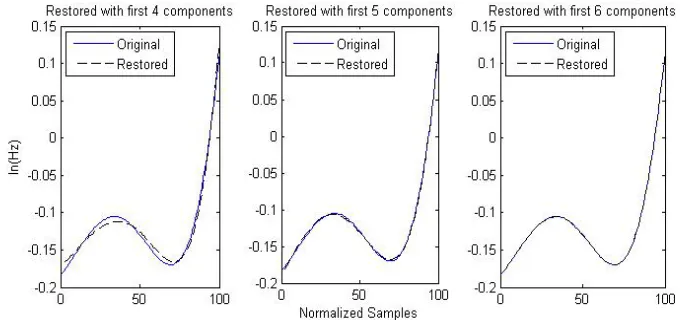
Based on the previous resultant eigen-intonations, the authors carry out the restoring experiment using L components selected, respectively considering L be 3, 4, 5 and 6. The results are shown in Table 1.
Table 1. The restoring rate r with L components selected
L – component number 3 4 5 6
r – restoring rate 81.61% 95.71% 99.46% 99.89%
From Table 1, it can be concluded that selecting five components is acceptable, but with six principal components, the restoring rate is 99.89% and the approximation error is almost equal to zero. The approximating examples are shown in Figure 3. That means a good six-dimensional representation for the space of all speech intonations is achieved, and these eigen-intonations are very efficient for intonation representation.
6.2 Modeling Affective Intonation
The emotional state expressed by intonation of each affective speech in the corpus is known, and there are six categories of emotions, including the neutral state. And there are 40 speeches within each emotional state. According to Section 5.2, all affective intonations labeled with
42 Zhuangluan Su and Zengfu Wang
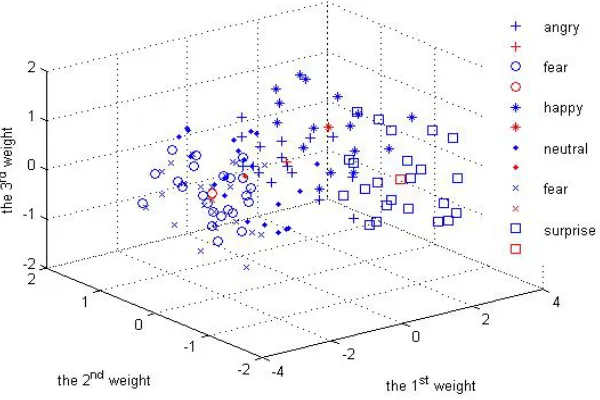
different emotions are projected into six-dimensional sub-space P spanned by eigen-intonations. The distribution of first three weights of the projecting vector Ω a
is shown as Figure 4, and the mass kernel of each emotional state is indicated by red color in the figure.
From Figure 4, one can see that the kernel of surprise, job and anger is far from that of neutral, where the “surprise” is farthest and then “angry” is next. However, the “fear” almost distributes in the same region with “sad”, and they can be distinguished from the neutral emotional region. In addition, it can be known from analysis on eigen-intonations that the last several weights corresponding to these three weights in the figure contain a very small contribution of energy or variance, so the difference of their distribution is not as clear as in Figure 4.
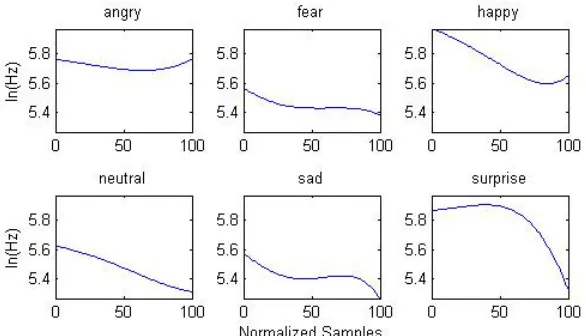
Now the projecting vectors Ω a in P of original intonations labeled with emotion are
given out as well as the corresponding kernel vector Ωα for each emotional state. By restoring with eigen-intonations, the kernel vectors are transformed as (10) into the original space, there they are regarded as rule-intonations. The rule-intonations representing emotion states are illustrated in Figure 5. From the figure, one can see that the intonations of anger, job and surprise are high, where the variety of surprise is greatest. However, the “fear” is flat and low, similar to that of the “sad”. All these qualitative results are in line with the previous works of other researchers. So the resultant rule-intonations are efficient for expressing emotions in theory.
Affective Intonation-Modeling for Mandarin Based on PCA 43
6.3 The Mixed-Emotional Intonation
When the affective rule-intonation was modeled with eigen-intonation in the previous sub-section, the emotion labeled in the corpus and expressed by resultant intonation was supposed to be pure. It is known that the emotions of humans felt in normal life are not always so simple, and they are usually mixed with several so-called pure emotions, whose intensities differ corresponding to constructing the different emotions. The experiment is performed as the following to explain that the modeling approach proposed with eigen-intonation is also effective for representing the mixed-emotional intonation.
All affective intonations labeled with emotions have been projected into sub-space P and the distribution of first three weights of the projecting vector Ω a in P has been shown in
Figure 4. Now only the mass kernel of each emotional state, which is corresponding to the resultant rule-intonation, is represented in Figure 6.
Nine equal space points in line between the neutral kernel and the surprise kernel are selected and indicated in the figure. If the kernel explains pure emotions, then what the points selected explain are the mixed emotions. Along the arrow in Figure 6, points at the starting vertex explain more neutral and those at the ending vertex explain more surprise. So the emotions expressed by the intonations correspond to these points transfer from neutral to surprise along the arrow and they are mixed. The mixed-emotional intonations corresponding to the selected-points are restored in original space and shown in the left of Figure 7. It can be concluded from the figure that, along the arrow, the first rule-intonations can express more neutral and the last ones express more surprise and all of them express the mixed emotions.
44 Zhuangluan Su and Zengfu Wang
Another nine equal space points between the happy kernel and the surprise kernel are also selected and the same experiment is performed. The illustrations of the experiment are shown in Figure 6 and the right of Figure 7.
Note:
The arrows in the figure indicate the gradual varying direction corresponding to that in sub-space showed in Figure 6 and each gradual changing curve is corresponding to one point selected in Figure 6.
Affective Intonation-Modeling for Mandarin Based on PCA 45
Figure 6 and Figure 7 show that the mixed-emotional intonation can be represented with eigen-intonation, so one can control the relative position of intonation-representation in the sub-space to explain the certain mixed-emotion felt in the usual human life. To sum up, the modeling approach proposed with eigen-intonation is effective for representing not only the simple emotional intonation but also the mixed-emotional intonation.
6.4 Synthesis with Affective Intonation
Based on the linear predictive coding technology [Quatieri 2004], the authors analyzed neutral speeches, modified their intonations with the six rule-intonations, respectively, and re-synthesized them. For example, the intonation of a neutral speech is modified to the surprise intonation, and the demonstration is shown as Figure 8. In the figure, the top is the waveform of the neutral speech, and the bottom includes the original F0 contour, the original intonation, the modified intonation, and the resultant F0 contour of the neutral speech. Moreover, the intonation of an original surprise speech is also plotted in the bottom figure for contrast. Figure 8 shows that the modified intonation is similar to the original intonation of the surprise speech, and the resultant F0 contour is higher than expressing surprise.