Tangible Objects for the Acquisition of Multimodal Interaction Patterns
Ronnie Taib, Natalie Ruiz
National ICT Australia Australian Technology Park Eveleigh NSW 1430, Sydney, Australia E-mail: {ronnie.taib, natalie.ruiz}@nicta.com.auAbstract
Multimodal user interfaces offer more intuitive interaction for end-users, however, usually only through predefined input schemes. This paper describes a user experiment for multimodal interaction pattern identification, using head gesture and speech inputs for a 3D graph manipulation. We show that a direct mapping between head gestures and the 3D object predominates, however even for such a simple task inputs vary greatly between users, and do not exhibit any clustering pattern. Also, in spite of the high degree of expressiveness of linguistic modalities, speech commands in particular tend to use a limited vocabulary. We observed a common set of verb and adverb compounds in a majority of users. In conclusion, we recommend that multimodal user interfaces be individually customisable or adaptive to users’ interaction preferences.
1.
Introduction
Extensive research on speech and gesture based Multimodal User Interfaces (MMUI) began with Bolt (1980), more recently addressed semantic fusion of pen and speech input (Oviatt, DeAngeli & Kuhn, 1997) and untethered gesture recognition (Schapira & Sharma, 2001). However, the interaction design of such systems usually relies on ad-hoc techniques and pseudo-standards, resulting in arbitrary choices made by the user interface designer, and in the best case, User Centred Design (UCD) methodologies are applied iteratively to refine such choices based on end-user inputs.
Research by Taib & Ruiz (2005) suggested that the need for an expensive and time consuming electronic prototype can be avoided when the interaction to be modelled is applicable to tangible objects. A proposed method for acquiring a set of intuitive interface-function mappings from target users involves a human agent who interprets the user’s input, and manipulates the tangible object accordingly. The output is observed by the user and can be corrected when a mistaken interpretation is made. The proposed methodology extends the traditional UCD framework, in particular, retains the main benefits of the Wizard of Oz (WoZ) approach, yet avoids the expensive development of electronic mock-ups and WoZ environment usually required in this process, e.g. (Bernsen, Dybkjaer, & Kiilerich, 2004).
In this paper, we propose a methodology of formative experiments for the design of multimodal interactions, especially when modalities are used in unusual combinations or contexts, for example using head gesture to manipulate virtual objects. We emphasise the need for individual customisation of multimodal interaction, by showing the diversity of user preferences even for simple tasks.
2.
Methodology
2.1. 3D-Graph Navigation Application
The application domain selected is a multimodal interaction extension module for the GEOMI visualisation tool, allowing users to manipulate 3D-graph structures using speech and head gesture (Ahmed et al., 2005). However, the original multimodal interaction techniques were chosen by the developer in a relatively arbitrary fashion.
2.2. Experiment Design
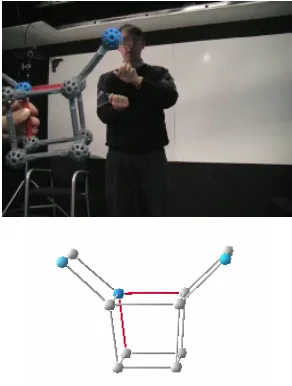
An initial comparison between tangible objects and virtual (electronic mock-up) objects (see Figure 1) during the design phase, showed no major impact of tangible versus non-tangible on the users’ behaviour, as perceived by the users themselves (Taib & Ruiz, 2005).
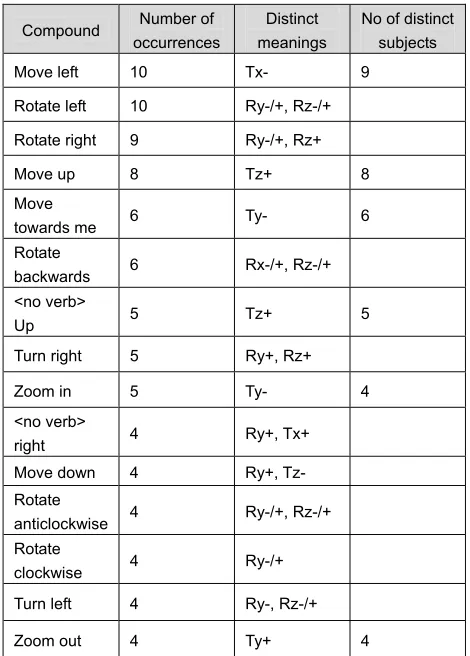
commands explicitly refer to the object to move. It includes the words: “it” (20%) and “the object” (10%), as well as references to specific features of the object, e.g. “the front blue ball” (8%). These are used for some rotations when the subject has trouble finding a speech command that does not conflict with the previous ones.
4.
Discussion
4.1. Speech vs. Head Gesture
This paper described the results of formative experiments targeting the initial steps of multimodal user interface design. The main result is the expansive range of multimodal inputs than can be expected from users when facing with a simple graph manipulation task. This paper presents only the results for two of the available of unimodal inputs channels elicited, namely speech and head gesture, but we expect to carry out the same methodology on the combined multimodal data collected during the experiment.
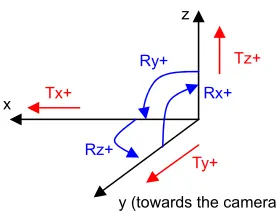
Head gesture was selected as an unusual but possible input modality for a 3D navigation application. We further constrained its expressiveness by limiting head gestures to 6 degrees of freedom, one at a time. Speech on the other hand is a very natural modality, even for the slightly unusual task of 3D navigation and positioning.
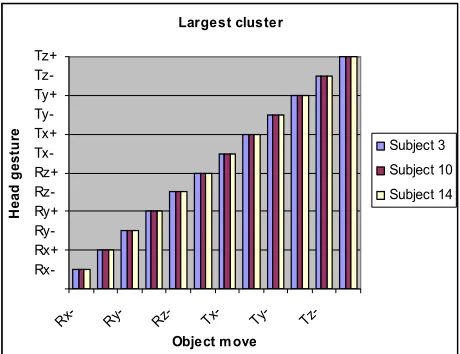
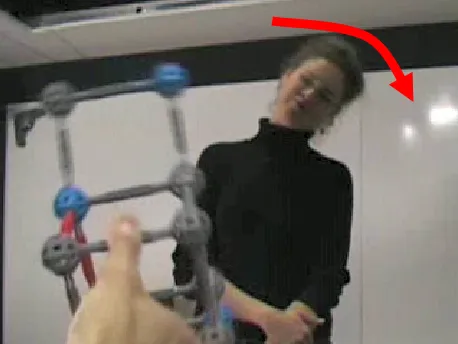
Even though head gesture was reported to be more challenging and less comfortable by the subjects, they were able to eventually construct consistent mappings between their gestures and the expected object moves. Rotations over the Y axis attracted a 100% consistency across users, all of them tilting their head sideways to provide that command, as shown in Figure 4.
The other rotations correspond to a direct or indirect mapping whereby the head movement replicates the expected move or its opposite direction combination. Translations inspired a larger variety of mappings, not always dominated by the direct or indirect mapping. This highlights either some difficulty to physically perform the direct mapping, e.g. Tz+ requires people to move their
head upwards from an already standing up position, or it may denote a preference for shorter, more discrete moves. On the other hand, speech operated rotations were found to be ambiguous, whereas many translations were intuitively done unambiguously yet consistently across subjects. These findings suggest the need to assess the combined multimodal (hands, head and speech inputs) condition, particularly focusing on whether subjects prefer head gestures to express rotations and speech to express translations.
4.2. Individual Customisation
Overall, the study results emphasise the need for user-specific customisation of multimodal interactions. It shows that there is no immediately accessible clustering of preferences across subjects even for a simple, finite set of inputs and tasks. Using predefined multimodal input patterns may result in moves totally opposed to the user’s expectations, since we showed that, in terms of head gesture as well as speech, the same input is often mapped to direct or indirect mapping according to the user. In fact, the same input may even target different degrees of freedom altogether, across users.
Furthermore, the exact type of gesture and its size may require some analysis towards customisation. Some users performed small amplitude, almost imperceptible gestures, whereas others used whole or upper body to perform wide movements as shown in Figure 5.
4.3. Future Work
We collected hand gesture and combined multimodal data during the experiment that will require annotation and analysis. In particular, we will examine the occasions when people combine input modalities and how this relates to individual modality-based difficulties and limitations.
Hand gestures proved to be the most efficient way to manipulate the 3D object, given its affordances, as can be seen in Figure 1. We suggest investigating other application domains where tangible interfaces can be used to elicit multimodal interaction without access to direct Figure 4: Example of Ry- gesture
physical affordances. This relies on tangible reifications of abstract concepts or task, e.g. “what to do with an incoming email”.
Another suggestion is to extend the current work by conducting a longitudinal study assessing the performance and usability impact of predefined multimodal mappings that correspond or conflict with intuitive user preferences.
5.
References
Ahmed, A. et al. (2005). GEOMI: GEOmetry for Maximum Insight. In GD05: 13th International Symposium on Graph Drawing. Limerick, Ireland: Springer-Verlag.
Bernsen, N. O., Dybkjaer, L. & Kiilerich, S. (2004). Evaluating Conversation with Hans Christian Andersen. In LREC'2004, Fourth International Conference on Language Resources and Evaluation (pp. 1011-1014). Lisbon, Portugal.
Bolt, R. A. (1980). "Put-That-There": Voice and Gesture at the Graphics Interface. In 7th annual conference on Computer Graphics and Interactive Techniques (pp. 262-270). Seattle, Washington, United States: ACM Press, New York, NY, USA.
Oviatt, S., DeAngeli, A. & Kuhn, K. Integration and Synchronization of Input Modes During Multimodal Human-Computer Interaction. In SIGCHI conference on Human factors in computing systems, (Atlanta, Georgia, United States, 22-27 March 1997). 1997, 415-422.
Schapira, E. & Sharma, R. (2001). Experimental Evaluation of Vision and Speech based Multimodal Interfaces. In PUI'01, Workshop on Perceptual User Interfaces (pp. 1-9). Orlando, Florida: ACM Press, New York, NY, USA.
Taib, R. & Ruiz, N. (2005). Evaluating Tangible Objects for Multimodal Interaction Design. In OZCHI'05, Annual Conference of the Australian Computer-Human Interaction Special Interest Group. Canberra, Australia: ACM Press.