The ALVIS Format for Linguistically Annotated Documents
A. Nazarenko, E. Alphonse, J. Derivi`ere, T. Hamon, G. Vauvert, D. Weissenbacher
Laboratoire dInformatique de Paris-Nord (UMR 7030) University Paris 13 & CNRS
99, Av. J.-B. Cl´ement, 93430 Villetaneuse, France {firstname.name}@lipn.univ-paris13.fr
Abstract
The paper describes the ALVIS annotation format and discusses the problems that we encountered for the indexing of large collections of documents for topic specific search engines. This paper is exemplified on the biological domain and on MedLine abstracts, as developing a specialized search engine for biologist is one of the ALVIS case studies. The ALVIS principle for linguistic annotations is based on existing works and standard propositions. We made the choice of stand-off annotations rather than inserted mark-up, and annotations are encoded as XML elements which form the linguistic subsection of the document record.
1.
Introduction
One of the objectives of the ALVIS project1 is to develop
semantic-based search engines that achieve good perfor-mance in information retrieval in specialized domains. As one of our case study, we are developing a specialized search engine for the biological domain that should be able to handle complex queries (boolean and even relational queries including normalized gene names, for instance). In this context, we are experimentally studying of the con-tribution of Natural Language Processing (NLP) in infor-mation retrieval. We are testing various indexing methods based on various types of linguistic annotation.
This paper presents and discusses the format that has been adopted in the ALVIS project for the linguistic annotation of the documents. It shows how NLP tools can add new annotations to a given document or exploit existing ones. The paper focuses on the linguistic part of the document annotations, disregarding the metadata associated with the document at the crawling step (Buntine et al., 2005). The section 2 presents in more details the context of the ALVIS project and explains the need for linguistically an-notated documents. The ALVIS format for linguistic anno-tatio is presented in section 3. The section 4 explains how such a rich levl of annotation can be achieved. The Sec-tion 5 discusses the advantages and limits of our format.
2.
Context: the ALVIS project
The ALVIS project aims at building a peer-to-peer network of semantic search engines and at developing open source components to help the design of new topic specific search engines. Among these components, there is a Natural Lan-guage Processing (NLP) line, which goal is to enrich the crawled documents with linguistic annotations to enable a semantic and domain specific indexing of these documents. The type and quality of the annotations vary with the fol-lowing factors:
• The way the annotated documents are used: for each
specific topic, beside the collection of documents to
1
ALVIS is a FP6 STREP projet aiming at developing an open source prototype of a distributed, semantic-based search engine. See http://www.alvis.info
index, we exploit a sample of documents for acquiring specialized linguistic resources (acquisition phase). The resulting resources (named entity dictionaries, ter-minologies, semantic tags) are then used to tune the generic NLP line for the corresponding specific do-main (production phase). A deep analysis of the doc-uments is required at the acquisition level whereas in-dexing necessitates an efficient and shallow analysis strategy.
• The availability of domain specific resources: the
more domain specific knowledge is available (or ac-quired), the richer the document annotations can be.
• The language of the documents: the intrinsic
complex-ity and the state of the art in NLP differ from one lan-guage to another. In ALVIS, four different lanlan-guages are processed (English, French, Slovene, Chinese): the various processing steps are not equally important for all languages (e.g. traditional word segmentation is useless for Chinese, lemmatisation is more important for Slovene than for English and even for French);
• The volume of textual data to process: since NLP is
known to be computationally expensive, the deepness of document analysis depends on the efficiency of the NLP components and the volume of documents to be analysed.
One of the objectives of the ALVIS project is to test the various combinations of annotations to identify which ones have a significant impact on Information Retrieval results, within a given specific domain. In this context, the defini-tion of the format for the linguistic annotadefini-tion of documents is a critical issue. It is also necessary to ensure the modu-larity of the ALVIS NLP line and the interchangeability of NLP tools.
3.
ALVIS format for linguistic annotations
The linguistic annotation is represented as a layered set of textual units and linguistic properties.
3.1. Annotation principle
propo-sitions (Grishman, 1997; Bird and Liberman, 1999). We made the choice of stand-off annotations rather than in-serted mark-up, and annotations are encoded as XML ele-ments which form the linguistic subsection of the document record (Buntine et al., 2005). The principle of stand-off an-notations is to separate the text of the document to annotate. It has numerous advantages:
• The initial textual data may be read-only and/or very
large, so copying it to insert mark-up may be unac-ceptable.
• The distribution of the initial data may be controlled
whereas the mark-up is intended to be freely available.
• The stand-off annotations do not pollute the initial
tex-tual data.
• Stand-off annotations allow embedded and
overlap-ping annotations that are incompatible with an inserted mark-up. It is therefore easier to encode concurrent annotations produced by different NLP tools, non lin-ear elements, which may be relevant linguistic entities (such as ”to... decide” in ”to completely decide” or the French negation ”ne... pas” in ”je ne mange pas”), relations (grammatical functions, semantic relations) between elements belonging to various levels in the hierarchy of annotations.
• New levels of annotations can be added without
dis-turbing the existing ones.
• Editing one level of annotation has minimal knock-on
effects on others.
• Each level of annotation can be stored and handled
separately, eventually in several files.
The main drawback of the standoff annotation principle is that it is difficult and computationally expensive to rebuild the textual signal from the list of annotations.
The problem of representing linguistic annotations is not new. It has been widely studied since the beginning of the
nineties and several ad hoc formats have been proposed
(see (Grishman, 1997; Bird and Liberman, 1999)). The efforts to unify these formats in order to allow interoper-ability among NLP tools are recent. An ISO proposition (TC37SC4/TEI) is currently under definition (Ide et al., 2004), which will include a Feature Structure Representa-tion, a Morpho-Syntactic Annotation Framework, a Cate-gory Data Repository, a Linguistic Annotation Framework, a Lexical Mark-up Framework and some Data Category S-Electronic Lexical Resources.
Our goal is not as general as that of the TC37SC4/TEI: strictly complying with the norm would make our anno-tation formalism more complex whereas a light version is sufficient for ALVIS needs.
3.2. Textual entities
Different levels of textual units are relevant for NLP. In ALVIS, we take five levels into consideration. At a basic level, the text is segmented into tokens. The other levels
are built on this first token level: we distinguish the words, the phrases, the semantic units and the sentences.
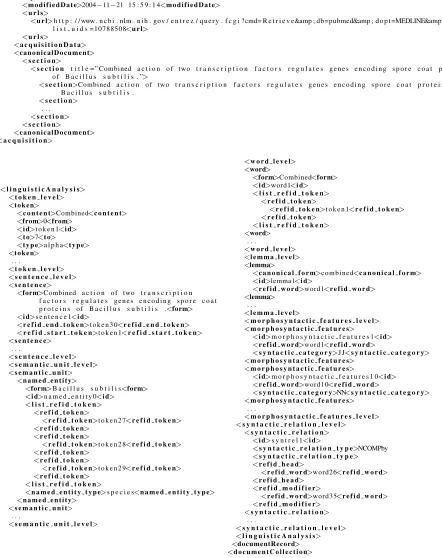
For sake of readability, the examples of the following sub-sections are given with traditional inserted annotation (slash of brackets) instead of stand-off annotations. The actual ALVIS format is shown on Figure 6.
3.2.1. Tokens
Tokens are the fundamental textual units in the ALVIS text
processing line. This segmentation is not linguistically
grounded. It serves no other purpose but to provide a start-ing point from which to implement further segmentation. This level of annotation follows the recommendations of the TC37SC4/TEI workgroup. However, this workgroup proposes to insert pointer mark-up in the textual signal to mark the token boundaries whereas we refer to the charac-ter offset.
To simplify further processing, we distinguish different types of tokens:
• Alphabetical tokens: sequences of letters (a-z and
A-Z) including accented characters;
• Numerical tokens: sequences of digits (0-9);
• Separating tokens: sequence of separator characters
(space,return...);
• Symbolic tokens: any other character.
The tokenisation is the basic stage of text analysis. Tokens are numbered from 1 for the first token. All others anno-tations refer directly or indirectly to that token numbering. In the example of figure 1, the slashes represent the token boundaries (note that blanks are tokens).
/Transcription/ /of/ /the/ /cotB/,/ /cotC/,/ /and/ /cotX/ /ge-nes/ /by/ /final/ /sigma/(/K/)/ /RNA/ /polymerase/ /is/ /activated/ /by/ /a/ /small/,/ /DNA/-/binding/ /protein/ /called/ /GerE/./
Figure 1: Tokenization.
3.2.2. Words
Words are the basic linguistic units. They are made of to-kens: every word is made of one or several tokens, numeric,
alphabetic or symbolic. Words may contain spaces (i.e. B.
Subtilisin biology orpomme de terrein French).
[Transcription] [of] [the] [cotB], [cotC], [and] [cotX] [genes] [by] [final] [sigma(K)] [RNA] [polymerase] [is] [activated] [by] [a] [small], [DNA-binding] [protein] [called] [GerE].
Figure 2: Word segmentation.
3.2.3. Phrases
A phrase is a group of words (or a single word) that func-tions as a syntactic unit. It is composed of a head (the main part of the phrase) and of optional modifier(s) that can be words or phrases. The syntactic properties of a phrase are derived from its head (a Noun for a Noun Phrase, an Adjec-tive for an Adjectival Phrase, etc.).
At the phrasal level described here, we only delimit the unit and no syntactic category is assigned to the phrase (see the
section??below).
In the following example (fig. 3), the phrases are delimited with inserted brackets.
[During [sporulation of Bacillus subtilis]], [[spore coat proteins] [encoded [by [cot genes]]]] [are expressed [in [the mother cell]] and [deposited [on [the forespore]]]]. Transcription [of [the cotB, cotC, and cotX genes]] [by [final [sigma(K) RNA polymerase]]] [is activated [by [a small, [DNA-binding protein] [called GerE]]]]. [The pro-moter region [of [each [of [these genes]]]]] [has [two [GerE binding sites]]].
Figure 3: Phrase identification.
3.2.4. Semantic units
The semantic units are the textual units that are considered as significant on a semantic point of view. They can be:
• Named entities that refer to well identified domain
en-tities (often designated by proper names but not al-ways)
• Terms that are the expressions referring to the
con-cepts specific to the domain of the text.
• Undefined semantic units: other types of relevant
se-mantic units can be identified, even if their sese-mantic status is not established.
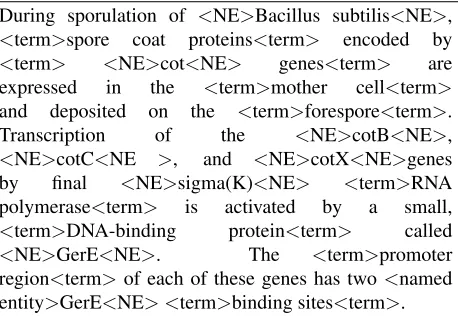
In the example of the figure 4, the named entities and terms are tagged as XML-like inserted mark-up.
3.2.5. Sentences
The sentences correspond to a traditional textual unit. They usually start from a word with a capital initial character and ends with a period. However various other types of sen-tences can be encountered in texts. In the ALVIS linguistic annotation format, we consider that titles, some list items and captions are sentences.
In the following, the sentences are identified by inserted brackets for sake of simplicity.
During sporulation of <NE>Bacillus subtilis<NE>,
<term>spore coat proteins<term> encoded by
<term> <NE>cot<NE> genes<term> are
expressed in the <term>mother cell<term>
and deposited on the <term>forespore<term>.
Transcription of the <NE>cotB<NE>,
<NE>cotC<NE >, and <NE>cotX<NE>genes by final <NE>sigma(K)<NE> <term>RNA
polymerase<term> is activated by a small,
<term>DNA-binding protein<term> called
<NE>GerE<NE>. The <term>promoter region<term>of each of these genes has two<named entity>GerE<NE> <term>binding sites<term>.
Figure 4: Named entity and term tagging.
[During sporulation of Bacillus subtilis, spore coat pro-teins encoded by cot genes are expressed in the mother cell and deposited on the forespore.] [Transcription of the cotB, cotC, and cotX genes by final sigma(K) RNA polymerase is activated by a small, DNA-binding protein called GerE.] [The promoter region of each of these genes has two GerE binding sites.]
Figure 5: Sentence segmentation.
The ALVIS format for these textual units is homogeneous from one level to another. Except for tokens, each textual unit has an identifier, a list of components and an optional form in which the sequence of characters to which it corre-sponds can be copied.
3.3. Properties of textual entities
Various properties can be associated with textual units. They are encoded as separate XML entities referring to the textual entities to which they are associated:
• Morpho-syntactic tags: the lemmas, the stems, the
syntactic categories2, the morpho-syntactic features.
• Syntactic relations, which define the role (or function)
played by two words between one another. These re-lations are represented as triplets: a relation type T, its head H (or governor) and its expansion E (or depen-dent, also called modifier or argument).
• Semantic tags: the semantic types, which are attached
to semantic units that can be words (registered as un-defined units by the tagger), named entities or terms.
• Semantic relations: the anaphoric relations and the
do-main specific relations. These relations are attached to semantic units (either named entities, terms or unde-fined semantic units) which may corresponds to words or phrases.
2
were not identified as semantic units beforehand. This step may or may not associate semantic tags to the identified semantic units.
• The word and sentence segmentations build word and
sentence units out of the token sequence. The word segmentation takes the pre-identified semantic units for granted and does not affect the semantic unit level of annotation.
• The syntactic tagging associates
morpho-syntactic and morpho-syntactic features to the words identified at the previous step.
• The lemmatiser associates its lemma,i.e.its canonical
form, to each word. If the word cannot be lemmatized (for instance a number or a foreign word where none of the rules applies), the information is omitted. This module assumes that word segmentation and morpho-syntactic information are provided.
• The terminological tagging identifies new semantic
units. This module aims at recognizing terms in the
documents differing from named entities, like gene
expression, spore coat cell. It can exploit existing terminological resources. As opposed to the prelim-inary tagging step, it relies on the word and morpho-syntactic information.
• The syntactic parsing is obviously the most expensive
NLP step. Parsing a large document base for indexing is impossible. The syntactic analysis is only applied on a subset of the document base in the acquisition phase. This step enriches the documents with syntactic relations.
• The semantic tagging associates semantic types to
pre-identified semantic units according to a an existing on-tology of the domain. Eventually, it also outputs new semantic units.
• The anaphora resolution exploits all the existing
an-notations to identify the antecedents of anaphoric pro-noun occurrences. It produces new semantic relations.
• The semantic relation tagging is a very specific NLP
steps that either exploits a set a extraction rules to tag semantic relations in the document or projects onto-logical relations on the document.
In this process of linguistic annotation, a given document is incrementally enriched with linguistic annotations : even of each NLP tool mainly operates on a specific annotation layer, they cooperate to the whole annotation. For instance, two different tools (the named entity and terminological taggers) are able to identify semantic units in the document, the latter enriching the raw tagging made by the former one.
4.2. Results
Our NLP line is intended to annotate large amount of doc-uments and web pages to be indexed in a search engines. In our first experiments, more 18 000 different documents
have been analyzed (19 850 000 words). In these experi-ments, all the NLP steps were applied up to the termino-logical tagging but only few terms were tagged since the terminological resource was very small.
The initial document size ranges from 1.8 Kbytes to 1 627 Kbytes. The size of the annotated document can be as much as 100 times the initial document size for large textual doc-uments.
5.
Conclusion
In this paper, we presented the format that has been adopted to encode the linguistic annotations of documents in the ALVIS project.
Besides incrementality and separability, we also argue that our format meets the requirements of openness, explicitness and consistency that any linguistic annotation framework is supposed to fulfil, according to (Ide et al., 2004).
The counterpart of explicitness is the huge size of the result-ing documents, which may be more than 100 times larger than the initial one. This will led us to develop a compres-sion method in order to handle large collections of docu-ments.
6.
References
S. Bird and M. Liberman. 1999. Annotation graphs as a framework for multidimensional linguistic data analysis.
In Association for Computational Linguistics, editor,
To-wards Standards and Tools for Discourse Tagging - Pro-ceedings of the Workshop, pages 1–10, Somerset. W. Buntine, K. Valtonen K, and M. Taylor. 2005. The
alvis document model for a semantic search engine. In
Association for Computational Linguistics, editor, 2nd
Annual European Semantic Web Conference, Heraklion, Crete, May 29.
R. Grishman. 1997. Tipster architecture design document version 2.3. Technical report, DARPA.
N. Ide, L. Romary, and E. de la Clergerie. 2004. Inter-national standard for a linguistic annotation framework.
Natural Language Engineering, 10 (3/4):211–225. A. Nazarenko, E. Alphonse, S. Aubin, K. Derivire, T.