Parser Evaluation and the BNC:
Evaluating 4 constituency parsers with 3 metrics
Jennifer Foster and Josef van Genabith
National Centre for Language Technology Dublin City University
Ireland
jfoster,[email protected]
Abstract
We evaluate discriminative parse reranking and parser self-training on a new English test set using four versions of the Charniak parser and a variety of parser evaluation metrics. The new test set consists of 1,000 hand-corrected British National Corpus parse trees. We directly evaluate parser output using both the Parseval and the Leaf Ancestor metrics. We also convert the hand-corrected and parser output phrase structure trees to dependency trees using a state-of-the-art functional tag labeller and constituent-to-dependency conversion tool, and then calculate label accuracy, unlabelled attachment and labelled attachment scores over the dependency structures. We find that reranking leads to a performance improvement on the new test set (albeit a modest one). We find that self-training using BNC data leads to significantly better results. However, it is not clear how effective self-training is when the training material comes from the North American News Corpus.
1.
Introduction
We evaluate state-of-the-art constituency parsing tech-niques using four different versions of the Charniak parser and a new English test set consisting of 1,000 sentences taken from the British National Corpus. The parsers are evaluated using three metrics: the oft-employed Parseval metric, the less well known Leaf-Ancestor metric, and a dependency evaluation which relies on an automatic func-tional tag labeller and a constituency-to-dependency con-version program to convert the parser output and gold stan-dard phrase structure trees to dependency trees. We present the evaluation results and highlight some areas where there is room for improvement.
The paper is organised as follows: in Section 2., we present the parsers which will be evaluated. In Section 3., we de-scribe the new test data. In Section 4., we present the eval-uation results. In Section 5., we present and analyse a more detailed breakdown of evaluation results, before summariz-ing and concludsummariz-ing in Section 6..
2.
The Parsers
We evaluate four different versions of the Charniak parser, a constituency parser with state-of-the-art performance on the standard English test set, Section 23 of the Wall Street Journal section of the Penn Treebank (WSJ23) (Marcus et al., 1994). The first parser (parser1) is Charniak’s lex-icalized history-based generative statistical parser which achieves a Parseval f-score of 89.1% on WSJ23 (Charniak, 2000). The second parser (parser2) extends the first parser by incorporating a discriminative reranker which uses fea-tures ranging over the entire parse tree to re-order the n -best parses returned by parser1 (Charniak and Johnson, 2005). The reranking parser achieves an f-score of 91.3% on WSJ23, a significant improvement over the first-stage parser.
The third parser (parser3) is the self-trained parser reported in McClosky et al. (2006a; 2006b): 1.75 million sentences from the North American News Corpus (NANC) are parsed
withparser2, andparser1is retrained on a combination of its original training material (Sections 2-21 of the WSJ) and the NANC trees produced byparser2. The resulting parser, parser3, is the re-trainedparser1combined with the dis-criminative reranker and it achieves an f-score of 92.1% on WSJ23. To obtain the fourth parser (parser4) we repeat the self-training procedure used to produceparser3, but we use sentences from the BNC instead of the NANC (Foster et al., 2007). The f-score ofparser4on WSJ23 is 91.7%. Table 1 summarises the results for all four parsers on WSJ23.
parser1 parser2 parser3 parser4
F-Score 89.1 91.3 92.1 91.7
Table 1: Parseval Results on WSJ23
3.
BNC Test Set
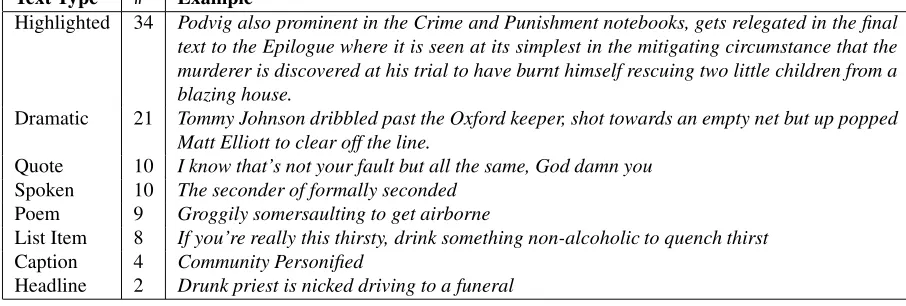
The new English test set consists of 1,000 sentences taken from the British National Corpus (BNC) (Burnard, 2000). The BNC is a one hundred million word balanced corpus of British English from the late twentieth century. Ninety per cent of it is written text, and the remaining 10% consists of transcribed spontaneous and scripted spoken language. The BNC sentences that are in the test set are not chosen completely at random. Each sentence in the test set has the property of containing a word which appears as a verb in the BNC but not in the usual training sections of the Wall Street Journal section of the Penn Treebank (WSJ02-21). Sen-tences were chosen in this way so that the resulting test set would be a difficult one for WSJ-trained parsers. Approx-imately 6% of the BNC test set consists of “non-standard” text such as spoken language, captions, headlines, lines from poems, etc. Examples are given in Table 2.
Text Type # Example
Highlighted 34 Podvig also prominent in the Crime and Punishment notebooks, gets relegated in the final text to the Epilogue where it is seen at its simplest in the mitigating circumstance that the murderer is discovered at his trial to have burnt himself rescuing two little children from a blazing house.
Dramatic 21 Tommy Johnson dribbled past the Oxford keeper, shot towards an empty net but up popped Matt Elliott to clear off the line.
Quote 10 I know that’s not your fault but all the same, God damn you Spoken 10 The seconder of formally seconded
Poem 9 Groggily somersaulting to get airborne
List Item 8 If you’re really this thirsty, drink something non-alcoholic to quench thirst
Caption 4 Community Personified
Headline 2 Drunk priest is nicked driving to a funeral
Table 2: Some examples of non-standard text from BNC test set sentences
When the two references did not agree, the guidelines took precedence over the Penn Treebank trees. Due to time con-straints, the annotator did not mark functional tags or traces. The annotator made two passes through the data, and anno-tated between 10 and 20 sentences per hour. Difficult pars-ing decisions were documented. Some pre-processpars-ing was carried on the BNC test sentences to ensure that they were tokenized in a similar way to Penn Treebank sentences (see (Wagner et al., 2007) for details).
4.
Parser Evaluation
4.1. Parseval Evaluation
The Parseval metric (Black et al., 1991) calculates preci-sion and recall over the constituents in a parse tree. Ac-cording, to the stronger version of the metric, labelled Par-seval, a constituent in a parser output tree is correct if there is a constituent in the corresponding gold parse tree which dominates the same sequence of terminal symbolsandhas the same label. The weaker version, unlabelled Parseval, considers a constituent to be correct if there is a constituent in the gold parse tree which dominates the same sequence of terminal symbols. We use the stricter labelled Parseval measure. In order to separate the evaluation of parsing and part-of-speech tagging, the Parseval metric does not cal-culate the accuracy of pre-terminal constituents, e.g. (NN man). Precision is the number of correct constituents pro-duced by the parser divided by the total number of con-stituents produced by the parser. Recall is the number of correct constituents produced by the parser divided by the total number of constituents in the set of gold standard parse trees. The f-score is the harmonic mean of precision and re-call.
The Parseval results for the four versions of the Charniak parser are shown in Table 3. McClosky et al. (2006b) re-port thatparser2 achieves a labelled f-score of 85.2% on sentences from Brown Corpus. The performance for the same parser is worse for the BNC — this is not unexpected, not only because the BNC contains sentences from a wide variety of text genres but also because the BNC test set is a difficult one. As with the WSJ23 test set, each successive version of the parser improves performance, withparser4 achieving the most significant improvement.
The significant improvement forparser4demonstrates that self-training on in-domain data has the potential to be used to adapt a parser to a new domain. McCloskey et al.(2006b) claim that self-training a parser on material from the same material as its original training material can be used to carry out domain adaptation, sinceparser3, the parser self-trained on NANC data, performs significantly better on the Brown corpus thanparser2. This claim is not completely borne out by our results forparser3— there is an improve-ment overparser1andparser2, but a relatively modest one.
Precision Recall F-Score
parser1 82.5 82.6 82.5
parser2 83.5 83.3 83.4
parser3 84.0 83.9 83.9
parser4 85.6 85.2 85.4
Table 3: Parseval Results on BNC Test Set
4.2. Leaf-Ancestor Evaluation
David McClosky, Eugene Charniak, and Mark Johnson. 2006a. Effective self-training for parsing. In Proceed-ings of the Human Language Technology Conference and North American chapter of the ACL annual meeting (HLT-NAACL-06), pages 152–159, New York, June. David McClosky, Eugene Charniak, and Mark Johnson.
2006b. Reranking and self-training for parser adaptation. InProceedings of the 21st International Conference on Computational Linguistics and 44th Annual Meeting of the ACL (COLING-ACL-06), pages 337–344, Sydney, Australia, July.
Joakim Nivre, Johan Hall, Sandra K¨ubler, Ryan Mac Don-ald, Jens Nilsson, Sebastian Riedel, and Deniz Yuret. 2007. The CoNLL 2007 shared task on dependency parsing. InProceedings of the CoNLL Shared Task Ses-sion of EMNLP-CoNLL 2007, pages 915–932, Prague, Czech Republic, June.
Slav Petrov, Leon Barrett, Romain Thibaux, and Dan Klein. 2006. Learning accurate, compact, and interpretable tree annotation. In Proceedings of the 21st International Conference on Computational Linguistics and 44th An-nual Meeting of the Association for Computational Lin-guistics, pages 433–440, Sydney, Australia.
Ines Rehbein and Josef van Genabith. 2007. Treebank an-notation schemes and parser evaluation for German. In Proceedings of the Joint EMNLP-CoNLL 2007, pages 630–639, Prague, Czech Republic.
Geoffrey Sampson and Anna Babarczy. 2002. A test of the leaf-ancestor metric for parse accuracy. In Carroll et al. (Carroll et al., 2002).
Joachim Wagner, Djam´e Seddah, Jennifer Foster, and Josef van Genabith. 2007. C-structures and f-structures for the British National Corpus. InProceedings of the 12th In-ternational Workshop on Lexical Functional Grammar, Stanford, CA.