Latest Developments in ELRA’s Services
Valérie Mapelli, Victoria Arranz, Hélène Mazo, Khalid Choukri
ELDA (Evaluations and Language resources Distribution Agency) 55-57 rue Brillat Savarin, 75013 Paris, France
E-mail: [email protected], [email protected], [email protected], [email protected]
Abstract
This paper describes the latest developments in ELRA’s services within the field of Language Resources (LR). These developments focus on 4 main groups of activities: the identification and distribution of Language Resources; the production of LRs; the evaluation of Human Language Technology (HLT), and the dissemination of information in the field. ELRA’s initial work on the distribution of language resources has evolved throughout the years, currently covering a much wider range of activities that have been considered crucial for the current needs of the R&D community and the “good health” of the LR world. Regarding distribution, considerable work has been done on a broader identification, which does not only consider resources to be immediately negotiated for distribution but which aims to inform on all available resources. This has been the seed for the Universal Catalogue. Furthermore, a Catalogue of LRs with favourable conditions for R&D has also been created. Moreover, the different activities in what regards identification on demand, production within different frameworks, evaluation of language technologies and participation in evaluation campaigns, as well as our very specific focus on information dissemination are described in detail in this paper.
1.
Introduction
For more than 12 years, since its creation in February 1995, ELRA (the European Language Resources Association) has focused its activities on a central point of interest: Language Resources (LRs). One of the main rationale that lays behind that orientation is to bring into focus the need for a mutual exchange and use of the LRs that are required for research and development works in the Human Language Technology world. Thanks to the funding of the European Commission during its first three years of activity and with the support of very active experts of the field, ELRA succeeded in providing the HLT community with a now internationally known platform of services for the identification, collection, validation and distribution of LRs. In order to answer to the ever increasing needs of this growing community, ELRA worked out at its early stage of development (October 1995) on the creation of an operational body to help with its everyday life activities: ELDA (the Evaluations and Language resources Distribution Agency).
ELRA, through ELDA, carries out a wide variety of activities related to LRs. These activities have been further developed over the past few years and these developments are the aim of the current paper.
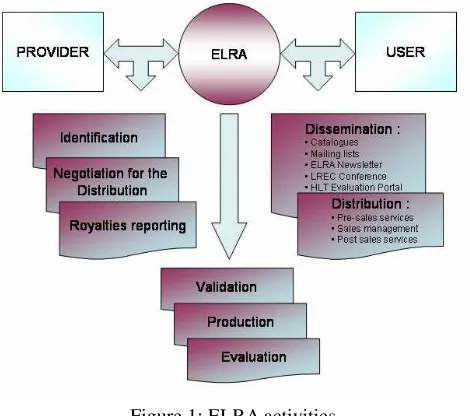
The ELRA activities, also illustrated in Figure 1, can be distributed over four main groups of services, where each of them consists of a long series of sub-activities: - Identification and Distribution of LRs, and related sub-activities: these can be represented by a two-direction relationship with two different types of entities, namely the providers and the users.
- Production of LRs: further to its interaction with both providers and users, ELRA also invests considerable efforts on the production of LRs.
- ELRA plays an important role in the area of Technology Evaluation, combining its skills acquired with LRs and
adapting them for the improvement of Language Engineering products.
- Both for its members and general users, ELRA carries out tasks of Dissemination, in order to inform on the resources available and any relevant activity (with the maintenance of catalogues, edition of the ELRA Newsletter, the organisation of the LREC Conference, and the maintenance of the HLT Portal, among others).
Figure 1: ELRA activities
2.
From LR Identification to Distribution
2.1 The Universal Catalogue
The efforts on the identification of LRs have been increased considerably at ELRA in the past few years. This is directly linked to ELRA’s emphasis on identifying already existing resources, easing their availability to their potential users within the HLT R&D community and, consequently, helping to reduce the efforts to produce already-available resources.
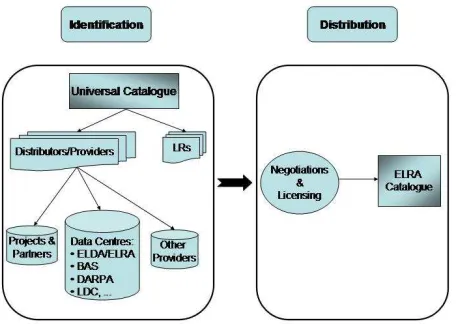
As a consequence, and further to our Catalogues of ready-for-distribution LRs, intensive work is taking place on the identification and compilation of the found LRs in what we refer to as the Universal Catalogue. This catalogue aims to be a repository for all identified LRs and plays a very important role towards the ELRA Catalogue since it represents an important source of information for the latter to acquire new LRs. Figure 2 shows how the Universal Catalogue comprises information regarding existing LRs and their Distributors and potential Providers. Such Distributors or potential Providers can be of the following nature: Data Centers, Projects and their Consortia Partners or other types (e.g., research groups producing LRs outside the context of a project, etc.). This figure also illustrates, in a simplified manner, how LRs initially identified for the Universal Catalogue may end up in the ELRA Catalogue. The distribution step comprises both the complex process of discussion and negotiation with the data providers (and licensing establishment) as well as the distribution procedure through the ELRA Catalogue, which also deals with licensing issues (but these in regard to the future users of the LRs).
Figure 2: Relation between the Universal Catalogue and the ELRA Catalogue
At present the Universal Catalogue comprises 1,139 identified resources. This figure is constantly being updated as LR additions and revisions (with potential deletions) take place on a regular basis.
The distribution of these figures according to the type of resources is as follows in Table 1:
LR Type # of LRs
Tools 58
Speech 389
Written 648
Terminology 22
Multimodal/Multimedia 22
Table 1: LR figures in the Universal Catalogue
The Universal Catalogue is available through the ELRA web site: http://www.elra.info.
2.2 From the Universal Catalogue to the ELRA
Catalogue of LRs
Further to the general identification task described in the previous section, ELRA is also carrying out identification upon demand. This implies searching for specific LRs that are required in a number of situations. For instance, identification may be done for ELRA members who need some specific resource not available in our catalogues, thus, contributing to the enrichment of the Universal Catalogue, and once negotiated and distributed, also to that of the ELRA Catalogue. Identification may also be done to search for LRs needed within the framework of some R&D project or even resulting from national or international projects ELDA may have been involved in. This has been the case of the evaluation campaigns and projects of the French Technolangue programme, packages which are currently being made available through the ELRA Catalogue.
Furthermore, ELRA may focus on community needs, such as those for specific technologies or languages and, thus, search for resources to satisfy these needs. All these scenarios aim to enrich the Universal Catalogue while leading towards the enrichment of the ELRA Catalogue, making the LRs available for the community.
It should also be mentioned that, in a number of occasions, no resource is found for a specific requirement. In that case, the production of that seemingly non-existing LR is foreseen and in some cases carried out to meet our members’ needs.
The link between the Universal Catalogue and the ELRA Catalogue takes place by means of a number of legal steps, where licensing is the key point. Some simple standard licenses have been specifically created for the distribution of LRs, and it is through these licenses that distribution rights are obtained to make the LRs public for the HLT community through our ELRA catalogue.
2.3 The
ELRA
Catalogue
of
Language
Resources: Focus on Evaluation Packages and
LRs with Favourable Conditions for R&D
Graph 11: Distribution of Language Resources available
272 275 275 275 278 278 278 282
31
1996 1997 1998 1999 2000 2001 2002 2003 2004 2005 2006
Speech Written Terminology
- Speech resources for automatic speech recognition over (fixed or mobile) telephone applications: LILA Hindi and Korean databases, Orientel Moroccan and Tunisian, etc.
- Speech resources for speech recognition over broadcast news applications: NEMLAR Broadcast News Speech Corpus for Arabic, ESTER Corpus for French, etc.
- Speech resources for speech-to-speech translation: TC-STAR for English, Spanish and Mandarin. - Multimodal resources: CHIL video annotations with
audio transcriptions.
- Written corpora: NEMLAR Written Corpus for Arabic.
- Lexica: phonetic lexica within LILA, Orientel or other SpeechDat-family projects, LC-STAR lexica for speech translation applications, etc.
Although they cannot be quoted for confidential reasons, it is also worth raising that, beyond its participation in national or international projects, ELDA also offers production services upon demand.
4.
Evaluation
As mentioned earlier, through its participation in major European projects (CHIL, TC-STAR, CLEF) and in French national programmes (Technolangue), ELDA is nowadays involved in the evaluation process itself, the evaluation of products, systems, and applications developed for HLT.
4.1 Collaborative and Customized Services for
the Evaluation of Language Technologies
With a strong background in evaluation, from evaluation campaigns management to distribution of evaluation packages, ELDA can now offer on-demand evaluation services and customized LRs to laboratories and/or companies wishing to evaluate their HLT-based systems. Below is given a non exhaustive number of technologies that could be evaluated by ELRA in three different areas of Human Language Technology:
- Text processing: Information retrieval, Question Answering, Machine Translation, Automatic Summarization, Parsing, Multilingual Text Alignment, Terminology Extraction,
- Speech processing: Automatic Speech Recognition, Speech Synthesis, Speech Translation, Broadcast News Transcription, Acoustic Person Tracking, Acoustic Speaker Identification, Speech Activity Detection, - Multi-modal interfaces: Multimodal Person
Tracking, Audiovisual Speech Recognition, Multimodal Person Identification.
Considering this multiplicity of fields, the task requires a number of criteria that must be taken into consideration to carry out a good evaluation campaign:
- Definition of the evaluation task(s),
- Finding or producing LRs to be used for the evaluation: defining the type of resource, checking availability or preparing new resources
from scratch,
- Finding or producing evaluation tools: defining the type of tool, checking availability or preparing new tools from scratch.
4.2 HLT-Evaluation.org: a Portal for Human
Language Technology Evaluation
The general mission of HLT evaluation is to assist in improving the quality of language engineering products. It is essential for validating research hypotheses, for assessing progress and for choosing between research alternatives. The language technology and neighbouring technology communities range from academic to industrial partners who share an interest in evaluation. Building a portal for these communities, which serves as a platform for communication between partners, and offers a permanent infrastructure for the development of evaluation activities in Europe is the main goal of the HLT Evaluation Portal: www.hlt-evaluation.org.
The portal provides all kinds of information related to evaluation for the language technology community, and also for the general public, and helps users who need to have quick and easily understandable information on evaluation protocols, including evaluation methodologies, metrics, evaluation tasks, resources and worldwide evaluation activities, such as research projects and campaigns.
5.
Dissemination
ELRA has also increased its activities for the dissemination of information on LRs and on the progress of Evaluation, as described below.
5.1 Language
Resources
and
Evaluation
Journal
The Language Resources and Evaluation Journal is the first publication devoted to the acquisition, creation, annotation, and use of LRs, together with methods for evaluation of resources, technologies, and applications. It is published by Springer. Nicoletta Calzolari, from ILC-CNR in Pisa (Italy) and Nancy Ide, from Vassar College in Poughkeepsie, NY (USA) are the editors in chief.
The ELRA members are granted complimentary access to the journal through the association under the condition that they subscribe to the publisher’s table-of-contents alert service. During LREC 2006, special conditions were offered to participants and in anticipation of LREC 2008, the Editors will try to arrange with Springer some special conditions for subscription to the LRE Journal to be offered to conference participants.
After LREC 2006 in Genoa, the flow of submissions to the Journal sensibly raised and it looked like the interest in the Journal spread worldwide thanks to the visibility and promotion given by the conference.
5.2 Language
Resources
and
Evaluation
Conference
In 10 years (the first LREC was held in Granada in 1998), LREC has become the major event on Language Resources and Evaluation for Human Language Technologies (HLT): http://www.lrec-conf.org/. The aim of LREC is to provide an overview of the state-of-the-art, explore new R&D directions and emerging trends, exchange information regarding LRs and their applications, evaluation methodologies and tools, ongoing and planned activities, industrial uses and needs, requirements coming from the e-society, both with respect to policy issues and to technological and organisational ones.
LREC provides a unique forum for researchers, industrials and funding agencies from across a wide spectrum of areas to discuss problems and opportunities, find new synergies and promote initiatives for international cooperation, in support to investigations in language sciences, progress in language technologies and development of corresponding products, services and applications, and standards.
6.
Conclusions
As it can be seen in this paper, ELRA has expanded its services along the last couple of years. Activities such as identification, evaluation, production and dissemination have seen their efforts considerably increased in a search to support researchers and developers.
The creation of the Universal Catalogue has triggered the existence of a tool that should prevent language resource developers from generating already existing resources, as well as help LR users in their search for material to work on.
Our efforts on evaluation are supporting the advance of evaluation in the area of HLT, in terms of developing evaluation methodologies, making evaluation packages available (with all their data, protocols, etc.), providing information on the field (for instance, through the HLT evaluation portal), participating and setting up evaluation campaigns (through ELDA’s participation in projects and R&D programmes) and brainstorming events (such as the different workshops organised for that purpose, including the one to take place at LREC 2008).
Our involvement in LR production has also had a direct impact on the availability of LRs, both regarding the needs of private users, such as companies working on HLT, or public LRs aiming to meet the needs of the community at large.
In what regards dissemination, our activity has been multifold, but always focusing on the dissemination of the activities taking place within the area. This is so for the Newsletter, publishing contributions from different HLT players, who describe their work, their achievements or simply the initiatives taking place in their context. This is also the case for our LREC Conference, which has become an event not to be missed in order to meet the community and have a friendly opportunity to discuss work around its main conference or its many satellite
workshops. Last but not least, this is also the case for the other events whose organisation ELRA is involved in, such as LangTech, the latest Evaluation Workshop at the MT Summit 2007, and even its involvement in the publication of the Language Resources and Evaluation Journal.
Although not the focus of the current document, other ELRA regular activities have continued, such as the validation of LRs for the ELRA Catalogue.